New Semester
Started
Get
50% OFF
Study Help!
--h --m --s
Claim Now
Question Answers
Textbooks
Find textbooks, questions and answers
Oops, something went wrong!
Change your search query and then try again
S
Books
FREE
Study Help
Expert Questions
Accounting
General Management
Mathematics
Finance
Organizational Behaviour
Law
Physics
Operating System
Management Leadership
Sociology
Programming
Marketing
Database
Computer Network
Economics
Textbooks Solutions
Accounting
Managerial Accounting
Management Leadership
Cost Accounting
Statistics
Business Law
Corporate Finance
Finance
Economics
Auditing
Tutors
Online Tutors
Find a Tutor
Hire a Tutor
Become a Tutor
AI Tutor
AI Study Planner
NEW
Sell Books
Search
Search
Sign In
Register
study help
mathematics
advanced engineering mathematics
Advanced Engineering Mathematics 10th edition Erwin Kreyszig - Solutions
Find the Euclidean norm of the vectors:[1/2 -1/2 -1/2 1/2]T
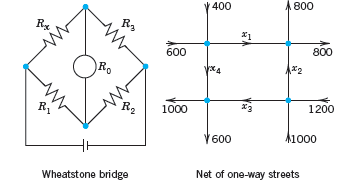
Show that if Rx/R3 = R1/R2 in the figure, then I = 0. (R0 is the resistance of the instrument by which I is measured.) This bridge is a method for determining Rx. R1, R2, R3 are known. R3 is variable. To get Rx, make I= 0 by varying R3. Then calculate Rx = R3R1/R2.
Find the Euclidean norm of the vectors:[2/3 2/3 1/3 0]T
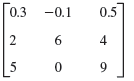
Find the rank by Theorem 3 (which is not very practical) and check by row reduction. Show details.
Are the following sets of vectors linearly independent? Show the details of your work.
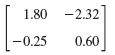
Formula (4) is occasionally needed in theory. To understand it, apply it and check the result by Gauss–Jordan: In Prob. 3 Data from Prob. 3 Find the inverse by Gauss–Jordan (or by (4*) if n = 2). Check by using (1).
Prove (3) and (4) for general 2 X 3 matrices and scalars c and k.
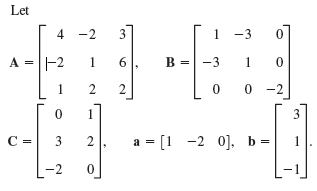
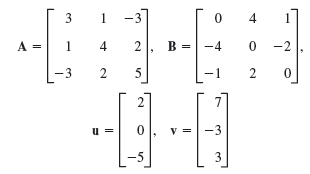
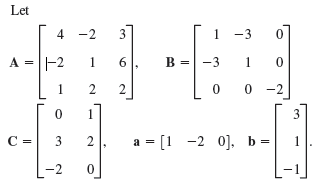
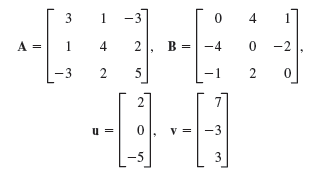
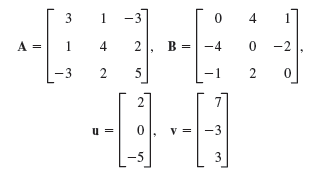
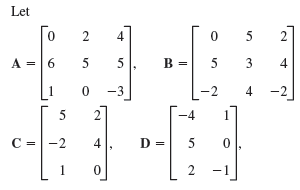
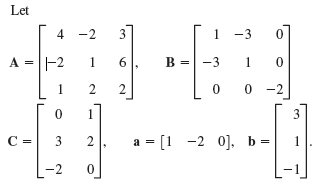
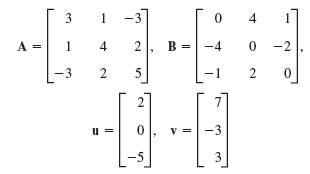
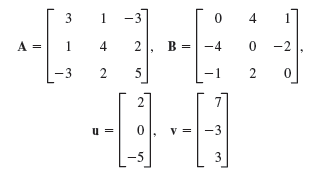
Showing all intermediate results, calculate the following expression or give reasons why they are undefined: 1.5a + 3.0b, 1.5aT + 3.0b, (A - B)b, Ab - Bb
Showing the details, calculate the following expressions or give reason why they are not defined, when AB - BA
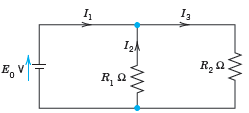
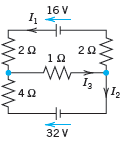
In Probs. 17–19, using Kirchhoff’s laws and showing the details, find the currents:
Find the Euclidean norm of the vectors:[1 0 0 1 -1 0 -1 1]T
Find the rank by Theorem 3 (which is not very practical) and check by row reduction. Show details.
Are the following sets of vectors linearly independent? Show the details of your work.
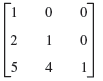
Is the inverse of a triangular matrix always triangular (as in Prob. 5)? Give reason. Data from Prob. 5 Find the inverse by Gauss–Jordan (or by (4*) if n = 2). Check by using (1).
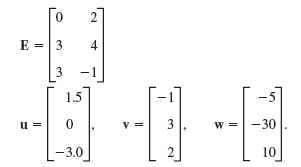
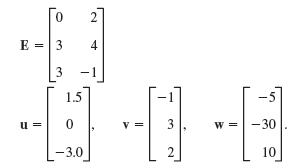
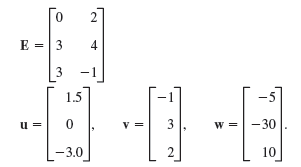
If the above vectors u, v, w represent forces in space, their sum is called their resultant. Calculate it.
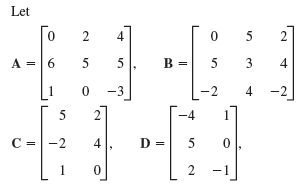
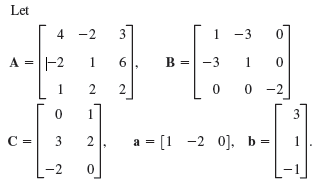
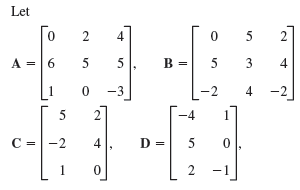
Showing all intermediate results, calculate the following expression or give reasons why they are undefined: ABC, ABa, ABb, CaT
Showing the details, calculate the following expressions or give reason why they are not defined, whendet A, det A2, (det A)2, det B A 4 2 B = -4 -3 2 5 06:1 -0-0 2 V -3 -5 3 3 u 4 -2 20
In Probs. 17–19, using Kirchhoff’s laws and showing the details, find the currents:
Show the following:Give examples showing that the rank of a product of matrices cannot exceed the rank of either factor.
Write a program for Gauss elimination and back substitution (a) That does not include pivoting (b) That does include pivoting. Apply the programs to Probs. 11–14 and to some larger systems of your choice.
Find the Euclidean norm of the vectors:[3 1 -4]T
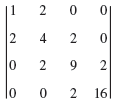
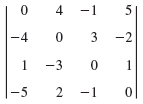
Showing the details, evaluate:
Show the following:If the row vectors of a square matrix are linearly independent, so are the column vectors, and conversely.
Prove that (A-1)-1 = A.
Find the following expression, indicating which of the rules in (3) or (4) they illustrate, or give reasons why they are not defined. (u + v) - w, u + (v - w), C + 0w, 0E + u - v
Showing the details, calculate the following expressions or give reason why they are not defined, when uTAu, vTBv
By definition, an equivalence relation on a set is a relation satisfying three conditions: (named as indicated)(i) Each element A of the set is equivalent to itself (Reflexivity).(ii) If A is equivalent to B, then B is equivalent to A (Symmetry).(iii) If A is equivalent to B and B is equivalent to
Show the following:If A is not square, either the row vectors or the column vectors of A are linearly dependent.
Showing all intermediate results, calculate the following expression or give reasons why they are undefined: 3A - 2B, (3A - 2B)T, 3AT - 2BT, (3A - 2B)TaT
Find the inverse transformation. Show the details.y1 = 5x1 + 3x2 - 3x3y2 = 3x1 + 2x2 - 2x3y3 = 2x1 - x2 + 2x3
Showing the details, evaluate:
Show the following:Rank A = rank B does not imply rank A2 = rank B2. (Give a counterexample.)
Verify (AT)-1 = (A-1)T for A in Prob. 1. Data from Prob 1 Find the inverse by Gauss–Jordan (or by (4*) if n = 2). Check by using (1).
Find the following expression, indicating which of the rules in (3) or (4) they illustrate, or give reasons why they are not defined. (2 · 7)C, 2(7C), -D + 0E, E - D + C + u
Showing all intermediate results, calculate the following expression or give reasons why they are undefined: CCT, BC, CB, CTB
Showing the details, calculate the following expressions or give reason why they are not defined, when Au, uTA
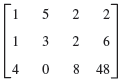
Solve the linear system given explicitly or by its augmented matrix. Show details. 10x + 4y - 2z = -4-3w - 17x + y + 2z = 2 w + x + y = 68w - 34x +
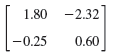
Find the inverse transformation. Show the details.y1 = 0.5x1 - 0.5x2y2 = 1.5x1 - 2.5x2
Showing the details, evaluate:
(a) Show experimentally that the n × n matrix A = [αjk] with αjk = j + k - 1 has rank 2 for any n. (Problem 20 shows n = 4.) Try to prove it.(b) Do the same when αjk = j + k + c, where c is any positive integer.(c) What is rank A if αjk = 2j+k-2? Try to find other large matrices of
Verify (A2)-1 = (A-1)2 for A in Prob. 1. Data from Prob. 1 Find the inverse by Gauss–Jordan (or by (4*) if n = 2). Check by using (1).
Find the following expression, indicating which of the rules in (3) or (4) they illustrate, or give reasons why they are not defined. 8C + 10D, 2(5D + 4C), 0.6C - 0.6D, 0.6(C - D)
Showing the details, calculate the following expressions or give reason why they are not defined, when AB, BA
What mapping gave the Joukowski airfoil? Explain details.
What is a Riemann surface? Its motivation? Its simplest example.
Find and sketch the image of the given region or curve under w = z2.1 < |z| < 2, |arg z| < π/8
Find and sketch the image of the given region or curve under w = z2.-4 < xy < 4
Find and sketch the image of the given region or curve under w = z2.x = -1, 1
Find and sketch the image of the given region or curve under w = 1/z.|z| < 1
Find and sketch the image of the given region or curve under w = 1/z.2 < |z| < 3, y > 0
Find and sketch the image of the given region or curve under w = 1/z.(x - 1/2)2 + y2 = 1/4, y > 0
Find the LFT that maps-1, 0, 1 onto 4 + 3i, 5i/2, 4 - 3i, respectively
Find the LFT that maps1, i, -i onto i, -1, 1, respectively
Find the LFT that maps0, 1, ∞ onto ∞, 1, 0, respectively
Find the fixed points of the mappingw = (2 + i)z
Find the fixed points of the mappingw = (3z + 2)/(z - 1)
Find the fixed points of the mappingw = z5 + 10z3 + 10z
Find the fixed points of the mappingw = (iz + 5)/(5z + i)
Find an analytic function w = f(z) that mapsThe infinite strip 0 < y < π/4 onto the upper half plane v > 0
Find an analytic function w = f(z) that mapsThe sector 0 < arg z < π/2 onto the region u < 1.
Find an analytic function w = f(z) that mapsThe region x > 0, y > 0, xy < c onto the strip 0 < v < 1.
Under what condition on the velocity vector V in (1) will F(z) in (2) be analytic?
Find and sketch the potential between two coaxial cylinders of radii r1 and r2 having potential U1 and U2, respectively.r1 = 2.5 mm r2 = 4.0 cm, U1 = 0 V, U2 = 220 V
Find the temperature between the plates y = 0 and y = d kept at 20 and 100°C, respectively. (i) Proceed directly. (ii) Use Example 1 and a suitable mapping.
Give the details of the derivation of the series (7) from the Poisson formula (5).
Why can potential problems be modeled and solved by methods of complex analysis? For what dimensions?
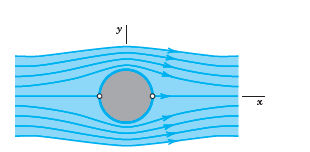
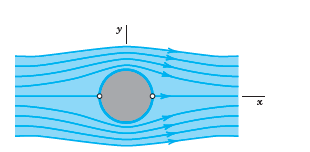
Guess from physics and from Fig. 416 where on the y-axis the speed is maximum. Then calculate.
Find and sketch the potential between two coaxial cylinders of radii r1 and r2 having potential U1 and U2, respectively.r1 = 10 cm, r2 = 1 m, U1 = 10 kV, U2 = -10 kV
Show that each term of (7) is a harmonic function in the disk r < R.
What is a harmonic function? A harmonic conjugate?
Find the potential Φ in the region R in the first quadrant of the z-plane bounded by the axes (having potential U1) and the hyperbola y = 1/x (having potential U2) by mapping R onto a suitable infinite strip. Show that Φ is harmonic. What are its boundary values?
Calculate the speed along the cylinder wall in Fig. 416, also confirming the answer to Prob. 3. Data from Prob. 3 Guess from physics and from Fig. 416 where on the y-axis the speed is maximum. Then calculate.
Find and sketch the potential between the parallel plates having potentials U1 and U2. Find the complex potential.Plates at x1 = -5 cm, x2 = 5 cm, potentials U1 = 250 V, U2 = 500 V, respectively.
Using (7), find the potential Φ(r, θ) in the unit disk r < 1 having the given boundary values Φ(1, θ). Using the sum of the first few terms of the series, compute some values of Φ and sketch a figure of the equipotential lines.Φ(1, θ) = 3/2 sin 3θ
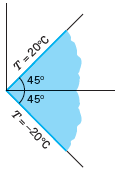
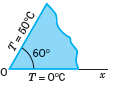
Find the temperature distribution T(x, y) and the complex potential F(z) in the given thin metal plate whose faces are insulated and whose edges are kept at the indicated temperatures or are insulated as shown. T = 20C 45 45 T=-20C
Give some examples of potential problems considered in this chapter. Make a list of corresponding functions.
Graph equipotential lines(a) In Example 1 of the text, (b) If the complex potential is F(z) = z2, iz2, ez.(c) Graph the equipotential surfaces for F(z) = Ln z as cylinders in space.
Using (7), find the potential Φ(r, θ) in the unit disk r < 1 having the given boundary values Φ(1, θ). Using the sum of the first few terms of the series, compute some values of Φ and sketch a figure of the equipotential lines.Φ(1, θ) = 5 - cos 2θ
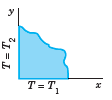
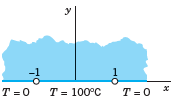
Find the temperature distribution T(x, y) and the complex potential F(z) in the given thin metal plate whose faces are insulated and whose edges are kept at the indicated temperatures or are insulated as shown.
Find and sketch the potential between the parallel plates having potentials U1 and U2. Find the complex potential.Plates at x1 = 12 cm, x2 = 24 cm, potentials U1 = 20 kV, U2 = 8 kV, respectively.
Sketch and interpret the flow with complex potential F(z) = z.
Using (7), find the potential Φ(r, θ) in the unit disk r < 1 having the given boundary values Φ(1, θ). Using the sum of the first few terms of the series, compute some values of Φ and sketch a figure of the equipotential lines.Φ(1, θ) = α cos2 4θ
Find the temperature distribution T(x, y) and the complex potential F(z) in the given thin metal plate whose faces are insulated and whose edges are kept at the indicated temperatures or are insulated as shown. T=T T = T y
Write a short essay on the various assumptions made in fluid flow in this chapter.
Let D: 0 ≤ x ≤ 1/2 π, 0 ≤ y ≤ 1; D* the image of D under w = sin z; and Φ* = u2 - v2. under and What is the corresponding potential Φ in D? What are its boundary values? Sketch D and D*.
What is the complex potential of an upward parallel flow of speed K > 0 in the direction of y = x? Sketch the flow.
Show that Φ = θ/π = (1/π) arctan (y/x) is harmonic in the upper half-plane and satisfies the boundary condition Φ (x, 0) = 1 if x < 0 and 0 if x > 0, and the corresponding complex potential is F(z) = -(i/π) Ln Z.
Using (7), find the potential Φ(r, θ) in the unit disk r < 1 having the given boundary values Φ(1, θ). Using the sum of the first few terms of the series, compute some values of Φ and sketch a figure of the equipotential lines.Φ(1, θ) = 8 sin4 θ
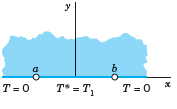
Find the temperature distribution T(x, y) and the complex potential F(z) in the given thin metal plate whose faces are insulated and whose edges are kept at the indicated temperatures or are insulated as shown.
State the maximum modulus theorem and mean value theorems for harmonic functions.
What happens in Prob. 7 if we replace sin z by cos z = sin (z + 1/2π)?Data from Prob. 7Let D: 0 ≤ x ≤ 1/2 π, 0 ≤ y ≤ 1; D* the image of D w = sin z; and Φ* = u2 - v2. under and What is the corresponding potential Φ in D? What are its boundary values? Sketch D and D*.
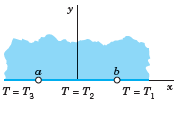
Find the temperature distribution T(x, y) and the complex potential F(z) in the given thin metal plate whose faces are insulated and whose edges are kept at the indicated temperatures or are insulated as shown. T = T T = T b T = T
What flow do you obtain from F(z) = -iKz, K positive real?
Graph the potentials in Probs. 7 and 9 and for two other functions of your choice as surfaces over a rectangle in the xy-plane. Find the locations of the maxima and minima by inspecting these graphs.Data from Prob. 7Verify (3) in Theorem 2 for the given Φ(x, y), (x0, y0) and circle of radius
Using (7), find the potential Φ(r, θ) in the unit disk r < 1 having the given boundary values Φ(1, θ). Using the sum of the first few terms of the series, compute some values of Φ and sketch a figure of the equipotential lines.Φ(1, θ) = θ/π if -π < θ < π
Find the temperature distribution T(x, y) and the complex potential F(z) in the given thin metal plate whose faces are insulated and whose edges are kept at the indicated temperatures or are insulated as shown.
Find the potential and the complex potential between the plates y = x and y = x + 10 kept at 10 V and 110 V, respectively.
Obtain the flow in Example 1 from that in Prob. 11 by a suitable conformal mapping.Data from Prob. 11What flow do you obtain from F(z) = -iKz, K positive real?
Find the location and size of the maximum of |F(z)| in the unit disk |z| ≤ 1.F(z) = cos z
Using (7), find the potential Φ(r, θ) in the unit disk r < 1 having the given boundary values Φ(1, θ). Using the sum of the first few terms of the series, compute some values of Φ and sketch a figure of the equipotential lines.Φ(1, θ) = θ if -1/2π < θ < 1/2π and 0 otherwise
Showing 1300 - 1400
of 3937
First
7
8
9
10
11
12
13
14
15
16
17
18
19
20
21
Last
Step by Step Answers

 Get 50% OFF
Claim Now
Get 50% OFF
Claim Now