New Semester
Started
Get
50% OFF
Study Help!
--h --m --s
Claim Now
Question Answers
Textbooks
Find textbooks, questions and answers
Oops, something went wrong!
Change your search query and then try again
S
Books
FREE
Study Help
Expert Questions
Accounting
General Management
Mathematics
Finance
Organizational Behaviour
Law
Physics
Operating System
Management Leadership
Sociology
Programming
Marketing
Database
Computer Network
Economics
Textbooks Solutions
Accounting
Managerial Accounting
Management Leadership
Cost Accounting
Statistics
Business Law
Corporate Finance
Finance
Economics
Auditing
Tutors
Online Tutors
Find a Tutor
Hire a Tutor
Become a Tutor
AI Tutor
AI Study Planner
NEW
Sell Books
Search
Search
Sign In
Register
study help
mathematics
advanced engineering mathematics
Advanced Engineering Mathematics 10th edition Erwin Kreyszig - Solutions
Summarize the second part of this section beginning with Complex Function, and indicate what is conceptually analogous to calculus and what is not.
Write a program for graphing equipotential lines u = const of a harmonic function u and of its conjugate v on the same axes. Apply the program to(a) u = x2 - y2, v = 2xy(b) u = x3 - 3xy2, v = 3x2y - y3.
Find the principal value. Show details.(-3)3-i
Find and graph all values of:3√1
Find and graph all values of:4√-1
Find and graph all roots in the complex plane.3√216
Find the principal value. Show details.(1 + i)1-i
Determine α and b so that the given function is harmonic and find a harmonic conjugate.u = αx3 + bxy
Find the value of the derivative ofz3/(z + i)3 at i
Find and graph all roots in the complex plane.3√1 + i
Find the value of the derivative ofi(1 - z)n at 0
Solve for z.ln z = 0.6 + 0.4i
Determine α and b so that the given function is harmonic and find a harmonic conjugate.u = eπx cos αv
Let z = x + iy. Showing details, find, in terms of x and y:Im (1/z̅2)
Give the details of the derivative of (9).
Let z = x + iy. Showing details, find, in terms of x and y:Re (z/z̅), Im (z/z̅)
Find all solutions.sinh z = 0
Represent in polar form, with the principal argument.-15i
Write a program for calculating these roots and for graphing them as points on the unit circle. Apply the program to zn = 1 with n = 2, 3, · · ·, 10. Then extend the program to one for arbitrary roots, using an idea near the end of the text, and apply the program to examples of your choice.
Find all solutions and graph some of them in the complex plane.ez = 1
Find the value of the derivative of(z - 4i)8 at = 3 + 4i
Are the following functions harmonic? If our answer is yes, find a corresponding analytic function f(z) = u(x, y) + iv(x, y).v = ex sin 2y
Let z = x + iy. Showing details, find, in terms of x and y:Re [(1 + i)16z2]
Let z = x + iy. Showing details, find, in terms of x and y:Re z4 - (Re z2)2
Find all solutions.cosh z = 0
Represent in polar form, with the principal argument.-4 - 4i
Graph in the complex plane and represent in the form x + iy:√8(cos 1/4π + i sin 1/4π)
Find out, and give reason, whether f (z) is continuous at z = 0 if f(0) = 0 and for z ≠ 0 the function f is equal to:(Re z)/(1 - |z|)
Show that the set of values of ln (i2) differs from the set of values of 2 ln i.
Are the following functions harmonic? If our answer is yes, find a corresponding analytic function f(z) = u(x, y) + iv(x, y).v = (2x + 1)y
Let z = x + iy. Showing details, find, in terms of x and y:Im (1/z), Im (1/z2)
Let z1 = -2 + 11i, z2 = 2 - i. Showing the details of your work, find, in the form x + iy:4 (z1 + z2)/(z1 - z2)
Find, in the form x + iy, showing details,(1 + i)/(1 - i)
Graph in the complex plane and represent in the form x + iy:3 (cos 1/2π - i sin 1/2π)
Find out, and give reason, whether f (z) is continuous at z = 0 if f(0) = 0 and for z ≠ 0 the function f is equal to:|z2| Im (1/z)
Find Re and Im ofexp (z2)
Find all values and graph some of them in the complex plane.ln (ei)
Are the following functions harmonic? If our answer is yes, find a corresponding analytic function f(z) = u(x, y) + iv(x, y).u = x/(x2 + y2)
Let z1 = -2 + 11i, z2 = 2 - i. Showing the details of your work, find, in the form x + iy:(z1 + z2)(z1 - z2), z12 - z22
Using the definitions, prove:cos z is even, cos (-z) = cos z, and sin z is odd, sin (-z) = -sin z.
Find, in the form x + iy, showing details,1/(4 + 3i)
Determine the principal value of the argument and graph it as in Fig. 325. (1 + i)20
Find and graph Re f, Im f, and |f| as surfaces over the z-plane. Also graph the two families of curves Re f(z) = const and Im f(z) = const in the same figure, and the curves |f(z)| = const in another figure, where(a) f(z) = z2.(b) f(z) = 1/z.(c) f(z) = z4.
Find all values and graph some of them in the complex plane.ln 1
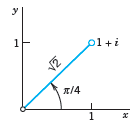
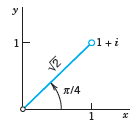
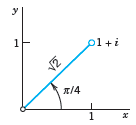
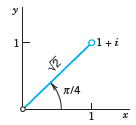
Write in exponential form (6):1 + i
Are the following functions harmonic? If our answer is yes, find a corresponding analytic function f(z) = u(x, y) + iv(x, y).u = xy
Determine the principal value of the argument and graph it as in Fig. 325. -π - πi
Write in exponential form (6):1/(1 - z)
Let z1 = -2 + 11i, z2 = 2 - i. Showing the details of your work, find, in the form x + iy:(z1 - z2)2/16, (z1/4 - z2/4)2
Find, in the form u + iv,sin πi, cos (1/2π - πi)
Find, in the form x + iy, showing details,(2 + 3i)2
Determine the principal value of the argument and graph it as in Fig. 325. 3 ± 4i
Find Re f, and Im f and their values at the given point z.f (z) = 1/(1 - z) at 1 - i
Find Ln z when z equalsei
Write in exponential form (6):-6.3
Are the following functions analytic? Use (1) or (7).f(z) = cos x cosh y - i sin x sinh y
How are general powers defined? Give an example. Convert it to the form x + iy.
Let z1 = -2 + 11i, z2 = 2 - i. Showing the details of your work, find, in the form x + iy:Re (z21), (Re z1)2
Find, in the form u + iv,cosh (-1 + 2i), cos (-2 - i)
Determine the principal value of the argument and graph it as in Fig. 325. -1 + i
Write a report by formulating the corresponding portions of the text in your own words and illustrating them with examples of your own.
ln z is more complicated than ln x. Explain. Give examples.
Find Ln z when z equals0.6 + 0.8i
Are the following functions analytic? Use (1) or (7).f(z) = 3π2/(z3 + 4π2z)
Discuss how ez, cos z, sin z, cosh z, sinh z, are related.
Derive the following laws for complex numbers from the corresponding laws for real numbers.z1 + z2 = z2 + z1, z1z2 = z2z1 (Commutative laws)(z1 + z2) + z3 = z1 + (z2 + z3), (Associative laws)(z1z2)z3 = z1(z2z3)z1(z2 + z3) = z1z2 + z1z3 (Distributed laws)0 + z = z + 0 = z,z + (-z) = (-z) +
Find, in the form u + iv,cos i, sin i
State the Cauchy–Riemann equations. Why are they of basic importance?
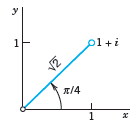
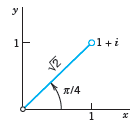
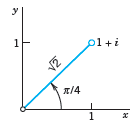
Represent in polar form and graph in the complex plane as in Fig. 325. Do these problems very carefully because polar forms will be needed frequently. Show the details. 1 + 1/2πi
Determine and sketch or graph the sets in the complex plane given byRe z ≥ -1
Find Ln z when z equals4 - 4i
Can a function be differentiable at a point without being analytic there? If yes, give an example.
Show that z = x + iy is pure imaginary if and only if z̅ = -z.
Harmonic functions verify by differentiation that Im cos z and Re sin z are harmonic.
What is an analytic function of a complex variable?
Represent in polar form and graph in the complex plane as in Fig. 325. Do these problems very carefully because polar forms will be needed frequently. Show the details.
Determine and sketch or graph the sets in the complex plane given by|arg z| < 1/4π
Find Ln z when z equals-11
Are the following functions analytic? Use (1) or (7).f(z) = Re (z2) - i Im (z2)
Find ez in the form u + iv and |ez| if z equals2 + 3πi
Formulas for hyperbolic functionsShow thatProve that cos z, sin z, cosh z, and sinh z are entire.
State the definition of the derivative from memory. Explain the big difference from that in calculus.
Formulas for hyperbolic functionsShow thatcosh2 z - sinh2 z = 1, cosh2 z + sinh2 z = cosh 2z
Write the two numbers in Prob. 1 in polar form. Find the principal values of their arguments.Data from Prob. 1Divide 15 + 23i by -3 + 7i. Check the result by multiplication.
Represent in polar form and graph in the complex plane as in Fig. 325. Do these problems very carefully because polar forms will be needed frequently. Show the details.2i, -2i y 1 1/4 pl+i 1 8
Determine and sketch or graph the sets in the complex plane given byπ < |z - 4 + 2i| < 3π
Find ez in the form u + iv and |ez| if z equals2πi(1 + i)
Are the following functions analytic? Use (1) or (7).f(z) = e-2x(cos 2y - i sin 2y)
Divide 15 + 23i by -3 + 7i. Check the result by multiplication.
Find the potential in the following charge-free regions.Between two coaxial circular cylinders of radii r0 and r1 kept at the potentials u0 and u1, respectively. Compare with Prob. 38.Data from Prob. 38Find the potential in the following charge-free regions.Between two concentric spheres of radii
Show that the following membranes of area 1 with c2 = 1 have the frequencies of the fundamental mode as given (4-decimal values). Compare.Quadrant of circle: α21/(4√π) = 0.7244(α21 = 5.13562 = first positive zero of J2)
Show that the following membranes of area 1 with c2 = 1 have the frequencies of the fundamental mode as given (4-decimal values). Compare.Rectangle with sides 1:2:√5/8 = 0.7906
Show that the following membranes of area 1 with c2 = 1 have the frequencies of the fundamental mode as given (4-decimal values). Compare.Square: 1/√2 = 0.7071
Show that u11 represents the fundamental mode of a semicircular membrane and find the corresponding frequency when c2 = 1 and R = 1.
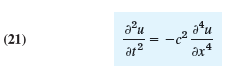
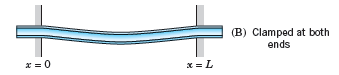
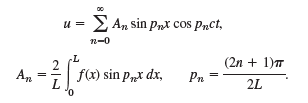
By the principles used in modeling the string it can be shown that small free vertical vibrations of a uniform elastic beam (Fig. 292) are modeled by the fourth-order PDEwhere c2 = EI/ρA (E = Young’s modulus of elasticity, I = moment of intertia of the cross section with respect to the y-axis in
These vibrations in the direction of the x-axis are modeled by the wave equation utt = c2uxx, c2 = E/ρ. If the rod is fastened at one end, x = 0, and free at the other, x = L, we have u(0, t) = 0 and ux(L, t) = 0. Show that the motion corresponding to initial displacement u(x, 0) = f(x) and
Show that the following membranes of area 1 with c2 = 1 have the frequencies of the fundamental mode as given (4-decimal values). Compare.Circle: α1/(2√π) = 0.6784
Let f(x, y) = u(x, y, 0) be the initial temperature in a thin square plate of side π with edges kept at 0°C and faces perfectly insulated. Separating variables, obtain from ut = c2∇2u the solution Find the temperature in Prob. 31 if f(x, y) = x (π - x)y(π - y). Data from Prob. 31 Let f(x, y)
Let f(x, y) = u(x, y, 0) be the initial temperature in a thin square plate of side π with edges kept at 0°C and faces perfectly insulated. Separating variables, obtain from ut = c2∇2u the solution where
Find the temperature distribution in a laterally insulated bar of length π with c2 = 1 for the adiabatic boundary condition and initial temperature:2π - 4|x - 1/2π|
Showing 800 - 900
of 3937
First
2
3
4
5
6
7
8
9
10
11
12
13
14
15
16
Last
Step by Step Answers

 Get 50% OFF
Claim Now
Get 50% OFF
Claim Now