New Semester
Started
Get
50% OFF
Study Help!
--h --m --s
Claim Now
Question Answers
Textbooks
Find textbooks, questions and answers
Oops, something went wrong!
Change your search query and then try again
S
Books
FREE
Study Help
Expert Questions
Accounting
General Management
Mathematics
Finance
Organizational Behaviour
Law
Physics
Operating System
Management Leadership
Sociology
Programming
Marketing
Database
Computer Network
Economics
Textbooks Solutions
Accounting
Managerial Accounting
Management Leadership
Cost Accounting
Statistics
Business Law
Corporate Finance
Finance
Economics
Auditing
Tutors
Online Tutors
Find a Tutor
Hire a Tutor
Become a Tutor
AI Tutor
AI Study Planner
NEW
Sell Books
Search
Search
Sign In
Register
study help
mathematics
advanced engineering mathematics
Advanced Engineering Mathematics 10th edition Erwin Kreyszig - Solutions
Find the temperature distribution in a laterally insulated bar of length π with c2 = 1 for the adiabatic boundary condition and initial temperature:100 cos 2x
Find the temperature distribution in a laterally insulated bar of length π with c2 = 1 for the adiabatic boundary condition and initial temperature:3x2
Find the temperature distribution in a laterally insulated thin copper bar (c2 = K/(σρ) = 1.158 cm2/sec) of length 100 cm and constant cross section with endpoints at x = 0 and 100 kept at 0°C and initial temperature:sin3 0.01πx
Find the temperature distribution in a laterally insulated thin copper bar (c2 = K/(σρ) = 1.158 cm2/sec) of length 100 cm and constant cross section with endpoints at x = 0 and 100 kept at 0°C and initial temperature:50 - |50 - x|
Find the temperature distribution in a laterally insulated thin copper bar (c2 = K/(σρ) = 1.158 cm2/sec) of length 100 cm and constant cross section with endpoints at x = 0 and 100 kept at 0°C and initial temperature:sin 0.01πx
Let r, θ, Φ be spherical coordinates. If u(r, θ, Φ) satisfies ∇2u = 0, show that v(r, θ, Φ) = u(1/r, θ, Φ)/r satisfies ∇2v = 0.
This happens if a PDE involves derivatives with respect to one variable only (or can be transformed to such a form), so that the other variable(s) can be treated as parameter(s). Solve for u = u(x, y):x2uxx + 2xux - 2u = 0
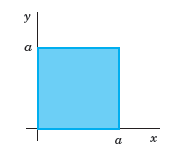
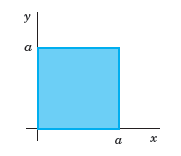
Find the steady state temperature in the plate in Prob. 21 with the upper and lower sides perfectly insulated, the left side kept at 0°C, and the right side kept at f(y)°C. Data from Prob. 21 The faces of the thin square plate in Fig. 297 with side α = 24 are perfectly insulated. The upper side
Sketch the intersections of the equipotential surfaces in Prob. 16 with xz-plane.Data from Prob. 16Find the potential in the interior of the sphere r = R = 1 if the interior is free of charges and the potential on the sphere isf (Φ) = cos Φ
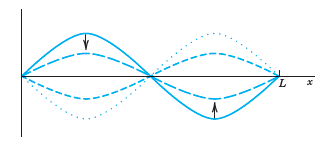
Find and sketch or graph (as in Fig. 288 in Sec. 12.3) the deflection u(x, t) of a vibrating string of length π, extending from x = 0 to x = π, and c2 = T/ρ = 4 starting with velocity zero and deflection: sin3 x
Show that the boundary condition leads to k = kmn = αmn/R where s = αmn is the mth positive zero of Jn(s).
This happens if a PDE involves derivatives with respect to one variable only (or can be transformed to such a form), so that the other variable(s) can be treated as parameter(s). Solve for u = u(x, y):uyy + 6uy + 13u = 4e3y
The faces of the thin square plate in Fig. 297 with side α = 24 are perfectly insulated. The upper side is kept at 25°C and the other sides are kept at 0°C. Find the steady-state temperature u(x, y) in the plate.
Show that in Prob. 17 the potential exterior to the sphere is the same as that of a point charge at the origin.Data from Prob. 17Find the potential in the interior of the sphere r = R = 1 if the interior is free of charges and the potential on the sphere isf (Φ) = 1
Transform to normal form and solve:uxx - 4uyy = 0
Show that Q(θ) must be periodic with period 2π and, therefore, n = 0, 1, 2, · · · in (25) and (26). Show that this yields the solutions Qn = cos nθ, Q*n = sin nθ, Wn = Jn(kr), n = 0, 1, · · ·.
Find the potential in the interior of the sphere r = R = 1 if the interior is free of charges and the potential on the sphere isf (Φ) = 10 cos3 Φ - 3 cos2 Φ - 5 cos Φ - 1
Show that forced vibrations of a membrane are modeled by the PDE utt = c2∇2u + P/ρ, where P(x, y, t) is the external force per unit area acting perpendicular to the xy-plane.
This happens if a PDE involves derivatives with respect to one variable only (or can be transformed to such a form), so that the other variable(s) can be treated as parameter(s). Solve for u = u(x, y):uy + y2u = 0
Show that substitution of u = F(r, θ)G(t) into the wave equation (6), that is,gives an ODE and a PDEShow that the PDE can now be separated by substituting F = W(r)Q(θ), giving (22) Utt = 2 ( 14 + = + 7/12 4 1480
Find the potential in the square 0 ≤ x ≤ 2, 0 ≤ y ≤ 2 if the upper side is kept at the potential 1000 sin 1/2πx and the other sides are grounded.
Find the potential in the interior of the sphere r = R = 1 if the interior is free of charges and the potential on the sphere isf (Φ) = cos 2Φ
Find the deflection of the membrane of sides α and b with c2 = 1 for the initial deflection
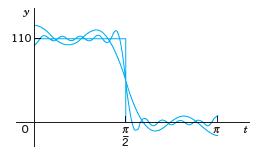
Find the potential in the rectangle 0 ≤ x ≤ 20, 0 ≤ y ≤ 40 whose upper side is kept at potential 110 V and whose other sides are grounded.
This happens if a PDE involves derivatives with respect to one variable only (or can be transformed to such a form), so that the other variable(s) can be treated as parameter(s). Solve for u = u(x, y):uxx + 16π2u = 0
Is it possible that for fixed c and R two or more um with different nodal lines correspond to the same eigenvalue? (Give a reason.)
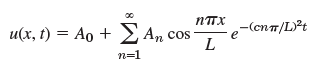
The heat flux of a solution u(x, t) across x = 0 is defined by Φ(t) = -Kux(0, t). Find Φ(t) for the solution (9). Explain the name. Is it physically understandable that Φ goes to 0 as t → ∞?
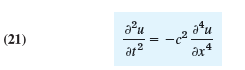
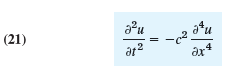
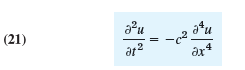
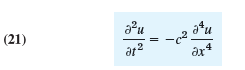
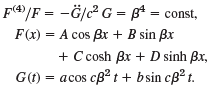
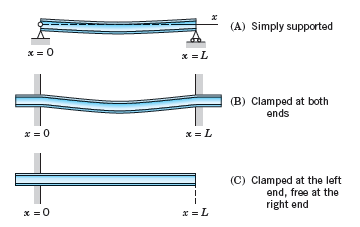
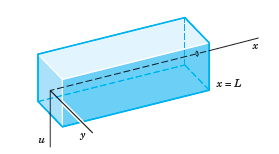
By the principles used in modeling the string it can be shown that small free vertical vibrations of a uniform elastic beam (Fig. 292) are modeled by the fourth-order PDEwhere c2 = EI/ρA (E = Young’s modulus of elasticity, I = moment of intertia of the cross section with respect to the y-axis in
Find the type, transform to normal form, and solve. Show your work in detail.uxx - 4uxy + 5uyy = 0
Find the potential in the interior of the sphere r = R = 1 if the interior is free of charges and the potential on the sphere isf (Φ) = 1
Find eigenvalues of the rectangular membrane of sides α = 2 and b = 1 to which there correspond two or more different (independent) eigenfunctions.
By the principles used in modeling the string it can be shown that small free vertical vibrations of a uniform elastic beam (Fig. 292) are modeled by the fourth-order PDEwhere c2 = EI/ρA (E = Young’s modulus of elasticity, I = moment of intertia of the cross section with respect to the y-axis in
Find the temperature in Prob. 11 with L = π, c = 1, and f (x) = x Data from Prob. 11 “Adiabatic” means no heat exchange with the neighborhood, because the bar is completely insulated, also at the ends. Physical Information: The heat flux at the ends is proportional to the value of ∂u/∂x
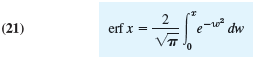
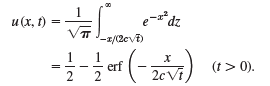
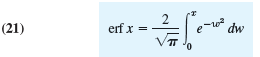
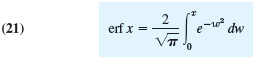
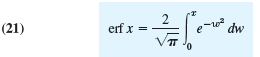
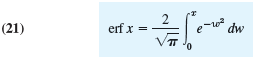
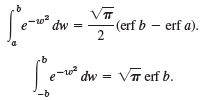
Following function is important in applied mathematics and physics (probability theory and statistics, thermodynamics, etc.) and fits our present discussion. Regarding it as a typical case of a special function defined by an integral that cannot be evaluated as in elementary calculus, do the
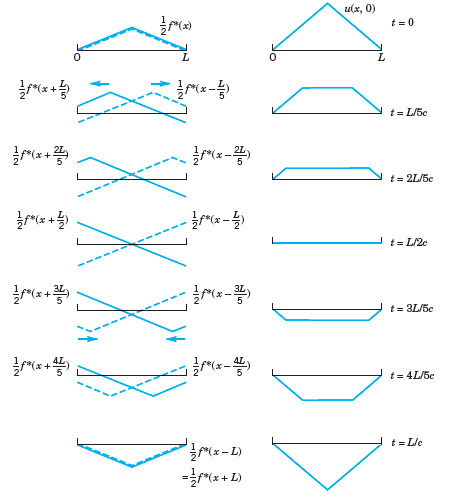
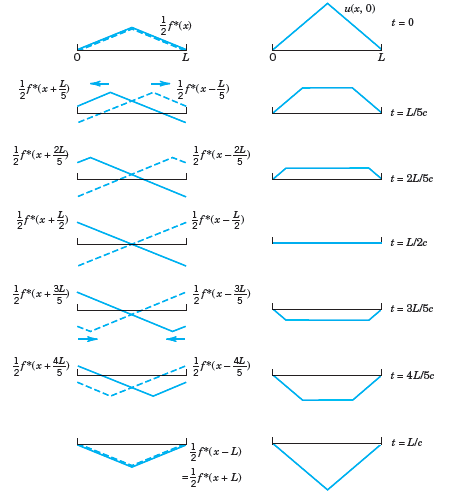
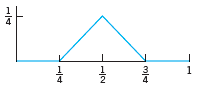
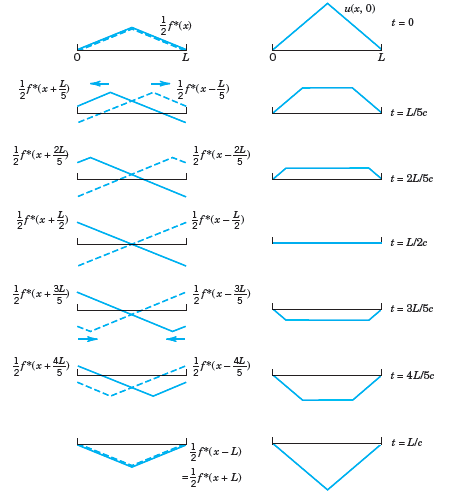
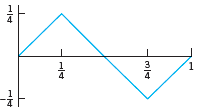
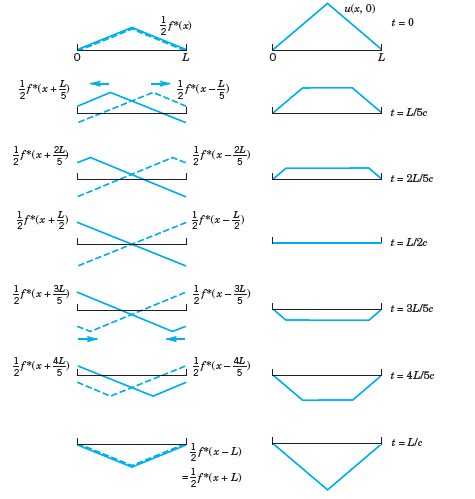
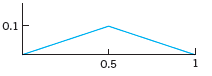
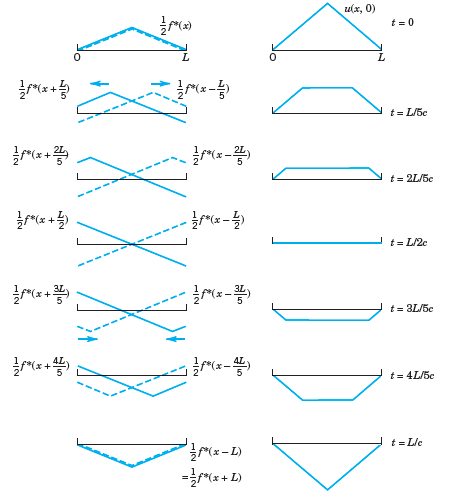
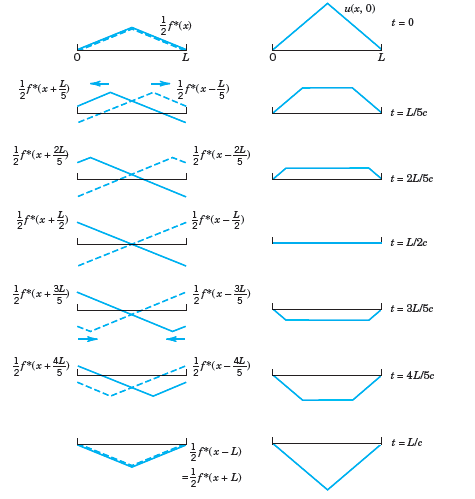
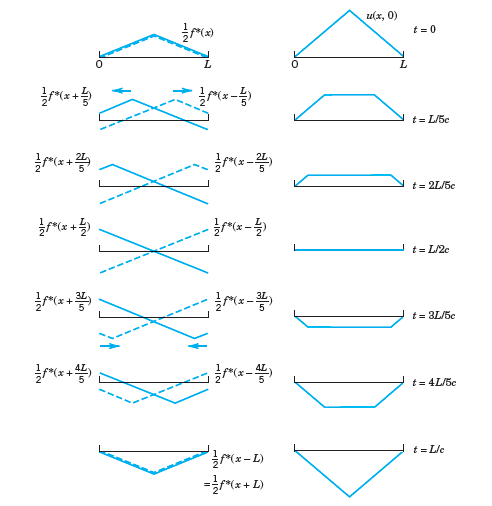
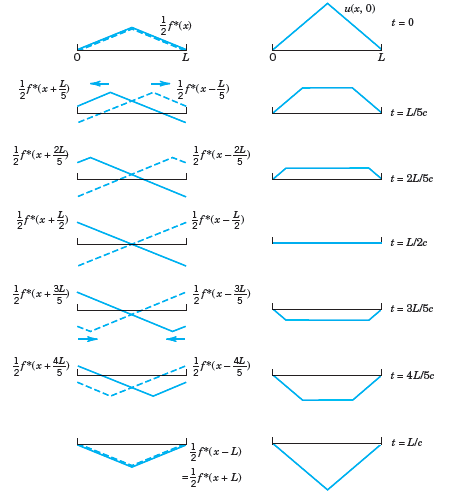
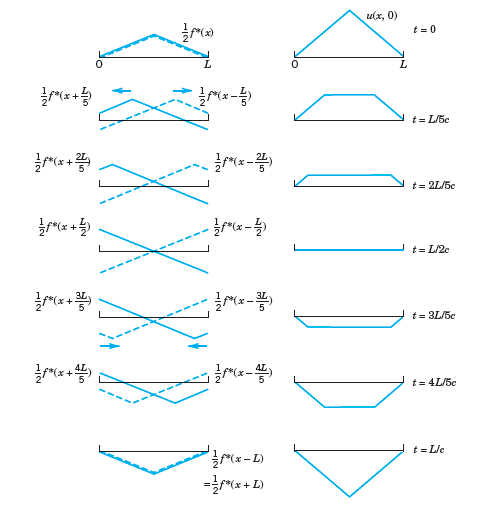
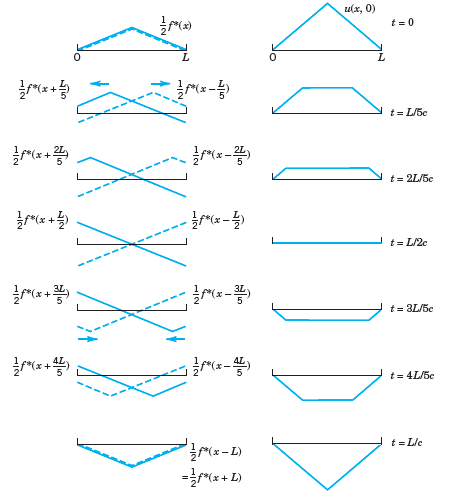
Find u(x, t) for the string of length L = 1 and c2 = 1 when the initial velocity is zero and the initial deflection with small k (say, 0.01) is as follows. Sketch or graph u(x, t) as in Fig. 291 in the text.
Verify that the function u (x, y) = α ln (x2 + y2) + b satisfies Laplace’s equation (3) and determine α and b so that u satisfies the boundary conditions u = 110 on the circle x2 + y2 = 1 and u = 0 on the circle x2 + y2 = 100.
Find a formula for the tension required to produce a desired fundamental frequency f1 of a drum.
Find the temperature in Prob. 11 with L = π, c = 1, and f (x) = 1 - x/π Data from Prob. 11 “Adiabatic” means no heat exchange with the neighborhood, because the bar is completely insulated, also at the ends. Physical Information: The heat flux at the ends is proportional to the value of
By the principles used in modeling the string it can be shown that small free vertical vibrations of a uniform elastic beam (Fig. 292) are modeled by the fourth-order PDEwhere c2 = EI/ρA (E = Young’s modulus of elasticity, I = moment of intertia of the cross section with respect to the y-axis in
Find the type, transform to normal form, and solve. Show your work in detail.xuxx - yuxy = 0
What are the analogs of Probs. 12 and 13 in heat conduction?Data from Prob. 12Find the electrostatic potential between coaxial cylinders of radii r1 = 2 cm and r2 = 4 cm kept at the potentials U1 = 220 V and U2 = 140 V, respectively.
Explain how the Laplace transform applies to PDEs.
Do Prob. 3 for the membrane with α = 4 and b = 2.Data from Prob. 3Determine and sketch the nodal lines of the square membrane for m = 1, 2, 3, 4 and n = 1, 2, 3, 4.
If the surface of the ball r2 = x2 + y2 + z2 ≤ R2 is kept at temperature zero and the initial temperature in the ball is f(r), show that the temperature u(r, t) in the ball is a solution of ut = c2(urr + 2ur/r) satisfying the conditions u(R, t) = 0, u(r, 0) = f(r). Show that setting v = ru gives
Find the deflection u(x, t) of the string of length L = π and c2 = 1 for zero initial displacement and “triangular” initial velocity ut(x, 0) = 0.01x if 0 ≤ x ≤ 1/2π, ut(x, 0) = 0.01(π - x) if 1/2π ≤ x ≤ π (Initial conditions with ut(x, 0) ≠ 0 are hard to realize experimentally.)
Name and explain the three kinds of boundary conditions for Laplace’s equation.
What happens to the frequency of an eigenfunction of a drum if you double the tension?
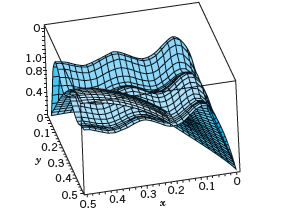
Verify (by substitution) that the given function is a solution of the PDE. Sketch or graph the solution as a surface in space.Laplace Equation (3)u = x/(x2 + y2), y/(x2 + y2)
Find the temperature in Prob. 11 with L = π, c = 1, and f (x) = 1 Data from Prob. 11 “Adiabatic” means no heat exchange with the neighborhood, because the bar is completely insulated, also at the ends. Physical Information: The heat flux at the ends is proportional to the value of ∂u/∂x
Let f(x) = 1 when x > 0 and 0 when x
Find the deflection u(x, y, t) of the square membrane of side π and c2 = 1 for initial velocity 0 and initial deflection0.1 xy (π - x)(π - y)
Find the type, transform to normal form, and solve. Show your work in detail.uxx + 5uxy + 4uyy = 0
Find the electrostatic potential between two concentric spheres of radii r1 = 2 cm and r2 = 4 cm kept at the potentials U1 = 220 V and U2 = 140 V, respectively. Sketch and compare the equipotential lines in Probs. 12 and 13. Comment.Data from Prob. 12Find the electrostatic potential between
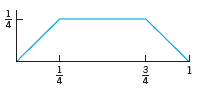
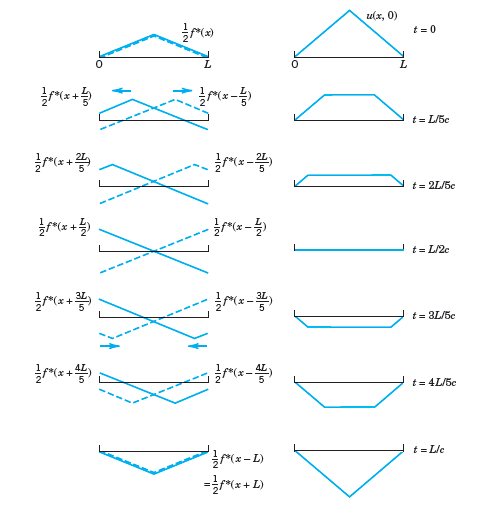
Find u(x, t) for the string of length L = 1 and c2 = 1 when the initial velocity is zero and the initial deflection with small k (say, 0.01) is as follows. Sketch or graph u(x, t) as in Fig. 291 in the text.2x - 4x2 if 0 x f(x+ f(x+2 f(x+1) f(x+) f(x+4) (x) (x) f(x -) - f(x-1) f(x-) [f(x - ) 1
How do problems for the wave equation and the heat equation differ regarding additional conditions?
Verify (by substitution) that the given function is a solution of the PDE. Sketch or graph the solution as a surface in space.Laplace Equation (3)u = cos y sinh x, sin y cosh x
Why and where did the error function occur?
Find the steady-state temperature in a semicircular thin plate r < α, 0 < θ < π with the semicircle r = α kept at constant temperature u0 and the segment -α < x < α at 0.
Verify (by substitution) that the given function is a solution of the PDE. Sketch or graph the solution as a surface in space.Laplace Equation (3)u = arctan (y/x)
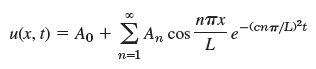
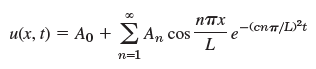
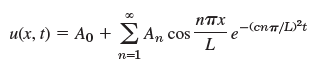
“Adiabatic” means no heat exchange with the neighborhood, because the bar is completely insulated, also at the ends. Physical Information: The heat flux at the ends is proportional to the value of ∂u/∂x there. Show that for the completely insulated bar ux(0, t) = 0, ux(L, t) = 0, u(x, t) =
Following function is important in applied mathematics and physics (probability theory and statistics, thermodynamics, etc.) and fits our present discussion. Regarding it as a typical case of a special function defined by an integral that cannot be evaluated as in elementary calculus, do the
Find the type, transform to normal form, and solve. Show your work in detail.uxx + 2uxy + uyy = 0
Substituting u(r) with r as in Prob. 9 into uxx + uyy + uzz = 0, verify that u" + 2u'/r = 0, in agreement with (7).Data from Prob. 9Show that the only solution of Laplace’s equation depending only on r = √x2 + y2 + z2 is u = c/r + k with constant c and k.
Find u(x, t) for the string of length L = 1 and c2 = 1 when the initial velocity is zero and the initial deflection with small k (say, 0.01) is as follows. Sketch or graph u(x, t) as in Fig. 291 in the text. ml4
Explain mathematically (not physically) why we got exponential functions in separating the heat equation, but not for the wave equation.
Find the deflection u(x, y, t) of the square membrane of side π and c2 = 1 for initial velocity 0 and initial deflection0.1 sin 2x sin 4y
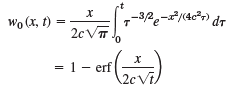
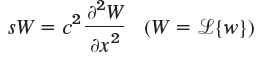
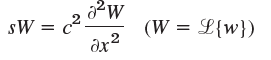
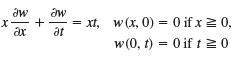
Find the temperature w(x, t) in a semi-infinite laterally insulated bar extending from x = 0 along the x-axis to infinity, assuming that the initial temperature is 0, w(x, t) → 0 as x → ∞ for every fixed t ≥ 0, and w(0, t) = f(t). Proceed as follows.Let w (0, t) = f(t) = u(t). Denote the
Verify (by substitution) that the given function is a solution of the PDE. Sketch or graph the solution as a surface in space.Laplace Equation (3)u = ex cos y, ex sin y
Following function is important in applied mathematics and physics (probability theory and statistics, thermodynamics, etc.) and fits our present discussion. Regarding it as a typical case of a special function defined by an integral that cannot be evaluated as in elementary calculus, do the
Find u(x, t) for the string of length L = 1 and c2 = 1 when the initial velocity is zero and the initial deflection with small k (say, 0.01) is as follows. Sketch or graph u(x, t) as in Fig. 291 in the text.
Verify (by substitution) that the given function is a solution of the PDE. Sketch or graph the solution as a surface in space.Heat Equation (2) with suitable cu = e-π2t cos 25x
When did we use polar coordinates? Cylindrical coordinates? Spherical coordinates?
Following function is important in applied mathematics and physics (probability theory and statistics, thermodynamics, etc.) and fits our present discussion. Regarding it as a typical case of a special function defined by an integral that cannot be evaluated as in elementary calculus, do the
In Prob. 8 find the temperature at any time.Data from Prob. 8If the ends x = 0 and x = L of the bar in the text are kept at constant temperatures U1 and U2 respectively, what is the temperature u1(x) in the bar after a long time (theoretically, as t → ∞)?First guess, then calculate.
Guess what the equipotential lines u(r, θ) = const in Probs. 5 and 7 may look like. Then graph some of them, using partial sums of the series.Data from Prob. 5The electrostatic potential satisfies Laplace’s equation ∇2u = 0 in any region free of charges. Also the heat equation ut =
Find the type, transform to normal form, and solve. Show your work in detail.uxx + 4uyy = 0
Show that the only solution of Laplace’s equation depending only on r = √x2 + y2 + z2 is u = c/r + k with constant c and k.
Find u(x, t) for the string of length L = 1 and c2 = 1 when the initial velocity is zero and the initial deflection with small k (say, 0.01) is as follows. Sketch or graph u(x, t) as in Fig. 291 in the text.
What do you remember about types of PDEs? Normal forms? Why is this important?
Find the temperature w(x, t) in a semi-infinite laterally insulated bar extending from x = 0 along the x-axis to infinity, assuming that the initial temperature is 0, w(x, t) → 0 as x → ∞ for every fixed t ≥ 0, and w(0, t) = f(t). Proceed as follows. Set up the model and show that the
(a) Write a program that gives and graphs partial sums of (15). Apply it to Probs. 5 and 6. Do the graphs show that those partial sums satisfy the boundary condition (3a)? Explain why. Why is the convergence rapid?(b) Do the tasks in (a) for Prob. 4. Graph a portion, say, 0 (c) Do the tasks in (b)
Using (13) sketch or graph a figure similar to Fig. 291 in Sec. 12.3) of the deflection u(x, t) of a vibrating string (length L = 1, ends fixed, c = 1) starting with initial velocity 0 and initial deflection (k small, say, k = 0.01). f (x) = kx(1 - x)
Verify that the potential u = c/r, r = √x2 + y2 + z2 satisfies Laplace’s equation in spherical coordinates.
Find u(x, t) for the string of length L = 1 and c2 = 1 when the initial velocity is zero and the initial deflection with small k (say, 0.01) is as follows. Sketch or graph u(x, t) as in Fig. 291 in the text. kx2(1 - x)
What are the eigenfunctions and their frequencies of the vibrating string? Of the vibrating membrane?
The electrostatic potential satisfies Laplace’s equation ∇2u = 0 in any region free of charges. Also the heat equation ut = c2 ∇2u (Sec. 12.5) reduces to Laplace’s equation if the temperature u is time-independent (“steady-state case”). Using (20), find the potential (equivalently:
Verify (by substitution) that the given function is a solution of the PDE. Sketch or graph the solution as a surface in space.Heat Equation (2) with suitable cu = e-ω2c2t cos ωx
Find the temperature u(x, t) in a bar of silver of length 10 cm and constant cross section of area 1 cm2 (density 10.6 g/cm3, thermal conductivity 1.04 cal/(cm sec ºC), specific heat 0.056 cal/(g ºC) that is perfectly insulated laterally, with ends kept at temperature 0ºC and initial
Using (6), obtain the solution of (1) in integral form satisfying the initial condition u (x, 0) = f(x), wheref (x) = (sin x)/x.
Using (13) sketch or graph a figure similar to Fig. 291 in Sec. 12.3) of the deflection u(x, t) of a vibrating string (length L = 1, ends fixed, c = 1) starting with initial velocity 0 and initial deflection (k small, say, k = 0.01). f (x) = k sin 2πx
Find u(x, t) for the string of length L = 1 and c2 = 1 when the initial velocity is zero and the initial deflection with small k (say, 0.01) is as follows. Sketch or graph u(x, t) as in Fig. 291 in the text.kx(1 - x) f(x+ f(x+2 f(x+1) f(x+) f(x+4) (x) (x) f(x -) - f(x-1) f(x-) [f(x - ) 1 FM(x-I)
When and why did Legendre’s equation occur? Bessel’s equation?
Solve by Laplace Transforms Solve Prob. 5 by separating variables Data from Prob. 5
Represent f (x, y) by a series (15), wheref (x, y) = xy, α and b arbitrary
Find the temperature u(x, t) in a bar of silver of length 10 cm and constant cross section of area 1 cm2 (density 10.6 g/cm3, thermal conductivity 1.04 cal/(cm sec ºC), specific heat 0.056 cal/(g ºC) that is perfectly insulated laterally, with ends kept at temperature 0ºC and initial
Using (6), obtain the solution of (1) in integral form satisfying the initial condition u (x, 0) = f(x), wheref(x) = x if |x| < 1 and 0 otherwise
Using (13) sketch or graph a figure similar to Fig. 291 in Sec. 12.3) of the deflection u(x, t) of a vibrating string (length L = 1, ends fixed, c = 1) starting with initial velocity 0 and initial deflection (k small, say, k = 0.01). f (x) = k(1 - cos πx)
Study the Gibbs phenomenon in Example 1 (Fig. 314) graphically.
Find u(x, t) for the string of length L = 1 and c2 = 1 when the initial velocity is zero and the initial deflection with small k (say, 0.01) is as follows. Sketch or graph u(x, t) as in Fig. 291 in the text.k (sin πx - 1/2 sin 2πx) f(x+ f(x+2 f(x+1) f(x+) f(x+4) (x) (x) f(x -) - f(x-1) f(x-) [f(x
What role did Fourier series play in this chapter? Fourier integrals?
Showing 900 - 1000
of 3937
First
3
4
5
6
7
8
9
10
11
12
13
14
15
16
17
Last
Step by Step Answers

 Get 50% OFF
Claim Now
Get 50% OFF
Claim Now