New Semester
Started
Get
50% OFF
Study Help!
--h --m --s
Claim Now
Question Answers
Textbooks
Find textbooks, questions and answers
Oops, something went wrong!
Change your search query and then try again
S
Books
FREE
Study Help
Expert Questions
Accounting
General Management
Mathematics
Finance
Organizational Behaviour
Law
Physics
Operating System
Management Leadership
Sociology
Programming
Marketing
Database
Computer Network
Economics
Textbooks Solutions
Accounting
Managerial Accounting
Management Leadership
Cost Accounting
Statistics
Business Law
Corporate Finance
Finance
Economics
Auditing
Tutors
Online Tutors
Find a Tutor
Hire a Tutor
Become a Tutor
AI Tutor
AI Study Planner
NEW
Sell Books
Search
Search
Sign In
Register
study help
mathematics
advanced engineering mathematics
Advanced Engineering Mathematics 10th edition Erwin Kreyszig - Solutions
Let a = [4, 7, 0], b = [3, -1, 5], c = [-6, 2, 0], and d = [1, -2, 8]. Calculate the following expressions. Try to make a sketch.b × c, c × b, c × c, c • c
Prove the Cauchy–Schwarz inequality.
With respect to right-handed Cartesian coordinates, let a = [2, 1, 0], b = [-3, 2, 0] c = [1, 4, -2], and d = [5, -1, 3]. Showing details, find:c × (a + b), a × c + b × c
What kind of surfaces are the level surfaces f(x, y, z) = const?f = z - (√x2 + y2)
Let v be the velocity vector of a steady fluid flow. Is the flow irrotational? Incompressible? Find the streamlines (the paths of the particles).v = [x, y, -z]
Let a = [3, 2, 0] = 3i + 2j; b = [-4, 6, 0] = 4i + 6j, c = [5, -1, 8] = 5i - j + 8k, d = [0, 0, 4] = 4k.Find:(a + b) + c, a + (b + c)
With respect to right-handed Cartesian coordinates, let a = [2, 1, 0], b = [-3, 2, 0] c = [1, 4, -2], and d = [5, -1, 3]. Showing details, find:3c × 5d, 15d × c, 15d • c, 15c • d
The force in an electrostatic field given by f(x, y, z) has the direction of the gradient. Find ∇f and its value at P.f = xy, P: (-4, 5)
Let a = [3, 2, 0] = 3i + 2j; b = [-4, 6, 0] = 4i + 6j, c = [5, -1, 8] = 5i - j + 8k, d = [0, 0, 4] = 4k.Find:2a, 1/2a, -a
Find a parametric representationCircle in the plane z = 1 with center (3, 2) and passing through the origin.
Show that the flow with velocity vector v = yi is incompressible. Show that the particles that at time t = 0 are in the cube whose faces are portions of the planes x = 0, x = 1, y = 0, y = 1, z = 0, z = 1 occupy at t = 1 the volume 1.
Let a = [4, 7, 0], b = [3, -1, 5], c = [-6, 2, 0], and d = [1, -2, 8]. Calculate the following expressions. Try to make a sketch.a • c, 3b • 8d, 24d • b, a • a
What laws do Probs. 1 and 4–7 illustrate?Data from Prob. 1a • b, b • a, b • cData from Prob. 4|a + b|, |a| + |b|Data from Prob. 5Let a = [1, -3, 5], b = [4, 0, 8], c = [-2, 9, 1].Find:|b + c|, |b| + |c|Data from Prob. 6Let a = [1, -3, 5], b = [4, 0, 8], c = [-2, 9, 1].Find:|a + c|2 + |a -
What kind of surfaces are the level surfaces f(x, y, z) = const?f = 5x2 + 2y2
Let v be the velocity vector of a steady fluid flow. Is the flow irrotational? Incompressible? Find the streamlines (the paths of the particles).v = [ y, -2x, 0]
Granted sufficient differentiability, which of the following expressions make sense? f curl v, v curl f,u ×v, u × v × w, f • v, f • (v × w), u • (v × w),v × curl v, div (fv), curl (fv), and curl (f • v).
Summarize the most important applications discussed in this section. Give examples. No proofs.
Prove and illustrate by an example.∇(f/g) = (1/g2)(g∇f - f∇g)
Find the terminal point Q of the vector v with components as given and initial point P. Find |v|.6, 1, -4; P: (-6, -1, -4)
What curves are represented by the following? Sketch them.[cos t, sin 2t, 0]
Write down the definitions and explain the significance of grad, div, and curl.
Useful Formulas for the Divergence. Prove(a) div (kv) = k div v (k constant)(b) div (fv) = f div v + v • ∇f(c) div (f∇g) = f ∇2g + ∇f • ∇g(d) div (f∇g) - div (g∇f) = f∇2g - g∇2fVerify (b) for f = exyz and v = axi + byj + czk. Obtain the answer to Prob. 6 from (b). Verify (c)
Let a = [1, -3, 5], b = [4, 0, 8], c = [-2, 9, 1].Find:15a • b + 15a • c, 15a • (b + c)
What does (a b c) = 0 imply with respect to these vectors?
What kind of surfaces are the level surfaces f(x, y, z) = const?f = 4x - 3y + 2z
Let v be the velocity vector of a steady fluid flow. Is the flow irrotational? Incompressible? Find the streamlines (the paths of the particles).v = [0, 3z2, 0]
Let a = [1, -3, 5], b = [4, 0, 8], c = [-2, 9, 1].Find:5a • 13b, 65a • b
Prove and illustrate by an example.∇(fn) = nfn-1 ∇f
Find the terminal point Q of the vector v with components as given and initial point P. Find |v|.1/2, 3, -1/4; P: (7/2, -3, 3/4)
What curves are represented by the following? Sketch them.[4 cos t, 4 sin t, 3t]
Can a moving body have constant speed but variable velocity? Nonzero acceleration?
For what v3 is v = [ex cos y, ex sin y, v3] solenoidal?
Let a = [1, -3, 5], b = [4, 0, 8], c = [-2, 9, 1].Find:|a • c|, |a||c|
A wheel is rotating about the y-axis with angular speed ω = 20 sec-1. The rotation appears clockwise if one looks from the origin in the positive y-direction. Find the velocity and speed at the point [8, 6, 0]. Make a sketch.
Find curl v for v given with respect to right-handed Cartesian coordinates. Show the details of your work.v = [0, 0, e-x sin y]
Let the temperature T in a body be independent of z so that it is given by a scalar function T = T(x, t). Identify the isotherms T(x, y) = const. Sketch some of them.T = 9x2 + 4y2
If r(t) represents a motion, what are r'(t), |r'(t)|, r"(t), and |r"(t)|?
Find grad f. Graph some level curves f = const. Indicate ∇f by arrows at some points of these curves.f = x4 + y4
Find the components of the vector v with initial point P and terminal point Q. Find |v|. Sketch |v|. Find the unit vector u in the direction of v.P: (0, 0, 0), Q: (2, 1, -2)
What curves are represented by the following? Sketch them.[2 + 4 cos t, 1 + sin t, 0]
How is the derivative of a vector function defined? What is its significance in geometry and mechanics?
Find div v and its value at P.v = x2y2z2[x, y, z], P: (3, -1, 4)
Let a = [1, -3, 5], b = [4, 0, 8], c = [-2, 9, 1].Find:|b + c|, |b| + |c|
Find curl v for v given with respect to right-handed Cartesian coordinates. Show the details of your work.v = xyz [x, y, z]
Let the temperature T in a body be independent of z so that it is given by a scalar function T = T(x, t). Identify the isotherms T(x, y) = const. Sketch some of them.T = y/(x2 + y2)
When is a vector product the zero vector? What is orthogonality?
Find grad f. Graph some level curves f = const. Indicate ∇f by arrows at some points of these curves.f = y/x
Find the components of the vector v with initial point P and terminal point Q. Find |v|. Sketch |v|. Find the unit vector u in the direction of v.P: (-3.0, 4,0, -0.5), Q: (5.5, 0, 1.2)
What curves are represented by the following? Sketch them.[0, t, t3]
What are right-handed and left-handed coordinates? When is this distinction important?
Find div v and its value at P.v = (x2 + y2)-1[x, y]
Let a = [1, -3, 5], b = [4, 0, 8], c = [-2, 9, 1].Find:|a|, |2b|, |-c|
Let the temperature T in a body be independent of z so that it is given by a scalar function T = T(x, t). Identify the isotherms T(x, y) = const. Sketch some of them.T = 3x - 4y
What is an inner product, a vector product, a scalar triple product? What applications motivate these products?
Let a = [1, -3, 5], b = [4, 0, 8], c = [-2, 9, 1].Find:(-3a + 5c) • b, 15(a - c) • b
Find grad f. Graph some level curves f = const. Indicate ∇f by arrows at some points of these curves.f = (x + 1)(2y - 1)
Find the components of the vector v with initial point P and terminal point Q. Find |v|. Sketch |v|. Find the unit vector u in the direction of v.P: (1, 1, 0), Q: (6, 2, 0)
What curves are represented by the following? Sketch them.[3 + 2 cos t, 2 sin t, 0]
What is a vector? A vector function? A vector field? A scalar? A scalar function? A scalar field? Give examples.
Find div v and its value at P.v = [x2, 4y2, 9z2], P: (-1, 0, 1/2)
Let a = [1, -3, 5], b = [4, 0, 8], c = [-2, 9, 1].Find:a • b, b • a, b • c
List the definitions and most important facts and formulas for grad, div, curl, and ∇2. Use your list to write a corresponding report of 3–4 pages, with examples of your own. No proofs.
Let the temperature T in a body be independent of z so that it is given by a scalar function T = T(x, t). Identify the isotherms T(x, y) = const. Sketch some of them.T = x2 - y2
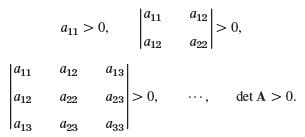
A necessary and sufficient condition for positive definiteness of a quadratic form Q(x) = xTAx with symmetric matrix A is that all the principal minors are positive that is, Show that the form in Prob. 22 is positive definite, whereas that in Prob. 23 is indefinite. Data from Prob. 22 4x12 +
Transform to canonical form (to principal axes). Express [x1 x2]T in terms of the new variables [y1 y2]T.3.7x12 + 3.2x1x2 + 1.3x22 = 4.5
What kind of conic section (or pair of straight lines) is given by the quadratic form? Transform it to principal axes. Express xT = [x1 x2] in terms of the new coordinate vector yT = [y1 y2], as in Example 6.-11x12 + 84x1x2 + 24x22 = 156
Show that the eigenvalues of a real matrix are real or complex conjugate in pairs.
Transform to canonical form (to principal axes). Express [x1 x2]T in terms of the new variables [y1 y2]T.4x12 + 24x1x2 - 14x22 = 20
Find further 2 × 2 and 3 × 3 matrices with multiple eigenvalues.
What kind of conic section (or pair of straight lines) is given by the quadratic form? Transform it to principal axes. Express xT = [x1 x2] in terms of the new coordinate vector yT = [y1 y2], as in Example 6.x12 - 12x1x2 + x22 = 70.
Find further 2 × 2 and 3 × 3 matrices with positive defect.
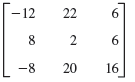
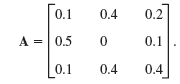
Find an eigenbasis and diagonalize.
Prove that A is normal if and only if the Hermitian and skew-Hermitian matrices in Prob. 18 commute.Data from Prob. 18This important concept denotes a matrix that commutes with its conjugate transpose, AA̅T = A̅TA. Prove that Hermitian, skew-Hermitian, and unitary matrices are normal. Give
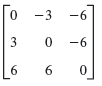
Do there exist skew-symmetric orthogonal 3 × 3 matrices?
What kind of conic section (or pair of straight lines) is given by the quadratic form? Transform it to principal axes. Express xT = [x1 x2] in terms of the new coordinate vector yT = [y1 y2], as in Example 6.3x12 + 22x1x2 + 3x22 = 0
Find the matrix A in the linear transformation y = Ax, where x = [x1 x2]T (x = [x1 x2 x3]T) are Cartesian coordinates. Find the eigenvalues and eigenvectors and explain their geometric meaning.Orthogonal projection (perpendicular projection) of R2 onto
Find the matrix A in the linear transformation y = Ax, where x = [x1 x2]T (x = [x1 x2 x3]T) are Cartesian coordinates. Find the eigenvalues and eigenvectors and explain their geometric meaning.Reflection about the x1-axis in R2.
Powers of unitary matrices in applications may sometimes be very simple. Show that C12 = I in Example 2. Find further examples.
What kind of conic section (or pair of straight lines) is given by the quadratic form? Transform it to principal axes. Express xT = [x1 x2] in terms of the new coordinate vector yT = [y1 y2], as in Example 6.7x12 + 6x1x2 + 7x22 = 200
Find the matrix A in the linear transformation y = Ax, where x = [x1 x2]T (x = [x1 x2 x3]T) are Cartesian coordinates. Find the eigenvalues and eigenvectors and explain their geometric meaning.Counterclockwise rotation through the angle π/2 about the origin
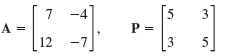
Verify that A and  = p-1AP have the same spectrum.
Let A = [αjk] be an n × n matrix with (not necessarily distinct) eigenvalues λ1, · · · , λn. Show.A - kI has the eigenvalues λ1 - k, · · ·, λn - k and the same eigenvectors as A.
Show that any square matrix may be written as the sum of a Hermitian and a skew-Hermitian matrix. Give examples.
Are the eigenvalues of A + B sums of the eigenvalues of A and of B?
Find an eigenbasis (a basis of eigenvectors) and diagonalize. Show the details.
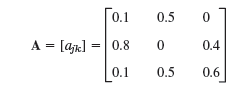
If not the whole output but only a portion of it is consumed by the industries themselves, then instead of Ax = x (as in Prob. 13), we have x - Ax = y, where x = [x1 x2 x3]T is produced, Ax is consumed by the industries, and, thus, y is the net production available for other consumers.
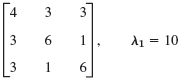
Find the eigenvalues. Find the eigenvectors.
Show that (ABC)̅ T = -C-1BA for any n × n Hermitain A, Skew-Hermitian B, and unitary C.
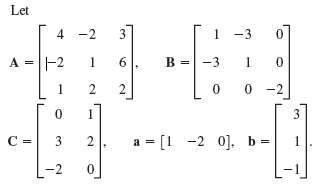
Showing all intermediate results, calculate the following expression or give reasons why they are undefined: Aa, AaT, (Ab)T, bTAT
Find and graph all values of:√81
Find all solutions and graph some of them in the complex plane.ez = 0
Are the following functions analytic? Use (1) or (7).f(z) = i/z8
What is d’Alembert’s solution method? To what PDE does it apply?
Solve by Laplace Transforms
Find u(x, t) for the string of length L = 1 and c2 = 1 when the initial velocity is zero and the initial deflection with small k (say, 0.01) is as follows. Sketch or graph u(x, t) as in Fig. 291 in the text. k sin 3πx
Compare these PDEs with respect to general behavior of eigenfunctions and kind of boundary and initial conditions. State the difference between Fig. 291 in Sec. 12.3 and Fig. 295.
Why did we introduce polar coordinates in this section?
Sketch the given function and represent it as indicated. If you have a CAS, graph approximate curves obtained by replacing ∞ with finite limits; also look for Gibbs phenomena.f(x) = e-2x if x > 0 and 0 otherwise; by the Fourier transform
Sketch the given function and represent it as indicated. If you have a CAS, graph approximate curves obtained by replacing ∞ with finite limits; also look for Gibbs phenomena.f(x) = x if 1 < x < α and 0 otherwise; by the Fourier cosine transform
What is the Fourier transform? The discrete Fourier transform?
Showing 700 - 800
of 3937
1
2
3
4
5
6
7
8
9
10
11
12
13
14
15
Last
Step by Step Answers

 Get 50% OFF
Claim Now
Get 50% OFF
Claim Now