New Semester
Started
Get
50% OFF
Study Help!
--h --m --s
Claim Now
Question Answers
Textbooks
Find textbooks, questions and answers
Oops, something went wrong!
Change your search query and then try again
S
Books
FREE
Study Help
Expert Questions
Accounting
General Management
Mathematics
Finance
Organizational Behaviour
Law
Physics
Operating System
Management Leadership
Sociology
Programming
Marketing
Database
Computer Network
Economics
Textbooks Solutions
Accounting
Managerial Accounting
Management Leadership
Cost Accounting
Statistics
Business Law
Corporate Finance
Finance
Economics
Auditing
Tutors
Online Tutors
Find a Tutor
Hire a Tutor
Become a Tutor
AI Tutor
AI Study Planner
NEW
Sell Books
Search
Search
Sign In
Register
study help
mathematics
advanced engineering mathematics
Advanced Engineering Mathematics 10th edition Erwin Kreyszig - Solutions
The electrostatic potential satisfies Laplace’s equation ∇2u = 0 in any region free of charges. Also the heat equation ut = c2 ∇2u (Sec. 12.5) reduces to Laplace’s equation if the temperature u is time-independent (“steady-state case”). Using (20), find the potential (equivalently:
Verify (by substitution) that the given function is a solution of the PDE. Sketch or graph the solution as a surface in space.Wave Equation (1) with suitable cu = sin αt sin bx
Find the temperature u(x, t) in a bar of silver of length 10 cm and constant cross section of area 1 cm2 (density 10.6 g/cm3, thermal conductivity 1.04 cal/(cm sec ºC), specific heat 0.056 cal/(g ºC) that is perfectly insulated laterally, with ends kept at temperature 0ºC and initial
Using (6), obtain the solution of (1) in integral form satisfying the initial condition u (x, 0) = f(x), wheref (x) = |x| if |x| < 1 and 0 otherwise
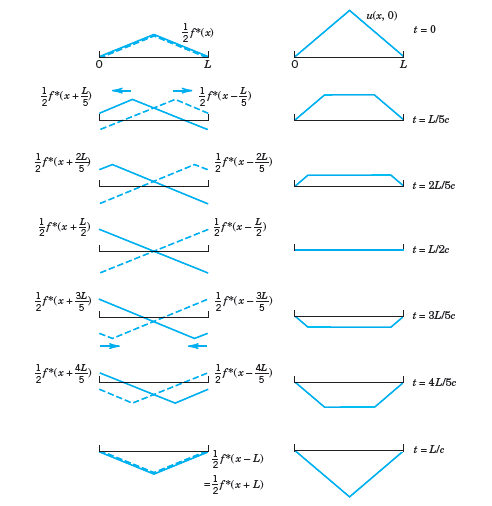
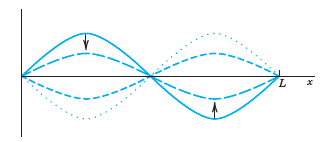
Using (13) sketch or graph a figure similar to Fig. 291 in Sec. 12.3) of the deflection u(x, t) of a vibrating string (length L = 1, ends fixed, c = 1) starting with initial velocity 0 and initial deflection (k small, say, k = 0.01). f (x) = k sin πx
Determine and sketch or graph the sets in the complex plane given by|z + 1 - 5i| ≤ 3/2
Find and sketch or graph (as in Fig. 288 in Sec. 12.3) the deflection u(x, t) of a vibrating string of length π, extending from x = 0 to x = π, and c2 = T/ρ = 4 starting with velocity zero and deflection: 1/2π - |x - 1/2π|
Evaluate the integral for the given data. Describe the kind of surface. Show the details of your work.F = [0, sin y, cos z], S the cylinder x = y2, where 0 ≤ y ≤ π/4 and 0 ≤ z ≤ y
Calculate ∫C F(r) • dr for the given data. If F is a force, this gives the work done by the force in the displacement along C. Show the details.F = [x2, y2, z2], C: r = [cos t, sin t, et] from (1, 0, 1) to (1, 0, e2π). Sketch C.
Familiarize yourself with parametric representations of important surfaces by deriving a representation (1), by finding the parameter curves (curves u = const and v = const) of the surface and a normal vector N = ru × rv of the surface. Show the details of your work.r(u, v) = [α cos v
Where did orientation of a surface play a role? Explain.
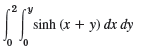
Describe the region of integration and evaluate. Prob. 6, order reversed. Data from Prob. 6
Find the total mass of a mass distribution of density σ in a region T in space.σ = arctan (y/x), T: x2 + y2 + z2 ≤ α2, z ≥ 0
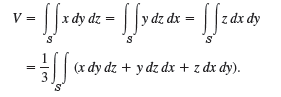
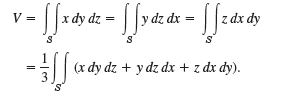
Use the divergence theorem, assuming that the assumptions on T and S are satisfied. Show that a region T with boundary surface S has the volume
State the divergence theorem from memory. Give applications.
Evaluate ∫C F(r) • dr counterclockwise around the boundary C of the region R by Green’s theorem, whereF = [ey/x, ey ln x + 2x], R: 1 + x4 ≤ y ≤ 2
Evaluate the surface integral ∫s∫ (curl F) • n dA directly for the given F and S.Verify Stokes’s theorem for F and S in Prob. 5.Data from Prob. 5F = [z2, 3/2x, 0], S: 0 ≤ x ≤ α, 0 ≤ y ≤ α, z = 1
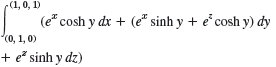
Show that the form under the integral sign is exact in the plane (Probs. 3–4) or in space (Probs. 5–9) and evaluate the integral. Show the details of your work.
Calculate ∫C F(r) • dr for the given data. If F is a force, this gives the work done by the force in the displacement along C. Show the details.F = [x + y, y + z, z + x], C: r = [2t, 5t, t] t = 0 to 1. Also from t = -1 to 1.
In some line and surface integrals we started from vector functions, but integrands were scalar functions. How and why did we proceed in this way?
Evaluate the integral for the given data. Describe the kind of surface. Show the details of your work.F = [0, sinh z, cosh x], S: x2 + z2 = 4, 0 ≤ x ≤ 1/√2, 0 ≤ y ≥ 5, z ≥ 0
Find the volume of the given region in space.The region beneath z = 4x2 + 9y2 and above the rectangle with vertices (0, 0), (3, 0), (3, 2), (0, 2) in the xy-plane.
Evaluate the surface integral ∫∫S F • n dA by the divergence theorem. Show the details.F = [x2, 0, z2], S the surface of the box |x| ≤ 1, |y| ≤ 3, 0 ≤ z ≤ 2
Use the divergence theorem, assuming that the assumptions on T and S are satisfied. Find the volume under a hemisphere of radius a from in Prob. 7. Data from Prob. 7 Show that a region T with boundary surface S has the volume
State Laplace’s equation. Explain its physical importance. Summarize our discussion on harmonic functions.
Find the volume of the given region in space.The first octant region bounded by the coordinate planes and the surfaces y = 1 - x2, z = 1 - x2. Sketch it.
Apply (4) to figures of your choice whose area can also be obtained by another method and compare the results.
Evaluate ∫C F • r' ds, F = (x2 + y2)-1[-y, x], C: x2 + y2 = 1, z = 0, oriented clockwise. Why can Stokes’s theorem not be applied? What (false) result would it give?
Write a program for evaluating surface integrals (3) that prints intermediate results (F, F • N, the integral over one of the two variables). Can you obtain experimentally some rules on functions and surfaces giving integrals that can be evaluated by the usual methods of calculus? Make a list of
Calculate ∫C F(r) • dr for the given data. If F is a force, this gives the work done by the force in the displacement along C. Show the details.F = [e-x, e-y, e-z], C: r = [t, t2, t] from (0, 0, 0) to (2, 4, 2). Sketch C.
Evaluate ∫C F (r) • dr for given F and C by the method that seems most suitable. Remember that if F is a force, the integral gives the work done in the displacement along C. Show details.F = [2x2, -4y2], C the straight-line segment from (4, 2) to (-6, 10)
Find the volume of the given region in space.The region above the xy-plane and below the paraboloid z = 1 - (x2 + y2).
Represent the paraboloid in Prob. 5 so that N∼(0, 0) ≠ 0 and show N∼.Data from Prob. 5Familiarize yourself with parametric representations of important surfaces by deriving a representation (1), by finding the parameter curves (curves u = const and v = const) of the surface and a normal
Evaluate the surface integral ∫∫S F • n dA by the divergence theorem. Show the details.F = [ex, ey, ez], S the surface of the cube |x| ≤ 1, |y| ≤ 1, |z| ≤ 1
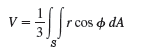
Use the divergence theorem, assuming that the assumptions on T and S are satisfied. Find the volume of a ball of radius α from Prob. 10. Data from Prob. 10 Show that a region T with boundary surface S has the volume where r is the distance of a variable point P: (x, y, z) on S from the origin O
Make a list of ideas and results on this topic in this chapter. See whether you can rearrange or combine parts of your material. Then subdivide the material into 3–5 portions and work out the details of each portion. Include no proofs but simple typical examples of your own that lead to a better
Using (9), find the value of ∫C ∂w/∂n ds taken counterclockwise over the boundary C of the region R.w = cosh x, R the triangle with vertices (0, 0), (4, 2), (0, 2).
Calculate this line integral by Stokes’s theorem for the given F and C. Assume the Cartesian coordinates to be right-handed and the z-component of the surface normal to be nonnegative.F = [-5y, 4x, z], C the circle x2 + y2 = 16, z = 4
Check, and if independent, integrate from (0, 0, 0) to (α, b, c).2ex2 (x cos 2y dx - sin 2y dy)
Evaluate these integrals for the following data. Indicate the kind of surface. Show the details.G = x + y + z, z = x + 2y, 0 ≤ x ≤ π, 0 ≤ y ≤ x
Let F be a vector function defined on a curve C. Let |F| be bounded, say |F| ≤ M on C, where M is some positive number. Show that
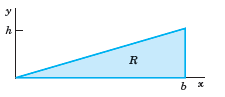
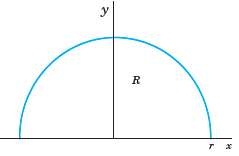
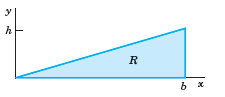
Find the center of gravity (x̅, y̅) of a mass of density f(x, y) = 1 in the given region R.
Evaluate ∫C F (r) • dr for given F and C by the method that seems most suitable. Remember that if F is a force, the integral gives the work done in the displacement along C. Show details.F = [ y2, 2xy + 5 sin x, 0], C the boundary of 0 ≤ x ≤ π/2, 0 ≤ y ≤ 2, z = 0
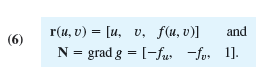
z = f(x, y). Show that z = f(x, y) or g = z - f(x, y) = 0 can be written (fu = ∂f/∂u, etc.)
Evaluate the surface integral ∫∫S F • n dA by the divergence theorem. Show the details.F = [sin y, cos x, cos z], S, the surface of x2 + y2 ≤ 4, |z| ≤ 2 (a cylinder and two disks!)
Using (9), find the value of ∫C ∂w/∂n ds taken counterclockwise over the boundary C of the region R.w = ex cos y + xy3, R: 1 ≤ y ≤ 10 - x2, x ≥ 0
Calculate this line integral by Stokes’s theorem for the given F and C. Assume the Cartesian coordinates to be right-handed and the z-component of the surface normal to be nonnegative.F = [y2, x2, z + x] around the triangle with vertices (0, 0, 0), (1, 0, 0), (1, 1, 0)
Check, and if independent, integrate from (0, 0, 0) to (α, b, c).x2y dx - 4xy2 dy + 8z2x dz
Evaluate these integrals for the following data. Indicate the kind of surface. Show the details.G = (1 + 9xz)3/2, S: r = [u, v, u3], 0 ≤ u ≤ 1, -2 ≤ v ≤ 2
Evaluate them with F or f and C as follows.F = [y2, z2, x2], C: r = [3 cos t, 3 sin t, 2t], 0 ≤ t ≤ 4π
Evaluate ∫C F (r) • dr for given F and C by the method that seems most suitable. Remember that if F is a force, the integral gives the work done in the displacement along C. Show details.F = [x3, e2y, e-4z], C: x2 + 9y2 = 9, z = x2
Find the center of gravity (x̅, y̅) of a mass of density f(x, y) = 1 in the given region R.
Find a normal vector. The answer gives one representation; there are many. Sketch the surface and parameter curves.Cylinder of revolution (x - 2)2 + (y + 1)2 = 25
Evaluate the surface integral ∫∫S F • n dA by the divergence theorem. Show the details.F = [2x2, 1/2y2, sin πz], S the surface of the tetrahedron with vertices (0, 0, 0), (1, 0, 0), (0, 1, 0), (0, 0, 1)
Using (9), find the value of ∫C ∂w/∂n ds taken counterclockwise over the boundary C of the region R.w = x3 - y3, 0 ≤ y ≤ x2, |x| ≤ 2
Calculate this line integral by Stokes’s theorem for the given F and C. Assume the Cartesian coordinates to be right-handed and the z-component of the surface normal to be nonnegative.F = [0, z3, 0], C the boundary curve of the cylinder x2 + y2 = 1, x ≥ 0, y ≥ 0, 0 ≤ z ≤ 1
Check, and if independent, integrate from (0, 0, 0) to (α, b, c).4y dx + z dy + (y - 2z) dz
Make Möbius strips from long slim rectangles R of grid paper (graph paper) by pasting the short sides together after giving the paper a half- twist. In each case count the number of parts obtained by cutting along lines parallel to the edge.(a) Make R three squares wide and cut until you reach the
Evaluate them with F or f and C as follows.F = [x + y, y + z, z + x], C: r = [4 cos t, sin t, 0], 0 ≤ t ≤ π
Evaluate ∫C F (r) • dr for given F and C by the method that seems most suitable. Remember that if F is a force, the integral gives the work done in the displacement along C. Show details.F = [9z, 5x, 3y], C the ellipse x2 + y2 = 9, z = x + 2
Find Ix, Iy, I0 of a mass of density f(x,y) = 1 in the region R in the figures, which the engineer is likely to need, along with other profiles listed in engineering handbooks. R as in Prob. 13. Data from Prob. 13 Find the center of gravity (x̅, y̅) of a mass of density f(x, y) = 1 in the given
Find a normal vector. The answer gives one representation; there are many. Sketch the surface and parameter curves.Sphere x2 + (y + 2.8)2 + (z - 3.2)2 = 2.25
Check, and if independent, integrate from (0, 0, 0) to (α, b, c).(cos (x2 + 2y2 + z2)) (2x dx + 4y dy + 2z dz)
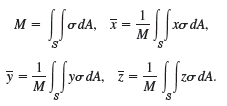
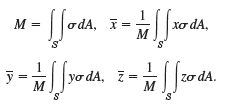
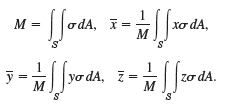
Justify the following formulas for the mass Mand the center of gravity (x̅, y̅, z̅) of a lamina S of density (mass per unit area) σ(x, y, z) in space:
Evaluate them with F or f and C as follows.f = xyz, C: r = [4t, 3t2, 12t], -2 ≤ t ≤ 2. Sketch C.
Evaluate ∫C F (r) • dr for given F and C by the method that seems most suitable. Remember that if F is a force, the integral gives the work done in the displacement along C. Show details.F = [z, 2y, x], C the helix r = [cos t, sin t, t] from (1, 0, 0) to (1, 0, 2π)
Find a normal vector. The answer gives one representation; there are many. Sketch the surface and parameter curves.Hyperbolic cylinder x2 - y2 = 1
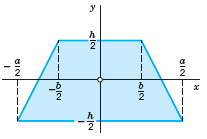
Find Ix, Iy, I0 of a mass of density f(x,y) = 1 in the region R in the figures, which the engineer is likely to need, along with other profiles listed in engineering handbooks. I EIN NIG NIG H NIR NIR N
Given a mass of density 1 in a region T of space, find the moment of intertia about the x-axisIx = ∫∫T∫ (y2 + z2) dx dy dz.The box -α ≤ x ≤ α, -b ≤ y ≤ b, -c ≤ z ≤ c
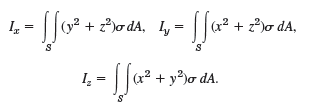
Justify the following formulas for the moments of inertia of the lamina in Prob. 19 about the x-, y-, and z-axes, respectively: Data from Prob. 19 Justify the following formulas for the mass Mand the center of gravity (x̅, y̅, z̅) of a lamina S of density (mass per unit area) σ(x, y, z) in
Find a formula for the moment of inertia of the lamina in Prob. 20 about the line y = x, z = 0. Data form Prob. 20 Justify the following formulas for the moments of inertia of the lamina in Prob. 19 about the x-, y-, and z-axes, respectively:
Find the coordinates x̅, y̅ of the center of gravity of a mass of density f(x, y) in the region R. Sketch R, show details.f = xy, R the triangle with vertices (0, 0), (2, 0), (2, 2)
Given a mass of density 1 in a region T of space, find the moment of intertia about the x-axisIx = ∫∫T∫ (y2 + z2) dx dy dz.The cylinder y2 + z2 ≤ α2, 0 ≤ x ≤ h
Find the coordinates x̅, y̅ of the center of gravity of a mass of density f(x, y) in the region R. Sketch R, show details.f = x2 + y2, R: x2 + y2 ≤ α2, y ≥ 0
Find the moment of inertia of a lamina S of density 1 about an axis B, whereS: x2 + y2 = z2, 0 ≤ z ≤ h, B: the z-axis
Find the coordinates x̅, y̅ of the center of gravity of a mass of density f(x, y) in the region R. Sketch R, show details.f = x2, R: -1 ≤ x ≤ 2, x2 ≤ y ≤ x + 2. Why is x̅ > 0?
Given a mass of density 1 in a region T of space, find the moment of intertia about the x-axisIx = ∫∫T∫ (y2 + z2) dx dy dz.The cone y2 + z2 ≤ x2, 0 ≤ x ≤ h
Using Steiner’s theorem, find the moment of inertia of a mass of density 1 on the sphere S: x2 + y2 + z2 = 1 about the line K: x =1, y = 0 from the moment of inertia of the mass about a suitable line B, which you must first calculate.
Find the coordinates x̅, y̅ of the center of gravity of a mass of density f(x, y) in the region R. Sketch R, show details.f = ky, k > 0, arbitrary, 0 ≤ y ≤ 1 - x2, 0 ≤ x ≤ 1
Show that for a solid of revolution, Ix = π/2 ∫h0 r4 (x) dx. Solve Probs. 20–23 by this formula.
Evaluate the integral directly or, if possible, by the divergence theorem. Show details.F = [αx, by, cz], S the sphere x2 + y2 + z2 = 36
Evaluate the integral directly or, if possible, by the divergence theorem. Show details.F = [y + z, 20y, 2z3], S the surface of 0 ≤ x ≤ 2, 0 ≤ y ≤ 1, 0 ≤ z ≤ y
Evaluate the integral directly or, if possible, by the divergence theorem. Show details.F = [ex, ey, ez], S the surface of the box |x| ≤ 1, |y| ≤ 1, |z| ≤ 1
Evaluate the integral directly or, if possible, by the divergence theorem. Show details.F = [y2, x2,z2], S: r = [u, u2, v], 0 ≤ u ≤ 2, -2 ≤ v ≤ 2
Evaluate the integral directly or, if possible, by the divergence theorem. Show details.F = [x + z, y + z, x + y], S the sphere of radius 3 with center 0
Derive the formula for Cn from An and Bn.
Are the following functions even or odd or neither even nor odd?ex, e-|x|, x3 cos nx, x2 tan πx, sinh x - cosh x
Find the cosine transform f̂c of f(x) = 1 if 0 < x < 1, f (x) = -1 if 1 < x < 2, f (x) = 0 if x > 2.
What is a Fourier series? A Fourier cosine series? A half-range expansion? Answer from memory.
The fundamental period is the smallest positive period. Find it forcos x, sin x, cos 2x, sin 2x, cos πx, sin πx, cos 2πx, sin 2πx
Show that 1/i = -i, e-ix = cos x - i sin x, eix + e-ix = 2 cos x, eix - e-ix = 2i sin x, eikx = cos kx + i sin kx.
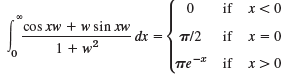
Show that the integral represents the indicated function. Use (5), (10), or (11); the integral tells you which one, and its value tells you what function to consider. Show your work in detail. cos xww sin xw 1+w dx 0 TT/2 Tre if x < 0 if x = 0 if x > 0
Showing the details, develop63x5 - 90x3 + 35x
What are the Euler formulas? By what very important idea did we obtain them?
Explain the role of the Bn’s. What happens if we let c → 0?
Are the following functions even or odd or neither even nor odd?Sums and products of even functions
Find f̂c(w) for f(x) = x if 0 < x < 2, f(x) = 0 if x > 2.
How did we proceed from 2π-periodic to general periodic functions?
Find the trigonometric polynomial F(x) of the form (2) for which the square error with respect to the given f(x) on the interval -π < x < π is minimum Compute the minimum value for N = 1, 2, · · ·, 5 (or also for larger values if you have a CAS).f (x) = |x| (-π < x < π)
If f(x) and g(x) have period p, show that h(x) = αf(x) + bg(x) (α, b, constant) has the period p. Thus all functions of period p form a vector space.
Showing 1000 - 1100
of 3937
First
4
5
6
7
8
9
10
11
12
13
14
15
16
17
18
Last
Step by Step Answers

 Get 50% OFF
Claim Now
Get 50% OFF
Claim Now