New Semester
Started
Get
50% OFF
Study Help!
--h --m --s
Claim Now
Question Answers
Textbooks
Find textbooks, questions and answers
Oops, something went wrong!
Change your search query and then try again
S
Books
FREE
Study Help
Expert Questions
Accounting
General Management
Mathematics
Finance
Organizational Behaviour
Law
Physics
Operating System
Management Leadership
Sociology
Programming
Marketing
Database
Computer Network
Economics
Textbooks Solutions
Accounting
Managerial Accounting
Management Leadership
Cost Accounting
Statistics
Business Law
Corporate Finance
Finance
Economics
Auditing
Tutors
Online Tutors
Find a Tutor
Hire a Tutor
Become a Tutor
AI Tutor
AI Study Planner
NEW
Sell Books
Search
Search
Sign In
Register
study help
mathematics
advanced engineering mathematics
Advanced Engineering Mathematics 10th edition Erwin Kreyszig - Solutions
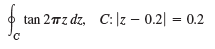
Evaluate by the methods of this chapter. Show details.
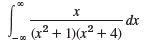
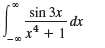
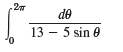
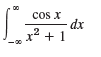
Find the Cauchy principal value (showing details):
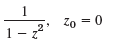
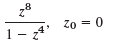
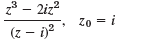
Find all Taylor and Laurent series with center z0. Determine the precise regions of convergence. Show details.
Assuming that we let the image of the x-axis be the meridians 0° and 180°, describe and sketch (or graph) the images of the following regions on the Riemann sphere: (a) |z| > 100(b) The lower half-plane(c) 1/2 ≤ |z| ≤ 2.
Find all points at which the mapping is not conformal. Give reason.cosh z
Find and sketch or graph the image of the given region under w = sin z.0 < x < π/2, 0 < y < 2
Find the fixed points.w = (α + ib)z2
Find the Laurent series that converges for 0 0|
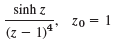
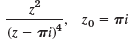
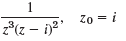
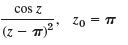
Find all the singularities in the finite plane and the corresponding residues. Show the details.ez/(z - πi)3
Evaluate the following integrals and show details of your work.
Integrate counterclockwise around C. Show the details.sin 3z/z2, C:|z| = π
Find the LFT that maps the given three points onto the three given points in the respective order.-1, 0, 1 onto -i, -1, i
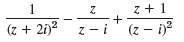
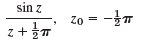
Determine the location of the singularities, including those at infinity. For poles also state the order. Give reasons.
Sketch or graph the given region and its image under the given mapping.2 ≤ Im z ≤ 5, w = iz
Find and sketch or graph the image of the given region under w = sin z.0 < x < 2π, 1 < y < 3
Find the fixed points.w = 16z5
Find the Laurent series that converges for 0 0|
Evaluate the following integrals and show details of your work.
Integrate counterclockwise around C. Show the details.5z3/z2 + 4, C:|z| = 3
Find the LFT that maps the given three points onto the three given points in the respective order.0, 1, ∞ onto ∞, 1, 0
Determine the location of the singularities, including those at infinity. For poles also state the order. Give reasons.z exp (1/(z - 1 - i)2)
Sketch or graph the given region and its image under the given mapping.|z -1/2| ≤ 1/2, w = 1/z
Describe the mapping w = cosh z in terms of the mapping w = sin z and rotations and translations.
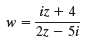
Find the fixed points.
Find the Laurent series that converges for 0 0|
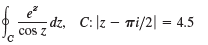
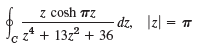
Evaluate (counterclockwise). Show the details.
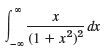
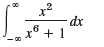
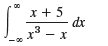
Evaluate the following integrals and show details of your work. .6 X - dx x6 +1
Integrate counterclockwise around C. Show the details.25z2/(z - 5)2, C:|z - 5| = 1
Find the LFT that maps the given three points onto the three given points in the respective order.1, i, 2 onto 0, -i - 1, -1/2
Find all points at which the mapping w = cosh 2πz is not conformal.
Determine the location of the singularities, including those at infinity. For poles also state the order. Give reasons.cot4 z
Sketch or graph the given region and its image under the given mapping.-Ln 2 ≤ x ≤ Ln 4, w = ez
Find an analytic function that maps the region R bounded by the positive x- and y-semi-axes and the hyperbola xy = π in the first quadrant onto the upper half-plane. Hint. First map R onto a horizontal strip.
Find all LFTs with fixed point(s).z = 0
Write a program for obtaining Laurent series by the use of partial fractions. Using the program, verify the calculations in Example 5 of the text. Apply the program to two other functions of your choice.
Evaluate (counterclockwise). Show the details.
Evaluate the following integrals and show details of your work.
Integrate counterclockwise around C. Show the details.cos z/zn, n = 0, 1, 2, · · ·, C:|z| = 1
Find an analytic function w = f(z) that maps the region 0 ≤ arg z ≤ π/4 onto the unit disk |w| ≤ 1.
Determine the location of the singularities, including those at infinity. For poles also state the order. Give reasons.1/(ez - e2x)
Sketch or graph the given region and its image under the given mapping.1 < |z| < 4, π/4 < θ ≤ 3π/4, w = Ln z
Find all LFTs with fixed point(s).z = ±i
Find all Taylor and Laurent series with center z0. Determine the precise regions of convergence. Show details.
Evaluate by the methods of this chapter. Show details.
Determine the location of the singularities, including those at infinity. For poles also state the order. Give reasons.e1/(z-1)/(ez - 1)
Find and sketch or graph the image of the given region under the mapping w = cos z.0 < x < π/2, 0 < y < 2 directly and from Prob. 11Data from Prob. 11Find and sketch or graph the image of the given region under w = sin z.0 < x < π/2, 0 < y < 2
Find all Taylor and Laurent series with center z0. Determine the precise regions of convergence. Show details.
Find and sketch or graph the image of the given region under the mapping w = cos z.π < x < 2π, y < 0
Find all Taylor and Laurent series with center z0. Determine the precise regions of convergence. Show details.
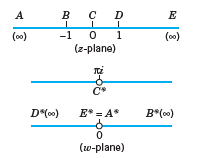
Show that w = Ln z-1/z+1 maps the upper half-plane onto the horizontal strip 0 ≤ Im w ≤ π as shown in the figure.
Find all Taylor and Laurent series with center z0. Determine the precise regions of convergence. Show details.
Evaluate (counterclockwise). Show the details.
Evaluate by the methods of this chapter. Show details.
Find the Cauchy principal value (showing details):
Find all points at which the mapping is not conformal. Give reason. sin πz
Let f(z) be analytic at z0. Suppose that f'(z0) = 0, · · ·, f(k-1)(z0) = 0. Then the mapping w = f(z) magnifies angles with vertex at z0 by a factor k. Illustrate this with examples for k = 2, 3, 4.
Experiment with integrals ∫∞ -∞ f(x) dx, f(x) = [(x - α1)(x - α2) · · · (x - αk)]-1, αj real and all different, k > 1. Conjecture that the principal value of these integrals is 0. Try to prove this for a special k, say, k = 3. For general k.
Find the magnification ratio M. Describe what it tells you about the mapping. Where is M = 1? Find the Jacobian J.w = 1/2z2
Find the magnification ratio M. Describe what it tells you about the mapping. Where is M = 1? Find the Jacobian J.w = 1/z
Find the magnification ratio M. Describe what it tells you about the mapping. Where is M = 1? Find the Jacobian J.w = ez
Find the magnification ratio M. Describe what it tells you about the mapping. Where is M = 1? Find the Jacobian J.w = Ln z
What is a conformal mapping? Why does it occur in complex analysis?
At what points are w = z5 - z and w = cos (πz2) not conformal?
What happens to angles at z0 under a mapping w = f(z) if f'(z0) = 0, f"(z0) = 0, f"'(z0) ≠ 0?
What is a linear fractional transformation? What can you do with it? List special cases.
What is the extended complex plane? Ways of introducing it?
What is a fixed point of a mapping? Its role in this chapter? Give examples.
To get a feel for increase in accuracy, integrate x2 from 0 to 1 by (2) with h = 1, 0.5, 0.25, 0.1.
Let A = [αjk] be an n × n matrix with (not necessarily distinct) eigenvalues λ1, · · · , λn. Show. The polynomial matrix has the eigenvalues where j = 1,· · ·,n, and the same eigenvectors as A.
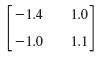
Find an eigenbasis and diagonalize.
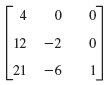
Find an eigenbasis (a basis of eigenvectors) and diagonalize. Show the details.
Find the eigenvalues. Find the corresponding eigenvectors.
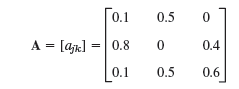
Suppose that three industries are interrelated so that their outputs are used as inputs by themselves, according to the 3 × 3 consumption matrix where αjk is the fraction of the output of industry k consumed (purchased) by industry j. Let pj be the price charged by industry j for its total
Find the eigenvalues. Find the eigenvectors.
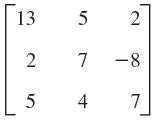
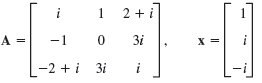
Is the matrix A Hermitian or skew-Hermitian? Find x̅TAx. Show the details.
Summarize the main concepts and facts in this section, giving illustrative examples of your own.
Find an eigenbasis (a basis of eigenvectors) and diagonalize. Show the details.
x1C3H8 + x2O2 → x3CO2 + x4H2O means finding integer x1, x2, x3, x4 such that the numbers of atoms of carbon (C), hydrogen (H), and oxygen (O) are the same on both sides of this reaction, in which propane C3H8 and O2 give carbon dioxide and water. Find the smallest positive integers x1, · · ·,
Find the Euclidean norm of the vectors:[1/2 1/3 -1/2 -1/3]T
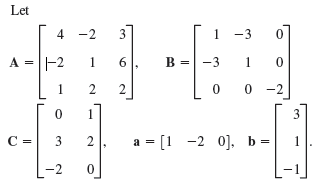
Showing all intermediate results, calculate the following expression or give reasons why they are undefined:BC, BCT, Bb, bTB Let A C = 4-2 -2 1 0 3 -2 1 2 1 2 3 6 2 B || 1 -3 -3 1 00 0 -2 a = [1 -2 0], b= 3
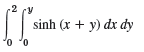
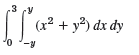
Describe the region of integration and evaluate.
What are typical applications of line integrals? Of surface integrals?
Evaluate ∫C F(r) • dr counterclockwise around the boundary C of the region R by Green’s theorem, whereF = [cosh y, -sinh x], R: 1 ≤ x ≤ 3, x ≤ y ≤ 3x
Verify (9) for f = 6y2, g = 2x2, S the unit cube in Prob. 3.Data from Prob. 3Verify (8) for f = 4y2, g = x2, S the surface of the “unit cube” 0 ≤ x ≤ 1, 0 ≤ y ≤ 1, 0 ≤ z ≤ 1. What are the assumptions on f and g in (8)? Must f and g be harmonic?
Find the total mass of a mass distribution of density σ in a region T in space.σ = sin 2x cos 2y, T : 0 ≤ x ≤ 1/4π, 1/4π - x ≤ y ≤ 1/4π, 0 ≤ z ≤ 6
What role did the gradient play in this chapter? The curl? State the definitions from memory.
Familiarize yourself with parametric representations of important surfaces by deriving a representation (1), by finding the parameter curves (curves u = const and v = const) of the surface and a normal vector N = ru × rv of the surface. Show the details of your work.r(u, v) = [u cos v, u sin
Calculate ∫C F(r) • dr for the given data. If F is a force, this gives the work done by the force in the displacement along C. Show the details.F as in Prob. 4, C the quarter-circle from (2, 0) to (0, 2) with center (0, 0)Data from Prob. 4Calculate ∫C F(r) • dr for the
Evaluate the integral for the given data. Describe the kind of surface. Show the details of your work.F = [x, y, z], S: r = [u cos v, u sin v, u2],0 ≤ u ≤ 4, -π ≤ v ≥ π
Show that the form under the integral sign is exact in the plane (Probs. 3–4) or in space (Probs. 5–9) and evaluate the integral. Show the details of your work.
Evaluate the surface integral ∫s∫ (curl F) • n dA directly for the given F and S.F = [z2, 3/2x, 0], S: 0 ≤ x ≤ α, 0 ≤ y ≤ α, z = 1
Evaluate ∫C F(r) • dr counterclockwise around the boundary C of the region R by Green’s theorem, whereF = [x2 + y2, x2 - y2], R: 1 ≤ y ≤ 2 - x2
What surface integrals can be converted to volume integrals? How?
Verify (8) for f = 4y2, g = x2, S the surface of the “unit cube” 0 ≤ x ≤ 1, 0 ≤ y ≤ 1, 0 ≤ z ≤ 1. What are the assumptions on f and g in (8)? Must f and g be harmonic?
Describe the region of integration and evaluate.
Find the total mass of a mass distribution of density σ in a region T in space.σ = e-x-y-z, T: 0 ≤ x ≤ 1 - y, 0 ≤ y ≤ 1, 0 ≤ z ≤ 2
What line integrals can be converted to surface integrals and conversely? How?
Familiarize yourself with parametric representations of important surfaces by deriving a representation (1), by finding the parameter curves (curves u = const and v = const) of the surface and a normal vector N = ru × rv of the surface. Show the details of your work.
Calculate ∫C F(r) • dr for the given data. If F is a force, this gives the work done by the force in the displacement along C. Show the details.F as in Prob. 2, C from (0, 0) straight to (1, 4). CompareData from Prob. 2F = [y2, -x2], C: y = 4x2 from (0, 0) to (1, 4)
Evaluate the integral for the given data. Describe the kind of surface. Show the details of your work.F = [0, x, 0], S: x2 + y2 + z2 = 1, x ≥ 0, y ≥ 0, z ≥ 0
Showing 500 - 600
of 3937
1
2
3
4
5
6
7
8
9
10
11
12
13
14
15
Last
Step by Step Answers

 Get 50% OFF
Claim Now
Get 50% OFF
Claim Now