New Semester
Started
Get
50% OFF
Study Help!
--h --m --s
Claim Now
Question Answers
Textbooks
Find textbooks, questions and answers
Oops, something went wrong!
Change your search query and then try again
S
Books
FREE
Study Help
Expert Questions
Accounting
General Management
Mathematics
Finance
Organizational Behaviour
Law
Physics
Operating System
Management Leadership
Sociology
Programming
Marketing
Database
Computer Network
Economics
Textbooks Solutions
Accounting
Managerial Accounting
Management Leadership
Cost Accounting
Statistics
Business Law
Corporate Finance
Finance
Economics
Auditing
Tutors
Online Tutors
Find a Tutor
Hire a Tutor
Become a Tutor
AI Tutor
AI Study Planner
NEW
Sell Books
Search
Search
Sign In
Register
study help
mathematics
advanced engineering mathematics
Advanced Engineering Mathematics 10th edition Erwin Kreyszig - Solutions
In rolling 3 fair dice, what is the probability of obtaining a sum not greater than 16?
Find a graph, as simple as possible, that cannot be vertex colored with three colors. Why is this of interest in connection with Prob. 24?Data from Prob. 24The famous four-color theorem states that one can color the vertices of any planar graph (so that adjacent vertices get different colors) with
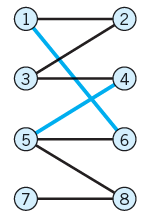
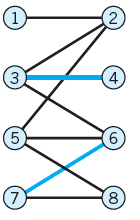
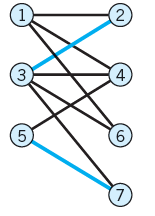
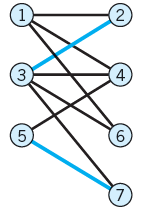
Using augmenting paths, find a maximum cardinality matching. (1) (3) 5 7 (2 (4) 6 (8)
What would be the answer to Prob. 22 if only the five ships S1, · · ·, S5 had to be accommodated?Data from Prob. 22How many piers does a harbor master need for accommodating six cruise ships with expected dates of arrival A and departure D in July, (A, D) = (10, 13), (13, 15), (16, 18), (14,
How many piers does a harbor master need for accommodating six cruise ships S1, · · ·, S6 with expected dates of arrival A and departure D in July, (A, D) = (10, 13), (13, 15), (16, 18), (14, 17), (12, 15), (16, 18), (14, 17), respectively, if each pier can accommodate only one ship, arrival
Company A has offices in Chicago, Los Angeles, and New York; Company B in Boston and New York; Company C in Chicago, Dallas, and Los Angeles. Represent this by a bipartite graph.
How many colors do you need for vertex coloring any tree?
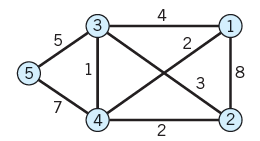
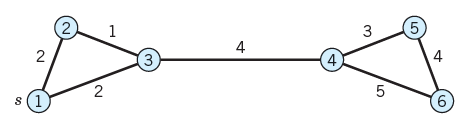
Find a shortest spanning tree. (5) 5 7 (3) 1 4 4 2 2 3 8 2)
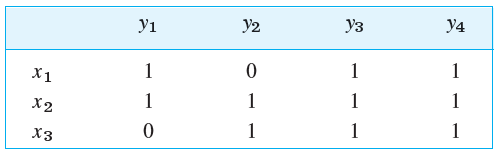
Three teachers x1, x2, x3 teach four classes y1, y2, y3, y4 for these numbers of periods: Show that this arrangement can be represented by a bipartite graph G and that a teaching schedule for one period corresponds to a matching in G. Set up a teaching schedule with the smallest possible number of
If a network has several sources s1, · · ·, sk, show that it can be reduced to the case of a single-source network by introducing a new vertex s and connecting s to s1, · · ·, sk, by k edges of capacity ∞. Similarly if there are several sinks. Illustrate this idea by a network with two
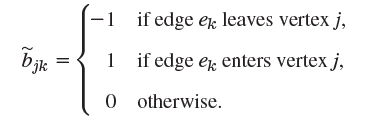
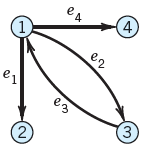
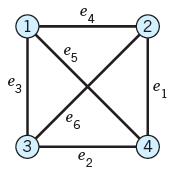
The definition is B? = [bjk], where Find the incidence matrix of the digraph in Prob. 11. Data from Prob. 11 Find the adjacency matrix of the given graph or digraph. bjk (-1 1 0 otherwise. if edge ek leaves vertex j, if edge ek enters vertex j, (1) e₁ N (2) 23 e4 e2 (4) (3)
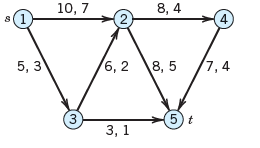
Find the maximum flow by inspection: 1 5, 3 10, 7 3 (2) 6, 2 3, 1 8,4 8,5 5) t 4 7,4
If two vertices in a tree are joined by a new edge, a cycle is formed.
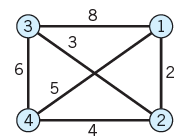
Find shortest paths by Dijkstra?s algorithm. (3) 6 4) 5 3 8 4 (1) 2 2
What is the smallest number of exam periods for six subjects α, b, c, d, e, f if some of the students simultaneously take α, b, f, some c, d, e, some α, c, e, and some c, e? Solve this as follows. Sketch a graph with six vertices α, · · ·, f and join vertices if they represent subjects
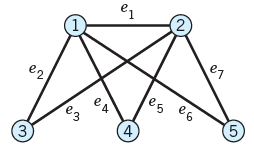
The definition is B = [bjk], where Find the incidence matrix of the graph in Prob. 8. Data from Prob. 8 Find the adjacency matrix of the given graph or digraph. bjk 1 if vertex j is an endpoint of edge ek, .0 otherwise. ег (3) (1) ез е1 (4) (2) les еб ет (5)
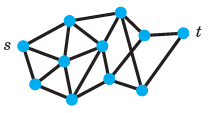
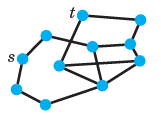
Find a shortest path and its length by Moore?s BFS algorithm, assuming that all the edges have length 1. S t
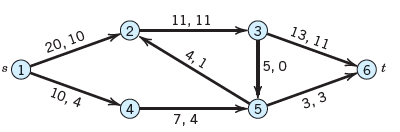
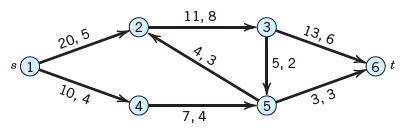
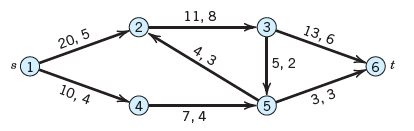
In Prob. 15, the cut set contains precisely all forward edges used to capacity by the maximum flow (Fig. 501). Is this just by chance? Data from Prob. 15 Find a minimum cut set in Fig. 500 and its capacity. s T 20, 10 10, 4 2 4) 11, 11 4,1 7,4 3 5,0 (5 13, 11 3,3 6 t (1) 20, 5 10, 4 2 4 11,8 4,3
In what case are all the off-diagonal entries of the adjacency matrix of a graph G equal to one?
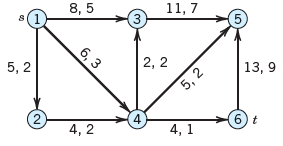
Find the maximum flow by inspection: s(1) 5, 2 (2) 8,5 6,3 4,2 3 4 11,7 2, 2 5, 2 4,1 5 13,9 6)t
A tree with exactly two vertices of degree 1 must be a path.
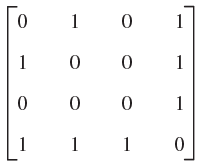
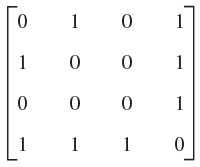
Make it for the graph in Prob. 15. Data from Prob. 15 Sketch the graph whose adjacency matrix is: 0 1 0 1 1 0 0 0 0 0 11 1 1 0
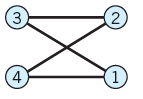
A planar graph is a graph that can be drawn on a sheet of paper so that no two edges cross. Show that the complete graph K4 with four vertices is planar. The complete graph K5 with five vertices is not planar. Make this plausible by attempting to draw K5 so that no edges cross. Interpret the result
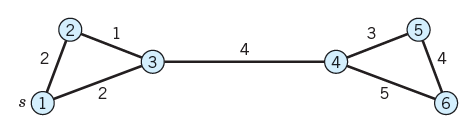
Is the graph in Fig. 484 an Euler graph. Give reason. 2 s (1 (2) 1 2 (3) 4 (4) 3 5 5 4 (6)
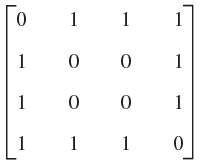
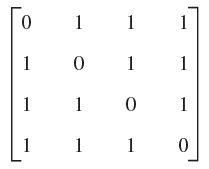
Fi Sketch the graph whose adjacency matrix is: 0 1 1 1 1 0 0 1 1 0 0 1 1 1 1 0
Find a minimum cut set in Fig. 500 and its capacity. (1) 20, 5 10, 4 2 4 11,8 4,3 7,4 (3) 5, 2 5 13,6 3,3 6t
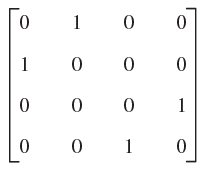
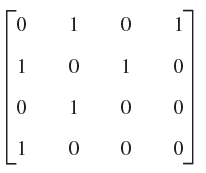
Sketch the graph for the given adjacency matrix. 0 1 0 0 1 0 0 0 0 0 0 1 1 0 0 1 0
An Euler graph G is a graph that has a closed Euler trail. An Euler trail is a trail that contains every edge of G exactly once. Which subgraph with four edges of the graph in Example 1,is an Euler graph?
Using augmenting paths, find a maximum cardinality matching:In Prob. 12Data from Prob. 12Find an augmenting path: (1) (3) (5) (7) (2) (4) (6) (8)
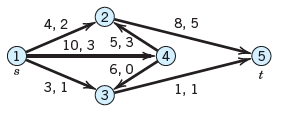
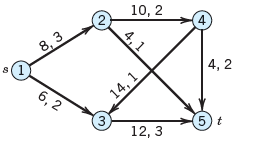
Find flow augmenting paths: 2) Co 4, 2 10,3 3, 1 (2) 5,3 6,0 (3) 8,5 1, 1 5
Prove the following.If in a graph any two vertices are connected by a unique path, the graph is a tree.Data from Prob. 14Prove the following.The path connecting any two vertices u and v in a tree is unique.
Sketch the graph for the given adjacency matrix. 0 1 0 1 1 0 1 0 0 1 0 0 0 0 0
Sketch the graph whose adjacency matrix is: 0 1 1 1 1 1 0 1 1 1 1 0 1 1 1 0
Sketch the graph whose adjacency matrix is: 0 1 0 1 1 0 0 0 0 0 11 1 1 0
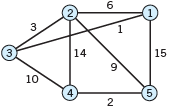
Find a shortest spanning tree by Prim?s algorithm. Write a program and apply it to Probs. 6. Data from Prob. 6 Find a shortest spanning tree by Prim?s algorithm. (3) 3 10 2 14 4) 6 1 9 2 5 15
Are the consecutive flow augmenting paths produced by Ford–Fulkerson unique?
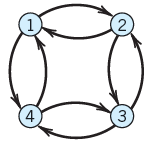
Find the adjacency matrix of: (1) (4) (2) (3)
Find flow augmenting paths: g (1) 8,3 6, 2 2 3 10, 2 4,1 14, 1 12, 3 4, 2 (5) t
Using augmenting paths, find a maximum cardinality matching:Data from Prob. 11Find an augmenting path: (1) im 3 (5) (2) 4 (6) (7)
The postman problem is the problem of finding a closed walk W: s?s (s the post office) in a graph G with edges (i, j) of length lij?> 0 such that every edge of G is traversed at least once and the length of W is minimum. Find a solution for the graph in Fig. 484 by inspection. (The problem is
How can you see that Ford–Fulkerson follows a BFS technique?
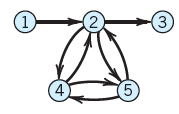
Find the adjacency matrix of the given graph or digraph. (1) (4) (2) (5) (3)
A (not necessarily connected) graph without cycles is called a forest. Give typical examples of applications in which graphs occur that are forests or trees.
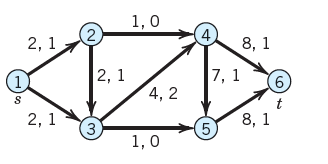
Write a program and apply it to Probs. 6?9. Data from Prob. 6 Find the maximum flow by Ford-Fulkerson: (1) SO (1 2, 1. S 2,1 2 2, 1 (3) 1,0 4, 2 1,0 4 8, 1 7,1 (6) 8, 1 LO 5
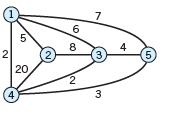
Find a shortest spanning tree by Prim?s algorithm. For the graph in Prob. 4 Data from Prob. 4 Find a shortest spanning tree by Kruskal?s algorithm. Sketch it. 2 5 20 4 (2) 6 8 Pol 2 7 (3) 3 4 5
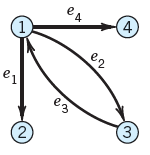
Find the adjacency matrix of the given graph or digraph. (1) e₁ N (2) 23 e4 e2 (4) (3)
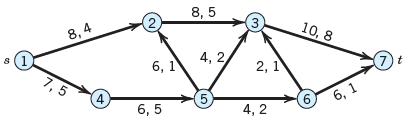
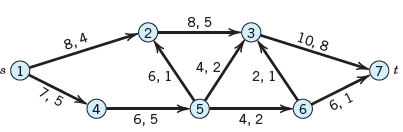
Which edges could be omitted from the network in Fig. 499 without decreasing the maximum flow? 8 (1) 8,4 7,5 4 2 6, 1 6, 5 8,5 4, 2 5 3 2, 1 4, 2 10, 8 6 6, 1 (7) t
Apply the algorithm in Prob. 10 to the graph in Example 1. Compare with the result in Example 1.Data from Prob. 10Design an algorithm for obtaining longest spanning trees.
Find the adjacency matrix of: (3) 4) (2) (1)
Find an augmenting path: (1) im 3 (5) (2) 4 (6) (7)
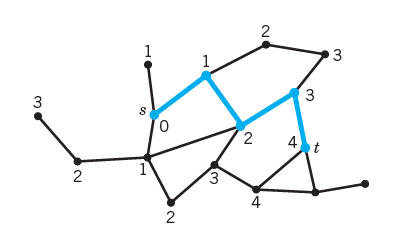
Find and sketch a Hamiltonian cycle in Prob. 1.Data from Prob. 1Find a shortest path P: s?t and its length by Moore?s algorithm. Sketch the graph with the labels and indicate P by heavier lines as in Fig. 482. S
Find the adjacency matrix of the given graph or digraph. (1) €3 (3) es es 5 €6 €2 (2) e. 4
Sketch the network in Fig. 499, and on each edge (i, j) write cij - fij and fij. Do you recognize that from this ?incremental network? one can more easily see flow augmenting paths? 1 8,4 7,5 4 2 6, 1 6,5 8,5 4, 2 (5) (3) 2, 1 4, 2 10, 8 6 6, 1 (7) t
What is BFS? DFS? In what connection did these concepts occur?
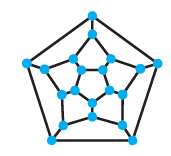
Find and sketch a Hamiltonian cycle in the graph of a dodecahedron, which has 12 pentagonal faces and 20 vertices (Fig. 483). This is a problem Hamilton himself considered.
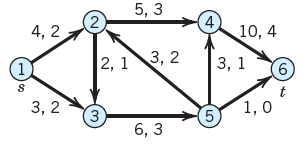
Find the maximum flow by Ford-Fulkerson: 4, 2 (1) S 3,2 (2) 2, 1 (3) 5, 3 3, 2 6,3 (4) 10, 4 3, 1 5) 1,0 (6)
This is just a sample of such ODEs; some more follow in the next problem set. Find a general solution in terms of Jv and J-v or indicate when this is not possible. Use the indicated substitutions. Show the details of your work.x2y" + xy' + 1/4 (x2 - 1)y = 0 (x = 2z)
Find a general solution in terms of Jv and Yv. Indicate whether you could also use J-v instead of Yv. Use the indicated substitution. Show the details of your work.y" + k2x2y = 0 (y = u√x, 1/2kx2 = z)
Apply the power series method. Do this by hand, not by a CAS, to get a feel for the method, e.g., why a series may terminate, or has even powers only, etc. Show the details.y' = -2xy
From what n on will your CAS no longer produce faithful graphs of Pn(x)? Why?
What is the hypergeometric equation? Where does the name come from?
This is just a sample of such ODEs; some more follow in the next problem set. Find a general solution in terms of Jv and J-v or indicate when this is not possible. Use the indicated substitutions. Show the details of your work.x2y" +1/4 (x + 3/4) y = 0 (y = u√x, √x = z)
Can a power series solution reduce to a polynomial? When? Why is this important?
Find a basis of solutions by the Frobenius method. Try to identify the series as expansions of known functions. Show the details of your work.xy" + (2x + 1)y' + (x + 1)y = 0
This is just a sample of such ODEs; some more follow in the next problem set. Find a general solution in terms of Jv and J-v or indicate when this is not possible. Use the indicated substitutions. Show the details of your work.Two-parameter ODEx2y" + xy' + (λ2x2 - v2)y = 0 (λx = z)
Find a general solution in terms of Jv and Yv. Indicate whether you could also use J-v instead of Yv. Use the indicated substitution. Show the details of your work.4xy" + 4y' + y = 0 (√x = z)
Determine the radius of convergence. Show the details of your work. 00 -m-0 2m x²
Write down the most important ODEs in this chapter from memory.
This is just a sample of such ODEs; some more follow in the next problem set. Find a general solution in terms of Jv and J-v or indicate when this is not possible. Use the indicated substitutions. Show the details of your work.y" + (e-2x - 1/9)y = 0 (e-x = z)
Determine the radius of convergence. Show the details of your work. m-0 2m+1 x (2m + 1)!
List the three cases of the Frobenius method, and give examples of your own.
Verify that the polynomials in (11') satisfy (1).
Find a basis of solutions by the Frobenius method. Try to identify the series as expansions of known functions. Show the details of your work.xy" + 2y' + xy = 0
This is just a sample of such ODEs; some more follow in the next problem set. Find a general solution in terms of Jv and J-v or indicate when this is not possible. Use the indicated substitutions. Show the details of your work.xy" + y' + 1/4y = 0 (√x = z)
Find a general solution in terms of Jv and Yv. Indicate whether you could also use J-v instead of Yv. Use the indicated substitution. Show the details of your work.9x2y" + 9xy' + (36x4 - 16)y = 0 (x2 = z)
What is the indicial equation? Why is it needed?
This is just a sample of such ODEs; some more follow in the next problem set. Find a general solution in terms of Jv and J-v or indicate when this is not possible. Use the indicated substitutions. Show the details of your work.x2y" + xy' + (x2 - 4/49)y = 0
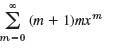
Determine the radius of convergence. Show the details of your work. Σ (m + 1)mxm m-0
What is the difference between the two methods in this chapter? Why do we need two methods?
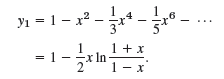
Show that (7) with n =1 gives y2(x) = P1(x) = x and (6) gives 3₁ = 1 = x²-x² 1 - x2 = 1 1 1+x 1- x x ln- 1
Show that (6) with n = 0 gives P0(x) = 1 and (7) gives (use ln (1 + x) = x - 1/2x2 + 1/3x3 + ....) Verify this by solving (1) with n = 0, setting z = y' and separating variables. 32(x)=x+ 228 +20+ x+ = 글 In 1+x 1-x
Write a report of 2–3 pages explaining the difference between the two methods. No proofs. Give simple examples of your own.
Show that the series (11) converges for all x. Why is the convergence very rapid?
Find a general solution in terms of Jv and Yv. Indicate whether you could also use J-v instead of Yv. Use the indicated substitution. Show the details of your work.x2y" + xy' + (x2 - 16) y = 0
(a) Write a review (2–3 pages) on power series in calculus. Use your own formulations and examples—do not just copy from textbooks. No proofs. (b) Collect and arrange Maclaurin series in a systematic list that you can use for your work.
Why are we looking for power series solutions of ODEs?
Find the location and kind of all critical points of the given nonlinear system by linearization.y'1 = -4y2y'2 = sin y1
Find the location and kind of all critical points of the given nonlinear system by linearization.y'1 = y2y'2 = y1 - y13
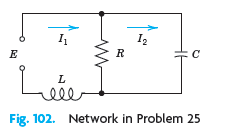
Find the currents in Fig. 102 when R = 2.5 ?, L = 1 H, C = 0.04 F, E(t) = 169 sin t V, I1(0) = 0, I2(0) = 0. E 1₁ R 1₂ с L еее Fig. 102. Network in Problem 25
Find a general solution. Show the details of your work.y'1 = y1 + 4y2 - 2 cos ty'2 = y1 + y2 - cos t + sin t
Find a general solution. Show the details of your work.y'1 = 4y2y'2 = 4y1 + 32t2
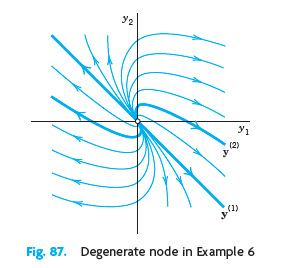
Graph some of the figures in this section, in particular Fig. 87 on the degenerate node, in which the vector y(2) depends on t. In each figure highlight a trajectory that satisfies an initial condition of your choice. 32 3/1 Fig. 87. Degenerate node in Example 6
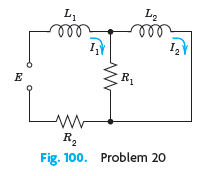
Find the currents in Fig. 100 (Prob. 20) for the following data, showing the details of your work. R1 = 1 ?, R2 = 1.4 ?, L1 = 0.8 H, L2?= 1 H, E = 100 V, I1(0) = I2(0) = 0 E L₁ m 1₂V R₁ L₂ m www R₂ Fig. 100. Problem 20
Stability concepts are basic in physics and engineering. Write a two-part report of 3 pages each (A) on general applications in which stability plays a role (be as precise as you can), and (B) on material related to stability in this section. Use your own formulations and examples; do not copy.
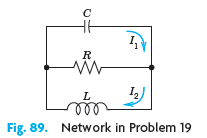
Show that a model for the currents I1(t) and I2(t) in Fig. 89 is Find a general solution, assuming that R = 3 ?, L = 4 H, C = 1/12 F. 히 [dt + R(I1 - Iz) = 0, LI2 + R(Iz - Ii) = 0. - = с 46 R www I L 000 Fig. 89. Network in Problem 19
What kind of critical point does y' = Ay have if A has the eigenvalues2 + 3i, 2 - 3i
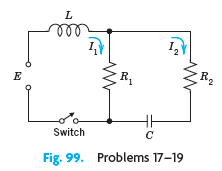
Find the currents in Fig. 99 (Probs. 17?19) for the following data, showing the details of your work. In Prob. 17 find the particular solution when currents and charge at t = 0 are zero. Data from Prob. 17 R1 = 2 ?, R2 = 8 ?, L = 1 H, C = 0.5 F, E = 200 V E L m IV R₁ Switch Fig. 99. Problems
Graph phase portraits for the systems in Prob. 17 with the values of b suggested in the answer. Try to illustrate how the phase portrait changes “continuously” under a continuous change of b.Data from Prob. 17The system in Example 4 in Sec. 4.3 has a center as its critical point. Replace each
Determine the type and stability of the critical point. Then find a real general solution and sketch or graph some of the trajectories in the phase plane. Show the details of your work.y'1 = -2y1 + 2y2y'2 = -2y1 – 2y2
How can you transform an ODE into a system of ODEs?
Showing 2000 - 2100
of 3937
First
14
15
16
17
18
19
20
21
22
23
24
25
26
27
28
Last
Step by Step Answers

 Get 50% OFF
Claim Now
Get 50% OFF
Claim Now