New Semester
Started
Get
50% OFF
Study Help!
--h --m --s
Claim Now
Question Answers
Textbooks
Find textbooks, questions and answers
Oops, something went wrong!
Change your search query and then try again
S
Books
FREE
Study Help
Expert Questions
Accounting
General Management
Mathematics
Finance
Organizational Behaviour
Law
Physics
Operating System
Management Leadership
Sociology
Programming
Marketing
Database
Computer Network
Economics
Textbooks Solutions
Accounting
Managerial Accounting
Management Leadership
Cost Accounting
Statistics
Business Law
Corporate Finance
Finance
Economics
Auditing
Tutors
Online Tutors
Find a Tutor
Hire a Tutor
Become a Tutor
AI Tutor
AI Study Planner
NEW
Sell Books
Search
Search
Sign In
Register
study help
mathematics
advanced engineering mathematics
Advanced Engineering Mathematics 10th edition Erwin Kreyszig - Solutions
What is population dynamics? Give examples.
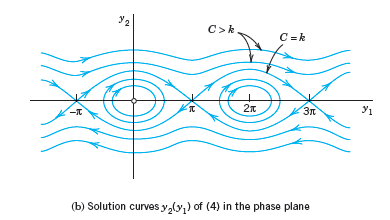
To what state (position, speed, direction of motion) do the four points of intersection of a closed trajectory with the axes in Fig. 93b correspond? The point of intersection of a wavy curve with the y2-axis? 32 T C>k. 2t C=k 3r (b) Solution curves y₂(₁) of (4) in the phase plane 31
Determine the type and stability of the critical point. Then find a real general solution and sketch or graph some of the trajectories in the phase plane. Show the details of your work.y'1 = y2y'2 = 2y2
Find a real general solution of the following systems. Show the details.y'1 = y1 + y2y'2 = 3y1 - y2
State some applications that can be modeled by systems of ODEs.
Solve the IVP. Show the details of your work.(D3 + 9D2 + 23D + 15I)y = 12exp(-4x), y(0) = 9, Dy(0) = -41, D2y(0) = 189
Solve the IVP. Show the details of your work.y"' + 5y" + 24y' + 20y = x, y(0) = 1.94, y'(0) = -3.95, y" = -24
Starting with a basis, find third-order linear ODEs with variable coefficients for which the reduction to second order turns out to be relatively simple.
Solve the given ODE. Show the details of your work.4x3y"' + 3xy' - 3y = 10
Write a report on the method of undetermined coefficients and the method of variation of parameters, discussing and comparing the advantages and disadvantages of each method. Illustrate your findings with typical examples. Try to show that the method of undetermined coefficients, say, for a
Solve the IVP by a CAS, giving a general solution and the particular solution and its graph.yiv + 0.45y"' - 0.165y" + 0.0045y' - 0.00175y = 0, y(0) = 17.4, y' (0) = -2.82, y" (0) = 2.0485, y"' (0) = -1.458675
Solve the given ODE. Show the details of your work.(D3 + 6D2 + 12D + 8I)y = 8x2
Are the given functions linearly independent or dependent on the half-axis x > 0? Give reason.sin x, cos x, sin 2x
Solve the given IVP, showing the details of your work.(D3 - 4D)y = 10 cos x + 5 sin x, y(0) = 3, y' (0) = -2, y" (0) = -1
Solve the IVP by a CAS, giving a general solution and the particular solution and its graph.yv - 5y"' + 4y' = 0, y(0) = 3, y' (0) = -5, y" (0) = 11, y"' (0) = -23, yiv (0) = 47
Solve the IVP by a CAS, giving a general solution and the particular solution and its graph.yiv - 9y" - 400y = 0, y(0) = 0, y' (0) = 0, y" (0) = 41, y "' (0) = 0
Solve the given ODE. Show the details of your work.y"' + 4.5y" + 6.75y' + 3.375y = 0
Are the given functions linearly independent or dependent on the half-axis x > 0? Give reason.ex cos x, ex sin x, ex
Solve the given IVP, showing the details of your work.(D3 - 2D2 - 3D)y = 74e-3x sin x, y(0) = -1.4, y' (0) = 3.2, y" (0) = -5 .2
Solve the IVP by a CAS, giving a general solution and the particular solution and its graph.yiv + 4y = 0, y(0) = 1/2, y' (0) = -3/2, Y" (0) = 5/2, y"' (0) = -7/2
Solve the IVP by a CAS, giving a general solution and the particular solution and its graph.4y"' + 8y" + 41y' + 37y = 0, y(0) = 9, y' (0) = -6.5, y" (0) = -39.75
Solve the given ODE. Show the details of your work.(D4 - 16I)y = 15 cosh x
Are the given functions linearly independent or dependent on the half-axis x > 0? Give reason.tan x, cot x, 1
Solve the given IVP, showing the details of your work.yiv + 5y" + 4y = 90 sin 4x, y(0) = 1, y' (0) = 2, y" (0) = - 1, y"' (0) = -32
Solve the IVP by a CAS, giving a general solution and the particular solution and its graph.y"' + 7.5y" + 14.25y' - 9.125y = 0, y(0) = 10.05, y' (0) = -54.975, y" (0) = 257.5125
Solve the IVP by a CAS, giving a general solution and the particular solution and its graph.y"' + 3.2y" + 4.81y' = 0, y(0) = 3.4, y' (0) = -4.6, y" (0) = 9.91
These properties are important in obtaining new solutions from given ones. Therefore extend Team Project 38 in Sec. 2.2 to nth-order ODEs. Explore statements on sums and multiples of solutions of (1) and (2) systematically and with proofs. Recognize clearly that no new ideas are needed in this
Solve the following ODEs, showing the details of your work.(D3 - 9D2 + 27D - 27I)y = 27 sin 3x
To get a feel for higher order ODEs, show that the given functions are solutions and form a basis on any interval. Use Wronskians. In Prob. 6, x > 0,1, x2, x4, x2y"' - 3xy" + 3y' = 0
Solve the given ODE. Show the details of your work.(D4 + 10D2 + 9l) y = 0
What is the Wronskian? What is it used for?
To get a feel for higher order ODEs, show that the given functions are solutions and form a basis on any interval. Use Wronskians. In Prob. 6, x > 0,1, e-x cos 2x, e-x sin 2x, y"' + 2y" + 5y' = 0
Solve the following ODEs, showing the details of your work.(x3D3 + x2D2 - 2xD + 2I)y = x-2
What form does an initial value problem for an nth order linear ODE have?
To get a feel for higher order ODEs, show that the given functions are solutions and form a basis on any interval. Use Wronskians. In Prob. 6, x > 0,e-4x, xe-4x, x2e-4x, y"' + 12y" + 48y' + 64y = 0
Solve the given ODE. Show the details of your work.yiv + 4y" = 0
If you know a general solution of a homogeneous linear ODE, what do you need to obtain from it a general solution of a corresponding nonhomogeneous linear ODE?
To get a feel for higher order ODEs, show that the given functions are solutions and form a basis on any interval. Use Wronskians. In Prob. 6, x > 0,cos x, sin x, x cos x, x sin x, yiv + 2y" + y = 0
Solve the following ODEs, showing the details of your work.(D4 + 10D2 + 9I)y = 6.5 sinh 2x
List some other basic theorems that extend from second-order to nth-order ODEs.
To get a feel for higher order ODEs, show that the given functions are solutions and form a basis on any interval. Use Wronskians. In Prob. 6, x > 0,ex, e-x, e2x, y"' - 2y" - y' + 2y = 0
Solve the given ODE. Show the details of your work.y"' + 25y' = 0
What is the superposition or linearity principle? For what nth-order ODEs does it hold?
To get a feel for higher order ODEs, show that the given functions are solutions and form a basis on any interval. Use Wronskians. In Prob. 6, x > 0,1, x, x2, x3, yiv = 0
Solve the following ODEs, showing the details of your work.y"' + 3y" + 3y' + y = ex - x - 1
Solve y" - y = 0 for the initial conditions y(0) = 1, y'(0) = -1. Then change the initial conditions to y(0) = 1.001, y' (0) = -0.999 and explain why this small change of 0.001 at t = 0 causes a large change later, e.g., 22 at t = 10. This is instability: a small initial difference
Find a real general solution of the following systems. Show the details.y'1 = y1 + 2y2y'2 = 1/2y1 + y2
Determine the type and stability of the critical point. Then find a real general solution and sketch or graph some of the trajectories in the phase plane. Show the details of your work.y'1 = y2y'2 = -9y1
Convert the van der Pol equation to a system. Graph the limit cycle and some approaching trajectories for μ = 0.2, 0.4, 06, 0.8, 1.0, 1.5, 2.0. Try to observe how the limit cycle changes its form continuously if you vary μ continuously. Describe in words how the limit cycle is deformed with
Find a general solution. Show the details of your work.y'1 = y2 + e3ty'2 = y1 - 3e3t
What are qualitative methods for systems? Why are they important?
What is the phase plane? The phase plane method? A trajectory? The phase portrait of a system of ODEs?
Find a real general solution of the following systems. Show the details.y'1 = 2y1 + 5y2y'2 = 5y1 + 12.5y2
Find the location and type of all critical points by linearization. Show the details of your work.y'1 = y2y2' = -y1 + 1/2y21
Find a general solution. Show the details of your work.y'1 = 4y1 + y2 + 0.6ty'2 = 2y1 + 3y2 - 2.5t
What are critical points of a system of ODEs? How did we classify them? Why are they important?
What are eigenvalues? What role did they play in this chapter?
Find a real general solution of the following systems. Show the details.y'1 = y2y'2 = -y1 + y3y'3 = -y'2
Determine the type and stability of the critical point. Then find a real general solution and sketch or graph some of the trajectories in the phase plane. Show the details of your work.y'1 = y1 + 2y2y'2 = 2y1 + y2
Find the location and type of all critical points by linearization. Show the details of your work.y1' = -y1 + y2 - y22y2' = -y1 - y2
Find a general solution. Show the details of your work.y'1 = -3y1 - 4y2 + 11t + 15y'2 = 5y1 + 6y2 + 3e-t - 15t - 20
What does stability mean in general? In connection with critical points? Why is stability important in engineering?
Find out experimentally how general you must choose y(p), in particular when the components of g have a different form (e.g., as in Prob. 7). Write a short report, covering also the situation in the case of the modification rule.Data form Prob. 7y'1 = -3y1 - 4y2 + 11t + 15y'2 = 5y1 + 6y2 + 3e-t -
What does linearization of a system mean?
Find a real general solution of the following systems. Show the details.y'1 = 10y1 - 10y2 - 4y3y'2 = -10y1 + y2 - 14y3y'3 = -4y1 - 14y2 - 2y3
Determine the type and stability of the critical point. Then find a real general solution and sketch or graph some of the trajectories in the phase plane. Show the details of your work.y'1 = 4y1 + y2y'2 = 4y1 + 4y2
Find the location and type of all critical points by first converting the ODE to a system and then linearizing it.y" - 9y + y3 = 0
Review the pendulum equations and their linearizations.
Solve, showing details:y'1 = y2 + 6e2ty'2 = y1 - e2ty1(0) = 1, y2(0) = 0
Find a general solution. Determine the kind and stability of the critical point.y'1 = 2y2y'2 = 8y1
Solve the following initial value problems.y'1 = 2y1 + 5y2Y'2 = -1/2y1 -3/2y2y1(0) = -12, y2(0) = 0
Solve y" + 2y' + 2y = 0. What kind of curves are the trajectories?
Find the location and type of all critical points by first converting the ODE to a system and then linearizing it.y" + cos y = 0
Find a general solution of the given ODE (a) by first converting it to a system, (b), as given. Show the details of your work.4y" - 15y' - 4y = 0
Solve, showing details:y'1 = y2 - 5 sin ty'2 = -4y1 + 17 cos ty1(0) = 5, y2(0) = 2
Find a general solution. Determine the kind and stability of the critical point.y'1 = -2y1 + 5y2y'2 = -y1 - 6y2
Solve the following initial value problems.y'1 = y2y'2 = y1y1(0) = 0, y2(0) = 2
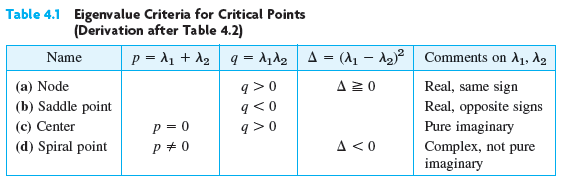
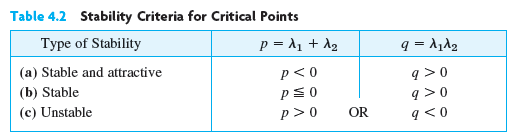
Discuss the critical points in (10)?(13) of Sec. 4.3 by using Tables 4.1 and 4.2. Table 4.1 Eigenvalue Criteria for Critical Points (Derivation after Table 4.2) Name (a) Node (b) Saddle point (c) Center (d) Spiral point p = λ₁ + λ₂ q = λ₁λ₂ A = (λ₁ - ₂)² Comments on A₁, A₂
Find the location and type of all critical points by first converting the ODE to a system and then linearizing it.y" + sin y = 0
Find a general solution of the given ODE (a) by first converting it to a system, (b), as given. Show the details of your work.y" + 2y' - 24y = 0
(a) In Example 2 choose a sequence of values of C that increases beyond bound, and compare the corresponding sequences of eigenvalues of A. What limits of these sequences do your numeric values (approximately) suggest?(b) Find these limits analytically.(c) Explain your result physically.(d) Below
Solve, showing details:y'1 = y1 + 2y2 + e2t - 2ty'2 = -y2 + 1 + ty1(0) = 1, y2(0) = -4
Find a general solution. Determine the kind and stability of the critical point.y'1 = -3y1 - 2y2y'2 = -2y1 - 3y2
Solve the following initial value problems.y'1 = 3y1 + 2y2y'2 = 2y1 + 3y2y1(0) = 0.5, y2(0) = -0.5
What happens in Example 4 of Sec. 4.3 if you change A to A + 0.1I, where I is the unit matrix?
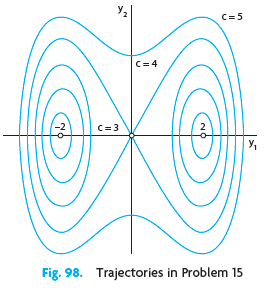
Write the y" - 4y + y3 = 0 as a system, solve it for y2 as a function of y1, and sketch or graph some of the trajectories in the phase plane. -2 C = 3 C = 4 ON 2 C=5 Fig. 98. Trajectories in Problem 15 Y
Write a short report in which you compare the application of the method of undetermined coefficients to a single ODE and to a system of ODEs, using ODEs and systems of your choice.
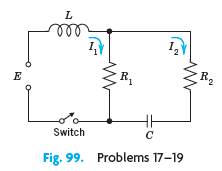
Find the currents in Fig. 99 (Probs. 17?19) for the following data, showing the details of your work. R1 = 2 ?, R2 = 8 ?, L = 1 H, C = 0.5 F, E = 200 V E L m IV R₁ Switch Fig. 99. Problems 17-19 с R₂
Find a general solution. Determine the kind and stability of the critical point.y'1 = -y1 + 2y2y'2 = -2y1 - y2
Show that F (y, y', y'') = 0 can be reduced to a first-order ODE with y as the independent variable and y'' = (dz/dy)z, where z = y'; derive this by the chain rule. Give two examples.
Find the Wronskian. Show linear independence by using quotients and confirm it by Theorem 2.e4.0x, e-1.5x
Find a general solution. Show the details of your calculation.(4D2 - 12D + 9I)y = 2e1.5x
Find a general solution. Show the details of your calculation.(x2D2 + 2xD – 12I)y = 0
Find a general solution. Show the details of your calculation.(2D2 - 3D - 2I)y = 13 - 2x2
What are the conditions for an RLC-circuit to be (I) overdamped, (II) critically damped, (III) underdamped? What is the critical resistance Rcrit (the analog of the critical damping constant 2√mk)?
(a) Verify that the given functions are linearly independent and form a basis of solutions of the given ODE. (b) Solve the IVP. Graph or sketch the solution.4y'' + 25y = 0y(0) = 3.0y' (0) = -2.5cos 2.5 xsin 2.5x
Solve and graph the solution. Show the details of your work.x2y" + 3xy' + y = 0, y(1) = 3.6, y' (1) = 0.4
Solve the initial value problem. State which rule you are using. Show each step of your calculation in detail.(x2D2 - 3xD + 3I)y = 3 ln x - 4, y(1) = 0, y' (1) = 1; yp = ln x
(a) Find a second-order homogeneous linear ODE for which the given functions are solutions. (b) Show linear independence by the Wronskian. (c) Solve the initial value problem.cosh 1.8x, sinh 1.8x, y(0) = 14.20, y' (0) = 16.38
Find the transient motion of the mass–spring system modeled by the ODE. Show the details of your work.(D2 + 4D + 8I)y = 2 cos 2t + sin 2t
Showing 2100 - 2200
of 3937
First
15
16
17
18
19
20
21
22
23
24
25
26
27
28
29
Last
Step by Step Answers

 Get 50% OFF
Claim Now
Get 50% OFF
Claim Now