New Semester
Started
Get
50% OFF
Study Help!
--h --m --s
Claim Now
Question Answers
Textbooks
Find textbooks, questions and answers
Oops, something went wrong!
Change your search query and then try again
S
Books
FREE
Study Help
Expert Questions
Accounting
General Management
Mathematics
Finance
Organizational Behaviour
Law
Physics
Operating System
Management Leadership
Sociology
Programming
Marketing
Database
Computer Network
Economics
Textbooks Solutions
Accounting
Managerial Accounting
Management Leadership
Cost Accounting
Statistics
Business Law
Corporate Finance
Finance
Economics
Auditing
Tutors
Online Tutors
Find a Tutor
Hire a Tutor
Become a Tutor
AI Tutor
AI Study Planner
NEW
Sell Books
Search
Search
Sign In
Register
study help
mathematics
advanced engineering mathematics
Advanced Engineering Mathematics 10th edition Erwin Kreyszig - Solutions
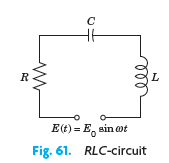
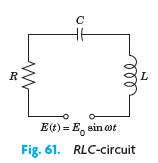
Solve the initial value problem for the RLC circuit in Fig. 61 with the given data, assuming zero initial current and charge. Graph or sketch the solution. Show the details of your work. R = 6 ?, L = 1 H, C = 0.04 F, E = 600 (cos t + 4 sin t) V R с E (t) = Esin cot Fig. 61. RLC-circuit L
(a) Verify that the given functions are linearly independent and form a basis of solutions of the given ODE. (b) Solve the IVP. Graph or sketch the solution.4x2y'' - 3y = 0y(1) = -3y' (1) = 0x3/2x-1/2
(a) Verify that the given functions are linearly independent and form a basis of solutions of the given ODE. (b) Solve the IVP. Graph or sketch the solution.y'' + 2y' + 2y = 0y(0) = 0y' (0) = 15e-x cos xe-x sin x
Solve and graph the solution. Show the details of your work.(x2D2 - xD - 15I)y = 0, y(1) = 0.1, y' (1) = -4.5
Find an ODE y" + ay' + by = 0 for the given basis.e(-2 +i)x, e(-2-i)x
Find the motion of the mass–spring system modeled by the ODE and the initial conditions. Sketch or graph the solution curve. In addition, sketch or graph the curve of y - yp to see when the system practically reaches the steady state.(D2 + 2D + 2I)y = e-t/2,
Solve the problem, showing the details of your work. Sketch or graph the solution.(x2D2 + xD - I)y = 16x3, y(1) = - 1, y' (1) = 1
Solve the IVP. Check that your answer satisfies the ODE as well as the initial conditions. Show the details of your work.y" + 25y = 0y(0) = 4.6y' (0) = -1.2
Derive the formula after (12) from (12). Can we have beats in a damped system?
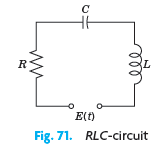
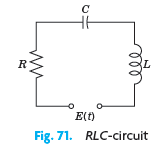
Find the steady-state current in the RLC-circuit in Fig. 71 when R = 2 k? (2000 ?), L = 1 H, C = 4 ? 10-3 F, and E = 110 sin 415t V (66 cycles/sec). R C rele L E(t) Fig. 71. RLC-circuit
Solve the IVP. Check that your answer satisfies the ODE as well as the initial conditions. Show the details of your work.y" + y' - 6y = 0y(0) = 10y' (0) = 0
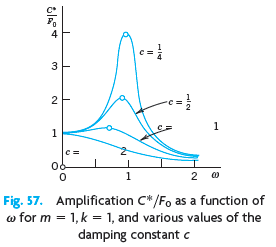
(a) Derive, in detail, the crucial formula (16). (b) By considering dC*/dc show that C* (?max) increase as c ( ?2mk) decreases. (c) Illustrate practical resonance with an ODE of your own in which you vary c, and sketch or graph corresponding curves as in Fig. 57. (d) Take your ODE with c fixed and
Find the steady-state current in the RLC-circuit in Fig. 71 when R = 50 ?, L = 30 H, C = 0.025 F, E = 200 sin 4t V. R C rele L E(t) Fig. 71. RLC-circuit
Solve the IVP. Check that your answer satisfies the ODE as well as the initial conditions. Show the details of your work.The ODE in Prob. 15y" + 0.54y' + (0.0729 + π)y = 0y(0) = 0y' (0) = 1
Solve the IVP. Check that your answer satisfies the ODE as well as the initial conditions. Show the details of your work.y" - y = 0y(0) = 2y' (0) = -2
Solve the IVP. Check that your answer satisfies the ODE as well as the initial conditions. Show the details of your work.The ODE in Prob. 5y" + 2πy' + π2y = 0y(0) = 4.5y' (0) = -4.5π - 1 = 13.137
Find an electrical analog of the mass–spring system with mass 4 kg, spring constant 10 Kg/sec2, damping constant 20 kg/sec, and driving force 100 sin 4t nt.
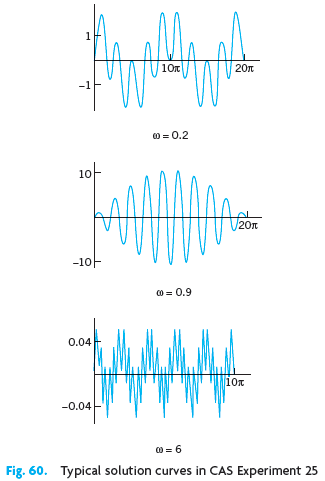
(a) Solve the initial value problem y" + y = cos ?t, ?2 ? 1, y(0) = 0, y' (0) = 0. Show that the solution can be written (b) Experiment with the solution by changing ? to see the change of the curves from those for small ? (>0) to beats, to resonance, and to large values of ? (see Fig. 60). y
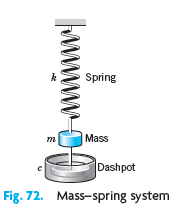
Show that the system in Fig. 72 with m = 4, c = 0, k = 36, and driving force 61 cos 3.1t exhibits beats. Choose zero initial conditions. m Spring Mass Dashpot Fig. 72. Mass-spring system
Linear Independence is of basic importance, in this chapter, in connection with general solutions, as explained in the text. Are the following functions linearly independent on the given interval? Show the details of your work.ekx, xekx, any interval
Solve and graph the solution. Show the details of your work.(x2D2 + xD + I)y = 0, y(1) = 1, y' (1) = 1
Solve the initial value problem. State which rule you are using. Show each step of your calculation in detail.(D2 + 0.2D + 0.26I)y = 1.22e0.5x, y(0) = 3.5, y' (0) = 0.35
Find an ODE y" + ay' + by = 0 for the given basis.e-√5xxe-√5x
Find the motion of the mass–spring system modeled by the ODE and the initial conditions. Sketch or graph the solution curve. In addition, sketch or graph the curve of y - yp to see when the system practically reaches the steady state.(D2+ 4I)y = sin t + 1/3 sin 3t + 1/5 sin 5t, y(0) = 0, y'
Determine the values of t corresponding to the maxima and minima of the oscillation y(t) = e-t sin t. Check your result by graphing y(t).
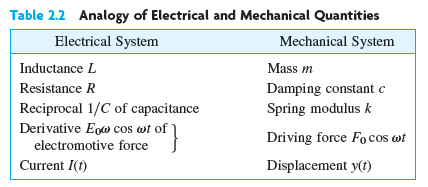
Explain Table 2.2 in a 1?2 page report with examples, e.g., the analog (with L = 1 H) of a mass?spring system of mass 5 kg, damping constant 10 kg/sec, spring constant 60 kg/sec2, and driving force 220 cos 10t kg/sec. Table 2.2 Analogy of Electrical and Mechanical Quantities Electrical System
Solve the problem, showing the details of your work. Sketch or graph the solution.y" + 16y = 17ex, y(0) = 6, y' (0) = -2
Find a general solution. Show the details of your calculation.(100D2 - 160D + 64I)y = 0
Find the steady-state current in the RLC-circuit in Fig. 61 for the given data. Show the details of your work. R = 12, L = 1.2 H, C = 20/3 ? 10-3?F, E = 12,000 sin 25t V R с E(t) = Esin cot RLC-circuit Fig. 61. L
If, in the motion of a small body on a straight line, the sum of velocity and acceleration equals a positive constant, how will the distance y(t) depend on the initial velocity and position?
Solve and graph the solution. Show the details of your work.x2y" + 3xy' + 0.75y = 0, y(1) = 1, y' (1) = -1.5
Find the critical motion (8) that starts from y0 with initial velocity v0. Graph solution curves for α = 1, y0 = 1 and several v0 such that (i) the curve does not intersect the t-axis, (ii) it intersects it at t = 1, 2, . . . . ., 5, respectively.
(a) Find a second-order homogeneous linear ODE for which the given functions are solutions. (b) Show linear independence by the Wronskian. (c) Solve the initial value problem.1 , e-2x, y(0) = 1, y' (0) = -1
Find the transient motion of the mass–spring system modeled by the ODE. Show the details of your work.(D2+ I)y = cos ωt, ω2 ≠ 1
Solve the given nonhomogeneous linear ODE by variation of parameters or undetermined coefficients. Show the details of your work.(x2D2 + xD - 9I)y = 48x5
Illustrate the linearity of L in (2) by taking c = 4, k = -6, y = e2x, and w = cos 2x. Prove that L is linear.
Find a general solution. Show the details of your calculation.y" + 6y' + 34y = 0
Find the transient motion of the mass–spring system modeled by the ODE. Show the details of your work.y" + 3y' + 3.25y = 3 cos t - 1.5 sin t
(a) Find a second-order homogeneous linear ODE for which the given functions are solutions.(b) Show linear independence by the Wronskian.(c) Solve the initial value problem.cos 5x, sin 5x, y(0) = 3, y' (0) = -5
Solve the given nonhomogeneous linear ODE by variation of parameters or undetermined coefficients. Show the details of your work.(D2 - 2D + l)y = 35x3/2 ex
Find a (real) general solution. State which rule you are using. Show each step of your work.(D2 – 16I)y = 9.6e4x + 30ex
Apply the given operator to the given functions. Show all steps in detail.(D2 - 4.20D + 4.4I/)y = 0
Find a real general solution. Show the details of your work.(x2D2 - 3xD + 10I)y = 0
Find a real general solution. Show the details of your work.(x2D2 - 0.2xD + 0.36I)y = 0
In tuning a stereo system to a radio station, we adjust the tuning control (turn a knob) that changes C (or perhaps L) in an RLC-circuit so that the amplitude of the steady-state current (5) becomes maximum. For what C will this happen?
Reduce to first order and solve, showing each step in detail.y'' + y'3 sin y = 0
Find a general solution. Show the details of your calculation.4y" + 32y' + 63y = 0
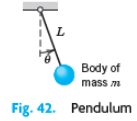
Find the frequency of oscillation of a pendulum of length L (Fig. 42), neglecting air resistance and the weight of the rod, and assuming ? to be so small that sin ? practically equals ?. L. Body of mass m Fig. 42. Pendulum
Find the steady-state motion of the mass–spring system modeled by the ODE. Show the details of your work.(4D2 + 12D + 9I)y = 225 - 75 sin 3t
Solve the given nonhomogeneous linear ODE by variation of parameters or undetermined coefficients. Show the details of your work.(D2 - 4D + 4I)y = 6e2x/x4
Find a (real) general solution. State which rule you are using. Show each step of your work.(D2 + 2D + 3/4l)y = 3ex + 9/2x
Apply the given operator to the given functions. Show all steps in detail.(4D2 - l)y = 0
Find a real general solution. Show the details of your work.(x2D2 - 4xD + 6I)y = C
What do you know about existence and uniqueness of solutions of linear second-order ODEs?
What is resonance? How can you remove undesirable resonance of a construction, such as a bridge, a ship, or a machine?
Describe applications of ODEs in mechanical systems. What are the electrical analogs of the latter?
Reduce to first order and solve, showing each step in detail.y'' + y' = 0
By what methods can you get a general solution of a nonhomogeneous ODE from a general solution of a homogeneous one?
How does the frequency of the harmonic oscillation change if we (i) double the mass, (ii) take a spring of twice the modulus? First find qualitative answers by physics, then look at formulas.
Find the steady-state motion of the mass–spring system modeled by the ODE. Show the details of your work.y" + 6y' + 8y = 42.5 cos 2t
Solve the given nonhomogeneous linear ODE by variation of parameters or undetermined coefficients. Show the details of your work.x2y" – 2xy' + 2y = x3 sin x
Find a (real) general solution. State which rule you are using. Show each step of your work.y" + 3y' + 2y = 12x2
Apply the given operator to the given functions. Show all steps in detail.(D - 2I)2; e2x, xe2x, e-2x
Find a real general solution. Show the details of your work.5x2y" + 23xy' + 16.2y = 0
What does an initial value problem of a second-order ODE look like? Why must you have a general solution to solve it?
Show that F (x, y', y'') = 0 can be reduced to first order in z = y' (from which y follows by integration). Give two examples of your own.
Why are linear ODEs preferable to nonlinear ones in modeling? What does an initial value problem of a second-order ODE look like? Why must you have a general solution to solve it?
Find the harmonic motion (4) that starts from y0 with initial velocity v0. Graph or sketch the solutions for ω0 = π, y0 = 1, and various v0 of your choice on common axes. At what t-values do all these curves intersect? Why?
Find a general solution. Check your answer by substitution. ODEs of this kind have important applications to be discussed in Secs. 2.4, 2.7, and 2.9.4y" - 25y = 0
Solve the given nonhomogeneous linear ODE by variation of parameters or undetermined coefficients. Show the details of your work.y" + 9y = sec 3x
Find a (real) general solution. State which rule you are using. Show each step of your work.y" + 5y' + 4y = 10e-3x
Apply the given operator to the given functions. Show all steps in detail.D2 + 2D; cosh 2x, e-x + e2x, cos x
Verify directly by substitution that x(1-a)/2 ln x is a solution of (1) if (2) has a double root, but xm1 and xm2 ln x are not solutions of (1) if the roots m1 and m2 of (2) are different.
If in a population y(t) the death rate is proportional to the population, and the birth rate is proportional to the chance encounters of meeting mates for reproduction, what will the model be? Without solving, find out what will eventually happen to a small initial population. To a large one. Then
In Prob. 36 find and graph the solution satisfying y(0) = 2 when (for simplicity) A = B = 1 and H = 0.2. What is the limit? What does it mean? What if there were no fishing?Data from Prob. 36Suppose that the population y(t) of a certain kind of fish is given by the logistic equation (11), and fish
Lake Erie has a water volume of about 450 km3 and a flow rate (in and out) of about 175 km2 per year. If at some instant the lake has pollution concentration p = 0.04%, how long, approximately, will it take to decrease it to p/2, assuming that the inflow is much cleaner, say, it has pollution
A CAS can usually graph solutions, even if they are integrals that cannot be evaluated by the usual analytical methods of calculus.(a) Show this for the five initial value problems y' = e-x2, y(0) = 0, +1, +2, graphing all five curves on the same axes.(b) Graph approximate solution curves, using
Find and solve the model for drug injection into the bloodstream if, beginning at t = 0, a constant amount A g/min is injected and the drug is simultaneously removed at a rate proportional to the amount of the drug present at time t.
If the temperature of a cake is 300°F when it leaves the oven and is 200°F ten minutes later, when will it be practically equal to the room temperature of 60°F, say, when will it be 61°F?
We have transformed ODEs to separable form, to exact form, and to linear form. The purpose of such transformations is an extension of solution methods to larger classes of ODEs. Describe the key idea of each of these transformations and give three typical examples of your choice for each
If in a reactor, uranium 23797 U loses 10% of its weight within one day, what is its half-life? How long would it take for 99% of the original amount to disappear?
Using a method of this section or separating variables, find the general solution. If an initial condition is given, find also the particular solution and sketch or graph it.y' = 1/(6ey - 2x)
If the growth rate of a culture of bacteria is proportional to the number of bacteria present and after 1 day is 1.25 times the original number, within what interval of time will the number of bacteria (a) double, (b) triple?
Solve the IVP. Indicate the method used. Show the details of your work.3 sec y dx + 1/3 sec x dy = 0, y(0) = 0
Using a method of this section or separating variables, find the general solution. If an initial condition is given, find also the particular solution and sketch or graph it.y' + xy = xy-1y(0) = 3
Experiments show for a gas at low pressure p (and constant temperature) the rate of change of the volume V(p) equals -V/p. Solve the model.
Solve the IVP. Indicate the method used. Show the details of your work.y' = √1 - y2y(0) = 1/√2
Another method of obtaining (4) results from the following idea. Write (3) as cy*where y* is the exponential function, which is a solution of the homogeneous linear ODE y*' + py* = 0. Replace the arbitrary constant c in (3) with a function u to be determined so that the resulting function
What should be the 146C content (in percent of y0) of a fossilized tree that is claimed to be 3000 years old?
Find the general solution. Indicate which method in this chapter you are using. Show the details of your work.(3xey + 2y) dx + (x2ey + x) dy = 0
In dropping a stone or an iron ball, air resistance is practically negligible. Experiments show that the acceleration of the motion is constant (equal to g = 9.80 m/sec2 = 32 ft/sec2 called the acceleration of gravity). Model this as an ODE for, the distance fallen as a function of time t. If the
If the growth rate of the number of bacteria at any time t is proportional to the number present at t and doubles in 1 week, how many bacteria can be expected after 2 weeks? After 4 weeks?
Find the general solution. Indicate which method in this chapter you are using. Show the details of your work.25yy' - 4x = 0
This is the simplest method to explain numerically solving an ODE, more precisely, an initial value problem (IVP). Using the method, to get a feel for numerics as well as for the nature of IVPs, solve the IVP numerically with a PC or a calculator, 10 steps. Graph the computed values and the
Solve the IVP. Show the steps of derivation, beginning with the general solution.xy' = y + 3x4 cos2 (y/x)y(1) = 0(Set y/x = u)
Working backward from the solution to the problem is useful in many areas. Euler, Lagrange, and other great masters did it. To get additional insight into the idea of integrating factors, start from a u(x, y) of your choice, find du = 0, destroy exactness by division by some F(x, y), and see what
Find the general solution. Indicate which method in this chapter you are using. Show the details of your work.y' + 2.5y = 1.6x
Show that for a family u(x, y) = c = const the orthogonal trajectories v(x, y) = c* = const can be obtained from the following Cauchy–Riemann equations (which are basic in complex analysis in Chap. 13) and use them to find the orthogonal trajectories of ex sin y = const. (Here, subscripts denote
Solve the IVP. Show the steps of derivation, beginning with the general solution.y' = -4x/yy(2) = 3
Under what conditions for the constants a, b, k, l is (ax + by) dx + (kx + ly) dy = 0 exact? Solve the exact ODE.
Showing 2200 - 2300
of 3937
First
16
17
18
19
20
21
22
23
24
25
26
27
28
29
30
Last
Step by Step Answers

 Get 50% OFF
Claim Now
Get 50% OFF
Claim Now