New Semester
Started
Get
50% OFF
Study Help!
--h --m --s
Claim Now
Question Answers
Textbooks
Find textbooks, questions and answers
Oops, something went wrong!
Change your search query and then try again
S
Books
FREE
Study Help
Expert Questions
Accounting
General Management
Mathematics
Finance
Organizational Behaviour
Law
Physics
Operating System
Management Leadership
Sociology
Programming
Marketing
Database
Computer Network
Economics
Textbooks Solutions
Accounting
Managerial Accounting
Management Leadership
Cost Accounting
Statistics
Business Law
Corporate Finance
Finance
Economics
Auditing
Tutors
Online Tutors
Find a Tutor
Hire a Tutor
Become a Tutor
AI Tutor
AI Study Planner
NEW
Sell Books
Search
Search
Sign In
Register
study help
mathematics
advanced engineering mathematics
Advanced Engineering Mathematics 10th edition Erwin Kreyszig - Solutions
Explain the use of the two shifting theorems from memory.
Solve the IVPs by the Laplace transform. If necessary, use partial fraction expansion as in Example 4 of the text. Show all details.y" - 4y' + 3y = 6t - 8, y(0) = 0, y' (0) = 0
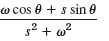
Find the transform. Show the details of your work. Assume that α, b, ω, θ are constants.
Sketch or graph the given function, which is assumed to be zero outside the given interval. Represent it, using unit step functions. Find its transform. Show the details of your work.t2 (t > 3/2)
Showing the details of your work, find L(f) if f(t) equals:1/2t2 sin πt
Can a discontinuous function have a Laplace transform? Give reason.
Solve by the Laplace transform, showing the details:
Using the Laplace transform and showing the details of your work, solve the IVP:y'1 = 4y1 + y2, y2 = -y1 + 2y2, y1(0) = 3, y2(0) = 1
If two different continuous functions have transforms, the latter are different. Why is this practically important?
Using the Laplace transform and showing the details of your work, solve the IVP:y"1 = y1 + 3y2, y2" = 4y1 - 4et, y1(0) = 2, y'1(0) = 3, y2(0) = 1, y'2(0) = 2
Solve the IVPs by the Laplace transform. If necessary, use partial fraction expansion as in Example 4 of the text. Show all details.y" + 3y' + 2.25y = 9t3 + 64, y(0) = 1, y' (0) = 31.5
Find the transform. Show the details of your work. Assume that α, b, ω, θ are constants. 19
Showing the details of your work, find L(f) if f(t) equals:4t cos 1/2πt
Find the transform, indicating the method used and showing the details.5 cosh 2t - 3 sinh t
Find and graph or sketch the solution of the IVP. Show the details.y" + 5y’ + 6y = u(t - 1) + δ(t - 2), y(0) = 0, y’ (0) = 1
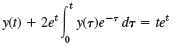
Solve by the Laplace transform, showing the details:
Find the transform. Show the details of your work. Assume that α, b, ω, θ are constants.
Using the Laplace transform and showing the details of your work, solve the IVP:y"1 + y2 = -101 sin 10t, y2" + y1 = 101 sin 10t, y1(0) = 0, y'1 (0) = 6, y2(0) = 8, y'2 (0) = -6
Find the transform. Show the details of your work. Assume that α, b, ω, θ are constants.
Solve the shifted data IVPs by the Laplace transform. Show the details.y' - 6y = 0, y(-1) = 4
Find and sketch or graph f(t) if L(f) equals6(1 - e-πs)/(s2 + 9)
Find the transform, indicating the method used and showing the details.sin2 (1/2 πt)
Experiment with the graphs of l0, . . , l10, finding out empirically how the first maximum, first minimum, . . . is moving with respect to its location as a function of n. Write a short report on this.
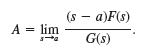
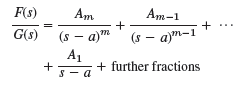
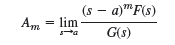
(a) Show that for a simple root α and fraction A/(s - α) in F(s)/G(s) we have the Heaviside formula (b) Similarly, show that for a root α of order m and fractions in we have the Heaviside formulas for the first coefficient and for the other coefficients
Solve by the Laplace transform, showing the details:
Find the transform. Show the details of your work. Assume that α, b, ω, θ are constants.
Using the Laplace transform and showing the details of your work, solve the IVP:y'1 + y'2 = 2 sinh t, y'2 + y'3 = et, y'3 + y'1 = 2et + e-t, y1(0) = 1, y2(0) = 1, y3(0) = 0
Find the transform. Show the details of your work. Assume that α, b, ω, θ are constants.
Solve the shifted data IVPs by the Laplace transform. Show the details.y" + 3y' - 4y = 6e2t-3, y(1.5) = 4, y' (1.5) = 5
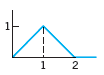
Find and sketch or graph f(t) if L(f) equalse-3s/s4
Find the transform, indicating the method used and showing the details.et/2u(t - 3)
Using differentiation, integration, s-shifting, or convolution, and showing the details, find f(t) if L(t) equals:
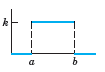
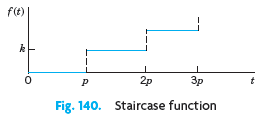
Find the Laplace transform of the staircase function in Fig. 140 by noting that it is the difference of kt/p and the function in 14(d).
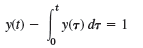
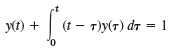
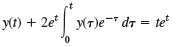
(a) Replace 2 in Prob. 13 by a parameter k and investigate graphically how the solution curve changes if you vary k, in particular near k = -2. Data from Prob. 13 (b) Make similar experiments with an integral equation of your choice whose solution is oscillating.
Find the transform. Show the details of your work. Assume that α, b, ω, θ are constants. 1 2
In Prob. 16, vary the initial conditions systematically, describe and explain the graphs physically. The great variety of curves will surprise you. Are they always periodic? Can you find empirical laws for the changes in terms of continuous changes of those conditions?Data from Prob. 16y'1 + y'2 =
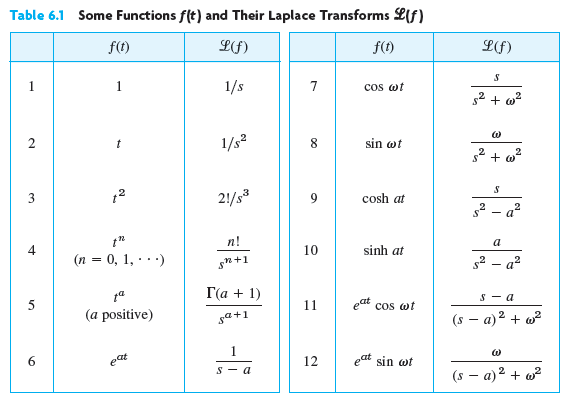
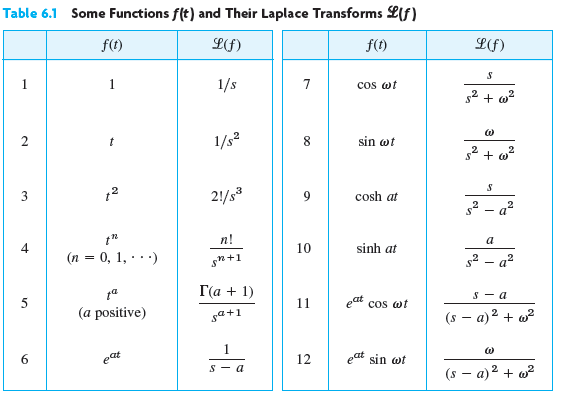
Convert table 6.1 to a table for finding inverse transforms (with obvious changes, e.g., L-1(1/sn) = tn-1/(n - 1), etc).
Find the transform, indicating the method used and showing the details.t cos t + sin t
Using differentiation, integration, s-shifting, or convolution, and showing the details, find f(t) if L(t) equals:
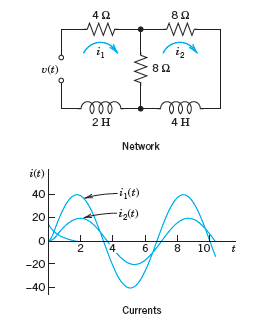
Using Laplace transforms, find the currents i1(t) and i2(t) in Fig. 148, where v(t) = 390 cos t and i1(0) = 0, i2(0) = 0. How soon will the currents practically reach their steady state?
Using (1) or (2), find L(f) if f(t) if equals:sin2 ωt
Derive formula 6 from formulas 9 and 10.
Find the transform, indicating the method used and showing the details.12t * e-3t
Using the Laplace transform and showing the details, solvey" + 6y’ + 8y = e-3t - e-5t, y(0) = 0, y’ (0) = 0
Using differentiation, integration, s-shifting, or convolution, and showing the details, find f(t) if L(t) equals:
Showing details, find f(t) if L(f) equals:
Give simple examples of functions (defined for all t > 0) that have no Laplace transform.
Find the inverse transform, indicating the method used and showing the details:
Using the Laplace transform and showing the details, solvey" + 9y = 8 sin t if 0 < t < π and 0 if t > π; y(0) = 0, y’ (0) = 4
Find the inverse transform, indicating the method used and showing the details:
Using the Laplace transform and showing the details, solvey" + y’ - 2y = 3 sin t - cos t if 0 < t < 2π and 3 sin 2t - cos 2t if t > 2π; y(0) = 1, y’ (0) = 0
If L(f(t)) = F(s) and c is any positive constant, show that L(f(ct)) = F(s/c)/c (Use (1).) Use this to obtain L(cos ωt) from L(cos t).
Find the inverse transform, indicating the method used and showing the details:
Using the Laplace transform and showing the details, solvey" + y = t if 0 < t < 1 and 0 if t > 1; y(0) = 0, y’ (0) = 0
Given F(s) = L(f), find f(t). a, b, L, n are constants. Show the details of your work.
Find the inverse transform, indicating the method used and showing the details:
Using the Laplace transform and showing the details, solvey" + 4y = 8t2 if 0 < t < 5 and 0 if t > 5; y(1) = 1 + cos 2, y’ (1) = 4 - 2 sin 2
Given F(s) = L(f), find f(t). a, b, L, n are constants. Show the details of your work.
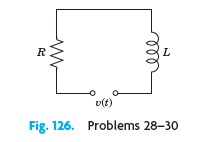
Using the Laplace transform and showing the details, find the current i(t) in the circuit in Fig. 126, assuming i(0) = 0 and: R = 25 Ω, L = 0.1 H, v = 490 e-5t V 0 1
Given F(s) = L(f), find f(t). a, b, L, n are constants. Show the details of your work.
Solve by the Laplace transform, showing the details and graphing the solution:y" + 4y' + 5y = 50t, y(0) = 5, y' (0) = -5
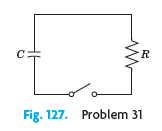
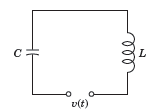
Using the Laplace transform, find the charge q(t) on the capacitor of capacitance C in Fig. 127 if the capacitor is charged so that its potential is V0 and the switch is closed at t = 0.
Given F(s) = L(f), find f(t). a, b, L, n are constants. Show the details of your work.
Solve by the Laplace transform, showing the details and graphing the solution:y" - y' - 2y = 12u(t - π) sin t, y(0) = 1, y' (0) = -1
Solve by the Laplace transform, showing the details and graphing the solution:y" + 3y' + 2y = 2u(t - 2), y(0) = 0, y' (0) = 0
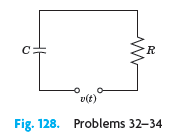
Using the Laplace transform and showing the details, find the current i(t) in the circuit in Fig. 128 with R = 10 Ω and C = 10-2 F, where the current at t = 0 is assumed to be zero, and: v = 0 if t 2
Solve by the Laplace transform, showing the details and graphing the solution:y'1 = 2y1 - 4y2, y'2 = y1 - 3y2, y1(0) = 3, y2(0) = 0
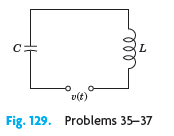
Using the Laplace transform and showing the details, find the current i(t) in the circuit in Fig. 129, assuming zero initial current and charge on the capacitor and: L = 1 H, C = 10-2 F, v = -9900 cos t V if π
Solve by the Laplace transform, showing the details and graphing the solution:y'1 = y2 + u(t - π), y'2 = -y1 + u(t - 2π), y1(0) = 1, y2(0) = 0
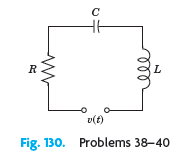
Using the Laplace transform and showing the details, find the current i(t) in the circuit in Fig. 130, assuming zero initial current and charge and: R = 2 Ω, L = 1 H, C = 0.5 F, v(t) = 1 kV if 0 2
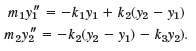
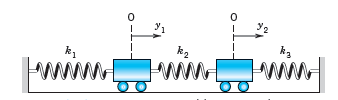
Model and solve by the Laplace transform: In Prob. 38, let m1 = m2 = 10 kg, k1 = k3 = 20 kg/sec2, k2 = 40 kg/sec2. Find the solution satisfying the initial conditions y1(0) = y2(0) = 0, y'1(0) = 1 meter/sec, y'2(0) = -1 meter/sec. Data from Prob. 38 Show that the model of the mechanical system in
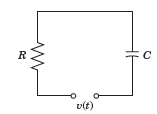
Model and solve by the Laplace transform: Find the current i(t) in the RC-circuit in Fig. 150, where R = 10 Ω, C = 0.1 F, v(t) = 10t V if 0 4, and the initial charge on the capacitor is 0.
Model and solve by the Laplace transform: Find and graph the charge q(t) and the current i(t) in the LC-circuit in Fig. 151, assuming L = 1 H, C = 1 F, v(t) = 1 - e-t if 0 π, and zero initial current and charge.
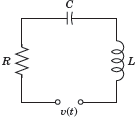
Model and solve by the Laplace transform: Find the current i(t) in the RLC-circuit in Fig. 152, where R = 160 Ω, L = 20 H, C = 0.002 F, v(t) = 37 sin 10t V, and current and charge at t = 0 are zero.
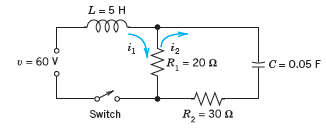
Model and solve by the Laplace transform: Set up the model of the network in Fig. 154 and find the solution, assuming that all charges and currents are 0 when the switch is closed at t = 0. Find the limits of i1(t) and i2(t) as t → ∞, (i) from the solution, (ii) directly from the given network.
Solve the linear system given explicitly or by its augmented matrix. Show details.4x - 6y = -11-3x + 8y = 10
Why is multiplication of matrices restricted by conditions on the factors?
What properties of matrix multiplication differ from those of the multiplication of numbers?
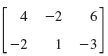
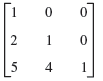
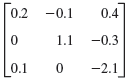
Find the inverse by Gauss–Jordan (or by (4*) if n = 2). Check by using (1).
Find three bases of R2.
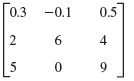
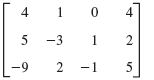
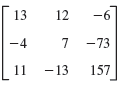
Find the rank. Find a basis for the row space. Find a basis for the column space. Row-reduce the matrix and its transpose.
Let A be a 100 × 100 matrix and B a 100 × 50 matrix. Are the following expressions defined or not? A + B, A2, B2, AB, BA, AAT, BTA, BTB, BBT, BTAB. Give reasons.
Expand a general second-order determinant in four possible ways and show that the results agree.
Solve the linear system given explicitly or by its augmented matrix. Show details. x + y - z = 9 8y + 6z = -6-2x + 4y - 6z = 40
Are there any linear systems without solutions? With one solution? With more than one solution? Give simple examples.
Find the inverse by Gauss–Jordan (or by (4*) if n = 2). Check by using (1).
Is the given set, taken with the usual addition and scalar multiplication, a vector space? Give reason. If your answer is yes, find the dimension and a basis.All vectors in R3 satisfying -v1 + 2v2 + 3v3 = 0, -4v1 + v2 + v3 = 0
Find the rank. Find a basis for the row space. Find a basis for the column space. Row-reduce the matrix and its transpose.
Solve the linear system given explicitly or by its augmented matrix. Show details.
Let C be 10 × 10 matrix and a a column vector with 10 components. Are the following expressions defined or not? Ca, CTa, CaT, aC, aTC, (CaT)T.
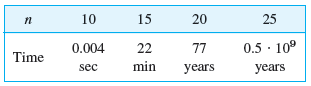
Show that the computation of an nth-order determinant by expansion involves n! multiplications, which if a multiplication takes 10-9 sec would take these times:
Solve the linear system given explicitly or by its augmented matrix. Show details.
Same questions as in Prob. 4 for symmetric matrices.Data from Prob. 4How many different entries can a 4 X 4 skew-symmetric matrix have? An n X n skew-symmetric matrix?
Motivate the definition of matrix multiplication.
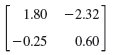
If A in Example 2 shows the number of items sold, what is the matrix B of units sold if a unit consists of(a) 5 items(b) 10 items?
Find the inverse by Gauss–Jordan (or by (4*) if n = 2). Check by using (1).
All polynomials in x of degree 4 or less with non negative coefficients.
Find the rank. Find a basis for the row space. Find a basis for the column space. Row-reduce the matrix and its transpose.
Show that det (kA) = Kn det A (not k det A). Give an example.
Explain the use of matrices in linear transformations.
Showing 100 - 200
of 3937
1
2
3
4
5
6
7
8
9
10
11
12
13
14
15
Last
Step by Step Answers

 Get 50% OFF
Claim Now
Get 50% OFF
Claim Now