New Semester
Started
Get
50% OFF
Study Help!
--h --m --s
Claim Now
Question Answers
Textbooks
Find textbooks, questions and answers
Oops, something went wrong!
Change your search query and then try again
S
Books
FREE
Study Help
Expert Questions
Accounting
General Management
Mathematics
Finance
Organizational Behaviour
Law
Physics
Operating System
Management Leadership
Sociology
Programming
Marketing
Database
Computer Network
Economics
Textbooks Solutions
Accounting
Managerial Accounting
Management Leadership
Cost Accounting
Statistics
Business Law
Corporate Finance
Finance
Economics
Auditing
Tutors
Online Tutors
Find a Tutor
Hire a Tutor
Become a Tutor
AI Tutor
AI Study Planner
NEW
Sell Books
Search
Search
Sign In
Register
study help
mathematics
advanced engineering mathematics
Advanced Engineering Mathematics 10th edition Erwin Kreyszig - Solutions
Integrate f(z) counterclockwise around the unit circle. Indicate whether Cauchy’s integral theorem applies. Show the details.f(z) = z-3
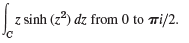
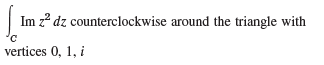
Integrate. Show the details. Begin by sketching the contour. Why?
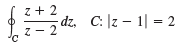
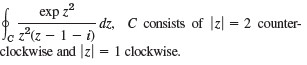
Integrate counterclockwise or as indicated. Show the details.
Find a parametric representation and sketch the path.Upper half of |z - 2 + i| = 2 from (4, -1) to (0, -1)
How did we use integral formulas for derivatives in evaluating integrals?
Integrate f(z) counterclockwise around the unit circle. Indicate whether Cauchy’s integral theorem applies. Show the details.f(z) = 1/(z4 - 1.1)
How does the situation for analytic functions differ with respect to derivatives from that in calculus?
Integrate f(z) counterclockwise around the unit circle. Indicate whether Cauchy’s integral theorem applies. Show the details.f(z) = 1/z̅
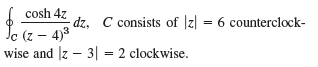
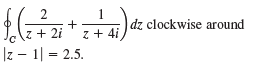
Integrate. Show the details. Begin by sketching the contour. Why?
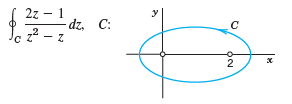
Integrate counterclockwise or as indicated. Show the details.
Find a parametric representation and sketch the path.x2 - 4y2 = 4, the branch through (2, 0)
What is Liouville’s theorem? To what complex functions does it apply?
Integrate f(z) counterclockwise around the unit circle. Indicate whether Cauchy’s integral theorem applies. Show the details.f(z) = Im z
What is Morera’s theorem?
Integrate f(z) counterclockwise around the unit circle. Indicate whether Cauchy’s integral theorem applies. Show the details.f(z) = 1/(πz - 1)
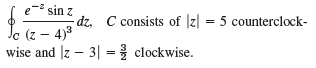
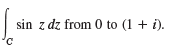
Integrate. Show the details. Begin by sketching the contour. Why?
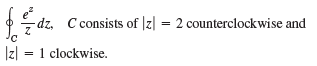
Integrate counterclockwise or as indicated. Show the details.
Find a parametric representation and sketch the path.|z + α + ib| = r, clockwise
If the integrals of a function f(z) over each of the two boundary circles of an annulus D taken in the same sense have different values, can f(z) be analytic everywhere in D? Give reason.
Integrate f(z) counterclockwise around the unit circle. Indicate whether Cauchy’s integral theorem applies. Show the details.f(z) = 1/|z|2
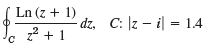
Integrate. Show the details. Begin by sketching the contour. Why?
Integrate counterclockwise or as indicated. Show the details.
Find a parametric representation and sketch the path.Parabola y = 1 - 1/4x2 (-2 ≤ x ≤ 2)
Integrate f(z) counterclockwise around the unit circle. Indicate whether Cauchy’s integral theorem applies. Show the details.f(z) = z3 cot z
Integrate by the first method or state why it does not apply and use the second method. Show the details.
Integrate by a suitable method.
Evaluate the integral. Does Cauchy’s theorem apply? Show details.
Integrate by the first method or state why it does not apply and use the second method. Show the details.
Integrate by a suitable method.
Evaluate the integral. Does Cauchy’s theorem apply? Show details. Use partial functions.
Integrate by the first method or state why it does not apply and use the second method. Show the details.
Integrate by a suitable method.
Evaluate the integral. Does Cauchy’s theorem apply? Show details.
Integrate by the first method or state why it does not apply and use the second method. Show the details.
Evaluate the integral. Does Cauchy’s theorem apply? Show details.
Integrate by the first method or state why it does not apply and use the second method. Show the details.
Integrate by a suitable method.
Integrate by the first method or state why it does not apply and use the second method. Show the details.
Integrate by a suitable method.
Evaluate the integral. Does Cauchy’s theorem apply? Show details.
Integrate by the first method or state why it does not apply and use the second method. Show the details.
Integrate by a suitable method.
Write programs for the two integration methods. Apply them to problems of your choice. Could you make them into a joint program that also decides which of the two methods to use in a given case?
Find an upper bound of the absolute value of the integral in Prob. 21. Data from Prob. 21 Integrate by the first method or state why it does not apply and use the second method. Show the details.
Are 1/z + z + z2 + · · · and z + z3/2 + z2 + z3 + · · ·power series? Explain
What is convergence test for series? State two tests from memory. Give examples.
Is the given sequence z1, z2, · · ·, zn, · · · bounded?Convergent? Find its limit points. Show your work in detail.zn = (1 + i)2n/2n
Which of the series in this section have you discussed in calculus? What is new?
Material in this section generalizes calculus. Give details.
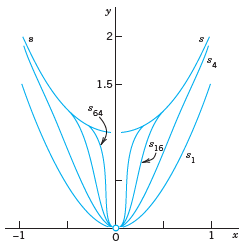
(a) Fig. 368. Produce this exciting figure using your CAS. Add further curves, say, those of s256, s1024 ,etc. on the same screen. (b) Study the nonuniformity of convergence experimentally by graphing partial sums near the endpoints of the convergence interval for real z = x.
Give all the details in the derivation of the series in those examples.
Write out the details of the proof on term wise addition and subtraction of power series.
Where does the power series converge uniformly? Give reason.
What are the only basically different possibilities for the convergence of a power series?
What is absolute convergence? Conditional convergence? Uniform convergence?
Is the given sequence z1, z2, · · ·, zn, · · · bounded?Convergent? Find its limit points. Show your work in detail.zn = nπ/(4 + 2ni)
Find the Maclaurin series and its radius of convergence.sin 2z2
Prove that n√n → 1 as n → ∞, as claimed.
What do you know about convergence of power series?
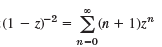
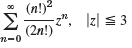
Find the Maclaurin series and its radius of convergence.
Show that (a) By using the Cauchy product. (b) By differentiating a suitable series.
Where does the power series converge uniformly? Give reason.
What is a Taylor series? Give some basic examples.
Show that if ∑αnzn has radius of convergence R (assumed finite), then ∑αnzn has radius of convergence √R.
Is the given sequence z1, z2, · · ·, zn, · · · bounded?Convergent? Find its limit points. Show your work in detail.zn = (-1)n + 10i
Find the Maclaurin series and its radius of convergence.
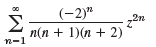
Find the radius of convergence in two ways: (a) Directly by the Cauchy–Hadamard formula in Sec. 15.2. (b) From a series of simpler terms by using Theorem 3 or Theorem 4.
What do you know about adding and multiplying power series?
Find the Maclaurin series and its radius of convergence.
Where does the power series converge uniformly? Give reason.
Find the Maclaurin series and its radius of convergence.cos2 1/2z
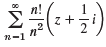
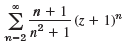
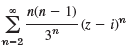
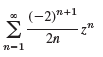
Find the center and the radius of convergence.
Does every function have a Taylor series development? Explain.
Is the given sequence z1, z2, · · ·, zn, · · · bounded?Convergent? Find its limit points. Show your work in detail.zn = n2 + i/n2
Can properties of functions be discovered from Maclaurin series? Give examples.
Find the Maclaurin series and its radius of convergence.sin2 z
Where does the power series converge uniformly? Give reason.
What do you know about term wise integration of series?
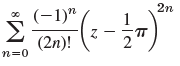
Find the center and the radius of convergence.
Is the given sequence z1, z2, · · ·, zn, · · · bounded?Convergent? Find its limit points. Show your work in detail.zn = (3 + 3i)-n
Find the Maclaurin series and its radius of convergence.
Find the radius of convergence in two ways: (a) Directly by the Cauchy–Hadamard formula in Sec. 15.2. (b) From a series of simpler terms by using Theorem 3 or Theorem 4.
How did we obtain Taylor’s formula from Cauchy’s formula?
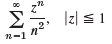
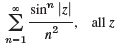
Prove that the series converges uniformly in the indicated region.
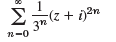
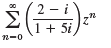
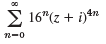
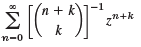
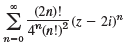
Find the radius of convergence.
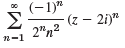
Find the center and the radius of convergence.
Write a program for graphing complex sequences. Use the program to discover sequences that have interesting “geometric” properties, e.g., lying on an ellipse, spiraling to its limit, having infinitely many limit points, etc.
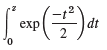
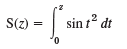
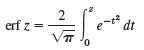
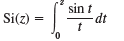
Find the Maclaurin series by term wise integrating the integrand. (The integrals cannot be evaluated by the usual methods of calculus. They define the error function erf z, sine integral Si(z), and Fresnel integrals S(z) and C(z), which occur in statistics, heat conduction, optics, and other
Find the radius of convergence in two ways: (a) Directly by the Cauchy–Hadamard formula in Sec. 15.2. (b) From a series of simpler terms by using Theorem 3 or Theorem 4.
Find the Maclaurin series by term wise integrating the integrand. (The integrals cannot be evaluated by the usual methods of calculus. They define the error function erf z, sine integral Si(z), and Fresnel integrals S(z) and C(z), which occur in statistics, heat conduction, optics, and other
Prove that the series converges uniformly in the indicated region.
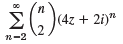
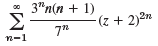
Find the radius of convergence.
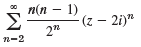
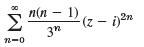
Find the center and the radius of convergence.
Show that a complex sequence is bounded if and only if the two corresponding sequences of the real parts and of the imaginary parts are bounded.
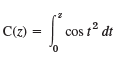
Find the Maclaurin series by term wise integrating the integrand. (The integrals cannot be evaluated by the usual methods of calculus. They define the error function erf z, sine integral Si(z), and Fresnel integrals S(z) and C(z), which occur in statistics, heat conduction, optics, and other
Find the radius of convergence in two ways: (a) Directly by the Cauchy–Hadamard formula in Sec. 15.2. (b) From a series of simpler terms by using Theorem 3 or Theorem 4.
Find the Maclaurin series by term wise integrating the integrand. (The integrals cannot be evaluated by the usual methods of calculus. They define the error function erf z, sine integral Si(z), and Fresnel integrals S(z) and C(z), which occur in statistics, heat conduction, optics, and other
Prove that the series converges uniformly in the indicated region.
Find the radius of convergence.
Find the center and the radius of convergence.
Showing 300 - 400
of 3937
1
2
3
4
5
6
7
8
9
10
11
12
13
14
15
Last
Step by Step Answers

 Get 50% OFF
Claim Now
Get 50% OFF
Claim Now