New Semester
Started
Get
50% OFF
Study Help!
--h --m --s
Claim Now
Question Answers
Textbooks
Find textbooks, questions and answers
Oops, something went wrong!
Change your search query and then try again
S
Books
FREE
Study Help
Expert Questions
Accounting
General Management
Mathematics
Finance
Organizational Behaviour
Law
Physics
Operating System
Management Leadership
Sociology
Programming
Marketing
Database
Computer Network
Economics
Textbooks Solutions
Accounting
Managerial Accounting
Management Leadership
Cost Accounting
Statistics
Business Law
Corporate Finance
Finance
Economics
Auditing
Tutors
Online Tutors
Find a Tutor
Hire a Tutor
Become a Tutor
AI Tutor
AI Study Planner
NEW
Sell Books
Search
Search
Sign In
Register
study help
mathematics
advanced engineering mathematics
Advanced Engineering Mathematics 10th edition Erwin Kreyszig - Solutions
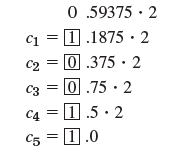
Convert (0.59375)10to (0.10011)2 by successive multiplication by 2 and dropping (removing) the integer parts, which give the binary digits c1, c2, · · · : 0.59375 · 2 1.1875 · 2 0 .375 · 2 0.75 · 2 1.5· 2 C1 C2 C3 C4 1.0 C5
(a) Apply this to p1(9.2) and p2(9.2) for the data x0 = 9.0, x1 = 9.5, x2 = 11.0, f0 = ln x0, f1 = ln x1, f2 = ln x2 (6S-values).(b) Given (xj, f(xj)) = (0.2, 0.9980), (0.4, 0.9686), (0.6, 0.8443), (0.8, 0.5358), (1.0, 0). Find f(0.7) from the quadratic interpolation polynomials based on (α) 0.6,
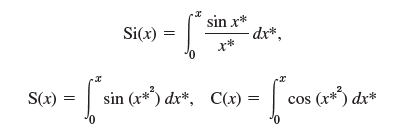
The following integrals cannot be evaluated by the usual methods of calculus. Evaluate them as indicated. Compare your value with that possibly given by your CAS. Si(x) is the sine integral. S(x) and C(x) are the Fresnel integrals. They occur in optics.S(1.25) by (7), 2m = 10 sin x* -dx* , Si(x) **
Compute e10 with 6S arithmetic in two ways (as in Prob. 19).Data from Prob. 19Calculate 1/e = 0.367879 (6S) from the partial sums of 5–10 terms of the Maclaurin series(a) Of e-x with w = 1(b) Of ex with x = 1 and then taking the reciprocal. Which is more accurate?
In Hermite interpolation we are looking for a polynomial p(x) (of degree 2n + 1 or less) such that p(x) and its derivative p'(x) have given values at n + 1 nodes. (More generally, p(x), p'(x), p"(x), · · · may be required to have given values at the nodes.)(a) Let C be a curve
Do the same task as in Prob. 19 for the difference 3.2 - 6.29.Data from Prob. 19Let 19.1 and 25.84 be correctly rounded. Find the shortest interval in which the sum s of the true (un rounded) numbers must lie.
The following integrals cannot be evaluated by the usual methods of calculus. Evaluate them as indicated. Compare your value with that possibly given by your CAS. Si(x) is the sine integral. S(x) and C(x) are the Fresnel integrals. They occur in optics.Obtain a better value in Prob. 17.Data from
Apply Newton’s method (6S-accuracy). First sketch the function(s) to see what is going on.Find the largest root of the Legendre polynomial P5(x) given by P5(x) = 1/8 (63x5 - 70x3 + 15x)(a) By Newton’s method(b) From a quadratic equation.
(a) Compute (1 - cos x)/sin x with 6S arithmetic for x = 0.005.(b) Looking at Prob. 16, find a much better formula.Data from Prob. 16Compute 1 - cos x with 6S arithmetic for x = 0.02(a) As given(b) By 2 sin2 1/2x (derive!).
Compute 0.38755/(5.6815 - 0.38419) as given and then rounded step wise to 4S, 3S, 2S, 1S. Comment.
Derive an error bound in Prob. 9 from (5).Data from Prob. 9Calculate the Lagrange polynomial p2(x) for the 5S-values f(0.25) = 0.27633, f(0.5) = 0.52050, f(1.0) = 0.84270 and from p2(x) an approximation of f(0.75) (= 0.71116).
Evaluate the integralsby Simpson€™s rule with 2m as indicated, and compare with the exact value known from calculus.B, 2m = 10 -2 dx .0.4 dx B = dx, J = хе 1 + x* х ||
For small |α| the equation (x - k)2 = α has nearly a double root. Why do these roots show instability?
Solve by fixed-point iteration and answer related questions where indicated. Show details.Solve x cosh x = 1.
Evaluate the integralsby Simpson€™s rule with 2m as indicated, and compare with the exact value known from calculus.A, 2m = 10 -2 dx .0.4 dx B = dx, J = хе 1 + x* х ||
Does a sketch of the product of the (x - xj) in (5) for the data in Example 2 indicate that extrapolation is likely to involve larger errors than interpolation does?
Solve x2 - 40x + 2 = 0, using 4S-computation.
Prove that the trapezoidal rule is stable with respect to rounding.
Calculate p2(x) in Example 2. Compute from it approximations of ln 9.4, ln 10, ln 10.5, ln 11.5 and ln 12. Compute the errors by using exact 5S-values and comment.
Solve by fixed-point iteration and answer related questions where indicated. Show details.Find a form x = g(x) of f(x) = 0 in Prob. 5 that yields convergence to the root near x = 1.Data from Prob. 5Solve by fixed-point iteration and answer related questions where indicated. Show details.Sketch f(x)
Give the details of the derivation of αj2 and αj3 in (13).
Integrate f(x) = x4 from 0 to 1 by (2) with h = 1, h = 0.5, h = 0.25 and estimate the error for h = 0.5 and h = 0.25 by (5).
Estimate the error for p2(9.2 ) in Example 2 from (5).
Solve by fixed-point iteration and answer related questions where indicated. Show details.f = x - cosec x the zero near x = 1.
Order of terms, in adding with a fixed number of digits, will generally affect the sum. Give an example. Find empirically a rule for the best order.
Derive the basic linear system (9) for k1, · · ·, kn-1.
Derive a formula for lower and upper bounds for the rectangular rule. Apply it to Prob. 1.Data from Prob. 1Derive a formula for lower and upperbounds for the rectangular rule. Apply it to Prob. 1.
Estimate the error in Prob. 1 by (5).Data from Prob. 1Calculate P1(x) in Example 1 and from it 3.
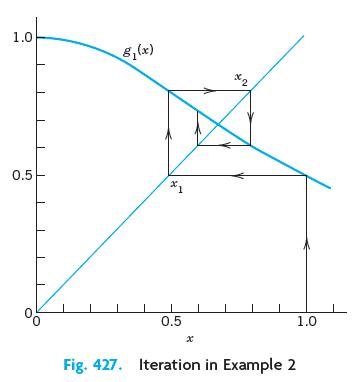
Solve by fixed-point iteration and answer related questions where indicated. Show details.Do the iterations (b) in Example 2. Sketch a figure similar to Fig. 427. Explain what happens. 1.0 5, (x) *2 0.5 0.5 1.0 Fig. 427. Iteration in Example 2
Write -76.437125, 60100, and -0.00001 in floating point form, rounded to 4S.
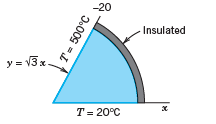
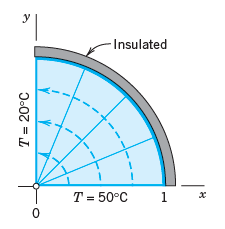
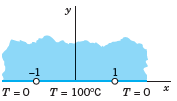
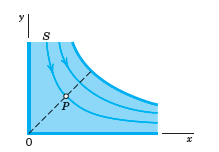
Find the temperature distribution T(x, y) and the complex potential F(z) in the given thin metal plate whose faces are insulated and whose edges are kept at the indicated temperatures or are insulated as shown. -20 Insulated y = v3 x. T= 20°C T= 500°C
Using (7), find the potential Φ(r, θ) in the unit disk r < 1 having the given boundary values Φ(1, θ). Using the sum of the first few terms of the series, compute some values of Φ and sketch a figure of the equipotential lines.
What areas of physics did we consider? Could you think of others?
State the theorem on the behavior of harmonic functions under conformal mapping. Verify it for Φ* = eu sin v and w = u + iv = z2.
Describe the streamlines for F(z) = 1/2z2 + z.
Interpret Prob. 18 as an electrostatic problem. What are the lines of electric force?Data from Prob. 18Find the potential in the angular region between the plates Arg z = π/6 kept at 800 V and Arg z = π/3 kept at 600 V.
Interpret Prob. 17 in Sec. 18.2 as a heat problem, with boundary temperatures, say, 10°C on the upper part and 200°C on the lower.Data from Prob. 17Find the temperature distribution T(x, y) and the complex potential F(z) in the given thin metal plate whose faces are insulated and whose edges are
Find the location (u1, v1) of the maximum of Φ* = eu cos v in R*: |w| ≤ 1, v ≥ 0, where w = u + iv where. Find the region R that is mapped onto R* by w = f(z) = z2. Find the potential in R resulting from Φ* and the location (x1, y1) of the maximum. Is (u1, v1) the image of (x1, y1)? If so, is
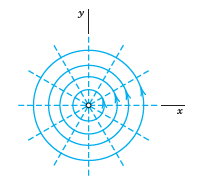
(a) Show that F(z) = -(Ki/2Ï€) ln z with positive real K gives a flow circulating counterclockwise around z = 0 (Fig. 421). z = 0 is called a vortex. Each time we travel around the vortex, the potential increases by K.(b) Source and sink combined. Find the complex potentials of a
Find the potential in the angular region between the plates Arg z = π/6 kept at 800 V and Arg z = π/3 kept at 600 V.
Find the temperature distribution T(x, y) and the complex potential F(z) in the given thin metal plate whose faces are insulated and whose edges are kept at the indicated temperatures or are insulated as shown.Figure 410, T(0, y) = -30°C, T(x, 0) = 100°C -Insulated II T = 50°C T = 20°C
Using (7), find the potential Φ(r, θ) in the unit disk r < 1 having the given boundary values Φ(1, θ). Using the sum of the first few terms of the series, compute some values of Φ and sketch a figure of the equipotential lines.
Verify the maximum principle for Φ(x, y) = ex sin y and the rectangle α ≤ x ≤ b, 0 ≤ y ≤ 2π.
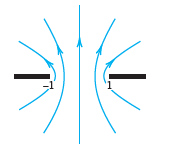
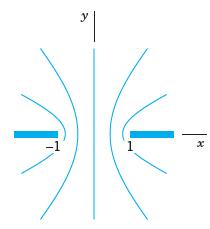
Show that F(z) = arccosh z gives confocal hyperbolas as streamlines, with foci at z = ±1, and the flow may be interpreted as a flow through an aperture (Fig. 419).
Find the equipotential lines of F(z) = i Ln z.
Find the location and size of the maximum of |F(z)| in the unit disk |z| ≤ 1.F(z) = αz + b (α, b complex, α ≠ 0)
Solve Prob. 15 if the sector is -1/8π < Arg z < 1/8π.Data from Prob. 15By applying a suitable conformal mapping, obtain from FIG. 406 the potential Φ in the sector -1/4π < Arg z < 1/4π such that Φ = -3kV if Arg z = -1/4π and Φ = 3kV if Arg z = 1/4π.
If plates at x1 = 1 and x2 = 10 are kept at potentials U1 = 220 V, U2 = 2kV, is the potential at x = 5 larger or smaller than the potential at r = 5 ? No calculation. Give reason.Data from Prob. 12Find the potential and complex potential between the coaxial cylinders of axis 0 (hence the vertical
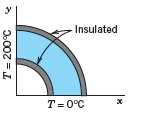
Find the temperature distribution T(x, y) and the complex potential F(z) in the given thin metal plate whose faces are insulated and whose edges are kept at the indicated temperatures or are insulated as shown. Insulated T = 0°C T = 200°C
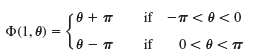
Using (7), find the potential Φ(r, θ) in the unit disk r < 1 having the given boundary values Φ(1, θ). Using the sum of the first few terms of the series, compute some values of Φ and sketch a figure of the equipotential lines.Φ(1, θ) = |θ|/π if -π < θ < π
Find the location and size of the maximum of |F(z)| in the unit disk |z| ≤ 1.F(z) = exp z2
Sketch or graph streamlines and equipotential lines of F(z) = iz3. Find V. Find all points at which V is horizontal.
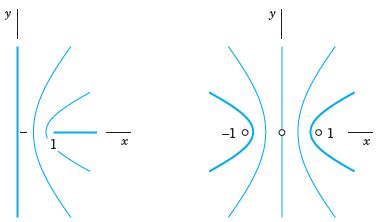
Show that F(z) in Prob. 13 gives the potentials in Fig. 402.Data from Prob. 13Show that F(z) = arccos z gives the potential of a slit in Fig. 401.Fig. 401.Fig. 402. y -1 1
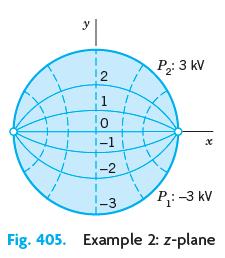
Figure 405 gives the impression that the potential on the y-axis changes more rapidly near 0 than near ±i. Can you verify this? y P 3 kV 12 1 i-1 -2 -3 P:-3 kV Fig. 405. Example 2: z-plane
Find the potential and complex potential between the coaxial cylinders of axis 0 (hence the vertical axis in space) and radii r1 = 1 cm, r2 = 10 cm, kept at potential U1 = 220 V and U2 = 2 kV, respectively.
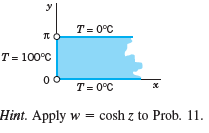
Find the temperature distribution T(x, y) and the complex potential F(z) in the given thin metal plate whose faces are insulated and whose edges are kept at the indicated temperatures or are insulated as shown.Data from Prob. 11Find the temperature distribution T(x, y) and the complex potential
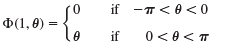
Using (7), find the potential Φ(r, θ) in the unit disk r < 1 having the given boundary values Φ(1, θ). Using the sum of the first few terms of the series, compute some values of Φ and sketch a figure of the equipotential lines.Φ(1, θ) = k if 0 < θ < π and 0 otherwise
(a) Verify Theorem 3 for(i) F(z) = z2 and the rectangle 1 ≤ x ≤ 5, 2 ≤ y ≤ 4(ii) F(z) = sin z and the unit disk(iii) F(z) = ez and any bounded domain.(b) F(z) = 1 + |z| is not zero in the disk |z| ≤ 2 and has a minimum at an interior point. Does this contradict Theorem 3?(c) F(x) = sin x
Find and sketch the potential between the axes (potential 500 V) and the hyperbola xy = 4 (potential 100 V).
Find the potential between the cylinders C1: |z| = 1 (potential U1 = 0) and C2: |z - c| = c (potential U2 = 220 V), where 0 < c < 1/2. Sketch or graph equipotential lines and their orthogonal trajectories for c = 1/4. Can you guess how the graph changes if you increase c (< 1/2)?
State Poisson’s integral formula. Derive it from Cauchy’s formula.
Using (7), find the potential Φ(r, θ) in the unit disk r < 1 having the given boundary values Φ(1, θ). Using the sum of the first few terms of the series, compute some values of Φ and sketch a figure of the equipotential lines.Φ(1, θ) = 16 cos3 2θ
What happens in Prob. 7 if you replace the potential by its conjugate harmonic?Data from Prob. 7Let D: 0 ≤ x ≤ 1/2 π, 0 ≤ y ≤ 1; D* the image of D under w = sin z; and Φ* = u2 - v2. What is the corresponding potential Φ in D? What are its boundary values? Sketch D and D*.
Explain the use of conformal mapping in potential theory.
Using (7), find the potential Φ(r, θ) in the unit disk r < 1 having the given boundary values Φ(1, θ). Using the sum of the first few terms of the series, compute some values of Φ and sketch a figure of the equipotential lines.Φ(1, θ) = 4 sin3 θ
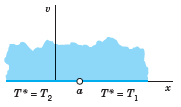
Find the temperature distribution T(x, y) and the complex potential F(z) in the given thin metal plate whose faces are insulated and whose edges are kept at the indicated temperatures or are insulated as shown. T* = T, T* = T,
Verify (3) in Theorem 2 for the given Φ(x, y), (x0, y0) and circle of radius 1.x2 - y2, (3, 8)
Apply Theorem 1 to Φ*(u, v) = u2 - v2, w = f(z) = ez, and any domain D, showing that the resulting potential Φ is harmonic.
What does the complex potential give physically?
Derive the first statement in Theorem 2 from Poisson’s integral formula.
Sketch or graph and interpret the flow in Example 1 on the whole upper half-plane.
Find and sketch the potential between the parallel plates having potentials U1 and U2. Find the complex potential.Plates at y = x and y = x + k potentials U1 = 0 V, U2 = 220 V, respectively.
Let Φ* = 4uv, w = f(z) = ez, and D: x < 0, 0 < y < π. Find Φ. What are its boundary values?
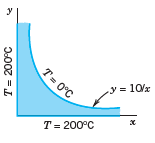
Find the temperature distribution T(x, y) and the complex potential F(z) in the given thin metal plate whose faces are insulated and whose edges are kept at the indicated temperatures or are insulated as shown. У T= 0°C у%3D 10х T= 200°C T = 200°C
Verify Theorem 1 for the given F(z), z0, and circle of radius 1.(z - 1)-2, z0 = -1
Find and sketch the potential between two coaxial cylinders of radii r1 and r2 having potential U1 and U2, respectively.If r1 = 2 cm, r2 = 6 cm and U1 = 300 V, U2 = 100 V, respectively, is the potential at r = 4 cm equal to 200 V? Less? More? Answer without calculation. Then calculate and
Give the details of the steps. What is the point of that proof?
What parts of complex analysis are mainly of interest to the engineer and physicist?
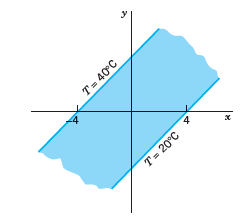
Find the temperature and the complex potential in an infinite plate with edges y = x - 4 and y = x + 4 kept at -20 and 40°C, respectively (Fig. 413). In what case will this be an approximate model? T= 40°C T= 20°C
Verify Theorem 1 for the given F(z), z0, and circle of radius 1.2z4, z0 = -2
Find and sketch the potential between two coaxial cylinders of radii r1 and r2 having potential U1 and U2, respectively.r1 = 1 mm r2 = 2 cm, U1 = 400 V, U2 = 0 V
Along what curves will the speed in Example 1 be constant? Is this obvious from Fig. 415? の
Find the LFT that maps0, 1, 2 onto 2i, 1 + 2i, 2 + 2i, respectively
Find the magnification ratio M. Describe what it tells you about the mapping. Where is M = 1? Find the Jacobian J.w = z3
Find all points at which the mapping is not conformal. Give reason.z2 + 1/z2
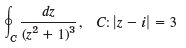
Evaluate (counterclockwise). Show the details. C:|z – il = 3 dz ,2 (z? + 1)3
Find all Taylor and Laurent series with center z0. Determine the precise regions of convergence. Show details.1/z, z0 = 1
Find all LFTs with fixed point(s).z = ±1
Determine the location and order of the zeros.(sin z - 1)3
Find all the singularities in the finite plane and the corresponding residues. Show the details.cos z/z4
Is the given series convergent or divergent? Give a reason. Show details. Vn п-1
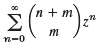
Find the radius of convergence in two ways:(a) Directly by the Cauchy€“Hadamard formula.(b) From a series of simpler terms by using Theorem 3 or Theorem 4. Σ( п+ m п т п-0
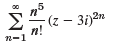
Find the radius of convergence. -(z – 3i)2n n! n-1
Solve for z.ln z = e - πi
Find all solutions.cosh z = -1
Represent in polar form, with the principal argument.12 + i, 12 - i
Graph in the complex plane and represent in the form x + iy:√50(cos 3/4π + i sin 3/4π)
Find the value of the derivative of(z - i)/(z + i) at i
Write in exponential form (6):n√z
Find the potential in the following charge-free regions.Between two concentric spheres of radii r0 and r1 kept at potentials u0 and u1, respectively.
Showing 2700 - 2800
of 3937
First
21
22
23
24
25
26
27
28
29
30
31
32
33
34
35
Last
Step by Step Answers

 Get 50% OFF
Claim Now
Get 50% OFF
Claim Now


![А: Го — [x (0), у (0)] 3D [xо. Уol. B: r1 = [x(1), y(1)] = [x1, yı] Vo = [x'(0), y'(0)] — [x6. уб1. V1 = [r](https://dsd5zvtm8ll6.cloudfront.net/si.question.images/images/question_images/1545/1/2/5/1485c18bd1c3aae71545107728742.jpg)