New Semester
Started
Get
50% OFF
Study Help!
--h --m --s
Claim Now
Question Answers
Textbooks
Find textbooks, questions and answers
Oops, something went wrong!
Change your search query and then try again
S
Books
FREE
Study Help
Expert Questions
Accounting
General Management
Mathematics
Finance
Organizational Behaviour
Law
Physics
Operating System
Management Leadership
Sociology
Programming
Marketing
Database
Computer Network
Economics
Textbooks Solutions
Accounting
Managerial Accounting
Management Leadership
Cost Accounting
Statistics
Business Law
Corporate Finance
Finance
Economics
Auditing
Tutors
Online Tutors
Find a Tutor
Hire a Tutor
Become a Tutor
AI Tutor
AI Study Planner
NEW
Sell Books
Search
Search
Sign In
Register
study help
mathematics
advanced engineering mathematics
Advanced Engineering Mathematics 10th edition Erwin Kreyszig - Solutions
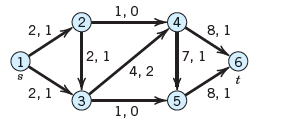
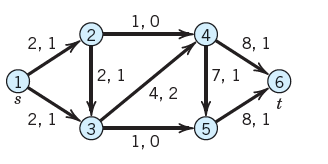
Find flow augmenting paths: 1,0 4 8, 1 2, 1 7, 1 2, 1 4, 2 (1) 2, 1 (3 8, 1 5. 1,0
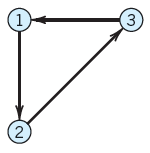
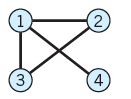
Find the adjacency matrix of: (1) 2 3,
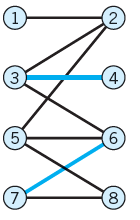
Find an augmenting path: (1) 2) (3 (4) (5 96. 7 (8
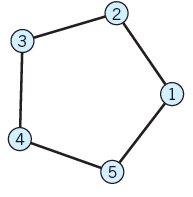
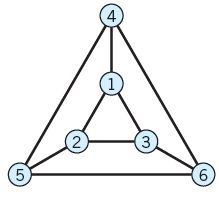
Does the graph in Prob. 4 have a Hamiltonian cycle?Data from Prob. 4 3 0, 4 3. 4 3. 3. 2. 2. 2.
Prove that, if the capacities in a network G are integers, then a maximum flow exists and is an integer.
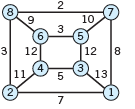
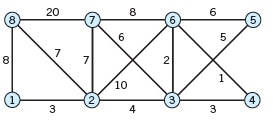
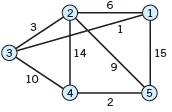
Find a shortest spanning tree by Prim€™s algorithm.For the graph in Prob. 6.Data from Prob. 6 7) 10, 3 5. 12 (8) (6 12 (3 13 11 (2) (1 (5, 5.
Design an algorithm for obtaining longest spanning trees.
Can you obtain the answer to Prob. 3 from that to Prob. 1?Data from Prob. 3If you answer is yes, find S and T: (1) 3 4)
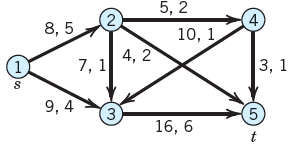
Find the maximum flow by Ford-Fulkerson:In Prob. 14Data from Prob. 14 5, 2 (2 (4) 10, 1 8, 5 4, 2 7, 1 3, 1 (1) 9, 4 3) 5 16, 6 t
Find a shortest spanning tree by Prim€™s algorithm. 5 8. (7 10 (1 (2 (3 3 3 2.
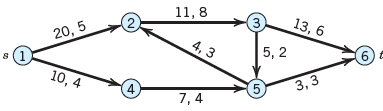
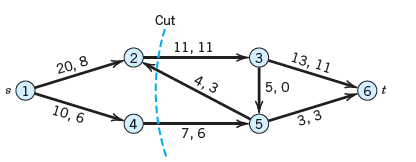
Find a minimum cut set and its capacity for the network:In Fig. 496. Verify that its capacity equals the maximum flow. 11, 8 13, 6 2 4, 3 20, 5 5, 2 6. s(1 10, 4 3,3 4 5. 7,4 3.
To get a minimum spanning tree, instead of adding shortest edges, one could think of deleting longest edges. For what graphs would this be feasible? Describe an algorithm for this.
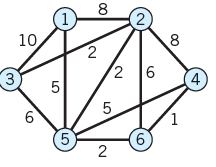
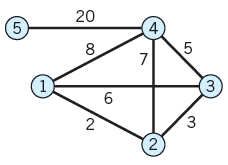
For each graph find the shortest paths. (1) 10 (2) 8 3 5. 6 2.
Find the maximum flow by Ford-Fulkerson:In Prob. 12Data from Prob. 12 1, 0 (2 2, 1 8, 1 2, 1 4, 2 7, 1 (1) 2, 1 8, 1 5 (3. 1,0 LO
Find a shortest spanning tree by Prim€™s algorithm. 3 (3 14 15 10 5, 2.
For each graph find the shortest paths. 20 (5 8 (1 (3) 3 2.
If you answer is yes, find S and T: (2) (3 (1 4 5)
What is the maximum number of edges that a shortest path between any two vertices in a graph with n vertices can have? Give a reason. In a complete graph with all edges of length 1?
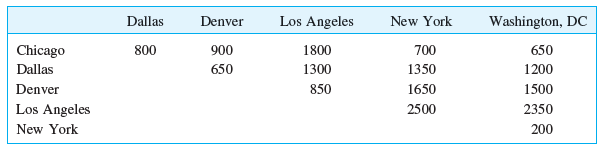
If for a complete graph (or one with very few edges missing), our data is an n × n distance table (as in Prob. 13), show that the present algorithm [which is O(n2)] cannot easily be replaced by an algorithm of order less than O(n2).Data from Prob. 13Find a shortest spanning tree in the
What is the (simple) reason that Kirchhoff’s law is preserved in augmenting a flow by the use of a flow augmenting path?
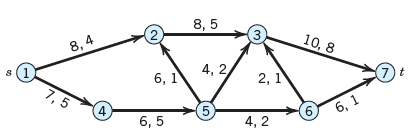
Find T and cap (S, T ) for:Fig 498, S = {1, 3, 5} Cut ! 11, 11 13, 11 20, 8 s (1 10, 6 5, 0 (6) t 4,3 3, 3 5. 7,6
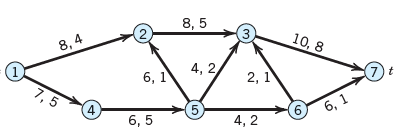
Find T and cap (S, T ) for:Fig 499, S = {1, 2} 8, 5 10, 8 (3 8, 4 4, 2 (7 t 6, 1 2, 1 7, 5 6. 4 6, 5 6, 1 4, 2
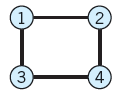
If you answer is yes, find S and T: (4 (1) (2 3 5 6.
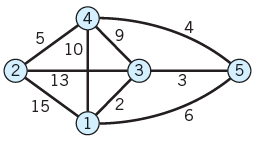
For each graph find the shortest paths. 4 9. 10 4 (2 (3) (5 13 15 (1 9. 2.
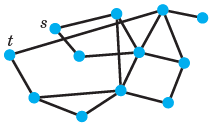
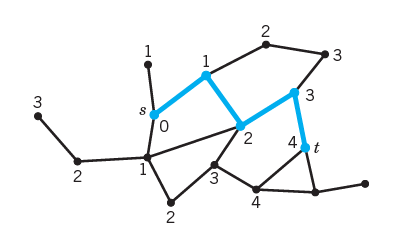
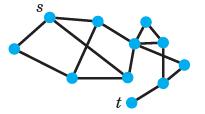
Find a shortest path P: s†’t and its length by Moore€™s algorithm. Sketch the graph with the labels and indicate P by heavier lines as in Fig. 482. 3 0, 4 3. 4 3. 3. 2. 2. 2.
Solve Example 1 by Ford–Fulkerson with initial flow 0. Is it more work than in Example 1?
Find T and cap (S, T ) for:Fig 49.9, S = {1, 2, 3} 8, 5 10, 8 2. 8, 4 4, 2 6, 1 s (1 7, 5 2, 1 (7 4 6, 1 6, 5 4, 2 2.
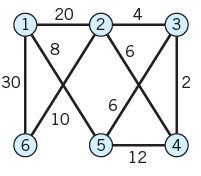
Find a shortest spanning tree by Kruskal€™s algorithm. Sketch it. 20 (1) (2 6 6, 10 (6) (5 12 2. 4.
Show that in Dijkstra’s algorithm, for Lk there is a path P: 1 → k of length Lk.
If you answer is yes, find S and T: (2 1) 4. 3.
Find a shortest path P: s†’t and its length by Moore€™s algorithm. Sketch the graph with the labels and indicate P by heavier lines as in Fig. 482. 3 0, 4 3. 4 3. 3. 2. 2. 2.
Why are slack variables always nonnegative? How many of them do we need?
Maximize or minimize as indicated.Maximize f = x1 + x2 subject to x1 + 2x2 ≤ 10, 2x2 + x2 ≤ 10, x2 ≤ 4.
The DC Drug Company produces two types of liquid pain killer, N (normal) and S (Super). Each bottle of N requires 2 units of drug A, 1 unit of drug B, and 1 unit of drug C. Each bottle of S requires 1 unit of A, 1 unit of B, and 3 units of C. The company is able to produce, each week, only 1400
Maximize or minimize the given objective function f subject to the given constraints.Maximize or minimize the given objective function f subject to the given constraints.Maximize f = -10x1 + 2x2 subject to x1 ≥ 0, x2 ≥ 0, -x1 + x2 ≥ -1, x1 + x2 ≤ 6, x2 ≤ 5.
Maximize or minimize the given objective function f subject to the given constraints.Maximize f = 5x1 + 25x2 in the region in Prob. 3.Data from Prob. 3-0.5x1 + x2 ≤ 2 x1 + x2 ≥ 2 -x1 + 5x2 ≥ 5
Write in normal form and solve by the simplex method, assuming all xj to be nonnegative.Maximize f = 2x1 + 3x2 subject to 5x1 + 3x2 ≤ 105, 3x1 + 6x2 ≤ 126.
Show that the gradients in Prob. 11 are orthogonal. Give a reason.Data from Prob. 11In Prob. 10, could you start from and do 5 steps?Data form Prob. 10f(x) = 9x21 + x22 + 18x1 - 4x2, 5 steps. Start from x0 = [2 4]T.
Maximize or minimize the given objective function f subject to the given constraints.Maximize f = 45.0x1 + 22.5x2 in the region in Prob. 4.Data from Prob. 4 -x1 + x2 ≤ 5 2x1 + x2 ≥ 10 x2 ≥
Write in normal form and solve by the simplex method, assuming all xj to be nonnegative.Maximize f = 2x1 + 3x2 + x3 subject to x1 + x2 + x3 ≤ 4.8, 10x1 + x3 ≤ 9.9, x2 - x3 ≤ 0.2.
Can we always expect a unique solution?
Write in normal form and solve by the simplex method, assuming all xj to be nonnegative.Maximize f = 4x1 - 10x2 - 20x3 subject to 3x1 + 4x2 + 5x3 ≤ 60, 2x1 + x2 ≤ 20, 2x1 + 3x3 ≤ 30.
Using an artificial variable, minimize f = 4x1 - x2 subject to x1 + x2 ≥ 2, -2x1 + 3x2 ≤ 1, 5x1 + 4x2 ≤ 50.
Do steepest descent steps when:f(x) = x21 - x2, x0 = (1, 1); 3 steps. Sketch your path. Predict the outcome of further steps.
Describe and graph the regions in the first quadrant of the x1x2-plane determined by the given inequalities. x1 + x2 ≥ 23x1 + 5x2 ≥ 152x1 + x2 ≥ -2-x1 + 2x2 ≤ 10
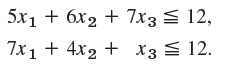
Maximize the total output f = x1+ x2+ x3(production from three distinct processes) subject to input constraints (limitation of time available for production) 5x1 + 6х2 + 7хз 12, 7x1 + 4x2 + X3 = 12.
Do steepest descent steps when:f(x) = x21 - x22 , x0 = (1, 2), 5 steps. First guess, then compute. Sketch the path. What if x0 = (2, 1)?
Write in normal form and solve by the simplex method, assuming all xj to be nonnegative.Maximize the daily profit in producing x1 metal frames F1 (profit $90 per frame) and x2 frames F2 (profit $50 per frame) subject to x1 + 3x2 ≤ 18 (material), x1 + x2 ≤ 10 (machine hours), 3x1 + x2 ≤ 24
Write in normal form and solve by the simplex method, assuming all xj to be nonnegative.Prob. 19Data from Prob. 19Giant Ladders, Inc., wants to maximize its daily total output of large step ladders by producing x1 of them by a process P1 and x2 by a process P2, where P1 requires 2 hours
Design a “method of steepest ascent” for determining maxima.
Do steepest descent steps when:f(x) = x21 + 0.5x22 - 5.0x1 - 3.0x2 + 24.95, x0 = (3, 4), 5 steps
Write in normal form and solve by the simplex method, assuming all xj to be nonnegative.Maximize the daily output in producing x1 chairs by Process P1 and x2 chairs by Process P2 subject to 3x1 + 4x2 ≤ 550 (machine hours), 5x1 + 4x2 ≤ 650 (labor)
Describe and graph the regions in the first quadrant of the x1x2-plane determined by the given inequalities.2x1 - x2 ≥ 68x1 + 10x2 ≤ 80x1 - 2x2 ≥ -3
Do Prob. 1 with the last two constraints interchanged.Data from Prob. 1Maximize z = f1(x) = 7x1 + 14x2 subject to 0 ≤ x1 ≤ 6, 0 ≤ x2 ≤ 3, 7x1 + 14x2 ≤ 84.
What happens if you apply the method of steepest descent to f(x) = x21 + x22? First guess, then calculate.
Write in normal form and solve by the simplex method, assuming all xj to be nonnegative.The problem in the example in the text with the constraints interchanged.
Solve the heat problem (1)–(3) by the explicit method with h = 0.2 and k = 0.01, 8 time steps, when f(x) = x if 0 ≤ x ≤ 1/2, f(x) = 1 - x if 1/2 ≤ x ≤ 1. Compare with the 3S-values 0.108, 0.175 for t = 0.08, x = 0.2, 0.4 obtained from the series (2 terms).
Solve the initial value problem by Adams–Moulton (7a), (7b), 10 steps with 1 correction per step. Solve exactly and compute the error. Use RK where no starting values are giveny' = (y - x - 1)2 + 2, y(0) = 1, h = 0.1, 10 steps
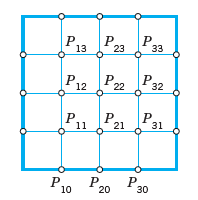
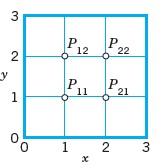
Find the potential in Fig. 472, using the given grid and the boundary values:u = 70 on the upper and left sides, u = 0 on the lower and right sides P2 P P. 13 33 23 P22 P12 P. P21 P31 |P11 P., P. 30 P. 20 P, 10
Find the potential in Fig. 472, using the given grid and the boundary values:u(P01) = u(P03) = u(P41) = u(P43) = 200,u(P10) = u(P30) = -400, u(P20) = 1600,u(P02) = u(P42) = u(P14) = u(P24) = u(P34) = 0 P2 P P. 13 33 23 P22 P12 P. P21 P31 |P11 P., P. 30 P. 20 P, 10
A laterally insulated homogeneous bar with ends at x = 0 and x = 1 has initial temperature 0. Its left end is kept at 0, whereas the temperature at the right end varies sinusoidally according toFind the temperature u (x, t) in the bar by the explicit method with h = 0.2 and r = 0.5 (one period,
Apply Runge–Kutta for systems to y'1 = 6y1 + 9y2, y'2 = y1 + 6y2, y1(0) = -3, y2(0) = -3, h = 0.05, 3 steps.
Apply Euler’s method for systems to y'1 = y2, y'2 = -4y1, y1(0) = 2, y2(0) = 0, h = 0.2, 10 steps. Sketch the solution.
Apply the A–M method to y' = (x + y - 4)2, y(0) = 4, h = 0.2, x = 0, · · ·, 1, starting with 4.00271, 4.02279, 4.08413.
Solve y' = 2x-1√y - lnx + x-1, y(1) = 0 for 1≤ x ≤ 1.8(a) By the Euler method with h = 0.1,(b) By the improved Euler method with h = 0.2(c) By RK with h = 0.4. Verify that the exact solution is y = (ln x)2 + ln x. Compute and compare the errors. Why is the comparison fair?
Solve y' + y = (x + 1)2, y(0) = 3 by the improved Euler method, 10 steps, with h = 0.1, Determine the errors.
Apply the program to Example 3 (10 steps, h = 0.1).
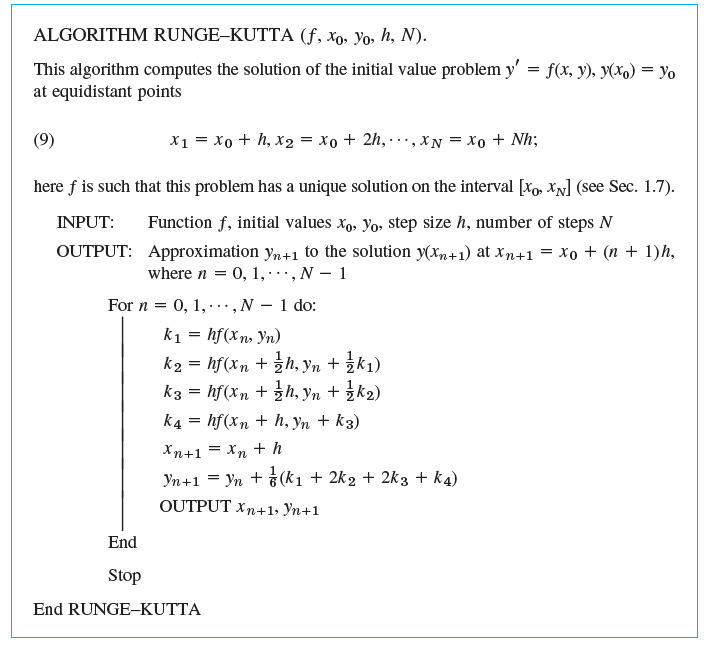
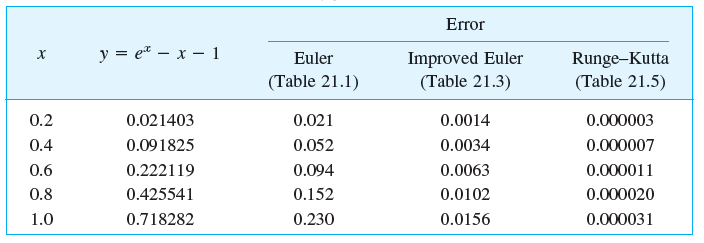
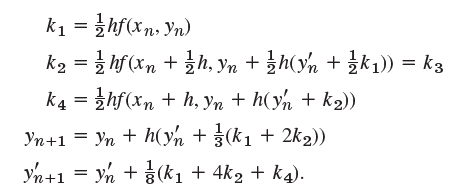
Kutta€™s third-order method is defined by yn+1= yn+ 1/6(k1+ 4k2+ k*3) with k1and k2as in RK (Table 21.3) and k*3= hf(xn+1, yn- k1+ 2k2). Apply this method to (4) in (6). Choose h = 0.2 and do 5 steps. Compare with Table 21.5.Table 21.3Table 21.5 ALGORITHM RUNGE-KUTTA (f, xo, Yo, h, N).
Do Prob. 17 with h = 0.01, 10 steps. Compute the errors. Compare the error for x = 0.1 with that in Prob. 17.Data from Prob. 17Solve y' = y, y(0) = 1 by Euler’s method, 10 steps, h = 0.1.
Apply the program to the square grid in 0 ≤ x ≤ 5, 0 ≤ y ≤ 5 with h = 1 and u = 220 on the upper and lower edges, u = 110 on the left edge and u = -10 on the right edge. Solve the linear system also by Gauss elimination. What accuracy is reached in the 20th Gauss–Seidel step?
Do 10 steps. Compare as indicated. Show details.Do Prob. 15 with h = 0.2, 5 steps, and compare the errors with those in Prob. 15.Data from Prob. 15y' + y tan x = sin 2x, y(0) = 1, h = 0.1
Apply the ADI method to the Dirichlet problem in Prob. 9, using the grid in Fig. 456, as before and starting values zero.Data from Prob. 9For the grid in Fig. 456 compute the potential at the four internal points by Gauss and by 5 Gauss€“Seidel steps with starting values 100, 100, 100,
Solve (1)–(3) by Crank–Nicolson with r = 1 (5 steps), where:f(x) = x(1 - x), h = 0.1. (Compare with Prob.15)Data from Prob. 15f(x) = x(1 - x), h = 0.2
Do 10 steps. Compare as indicated. Show details.y' = (1 - x-1)y, y(1) = 1, h = 0.1
The classical RK for a first-order ODE extends to second-order ODEs. If the ODE is y" = f(x, y), not containing y', thenApply this RKN (Runge€“Kutta€“Nyström) method to the Airy ODE in Example 2 with h = 0.2 as before, to obtain approximate values of Ai(x). k1 =
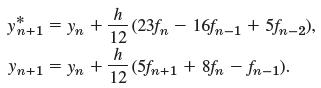
How much can you reduce the error in Prob. 13 by halfing h (20 steps, h = 0.05)? First guess, then compute.Data from Prob. 13 Using Prob. 12, solve y' = 2xy, y(0) = 1 (10 steps, h = 0.1, RK starting values). Compare with the exact solution and comment.Data from Prob. 12 h (23f,- 16fn-1 +
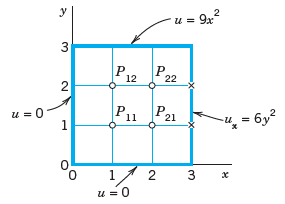
If, in Prob. 13, the axes are grounded (u = 0), what constant potential must the other portion of the boundary have in order to produce 220 V at P11?Data from Prob. 13Solve the mixed boundary value problem for the Laplace equation ˆ‡2u = 0 in the rectangle in Fig. 458a (using the
Using the answer to Prob. 13, try to sketch some isotherms.Data from Prob.13For the square 0 ≤ x ≤ 4, 0 ≤ y ≤ 4 let the boundary temperatures be on the horizontal and 50°C on the vertical edges. Find the temperatures at the interior points of a square grid with h = 1.
Solve the heat problem (1)–(3) by Crank–Nicolson for 0 ≤ t ≤ 0.20 with h = 0.2 and k = 0.04 when f(x) = x if 0 ≤ x ≤ 1/2, f(x) = 1 - x if 1/2 ≤ x ≤ 1. Compare with the exact values for t = 0.20 obtained from the series (2 terms).
Do 10 steps. Compare as indicated. Show details.y' = y - y2, y(0) = 0.2, h = 0.1. Compare with Prob. 8.Data from Prob. 8y' = y - y2, y(0) = 0.2, h = 0.1
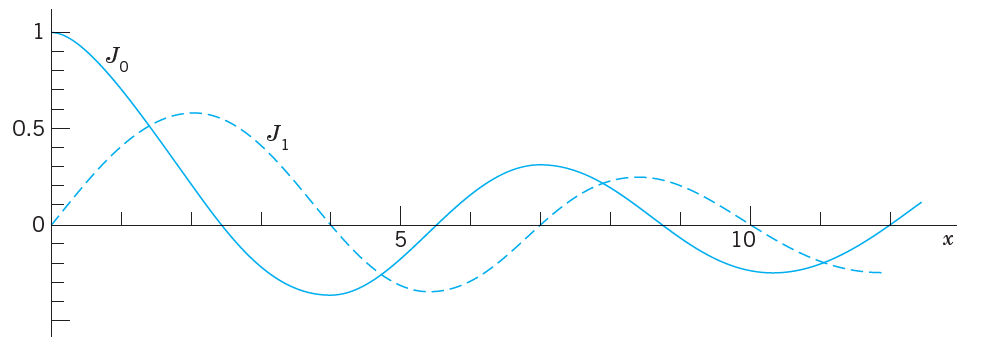
xy" + y' + xy = 0, y(1) = 0.765198, y'(1) = -0.440051, h = 0.5, 5 steps. (This gives the standard solution J0(x) in Fig. 110 0.5 - LO
Do Prob. 9 by Gauss€“Seidel, starting from 0. Compare and comment.Data from Prob. 9For the grid in Fig. 456 compute the potential at the four internal points by Gauss and by 5 Gauss€“Seidel steps with starting values 100, 100, 100, 100 (showing the details of your work) if the
Do 10 steps. Solve exactly. Compute the error. Show details.Do Prob. 7 using the improved Euler method, 20 steps with h = 0.05. Compare.Data from Prob. 7y' - xy2 = 0, y(0) = 1, h = 0.1
Solve by the classical RK.The system in Prob. 4Data from Prob. 4Solve by the Euler’s method. Graph the solution in the y1y2-plane. Calculate the errors.y'1 = -3y1 + y2, y'2 = y1 - 3y2, y1(0) = 2, y2(0) = 0, h = 0.1, 5 steps
If the left end of a laterally insulated bar extending from x = 0 to x = 1 is insulated, the boundary condition at x = 0 is un(0, t) = ux(0, t) = 0. Show that, in the application of the explicit method given by (5), we can compute uoj+1 by the formulauoj+1 = (1 - 2r)u0j + 2ru1j.Apply this with h =
Solve the initial value problem by Adams–Moulton (7a), (7b), 10 steps with 1 correction per step. Solve exactly and compute the error. Use RK where no starting values are giveny' = x/y, y(1) = 3, h = 0.2
For the grid in Fig. 456 compute the potential at the four internal points by Gauss and by 5 Gauss€“Seidel steps with starting values 100, 100, 100, 100 (showing the details of your work) if the boundary values on the edges are:u = x4 on the lower edge, 81 - 54y2 + y4 on the right, x4 -
Solve by the classical RK.The system in Prob. 2Data from Prob. 2y'1 = -y1 + y2, y'2 = -y1 - y2, y1(0) = 0, y2(0) = 4, h = 0.2, 5 steps
In a laterally insulated bar of length 1 let the initial temperature be f(x) = x if 0 ≤ x < 0.5, f(x) = 1 -x if 0.5 ≤ x ≤ 1. Let (1) and (3) hold. Apply the explicit method with h = 0.2, k = 0.01, 5 steps. Expect the solution to satisfy u(x, t) = u(1 - x, t) for all t?
Solve the initial value problem by Adams–Moulton (7a), (7b), 10 steps with 1 correction per step. Solve exactly and compute the error. Use RK where no starting values are giveny' = 1 - 4y2, y(0) = 0, h = 0.1
For the grid in Fig. 456 compute the potential at the four internal points by Gauss and by 5 Gauss€“Seidel steps with starting values 100, 100, 100, 100 (showing the details of your work) if the boundary values on the edges are:u = 220 on the upper and lower edges, 110 on the left and
Compute approximate values in Prob. 7, using a finer grid (h = 0.1, k = 0.1), and notice the increase in accuracy.Data from Prob. 7If the string governed by the wave equation (1) starts from its equilibrium position with initial velocity g(x) = sin πx, what is its displacement at time t = 0.4 and
Do 10 steps. Solve exactly. Compute the error. Show details.y' = 2(1 + y2), y(0) = 0, h = 0.05
Solve by the Euler’s method. Graph the solution in the y1y2-plane. Calculate the errors.y'1 = y1, y'2 = -y2, y1(0) = 2, y2(0) = 2, h = 0.1, 10 steps
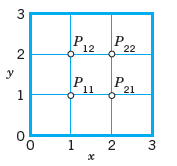
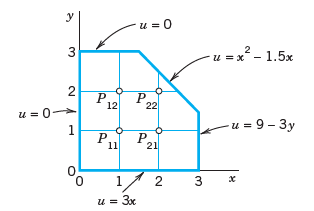
Solve ˆ‡2u = -Ï€2y sin 1/3Ï€x for the grid in Fig. 462 and uy(1, 3) = uy(2, 3) = 1/2ˆš243, u = 0 on the other three sides of the square. и%3D 9 3 P, P. 12 22 2 P21 и %3 0 - бу? и 11 -и, х 2 3 х и в 0
For the grid in Fig. 456 compute the potential at the four internal points by Gauss and by 5 Gauss€“Seidel steps with starting values 100, 100, 100, 100 (showing the details of your work) if the boundary values on the edges are:u = 0 on the left, x3 on the lower edge, 27 - 9y2 on the
Solve (1)–(3) (h = k = 0.2, 5 time steps) subject to f(x) = x2, g(x) = 2x, ux(0, t) = 2t, u(1, t) = (1 + t)2.
Do 10 steps. Solve exactly. Compute the error. Show details.y' = (y + x)2, y(0) = 0, h = 0.1
Solve by the Euler’s method. Graph the solution in the y1y2-plane. Calculate the errors.y'1 = -3y1 + y2, y'2 = y1 - 3y2, y1(0) = 2, y2(0) = 0, h = 0.1, 5 steps
(a) Write programs for the explicit and the Crank€”Nicolson methods.(b) Apply the programs to the heat problem of a laterally insulated bar of length 1 with u(x, 0) = sin Ï€x and u(0, t) = u(1, t) = 0 for all t, using h = 0.2, k = 0.01 for the explicit method (20 steps), h = 0.2
Showing 2500 - 2600
of 3937
First
19
20
21
22
23
24
25
26
27
28
29
30
31
32
33
Last
Step by Step Answers

 Get 50% OFF
Claim Now
Get 50% OFF
Claim Now