New Semester
Started
Get
50% OFF
Study Help!
--h --m --s
Claim Now
Question Answers
Textbooks
Find textbooks, questions and answers
Oops, something went wrong!
Change your search query and then try again
S
Books
FREE
Study Help
Expert Questions
Accounting
General Management
Mathematics
Finance
Organizational Behaviour
Law
Physics
Operating System
Management Leadership
Sociology
Programming
Marketing
Database
Computer Network
Economics
Textbooks Solutions
Accounting
Managerial Accounting
Management Leadership
Cost Accounting
Statistics
Business Law
Corporate Finance
Finance
Economics
Auditing
Tutors
Online Tutors
Find a Tutor
Hire a Tutor
Become a Tutor
AI Tutor
AI Study Planner
NEW
Sell Books
Search
Search
Sign In
Register
study help
mathematics
advanced engineering mathematics
Advanced Engineering Mathematics 10th edition Erwin Kreyszig - Solutions
Solve the given nonhomogeneous linear ODE by variation of parameters or undetermined coefficients. Show the details of your work.(D2 + 4I)y = cosh 2x
Find a (real) general solution. State which rule you are using. Show each step of your work.(3D2 + 27I)y = 3 cos x + cos 3x
Find a real general solution. Show the details of your work.(x2D2 - 3xD + 4I)y = 0
Find a real general solution. Show the details of your work.x2y" - 20y = 0
Find a (real) general solution. State which rule you are using. Show each step of your work.10y" + 50y' + 57.6y = cos x
Solve the given nonhomogeneous linear ODE by variation of parameters or undetermined coefficients. Show the details of your work.y" + 9y = csc 3x
If a weight of 20 nt (about 4.5 lb) stretches a certain spring by 2 cm, what will the frequency of the corresponding harmonic oscillation be? The period?
Solve the given nonhomogeneous linear ODE by variation of parameters or undetermined coefficients. Show the details of your work.y" - 4y' + 5y = e2x csc x
Find a (real) general solution. State which rule you are using. Show each step of your work.y" - 9y = 18 cos πx
Find a real general solution. Show the details of your work.xy" + 2y' = 0
Linear accelerators are used in physics for accelerating charged particles. Suppose that an alpha particle enters an accelerator and undergoes a constant acceleration that increases the speed of the particle from 103 m/sec to 104 m/sec in 10-3 sec. Find the acceleration a and the distance
Find the steady-state motion of the mass–spring system modeled by the ODE. Show the details of your work.(D2 + 4D + 3I)y = cos t + 1/3 cos 3t
Find the steady-state motion of the mass–spring system modeled by the ODE. Show the details of your work.(D2 + D + 4.25I)y = 22.1 cos 4.5t
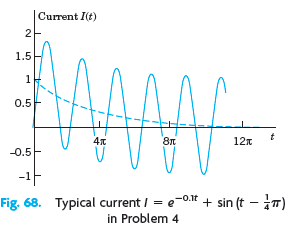
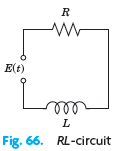
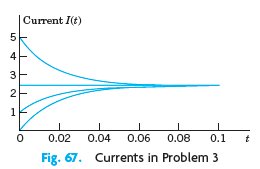
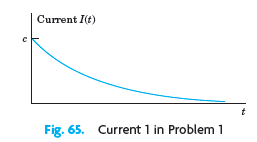
Solve Prob. 3 when E = E0sin ωt and R, L, E0, and?are arbitrary. Sketch a typical solution. Data from Prob. 3 Model the RL-circuit in Fig. 66. Find a general solution when R, L, E are any constants. Graph or sketch solutions when L = 0.25 H, R = 10 Ω, and E = 48 V. Current I(t) 2 1.5 1 0.5 4
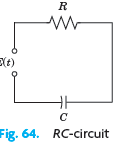
Solve Prob. 1 when E = E0sin ωt and R, C, E0, and are arbitrary. Data from prob. 1 Model the RC-circuit in Fig. 64. Find the current due to a constant E. R E(t) Fig. 64. RC-circuit
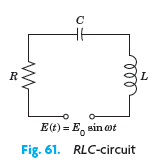
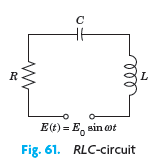
Find the steady-state current in the RLC- circuit in Fig. 61 for the given data. Show the details of your work. R = 4 Ω, L = 0.5 H, C = 0.1 F, E = 500 sin 2t V L E(t) = E, sin ot Fig. 61. RLC-circuit
Find the steady-state current in the RLC-circuit in Fig. 61 for the given data. Show the details of your work. R = 2 Ω, L = 1 H, C = 1/20 F, E = 157 sin 3t V L E(t) = E, sin ot Fig. 61. RLC-circuit
Linear Independence is of basic importance, in this chapter, in connection with general solutions, as explained in the text. Are the following functions linearly independent on the given interval? Show the details of your work.e-x cos 1/2x, 0, -1 < x < 1
Linear Independence is of basic importance, in this chapter, in connection with general solutions, as explained in the text. Are the following functions linearly independent on the given interval? Show the details of your work.In x, ln (x3), x > 1
Linear Independence is of basic importance, in this chapter, in connection with general solutions, as explained in the text. Are the following functions linearly independent on the given interval? Show the details of your work.eαx, e-αx, x > 0
Solve the IVP. Check that your answer satisfies the ODE as well as the initial conditions. Show the details of your work.9y" - 30y' + 25y = 0, y(0) = 3.3, y' (0) = 10.0
Solve the IVP. Check that your answer satisfies the ODE as well as the initial conditions. Show the details of your work.8y" - 2y' - y = 0, y(0) = -0.2, y' (0) = -0.325
Solve the IVP. Check that your answer satisfies the ODE as well as the initial conditions. Show the details of your work.y" - k2y = 0 (k ≠ 0), y(0) = 1, y' (0) = 1
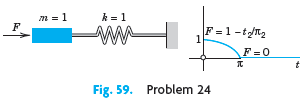
Solve y" + y = 1 - t2/π2?if 0<t<π and 0 if t ?? ??; here, y(0) = 0, y' (0) = 0. This models an undamped system on which a force F acts during some interval of time (see Fig. 59), for instance, the force on a gun barrel when a shell is fired, the barrel being braked by heavy springs (and
Solve the IVP. Check that your answer satisfies the ODE as well as the initial conditions. Show the details of your work.4y" - 4y' - 3y = 0, y( -2) = e, y' (-2) = -e/ 2
Solve y" + 25y = 99 cos 4.9t, y(0) = 2, y' (0) = 0. How does the graph of the solution change if you change(a) y(0)(b) the frequency of the driving force?
Solve the IVP. Check that your answer satisfies the ODE as well as the initial conditions. Show the details of your work.y" + 4y' + (π2 + 4)y = 0, y(1/2) = 1, y' (1/2) = -2
Find the motion of the mass–spring system modeled by the ODE and the initial conditions. Sketch or graph the solution curve. In addition, sketch or graph the curve of y - yp to see when the system practically reaches the steady state.(D2+ 5I)y = cos πt - sin πt, y(0) = 0, y' (0) = 0
Find an ODE y" + ay' + by = 0 for the given basis.e-3.1x cos 2.1x, e-3.1x sin 2.1x
Find the motion of the mass–spring system modeled by the ODE and the initial conditions. Sketch or graph the solution curve. In addition, sketch or graph the curve of y - yp to see when the system practically reaches the steady state.(D2+ 8D + 17I)y = 474.5 sin 0.5t, y(0) = -5.4, y' (0) = 9.4
(a) Verify that the given functions are linearly independent and form a basis of solutions of the given ODE. (b) Solve the IVP. Graph or sketch the solution.x2y'' - xy' + y = 0, y(1) = 4.3, y' (1) = 0.5, x, x ln x
Find the motion of the mass–spring system modeled by the ODE and the initial conditions. Sketch or graph the solution curve. In addition, sketch or graph the curve of y - yp to see when the system practically reaches the steady state.y" + 25y = 24 sin t, y(0) = 1, y'(0) = 1
(a) Verify that the given functions are linearly independent and form a basis of solutions of the given ODE. (b) Solve the IVP. Graph or sketch the solution.y'' + 0.6y' + 0.09y = 0, y(0) = 2.2,y' (0) = 0.14, e-0.3x, xe-0.3x
Find the transient motion of the mass–spring system modeled by the ODE. Show the details of your work.(D2+ I)y = 5e-t cos t
Find a general solution. Check your answer by substitution. ODEs of this kind have important applications to be discussed in Secs. 2.4, 2.7, and 2.9.y" + 2k2y' + k4y = 0
In a straight-line motion, let the velocity be the reciprocal of the acceleration. Find the distance y(t) for arbitrary initial position and velocity.
Find the transient motion of the mass–spring system modeled by the ODE. Show the details of your work.(D2+ 2D + 5I)y = 4 cos t + 8 sin t
Find a general solution. Check your answer by substitution. ODEs of this kind have important applications to be discussed in Secs. 2.4, 2.7, and 2.9.y" + 9y' + 20y = 0
Apply the given operator to the given functions. Show all steps in detail.(D2 + 3.0D + 2.5I)y = 0
Reduce to first order and solve, showing each step in detail.y'' + (1 + 1/y)y'2 = 0
Find the transient motion of the mass–spring system modeled by the ODE. Show the details of your work.y" + 16y = 56 cos 4t
Find a general solution. Check your answer by substitution. ODEs of this kind have important applications to be discussed in Secs. 2.4, 2.7, and 2.9.100y" + 240y' + (196π2 + 144)y = 0
Apply the given operator to the given functions. Show all steps in detail.(D2 + 4.80D + 5.76I)y = 0
Reduce to first order and solve, showing each step in detail.y'' = 1 + y'2
Find the transient motion of the mass–spring system modeled by the ODE. Show the details of your work.2y" + 4y' + 6.5y = 4 sin 1.5t
Find a general solution. Check your answer by substitution. ODEs of this kind have important applications to be discussed in Secs. 2.4, 2.7, and 2.9.y" + y' + 3.25y = 0
Apply the given operator to the given functions. Show all steps in detail.(D2 + 3I)y = 0
Find a general solution. Check your answer by substitution. ODEs of this kind have important applications to be discussed in Secs. 2.4, 2.7, and 2.9.10y" - 32y' + 25.6y = 0
Apply the given operator to the given functions. Show all steps in detail.(D2 + 4.00D + 3.36I)y = 0
Reduce to first order and solve, showing each step in detail.xy'' + 2y' + xy = 0, y1 = (cos x)/x
Reduce to first order and solve, showing each step in detail.2xy'' = 3y'
Find the steady-state motion of the mass–spring system modeled by the ODE. Show the details of your work.y" + 2.5y' + 10y = -13.6 sin 4t
Find a general solution. Check your answer by substitution. ODEs of this kind have important applications to be discussed in Secs. 2.4, 2.7, and 2.9.y" + 4y' + (π2 + 4)y = 0
Apply the given operator to the given functions. Show all steps in detail.(D + 6I)2; 6x + sin 6x, xe-6x
Find a general solution. Check your answer by substitution. ODEs of this kind have important applications to be discussed in Secs. 2.4, 2.7, and 2.9.y" + 36y = 0
Apply the given operator to the given functions. Show all steps in detail.D - 3I; 3x2 + 3x, 3e3x, cos 4x - sin 4x
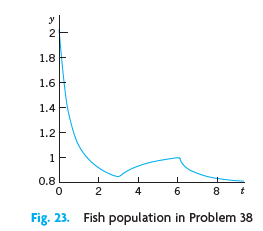
In Prob. 36 assume that you fish for 3 years, then fishing is banned for the next 3 years. Thereafter you start again. And so on. This is called intermittent harvesting. Describe qualitatively how the population will develop if intermitting is continued periodically. Find and graph the solution for
Suppose that the population y(t) of a certain kind of fish is given by the logistic equation (11), and fish are caught at a rate Hy proportional to y. Solve this so-called Schaefer model. Find the equilibrium solutions y1 and y2 (> 0) when H < A. The expression Y = Hy2 is called the
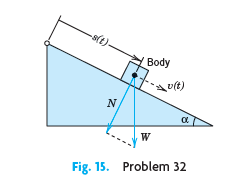
If a body slides on a surface, it experiences friction F (a force against the direction of motion). Experiments show that |F| = μ|N| (Coulomb's law of kinetic friction without lubrication), where N is the normal force (force that holds the two surfaces together; see Fig. 15) and the constant of
A Riccati equation is of the form? ?y' + p(x)y = g(x)y2 + h(x) A Clairaut equation is of the form y = xy' + g(y'). (a) Apply the transformation y = Y + 1/u to the Riccati equation (14), where Y is a solution of (14), and obtain for u the linear ODE u' + (2Yg - p)u = -g. Explain the effect of the
A rocket is shot straight up from the earth, with a net acceleration (= acceleration by the rocket engine minus gravitational pullback) of 7t m/sec2 during the initial stage of flight until the engine cut out at t = 10 sec. How high will it go, air resistance neglected?
A metal bar whose temperature is is 20°C placed in boiling water. How long does it take to heat the bar to practically 100°C say, to 99.9°C, if the temperature of the bar after 1 min of heating is 51.5°C? First guess, then calculate.
Using a method of this section or separating variables, find the general solution. If an initial condition is given, find also the particular solution and sketch or graph it.2xyy' + (x - 1)y2 = x2ex, (Set y2 = z)
Could you see, practically without calculation, that the answer in Prob. 27 must lie between 60 and 70 min? Explain.Data from Prob 27If a wet sheet in a dryer loses its moisture at a rate proportional to its moisture content, and if it loses half of its moisture during the first 10 min of drying,
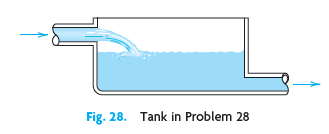
The tank in Fig. 28 contains 80 lb of salt dissolved in 500 gal of water. The inflow per minute is 20 lb of salt dissolved in 20 gal of water. The outflow is 20 gal/min of the uniform mixture. Find the time when the salt content y(t) in the tank reaches 95% of its limiting value (as t ?? ??). Fig.
Using a method of this section or separating variables, find the general solution. If an initial condition is given, find also the particular solution and sketch or graph it.y' = (tan y)/(x - 1), y(0) = 1/2π
Solve the IVP. Indicate the method used. Show the details of your work.x sinh y dy = cosh y dx, y(3) = 0
Using a method of this section or separating variables, find the general solution. If an initial condition is given, find also the particular solution and sketch or graph it.y' + y = -x/y
A tank contains 400 gal of brine in which 100 lb of salt are dissolved. Fresh water runs into the tank at a rate of 2 gal/min. The mixture, kept practically uniform by stirring, runs out at the same rate. How much salt will there be in the tank at the end of 1 hour?
Solve the IVP. Indicate the method used. Show the details of your work.y' + 1/2y = y3, y(0) = 1/3
Using a method of this section or separating variables, find the general solution. If an initial condition is given, find also the particular solution and sketch or graph it.y' + y = y2, y(0) = -1/3
Solve the IVP. Indicate the method used. Show the details of your work.y' + 4xy = e-2x2, y(0) = -4.3
These properties are of practical and theoretical importance because they enable us to obtain new solutions from given ones. Thus in modeling, whenever possible, we prefer linear ODEs over nonlinear ones, which have no similar properties.Show that nonhomogeneous linear ODEs (1) and homogeneous
The efficiency of the engines of subsonic airplanes depends on air pressure and is usually maximum near 35,000 ft. Find the air pressure y(x) at this height. Physical information. The rate of change y'(x) is proportional to the pressure. At 18,000 ft it is half its value y0 = y(0) at sea level.
(a) If the birth rate and death rate of the number of bacteria are proportional to the number of bacteria present, what is the population as a function of time.(b) What is the limiting situation for increasing time? Interpret it.
Find the general solution. Indicate which method in this chapter you are using. Show the details of your work.y' = ay + by2 (a ≠ 0)
This is the simplest method to explain numerically solving an ODE, more precisely, an initial value problem (IVP). Using the method, to get a feel for numerics as well as for the nature of IVPs, solve the IVP numerically with a PC or a calculator, 10 steps. Graph the computed values and the
These properties are of practical and theoretical importance because they enable us to obtain new solutions from given ones. Thus in modeling, whenever possible, we prefer linear ODEs over nonlinear ones, which have no similar properties.Show that nonhomogeneous linear ODEs (1) and homogeneous
Radium 22488 Ra has a half-life of about 3.6 days.(a) Given 1 gram, how much will still be present after 1 day?(b) After 1 year?
Introduce limits of integration in (3) such that y obtained from (3) satisfies the initial condition y(x0) = y0.
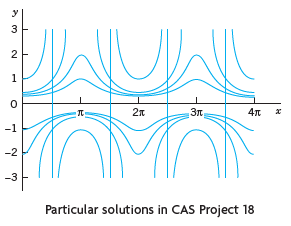
Graph particular solutions of the following ODE, proceeding as explained.(21)? ? ?dy - y2sin x dx = 0 (a) Show that (21) is not exact. Find an integrating factor using either Theorem 1 or 2. Solve (21). (b) Solve (21) by separating variables. Is this simpler than (a)? (c) Graph the seven particular
Find the general solution. Indicate which method in this chapter you are using. Show the details of your work.y' - 0.4y = 29 sin x
This is the simplest method to explain numerically solving an ODE, more precisely, an initial value problem (IVP). Using the method, to get a feel for numerics as well as for the nature of IVPs, solve the IVP numerically with a PC or a calculator, 10 steps. Graph the computed values and the
These properties are of practical and theoretical importance because they enable us to obtain new solutions from given ones. Thus in modeling, whenever possible, we prefer linear ODEs over nonlinear ones, which have no similar properties.Show that nonhomogeneous linear ODEs (1) and homogeneous
If y' = f(x) with f independent of y, show that the curves of the corresponding family are congruent, and so are their OTs.
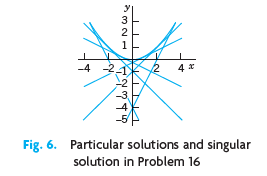
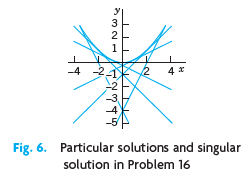
An ODE may sometimes have an additional solution that cannot be obtained from the general solution and is then called a singular solution. The ODE y'2- xy' + y = 0 is of this kind. Show by differentiation and substitution that it has the general solution y = cx - c2 and the singular solution y
Solve the IVP. Show the steps of derivation, beginning with the general solution.y' = (x + y - 2)2, y(0) = 2, (Set v = x + y - 2)
Graph a direction field (by a CAS or by hand) and sketch some solution curves. Solve the ODE exactly and compare. In Prob. 16 use Euler’s method.Solve y' = y - y2, y(0) = 0.2 by Euler’s method (10 steps, h = 0.1). Solve exactly and compute the error.
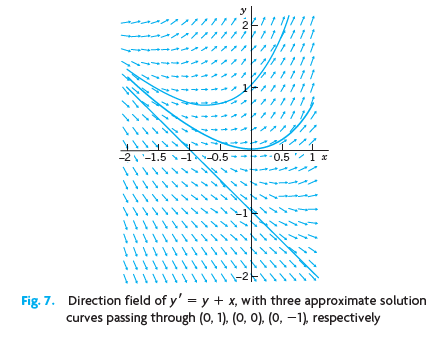
Discuss direction fields as follows.(a) Graph portions of the direction field of the ODE (2) (see Fig. 7), for instance, -5<x<2, -1<y<5. Explain what you have gained by this enlargement of the portion of the field.(b) Using implicit differentiation, find an ODE with the general solution
Model the motion of a body B on a straight line with velocity as given, y(t) being the distance of B from a point y = 0 at time t. Graph a direction field of the model (the ODE). In the field sketch the solution curve satisfying the given initial condition.Square of the distance plus square of the
(a) Solve the ODE y' - y/x = -x-1 cos (1/x). Find an initial condition for which the arbitrary constant becomes zero. Graph the resulting particular solution, experimenting to obtain a good figure near x = 0.(b) Generalizing (a) from n = 1 to arbitrary n, solve the ODE y' - ny/x = -xn-2 cos
Find the conditions under which the orthogonal trajectories of families of ellipses x2/a2 + y2/b2 = c are again conic sections. Illustrate your result graphically by sketches or by using your CAS. What happens if a → 0? If b → 0?
Solve the IVP. Show the steps of derivation, beginning with the general solution.dr/dt = -2tr, r(0) = r0
Test for exactness. If exact, solve. If not, use an integrating factor as given or obtained by inspection or by the theorems in the text. Also, if an initial condition is given, find the corresponding particular solution.(a + 1)y dx + (b + 1)x dy = 0, y(1) = 1, F = xayb
Graph a direction field (by a CAS or by hand) and sketch some solution curves. Solve the ODE exactly and compare.xy' = y + x2
Model the motion of a body B on a straight line with velocity as given, y(t) being the distance of B from a point y = 0 at time t. Graph a direction field of the model (the ODE). In the field sketch the solution curve satisfying the given initial condition. Product of velocity times distance
Find the general solution. If an initial condition is given, find also the corresponding particular solution and graph or sketch it. (Show the details of your work.)xy' + 4y = 8x4, y(1) = 2
(a) Verify that y is a solution of the ODE.(b) Determine from y the particular solution of the IVP(c) Graph the solution of the IVP.yy' = 4x, y2 - 4x2 = c (y > 0), y(1) = 4
Solve the IVP. Show the steps of derivation, beginning with the general solution.y' = 1 + 4y2, y(1) = 0
Test for exactness. If exact, solve. If not, use an integrating factor as given or obtained by inspection or by the theorems in the text. Also, if an initial condition is given, find the corresponding particular solution.(2xy dx + dy)ex2 = 0, y(0) = 2
Showing 3800 - 3900
of 3937
First
26
27
28
29
30
31
32
33
34
35
36
37
38
39
40
Step by Step Answers

 Get 50% OFF
Claim Now
Get 50% OFF
Claim Now