New Semester
Started
Get
50% OFF
Study Help!
--h --m --s
Claim Now
Question Answers
Textbooks
Find textbooks, questions and answers
Oops, something went wrong!
Change your search query and then try again
S
Books
FREE
Study Help
Expert Questions
Accounting
General Management
Mathematics
Finance
Organizational Behaviour
Law
Physics
Operating System
Management Leadership
Sociology
Programming
Marketing
Database
Computer Network
Economics
Textbooks Solutions
Accounting
Managerial Accounting
Management Leadership
Cost Accounting
Statistics
Business Law
Corporate Finance
Finance
Economics
Auditing
Tutors
Online Tutors
Find a Tutor
Hire a Tutor
Become a Tutor
AI Tutor
AI Study Planner
NEW
Sell Books
Search
Search
Sign In
Register
study help
mathematics
advanced engineering mathematics
Advanced Engineering Mathematics 10th edition Erwin Kreyszig - Solutions
Find the transform. Show the details of your work. Assume that α, b, ω, θ are constants.(α - bt)2
Solve the IVPs by the Laplace transform. If necessary, use partial fraction expansion as in Example 4 of the text. Show all details.y' + 2y = 0, y(0) = 1.5
Show that Iv(x) is real for all real x (and real v), Iv ≠ 0 for all real x ≠ 0, and I-n(x) = In(x), where n is any integer.
Apply the power series method. Do this by hand, not by a CAS, to get a feel for the method, e.g., why a series may terminate, or has even powers only, etc. Show the details.xy' - 3y = k (= const)
Apply the power series method. Do this by hand, not by a CAS, to get a feel for the method, e.g., why a series may terminate, or has even powers only, etc. Show the details.(1 + x)y' = y
If a system has a center as its critical point, what happens if you replace the matrix A by A∼ = A + kI with any real number k ≠ 0 (representing measurement errors in the diagonal entries)?
Find a general solution. Determine the kind and stability of the critical point.y'1 = 4y2y'2 = -4y1
What happens to the critical point in Example 1 if you introduce τ = -t as a new independent variable?
Find the location and type of all critical points by first converting the ODE to a system and then linearizing it.y" + 9y + y2 = 0
A bar with heat generation of constant rate H( >0) is modeled by ut = c2uxx + H. Solve this problem if L = π and the ends of the bar are kept at 0°C. Set u = v - Hx(x - π)/(2c2).
This happens if a PDE involves derivatives with respect to one variable only (or can be transformed to such a form), so that the other variable(s) can be treated as parameter(s). Solve for u = u(x, y):uyy = 0
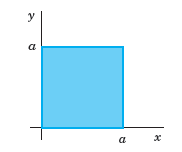
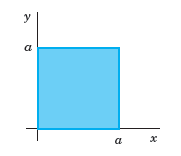
Show that among all rectangular membranes of the same area A = αb and the same c the square membrane is that for which u11 has the lowest frequency.
Find the potential in the interior of the sphere r = R = 1 if the interior is free of charges and the potential on the sphere isf (Φ) = 1 - cos2 Φ
Find the type, transform to normal form, and solve. Show your work in detail.uxx - 6uxy + 9uyy = 0
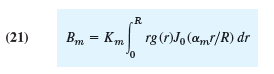
Nonzero initial velocity is more of theoretical interest because it is difficult to obtain experimentally. Show that for (17) to satisfy (9b) we must havewhere Km = 2/(cαmR)J21(αm). Bm = Km rg(r)Jo(amr/R) dr (21)
This happens if a PDE involves derivatives with respect to one variable only (or can be transformed to such a form), so that the other variable(s) can be treated as parameter(s). Solve for u = u(x, y):25uyy - 4u = 0
Transform to normal form and solve:uxx + 6uxy + 9uyy = 0
Show that the Tricomi equation yuxx + uyy = 0 is of mixed type. Obtain the Airy equation G" - yG = 0 from the Tricomi equation by separation.
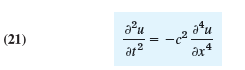
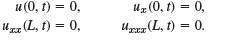
By the principles used in modeling the string it can be shown that small free vertical vibrations of a uniform elastic beam (Fig. 292) are modeled by the fourth-order PDEwhere c2 = EI/ÏA (E = Young€™s modulus of elasticity, I = moment of intertia of the cross section with
Find the steady-state solutions (temperatures) in the square plate in Fig. 297 with α = 2 satisfying the following boundary conditions. Graph isotherms.(a) u = 80 sin πx on the upper side, 0 on the others.(b) u = 0 on the vertical sides, assuming that the other sides are
This happens if a PDE involves derivatives with respect to one variable only (or can be transformed to such a form), so that the other variable(s) can be treated as parameter(s). Solve for u = u(x, y):2uxx + 9ux + 4u = -3 cos x - 29 sin x
Find the potentials exterior to the sphere in Probs. 16 and 19.Data from Prob. 16Find the potential in the interior of the sphere r = R = 1 if the interior is free of charges and the potential on the sphere isf (Φ) = cos ΦData from Prob. 19Find the potential in the interior of the sphere r = R =
Find the steady-state temperature in the plate in Prob. 21 if the lower side is kept at U0°C the upper side at U1°C and the other sides are kept at 0°C. Split into two problems in which the boundary temperature is 0 on three sides for each problem.Data from Prob. 21The faces of the thin
(a) Show that ez is entire. What about e1/z? ez̅? ex(cos ky + i sin ky)? (Use the Cauchy–Riemann equations.)(b) Find all z such that(i) ez is real.(ii) |e-z| < 1.(iii) ez̅ = e̅z̅.(c) It is interesting that f(z) = ez is uniquely determined by the two properties f(x + i0) = ex and f'(z)
Find the value of the derivative of(1.5z + 2i)/(3iz - 4) at any z. Explain the result.
Find all solutions and graph some of them in the complex plane.ez = 4 + 3i
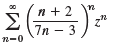
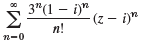
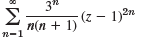
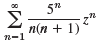
Find the radius of convergence in two ways:(a) Directly by the Cauchy€“Hadamard formula in Sec. 15.2.(b) From a series of simpler terms by using Theorem 3 or Theorem 4.
Find the radius of convergence in two ways:(a) Directly by the Cauchy€“Hadamard formula in Sec. 15.2.(b) From a series of simpler terms by using Theorem 3 or Theorem 4.
Find the radius of convergence in two ways:(a) Directly by the Cauchy€“Hadamard formula in Sec. 15.2.(b) From a series of simpler terms by using Theorem 3 or Theorem 4. 00
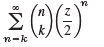
Prove that the series converges uniformly in the indicated region.
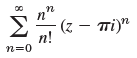
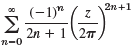
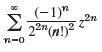
Find the center and the radius of convergence.
Find all the singularities in the finite plane and the corresponding residues. Show the details.e1/(1-z)
Determine the location of the singularities, including those at infinity. For poles also state the order. Give reasons.tan πz
Sketch or graph the given region and its image under the given mapping.|z| < 1/2, Im z > 0, w = 1/z
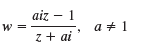
Find the fixed points. aiz – 1 a + 1 z+ ai
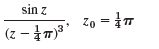
Find the Laurent series that converges for 0 < |z - z0| < R and determine the precise region of convergence. Show details. sin z Zo Zo = 17 (z – m)3*
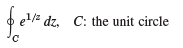
Evaluate (counterclockwise). Show the details. el/ dz, C: the unit circle
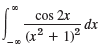
Evaluate the following integrals and show details of your work. cos 2x dx (x2 + 1)2
Integrate counterclockwise around C. Show the details.15z + 9/z3 - 9z, C:|z| = 4
Find the LFT that maps the given three points onto the three given points in the respective order.-3/2, 0, 1 onto 0, 3/2, 1
Find an LFT that maps |z| ≤ 1 onto |w| ≤ 1 so that z = i/2 is mapped onto w = 0. Sketch the images of the lines x = const and y = const.
Determine the location of the singularities, including those at infinity. For poles also state the order. Give reasons.z3 exp(1/z- 1)
Sketch or graph the given region and its image under the given mapping.-1 ≤ x ≤ 2, -π < y < π, w = ez
Find the images of the lines y = k = const under the mapping w = cos z.
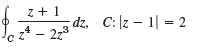
Evaluate (counterclockwise). Show the details. dz, C: |z – 1| = 2 Jczt – 223
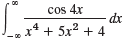
Evaluate the following integrals and show details of your work. 00 cos 4x – dx x* + 5x2 + 4
Integrate counterclockwise around C. Show the details.cot 4z, C:|z| = 3/4
Find an analytic function that maps the second quadrant of the z-plane onto the interior of the unit circle in the w-plane.
Determine the location of the singularities, including those at infinity. For poles also state the order. Give reasons.1/(cos z - sin z)
Sketch or graph the given region and its image under the given mapping.1/2 ≤ |z| ≤ 1, 0 ≤ θ < π/2, w = Ln z
Find and sketch or graph the image of the given region under the mapping w = cos z.0 < x < 2π, 1/2 < y < 1
Find all LFTs with fixed point(s).Without any fixed points
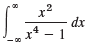
Evaluate the following integrals and show details of your work. dx .3 8 -x*
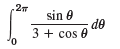
Evaluate by the methods of this chapter. Show details. .27 sin 0 3 + cos 0
Determine the location of the singularities, including those at infinity. For poles also state the order. Give reasons.(z - π)-1 sin z
Find and sketch or graph the image of the given region under the mapping w = cos z.-1 < x < 1, 0 ≤ y ≤ 1
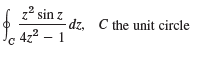
Evaluate (counterclockwise). Show the details. z? sin z dz, dz. C the unit circle c 4z² – 1
Evaluate the following integrals and show details of your work. dx 2 - ix
Evaluate by the methods of this chapter. Show details. dx 1+ 4x* -0-
Verify Theorem 1 for f(z) = z-3 - z-1. Prove Theorem 1.
Find all points at which the mapping is not conformal. Give reason.exp (z5 - 80z)
Find and sketch the image of the region 2 ≤ |z| ≤ 3, π/4 ≤ θ ≤ π/2 under the mapping w = Ln z.
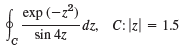
Evaluate (counterclockwise). Show the details. exp (-2?) -dz, C:|z| = 1.5 sin 4z
Evaluate by the methods of this chapter. Show details. dx x² – 4ix -00
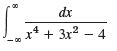
Find the Cauchy principal value (showing details): dx x* + 3x2 .4
Find the magnification ratio M. Describe what it tells you about the mapping. Where is M = 1? Find the Jacobian J.w = 1/z2
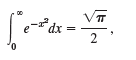
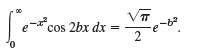
(a) Integrating e-z2 around the boundary C of the rectangle with vertices -α, α, α + ib, -α + ib, letting α †’ ˆž, and usingshow that(This integral is needed in heat conduction in Sec. 12.7.)(b) Solve
Prove the statement in Prob. 27 for general k = 1, 2, · · ·. Use the Taylor series.Data from Prob. 27Let f(z) be analytic at z0. Suppose that f'(z0) = 0, · · ·, f(k-1)(z0) = 0. Then the mapping w = f(z) magnifies angles with vertex at z0 by a factor k. Illustrate this with examples for k
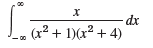
Find the Cauchy principal value (showing details): dx -00
Find the magnification ratio M. Describe what it tells you about the mapping. Where is M = 1? Find the Jacobian J.w = z +1/2z - 2
Find and sketch the image of the given region or curve under w = z2.1/√π < |z| < √π, 0 < arg z < π/2
Find and sketch the image of the given region or curve under w = z2.0 < y < 2
Find and sketch the image of the given region or curve under w = z2.y = -2, 2
Find and sketch the image of the given region or curve under w = 1/z.|z| < 1, 0 < arg z < π/2
Find and sketch the image of the given region or curve under w = 1/z.0 ≤ arg z ≤ π/4
Find and sketch the image of the given region or curve under w = 1/z.z = 1 + iy (-∞ < y < ∞)
Find the LFT that maps0, 2, 4 onto ∞, 1/2, 1/4, respectively
Find the LFT that maps-1, -i, i onto 1 - i, 2, 0, respectively
Find the fixed points of the mappingw = z4 + z - 64
Find the fixed points of the mappingw = (2iz - 1)/(z + 2i)
Find an analytic function w = f(z) that mapsThe quarter-disk |z| < 1, x > 0, y > 0 onto the exterior of the unit circle |w| = 1.
Find an analytic function w = f(z) that mapsThe interior of the unit circle |z| = 1 onto the exterior of the circle |w + 2| = 2.
Find an analytic function w = f(z) that mapsThe semi-disk |z| < 2, y > 0 onto the exterior of the circle |w - π| = π.
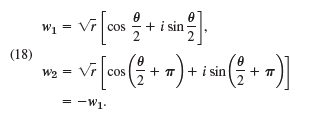
(a) Show that w = ˆšz has the values(b) Obtain from (18) the often more practical formulawhere sign y = 1 if y ‰¥ 0, sign y = -1 if y < 0, and all square roots of positive numbers are taken with positive sign. Use (10) in App. A3.1 with x = θ/2.(c) Find the square
Represent in polar form, with the principal argument.0.6 + 0.8i
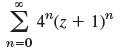
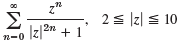
Where does the power series converge uniformly? Give reason.
Is the given sequence z1, z2, · · ·, zn, · · · bounded?Convergent? Find its limit points. Show your work in detail..zn = (3 + 4i)n/n!
Where does the power series converge uniformly? Give reason.
Is the given sequence z1, z2, · · ·, zn, · · · bounded? Convergent? Find its limit points. Show your work in detail.zn = (1 + 2i)n
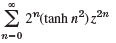
Where does the power series converge uniformly? Give reason. 00 E 2"(tanh n²)z2" 2n n-0
Find the center and the radius of convergence.
Is the given sequence z1, z2, · · ·, zn, · · · bounded? Convergent? Find its limit points. Show your work in detail.zn = (cos nπi)/n
Where does the power series converge uniformly? Give reason.
Find the center and the radius of convergence.
Is the given sequence z1, z2, · · ·, zn, · · · bounded?Convergent? Find its limit points. Show your work in detail.zn = [(1 + 3i)/√10]n
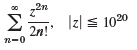
Prove that the series converges uniformly in the indicated region. 2n Σ 2n!' Izl s 1020 n-0
Find the center and the radius of convergence.
Is the given sequence z1, z2, · · ·, zn, · · · bounded? Convergent? Find its limit points. Show your work in detail.zn = sin (1/4nπ) + in
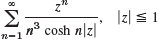
Prove that the series converges uniformly in the indicated region. 00 Σ Iz| s 1 n3 cosh n|z| 2-1
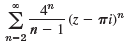
Find the radius of convergence. 4" -(г — пі)" п — 1 п-2 п
Showing 2900 - 3000
of 3937
First
23
24
25
26
27
28
29
30
31
32
33
34
35
36
37
Last
Step by Step Answers

 Get 50% OFF
Claim Now
Get 50% OFF
Claim Now







![(19) Vz = ±[V4(z| + x) + (sign y)i V(|z| + x)]](https://dsd5zvtm8ll6.cloudfront.net/si.question.images/images/question_images/1544/0/9/0/1125c08f200ddc681544018926338.jpg)