New Semester
Started
Get
50% OFF
Study Help!
--h --m --s
Claim Now
Question Answers
Textbooks
Find textbooks, questions and answers
Oops, something went wrong!
Change your search query and then try again
S
Books
FREE
Study Help
Expert Questions
Accounting
General Management
Mathematics
Finance
Organizational Behaviour
Law
Physics
Operating System
Management Leadership
Sociology
Programming
Marketing
Database
Computer Network
Economics
Textbooks Solutions
Accounting
Managerial Accounting
Management Leadership
Cost Accounting
Statistics
Business Law
Corporate Finance
Finance
Economics
Auditing
Tutors
Online Tutors
Find a Tutor
Hire a Tutor
Become a Tutor
AI Tutor
AI Study Planner
NEW
Sell Books
Search
Search
Sign In
Register
study help
mathematics
advanced engineering mathematics
Advanced Engineering Mathematics 10th edition Erwin Kreyszig - Solutions
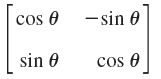
Find the eigenvalues. Find the corresponding eigenvectors. - sin cos 0 0 sin 0 cos e
Find an eigenbasis (a basis of eigenvectors) and diagonalize. Show the details. -1
Are the following matrices symmetric, skew-symmetric, or orthogonal? Find the spectrum of each, thereby illustrating Theorems 1 and 5. Show your work in detail. 7. colo tlo -lo
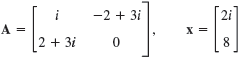
Is the matrix A Hermitian or skew-Hermitian? Find xÌ…TAx. Show the details. [2i -2 + 3i i 2 + 3i
Find the eigenvalues. Find the eigenvectors. -7 – 12 -12 7. 4.
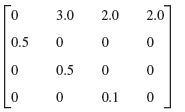
Find the growth rate in the Leslie model (see Example 3) with the matrix as given. Show the details. 3.0 2.0 2.0 0.5 0.5 0.1
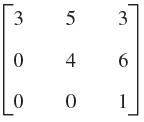
Find the eigenvalues. Find the corresponding eigenvectors. 3 5 3 4 6. 1
Find an eigenbasis (a basis of eigenvectors) and diagonalize. Show the details. 7.7 -4.3 1.3 9.3
(a) Prove that the product of two orthogonal matrices is orthogonal, and so is the inverse of an orthogonal matrix. What does this mean in terms of rotations?(b) Show that (6) is an orthogonal transformation. Verify that it satisfies Theorem 3. Find the inverse transformation.(c) Write a program
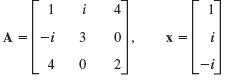
Is the matrix A Hermitian or skew-Hermitian? Find xÌ…TAx. Show the details. 1 i 4 1 -i i 3 4
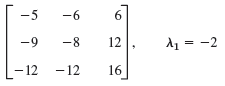
Find an eigenbasis (a basis of eigenvectors) and diagonalize. Show the details. -5 -6 -9 -8 12 A1 = -2 –12 - 12 - 12 16
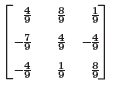
Show that a consumption matrix as considered in Prob. 13 must have column sums 1 and always has the eigenvalue 1.Prob 13Suppose that three industries are interrelated so that their outputs are used as inputs by themselves, according to the 3 × 3 consumption matrixwhere
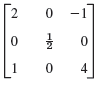
Find the eigenvalues. Find the corresponding eigenvectors. [2
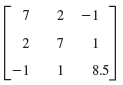
Find the eigenvalues. Find the eigenvectors. 2 -1 1 -1 8.5 2.
What kind of conic section (or pair of straight lines) is given by the quadratic form? Transform it to principal axes. Express xT = [x1 x2] in terms of the new coordinate vector yT = [y1 y2], as in Example 6.3x12 + 8x1x2 - 3x22 = 10
Find div v and its value at P.v = [0, cos xyz, sin xyz], P: (2, 1/2π, 0]
What curves are represented by the following? Sketch them.[α + t, b + 3t, c - 5t]
Find the components of the vector v with initial point P and terminal point Q. Find |v|. Sketch |v|. Find the unit vector u in the direction of v.P: (1, 1, 1), Q: (2, 2, 0)
Let the temperature T in a body be independent of z so that it is given by a scalar function T = T(x, t). Identify the isotherms T(x, y) = const. Sketch some of them.T = arctan (y/x)
Let the temperature T in a body be independent of z so that it is given by a scalar function T = T(x, t). Identify the isotherms T(x, y) = const. Sketch some of them.T = x/(x2 + y2)
What happens in Example 5 if you choose a P at distance 2d from the axis of rotation?
Let a = [1, -3, 5], b = [4, 0, 8], c = [-2, 9, 1].Find:|a + c|2 + |a - c|2 - 2(|a|2 + |c|2)
Find div v and its value at P.v = (x2 + y2 + z2)-3/2[x, y, z]
What curves are represented by the following? Sketch them.[α + 3 cos πt, b - 2 sin πt, 0]
Find the terminal point Q of the vector v with components as given and initial point P. Find |v|.4, 0, 0; P: (0, 2, 13)
Find grad f. Graph some level curves f = const. Indicate ∇f by arrows at some points of these curves.f = (x2 - y2)/(x2 + y2)
Find curl v for v given with respect to right-handed Cartesian coordinates. Show the details of your work.v = [e-z2, e-x2, e-y2]
What are the velocity and speed in Prob. 7 at the point (4, 2, -2) if the wheel rotates about the line y = x, z = 0 with ω = 10 sec-1?Data from Prob. 7A wheel is rotating about the y-axis with angular speed ω = 20 sec-1. The rotation appears clockwise if one looks from the origin in the positive
What curves are represented by the following? Sketch them.[cosh t, sinh t, 2]
Find the terminal point Q of the vector v with components as given and initial point P. Find |v|.13.1, 0.8, -2.0; P: (0, 0, 0)
Prove and illustrate by an example.∇̅(fg) = f∇g + g∇̅f
Let v be the velocity vector of a steady fluid flow. Is the flow irrotational? Incompressible? Find the streamlines (the paths of the particles).v = [sec x, csc x, 0]
What kind of surfaces are the level surfaces f(x, y, z) = const?f = 9(x2 + y2) + z2
Graph the given velocity field v of a fluid flow in a square centered at the origin with sides parallel to the coordinate axes. Recall that the divergence measures outflow minus inflow. By looking at the flow near the sides of the square, can you see whether div v must be positive or negative or
Find the terminal point Q of the vector v with components as given and initial point P. Find |v|.0, -3, 3; P: (0, 3, -3)
Prove and illustrate by an example.∇2(fg) = g∇2f + 2∇f • ∇g + f ∇2g
Let v be the velocity vector of a steady fluid flow. Is the flow irrotational? Incompressible? Find the streamlines (the paths of the particles).v = [-y, x, π]
What kind of surfaces are the level surfaces f(x, y, z) = const?f = z - √x2 + y2
What does u • v = u • w imply if u = 0? If u ≠ 0?
What does a × b = a × c with a ≠ 0 imply?
(a) What direction does curl v have if v is parallel to the yz-plane?(b) If, moreover, v is independent of x?
Let the temperature T in a body be independent of z so that it is given by a scalar function T = T(x, t). Identify the isotherms T(x, y) = const. Sketch some of them.T = xy
Find grad f. Graph some level curves f = const. Indicate ∇f by arrows at some points of these curves.f = 9x2 + 4y2
Find curl v for v given with respect to right-handed Cartesian coordinates. Show the details of your work.v = [2y2, 5x, 0]
Verify Lagrange€™s identity for |a x b| for a = [3, 4, 2] and b = [1, 0, 2]. Prove it, using sin2γ = 1 - cos2 γ. The identity is |a x b| = V(a • a) (b • b) – (a • b)?. (12)
Let a = [1, -3, 5], b = [4, 0, 8], c = [-2, 9, 1].Find:|a + b|, |a| + |b|
Find div v and its value at P.v = [v1( y, z), v2(z, x), v3(x, y)], P: (3, 1, -1)]
What curves are represented by the following? Sketch them.[-2, 2 + 5 cos t, -1 + 5 sin t]
Find the components of the vector v with initial point P and terminal point Q. Find |v|. Sketch |v|. Find the unit vector u in the direction of v.P: (1, 4, 2), Q: (-1, -4, -2)
Find grad f. Graph some level curves f = const. Indicate ∇f by arrows at some points of these curves.(y + 6)2 + (x - 4)2
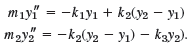
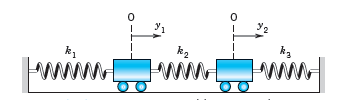
Model and solve by the Laplace transform:Find the model (the system of ODEs) in Prob. 38 extended by adding another mass m3 and another spring of modulus k4 in series.Data from Prob. 38Show that the model of the mechanical system in Fig. 149 (no friction, no damping) is туй — -kiy1 + ka(y2 —
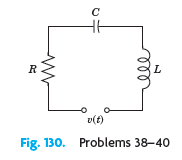
Using the Laplace transform and showing the details, find the current i(t) in the circuit in Fig. 130, assuming zero initial current and charge and:R = 2 Ω, L = 1 H, C = 0.1 F, v = 255 sin t V if 0 < t < 2π and 0 if t > 2π v(t) Problems 38-40 Fig. 130.
Using the Laplace transform and showing the details, find the current i(t) in the circuit in Fig. 130, assuming zero initial current and charge and:R = 4 Ω, L = 1 H, C = 0.05 F, v = 34e-t V if 0 < t < 4 and 0 if t > 4 v(t) Problems 38-40 Fig. 130.
Model and solve by the Laplace transform:Show that the model of the mechanical system in Fig. 149 (no friction, no damping) is туй — -kiy1 + ka(y2 — Ул) mıyi т2у? — —k2(у — у) — КзУ2). -k2(y2 www wim
In Probs. 37€“45 find the inverse transform. Show the details of your work. (s + 1)3
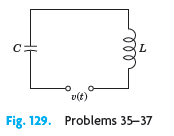
Using the Laplace transform and showing the details, find the current i(t) in the circuit in Fig. 129, assuming zero initial current and charge on the capacitor and:L = 1 H, C = 0.25 F, v = 200 (t - 1/3t3) V if 0 < t < 1 and 0 if t > 1 v(t) Fig. 129. Problems 35-37
Solve by the Laplace transform, showing the details and graphing the solution:y'1 = 2y1 + 4y2, y'2 = y1 + 2y2, y1(0) = -4, y2(0) = -4
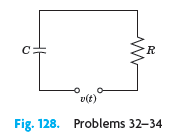
Using the Laplace transform and showing the details, find the current i(t) in the circuit in Fig. 128 with R = 10 Ω and C = 10-2F, where the current at t = 0 is assumed to be zero, and:v(t) = 100 V if 0.5 < t < 0.6 and 0 otherwise. Why does i(t) have jumps? R. v(t) Problems 32-34
Solve by the Laplace transform, showing the details and graphing the solution:y'1 = y2, y'2 = -4y1 + δ(t - π), y1(0) = 0, y2(0) = 0
Using the Laplace transform and showing the details, find the current i(t) in the circuit in Fig. 128 with R = 10 Ω and C = 10-2F, where the current at t = 0 is assumed to be zero, and:v = 0 if t < 4 and 14 ·106e-3t V if t > 4 R. v(t) Problems 32-34 Fig. 128.
Solve by the Laplace transform, showing the details and graphing the solution:y" + 4y = δ(t - π) - δ(t - 2π), y(0) = 1, y' (0) = 0
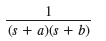
Given F(s) = L(f), find f(t). a, b, L, n are constants. Show the details of your work. (s + a)(s + b)
Solve by the Laplace transform, showing the details and graphing the solution:y" + 16y = 4δ(t - π), y(0) = -1, y' (0) = 0
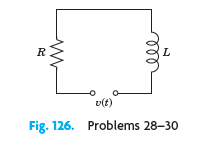
Using the Laplace transform and showing the details, find the current i(t) in the circuit in Fig. 126, assuming i(0) = 0 and:R = 10 Ω, L = 0.5 H, v = 200t V if 0 < t < 2 and 0 if t > 2 v(t) Fig. 126. Problems 28-30
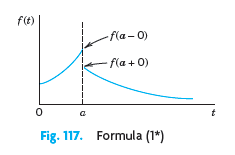
(a) Give reasons why Theorems 1 and 2 are more important than Theorem 3.(b) Extend Theorem 1 by showing that if f(t) is continuous, except for an ordinary discontinuity (finite jump) at some t = α (>0) the other conditions remaining as in Theorem 1, then (see Fig. 117)(1*) L(f') =
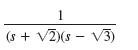
Given F(s) = L(f), find f(t). a, b, L, n are constants. Show the details of your work. 1 (s + V2(s – V3)
Using the Laplace transform and showing the details, find the current i(t) in the circuit in Fig. 126, assuming i(0) = 0 and:R = 1 kΩ (= 1000 Ω), L = 1 H, v = 0 if 0 < t < π, and 40 sin t V if t > π v(t) Fig. 126. Problems 28-30
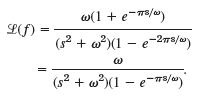
Find the inverse transform, indicating the method used and showing the details: 3s s2 - 2s + 2
Using the Laplace transform and showing the details, solvey" + 2y’ + 5y = 10 sin t if 0 < t < 2π and 0 if t > 2π; y(π) = 1, y’ (π) = 2e-π - 2
Find the inverse transform, indicating the method used and showing the details: 2s – 10 -5s
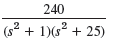
Showing details, find f(t) if L(f) equals: 240 (s2 + 1)(s + 25)
Prove that L-1 is linear. Use the fact that L is linear.
Using the Laplace transform and showing the details, solvey" + 3y’ + 2y = 1 if 0 < t < 1 and 0 if t > 1; y(0) = 0, y’ (0) = 0
Find the inverse transform, indicating the method used and showing the details: 2 - 6.25 (s2 + 6.25)2
Using Theorem 3, find f (t) if L(F) equals: 20 g3 – 2Ts?
Using the Laplace transform and showing the details, solvey" + 3y’ + 2y = 4t if 0 < t < 1 and 8 if t > 1; y(0) = 0, y' (0) = 0
Show that L(1/√t) = √π/s. [Use (30) Г(1/2) = √π in App. 3.1.] Conclude from this that the conditions in Theorem 3 are sufficient but not necessary for the existence of a Laplace transform.
Find the inverse transform, indicating the method used and showing the details: 16 s2 + s+
Proceeding as in Example 1, obtain(a) L(t cos ωt) = S2 - ω2/(s2 + ω2)2and from this and Example 1(b) formula 21(c) 22(d) 23 in Sec. 6.9(e) L(t cosh αt) = S2 + α2/(s2 - α2)2(f) L(t sinh αt) = 2αs/(s2 - α2)2
Using differentiation, integration, s-shifting, or convolution, and showing the details, find f(t) if L(t) equals: s+a In
Using the Laplace transform and showing the details, solvey" + 10y’ + 24y = 144t2, y(0) = 19/12, y’ (0) = -5
Find the inverse transform, indicating the method used and showing the details: 7.5 s2 - 2s - 8
Show that et2 does not satisfy a condition of the form (2).
Using (1) or (2), find L(f) if f(t) if equals:sin4 t. Use Prob. 19.Data from Prob. 19sin2 ωt
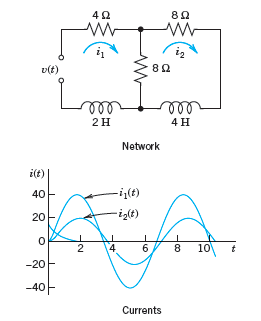
Solve Prob. 19 when the EMF (electromotive force) is acting from 0 to only. Can you do this just by looking at Prob. 19, practically without calculation?Data from Prob. 19Using Laplace transforms, find the currents i1(t) and i2(t) in Fig. 148, where v(t) = 390 cos t and i1(0) = 0, i2(0) = 0. How
Using differentiation, integration, s-shifting, or convolution, and showing the details, find f(t) if L(t) equals:arccot s/π
Using the Laplace transform and showing the details, solve9y" - 6y' + y = 0, y(0) = 3, y’ (0) = 1
Find the transform, indicating the method used and showing the details.(sin ωt) * (cos ωt)
Using L(f) in Prob. 10, find L(f1), where f1(t) = 0 if t<2 and f1(t) = 1 if t > 2.Data from Prob. 10Find the transform. Show the details of your work. Assume that α, b, ω, θ are constants. k
Using (1) or (2), find L(f) if f(t) if equals:cos2 2t
Prove:(a) Commutativity, f * g = g * f(b) Associativity, ( f * g) * v = f * (g * v)(c) Distributivity, f * (g1 + g2) = f * g1 + f * g2(d) Dirac€™s delta. Derive the sifting formula (4) in Sec. 6.4 by using fk with α = 0 [(1), Sec. 6.4] and applying the mean value
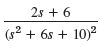
Using differentiation, integration, s-shifting, or convolution, and showing the details, find f(t) if L(t) equals: 2s + 6 (s2 + 6s + 10)2
Find the transform, indicating the method used and showing the details.u(t - 2π) sin t
Find and sketch or graph f(t) if L(f) equals2(e-s - e-3s)/(s2 - 4)
Using (1) or (2), find L(f) if f(t) if equals:t cos 4t
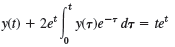
Solve by the Laplace transform, showing the details: У) + 2e| ут)е"" dт 3 te'
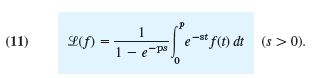
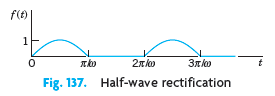
(a) The Laplace transform of α piece wise continuous function f(t) with period p isProve this theorem. Write ˆ«ˆž0 = ˆ«p0 + ˆ«2pp + . . .. Set t = (n - 1)p in the nth integral. Take out e-(n-1)p from under the integral sign. Use the sum
Using differentiation, integration, s-shifting, or convolution, and showing the details, find f(t) if L(t) equals: (s2 + 16)2
Find the transform, indicating the method used and showing the details.16t2u(t - 1/4)
Find and sketch or graph f(t) if L(f) equals4(e-2s - 2e-5s)/s
Showing 3500 - 3600
of 3937
First
26
27
28
29
30
31
32
33
34
35
36
37
38
39
40
Step by Step Answers

 Get 50% OFF
Claim Now
Get 50% OFF
Claim Now






![0.1 0.1 0.5 A = [ajk] =| 0.8 0.4 0.5 0.6 0.1](https://dsd5zvtm8ll6.cloudfront.net/si.question.images/images/question_images/1542/8/8/1/8255bf6822132f871542326793735.jpg)