New Semester
Started
Get
50% OFF
Study Help!
--h --m --s
Claim Now
Question Answers
Textbooks
Find textbooks, questions and answers
Oops, something went wrong!
Change your search query and then try again
S
Books
FREE
Study Help
Expert Questions
Accounting
General Management
Mathematics
Finance
Organizational Behaviour
Law
Physics
Operating System
Management Leadership
Sociology
Programming
Marketing
Database
Computer Network
Economics
Textbooks Solutions
Accounting
Managerial Accounting
Management Leadership
Cost Accounting
Statistics
Business Law
Corporate Finance
Finance
Economics
Auditing
Tutors
Online Tutors
Find a Tutor
Hire a Tutor
Become a Tutor
AI Tutor
AI Study Planner
NEW
Sell Books
Search
Search
Sign In
Register
study help
mathematics
advanced engineering mathematics
Advanced Engineering Mathematics 10th edition Erwin Kreyszig - Solutions
(a) Prove that (1) is equivalent to the pair of relations(b)(c)(d) If f(z) is differentiable at z0, show that f(z) is continuous at z0.(e) Show that f(z) = Re z = x is not differentiable at any z. Can you find other such functions?(f) Show that f(z) = |z|2 is differentiable only at z = 0;
Find and graph all roots in the complex plane.4√-4
Find the principal value. Show details.(i)i/2
Find f(z) = u(x, y) + iv(x, y) with u or v as given. Check by the Cauchy–Riemann equations for analyticity.v = y/(x2 + y2)
Find the principal value. Show details.(3 + 4i)1/3
Find f(z) = u(x, y) + iv(x, y) with u or v as given. Check by the Cauchy–Riemann equations for analyticity.u = cos 3x cosh 3y
Solve and graph the solutions. Show details.z2 - (6 - 2i) z + 17 - 6i = 0
By definition, the inverse sine w = arcsin z is the relation such that sin w = z. The inverse cosine w = arccos z is the relation such that cow w = z. The inverse tangent, inverse cotangent, inverse hyperbolic sine, etc., are defined and denoted in a similar fashion. (Note that all these relations
Let f(z) be analytic. Prove that each of the following conditions is sufficient for f(z) = const.(a) Re f(z) = const(b) Im f(z) = const(c) f'(z) = 0
Find f(z) = u(x, y) + iv(x, y) with u or v as given. Check by the Cauchy–Riemann equations for analyticity.v = cos 2x sinh 2y
Solve and graph the solutions. Show details.z4 + 324 = 0. Using the solutions, factor z4 + 324 into quadratic factors with real coefficients.
(a) Write f(z) in terms of partial fractions and integrate it counterclockwise over the unit circle, where(b) In the light of the principle of deformation of path. Then consider another family of paths with common endpoints, say, z(t) = t + iα(t - t2), 0 ‰¤ t
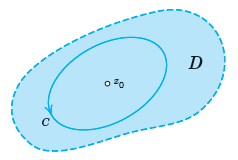
Gain additional insight into the proof of Cauchy€™s integral theorem by producing (2) with a contour enclosing z0(as in Fig. 356) and taking the limit as in the text. Chooseand (c) another example of your choice. z3 – 6 sin z dz, (b) (a) dz, c z- D o 20
Integrate. Show the details. Begin by sketching the contour. Why? exp (z) dz, Jc z(z – 21)2 C: z - 3i| = 2 clockwise.
Integrate counterclockwise or as indicated. Show the details. C the circle with center dz, z2 + 4z + 3 radius 2 -1 and
Integrate by the first method or state why it does not apply and use the second method. Show the details. cos 2z dz, C the semicircle Izl = TT, x20 from
Integrate by a suitable method. Re z dz from 0 to 3 + 27i along y = x
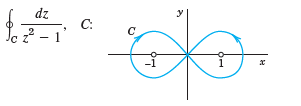
Evaluate the integral. Does Cauchy€™s theorem apply? Show details.Use partial functions. dz C:
Integrate by the first method or state why it does not apply and use the second method. Show the details. (z + z-1) dz, C the unit circle, counterclockwise
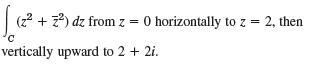
Integrate by a suitable method. (2? + + z?) dz from z = 0 horizontally to z = 2, then vertically upward to 2 + 2i.
Evaluate the integral. Does Cauchy€™s theorem apply? Show details. coth z dz, C the circle |z – mi| = 1 clockwise. Jc
Evaluate the integral. Does Cauchy€™s theorem apply? Show details. tan z -dz, C the boundary of the square with 4 - 16 vertices +1, ±i clockwise.
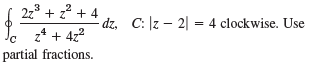
Evaluate the integral. Does Cauchy€™s theorem apply? Show details. 27* + z* + 4 dz, z* + 422 partial fractions. C: |z – 2| = 4 clockwise. Use
Showing the details, developWhat can you say about the coefficients of the Fourier–Legendre series of f(x) if the Maclaurin series of f(x) contains only powers x4m (m = 0, 1, 2, · · ·)?
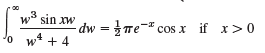
Show that the integral represents the indicated function. Use (5), (10), or (11); the integral tells you which one, and its value tells you what function to consider. Show your work in detail. w* sin xw -dw = Te- w* + 4 cos x if x>0
Find for if if . Try to obtain from it for in Prob. 5 by using (5a).Data from Prob. 5Find f̂c(w) for f(x) = x2 if 0 < x < 1, f(x) = 0 if x > 1.
Are the following functions even or odd or neither even nor odd?Product of an odd times an even function
Show that y" + fy' + (g + λh) y = 0 takes the form (1) if you set p = exp (∫f dx), q = pg, r = hp. Why would you do such a transformation?
Showing the details, develop1, x, x2, x3, x4
Show that the integral represents the indicated function. Use (5), (10), or (11); the integral tells you which one, and its value tells you what function to consider. Show your work in detail. < cos x if 0< |x| Cos cos os7 1- w2 cos xw dw 0 if
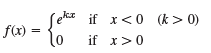
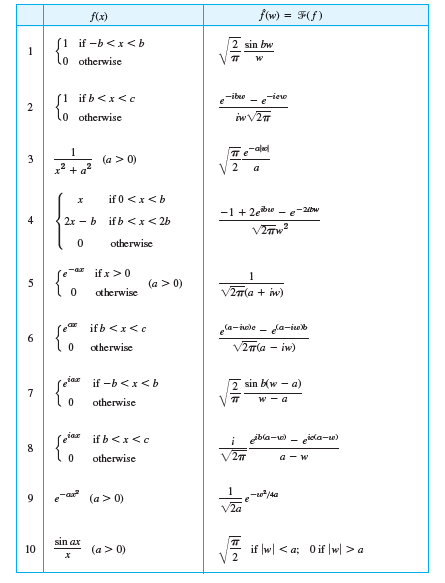
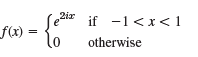
Find the Fourier transform of (without using Table III in Sec. 11.10). Show details. eka if x 0) if x>0 f(x) f(x) f(w) = F(f) (1 if -b
If f(x) has period p, show that f(αx), α ≠ 0 and f(x/b), b ≠ 0, are periodic functions of x of periods p/α and bp, respectively. Give examples.
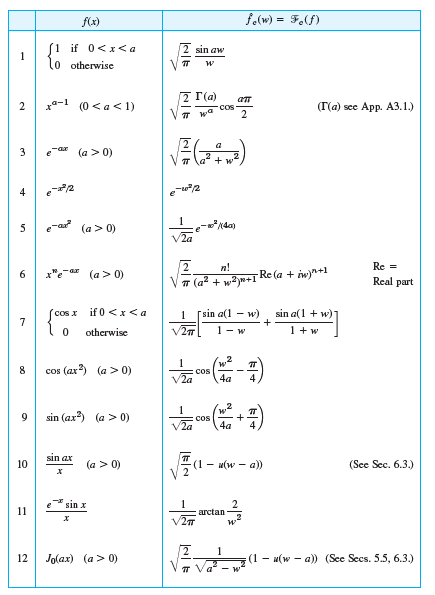
Derive formula 3 in Table I of Sec. 11.10 by integration. fe(w) = F.(f) f(x) (1 if 0 0) (See Sec. 6.3.) sin X 11 arctan 12 Jolax) (a> 0) (1 - a(w - a)) (See Secs. 5.5, 6.3.) 2. 3.
Are the following functions even or odd or neither even nor odd?Sums and products of odd functions
Using Prob. 3, derive the orthogonality of 1, cos πx, sin πx, cos 2πx, sin 2πx, · · · on -1 ≤ x ≤ 1 (r(x) = 1) from that of 1, cos x, sin x, cos 2x, sin 2x, · · · on -π ≤ x ≤ π.Data from Prob. 3Show that if the functions y0(x), y1(x), · · · form an orthogonal set on an
ym of (1), (2) means that we multiply ym by a nonzero constant cm such that cmym has norm 1. Show that zm = cym with any c ≠ 0 is an eigenfunction for the eigenvalue corresponding to ym.
Showing the details, develop(x + 1)2
Find the Fourier transform of (without using able III in Sec. 11.10). Show details. if -1
Find the trigonometric polynomial F(x) of the form (2) for which the square error with respect to the given f(x) on the interval -π < x < π is minimum Compute the minimum value for N = 1, 2, · · ·, 5 (or also for larger values if you have a CAS).f (x) = x (-π < x < π)
Find f in Prob. 1 from the answer f̂cData from Prob. 1Find the cosine transform f̂c of f(x) = 1 if 0 < x < 1, f (x) = -1 if 1 < x < 2, f (x) = 0 if x > 2.
Are the following functions even or odd or neither even nor odd?sin2 x, sin (x2), ln x, x/(x2 + 1), x cot x
In Example 1, what happens to the amplitudes Cn if we take a stiffer spring, say, of k = 49? If we increase the damping?
Evaluate the integral directly or, if possible, by the divergence theorem. Show details.F = [x, xy, z], S the boundary of x2 + y2 ≤ 1, 0 ≤ z ≤ 5
Evaluate the integral directly or, if possible, by the divergence theorem. Show details.F = [y2, x2,z2], S the portion of the paraboloid z = x2 + y2, z ≤ 9
Evaluate the integral directly or, if possible, by the divergence theorem. Show details.F = [1, 1, 1], S x2 + y2 + 4z2 = 4, z ≥ 0
Evaluate the integral directly or, if possible, by the divergence theorem. Show details.F = [x + y2, y + z2, z + x2], S the ellipsoid with semi-axes of lengths α, b, c
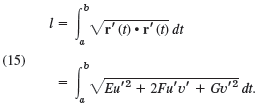
Given a surface S: r (u, v), the differential formwith coefficients (in standard notation, unrelated to F, G elsewhere in this chapter)is called the first fundamental form of S. This form is basic because it permits us to calculate lengths, angles, and areas on S. To show this prove
Why is Ix in Prob. 23 for large h larger than Ix in Prob. 22 (and the same h)? Why is it smaller for h = 1? Give physical reason.Data from Prob. 22Given a mass of density 1 in a region T of space, find the moment of intertia about the x-axisIx = ∫∫T∫ (y2 + z2) dx dy dz.The paraboloid y2
Find the coordinates x̅, y̅ of the center of gravity of a mass of density f(x, y) in the region R. Sketch R, show details.f = 1, R: 0 ≤ y ≤ 1 - x4
If IB is the moment of inertia of a mass distribution of total mass M with respect to a line B through the center of gravity, show that its moment of inertia IΚ with respect to a line K, which is parallel to B and has the distance k from it isIΚ = IB + k2M.
Given a mass of density 1 in a region T of space, find the moment of intertia about the x-axis Ix = ∫∫T∫ (y2 + z2) dx dy dz.The paraboloid y2 + z2 ≤ x, 0 ≤ x ≤ h
Find the moment of inertia of a lamina S of density 1 about an axis B, where S: x2 + y2 = 1, 0 ≤ z ≤ h, B: the line z = h/2 in the xz-plane
Given a mass of density 1 in a region T of space, find the moment of intertia about the x-axisIx = ∫∫T∫ (y2 + z2) dx dy dz.The ball x2 + y2 + z2 ≤ α2
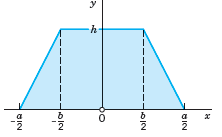
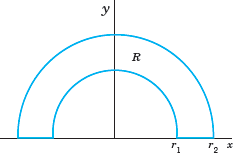
Find Ix, Iy, I0of a mass of density f(x,y) = 1 in the region R in the figures, which the engineer is likely to need, along with other profiles listed in engineering handbooks. У h- 2. SIN
Tangent Planes T(P) will be less important in our work, but you should know how to represent them.(a) If S: r(u, v), then T(P): (r* - r ru rv) = 0 (a scalar triple product) or r*(p, q) = r(P) + pru(P) + qrv(P).(b) If S: g(x, y, z) = 0, then T(P): (r* - r(P)) · ∇g = 0.(c) If
Evaluate ∫C F (r) • dr for given F and C by the method that seems most suitable. Remember that if F is a force, the integral gives the work done in the displacement along C. Show details.F = [zexz, 2 sinh 2y, xexz], C the parabola y = x, z = x2, -1 ≤ x ≤ 1
Evaluate them with F or f and C as follows.F = [xz, yz, x2y2], C: r = [t, t, et], 0 ≤ t ≤ 5. Sketch C.
Construct three simple examples in each of which two equations (6') are satisfied, but the third is not.
Calculate this line integral by Stokes’s theorem for the given F and C. Assume the Cartesian coordinates to be right-handed and the z-component of the surface normal to be nonnegative.F = [0 cos x, 0], C the boundary curve of y2 + z2 = 4, y ≥ 0, z ≥ 0, 0 ≤ x ≤ π
Same task as in Prob. 19 when w = x2 + y2 and C the boundary curve of the triangle with vertices (0, 0), (1, 0), (0, 1).Data from Prob. 19Show that w = ex sin y satisfies Laplace’s equation ∇2w = 0 and, using (12), integrate w(∂w/∂n) counterclockwise around the boundary curve C of the
Evaluate the surface integral ∫∫S F • n dA by the divergence theorem. Show the details.F = [xy, yz, zx], S the surface of the cone x2 + y2 ≤ 4z2, 0 ≤ z ≤ 2
Find a normal vector. The answer gives one representation; there are many. Sketch the surface and parameter curves.Elliptic cone z = √x2 + 4y2
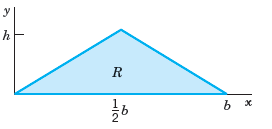
Find Ix, Iy, I0of a mass of density f(x,y) = 1 in the region R in the figures, which the engineer is likely to need, along with other profiles listed in engineering handbooks.R as in Prob. 12.Data form Prob. 12Find the center of gravity (xÌ…, yÌ…) of a mass of density f(x,
Evaluate ∫C F (r) • dr for given F and C by the method that seems most suitable. Remember that if F is a force, the integral gives the work done in the displacement along C. Show details.F = [sin πy, cos πx, sin πx], C the boundary curve of 0 ≤ x ≤ 1, 0 ≤ y ≤ 2, z = x
Evaluate them with F or f and C as follows.F = [ y1/3, x1/3, 0], C the hypocycloid r = [cos3 t, sin3 t, 0], 0 ≤ t ≤ π/4
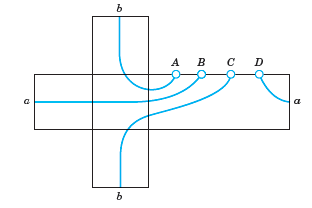
Make a paper cross (Fig. 251) into a €œdouble ring€ by joining opposite arms along their outer edges (without twist), one ring below the plane of the cross and the other above. Show experimentally that one can choose any four boundary points A, B, C, D and join A and C as well
Check, and if independent, integrate from (0, 0, 0) to (α, b, c).(cos xy)(yz dx + xz dy) - 2 sin xy dz
Calculate this line integral by Stokes’s theorem for the given F and C. Assume the Cartesian coordinates to be right-handed and the z-component of the surface normal to be nonnegative.F = [-y, 2z, 0], C the boundary curve of y2 + z2 = 4, z ≥ 0, 0 ≤ x ≤ h
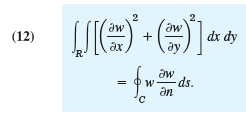
Show that for a solution w(x, y) of Laplace€™s equation ˆ‡2w = 0 in a region R with boundary curve C and outer unit normal vector n, LSE)-e)-« dx dy (12) дw -ds. Әn C. ||
Evaluate the surface integral ∫∫S F • n dA by the divergence theorem. Show the details.F = [cosh x, z, y], S as in Prob. 15Data from Prob. 15F = [2x2, 1/2y2, sin πz], S the surface of the tetrahedron with vertices (0, 0, 0), (1, 0, 0), (0, 1, 0), (0, 0, 1)
Find a normal vector. The answer gives one representation; there are many. Sketch the surface and parameter curves.Ellipsoid x2 + y2 + 19z2 = 1
Evaluate ∫C F (r) • dr for given F and C by the method that seems most suitable. Remember that if F is a force, the integral gives the work done in the displacement along C. Show details.F = [x2, y2,y2x], C the helix r = [2 cos t, 2 sin t, 3t] from (2, 0, 0) to (-2, 0, 3π)
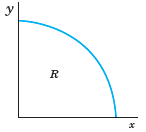
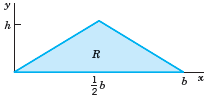
Find the center of gravity (xÌ…, yÌ…) of a mass of density f(x, y) = 1 in the given region R. х
Evaluate these integrals for the following data. Indicate the kind of surface. Show the details.G = arctan (y/x), S: z = x2 + y2, 1 ≤ z ≤ 9, x ≥ 0, y ≥ 0
Check, and if independent, integrate from (0, 0, 0) to (α, b, c).ey dx + (xey - ez) dy - yez dz
Calculate this line integral by Stokes’s theorem for the given F and C. Assume the Cartesian coordinates to be right-handed and the z-component of the surface normal to be nonnegative.F = [ey, 0, ex], C as in Prob. 15Data from Prob. 15F = [y2, x2, z + x] around the triangle with vertices (0,
Using (9), find the value of ∫C ∂w/∂n ds taken counterclockwise over the boundary C of the region R.W = x2 + y2, C: x2 + y2 = 4. Confirm the answer by direct integration.
Evaluate the surface integral ∫∫S F • n dA by the divergence theorem. Show the details.F = as in Prob. 13, S the surface of x2 + y2 ≤ 9, 0 ≤ z ≤ 2Data from Prob. 13F = [sin y, cos x, cos z], S, the surface of x2 + y2 ≤ 4, |z| ≤ 2 (a cylinder and two disks!)
Find a normal vector. The answer gives one representation; there are many. Sketch the surface and parameter curves.Plane 4x + 3y + 2z = 12
Evaluate ∫C F (r) • dr for given F and C by the method that seems most suitable. Remember that if F is a force, the integral gives the work done in the displacement along C. Show details.F = [-y3, x3 + e-y, 0], C the circle x2 + y2 = 25, z = 2
Find the center of gravity (xÌ…, yÌ…) of a mass of density f(x, y) = 1 in the given region R.
Using (9), find a bound for the absolute value of the work W done by the force F = [x2, y] in the displacement from (0, 0) straight to (3, 4). Integrate exactly and compare.
Evaluate these integrals for the following data. Indicate the kind of surface. Show the details.G = αx + by + cz, S: x2 + y2 + z2 = 1, y = 0, z = 0
Check, and if independent, integrate from (0, 0, 0) to (α, b, c).(sinh xy) (z dx - x dz)
Calculate this line integral by Stokes’s theorem for the given F and C. Assume the Cartesian coordinates to be right-handed and the z-component of the surface normal to be nonnegative.F = [z3, x3, y3], C the circle x = 2, y2 + z2 = 9
Using (9), find the value of ∫C ∂w/∂n ds taken counterclockwise over the boundary C of the region R.w = x2y + xy2, R: x2 + y2 ≤ 1, x ≥ 0, y ≥ 0
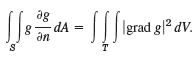
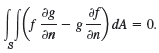
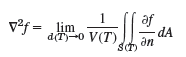
The importance of the divergence theorem in potential theory is obvious from (7)€“(9) and Theorems 1€“3. To emphasize it further, consider functions f and g that are harmonic in some domain D containing a region T with boundary surface S such that T satisfies the assumptions in
Evaluate the surface integral ∫∫S F • n dA by the divergence theorem. Show the details.F = [x3 - y3, y3 - z3, z3 - x3], S the surface of x2 + y2 + z2 ≤ 25, z ≥ 0
Find the points in Probs. 1–8 at which (4) N ≠ 0 does not hold. Indicate whether this results from the shape of the surface or from the choice of the representation.
Evaluate ∫C F (r) • dr for given F and C by the method that seems most suitable. Remember that if F is a force, the integral gives the work done in the displacement along C. Show details.F = [y cos xy, x cos xy, ez], C the straight-line segment from (π, 1, 0) to (1/2, π, 1)
Find the center of gravity (xÌ…, yÌ…) of a mass of density f(x, y) = 1 in the given region R. h R
Consider the integral ∫C F(r) • dr, where F = [xy, -y2].(a) Find the value of the integral when r = [cos t, sin t], 0 ≤ t ≤ π/2. Show that the value remains the same if you set t = -p or t = p2 or apply two other parametric transformations of your own choice.(b) Evaluate the
Evaluate these integrals for the following data. Indicate the kind of surface. Show the details.G = cos x + sin x, S the portion of x + y + z = 1 in the first octant
Integrate x2y dx + 2xy2 dy over various circles through the points (0, 0) and (1, 1). Find experimentally the smallest value of the integral and the approximate location of the center of the circle.
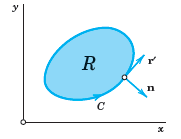
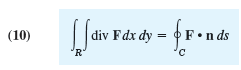
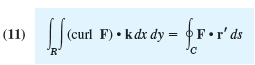
Let R and C be as in Green€™s theorem, r' a unit tangent vector, and n the outer unit normal vector of C (Fig. 240 in Example 4). Show that (1) may be writtenorwhere k is a unit vector perpendicular to the xy-plane. Verify (10) and (11) for F = [7x, -3y] and C the circle x2 + y2 = 4 as
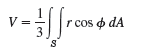
Use the divergence theorem, assuming that the assumptions on T and S are satisfied.Show that a region T with boundary surface S has the volumewhere r is the distance of a variable point P: (x, y, z) on S from the origin O and Ï• is the angle between the directed line OP and the outer
Evaluate the surface integral ∫∫S F • n dA by the divergence theorem. Show the details.Solve Prob. 9 by direct integration.Data form Prob. 9F = [x2, 0, z2], S the surface of the box |x| ≤ 1, |y| ≤ 3, 0 ≤ z ≤ 2
Calculate ∫C F(r) • dr for the given data. If F is a force, this gives the work done by the force in the displacement along C. Show the details.F = [x, -z, 2y] from (0, 0, 0) straight to (1, 1, 0), then to (1, 1, 1), back to (0, 0, 0)
Evaluate the integral for the given data. Describe the kind of surface. Show the details of your work.F = [y2, x2, z4], S: z = 4 √x2 + y2, 0 ≤ z ≤ 8, y ≥ 0
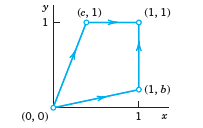
(a) Show that I = ˆ«C (x2y dx + 2xy2dy) is path dependent in the xy-plane.(b) Integrate from (0, 0) along the straight-line segment to (1, b), 0 ‰¤ b ‰¤ 1, and then vertically up to (1, 1); see the figure. For which b is I maximum? What is its maximum
Showing 3200 - 3300
of 3937
First
26
27
28
29
30
31
32
33
34
35
36
37
38
39
40
Step by Step Answers

 Get 50% OFF
Claim Now
Get 50% OFF
Claim Now