New Semester
Started
Get
50% OFF
Study Help!
--h --m --s
Claim Now
Question Answers
Textbooks
Find textbooks, questions and answers
Oops, something went wrong!
Change your search query and then try again
S
Books
FREE
Study Help
Expert Questions
Accounting
General Management
Mathematics
Finance
Organizational Behaviour
Law
Physics
Operating System
Management Leadership
Sociology
Programming
Marketing
Database
Computer Network
Economics
Textbooks Solutions
Accounting
Managerial Accounting
Management Leadership
Cost Accounting
Statistics
Business Law
Corporate Finance
Finance
Economics
Auditing
Tutors
Online Tutors
Find a Tutor
Hire a Tutor
Become a Tutor
AI Tutor
AI Study Planner
NEW
Sell Books
Search
Search
Sign In
Register
study help
mathematics
advanced engineering mathematics
Advanced Engineering Mathematics 10th edition Erwin Kreyszig - Solutions
This happens if a PDE involves derivatives with respect to one variable only (or can be transformed to such a form), so that the other variable(s) can be treated as parameter(s). Solve for u = u(x, y):uxy = ux
Find and sketch or graph the deflection u(x, t) of a vibrating string of length Ï€, extending from x = 0 to x = Ï€, and c2= T/Ï = 4 starting with velocity zero and deflection:sin 4x
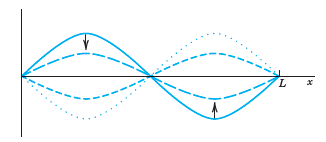
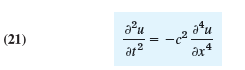
By the principles used in modeling the string it can be shown that small free vertical vibrations of a uniform elastic beam (Fig. 292) are modeled by the fourth-order PDEwhere c2 = EI/ÏA (E = Young€™s modulus of elasticity, I = moment of intertia of the cross section with
Solve for u = u(x, y):uxx + ux = 0, u (0, y) = f (y), ux (0, y) = g(y)
Find the eigenvalues and eigenfunctions. Verify orthogonality. Start by writing the ODE in the form (1), using Prob. 6. Show details of your work.Orthogonal polynomials play a great role in applications. For this reason, Legendre polynomials and various other orthogonal polynomials have been
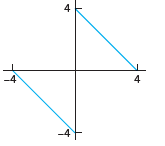
Is the given function even or odd or neither even nor odd? Find its Fourier series. Show details of your work. -4 4
f(x) = |sin x| (-π < x < π), full-wave rectifier.
Obtain the solution to Prob. 26 from that of Prob. 27.Data from Prob. 26Find (a) The Fourier cosine series(b) The Fourier sine series. Sketch f(x) and its two periodic extensions. Show the details.Data from Prob. 27Find(a) The Fourier cosine series(b) The Fourier sine series. Sketch f(x) and
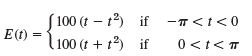
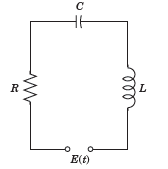
Find the steady-state current I(t) in the RLC-circuit in Fig. 275, where R = 10 Ω, L = 1 H, C = 10-1 F and with E(t) V as follows and periodic with period 2π. Graph or sketch the first four partial sums. The coefficients of the solution decrease rapidly. Remember that the ODE
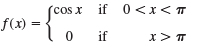
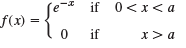
Represent f(x) as an integral (11). (cos x if f(x) 0
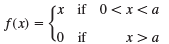
Represent f(x) as an integral (11). (x if 0
(a) Show that if f(x) has a Fourier transform, so does f(x - α), and F{f(x - α)} = e-iwαF{f(x)}.(b) Using (a), obtain formula 1 in Table III, from formula 2.(c) Show that if f̂(w) is the Fourier transform of f(x), then f̂(w -
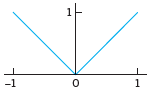
Is the given function even or odd or neither even nor odd? Find its Fourier series. Show details of your work.f (x) = x|x| (-1 < x < 1), p = 2
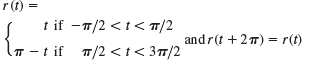
Find the steady-state oscillations of y" + cy' + y = r(t) with c > 0 and r(t) as given. The spring constant is k = 1. Show the details and sketch r(t). r(t) = t if -T/2
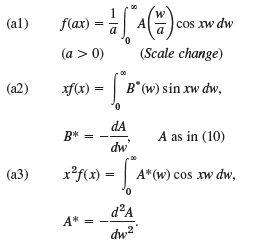
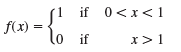
(a) Show that (10) implies(b) Solve Prob. 8 by applying (a3) to the result of Prob. 7.Data from Prob. 7Represent f(x) as an integral (10).(c) Verify (a2) for f(x) = 1 if 0 < x < α and f(x) = 0 if x > α.(d) Find formulas for the Fourier sine integral similar to
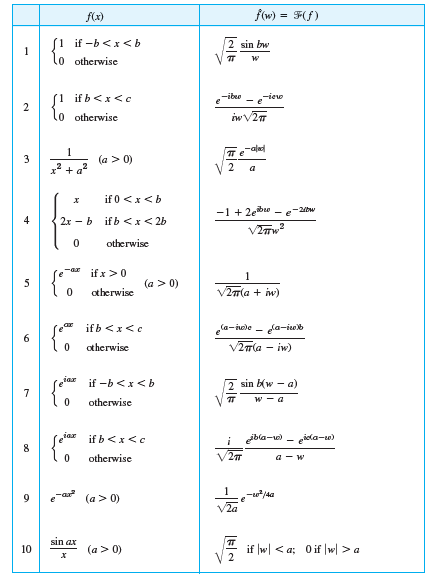
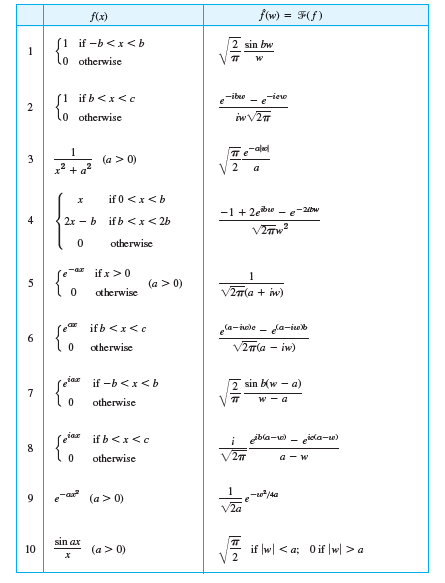
In Table III obtain formula 7 from formula 8. f(w) = F(f) f(x) (1 if -b < x
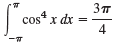
Using (8), prove that the series has the indicated sum. Compute the first few partial sums to see that the convergence is rapid. Зп 4 cos* x dx 4.
Is the given function even or odd or neither even nor odd? Find its Fourier series. Show details of your work.f(x) = cos πx (-1/2 < x < 1/2), p = 1
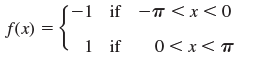
Find the steady-state oscillations of y" + cy' + y = r(t) with c > 0 and r(t) as given. The spring constant is k = 1. Show the details and sketch r(t). (-1 if - TT
These orthogonal polynomials are defined by Heo(1) = 1 andAs is true for many special functions, the literature contains more than one notation, and one sometimes defines as Hermite polynomials the functionsThis differs from our definition, which is preferred in applications.(a) A generating
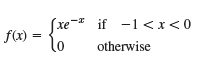
Find F(f(x)) for f(x) = xe-x if x > 0, f(x) = 0 if x < 0, by (9) and formula 5 in Table III (with α = 1). Consider xe-xand e-x. f(w) = F(f) f(x) (1 if -b < x
Represent f(x) as an integral (10). if 0
What function does the series of the cosine terms in Prob. 13 represent The series of the sine terms?Data from Prob. 13Find the Fourier series of as given over one period and sketch and partial sums. (0 if -1
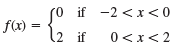
Why does the series in Prob. 11 have no cosine terms?Data from Prob. 11Find the Fourier series of as given over one period and sketch and partial sums. (0 if -2
Is the given function even or odd or neither even nor odd? Find its Fourier series. Show details of your work.f(x) = 1 - x2/4 (-2 < x < 2), p = 4
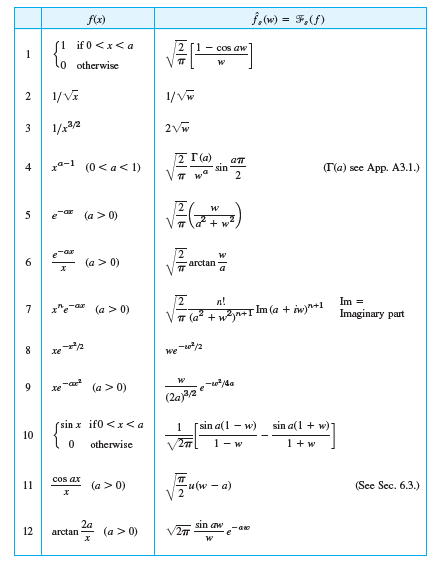
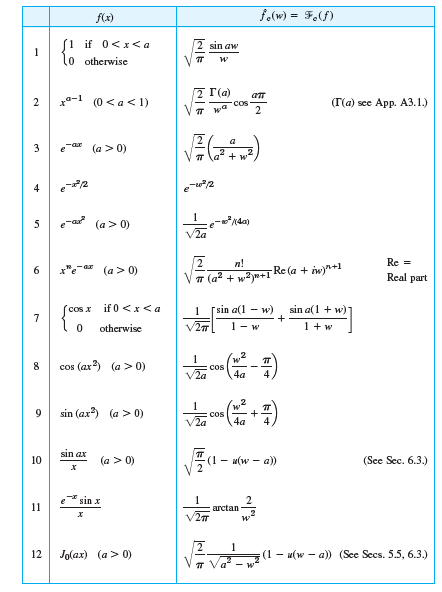
Using formulas 2 and 4 in Table II, a value needed for Bessel functions and other applications. Î,(w) = F,(f) f(x) (1 if 0 0) arctan a п! Im = "-a (a > 0) Imaginary part V7 (a +wyn+T Im (a + iw)+1 u/da (a > 0) xe (2a)2 x if0 0) sin aw 12 arctan 00 9.
Find from (4b) and a suitable formula in Table I. fa(w) = F,(f) f(x) < a (1 if 0 0) IT a (a > 0) V2a 2. V T (a2 + w?yw+1 Re = n! (a > 0) -Re (a + iw)+1 Real part Scos x if 0 0) :cos V2a 4a sin ax (a > 0) 10 (1 — и(w — а)) (See Sec. 6.3.) х sin x 11 arctan V27 (1 - a(w - a) (See Secs. 5.5,
Find the eigenvalues and eigenfunctions. Verify orthogonality. Start by writing the ODE in the form (1), using Prob. 6. Show details of your work.y" - 2y' + (λ + 1)y = 0, y(0) = 0, y(1) = 0Data from Prob. 6Show that y" + fy' + (g + λh) y = 0 takes the form (1) if you setp = exp (∫f dx), q = pg,
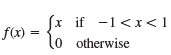
Find the Fourier transform of (without using Table III in Sec. 11.10). Show details. (x if -1
Find and graph (on common axes) the partial sums up to Sm0 whose graph practically coincides with that of f(x) within graphical accuracy. State m0. On what does the size of m0 seem to depend?f (x) = e-x2
Find the eigenvalues and eigenfunctions. Verify orthogonality. Start by writing the ODE in the form (1), using Prob. 6. Show details of your work.y" + λy = 0, y(0) = y(1), y'(0) = y'(1)Data from Prob. 6Show that y" + fy' + (g + λh) y = 0 takes the form (1) if you setp = exp (∫f dx), q = pg, r =
Find and graph (on common axes) the partial sums up to Sm0 whose graph practically coincides with that of f(x) within graphical accuracy. State m0. On what does the size of m0 seem to depend?f (x) = J0(α0,1 x), α0,1 = the first positive zero of J0(x)
Find and graph (on common axes) the partial sums up to Sm0 whose graph practically coincides with that of f(x) within graphical accuracy. State m0. On what does the size of m0 seem to depend?
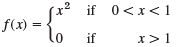
Represent f(x) as an integral (10). .2 if 0
Find the Fourier transform. Show details. if -1
Does the Fourier cosine transform of f(x) = k = const (0 < x < ∞) exist? The Fourier sine transform?
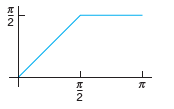
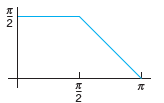
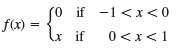
Is the given function even or odd or neither even nor odd? Find its Fourier series. Show details of your work. -1
Find the eigenvalues and eigenfunctions. Verify orthogonality. Start by writing the ODE in the form (1), using Prob. 6. Show details of your work.y" + λy = 0, y(0) = 0, y(L) = 0Data from Prob. 6Show that y" + fy' + (g + λh) y = 0 takes the form (1) if you setp = exp (∫f dx), q = pg, r = hp. Why
Find a general solution of the ODE y" + ω2y = r(t) with r(t) as given. Show the details of your work.r(t) = π/4 |cos t| if -π < t < π and r(t + 2π) = r(t), |ω| ≠ 0, 2, 4, · · ·
Find the Fourier transform of (without using Table III in Sec. 11.10). Show details. -|x| f(x) = e-lal (-0
Why are the square errors in Prob. 5 substantially larger than in Prob. 3?Data from Prob. 3Find the trigonometric polynomial F(x) of the form (2) for which the square error with respect to the given f(x) on the interval -π < x < π is minimum Compute the minimum value for
Show that the integral represents the indicated function. Use (5), (10), or (11); the integral tells you which one, and its value tells you what function to consider. Show your work in detail. (7 sin x if 0SIST sin TTW sin xw dw 1 - w? 0 if
cos nx, sin nx, cos 2πx/k, sin 2πx/k, cos 2πnx/k, sin 2πnx/k.
Evaluate the integral for the given data. Describe the kind of surface. Show the details of your work.F = [cosh y, 0, sinh x], S: z = x + y2, 0 ≤ y ≤ x, 0 ≤ x ≤ 1
Why are x̅ and , y̅ in Prob. 25 independent of k?Data from Prob. 25Find the coordinates x̅, y̅ of the center of gravity of a mass of density f(x, y) in the region R. Sketch R, show details.f = ky, k > 0, arbitrary, 0 ≤ y ≤ 1 - x2, 0 ≤ x ≤ 1
Evaluate them with F or f and C as follows.f = 3x + y + 5z, C: r = [t, cosh t, sinh t], 0 ≤ t ≤ 1. Sketch C.
u = const and v = const on r(u, v) occur if and only if ru • rv = 0. Give examples. Prove it.
Similarity is basic, for instance, in designing numeric methods.(a) By definition, the trace of an n × n matrix A = [αjk] is the sum of the diagonal entries,trace A = α11 + α22 + · · ·
Show that
Let f = xy - yz, v = [2y, 2z, 4x + z], and w = [3z2, x2 - y2, y2]. Findv • ((curl w) × v)
Find the component of a in the direction of b. Make a sketch.a = [8, 2, 0], b = [-4, -1, 0]
Find v such that the resultant of p, q, u, v with p, q, u as in Prob. 24 has no components in x- and y-directions.Data from Prob. 24Find the resultant in terms of components and its magnitude.p = [-1, 2, -3], q = [1, 1, 1], u = [1, -2, 2]
Find v such that p, q, u in Prob. 21 and v are in equilibrium.Data from Prob. 21Find the resultant in terms of components and its magnitude.p = [2, 3, 0], q = [0, 6, 1], u = [2, 0, -4]
Let a = [1, 1, 0], b = [3, 2, 1], and c = [1, 0, 2]. Find the angle between:Deduce the law of cosines by using vectors a, b, and a - b.
When is the component of a vector v in the direction of a vector w equal to the component of w in the direction of v?
Solve Prob. 25 if p = [1, 0, 3], Q: (2, 0, 3), and A: (4, 3, 5).Data from Prob. 25Find the moment vector m and m of p = [2, 3, 0] about Q: (2, 1, 0) acting on a line through A: (0, 3, 0). Make a sketch.
Given a curve C: r(t), find a tangent vector r'(t), a unit tangent vector u'(t), and the tangent of C at P. Sketch curve and tangent.r(t) = [cos t, sin t, 9t], P: (1, 0, 18π)
Experiments show that in a temperature field, heat flows in the direction of maximum decrease of temperature T. Find this direction in general and at the given point P. Sketch that direction at P as an arrow.T = x2 + y2 + 4z2, P: (2, -1, 2)
Given a curve C: r(t), find a tangent vector r'(t), a unit tangent vector u' (t), and the tangent of C at P. Sketch curve and tangent.r(t) = [t, 1/2t2, 1], P: (2, 2, 1)
Find a parametric representation.Straight line through (1, 1, 1) and (4, 0, 2). Sketch it.
Assuming sufficient differentiability, show that(a) curl (u + v) = curl u + curl v(b) div (curl v) = 0(c) curl (fv) = (grad f) × v + f curl v(d) curl (grad f) = 0(e) div (u × v) = v • curl u - u • curl v
Find curl v for v given with respect to right-handed Cartesian coordinates. Show the details of your work.v = (x2 + y2 + z2)-3/2 [x, y, z]
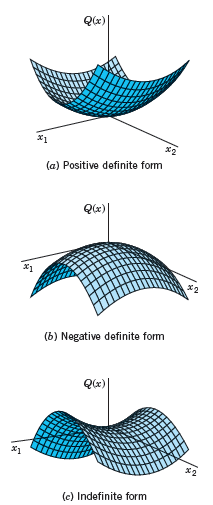
A quadratic form Q(x) = xTAx and its (symmetric!) matrix A are called (a) positive definite If Q(x) > 0 for all x ‰ 0, (b) negative definite If Q(x) < 0 for all x ‰ 0, (c) indefinite If Q(x) takes both positive and negative values. (See Fig. 162.) [Q(x) and A are called
Let A = [αjk] be an n × n matrix with (not necessarily distinct) eigenvalues λ1, · · · , λn. Show.A Leslie matrix L with positive l12, l13, l21, l32 has a positive eigenvalue.
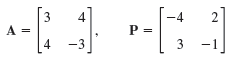
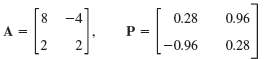
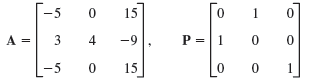
Find the eigenvalues. Find the corresponding eigenvectors. 3
Are the following sets of vectors linearly independent? Show the details of your work. [4 -1 3], [0 8 1), [1 3 -5], [2 6 1]
If you write the matrix in Example 2 in the form A = [αjk], what is α31? α13? α26? α33?
Is the given set of vectors a vector space? Give reasons. If your answer is yes, determine the dimension and find a basis. (v1, v2, · · · denote components.)All vectors in Rn with |vj| = 1 for j = 1, · · ·, n
Determine the ranks of the coefficient matrix and the augmented matrix and state how many solutions the linear system will have.In Prob. 24Data from Prob. 24Showing the details, find all solutions or indicate that no solution exists.-6x + 39y - 9z = -122x - 13y + 3z = 4
Verify (3) for the vectors in Probs. 16 and 19.Data from Prob. 16Find the Euclidean norm of the vectors:[1/2 1/3 -1/2 -1/3]TData from Prob. 19Find the Euclidean norm of the vectors:[2/3 2/3 1/3 0]T
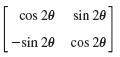
Give an application of the matrix in Prob. 2 that makes the form of the inverse obvious.Data from Prob 2Find the inverse by Gauss€“Jordan (or by (4*) if n = 2). Check by using (1). sin 20 cos 20 cos 20 -sin 20
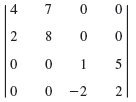
Showing the details, evaluate: 4 1 0 -2 2. 2.
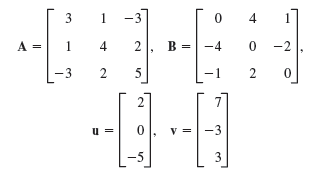
Showing the details, calculate the following expressions or give reason why they are not defined, whenuTv, uvT 3 1 -3 4 1 2, B =-4 A = 4 -2 -3 2 V =-3
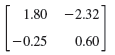
Prove the formula in Prob. 13.Data from prob 13Verify (AT)-1 = (A-1)T for A in Prob. 1.Data from Prob 1Find the inverse by Gauss€“Jordan (or by (4*) if n = 2). Check by using (1). -2.32 1.80 -0.25 0.60
Prove the formula in Prob. 11.Data from Prob. 11Verify (A2)-1 = (A-1)2 for A in Prob. 1.Data from Prob. 1Find the inverse by Gauss€“Jordan (or by (4*) if n = 2). Check by using (1). -2.32 1.80 -0.25 0.60
Showing the details, calculate the following expressions or give reason why they are not defined, whenAT, BT 3 1 -3 4 1 2, B =-4 A = 4 -2 -3 2 V =-3
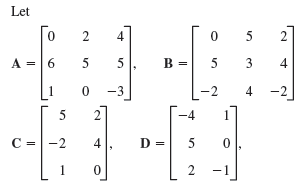
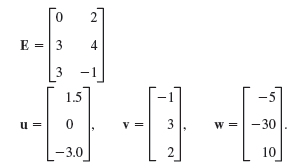
Find the following expression, indicating which of the rules in (3) or (4) they illustrate, or give reasons why they are not defined.(4 · 3)A, 4(3A), 14B - 3B, 11B Let 4 A 6. B = 3 -3 -2 4 -2 2 -4 D =| -2 5 1 -1 2. 27 E = 3 4 1.5 3 w =-30 -3.0 10
(a) Illustrate (10d) by simple examples.(b) Prove (10d).
If a 12 × 12 matrix A shows the distances between 12 cities in kilometers, how can you obtain from A the matrix B showing these distances in miles?
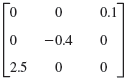
Find the inverse by Gauss€“Jordan (or by (4*) if n = 2). Check by using (1). 0.1 -0.4 2.5
What is the main diagonal of A in Example 1? Of A and B in Example 3?
How many different entries can a 4 × 4 skew-symmetric matrix have? An n × n skew-symmetric matrix?
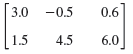
Solve the linear system given explicitly or by its augmented matrix. Show details. [3.0 -0.5 0.6 1.5 4.5 6.0
Showing the details of your work, find L(f) if f(t) equals:te-t cos t
Find a general solution in terms of Jv and Yv. Indicate whether you could also use J-v instead of Yv. Use the indicated substitution. Show the details of your work.xy" + y' + 36y = 0 (12√x = z)
Find a general solution by conversion to a single ODE.The system in Prob. 8.Data from Prob. 8y'1 = 8y1 - y2y'2 = y1 + 10y2
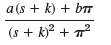
Find the inverse transform. Show the details of your work. a(s + k) + bT (s + k)? + 7?
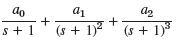
Find the inverse transform. Show the details of your work. do (s + 1)2 (s + 1)3
Find the inverse transform. Show the details of your work. s2 - 2s – 3 4.
Given F(s) = L(f), find f(t). a, b, L, n are constants. Show the details of your work. 4s + 32 - 16 s2 - 16
Using Theorem 3, find f(t) if L(F) equals: ,2
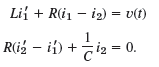
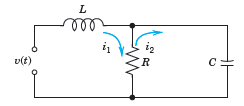
Model and solve by the Laplace transform:Show that, by Kirchhoff€™s Voltage Law, the currents in the network in Fig. 153 are obtained from the systemSolve this system, assuming that R = 10 Ω, L = 20 H, C = 0.05 F, v = 20 V, i1(0) = 0, i2(0) = 2 A.Fig. 153 Lij + R(i1 – i2) =
Using the Laplace transform and showing the details of your work, solve the IVP:y'1 = 4y2 - 8 cos 4t, y'2 = -3y1 - 9 sin 4t, y1(0) = 0, y2(0) = 3
Find and graph or sketch the solution of the IVP. Show the details.y" + 16y = 4δ(t - 3π), y(0) = 2, y’(0) = 0
Find:(cos ωt) * (cos ωt)
Sketch or graph the given function, which is assumed to be zero outside the given interval. Represent it, using unit step functions. Find its transform. Show the details of your work.cos 4t (0 < t < π)
Solve the IVPs by the Laplace transform. If necessary, use partial fraction expansion. Show all details.y" + 9y = 10e-t, y(0) = 0, y'(0) = 0
Using the Laplace transform and showing the details of your work, solve the IVP:y'1 + y2 = 0, y1 + y'2 = 2 cos t, y1(0) = 1, y2(0) = 0
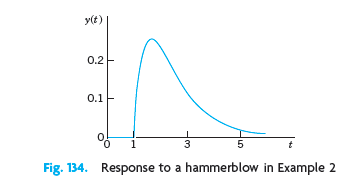
(a) Text, take a rectangular wave of area 1 from 1 to 1 + k. Graph the responses for a sequence of values of k approaching zero, illustrating that for smaller and smaller k those curves approach the curve shown in Fig. 134. If your CAS gives no solution for the differential equation, involving k,
Sketch or graph the given function, which is assumed to be zero outside the given interval. Represent it, using unit step functions. Find its transform. Show the details of your work.t (0 < t < 2)
Showing 2800 - 2900
of 3937
First
22
23
24
25
26
27
28
29
30
31
32
33
34
35
36
Last
Step by Step Answers

 Get 50% OFF
Claim Now
Get 50% OFF
Claim Now


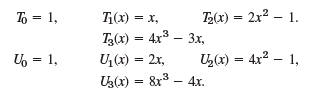
![T, (x) = cos (n arccos x) sin [(n + 1) arccos x] = (x)](https://dsd5zvtm8ll6.cloudfront.net/si.question.images/images/question_images/1543/6/7/5/0105c029c83002671543657555534.jpg)









![[4 -1 3], [0 8 1), [1 3 -5], [2 6 1]](https://dsd5zvtm8ll6.cloudfront.net/si.question.images/images/question_images/1542/4/7/3/7775bf04831f06c31542289332905.jpg)