New Semester
Started
Get
50% OFF
Study Help!
--h --m --s
Claim Now
Question Answers
Textbooks
Find textbooks, questions and answers
Oops, something went wrong!
Change your search query and then try again
S
Books
FREE
Study Help
Expert Questions
Accounting
General Management
Mathematics
Finance
Organizational Behaviour
Law
Physics
Operating System
Management Leadership
Sociology
Programming
Marketing
Database
Computer Network
Economics
Textbooks Solutions
Accounting
Managerial Accounting
Management Leadership
Cost Accounting
Statistics
Business Law
Corporate Finance
Finance
Economics
Auditing
Tutors
Online Tutors
Find a Tutor
Hire a Tutor
Become a Tutor
AI Tutor
AI Study Planner
NEW
Sell Books
Search
Search
Sign In
Register
study help
mathematics
advanced engineering mathematics
Advanced Engineering Mathematics 10th edition Erwin Kreyszig - Solutions
Solve the shifted data IVPs by the Laplace transform. Show the details.y" + 2y' + 5y = 50t - 100, y(2) = -4, y' (2) = 14
Using the Laplace transform and showing the details of your work, solve the IVP:4y'1 + y2r - 2y'3 = 0, -2y'1 + y'3 = 1, 2y'2 - 4y'3 = -16t
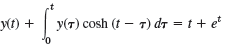
Solve by the Laplace transform, showing the details: y(7) cosh (t – T) dr = t + e yt) +
Find and graph or sketch the solution of the IVP. Show the details.y" + 2y’ + 5y = 25t - 100δ(t - π), y(0) = -2, y’ (0) = 5
Find the transform, indicating the method used and showing the details.e-t(cos 4t - 2 sin 4t)
Show that
Find and sketch or graph f(t) if L(f) equalse-3s/(s - 1)3
Solve the shifted data IVPs by the Laplace transform. Show the details.y" - 2y' - 3y = 0, y(4) = -3, y' (4) = -17
Using the Laplace transform and showing the details of your work, solve the IVP:y"1 = -2y1 + 2y2, y2" = 2y1 - 5y2, y1(0) = 1, y'1 (0) = 0, y2(0) = 3, y'2 (0) = 0
Using the Laplace transform and showing the details of your work, solve the IVP:y'1 = -y2, y'2 = -y1 + 2[1 - u(t - 2π)] cos t, y1(0) = 1, y2(0) = 0
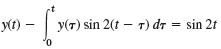
Solve by the Laplace transform, showing the details: yt) – y(7) sin 2(t – T) dr = sin 2t
Find and graph or sketch the solution of the IVP. Show the details.y" + 5y’ + 6y = δ(t - 1/2π) + u(t - π) cos t, y(0) = 0, y’ (0) = 0
Showing the details of your work, find L(f) if f(t) equals:tnekt
Sketch or graph the given function, which is assumed to be zero outside the given interval. Represent it, using unit step functions. Find its transform. Show the details of your work.sinh t (0 < t < 2)
Find the transform. Show the details of your work. Assume that α, b, ω, θ are constants. k
Solve the IVPs by the Laplace transform. If necessary, use partial fraction expansion as in Example 4 of the text. Show all details.y" + 0.04y = 0.02t2, y(0) = -25, y' (0) = 0
Using the Laplace transform and showing the details of your work, solve the IVP:y'1 = -2y1 + 3y2, y'2 = 4y1 - y2, y1(0) = 4, y2(0) = 3
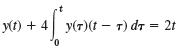
Solve by the Laplace transform, showing the details: y(t) + 4 y(7)(t – 7) dr = 2t 0.
Find and graph or sketch the solution of the IVP. Show the details.y" + 3y’ + 2y = 10(sin t + δ(t - 1)), y(0) = 1, y’ (0) = -1
Sketch or graph the given function, which is assumed to be zero outside the given interval. Represent it, using unit step functions. Find its transform. Show the details of your work.t2 (1 < t < 2)
Find the transform. Show the details of your work. Assume that α, b, ω, θ are constants.1.5 sin (3t - π/2)
Solve the IVPs by the Laplace transform. If necessary, use partial fraction expansion as in Example 4 of the text. Show all details.y" - 4y' + 4y = 0, y(0) = 8.1, y' (0) = 3.9
Using the Laplace transform and showing the details of your work, solve the IVP:y'1 = 5y1 + y2, y'2 = y1 + 5y2, y1(0) = 1, y2(0) = -3
Find and graph or sketch the solution of the IVP. Show the details.y" + 4y’ + 5y = δ(t - 1), y(0) = 0, y’ (0) = 3
Showing the details of your work, find L(f) if f(t) equals:t2 sin 3t
Sketch or graph the given function, which is assumed to be zero outside the given interval. Represent it, using unit step functions. Find its transform. Show the details of your work.sin πt (2 < t < 4)
Find the transform. Show the details of your work. Assume that α, b, ω, θ are constants.e-t sinh 4t
Solve the IVPs by the Laplace transform. If necessary, use partial fraction expansion as in Example 4 of the text. Show all details.y" - 6y' + 5y = 29 cos 2t, y(0) = 3.2, y' (0) = 6.2
Use the powerful formulas (21) to do Probs. 19–25. Show the details of your work.Evaluate ∫x-1 J4(x) dx.
Use the powerful formulas (21) to do Probs. 19–25. Show the details of your work.Derive (1) from (21).
Derive (22) in Example 3 from (27).
Solve the initial value problem by a power series. Graph the partial sums of the powers up to and including x5. Find the value of the sum s (5 digits) at x1.(1 - x2)y" - 2xy' + 30y = 0, y(0) = 0, y' (0) = 1.875, x1 = 0.5
Find a basis of solutions. Try to identify the series as expansions of known functions. Show the details of your work.xy" + 3y' + 4x3y = 0
Find a general solution in terms of hyper geometric functions.4(t2 - 3t + 2)ÿ - 2ý + y = 0
Find a basis of solutions. Try to identify the series as expansions of known functions. Show the details of your work.x2y" + 2x3y' + (x2 - 2)y = 0
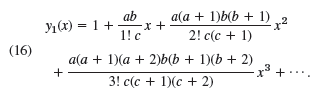
Gauss€™s hypergeometric ODE is
ZEROS of Bessel functions play a key role in modelingCompute the first four positive zeros of J0(x) and J1(x) from (14). Determine the error and comment.
Differentiating (13) with respect to u, using (13) in the resulting formula, and comparing coefficients of un, obtain the Bonnet recursion.where n = 1, 2, . . . . This formula is useful for computations, the loss of significant digits being small (except near zeros). Try (14) out for a few
Find a basis of solutions. Try to identify the series as expansions of known functions. Show the details of your work.16(x + 1)2y" + 3y = 0
Find a basis of solutions by the Frobenius method. Try to identify the series as expansions of known functions. Show the details of your work.x2y" + 6xy' + (4x2 + 6)y = 0
(a) Experiment with (14) for integer n. Using graphs, find out from which x = xn on the curves of (11) and (14) practically coincide. How does xn change with n?(b) What happens in (b) if n = ±1/2? (Our usual notation in this case would be v.)(c) How does the error of (14) behave as a function of x
Modified Bessel functions of the first kind of order v are defined by Iv (x) = i-vJv (ix), i = ˆš-1. Show that Ivsatisfies the ODE
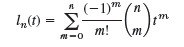
Applying the binomial theorem to (x2- 1)n, differentiating it n times term by term, and comparing the result with (11), show that
Find a power series solution in powers of x. Show the details.(1 - x2)y" - 2xy' + 2y = 0
Find a basis of solutions. Try to identify the series as expansions of known functions. Show the details of your work.xy" + (1 - 2x) y' + (x - 1) y = 0
Find a basis of solutions by the Frobenius method. Try to identify the series as expansions of known functions. Show the details of your work.xy" + 2y' + 4xy = 0
It can be shown that for large x,with ˆ¼ defined as in (14) of Sec. 5.4.(a) Graph Yn for n = 0, . . ., 5 on common axes. Are there relations between zeros of one function and extrema of another? For what functions?(b) Find out from graphs from which x = xn on the curves of (8) and
Find a power series solution in powers of x. Show the details.y" - y' + xy = 0
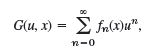
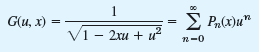
Generating functions play a significant role in modern applied mathematics. The idea is simple. If we want to study a certain sequence (fn(x)) and can find a functionis a generating function of the Legendre polynomials. Start from the binomial expansion of 1/ˆš1-v, then set v = 2xu - u2,
Find a general solution in terms of Jv and Yv. Indicate whether you could also use J-v instead of Yv. Use the indicated substitution. Show the details of your work.y" + k2x4y = 0 (y = u√x, 1/3kx3 = z)
Find a basis of solutions by the Frobenius method. Try to identify the series as expansions of known functions. Show the details of your work.xy" + 2x3y' + (x2 - 2)y = 0
Graph P2(x), . . . , P10(x) on common axes. For what x (approximately) and n = 2, . . . , 10 is |Pn(x)| < 1/2?
Find a basis of solutions by the Frobenius method. Try to identify the series as expansions of known functions. Show the details of your work.xy" + y = 0
Find a general solution in terms of Jv and Yv. Indicate whether you could also use J-v instead of Yv. Use the indicated substitution. Show the details of your work.y" + xy = 0 (y = u√x, 2/3x3/2 = z)
Find a basis of solutions by the Frobenius method. Try to identify the series as expansions of known functions. Show the details of your work.(x + 2)2y" + (x + 2)y' - y = 0
Find a general solution in terms of Jv and Yv. Indicate whether you could also use J-v instead of Yv. Use the indicated substitution. Show the details of your work.xy" + 5y' + xy + 0 (y = u/x2)
Find the location and kind of all critical points of the given nonlinear system by linearization.y'1 = 2y2 + 2y22y'2 = -8y1
Find the location and kind of all critical points of the given nonlinear system by linearization.y'1 = cos y2y'2 = 3y1
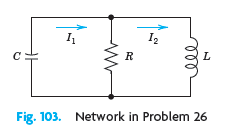
Find the currents in Fig. 103 when R = 1 Ω, L = 1.25 H, C = 0.2 F, I1(0) = 1, I2(0) = 1 A. I2 L. Network in Problem 26 Fig. 103.
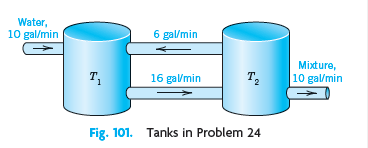
Tank T1in Fig. 101 initially contains 200 gal of water in which 160 lb of salt are dissolved. Tank T2initially contains 100 gal of pure water. Liquid is pumped through the system as indicated, and the mixtures are kept uniform by stirring. Find the amounts of salt y1(t) and y2(t) in T1and T2,
Find a general solution. Show the details of your work.y'1 = y1 + y2 + sin ty'2 = 4y1 + y2
Find a general solution. Show the details of your work.y'1 = 2y1 + 2y2 + ety'2 = -2y1 - 3y2 + et
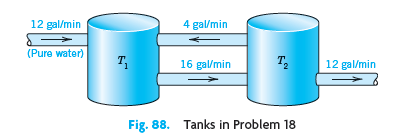
Each of the two tanks contains 200 gal of water, in which initially 100 lb (Tank T1) and 200 lb (Tank T2) of fertilizer are dissolved. The inflow, circulation, and outflow are shown in Fig. 88. The mixture is kept uniform by stirring. Find the fertilizer contents y1(t) in T1and y2(t) in T2. 12
What kind of critical point does y' = Ay have if A has the eigenvalues-4 and 2
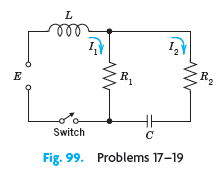
Find the currents in Fig. 99 (Probs. 17€“19) for the following data, showing the details of your work.Solve Prob. 17 with E = 440 sin t V and the other data as before.Data from Prob. 17R1 = 2 Ω, R2 = 8 Ω, L = 1 H, C = 0.5 F, E = 200 V ll R R. Switch Fig. 99.
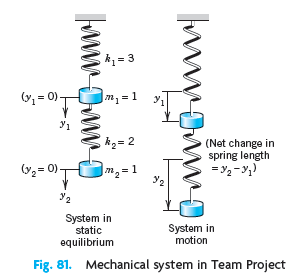
(a) Set up the model for the (undamped) system in Fig. 81.(b) Solve the system of ODEs obtained. Try y = xeωt and set ω2 = λ. Proceed as in Example 1 or 2.(c) Describe the influence of initial conditions on the possible kind of motions. k = 3 (y, = 0)- m, = 1
(a) Determine the type of the critical point at (0, 0) when μ > 0, μ = 0, μ < 0.(b) Rayleigh equation. Show that the Rayleigh equation 0) " class="fr-fic fr-dib">also describes self-sustained oscillations and that by differentiating it and setting y = Y' one obtains the van der Pol
Solve the following initial value problems.y'1 = -y1 - y2y'2 = y1 – y2y1(0) = 1, y2(0) = 0
Find a general solution. Determine the kind and stability of the critical point.y'1 = 3y1 + 4y2y'2 = 3y1 + 2y2
Solve, showing details:y'1 = 4y2 + 5ety'2 = -y1 - 20e-ty1(0) = 1, y2(0) = 0
Find a general solution of the given ODE (a) by first converting it to a system, (b), as given. Show the details of your work.y"' + 2y" - y' - 2y = 0
Solve y" + 1/9y = 0. Find the trajectories. Sketch or graph some of them.
Solve the following initial value problems.y'1 = y1 + 3y2y'2 = 1/3y 1 + y2y1(0) = 12, y2(0) = 2
Find a general solution. Determine the kind and stability of the critical point.y'1 = 5y1y'2 = y2
Solve, showing details:y'1 = y1 + 4y2 - t2 + 6ty'2 = y1 + y2 - t2 + t - 1y1(0) = 2, y2(0) = -1
Solve, showing details:y'1 = -3y1 - 4y2 + 5ety'2 = 5y1 + 6y2 - 6ety1(0) = 19, y2(0) = -23
Find a general solution of the given ODE (a) by first converting it to a system, (b), as given. Show the details of your work.y" + 3y' + 2y = 0
Find the location and type of all critical points by first converting the ODE to a system and then linearizing it.y" + y - y3 = 0
Determine the type and stability of the critical point. Then find a real general solution and sketch or graph some of the trajectories in the phase plane. Show the details of your work.y'1 = y2y'2 = -5y1 - 2y2
Solve the following initial value problems.y'1 = 2y1 + 2y2y'2 = 5y1 - y2y1(0) = 0, y2(0) = 7
In Example 2 find the currents:If the capacitance is changed to C = 5/27 F. (General solution only.)
Find the location and type of all critical points by linearization. Show the details of your work.y1' = y2 - y22y2' = y1 - y21
Determine the type and stability of the critical point. Then find a real general solution and sketch or graph some of the trajectories in the phase plane. Show the details of your work.y'1 = -y1 + 4y2y'2 = 3y1 - 2y2
Find a real general solution of the following systems. Show the details.y'1 = 8y1 - y2y'2 = y1 + 10y2
Find a general solution. Show the details of your work.y'1 = 4y2y'2 = 4y1 - 16t2 + 2
Find the location and type of all critical points by linearization. Show the details of your work.y'1 = y2y2' = -y1 - y21
Determine the type and stability of the critical point. Then find a real general solution and sketch or graph some of the trajectories in the phase plane. Show the details of your work.y'1 = -6y1 - y2y'2 = -9y1 - 6y2
Find a real general solution of the following systems. Show the details.y'1 = 2y1 - 2y2y'2 = 2y1 + 2y2
Find a general solution. Show the details of your work.y'1 = 4y1 - 8y2 + 2 cosh ty'2 = 2y1 - 6y2 + cosh t + 2 sinh t
Find the location and type of all critical points by linearization. Show the details of your work.y'1 = 4y1 - y21y'2 = y2
Determine the type and stability of the critical point. Then find a real general solution and sketch or graph some of the trajectories in the phase plane. Show the details of your work.y'1 = 2y1 + y2y'2 = 5y1 - 2y2
Find a real general solution of the following systems. Show the details.y'1 = -8y1 - 2y2y'2 = 2y1 - 4y2
Find a general solution. Show the details of your work.y'1 = y1 + y2 + 10 cos ty'2 = 3y1 - y2 - 10 sin t
What happens in Example 1 if we replace T1 by a tank containing 200 gal of water and 150 lb of fertilizer dissolved in it?
Determine the type and stability of the critical point. Then find a real general solution and sketch or graph some of the trajectories in the phase plane. Show the details of your work.y'1 = -4y1y'2 = -3y2
Find a real general solution of the following systems. Show the details.y'1 = 6y1 + 9y2y'2 = y1 + 6y2
Prove that the product of two unitary n x n matrices and the inverse of a unitary matrix are unitary. Give examples.
Prove that eigenvectors of a symmetric matrix corresponding to different eigenvalues are orthogonal. Give examples.
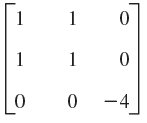
Find an eigenbasis (a basis of eigenvectors) and diagonalize. Show the details. 1 0 -4
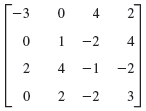
Find the eigenvalues. Find the corresponding eigenvectors. -3 1 -2 4 -1 -2 2 -2 3 2. 4)
Showing 3600 - 3700
of 3937
First
26
27
28
29
30
31
32
33
34
35
36
37
38
39
40
Step by Step Answers

 Get 50% OFF
Claim Now
Get 50% OFF
Claim Now







![ат -[(x² – 1)*]. 1)](https://dsd5zvtm8ll6.cloudfront.net/si.question.images/images/question_images/1542/1/0/1/5105bea9a069498f1542030080382.jpg)