New Semester
Started
Get
50% OFF
Study Help!
--h --m --s
Claim Now
Question Answers
Textbooks
Find textbooks, questions and answers
Oops, something went wrong!
Change your search query and then try again
S
Books
FREE
Study Help
Expert Questions
Accounting
General Management
Mathematics
Finance
Organizational Behaviour
Law
Physics
Operating System
Management Leadership
Sociology
Programming
Marketing
Database
Computer Network
Economics
Textbooks Solutions
Accounting
Managerial Accounting
Management Leadership
Cost Accounting
Statistics
Business Law
Corporate Finance
Finance
Economics
Auditing
Tutors
Online Tutors
Find a Tutor
Hire a Tutor
Become a Tutor
AI Tutor
AI Study Planner
NEW
Sell Books
Search
Search
Sign In
Register
study help
mathematics
precalculus
Thomas Calculus Early Transcendentals 13th Edition Joel R Hass, Christopher E Heil, Maurice D Weir - Solutions
Determine whether the improper integral diverges or converges. Evaluate the integral if it converges. 16 10 / 4 dx
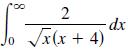
Determine whether the improper integral diverges or converges. Evaluate the integral if it converges. "00 2 √x(x + 4) dx
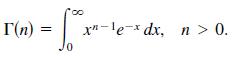
The Gamma Function Γ(n) is defined by(a) Find Γ(1), Γ(2), and Γ(3).(b) Use integration by parts to show that Γ(n + 1) = nΓ(n).(c) Write Γ(n) using factorial notation where n is a positive integer. I(n) = *00 Jo 10 xn-le-dx,n>0.
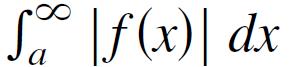
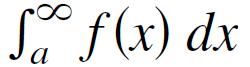
Let f be continuous on the interval [a, ∞). Show that if the improper integral converges, then the improper integralalso converges. xp |(x)f| D
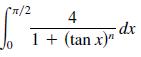
Consider the integralwhere n is a positive integer.(a) Is the integral improper? Explain.(b) Use a graphing utility to graph the integrand for n = 2, 4, 8, and 12.(c) Use the graphs to approximate the integral as n ∞.(d) Use a computer algebra system to evaluate the integral for the values of n
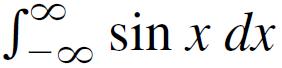
(a) Show thatdiverges.(b) Show that (c) What do parts (a) and (b) show about the definition of improper integrals? So sin x dx
Express the curvature of a twice-differentiable curve r = ƒ(θ) in the polar coordinate plane in terms of ƒ and its derivatives.
Graph the curves and sketch their velocity and acceleration vectors at the given values of t. Then write a in the form a = aTT + aNN without finding T and N, and find the value of κ at the given values of t. r(t) = (4 cos t)i + (√2 sin t)j, t = 0 and π/4
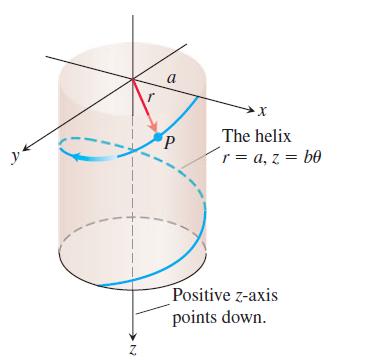
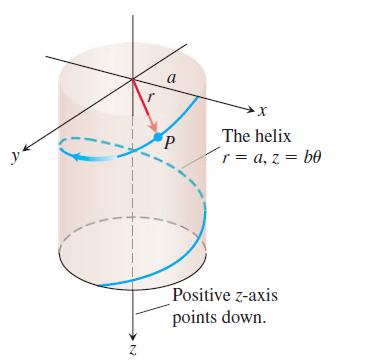
A frictionless particle P, starting from rest at time t = 0 at the point (a, 0, 0), slides down the helixunder the influence of gravity, as in the accompanying figure. The θ in this equation is the cylindrical coordinate θ and the helix is the curve r = a, z = bθ, θ ≥ 0, in cylindrical
Graph the curves and sketch their velocity and acceleration vectors at the given values of t. Then write a in the form a = aTT + aNN without finding T and N, and find the value of κ at the given values of t. r(t) = (√3 sec t)i + (√3 tan 1)j, t = 0
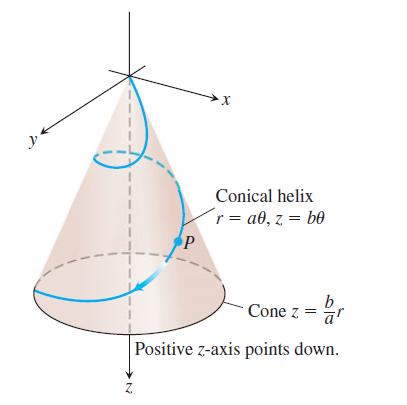
Suppose the curve in Exercise 1 is replaced by the conical helix r = aθ, z = bθ shown in the accompanying figure.a. Express the angular velocity dθ/dt as a function of θ.b. Express the distance the particle travels along the helix as a function of θ.Data in Exercise 1A frictionless particle P,
The position of a particle in the plane at time t isFind the particle’s highest speed. r 1 V1 + 1² i + t V1 + 1² j.
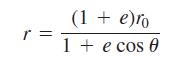
Deduce from the orbit equationthat a planet is closest to its sun when θ = 0 and show that r = r0 at that time. r = (1 + e)ro 1 + e cos 0
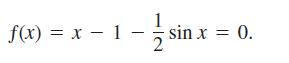
The problem of locating a planet in its orbit at a given time and date eventually leads to solving “Kepler” equations of the forma. Show that this particular equation has a solution between x = 0 and x = 2.b. With your computer or calculator in radian mode, use Newton’s method to find the
Suppose r(t) = (et cos t)i + (et sin t)j. Show that the angle between r and a never changes. What is the angle?
At point P, the velocity and acceleration of a particle moving in the plane are v = 3i + 4j and a = 5i + 15j. Find the curvature of the particle’s path at P.
Find the point on the curve y = ex where the curvature is greatest.
A particle moves around the unit circle in the xy-plane. Its position at time t is r = xi + yj, where x and y are differentiable functions of t. Find dy / dt if v · i = y. Is the motion clockwise or counterclockwise?
A slender rod through the origin of the polar coordinate plane rotates (in the plane) about the origin at the rate of 3 rad / min. A beetle starting from the point (2, 0) crawls along the rod toward the origin at the rate of 1 in. / min.a. Find the beetle’s acceleration and velocity in polar form
You send a message through a pneumatic tube that follows the curve 9y = x3 (distance in meters). At the point (3, 3), v · i = 4 and a · i = -2. Find the values of v · j and a · j at (3, 3).
a. Show that when you express ds2 = dx2 + dy2 + dz2 in terms of cylindrical coordinates, you get ds2 = dr2 + r2 dθ2 + dz2.b. Interpret this result geometrically in terms of the edges and a diagonal of a box. Sketch the box.c. Use the result in part (a) to find the length of the curve r = eθ, z =
A particle moves in the plane so that its velocity and position vectors are always orthogonal. Show that the particle moves in a circle centered at the origin.
A shot leaves the thrower’s hand 6.5 ft above the ground at a 45° angle at 44 ft / sec. Where is it 3 sec later?
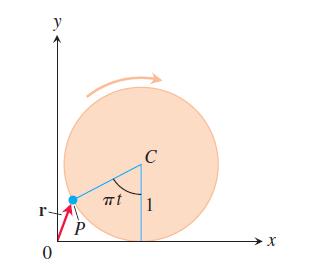
A circular wheel with radius 1 ft and center C rolls to the right along the x-axis at a half-turn per second. At time t seconds, the position vector of the point P on the wheel’s circumference isa. Sketch the curve traced by P during the interval 0 ≤ t ≤ 3.b. Find v and a at t = 0, 1, 2, and
A javelin leaves the thrower’s hand 7 ft above the ground at a 45° angle at 80 ft / sec. How high does it go?
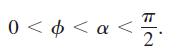
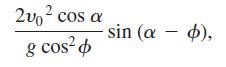
A golf ball is hit with an initial speed ν0 at an angle a to the horizontal from a point that lies at the foot of a straight-sided hill that is inclined at an angle ϕ to the horizontal, whereShow that the ball lands at a distancemeasured up the face of the hill. Hence, show that the greatest
Find T, N, B, κ, and τ at the given value of t. r(t) = (3 cosh 2t)i + (3 sinh 2t)j + 6tk, t = ln 2
Find the lengths of the curves. r(t) = (2 cos t)i + (2 sin t)j + t²k, 0 ≤ t ≤ π/4
Find T, N, B, κ, and τ at the given value of t. r(t) = " (1 + 1)³/² i + # (1 - rp/2j + 2rk.r=0 4 tk, t
To illustrate that the length of a smooth space curve does not depend on the parametrization you use to compute it, calculate the length of one turn of the helix in Example 1 with the following parametrizations. a. r(t) = (cos 4t)i + (sin 4t)j + 4tk, 0≤t≤ π/2 b. r(t) = [cos (t/2)] + [sin
The length 2π√2 of the turn of the helix in Example 1 is also the length of the diagonal of a square 2π units on a side. Show how to obtain this square by cutting away and flattening a portion of the cylinder around which the helix winds. EXAMPLE 1 A glider is soaring upward along the helix
Find the lengths of the curves. r(t) = (3 cos t)i + (3 sin t)j + 2t³/2k, 0≤ t ≤ 3
Find T, N, B, κ, and τ at the given value of t. r(t) = ti + 2e²¹j, 2¹j, t = In 2
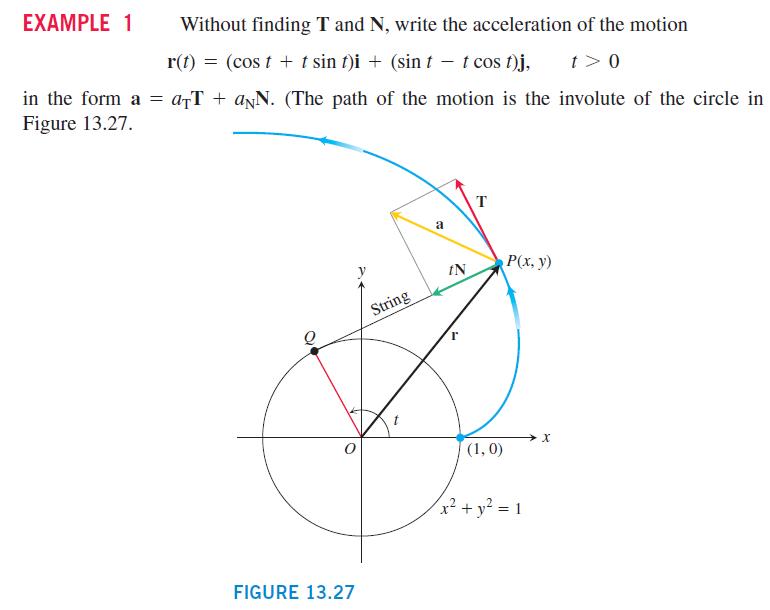
If you already know |aN| and |v|, then the formula aN = k |v|2 gives a convenient way to find the curvature. Use it to find the curvature and radius of curvature of the curve(Take aN and |v| from Example 1.) r(t) (cost + t sin t)i + (sin t t cos t)j, t > 0. -
Find T, N, B, κ, and τ at the given value of t. r(t) = (et sin 2t)i + (e¹ cos 2t)j + 2e¹k, t = 0
Write a in the form a = aTT + aNN at t = 0 without finding T and N. r(t) = = (2+t)i + (t + 2t²)j + (1 + t²)k
Write a in the form a = aTT + aNN at t = 0 without finding T and N. r(t) = (2 + 3t + 3t²)i + (4t + 4t²)j − (6 cos t)k
Find T, N, B, κ, and τ as functions of t if r(t) = (sin t)i + (√2 cost)j + (sin t)k.
In Potsdam in 1988, Petra Felke of (then) East Germany set a women’s world record by throwing a javelin 262 ft 5 in.a. Assuming that Felke launched the javelin at a 40° angle to the horizontal 6.5 ft above the ground, what was the javelin’s initial speed?b. How high did the javelin go?
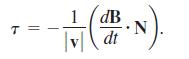
If we start with the definition τ = -(dB/ds) · N and apply the Chain Rule to rewrite dB/ds aswe arrive at the formulaUse the formula to find the torsion of the helix in Example 2. dB ds dB dt dt ds dB 1 dt V
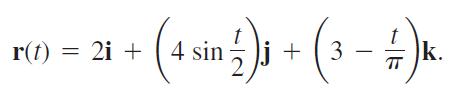
The position of a particle moving in space at time t ≥ 0 isFind the first time r is orthogonal to the vector i - j. r(t) = 2i+ 4 sin (4 sin ½)j + + - (³-1/7) K. 3 k.
At what times in the interval 0 ≤ t ≤ π are the velocity and acceleration vectors of the motion r(t) = i + (5 cos t)j + (3 sin t)k orthogonal?
Find equations for the osculating, normal, and rectifying planes of the curve r(t) = ti + t2j + t3k at the point (1, 1, 1).
Verify the results given in the text (following Example 4) for the maximum height, flight time, and range for ideal projectile motion. EXAMPLE 4 A projectile is fired from the origin over horizontal ground at an initial speed of 500 m/sec and a launch angle of 60°. Where will the projectile be 10
Find parametric equations for the line that is tangent to the curve r(t) = eti + (sin t)j + ln (1 - t)k at t = 0.
By eliminating α from the ideal projectile equationsshow that x2 + (y + gt2/2)2 = ν02 t2. This shows that projectiles launched simultaneously from the origin at the same initial speed will, at any given instant, all lie on the circle of radius ν0t centered at (0, -gt2/2), regardless of their
Find parametric equations for the line tangent to the helix r(t) = (√2 cos t)i + (√2 sin t)j + tk at the point where t = π/4.
Show that the radius of curvature of a twice-differentiable plane curve r(t) = ƒ(t)i + g(t)j is given by the formula x² + y² √x² + y² = ²² - where s = /j² + j². Vi² dt
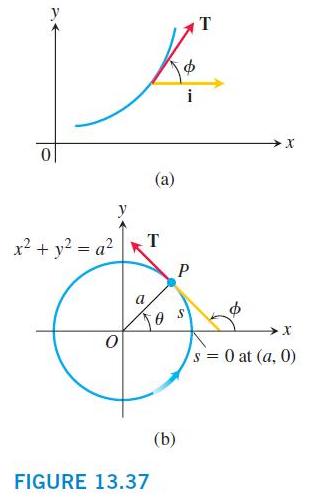
An alternative definition gives the curvature of a sufficiently differentiable plane curve to be |df/ds|, where ϕ is the angle between T and i (Figure 13.37a). Figure 13.37b shows the distance s measured counterclockwise around the circle x2 + y2 = a2 from the point (a, 0) to a point P, along with
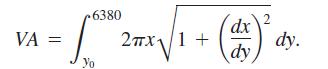
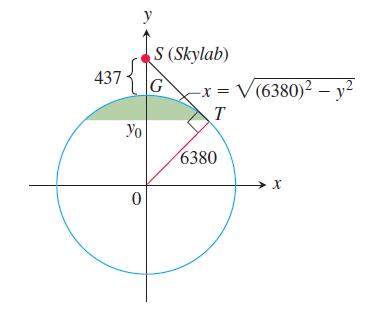
What percentage of Earth’s surface area could the astronauts see when Skylab 4 was at its apogee height, 437 km above the surface? To find out, model the visible surface as the surface generated by revolving the circular arc GT, shown here, about the y-axis. Then carry out these steps:1. Use
Consider the baseball problem in Example 5 when there is linear drag (Exercise 37). Assume a drag coefficient k = 0.12, but no gust of wind.a. From Exercise 37, find a vector form for the path of the baseball.b. How high does the baseball go, and when does it reach maximum height?c. Find the range
Show, by reference to a figure, that the angle β between the tangents to two curves at a point of intersection may be found from the formulaWhen will the two curves intersect at right angles? tan ₂-tan ₁ tan B= 1+ tantan ₁ i (6)
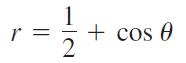
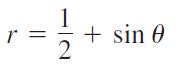
Graph the limaçons. Limaçon (“lee-ma-sahn”) is Old French for “snail.” You will understand the name when you graph the limaçons. Equations for limaçons have the form r = a ± b cos θ or r = a ± b sin θ. There are four basic shapes.a.b. r || 1 2 + cos 0
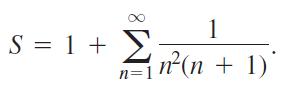
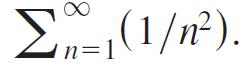
a. Use Theorem 8 to show thatb. From Example 5, show thatc. Explain why taking the first M terms in the series in part (b) gives a better approximation to S than taking the first M terms in the original seriesd. We know the exact value of S is π2/6. Which of the sumsgives a better approximation to
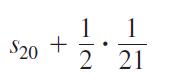
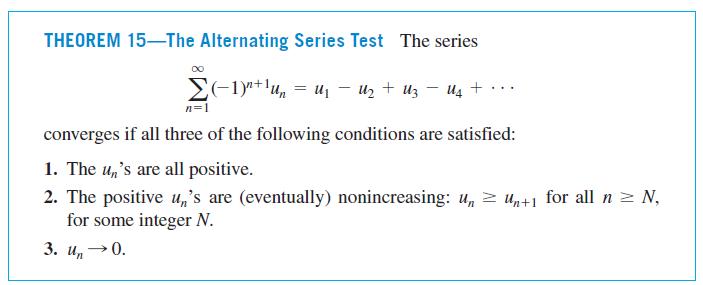
The limit L of an alternating series that satisfies the conditions of Theorem 15 lies between the values of any two consecutive partial sums. This suggests using the averageto estimate L. Computeas an approximation to the sum of the alternating harmonic series. The exact sum is ln 2 = 0.69314718 .
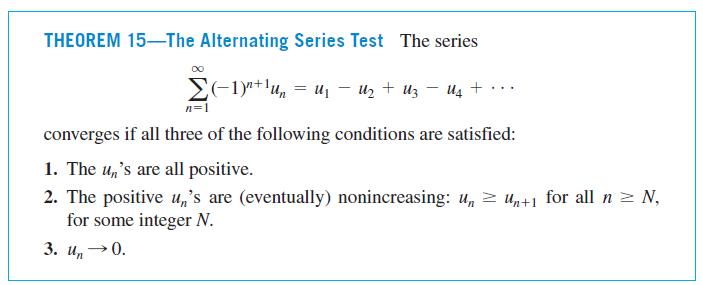
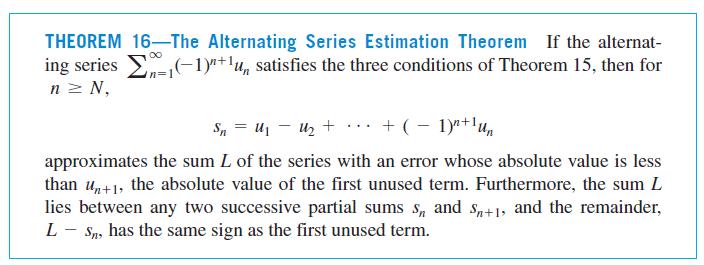
Prove the assertion in Theorem 16 that whenever an alternating series satisfying the conditions of Theorem 15 is approximated with one of its partial sums, then the remainder (sum of the unused terms) has the same sign as the first unused term. THEOREM 15-The Alternating Series Test The
Just as you describe curves in the plane parametrically with a pair of equations x = ƒ(t), y = g(t) defined on some parameter interval I, you can sometimes describe surfaces in space with a triple of equations x = ƒ(u, ν), y = g(u, ν), z = h(u, ν) defined on some parameter rectangle a ≤ u
Find the points on the sphere x2 + y2 + z2 = 25 where ƒ(x, y, z) = x + 2y + 3z has its maximum and minimum values.
The derivative of ƒ(x, y, z) at a point P is greatest in the direction of v = i + j - k. In this direction, the value of the derivative is 2√3.a. What is ∇ƒ at P ? Give reasons for your answer.b. What is the derivative of ƒ at P in the direction of i + j ?
Show that each function satisfies a Laplace equation. f(x, y) = InVx² + y₂² √x²
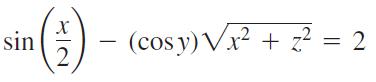
Use a CAS to plot the implicitly defined level surfaces. sin (cosy) √x² + z² = 2
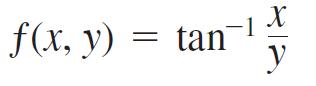
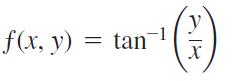
Show that each function satisfies a Laplace equation. f(x, y) = X tan¯¹ y
Just as you describe curves in the plane parametrically with a pair of equations x = ƒ(t), y = g(t) defined on some parameter interval I, you can sometimes describe surfaces in space with a triple of equations x = ƒ(u, ν), y = g(u, ν), z = h(u, ν) defined on some parameter rectangle a ≤ u
Just as you describe curves in the plane parametrically with a pair of equations x = ƒ(t), y = g(t) defined on some parameter interval I, you can sometimes describe surfaces in space with a triple of equations x = ƒ(u, ν), y = g(u, ν), z = h(u, ν) defined on some parameter rectangle a ≤ u
Just as you describe curves in the plane parametrically with a pair of equations x = ƒ(t), y = g(t) defined on some parameter interval I, you can sometimes describe surfaces in space with a triple of equations x = ƒ(u, ν), y = g(u, ν), z = h(u, ν) defined on some parameter rectangle a ≤ u
Show that each function satisfies a Laplace equation.ƒ(x, y) = e-2y cos 2x
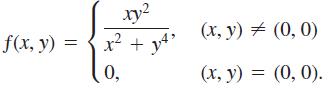
Let Show that ƒx(0, 0) and ƒy(0, 0) exist, but ƒ is not differentiable at (0, 0). f(x, y) = xy² x² + y4² 0, (x, y) = (0, 0) (x, y) = (0, 0).
Show that each function satisfies a Laplace equation.ƒ(x, y) = 3x + 2y - 4
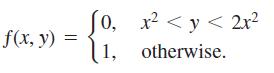
LetShow that ƒx(0, 0) and ƒy(0, 0) exist, but ƒ is not differentiable at (0, 0). f(x, y) = Jo, x²
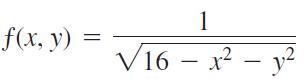
(a) Find the function’s domain, (b) Find the function’s range, (c) Describe the function’s level curves, (d) Find the boundary of the function’s domain, (e) Determine if the domain is an open region, a closed region, or neither, and (f) Decide if the domain is bounded or unbounded.
Show that each function satisfies a Laplace equation.ƒ(x, y, z) = (x2 + y2 + z2)-1/2
Show that each function satisfies a Laplace equation.ƒ(x, y, z) = e3x+4y cos 5z
Draw a branch diagram and write a Chain Rule formula for each derivative. dw for w= g(x, y), x = h(r, s, t), y = k(r, s, t) Əs
Does a function ƒ(x, y) with continuous first partial derivatives throughout an open region R have to be continuous on R? Give reasons for your answer.
If a function ƒ(x, y) has continuous second partial derivatives throughout an open region R, must the first-order partial derivatives of ƒ be continuous on R? Give reasons for your answer.
(a) Find the function’s domain, (b) Find the function’s range, (c) Describe the function’s level curves, (d) Find the boundary of the function’s domain, (e) Determine if the domain is an open region, a closed region, or neither, and (f) Decide if the domain is bounded or unbounded.
Find the maximum and minimum values of ƒ(x, y, z) = x - 2y + 5z on the sphere x2 + y2 + z2 = 30.
Find ƒx, ƒy, and ƒz. f(x, y, z) = x - √y² + z² 12
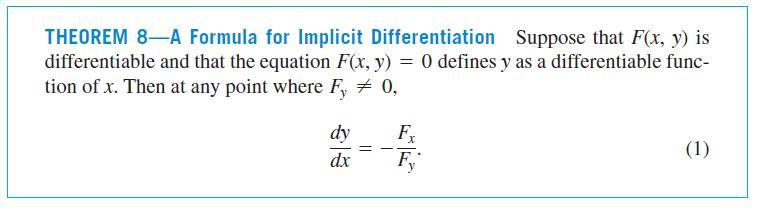
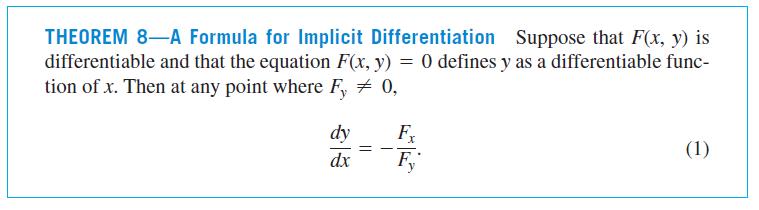
Assuming that the equations define y as a differentiable function of x, use Theorem 8 to find the value of dy / dx at the given point.x3 - 2y2 + xy = 0, (1, 1) THEOREM 8-A Formula for Implicit Differentiation Suppose that F(x, y) is differentiable and that the equation F(x, y) = 0 defines y as a
Find ƒx, ƒy, and ƒz.ƒ(x, y, z) = xy + yz + xz
Sketch the curve ƒ(x, y) = c together with ∇ƒ and the tangent line at the given point. Then write an equation for the tangent line. ( V2, V2) 1 = z + x
Describe the method of Lagrange multipliers and give examples.
Find the directions in which the functions increase and decrease most rapidly at P0. Then find the derivatives of the functions in these directions.h(x, y, z) = ln (x2 + y2 - 1) + y + 6z, P0(1, 1, 0)
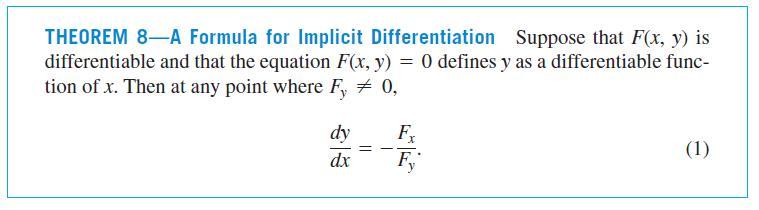
Assuming that the equations define y as a differentiable function of x, use Theorem 8 to find the value of dy / dx at the given point.xy + y2 - 3x - 3 = 0, (-1, 1) THEOREM 8-A Formula for Implicit Differentiation Suppose that F(x, y) is differentiable and that the equation F(x, y) = 0 defines y as
(a) Find the function’s domain, (b) Find the function’s range, (c) Describe the function’s level curves, (d) Find the boundary of the function’s domain, (e) Determine if the domain is an open region, a closed region, or neither, and (f) Decide if the domain is
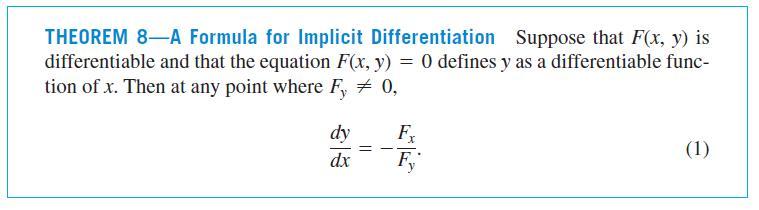
Assuming that the equations define y as a differentiable function of x, use Theorem 8 to find the value of dy / dx at the given point.x2 + xy + y2 - 7 = 0, (1, 2) THEOREM 8-A Formula for Implicit Differentiation Suppose that F(x, y) is differentiable and that the equation F(x, y) = 0 defines y as a
Sketch the curve ƒ(x, y) = c together with ∇ƒ and the tangent line at the given point. Then write an equation for the tangent line. x² − y = 1, (√2, 1) -
How does Taylor’s formula for a function ƒ(x, y) generate polynomial approximations and error estimates?
Find three real numbers whose sum is 9 and the sum of whose squares is as small as possible.
(a) Find the function’s domain, (b) Find the function’s range, (c) Describe the function’s level curves, (d) Find the boundary of the function’s domain, (e) Determine if the domain is an open region, a closed region, or neither, and (f) Decide if the domain is
Find ƒx, ƒy, and ƒz.ƒ(x, y, z) = (x2 + y2 + z2)-1/2
(a) Find the function’s domain, (b) Find the function’s range, (c) Describe the function’s level curves, (d) Find the boundary of the function’s domain, (e) Determine if the domain is an open region, a closed region, or neither, and (f) Decide if the domain is bounded or unbounded.
If w = ƒ(x, y, z), where the variables x, y, and z are constrained by an equation g(x, y, z) = 0, what is the meaning of the notation (∂w/∂x)y? How can an arrow diagram help you calculate this partial derivative with constrained variables? Give examples.
Assuming that the equations define y as a differentiable function of x, use Theorem 8 to find the value of dy / dx at the given point.xey + sin xy + y - ln 2 = 0, (0, ln 2) THEOREM 8-A Formula for Implicit Differentiation Suppose that F(x, y) is differentiable and that the equation F(x, y) = 0
Find the largest product the positive numbers x, y, and z can have if x + y + z2 = 16.
(a) Find the function’s domain, (b) Find the function’s range, (c) Describe the function’s level curves, (d) Find the boundary of the function’s domain, (e) Determine if the domain is an open region, a closed region, or neither, and (f) Decide if the domain is
Find ƒx, ƒy, and ƒz.ƒ(x, y, z) = sin-1 (xyz)
Sketch the curve ƒ(x, y) = c together with ∇ƒ and the tangent line at the given point. Then write an equation for the tangent line.xy = -4, (2, -2)
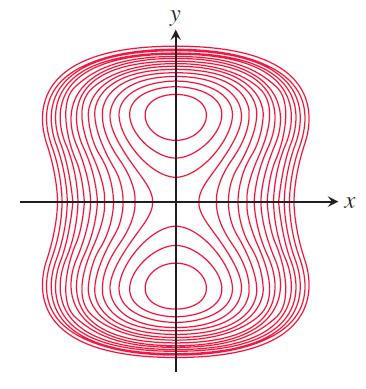
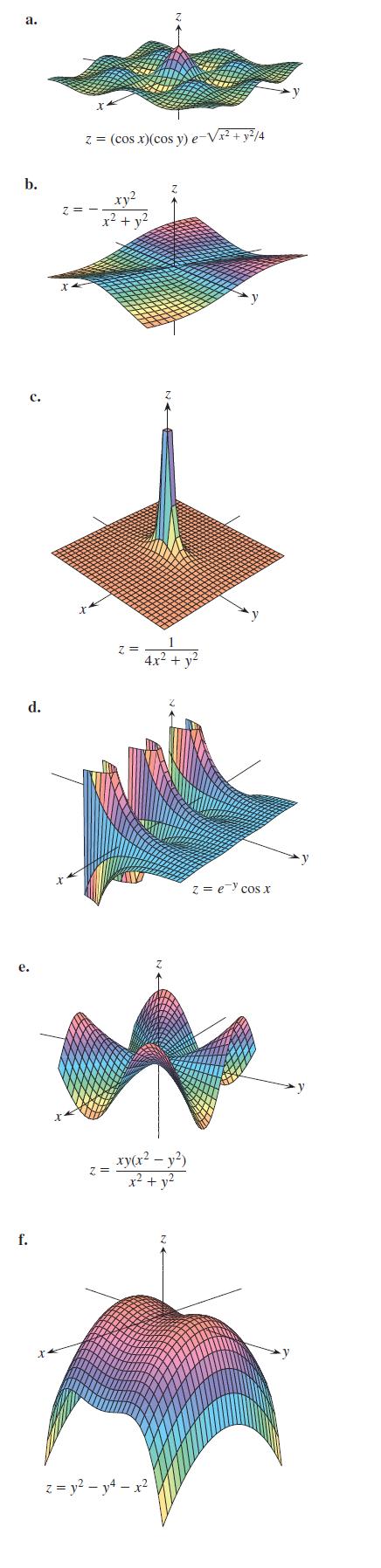
Show level curves for the functions graphed in (a)–(f) the shown below. Match each set of curves with the appropriate function. X
Find the dimensions of the closed rectangular box with maximum volume that can be inscribed in the unit sphere.
Showing 7700 - 7800
of 29454
First
71
72
73
74
75
76
77
78
79
80
81
82
83
84
85
Last
Step by Step Answers

 Get 50% OFF
Claim Now
Get 50% OFF
Claim Now