New Semester
Started
Get
50% OFF
Study Help!
--h --m --s
Claim Now
Question Answers
Textbooks
Find textbooks, questions and answers
Oops, something went wrong!
Change your search query and then try again
S
Books
FREE
Study Help
Expert Questions
Accounting
General Management
Mathematics
Finance
Organizational Behaviour
Law
Physics
Operating System
Management Leadership
Sociology
Programming
Marketing
Database
Computer Network
Economics
Textbooks Solutions
Accounting
Managerial Accounting
Management Leadership
Cost Accounting
Statistics
Business Law
Corporate Finance
Finance
Economics
Auditing
Tutors
Online Tutors
Find a Tutor
Hire a Tutor
Become a Tutor
AI Tutor
AI Study Planner
NEW
Sell Books
Search
Search
Sign In
Register
study help
mathematics
precalculus
Thomas Calculus Early Transcendentals 13th Edition Joel R Hass, Christopher E Heil, Maurice D Weir - Solutions
Use a CAS to perform the following steps for each of the function.a. Plot the surface over the given rectangle.b. Plot several level curves in the rectangle.c. Plot the level curve of ƒ through the given point. f(x, y) = (sin x)(cos y)e Vx² + y²/8, 0≤ x ≤ 5m, 0 ≤ y ≤ 5m, P(4, 4T)
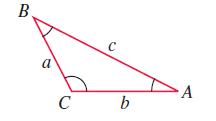
The triangle shown here.Express a implicitly as a function of A, b, and B and calculate ∂a/∂A and ∂a/∂B. B a C C b -А A
Use a CAS to perform the following steps for each of the function.a. Plot the surface over the given rectangle.b. Plot several level curves in the rectangle.c. Plot the level curve of ƒ through the given point. f(x, y) = sin(x + 2 cos y), -2π ≤ x ≤ 2π, -2π ≤ y ≤ 2T, P(TT, TT)
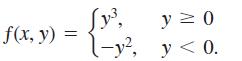
LetFind ƒx, ƒy, ƒxy, and ƒyx, and state the domain for each partial derivative. f(x, y) = [y³, y = 0 1-y², y < 0.
Use a CAS to perform the following steps for each of the function.a. Plot the surface over the given rectangle.b. Plot several level curves in the rectangle.c. Plot the level curve of ƒ through the given point. f(x, y) = e(-y) sin(x² + y²), 0 ≤ x ≤ 2π, -2π ≤ y ≤ π, P(TT, -TT)
Express νx in terms of u and y if the equations x = y ln u and y = u ln ν define u and ν as functions of the independent variables x and y, and if νx exists.
Find ∂x/∂u and ∂y/∂u if the equations u = x2 - y2 and y = x2 - y define x and y as functions of the independent variables u and y, and the partial derivatives exist. Then let s = x2 + y2 and find ∂s/∂u.
Use a CAS to plot the implicitly defined level surfaces.4 ln (x2 + y2 + z2) = 1
Show that each function satisfies a Laplace equation.ƒ(x, y, z) = x2 + y2 - 2z2
Use a CAS to plot the implicitly defined level surfaces.x2 + z2 = 1
Show that each function satisfies a Laplace equation.ƒ(x, y, z) = 2z3 - 3(x2 + y2)z
Use a CAS to plot the implicitly defined level surfaces.x + y2 - 3z2 = 1
Find the velocity and acceleration vectors in terms of ur and uθ. ra sin 20 and de dt 21
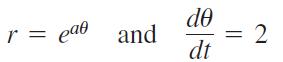
Find the velocity and acceleration vectors in terms of ur and uθ. r = eao and de dt = 2
Find the velocity and acceleration vectors in terms of ur and uθ. r = a(1 + sin t) and 0 = 1 - et
Find the velocity and acceleration vectors in terms of ur and uθ. r = 2 cos 4t and 0 = 2t
For what values of ν0 in Equation (5) is the orbit in Equation (6) a circle? An ellipse? A parabola? A hyperbola? = rovo GM - 1 (5)
Write a in the form a = aTT + aNN without finding T and N.r(t) = (a cos t)i + (a sin t)j + btk
How do you define and calculate the velocity, speed, direction of motion, and acceleration of a body moving along a sufficiently differentiable space curve? Give an example.
Write a in the form a = aTT + aNN without finding T and N.r(t) = (1 + 3t)i + (t - 2)j - 3tk
What is special about the derivatives of vector functions of constant length? Give an example.
Write a in the form a = aTT + aNN at the given value of t without finding T and N.r(t) = (t + 1)i + 2tj + t2k, t = 1
What are the vector and parametric equations for ideal projectile motion? How do you find a projectile’s maximum height, flight time, and range? Give examples.
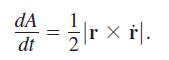
Suppose that r is the position vector of a particle moving along a plane curve and dA / dt is the rate at which the vector sweeps out area. Without introducing coordinates, and assuming the necessary derivatives exist, give a geometric argument based on increments and limits for the validity of the
Write a in the form a = aTT + aNN at the given value of t without finding T and N.r(t) = (t cos t)i + (t sin t)j + t2k, t = 0
Write a in the form a = aTT + aNN at the given value of t without finding T and N.r(t) = t2i + (t + (1/3)t3)j + (t - (1/3)t3)k, t = 0
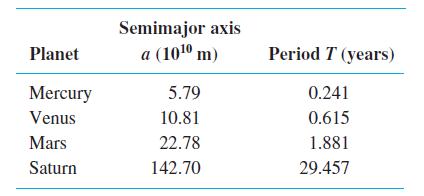
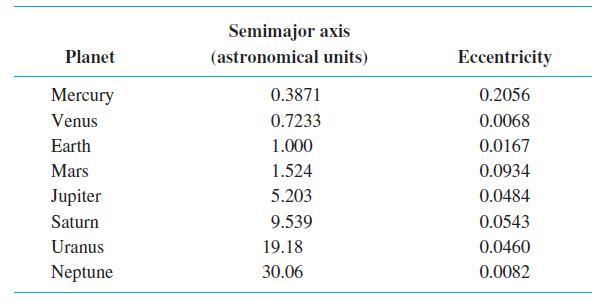
Do the data in the accompanying table support Kepler’s third law? Give reasons for your answer. Planet Mercury Venus Mars Saturn Semimajor axis a (10¹⁰ m) 5.79 10.81 22.78 142.70 Period T (years) 0.241 0.615 1.881 29.457
Complete the derivation of Kepler’s third law (the part following Equation (10)). 2a romax = = 2ro 1- e 2roGM 2GM rovo 2. (10)
How do you define and calculate the length of a segment of a smooth space curve? Give an example. What mathematical assumptions are involved in the definition?
Write a in the form a = aTT + aNN at the given value of t without finding T and N.r(t) = (et cos t)i + (et sin t)j + √2etk, t = 0
How do you measure distance along a smooth curve in space from a preselected base point? Give an example.
Find r, T, N, and B at the given value of t. Then find equations for the osculating, normal, and rectifying planes at that value of t.r(t) = (cos t)i + (sin t)j - k, t = π/4
Show that a planet in a circular orbit moves with a constant speed.
What is a differentiable curve’s unit tangent vector? Give an example.
Find r, T, N, and B at the given value of t. Then find equations for the osculating, normal, and rectifying planes at that value of t.r(t) = (cos t)i + (sin t)j + tk, t = 0
Define curvature, circle of curvature (osculating circle), center of curvature, and radius of curvature for twice-differentiable curves in the plane. Give examples. What curves have zero curvature? Constant curvature?
You found T, N, and k. Now, in the following, find B and t for these space curves.r(t) = (3 sin t)i + (3 cos t)j + 4tk
What is a plane curve’s principal normal vector? When is it defined? Which way does it point? Give an example.
You found T, N, and k. Now, in the following, find B and t for these space curves.r(t) = (cos t + t sin t)i + (sin t - t cos t)j + 3k
How do you define N and κ for curves in space? How are these quantities related? Give examples.
You found T, N, and k. Now, in the following, find B and t for these space curves.r(t) = (et cos t)i + (et sin t)j + 2k
Show that κ and τ are both zero for the line r(t) = (xo + At)i + (yo + Bt)j + (zo + Ct)k.
Estimate the length of the major axis of Earth’s orbit if its orbital period is 365.256 days.
What is a curve’s binormal vector? Give an example. How is this vector related to the curve’s torsion? Give an example.
You found T, N, and k. Now, in the following, find B and t for these space curves.r(t) = (6 sin 2t)i + (6 cos 2t)j + 5tk
What formulas are available for writing a moving object’s acceleration as a sum of its tangential and normal components? Give an example. Why might one want to write the acceleration this way? What if the object moves at a constant speed? At a constant speed around a circle?
Estimate the length of the major axis of the orbit of Uranus if its orbital period is 84 years.
You found T, N, and k. Now, in the following, find B and t for these space curves.r(t) = (t3/3)i + (t2/2)j, t > 0
The eccentricity of Earth’s orbit is e = 0.0167, so the orbit is nearly circular, with radius approximately 150 * 106 km. Find the rate dA/dt in units of km2/sec satisfying Kepler’s second law.
You found T, N, and k. Now, in the following, find B and t for these space curves.r(t) = (cos3 t)i + (sin3 t)j, 0 < t < π/2
Estimate the oribital period of Jupiter, assuming that a = 77.8 * 1010 m.
Rounding the answers to four decimal places, use a CAS to find v, a, speed, T, N, B, κ, τ, and the tangential and normal components of acceleration for the curves at the given values of t. r(t) = (t cos t)i + (t sin t)j + tk, t = √3
You found T, N, and k. Now, in the following, find B and t for these space curves.r(t) = ti + (a cosh (t/a))j, a > 0
Io is one of the moons of Jupiter. It has a semimajor axis of 0.042 * 1010 m and an orbital period of 1.769 days. Use these data to estimate the mass of Jupiter.
You found T, N, and k. Now, in the following, find B and t for these space curves.r(t) = (cosh t)i - (sinh t)j + tk
The period of the moon’s rotation around Earth is 2.36055 * 106 sec. Estimate the distance to the moon.
Can anything be said about the acceleration of a particle that is moving at a constant speed? Give reasons for your answer.
Can anything be said about the speed of a particle whose acceleration is always orthogonal to its velocity? Give reasons for your answer.
Show that a moving particle will move in a straight line if the normal component of its acceleration is zero.
What can be said about the torsion of a smooth plane curve r(t) = ƒ(t)i + g(t)j? Give reasons for your answer.
That a sufficiently differentiable curve with zero torsion lies in a plane is a special case of the fact that a particle whose velocity remains perpendicular to a fixed vector C moves in a plane perpendicular to C. This, in turn, can be viewed as the following result.Suppose r(t) = ƒ(t)i + g(t)j +
Rounding the answers to four decimal places, use a CAS to find v, a, speed, T, N, B, κ, τ, and the tangential and normal components of acceleration for the curves at the given values of t. r(t) = (et cos t)i + (et sin t)j + e¹k, t = ln 2
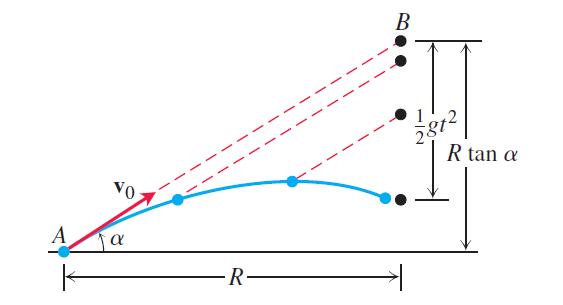
The accompanying figure shows an experiment with two marbles. Marble A was launched toward marble B with launch angle α and initial speed ν0. At the same instant, marble B was released to fall from rest at R tan α units directly above a spot R units downrange from A. The marbles were found to
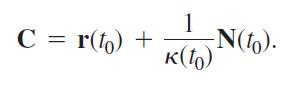
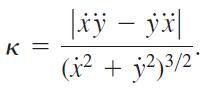
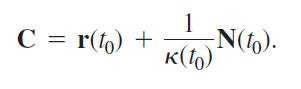
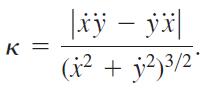
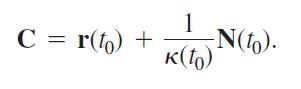
You will use a CAS to explore the osculating circle at a point P on a plane curve where k ≠ 0. Use a CAS to perform the following steps:a. Plot the plane curve given in parametric or function form over the specified interval to see what it looks like.b. Calculate the curvature k of the curve at
Rounding the answers to four decimal places, use a CAS to find v, a, speed, T, N, B, κ, τ, and the tangential and normal components of acceleration for the curves at the given values of t. r(t) = (t sin t)i + (1 cos t)j + V-tk, t = -3″
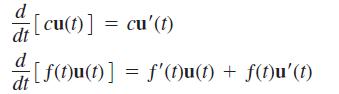
Prove the two Scalar Multiple Rules for vector functions. d [cu(t)] = cu' (t) d ƒ [ƒ(t)u(t)] = f'(t)u(t) + f(t)u'(t) dt
You will use a CAS to explore the osculating circle at a point P on a plane curve where κ ≠ 0. Use a CAS to perform the following steps:a. Plot the plane curve given in parametric or function form over the specified interval to see what it looks like.b. Calculate the curvature k of the curve at
You will use a CAS to explore the osculating circle at a point P on a plane curve where κ ≠ 0. Use a CAS to perform the following steps:a. Plot the plane curve given in parametric or function form over the specified interval to see what it looks like.b. Calculate the curvature k of the curve at
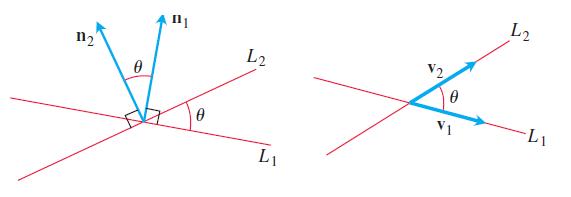
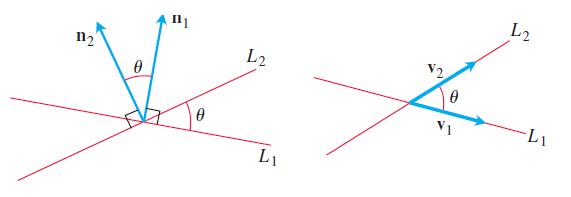
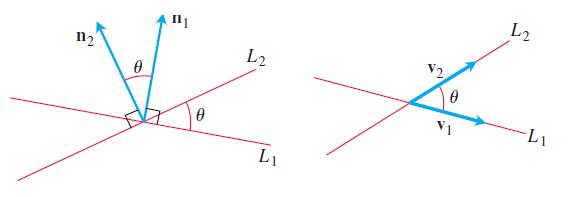
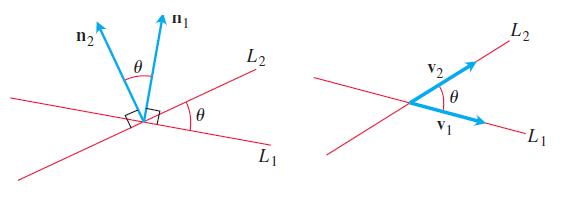
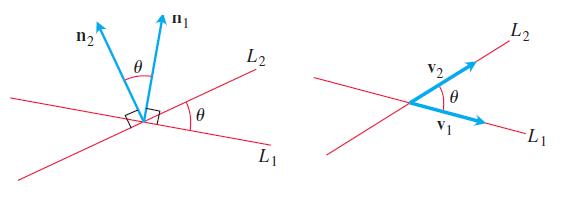
That do not cross at right angles is the same as the angle determined by vectors normal to the lines or by the vectors parallel to the lines.Use this fact and the results of Exercise 31 or 32 to find the acute angles between the lines.3x + y = 5, 2x - y = 4Exercise 31Show that v = ai + bj is
That do not cross at right angles is the same as the angle determined by vectors normal to the lines or by the vectors parallel to the lines.Use this fact and the results of Exercise 31 or 32 to find the acute angles between the lines.√3x - y = -2, x - √3y = 1Exercise 31Show that v = ai + bj is
That do not cross at right angles is the same as the angle determined by vectors normal to the lines or by the vectors parallel to the lines.Use this fact and the results of Exercise 31 or 32 to find the acute angles between the lines.x + √3y = 1, (1 - √3)x + (1 + √3)y = 8Exercise 31Show that
That do not cross at right angles is the same as the angle determined by vectors normal to the lines or by the vectors parallel to the lines.Use this fact and the results of Exercise 31 or 32 to find the acute angles between the lines.3x - 4y = 3, x - y = 7Exercise 31Show that v = ai + bj is
That do not cross at right angles is the same as the angle determined by vectors normal to the lines or by the vectors parallel to the lines.Use this fact and the results of Exercise 31 or 32 to find the acute angles between the lines.12x + 5y = 1, 2x - 2y = 3Exercise 31Show that v = ai + bj is
Find the velocity and acceleration vectors in terms of ur and uθ. a(1 cos ) and - r = a(1 ᎾᏢ dt 3
Rounding the answers to four decimal places, use a CAS to find v, a, speed, T, N, B, κ, τ, and the tangential and normal components of acceleration for the curves at the given values of t. r(t) = (3t − t²)i + (3t²)j + (3t + t³)k, t= 1
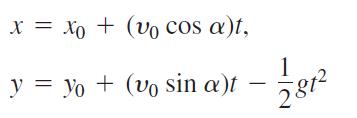
Derive the equations(see Equation (7) in the text) by solving the following initial value problem for a vector r in the plane. x = xo + (vo cos a)t, X yo + (vo sin a)t y 1 2812
State the rules for differentiating and integrating vector functions. Give examples.
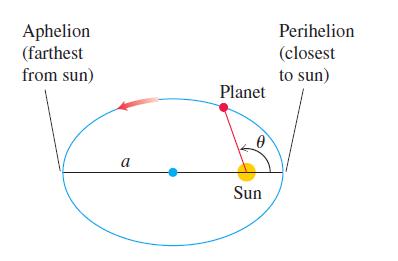
A planet travels about its sun in an ellipse whose semimajor axis has length a.a. Show that r = a(1 - e) when the planet is closest to the sun and that r = a(1 + e) when the planet is farthest from the sun.b. Use the data in the table in Exercise 76 to find how close each planet in our solar system
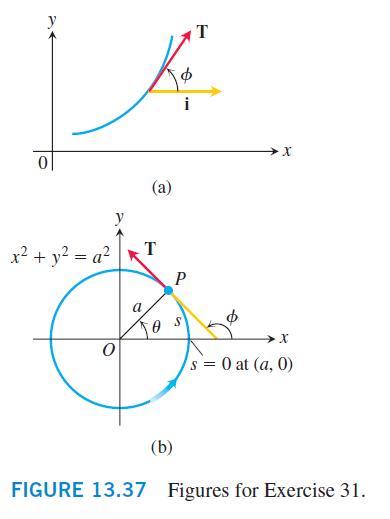
An alternative definition gives the curvature of a sufficiently differentiable plane curve to be |df/ds|, where ϕ is the angle between T and i (Figure 13.37a). Figure 13.37b shows the distance s measuredcounterclockwise around the circle x2 + y2 = a2 from the point (a, 0) to a point P, along with
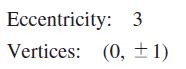
Give the eccentricities and the vertices or foci of hyperbolas centered at the origin of the xy-plane. In each case, find the hyperbola’s standard-form equation in Cartesian coordinates. Eccentricity: 3 Vertices: (0,+1)
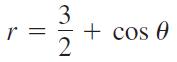
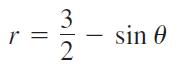
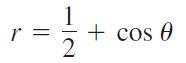
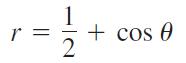
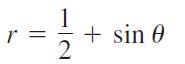
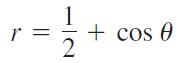
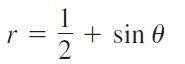
Graph the limaçons. Limaçon (“lee-ma-sahn”) is Old French for “snail.” You will understand the name when you graph the limaçons in Exercise 21. Equations for limaçons have the form r = a ± b cos θ or r = a ± b sin θ. There are four basic shapes.a.b.Data from in Exercise 21a.b. r
Graph the limaçons. Limaçon (“lee-ma-sahn”) is Old French for “snail.” You will understand the name when you graph the limaçons in Exercise 21. Equations for limaçons have the form r = a ± b cos θ or r = a ± b sin θ. There are four basic shapes.a. r = 2 + cos θ b. r = -2 + sin
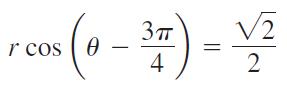
Sketch the lines. Also, find a Cartesian equation for each line. п s (0-37) - V2 = 4 r cos
Sketch the lines. Also, find a Cartesian equation for each line.r = 2 sec θ
Find the lengths of the curves.The parabolic segment r = 6/(1 + cos θ), 0 ≤ θ ≤ π/2
Find the lengths of the curve.x = cos t, y = t + sin t, 0 ≤ t ≤ π
Graph the sets of points whose polar coordinates satisfy the equations and inequalitie.-π/4 ≤ θ ≤ π/4, -1 ≤ r ≤ 1
Find a parametrization for the curve.The left half of the parabola y = x2 + 2x
Give equations for ellipses. Put each equation in standard form. Then sketch the ellipse. Include the foci in your sketch.169x2 + 25y2 = 4225
Graph the limaçons. Limaçon (“lee-ma-sahn”) is Old French for “snail.” You will understand the name when you graph the limaçons in Exercise 21. Equations for limaçons have the form r = a ± b cos θ or r = a ± b sin θ. There are four basic shapes.a. r = 1 - cos θb. r = -1 + sin
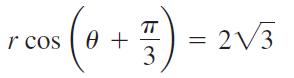
Sketch the lines. Also, find a Cartesian equation for each line. r cos ( Ꮎ 0 + πT 3 = 2√3
Find the eccentricity of the hyperbola. Then find and graph the hyperbola’s foci and directrices.64x2 - 36y2 = 2304
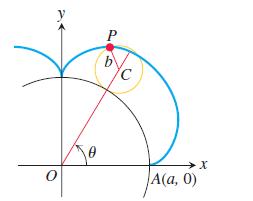
When a circle rolls externally along the circumference of a second, fixed circle, any point P on the circumference of the rolling circle describes an epicycloid, as shown here. Let the fixed circle have its center at the origin O and have radius a.Let the radius of the rolling circle be b and let
Find the lengths of the curves.The curve r = a sin2 (θ/2), 0 ≤ θ ≤ π, a > 0
Find the area under y = x3 over [0, 1] using the following parametrizations.a. x = t2, y = t6 b. x = t3, y = t9
Find the centroid of the region enclosed by the x-axis and the cycloid arch x = a(t - sin t), y = a(1 - cos t); 0 ≤ t ≤ 2π.
Graph the sets of points whose polar coordinates satisfy the equations and inequalitie.π/4 ≤ θ ≤ 3π/4, 0 ≤ r ≤ 1
Find a parametrization for the curve.The lower half of the parabola x - 1 = y2
Give equations for ellipses. Put each equation in standard form. Then sketch the ellipse. Include the foci in your sketch.6x2 + 9y2 = 54
Find the eccentricity of the hyperbola. Then find and graph the hyperbola’s foci and directrices.8y2 - 2x2 = 16
Showing 7900 - 8000
of 29454
First
73
74
75
76
77
78
79
80
81
82
83
84
85
86
87
Last
Step by Step Answers

 Get 50% OFF
Claim Now
Get 50% OFF
Claim Now