New Semester
Started
Get
50% OFF
Study Help!
--h --m --s
Claim Now
Question Answers
Textbooks
Find textbooks, questions and answers
Oops, something went wrong!
Change your search query and then try again
S
Books
FREE
Study Help
Expert Questions
Accounting
General Management
Mathematics
Finance
Organizational Behaviour
Law
Physics
Operating System
Management Leadership
Sociology
Programming
Marketing
Database
Computer Network
Economics
Textbooks Solutions
Accounting
Managerial Accounting
Management Leadership
Cost Accounting
Statistics
Business Law
Corporate Finance
Finance
Economics
Auditing
Tutors
Online Tutors
Find a Tutor
Hire a Tutor
Become a Tutor
AI Tutor
AI Study Planner
NEW
Sell Books
Search
Search
Sign In
Register
study help
mathematics
precalculus
Thomas Calculus Early Transcendentals 13th Edition Joel R Hass, Christopher E Heil, Maurice D Weir - Solutions
Find parametric equations for the line tangent to the curve of intersection of the surfaces at the given point.Surfaces: xyz = 1, x2 + 2y2 + 3z2 = 6Point: (1, 1, 1)
Draw a branch diagram and write a Chain Rule formula for each derivative. dw əx t = dw and for w= f(r, s, t), r = g(x, y), dy k(x, y) s s = h(x, y),
By minimizing the function ƒ(x, y, u, ν) = (x - u)2 + (y - ν)2 subject to the constraints y = x + 1 and u = ν2, find the minimum distance in the xy-plane from the line y = x + 1 to the parabola y2 = x.
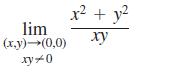
By considering different paths of approach, show that the limits do not exist. lim (x,y)→(0,0) xy+0 x² + y² xy
Find the maximum and minimum values of 3x - y + 6 subject to the constraint x2 + y2 = 4.
Find and sketch the level curves ƒ(x, y) = c on the same set of coordinate axes for the given values of c. We refer to these level curves as a contour map.ƒ(x, y) = x2 + y2, c = 0, 1, 4, 9, 16, 25
What is the gradient vector of a differentiable function ƒ(x, y)? How is it related to the function’s directional derivatives? State the analogous results for functions of three independent variables.
Find and sketch the level curves ƒ(x, y) = c on the same set of coordinate axes for the given values of c. We refer to these level curves as a contour map. f(x, y) = √25 – x² - y², c = 0, 1, 2, 3, 4
Find the derivative of the function at P0 in the direction of u.ƒ(x, y, z) = xy + yz + zx, P0(1, -1, 2), u = 3i + 6j - 2k
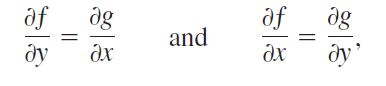
Suppose that ƒ and g are functions of x and y such thatand suppose thatFind ƒ(x, y) and g(x, y). af ag ду ax = and af ax = dg ду
Find parametric equations for the line tangent to the curve of intersection of the surfaces at the given point.Surfaces: x2 + 2y + 2z = 4, y = 1Point: (1, 1, 1 / 2)
Prove the following theorem: If ƒ(x, y) is defined in an open region R of the xy-plane and if ƒx and ƒy are bounded on R, then ƒ(x, y) is continuous on R.
The temperature at a point (x, y) on a metal plate is T(x, y) = 4x2 - 4xy + y2. An ant on the plate walks around the circle of radius 5 centered at the origin. What are the highest and lowest temperatures encountered by the ant?
Draw a branch diagram and write a Chain Rule formula for each derivative. dw du and aw for w= g(x, y), x = h(u, v), y = k(u, v) əv
Find and sketch the level curves ƒ(x, y) = c on the same set of coordinate axes for the given values of c. We refer to these level curves as a contour map.ƒ(x, y) = xy, c = -9, -4, -1, 0, 1, 4, 9
How do you find the tangent line at a point on a level curve of a differentiable function ƒ(x, y)? How do you find the tangent plane and normal line at a point on a level surface of a differentiable function ƒ(x, y, z)? Give examples.
Find the derivative of the function at P0 in the direction of u.ƒ(x, y, z) = x2 + 2y2 - 3z2, P0(1, 1, 1), u = i + j + k
Draw a branch diagram and write a Chain Rule formula for each derivative. dw əx dw and for w= g(u, v), dy U = h(x, y), v = k(x, y)
Find parametric equations for the line tangent to the curve of intersection of the surfaces at the given point.Surfaces: x + y2 + z = 2, y = 1Point: (1 / 2, 1, 1 / 2)
Suppose that r(t) = g(t)i + h(t)j + k(t)k is a smooth curve in the domain of a differentiable function ƒ(x, y, z). Describe the relation between dƒ / dt, ∇ƒ, and v = dr/dt. What can be said about ∇ƒ and v at interior points of the curve where ƒ has extreme values relative to its other
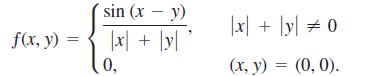
LetIs ƒ continuous at the origin? Why? f(x, y) = sin (x - y) |x] + [y] 0, |x + y = 0 (x, y) = (0,0).
Your firm has been asked to design a storage tank for liquid petroleum gas. The customer’s specifications call for a cylindrical tank with hemispherical ends, and the tank is to hold 8000 m3 of gas. The customer also wants to use the smallest amount of material possible in building the tank. What
How can you use directional derivatives to estimate change?
Draw a branch diagram and write a Chain Rule formula for each derivative. əz at əz and for z Əs = f(x, y), = g(t, s), y = h(t, s)
Find the derivative of the function at P0 in the direction of u.g(x, y, z) = 3ex cos yz, P0(0, 0, 0), u = 2i + j - 2k
Let ƒ(x, y) = (x2 - y2) > (x2 + y2) for (x, y) ≠ (0, 0). Is it possible to define ƒ(0, 0) in a way that makes ƒ continuous at the origin? Why?
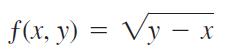
(a) Find the function’s domain, (b) Find the function’s range, (c) Describe the function’s level curves, (d) Find the boundary of the function’s domain, (e) Determine if the domain is an open region, a closed region, or neither, and (f) Decide if the domain is bounded or unbounded.
Find parametric equations for the line tangent to the curve of intersection of the surfaces at the given point.Surfaces: x3 + 3x2y2 + y3 + 4xy - z2 = 0, x2 + y2 + z2 = 11Point: (1, 1, 3)
Find the point on the plane x + 2y + 3z = 13 closest to the point (1, 1, 1).
(a) Find the function’s domain, (b) Find the function’s range, (c) Describe the function’s level curves, (d) Find the boundary of the function’s domain, (e) Determine if the domain is an open region, a closed region, or neither, and (f) Decide if the domain is
By about how much willchange if the point P(x, y, z) moves from P0(3, 4, 12) a distance of ds = 0.1 unit in the direction of 3i + 6j - 2k? f(x, y, z) = ln√x² + y² + z²
How do you linearize a function ƒ(x, y) of two independent variables at a point (x0, y0)? Why might you want to do this? How do you linearize a function of three independent variables?
Find the derivative of the function at P0 in the direction of u.h(x, y, z) = cos xy + eyz + ln zx, P0(1, 0, 1/2), u = i + 2j + 2k
By about how much willchange as the point P(x, y, z) moves from the origin a distance of ds = 0.1 unit in the direction of 2i + 2j - 2k? f(x, y, z) = et cos yz
Find parametric equations for the line tangent to the curve of intersection of the surfaces at the given point.Surfaces: x2 + y2 = 4, x2 + y2 - z = 0Point: (√2, √2, 4)
Draw a branch diagram and write a Chain Rule formula for each derivative. Əv ər for y = f(u), = g(r, s) U =
We know that if ƒ(x, y) is a function of two variables and if u = ai + bj is a unit vector, then Du ƒ(x, y) = ƒx(x, y)a + ƒy(x, y)b is the rate of change of ƒ(x, y) at (x, y) in the direction of u. Give a similar formula for the rate of change of the rate of change of ƒ(x, y) at (x, y)
Find the partial derivative of the function with respect to each variable. f(x, y) = = -1/1 In (x² + y²) + tan -1 y X
What can you say about the accuracy of linear approximations of functions of two (three) independent variables?
Find the partial derivative of the function with respect to each variable.g(r, θ) = r cos θ + r sin θ
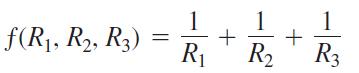
Find the partial derivative of the function with respect to each variable. ƒ(R₁, R₂, R₂) 1 1 1 + + R₂ R₁ R3
A heat-seeking particle has the property that at any point (x, y) in the plane it moves in the direction of maximum temperature increase. If the temperature at (x, y) is T(x, y) = -e-2y cos x, find an equation y = ƒ(x) for the path of a heat-seeking particle at the point (π/4, 0).
Find the minimum distance from the surface x2 - y2 - z2 = 1 to the origin.
Draw a branch diagram and write a Chain Rule formula for each derivative. dw əs and dw at for w= = h(s, t) g(u), u =
If (x, y) moves from (x0, y0) to a point (x0 + dx, y0 + dy) nearby, how can you estimate the resulting change in the value of a differentiable function ƒ(x, y)? Give an example.
Find the directions in which the functions increase and decrease most rapidly at P0. Then find the derivatives of the functions in these directions.ƒ(x, y) = x2y + exy sin y, P0(1, 0)
A particle traveling in a straight line with constant velocity i + j - 5k passes through the point (0, 0, 30) and hits the surface z = 2x2 + 3y2. The particle ricochets off the surface, the angle of reflection being equal to the angle of incidence. Assuming no loss of speed, what is the velocity of
Find the point on the surface z = xy + 1 nearest the origin.
Draw a branch diagram and write a Chain Rule formula for each derivative. aw др Z = for w = f(x, y, z, v), x = g(p, q), y = h(p, q), j(p, q), υ = k(p, q)
(a) Find the function’s domain, (b) Find the function’s range, (c) Describe the function’s level curves, (d) Find the boundary of the function’s domain, (e) Determine if the domain is an open region, a closed region, or neither, and (f) Decide if the domain is
How do you define local maxima, local minima, and saddle points for a differentiable function ƒ(x, y)? Give examples.
Find the directions in which the functions increase and decrease most rapidly at P0. Then find the derivatives of the functions in these directions.ƒ(x, y, z) = (x/y) - yz, P0(4, 1, 1)
Draw a branch diagram and write a Chain Rule formula for each derivative. dw ər and dw for w= ds f(x, y), x = g(r), y = h(s)
(a) Find the function’s domain, (b) Find the function’s range, (c) Describe the function’s level curves, (d) Find the boundary of the function’s domain, (e) Determine if the domain is an open region, a closed region, or neither, and (f) Decide if the domain is
What derivative tests are available for determining the local extreme values of a function ƒ(x, y)? How do they enable you to narrow your search for these values? Give examples.
Find the partial derivative of the function with respect to each variable. P(n, R, T, V) = nRT V (the ideal gas law)
Find the directions in which the functions increase and decrease most rapidly at P0. Then find the derivatives of the functions in these directions.g(x, y, z) = xey + z2, P0(1, ln 2, 1/2)
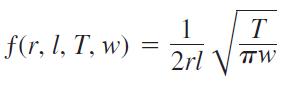
Find the partial derivative of the function with respect to each variable. f(r, 1, T, w) = 1 2rl V T TTW
Find the partial derivative of the function with respect to each variable.h(x, y, z) = sin (2πx + y - 3z)
By about how much will h(x, y, z) = cos (πxy) + xz2 change if the point P(x, y, z) moves from P0(-1, -1, -1) a distance of ds = 0.1 unit toward the origin?
On a flat surface of land, geologists drilled a borehole straight down and hit a mineral deposit at 1000 ft. They drilled a second borehole 100 ft to the north of the first and hit the mineral deposit at 950 ft. A third borehole 100 ft east of the first borehole struck the mineral deposit at 1025
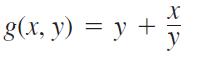
Find the second-order partial derivatives of the function. g(x, y) = y + √ y
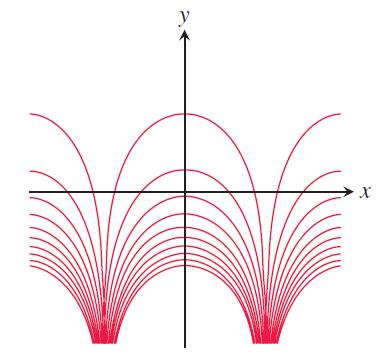
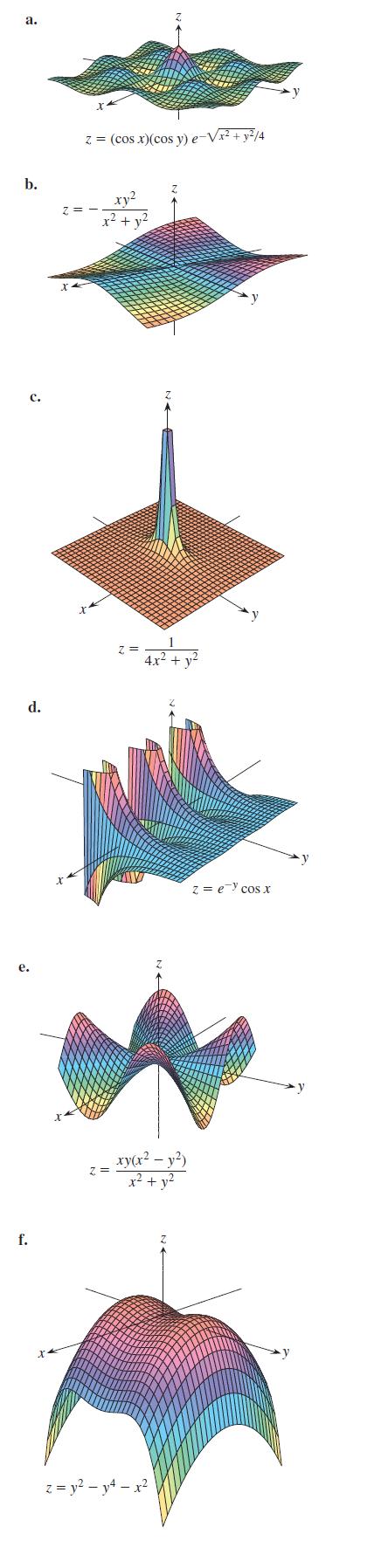
Show level curves for the functions graphed in (a)–(f) on the following page. Match each set of curves with the appropriate function. X
Find the point(s) on the surface xyz = 1 closest to the origin.
(a) Find the function’s domain, (b) Find the function’s range, (c) Describe the function’s level curves, (d) Find the boundary of the function’s domain, (e) Determine if the domain is an open region, a closed region, or neither, and (f) Decide if the domain is
How do you find the extrema of a continuous function ƒ(x, y) on a closed bounded region of the xy-plane? Give an example.
Find the directions in which the functions increase and decrease most rapidly at P0. Then find the derivatives of the functions in these directions.ƒ(x, y, z) = ln xy + ln yz + ln xz, P0(1, 1, 1)
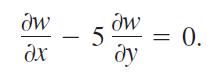
Show that if w = ƒ(s) is any differentiable function of s and if s = y + 5x, then dw ax 5 dw ду = 0.
Find all solutions of the one-dimensional heat equation of the form w = ert sin πx, where r is a constant.
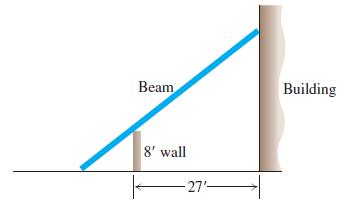
We posed a problem of finding the length L of the shortest beam that can reach over a wall of height h to a tall building located k units from the wall. Use Lagrange multipliers to show that L = (h2/3 + k2/3)3/2.Data in Section 4.6, Exercise 39The 8-ft wall shown here stands 27 ft from the
Find all solutions of the one-dimensional heat equation that have the form w = ert sin kx and satisfy the conditions that w(0, t) = 0 and w(L, t) = 0. What happens to these solutions as t → ∞?
Find the second-order partial derivatives of the function.g(x, y) = ex + y sin x
Find the second-order partial derivatives of the function.ƒ(x, y) = x + xy - 5x3 + ln (x2 + 1)
Find the second-order partial derivatives of the function.ƒ(x, y) = y2 - 3xy + cos y + 7ey
Find dw/dt at t = 0 if w = sin (xy + π), x = et, and y = ln (t + 1).
Find dw/dt at t = 1 if w = xey + y sin z - cos z, x = 2√t, y = t - 1 + ln t, and z = πt.
Find ∂w/∂r and ∂w/∂s when r = π and s = 0 if w = sin (2x - y), x = r + sin s, y = rs.
Find the value of the derivative of ƒ(x, y, z) = xy + yz + xz with respect to t on the curve x = cos t, y = sin t, z = cos 2t at t = 1.
Assuming that the equations define y as a differentiable function of x, find the value of dy / dx at point P.1 - x - y2 - sin xy = 0, P(0, 1)
Assuming that the equations define y as a differentiable function of x, find the value of dy / dx at point P.2xy + ex+y - 2 = 0, P(0, ln 2)
Find the directions in which ƒ increases and decreases most rapidly at P0 and find the derivative of ƒ in each direction. Also, find the derivative of ƒ at P0 in the direction of the vector v.ƒ(x, y) = cos x cos y, P0(π/4, π/4), v = 3i + 4j
Find the directions in which ƒ increases and decreases most rapidly at P0 and find the derivative of ƒ in each direction. Also, find the derivative of ƒ at P0 in the direction of the vector v.ƒ(x, y) = x2e-2y, P0(1, 0), v = i + j
Find the directions in which ƒ increases and decreases most rapidly at P0 and find the derivative of ƒ in each direction. Also, find the derivative of ƒ at P0 in the direction of the vector v.ƒ(x, y, z) = ln (2x + 3y + 6z), P0(-1, -1, 1), v = 2i + 3j + 6k
Find the directions in which ƒ increases and decreases most rapidly at P0 and find the derivative of ƒ in each direction. Also, find the derivative of ƒ at P0 in the direction of the vector v.ƒ(x, y, z) = x2 + 3xy - z2 + 2y + z + 4, P0(0, 0, 0), v = i + j + k
Find the derivative of ƒ(x, y, z) = xyz in the direction of the velocity vector of the helix r(t) = (cos 3t)i + (sin 3t)j + 3t k at t = π/3.
What is the largest value that the directional derivative of ƒ(x, y, z) = xyz can have at the point (1, 1, 1)?
At the point (1, 2), the function ƒ(x, y) has a derivative of 2 in the direction toward (2, 2) and a derivative of -2 in the direction toward (1, 1).a. Find ƒx(1, 2) and ƒy(1, 2).b. Find the derivative of ƒ at (1, 2) in the direction toward the point (4, 6).
Which of the following statements are true if ƒ(x, y) is differentiable at (x0, y0)? Give reasons for your answers.a. If u is a unit vector, the derivative of ƒ at (x0 , y0) in the direction of u is (ƒx(x0, y0)i + ƒy(x0, y0)j) · u.b. The derivative of ƒ at (x0, y0) in the direction of u is a
Sketch the surface ƒ(x, y, z) = c together with ∇ƒ at the given points.x2 + y + z2 = 0; (0, -1, ±1), (0, 0, 0)
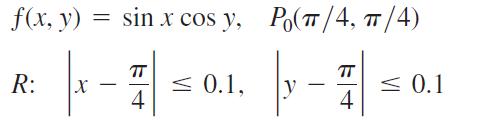
Find the linearization L(x, y) of the function ƒ(x, y) at the point P0. Then find an upper bound for the magnitude of the error E in the approximation ƒ(x, y) ≈ L(x, y) over the rectangle R. f(x, y) = sin x cos y, Po(π/4, π/4) HR 4 R: X - ≤0.1, y - TT 푸= 4 ≤0.1
Find an equation for the plane tangent to the surface z = ƒ(x, y) at the given point.z = ln (x2 + y2), (0, 1, 0)
Find an equation for the plane tangent to the surface z = ƒ(x, y) at the given point.z = 1/(x2 + y2), (1, 1, 1/2)
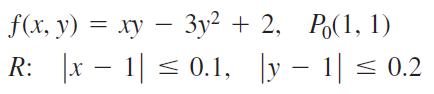
Find the linearization L(x, y) of the function ƒ(x, y) at the point P0. Then find an upper bound for the magnitude of the error E in the approximation ƒ(x, y) ≈ L(x, y) over the rectangle R. f(x, y) = xy - 3y² + 2, Po(1, 1) R: x 1 ≤ 0.1, y - 1 ≤ 0.2 -
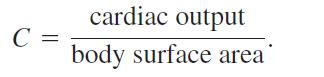
To make different people comparable in studies of cardiac output, researchers divide the measured cardiac output by the body surface area to find the cardiac index C:The body surface area B of a person with weight w and height h is approximated by the formulawhich gives B in square centimeters when
Find the linearizations of the functions at the given point.ƒ(x, y, z) = xy + 2yz - 3xz at (1, 0, 0) and (1, 1, 0)
Find the linearizations of the functions at the given point.ƒ(x, y, z) = √2 cos x sin ( y + z) at (0, 0, π/4) and (π/4, π/4, 0)
Is ƒ(x, y) = x2 - xy + y2 - 3 more sensitive to changes in x or to changes in y when it is near the point (1, 2)? How do you know?
Test the functions for local maxima and minima and saddle points. Find each function’s value at these points.ƒ(x, y) = x2 - xy + y2 + 2x + 2y - 4
Test the functions for local maxima and minima and saddle points. Find each function’s value at these points.ƒ(x, y) = x3 + y3 - 3xy + 15
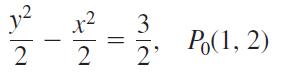
Find equations for the lines that are tangent and normal to the level curve ƒ(x, y) = c at the point P0. Then sketch the lines and level curve together with ∇ƒ at P0. 2 1 2 2' Po(1, 2)
Showing 7500 - 7600
of 29454
First
69
70
71
72
73
74
75
76
77
78
79
80
81
82
83
Last
Step by Step Answers

 Get 50% OFF
Claim Now
Get 50% OFF
Claim Now