New Semester
Started
Get
50% OFF
Study Help!
--h --m --s
Claim Now
Question Answers
Textbooks
Find textbooks, questions and answers
Oops, something went wrong!
Change your search query and then try again
S
Books
FREE
Study Help
Expert Questions
Accounting
General Management
Mathematics
Finance
Organizational Behaviour
Law
Physics
Operating System
Management Leadership
Sociology
Programming
Marketing
Database
Computer Network
Economics
Textbooks Solutions
Accounting
Managerial Accounting
Management Leadership
Cost Accounting
Statistics
Business Law
Corporate Finance
Finance
Economics
Auditing
Tutors
Online Tutors
Find a Tutor
Hire a Tutor
Become a Tutor
AI Tutor
AI Study Planner
NEW
Sell Books
Search
Search
Sign In
Register
study help
physics
university physics
University Physics with Modern Physics 13th edition Hugh D. Young, Roger A. Freedman, A. Lewis Ford - Solutions
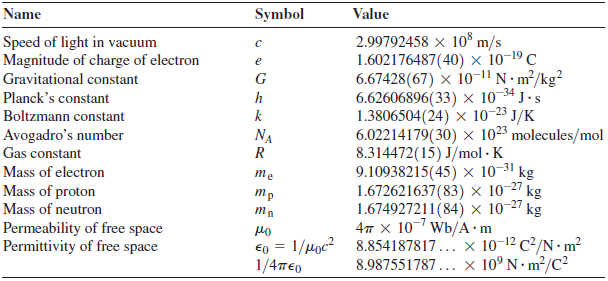
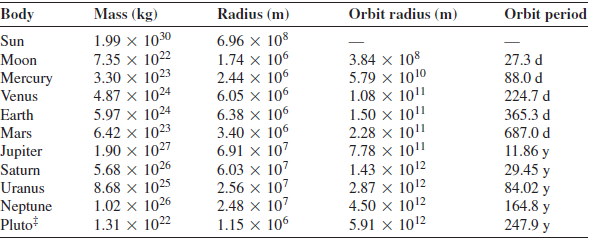
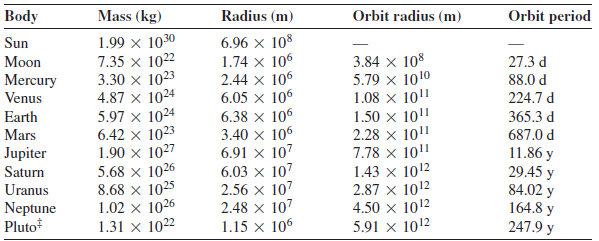
On December 25, 2004, the Huygens probe separated from the Cassini spacecraft orbiting Saturn and began a 22-day journey to Saturn€™s giant moon Titan, on whose surface it landed. Besides the data in Appendix F, it is useful to know that Titan is 1.22 × 10⁶km from the center
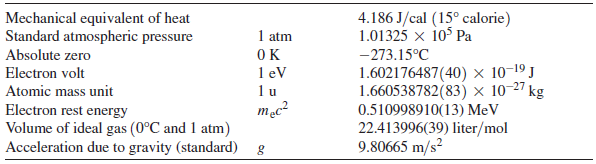
(a) Use data from Appendix F to calculate the acceleration due to gravity on the moon.(b) Calculate the friction force on a walking 65-kg astronaut carrying a 43-kg instrument pack on the moon if the coefficient of kinetic friction at her hip joint is 0.0050.(c) What would be the friction force on
As shown in Fig. E10.20, a string is wrapped several times around the rim of a small hoop with radius 0.0800 m and mass 0.180 kg. The free end of the string is pulled upward in just the right way so that the hoop does not move vertically as the string unwinds.(a) Find the tension in the string as
You decide to visit Santa Claus at the north pole to put in a good word about your splendid behavior throughout the year. While there, you notice that the elf Sneezy, when hanging from a rope, produces a tension of 475.0 N in the rope. If Sneezy hangs from a similar rope while delivering presents
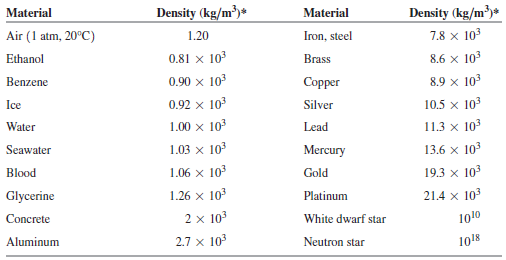
A piece of wood is 0.600 m long, 0.250 m wide, and 0.080 m thick. Its density is 700 kg/m3. What volume of lead must be fastened underneath it to sink the wood in calm water so that its top is just even with the water level? What is the mass of this volume of lead?
When an open-faced boat has a mass of 5750 kg, including its cargo and passengers, it floats with the water just up to the top of its gunwales (sides) on a freshwater lake.(a) What is the volume of this boat?(b) The captain decides that it is too dangerous to float with his boat on the verge of
An open cylindrical tank of acid rests at the edge of a table 1.4 m above the floor of the chemistry lab. If this tank springs a small hole in the side at its base, how far from the foot of the table will the acid hit the floor if the acid in the tank is 75 cm deep?
A firehose must be able to shoot water to the top of a building 28.0 m tall when aimed straight up. Water enters this hose at a steady rate of and shoots out of a round nozzle.(a) What is the maximum diameter this nozzle can have?(b) If the only nozzle available has a diameter twice as great, what
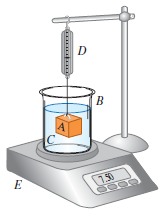
Block A in Fig. P12.74 hangs by a cord from spring balance D and is submerged in a liquid C contained in beaker B. The mass of the beaker is 1.00 kg; the mass of the liquid is 1.80 kg. Balance D reads 3.50 kg, and balance E reads 7.50 kg. The volume of block A is 3.80 ×
A closed and elevated vertical cylindrical tank with diameter 2.00 m contains water to a depth of 0.800 m. A worker accidently pokes a circular hole with diameter 0.0200 m in the bottom of the tank. As the water drains from the tank, compressed air above the water in the tank maintains a gauge
A block of balsa wood placed in one scale pan of an equalarm balance is exactly balanced by a 0.115-kg brass mass in the other scale pan. Find the true mass of the balsa wood if its density is 150 kg/m3. Explain why it is accurate to ignore the buoyancy in air of the brass but not the buoyancy in
A plastic ball has radius 12.0 cm and floats in water with 24.0% of its volume submerged.(a) What force must you apply to the ball to hold it at rest totally below the surface of the water?(b) If you let go of the ball, what is its acceleration the instant you release it?
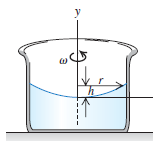
A cylindrical container of an in-compressible liquid with density Ï rotates with constant angular speed ω about its axis of symmetry, which we take to be the y-axis (Fig. P12.86).(a) Show that the pressure at a given height within the fluid increases in the radial direction
A 0.180-kg cube of ice (frozen water) is floating in glycerine. The gylcerine is in a tall cylinder that has inside radius 3.50 cm. The level of the glycerine is well below the top of the cylinder. If the ice completely melts, by what distance does the height of liquid in the cylinder change? Does
(a) As you can tell by watching them in an aquarium, fish are able to remain at any depth in water with no effort. What does this ability tell you about their density?(b) Fish are able to inflate themselves using a sac (called the swim bladder) located under their spinal column. These sacs can be
Viscous blood is flowing through an artery partially clogged by cholesterol. A surgeon wants to remove enough of the cholesterol to double the flow rate of blood through this artery. If the original diameter of the artery is D, what should be the new diameter (in terms of D) to accomplish this for
A pressure difference of 6.00 × 10⁴ Pa is required to maintain a volume flow rate of 0.800 m3/s for a viscous fluid flowing through a section of cylindrical pipe that has radius 0.210 m? What pressure difference is required to maintain the same volume flow rate if the radius of the pipe is
A medical technician is trying to determine what percentage of a patient’s artery is blocked by plaque. To do this, she measures the blood pressure just before the region of blockage and finds that it is 1.20 × 10⁴ Pa, while in the region of blockage it is 1.15 × 10⁴ Pa. Furthermore, she knows
At a point where an irrigation canal having a rectangular cross section is 18.5 m wide and 3.75 m deep, the water flows at 2.50 cm s. At a point downstream, but on the same level, the canal is 16.5 m wide, but the water flows at 11.0 cm/s. How deep is the canal at this point?
You need to extend a 2.50-inch-diameter pipe, but you have only a 1.00-inch-diameter pipe on hand. You make a fitting to connect these pipes end to end. If the water is flowing at 6.00 cm s in the wide pipe, how fast will it be flowing through the narrow one?
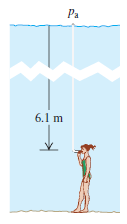
For the hydraulic lift shown in Fig. 12.7, what must be the ratio of the diameter of the vessel at the car to the diameter of the vessel where the force F1is applied so that a 1520-kg car can be lifted with a force F1of just 125 N?Figure 12.7: Pa 6.1 m
If the force on the tympanic membrane (eardrum) increases by about 1.5 N above the force from atmospheric pressure, the membrane can be damaged. When you go scuba diving in the ocean, below what depth could damage to your eardrum start to occur? The eardrum is typically 8.2 mm in diameter.Table
(a) What is the difference between the pressure of the blood in your brain when you stand on your head and the pressure when you stand on your feet? Assume that you are 1.85 m tall. The density of blood is 1060 kg/m3.(b) What effect does the increased pressure have on the blood vessels in your
A cube 5.0 cm on each side is made of a metal alloy. After you drill a cylindrical hole 2.0 cm in diameter all the way through and perpendicular to one face, you find that the cube weighs 7.50 N.(a) What is the density of this metal?(b) What did the cube weigh before you drilled the hole in it?
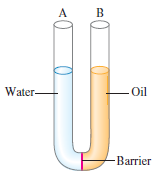
A narrow, U-shaped glass tube with open ends is filled with 25.0 cm of oil (of specific gravity 0.80) and 25.0 cm of water on opposite sides, with a barrier separating the liquids (Fig. P12.58).Figure P12.58: (a) Assume that the two liquids do not mix, and find the final heights of the
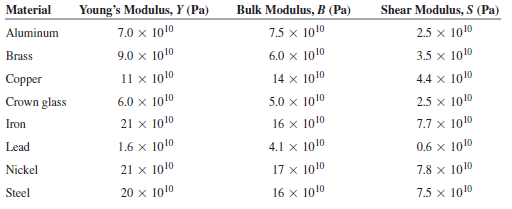
A wire of length I0and cross-sectional area A supports a hanging weight W.(a) Show that if the wire obeys Eq. (11.7), it behaves like a spring of force constant AY/I0, where Y is Young€™s modulus for the material of which the wire is made. (b) What would the force constant be for a
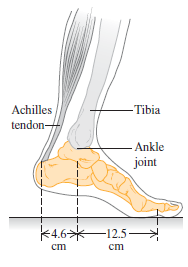
As part of an exercise program, a 75-kg person does toe raises in which he raises his entire body weight on the ball of one foot (Fig. P11.63). The Achilles tendon pulls straight upward on the heel bone of his foot. This tendon is 25 cm long and has a cross-sectional area of 78 mm2and a
A uniform, 7.5-m-long beam weighing 5860 N is hinged to a wall and supported by a thin cable attached 1.5 m from the free end of the beam. The cable runs between the beam and the wall and makes a 40º angle with the beam. What is the tension in the cable when the beam is at an angle of 30º above
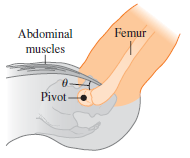
In a simplified version of the musculature action in leg raises, the abdominal muscles pull on the femur (thigh bone) to raise the leg by pivoting it about one end (Fig. P11.57). When you are lying horizontally, these muscles make an angle of approximately 5° with the femur, and if you raise
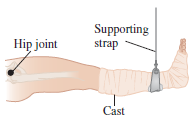
A therapist tells a 74-kg patient with a broken leg that he must have his leg in a cast suspended horizontally. For minimum discomfort, the leg should be supported by a vertical strap attached at the center of mass of the leg€“cast system. (Fig. P11.55). In order to comply with these
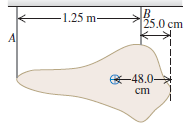
A museum of modern art is displaying an irregular 426-N sculpture by hanging it from two thin vertical wires, A and B, that are 1.25 m apart (Fig. P11.54). The center of gravity of this piece of art is located 48.0 cm from its extreme right tip. Find the tension in each wire.Figure P11.54: -1.25 m-
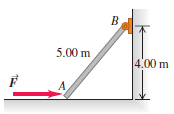
End A of the bar AB in Fig. P11.53 rests on a frictionless horizontal surface, and end B is hinged. A horizontal force F of magnitude 160 N is exerted on end A. You can ignore the weight of the bar. What are the horizontal and vertical components of the force exerted by the bar on the hinge at
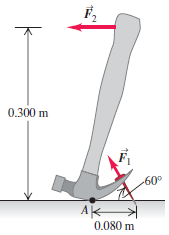
A claw hammer is used to pull a nail out of a board (Fig. P11.52). The nail is at an angle of 60º to the board, and a force F1of magnitude 400 N applied to the nail is required to pull it from the board. The hammer head contacts the board at point A, which is 0.080 m from where the nail
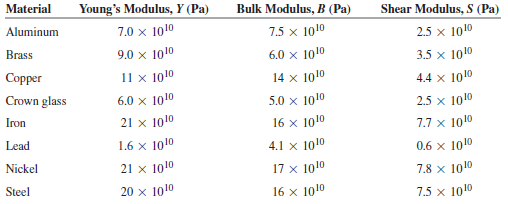
A copper cube measures 6.00 cm on each side. The bottom face is held in place by very strong glue to a flat horizontal surface, while a horizontal force F is applied to the upper face parallel to one of the edges. (Consult Table 11.1.)(a) Show that the glue exerts a force F on the bottom face that
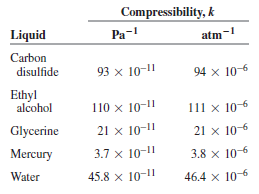
In the Challenger Deep of the Marianas Trench, the depth of seawater is 10.9 km and the pressure is (about 1.15 × 10³atm).(a) If a cubic meter of water is taken from the surface to this depth, what is the change in its volume? (Normal atmospheric pressure is about 1.0 ×
The bulk modulus for bone is 15 GPa.(a) If a diver-in-training is put into a pressurized suit, by how much would the pressure have to be raised (in atmospheres) above atmospheric pressure to compress her bones by 0.10% of their original volume?(b) Given that the pressure in the ocean increases 1.0
A uniform rod is 2.00 m long and has mass 1.80 kg. A 2.40-kg clamp is attached to the rod. How far should the center of gravity of the clamp be from the left-hand end of the rod in order for the center of gravity of the composite object to be 1.20 m from the left-hand end of the rod?
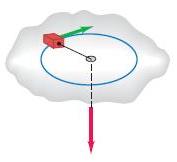
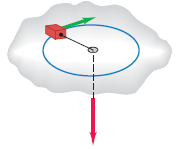
A block with mass m is revolving with linear speed v1in a circle of radius r1on a frictionless horizontal surface (see Fig. E10.42). The string is slowly pulled from below until the radius of the circle in which the block is revolving is reduced to r2.D(a) Calculate the tension T in the string as a
Tarzan has foolishly gotten himself into another scrape with the animals and must be rescued once again by Jane. The 60.0-kg Jane starts from rest at a height of 5.00 m in the trees and swings down to the ground using a thin, but very rigid, 30.0-kg vine 8.00 m long. She arrives just in time to
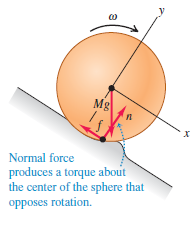
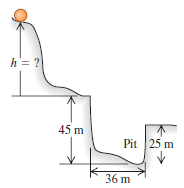
A uniform marble rolls without slipping down the path shown in Fig. P10.80, starting from rest. (a) Find the minimum height h required for the marble not to fall into the pit.(b) The moment of inertia of the marble depends on its radius. Explain why the answer to part (a) does not depend on
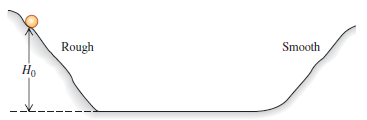
A basketball (which can be closely modeled as a hollow spherical shell) rolls down a mountainside into a valley and then up the opposite side, starting from rest at a height H0above the bottom. In Fig. P10.79, the rough part of the terrain prevents slipping while the smooth part has no friction.(a)
Starting from rest, a constant force F = 100 N is applied to the free end of a 50-m cable wrapped around the outer rim of a uniform solid cylinder, similar to the situation shown in Fig. 10.9(a). The cylinder has mass 4.00 kg and diameter 30.0 cm and is free to turn about a fixed, frictionless axle
In November 2003, the now-most-distant-known object in the solar system was discovered by observation with a telescope on Mt. Palomar. This object, known as Sedna, is approximately 1700 km in diameter, takes about 10,500 years to orbit our sun, and reaches a maximum speed of 4.64 km/s. Calculations
A uniform, 4.5-kg, square, solid wooden gate 1.5 m on each side hangs vertically from a frictionless pivot at the center of its upper edge. A 1.1-kg raven flying horizontally at 5.0 m/s flies into this door at its center and bounces back at 2.0 m/s in the opposite direction.(a) What is the angular
A thin uniform rod has a length of 0.500 m and is rotating in a circle on a frictionless table. The axis of rotation is perpendicular to the length of the rod at one end and is stationary. The rod has an angular velocity of 0.400 rad/s and a moment of inertia about the axis of 3.00 × 10⁻³
A small block on a frictionless, horizontal surface has a mass of 0.0250 kg. It is attached to a massless cord passing through a hole in the surface (Fig. E10.42). The block is originally revolving at a distance of 0.300 m from the hole with an angular speed 1.75 rad/s. of The cord is then pulled
(a) Calculate the magnitude of the angular momentum of the earth in a circular orbit around the sun. Is it reasonable to model it as a particle?(b) Calculate the magnitude of the angular momentum of the earth due to its rotation around an axis through the north and south poles, modeling it as a
A size-5 soccer ball of diameter 22.6 cm and mass 426 g rolls up a hill without slipping, reaching a maximum height of 5.00 m above the base of the hill. We can model this ball as a thin-walled hollow sphere.(a) At what rate was it rotating at the base of the hill?(b) How much rotational kinetic
A bicycle racer is going downhill at 11.0 m/s when, to his horror, one of his 2.25-kg wheels comes off as he is 75.0 m above the foot of the hill. We can model the wheel as a thin-walled cylinder 85.0 cm in diameter and neglect the small mass of the spokes.(a) How fast is the wheel moving when it
A uniform disk with mass 40.0 kg and radius 0.200 m is pivoted at its center about a horizontal, frictionless axle that is stationary. The disk is initially at rest, and then a constant force F = 30.0 is applied tangent to the rim of the disk.(a) What is the magnitude v of the tangential velocity
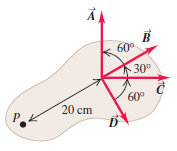
In Fig. E10.7, forces A, B, C, and D each have magnitude 50 N and act at the same point on the object.(a) What torque (magnitude and direction) does each of these forces exert on the object about point P?(b) What is the total torque about point P?Figure E10.7: 60 30° 60° 20 cm
A metal bar is in the xy-plane with one end of the bar at the origin. A force F = (7.00 N)î + (–3.00 N)ĵ is applied to the bar at the point x = 3.00 m, y = 4.00 m.(a) In terms of unit vectors î and ĵ, what is the position vector for the point where the force is applied?(b) What are the
A sphere with radius R = 0.200 m has density that decreases with distance r from the center of the sphere according to ρ = 3.00 × 10³ kg/m3 – (9.00 × 10³ kg/m4)r.(a) Calculate the total mass of the sphere.(b) Calculate the moment of inertia of the sphere for an axis along a diameter.
Using Problem 9.93 as a guide, apply it to a person running at 12 km h, with his arms and legs each swinging through ± 30º in ½ s. As before, assume that the arms and legs are kept straight.Problem 9.93:If a person of mass M simply moved forward with speed V, his kinetic energy
If a person of mass M simply moved forward with speed V, his kinetic energy would be 1/2 MV2, However, in addition to possessing a forward motion, various parts of his body (such as the arms and legs) undergo rotation. Therefore, his total kinetic energy is the sum of the energy from his forward
A dancer is spinning at 72 rpm about an axis through her center with her arms outstretched, as shown in Fig. P9.92. From biomedical measurements, the typical distribution of mass in a human body is as follows:Head: 7.0%Arms: 13% (for both)Trunk and legs: 80.0%Suppose you are this dancer. Using this
In the system shown in Fig. 9.17, a 12.0-kg mass is released from rest and falls, causing the uniform 10.0-kg cylinder of diameter 30.0 cm to turn about a frictionless axle through its center. How far will the mass have to descend to give the cylinder 480 J of kinetic energy?Figure 9.17 Our
A thin, light wire is wrapped around the rim of a wheel, as shown in Fig. E9.49. The wheel rotates about a stationary horizontal axle that passes through the center of the wheel. The wheel has radius 0.180 m and moment of inertia for rotation about the axle of I = 0.480 kg ˆ™ m2. A small
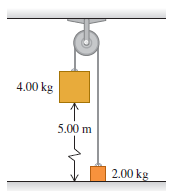
The pulley in Fig. P9.84 has radius 0.160 m and moment of inertia 0.560 kg ˆ™ m2. The rope does not slip on the pulley rim. Use energy methods to calculate the speed of the 4.00-kg block just before it strikes the floor.Figure P9.84: 4.00 kg 5.00 m 2.00 kg
A meter stick with a mass of 0.180 kg is pivoted about one end so it can rotate without friction about a horizontal axis. The meter stick is held in a horizontal position and released. As it swings through the vertical, calculate(a) The change in gravitational potential energy that has occurred;(b)
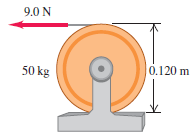
As an intern with an engineering firm, you are asked to measure the moment of inertia of a large wheel, for rotation about an axis through its center. Since you were a good physics student, you know what to do. You measure the diameter of the wheel to be 0.740 m and find that it weighs 280 N. You
A vacuum cleaner belt is looped over a shaft of radius 0.45 cm and a wheel of radius 1.80 cm. The arrangement of the belt, shaft, and wheel is similar to that of the chain and sprockets in Fig. Q9.4. The motor turns the shaft at 60.0 rev/s and the moving belt turns the wheel, which in turn is
A classic 1957 Chevrolet Corvette of mass 1240 kg starts from rest and speeds up with a constant tangential acceleration of 2.00 m/s2 on a circular test track of radius 60.0 m. Treat the car as a particle.(a) What is its angular acceleration?(b) What is its angular speed 6.00 s after it starts?(c)
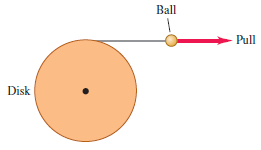
A disk of radius 25.0 cm is free to turn about an axle perpendicular to it through its center. It has very thin but strong string wrapped around its rim, and the string is attached to a ball that is pulled tangentially away from the rim of the disk (Fig. P9.65). The pull increases in magnitude and
A uniform disk with radius R = 0.400 and mass 30.0 kg rotates in a horizontal plane on a frictionless vertical axle that passes through the center of the disk. The angle through which the disk has turned varies with time according to θ(t) = (1.10 rad/s)t + (8.60 rad/s2)t2. What is the
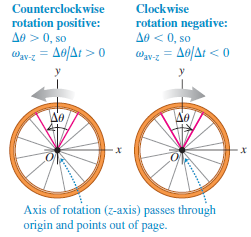
A flywheel has angular acceleration αz(t) = 8.60 rad/s2 – (2.30 rads/s3)t, where counterclockwise rotation is positive.(a) If the flywheel is at rest at t = 0, what is its angular velocity at 5.00 s?(b) Through what angle (in radians) does the flywheel turn in the time interval from t = 0 to t =
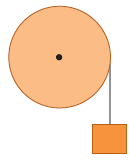
A thin, light wire is wrapped around the rim of a wheel, as shown in Fig. E9.49. The wheel rotates without friction about a stationary horizontal axis that passes through the center of the wheel. The wheel is a uniform disk with radius R = 0.280 m. An object of mass m = 4.20 kg is suspended from
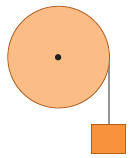
A bucket of mass m is tied to a massless cable that is wrapped around the outer rim of a frictionless uniform pulley of radius R, similar to the system shown in Fig. E9.47. In terms of the stated variables, what must be the moment of inertia of the pulley so that it always has half as much kinetic
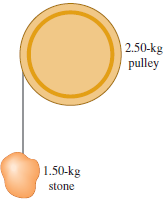
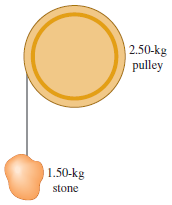
A frictionless pulley has the shape of a uniform solid disk of mass 2.50 kg and radius 20.0 cm. A 1.50-kg stone is attached to a very light wire that is wrapped around the rim of the pulley (Fig. E9.47), and the system is released from rest.(a) How far must the stone fall so that the pulley has
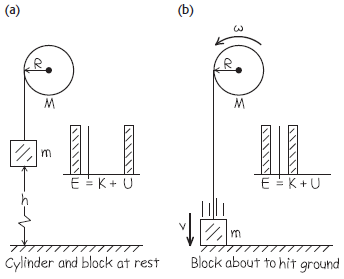
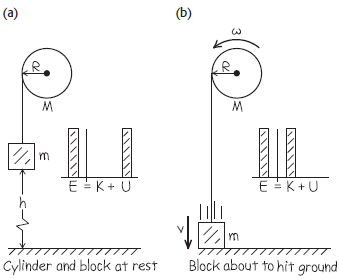
Suppose the solid cylinder in the apparatus described in Example 9.8 (Section 9.4) is replaced by a thin-walled, hollow cylinder with the same mass M and radius R. The cylinder is attached to the axle by spokes of a negligible moment of inertia.(a) Find the speed of the hanging mass m just as it
A hollow spherical shell has mass 8.20 kg and radius 0.220 m. It is initially at rest and then rotates about a stationary axis that lies along a diameter with a constant acceleration of 0.890 rad/s2. What is the kinetic energy of the shell after it has turned through 6.00 rev?
A uniform sphere with mass 28.0 kg and radius 0.380 m is rotating at constant angular velocity about a stationary axis that lies along a diameter of the sphere. If the kinetic energy of the sphere is 176 J, what is the tangential velocity of a point on the rim of the sphere?
A wheel is turning about an axis through its center with constant angular acceleration. Starting from rest, at t = 0, the wheel turns through 8.20 revolutions in 12.0 s. At t = 12.0 s the kinetic energy of the wheel is 36.0 J. For an axis through its center, what is the moment of inertia of the
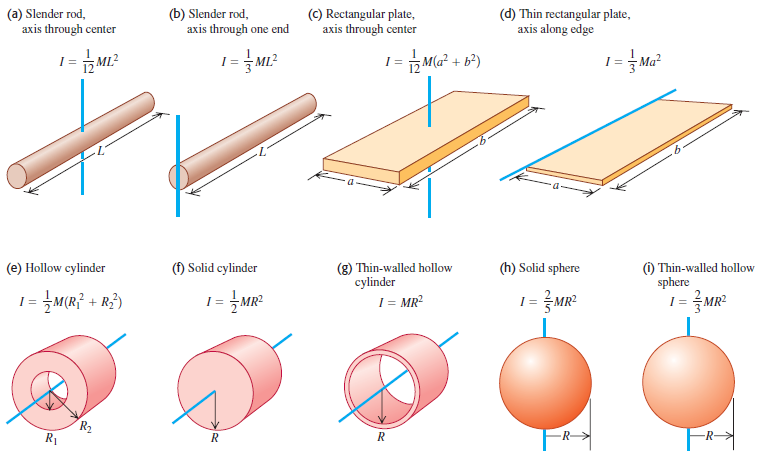
Calculate the moment of inertia of each of the following uniform objects about the axes indicated. Consult Table 9.2 as needed.(a) A thin 2.50-kg rod of length 75.0 cm, about an axis perpendicular to it and passing through (i) one end and (ii) its center, and (iii) about an axis parallel to the rod
A lunar lander is descending toward the moon’s surface. Until the lander reaches the surface, its height above the surface of the moon is given by y(t) = b – ct + dt2, where b = 800 m is the initial height of the lander above the surface, c = 60.0 m/s, and d = 1.05 m/s2.(a) What is the initial
A typical male sprinter can maintain his maximum acceleration for 2.0 s and his maximum speed is 10 m/s. After reaching this maximum speed, his acceleration becomes zero and then he runs at constant speed. Assume that his acceleration is constant during the first 2.0 s of the race, that he starts
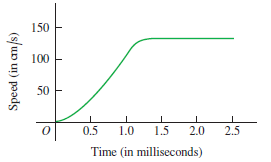
Flying Leap of the Flea. High-speed motion pictures (3500 frames/second) of a jumping, 210-μg flea yielded the data used to plot the graph given in Fig. E2.54. (See €œThe Flying Leap of the Flea€ by M. Rothschild, Y. Schlein, K. Parker, C. Neville, and S.
Given two vectors and A = 4.00î + 7.00î and B = 5.00î – 2.00î,(a) Find the magnitude of each vector;(b) Write an expression for the vector difference A – B using unit vectors;(c) Find the magnitude and direction of the vector difference A – B.(d) In a vector diagram show A, B, and A
Two stones are thrown vertically upward from the ground, one with three times the initial speed of the other.(a) If the faster stone takes 10 s to return to the ground, how long will it take the slower stone to return?(b) If the slower stone reaches a maximum height of H, how high (in terms of H)
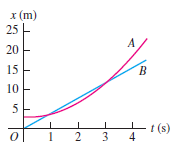
Two cars, A and B, move along the x-axis. Figure E2.32 is a graph of the positions of A and B versus time.Figure E2.32(a) In motion diagrams (like Figs. 2.13b and 2.14b), show the position, velocity, and acceleration of each of the two cars at t = 0, t = 1 s, and t = 3 s.(b) At what time(s), if
Are We Martians? It has been suggested, and not facetiously, that life might have originated on Mars and been carried to the earth when a meteor hit Mars and blasted pieces of rock (perhaps containing primitive life) free of the surface. Astronomers know that many Martian rocks have come to the
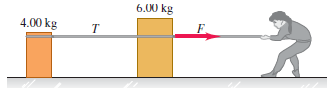
Two crates, one with mass 4.00 kg and the other with mass 6.00 kg, sit on the friction less surface of a frozen pond, connected by a light rope (Fig. P4.43). A woman wearing golf shoes (so she can get traction on the ice) pulls horizontally on the 6.00-kg crate with a force F that gives the crate
Human Biomechanics. The fastest served tennis ball, served by “Big Bill” Tilden in 1931, was measured at 73.14 m/s. The mass of a tennis ball is 57 g, and the ball is typically in contact with the tennis racquet for 30.0 ms, with the ball starting from rest. Assuming constant acceleration,(a)
Human Biomechanics. The fastest pitched baseball was measured at Typically, a baseball has a mass of 145 g. If the pitcher exerted his force (assumed to be horizontal and constant) over a distance of 1.0 m,(a) What force did he produce on the ball during this record-setting pitch? (b) Draw
A 4.80-kg bucket of water is accelerated upward by a cord of negligible mass whose breaking strength is 75.0 N. If the bucket starts from rest, what is the minimum time required to raise the bucket a vertical distance of 12.0 m without breaking the cord?
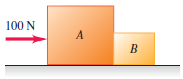
Boxes A and B are in contact on a horizontal, friction less surface, as shown in Fig. E4.23. Box A has mass 20.0 kg and box B has mass 5.0 kg. A horizontal force of 100 N is exerted on box A. What is the magnitude of the force that box A exerts on box B?Figure E4.23 100 N
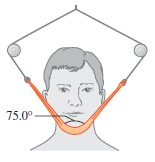
Jaw Injury. Due to a jaw injury, a patient must wear a strap (Fig. E4.3) that produces a net upward force of 5.00 N on his chin. The tension is the same throughout the strap. To what tension must the strap be adjusted to provide the necessary upward force?Figure E4.3: 75.0°
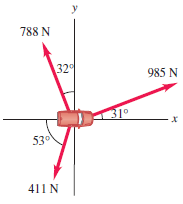
Workmen are trying to free an SUV stuck in the mud. To extricate the vehicle, they use three horizontal ropes, producing the force vectors shown in Fig. E4.2.(a) Find the x- and y-components of each of the three pulls.(b) Use the components to find the magnitude and direction of the resultant of
Two soccer players, Mia and Alice, are running as Alice passes the ball to Mia. Mia is running due north with a speed of 6.00 m s. The velocity of the ball relative to Mia is 5.00 m/s in a direction 30.0o east of south. What are the magnitude and direction of the velocity of the ball relative to
A World Record. In the shot put, a standard track and-field event, a 7.3-kg object (the shot) is thrown by releasing it at approximately 40° over a straight left leg. The world record for distance, set by Randy Barnes in 1990, is 23.11 m. Assuming that Barnes released the shot put at 40.0° from a
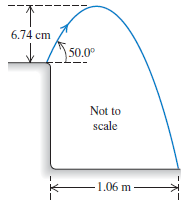
A grasshopper leaps into the air from the edge of a vertical cliff, as shown in Fig. P3.63. Use information from the figure to find (a) The initial speed of the grasshopper and(b) The height of the cliff.Figure P3.63: 6.74 cm 50.0° Not to scale 1.06 m
An Errand of Mercy. An airplane is dropping bales of hay to cattle stranded in a blizzard on the Great Plains. The pilot releases the bales at 150 m above the level ground when the plane is flying at 75 m/s in a direction 55° above the horizontal. How far in front of the cattle should the pilot
A toy rocket is launched with an initial velocity of 12.0 m s in the horizontal direction from the roof of a 30.0-m-tall building. The rocket’s engine produces a horizontal acceleration of (1.60 m/s3)t, in the same direction as the initial velocity, but in the vertical direction the acceleration
A jungle veterinarian with a blow-gun loaded with a tranquilizer dart and a sly 1.5-kg monkey are each 25 m above the ground in trees 70 m apart. Just as the hunter shoots horizontally at the monkey, the monkey drops from the tree in a vain attempt to escape being hit. What must the minimum muzzle
Spiraling Up. It is common to see birds of prey rising upward on thermals. The paths they take may be spiral-like. You can model the spiral motion as uniform circular motion combined with a constant upward velocity. Assume a bird completes a circle of radius 6.00 m every 5.00 s and rises vertically
A small toy airplane is flying in the xy-plane parallel to the ground. In the time interval to t = 0 to t = 1.00 s, its velocity as a function of time is given by v = (1.20 m/s2)tî + [12.0 m/s – (2.00 m/s2)t]j. At what value of t is the velocity of the plane perpendicular to its acceleration?
The position of a dragonfly that is flying parallel to the ground is given as a function of time by r = [2.90 m + (0.0900 m/s2)t2]î – (0.0150 m/s3)t3ĵ.(a) At what value of t does the velocity vector of the insect make an angle of 30.0o clockwise from the +x-axis?(b) At the time calculated in
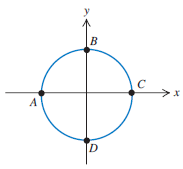
An athlete starts at point A and runs at a constant speed 6.0 m/s of around a circular track 100 m in diameter, as shown in Fig. P3.40. Find the x and y-components of this runner€™s average velocity and average acceleration between points(a) A and B,(b) A and C,(c) C and D, and(d) A and A
Dizziness. Our balance is maintained, at least in part, by the endolymph fluid in the inner ear. Spinning displaces this fluid, causing dizziness. Suppose a dancer (or skater) is spinning at a very fast 3.0 revolutions per second about a vertical axis through the center of his head. Although the
The Champion Jumper of the Insect World. The froghopper, Philaenus spumarius, holds the world record for insect jumps. When leaping at an angle of 58.0° above the horizontal, some of the tiny critters have reached a maximum height of 58.7 cm above the level ground. (See Nature, Vol. 424, July 31,
Showing 1800 - 1900
of 2042
First
7
8
9
10
11
12
13
14
15
16
17
18
19
20
21
Step by Step Answers

 Get 50% OFF
Claim Now
Get 50% OFF
Claim Now