New Semester
Started
Get
50% OFF
Study Help!
--h --m --s
Claim Now
Question Answers
Textbooks
Find textbooks, questions and answers
Oops, something went wrong!
Change your search query and then try again
S
Books
FREE
Study Help
Expert Questions
Accounting
General Management
Mathematics
Finance
Organizational Behaviour
Law
Physics
Operating System
Management Leadership
Sociology
Programming
Marketing
Database
Computer Network
Economics
Textbooks Solutions
Accounting
Managerial Accounting
Management Leadership
Cost Accounting
Statistics
Business Law
Corporate Finance
Finance
Economics
Auditing
Tutors
Online Tutors
Find a Tutor
Hire a Tutor
Become a Tutor
AI Tutor
AI Study Planner
NEW
Sell Books
Search
Search
Sign In
Register
study help
physics
university physics
University Physics with Modern Physics 13th edition Hugh D. Young, Roger A. Freedman, A. Lewis Ford - Solutions
A rookie quarterback throws a football with an initial upward velocity component 12.0 m/s of and a horizontal velocity component of 20.0 m/s. Ignore air resistance.(a) How much time is required for the football to reach the highest point of the trajectory?(b) How high is this point?(c) How much
A remote-controlled car is moving in a vacant parking lot. The velocity of the car as a function of time is given by v = [5.00 m/s – (0.0180 m/s3)t2]î + [2.00 m/s + (0.550 m/s2)t]ĵ.(a) What are and αx(t) and αy(t), the x- and y-components of the velocity of the car as functions of time?(b)
The position of a squirrel running in a park is given by r = [(0.280 m/s)t + (0.0360 m/s2)t2]î + (0.0190 m/s3)t3 ĵ.(a) What are and ux(t) and uy(t), the x- and y-components of the velocity of the squirrel, as functions of time?(b) At t = 5.00 s, how far is the squirrel from its initial
Prevention of Hip Fractures. Falls resulting in hip fractures are a major cause of injury and even death to the elderly. Typically, the hip’s speed at impact is about 2.0 m/s. If this can be reduced to 1.3 m/s or less, the hip will usually not fracture. One way to do this is by wearing elastic
Air-Bag Injuries. During an auto accident, the vehicle’s air bags deploy and slow down the passengers more gently than if they had hit the windshield or steering wheel. According to safety standards, the bags produce a maximum acceleration of 60g that lasts for only 36 ms (or less). How far (in
If a pilot accelerates at more than 4g, he begins to “gray out” but doesn’t completely lose consciousness.(a) Assuming constant acceleration, what is the shortest time that a jet pilot starting from rest can take to reach Mach 4 (four times the speed of sound) without graying out?(b) How far
A jet fighter pilot wishes to accelerate from rest at a constant acceleration of 5g to reach Mach 3 (three times the speed of sound) as quickly as possible. Experimental tests reveal that he will black out if this acceleration lasts for more than 5.0 s. Use 331 m/s for the speed of sound.(a) Will
A race car starts from rest and travels east along a straight and level track. For the first 5.0 s of the car’s motion, the eastward component of the car’s velocity is given by Ux(t) = (0.860 m/s2)t2. What is the acceleration of the car when Ux = 16.0 m/s?
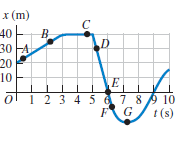
A test car travels in a straight line along the x-axis. The graph in Fig. E2.11 shows the car€™s position x as a function of time. Find its instantaneous velocity at points A through G.Figure E2.11: x (m) 40 30 20 B. 10 2 3 4 5 6 7 89 10 t (s)
A bird is flying due east. Its distance from a tall building is given by x(t) = 28.0 m + (12.4 m/s)t – (0.0450 m/s3)t3. What is the instantaneous velocity of the bird when t = 8.00 s?
Starting from the front door of your ranch house, you walk 60.0 m due east to your windmill, and then you turn around and slowly walk 40.0 m west to a bench where you sit and watch the sunrise. It takes you 28.0 s to walk from your house to the windmill and then 36.0 s to walk from the windmill to
A car travels in the +x-direction on a straight and level road. For the first 4.00 s of its motion, the average velocity of the car is uav-x = 6.25 m/s. How far does the car travel in 4.00 s?
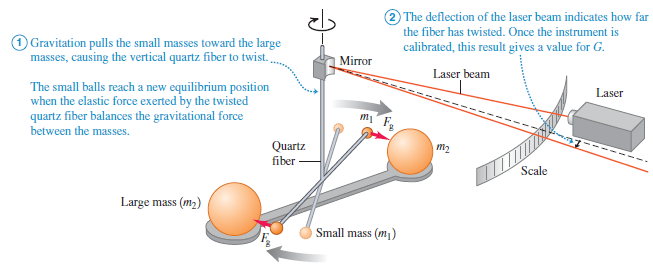
In the Cavendish balance apparatus shown in Fig. 13.4, suppose that m1= 1.10 kg, m2= 25.0 kg, and the rod connecting the pairs is 30.0 cm long. If, in each pair, m1and m2are 12.0 cm apart center to center, find(a) The net force(b) The net torque (about the rotation axis) on the rotating part of the
A couple of astronauts agree to rendezvous in space after hours. Their plan is to let gravity bring them together. One of them has a mass of 65 kg and the other a mass of 72 kg, and they start from rest 20.0 m apart.(a) Make a free-body diagram of each astronaut, and use it to find his or her
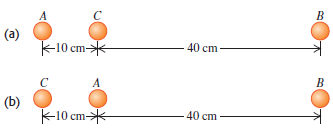
Find the magnitude and direction of the net gravitational force on mass A due to masses B and C in Fig. E13.6. Each mass is 2.00 kg.Figure E13.6: (a) К10 ст-* 40 cm (b) K10 cm- 40 cm cm-
Titania, the largest moon of the planet Uranus, has 1/8 the radius of the earth and 1/1700 the mass of the earth.(a) What is the acceleration due to gravity at the surface of Titania?(b) What is the average density of Titania? (This is less than the density of rock, which is one piece of evidence
Jupiter’s moon Io has active volcanoes (in fact, it is the most volcanically active body in the solar system) that eject material as high as 500 km (or even higher) above the surface. Io has a mass of 8.94 × 10²² kg and a radius of 1815 km. Ignore any variation in gravity over the 500-km range
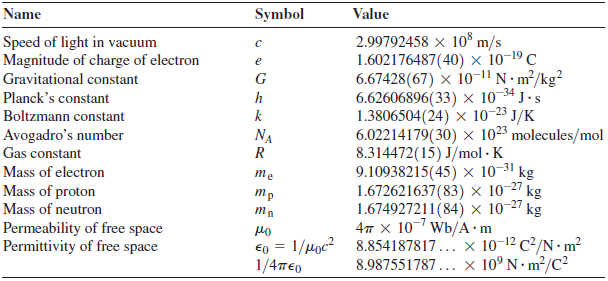
Use the results of Example 13.5 (Section 13.3) to calculate the escape speed for a spacecraft(a) From the surface of Mars and(b) From the surface of Jupiter. Use the data in Appendix F.(c) Why is the escape speed for a spacecraft independent of the spacecraft's mass?In Example 13.5:In Jules Verne's
Two satellites are in circular orbits around a planet that has radius 9.00 × 10⁶ m. One satellite has mass 68.0 kg, orbital radius 5.00 × 10⁷ m, and orbital speed 4800 m s. The second satellite has mass 84.0 kg and orbital radius 3.00 × 10⁷ m. What is the orbital speed of this second satellite?
In 2004 astronomers reported the discovery of a large Jupiter-sized planet orbiting very close to the star HD 179949 (hence the term “hot Jupiter”). The orbit was 1/9 just the distance of Mercury from our sun, and it takes the planet only 3.09 days to make one orbit (assumed to be
An experiment is performed in deep space with two uniform spheres, one with mass 50.0 kg and the other with mass 100.0 kg. They have equal radii, r = 0.20 m. The spheres are released from rest with their centers 40.0 m apart. They accelerate toward each other because of their mutual gravitational
Your starship, the Aimless Wanderer, lands on the mysterious planet Mongo. As chief scientist-engineer, you make the following measurements: A 2.50-kg stone thrown upward from the ground at 12.0 m/s returns to the ground in 6.00 s; the circumference of Mongo at the equator is 2.00 × 10⁵ km; and
An astronaut, whose mission is to go where no one has gone before, lands on a spherical planet in a distant galaxy. As she stands on the surface of the planet, she releases a small rock from rest and finds that it takes the rock 0.480 s to fall 1.90 m. If the radius of the planet is 8.60 × 10⁷ m,
In Example 13.5 (Section 13.3) we ignored the gravitational effects of the moon on a spacecraft en route from the earth to the moon. In fact, we must include the gravitational potential energy due to the moon as well. For this problem, you can ignore the motion of the earth and moon.(a) If the moon
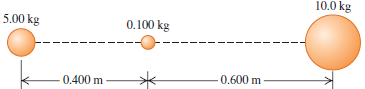
The 0.100-kg sphere in Fig. P13.62 is released from rest at the position shown in the sketch, with its center 0.400 m from the center of the 5.00-kg mass. Assume that the only forces on the 0.100-kg sphere are the gravitational forces exerted by the other two spheres and that the 5.00-kg and
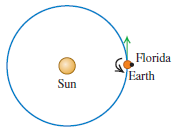
A spacecraft is to be launched from the surface of the earth so that it will escape from the solar system altogether.(a) Find the speed relative to the center of the earth with which the spacecraft must be launched. Take into consideration the gravitational effects of both the earth and the sun,
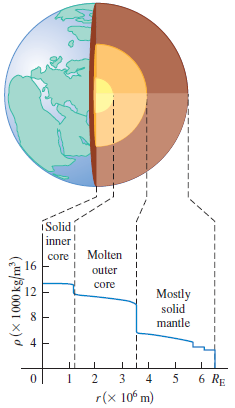
Find the gravitational force that the earth exerts on a 10.0-kg mass if it is placed at the following locations. Consult Fig. 13.9, and assume a constant density through each of the interior regions (mantle, outer core, inner core), but not the same density in each of these regions. Use the graph
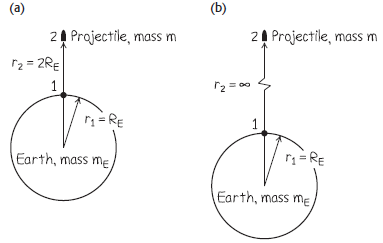
If a satellite is in a sufficiently low orbit, it will encounter air drag from the earth’s atmosphere. Since air drag does negative work (the force of air drag is directed opposite the motion), the mechanical energy will decrease. According to Eq. (13.13), if E decreases (becomes more negative),
Two stars, with masses M1and M2, are in circular orbits around their center of mass. The star with mass has M1an orbit of radius R1; the star with mass M2has an orbit of radius R2.(a) Show that the ratio of the orbital radii of the two stars equals the reciprocal of the ratio of their
In Example 13.10 (Section 13.6) we saw that inside a planet of uniform density (not a realistic assumption for the earth) the acceleration due to gravity increases uniformly with distance from the center of the planet. That is, g(r) = gsr/R, where gs is the acceleration due to gravity at the
A 5000-kg spacecraft is in a circular orbit 2000 km above the surface of Mars. How much work must the spacecraft engines perform to move the spacecraft to a circular orbit that is 4000 km above the surface?
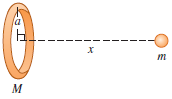
An object in the shape of a thin ring has radius a and mass M. A uniform sphere with mass m and radius R is placed with its center at a distance x to the right of the center of the ring, along a line through the center of the ring, and perpendicular to its plane (see Fig. E13.33). What is the
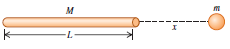
A thin, uniform rod has length L and mass M. Calculate the magnitude of the gravitational force the rod exerts on a particle with mass m that is at a point along the axis of the rod a distance x from one end (see Fig. E13.32). Show that your result reduces to the expected result when x is much
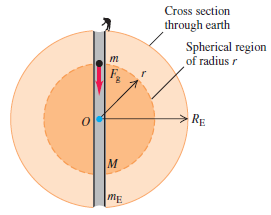
A shaft is drilled from the surface to the center of the earth (see Fig. 13.24). As in Example 13.10 (Section 13.6), make the unrealistic assumption that the density of the earth is uniform. With this approximation, the gravitational force on an object with mass m, that is inside the earth at a
(a) When an object is in a circular orbit of radius r around the earth (mass ), the period of the orbit is T, given by Eq. (13.12), and the orbital speed is given by Eq. (13.10). Show that when the object is moved into a circular orbit of slightly larger radius where its new period is and its new
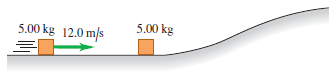
A 5.00-kg chunk of ice is sliding at 12.0 m/s on the floor of an ice-covered valley when it collides with and sticks to another 5.00-kg chunk of ice that is initially at rest. Since the valley is icy, there is no friction. After the collision, how high above the valley floor will the combined
A small wooden block with mass 0.800 kg is suspended from the lower end of a light cord that is 1.60 m long. The block is initially at rest. A bullet with mass 12.0 g is fired at the block with a horizontal velocity v0. The bullet strikes the block and becomes embedded in it. After the collision
An 8.00-kg block of wood sits at the edge of a frictionless table, 2.20 m above the floor. A 0.500-kg blob of clay slides along the length of the table with a speed of 24.0 m/s, strikes the block of wood, and sticks to it. The combined object leaves the edge of the table and travels to the floor.
A 1500-kg blue convertible is traveling south, and a 2000-kg red SUV is traveling west. If the total momentum of the system consisting of the two cars is 7200 kg ∙ m/s directed at 60.0º west of south, what is the speed of each vehicle?
In a volcanic eruption, a 2400-kg boulder is thrown vertically upward into the air. At its highest point, it suddenly explodes (due to trapped gases) into two fragments, one being three times the mass of the other. The lighter fragment starts out with only horizontal velocity and lands 318 m
Two identical 1.50-kg masses are pressed against opposite ends of a light spring of force constant compressing the spring by 20.0 cm from its normal length. Find the speed of each mass when it has moved free of the spring on a frictionless horizontal table?
Starting at t = 0, a horizontal net force F(0.280 N/s)tî + (–0.450 N/s2)t2ĵ is applied to a box that has an initial momentum p = (– 3.00 kg ∙ m/s)î + (4.00 kg ∙ m/s)ĵ. What is the momentum of the box at t = 2.00 s?
To warm up for a match, a tennis player hits the 57.0-g ball vertically with her racket. If the ball is stationary just before it is hit and goes 5.50 m high, what impulse did she impart to it?
Experimental tests have shown that bone will rupture if it is subjected to a force density of 1.03 × 10⁸ N/m2. Suppose a 70.0-kg person carelessly rollerskates into an overhead metal beam that hits his forehead and completely stops his forward motion. If the area of contact with the person’s
The mass of a regulation tennis ball is 57 g (although it can vary slightly), and tests have shown that the ball is in contact with the tennis racket for 30 ms. (This number can also vary, depending on the racket and swing.) We shall assume a 30.0-ms contact time for this exercise. The
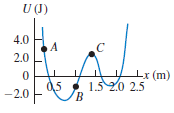
A particle moves along the x-axis while acted on by a single conservative force parallel to the x-axis. The force corresponds to the potential-energy function graphed in Fig. P7.86. The particle is released from rest at point A.(a) What is the direction of the force on the particle when it is at
A small block with mass 0.0400 kg slides in a vertical circle of radius R = 0.500 m on the inside of a circular track. During one of the revolutions of the block, when the block is at the bottom of its path, point A, the magnitude of the normal force exerted on the block by the track has magnitude
A small block with mass 0.0500 kg slides in a vertical circle of radius R = 0.800 on the inside of a circular track. There is no friction between the track and the block. At the bottom of the block’s path, the normal force the track exerts on the block has magnitude 3.40 N. What is the magnitude
A basket of negligible weight hangs from a vertical spring scale of force constant 1500 N/m.(a) If you suddenly put a 3.0-kg adobe brick in the basket, find the maximum distance that the spring will stretch.(b) If, instead, you release the brick from 1.0 m above the basket, by how much will the
A 3.00-kg fish is attached to the lower end of a vertical spring that has negligible mass and force constant 900 N/m. The spring initially is neither stretched nor compressed. The fish is released from rest.(a) What is its speed after it has descended 0.0500 m from its initial position?(b) What is
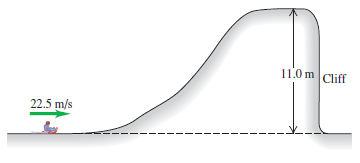
A sled with rider having a combined mass of 125 kg travels over the perfectly smooth icy hill shown in Fig. 7.68. How far does the sled land from the foot of the cliff?Figure 7.68: 11.0m Cliff 22.5 m/s
A ball is thrown upward with an initial velocity of 15 m/s at an angle of 60.0° above the horizontal. Use energy conservation to find the ball’s greatest height above the ground?
A 0.300-kg potato is tied to a string with length 2.50 m, and the other end of the string is tied to a rigid support. The potato is held straight out horizontally from the point of support, with the string pulled taut, and is then released.(a) What is the speed of the potato at the lowest point of
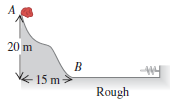
A 15.0-kg stone slides down a snow-covered hill (Fig. P7.49), leaving point A with a speed of 10.00 m/s. There is no friction on the hill between points A and B, but there is friction on the level ground at the bottom of the hill, between B and the wall. After entering the rough horizontal region,
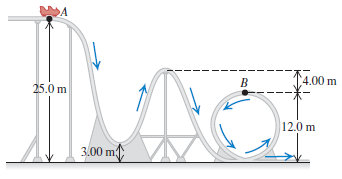
A 350-kg roller coaster starts from rest at point A and slides down the frictionless loop-the-loop shown in Fig. P7.45.(a) How fast is this roller coaster moving at point B?(b) How hard does it press against the track at point B?Figure P7.45 14.00 m 25.0 m 12.0 m 3.00 m
While a roofer is working on a roof that slants at 36° above the horizontal, he accidentally nudges his 85.0-N toolbox, causing it to start sliding downward, starting from rest. If it starts 4.25 m from the lower edge of the roof, how fast will the toolbox be moving just as it reaches the edge of
A 2.50-kg block on a horizontal floor is attached to a horizontal spring that is initially compressed 0.0300 m. The spring has force constant 840 N/m. The coefficient of kinetic friction between the floor and the block is μk = 0.40. The block and spring are released from rest and the block
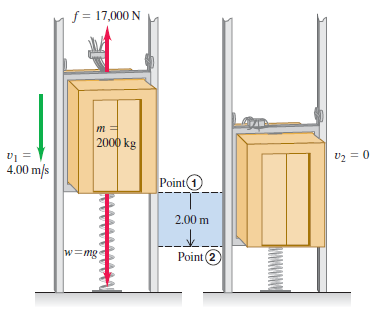
(a) For the elevator of Example 7.9, what is the speed of the elevator after it has moved downward 1.00 m from point 1 in Fig. 7.17?(b) When the elevator is 1.00 m below point 1 in Fig. 7.17, what is its acceleration?Example 7.9:A 2000-kg (19,600-n) elevator with broken cables in a test rig is
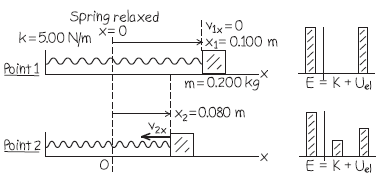
Consider the glider of Example 7.7 and Fig. 7.16.(a) As in the example, the glider is released from rest with the spring stretched 0.100 m. What is the speed of the glider when it returns to x = 0?(b) What must the initial displacement of the glider be if its maximum speed in the subsequent motion
Consider the glider of Example 7.7 and Fig. 7.16. As in the example, the glider is released from rest with the spring stretched 0.100 m. What is the displacement x of the glider from its equilibrium position when its speed is 0.20 m/s?Example 7.7:A glider with mass m = 0.200 kg sits on a
Tendons are strong elastic fibers that attach muscles to bones. To a reasonable approximation, they obey Hooke’s law. In laboratory tests on a particular tendon, it was found that, when a 250-g object was hung from it, the tendon stretched 1.23 cm.(a) Find the force constant of this tendon in
The maximum energy that a bone can absorb without breaking depends on its characteristics, such as its cross-sectional area and its elasticity. For healthy human leg bones of approximately 6.0 cm2 cross-sectional area, this energy has been experimentally measured to be about 200 J. (a) From
For its size, the common flea is one of the most accomplished jumpers in the animal world. A 2.0-mm-long, 0.50-mg critter can reach a height of 20 cm in a single leap.(a) Neglecting air drag, what is the takeoff speed of such a flea?(b) Calculate the kinetic energy of this flea at takeoff and its
The food calorie, equal to 4186 J, is a measure of how much energy is released when food is metabolized by the body. A certain brand of fruit-and-cereal bar contains 140 food calories per bar.(a) If a 65-kg hiker eats one of these bars, how high a mountain must he climb to “work off” the
The maximum height a typical human can jump from a crouched start is about 60 cm. By how much does the gravitational potential energy increase for a 72-kg person in such a jump? Where does this energy come from?
All birds, independent of their size, must maintain a power output of 10–25 watts per kilogram of body mass in order to fly by flapping their wings.(a) The Andean giant hummingbird (Patagona gigas) has mass 70 g and flaps its wings 10 times per second while hovering. Estimate the amount of work
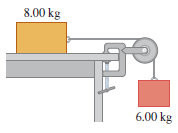
Consider the system shown in Fig. P6.86. The rope and pulley have negligible mass, and the pulley is frictionless. Initially the 6.00-kg block is moving downward and the 8.00-kg block is moving to the right, both with a speed of 0.900 m/s. The blocks come to rest after moving 2.00 m. Use the
Your cat “Ms.” (mass 7.00 kg) is trying to make it to the top of a frictionless ramp 2.00 m long and inclined upward 30.0º at above the horizontal. Since the poor cat can’t get any traction on the ramp, you push her up the entire length of the ramp by exerting a constant 100-N force parallel
You are asked to design spring bumpers for the walls of a parking garage. A freely rolling 1200-kg car moving at 0.65 m/s is to compress the spring no more than 0.090 m before stopping. What should be the force constant of the spring? Assume that the spring has negligible mass.
A block of ice with mass 4.00 kg is initially at rest on a frictionless, horizontal surface. A worker then applies a horizontal force F to it. As a result, the block moves along the x-axis such that its position as a function of time is given by x(t) = αt2 + βt2, where α = 0.200 m/s2 and β =
A net force along the x-axis that has x-component Fx = –12.0 N + (0.300 N/m2)x2 is applied to a 5.00-kg object that is initially at the origin and moving in the –x-direction with a speed of 6.00 m s. What is the speed of the object when it reaches the point x = 5.00 m?
When a car is hit from behind, its passengers undergo sudden forward acceleration, which can cause a severe neck injury known as whiplash. During normal acceleration, the neck muscles play a large role in accelerating the head so that the bones are not injured. But during a very sudden
A 5.00-kg package slides 1.50 m down a long ramp that is inclined at 24.0º below the horizontal. The coefficient of kinetic friction between the package and the ramp is Calculate(a) The work done on the package by friction;(b) The work done on the package by gravity;(c) The work done on the
A 20.0-kg crate sits at rest at the bottom of a 15.0-m-long ramp that is inclined at 34.0º above the horizontal. A constant horizontal force of 290 N is applied to the crate to push it up the ramp. While the crate is moving, the ramp exerts a constant frictional force on it that has magnitude 65.0
It is 5.0 km from your home to the physics lab. As part of your physical fitness program, you could run that distance at 10 km h (which uses up energy at the rate of 700 W), or you could walk it leisurely at 3.0 km h (which uses energy at 290 W). Which choice would burn up more energy, and how much
A crate on a motorized cart starts from rest and moves with a constant eastward acceleration of α = 2.80 m/s2. A worker assists the cart by pushing on the crate with a force that is eastward and has magnitude that depends on time according to F(t) = (5.40 N/s)t. What is the instantaneous power
A force in the +x-direction with magnitude F(x) = 18.0 N – (0.530 N/m)x is applied to a 6.00-kg box that is sitting on the horizontal, frictionless surface of a frozen lake. F(x) is the only horizontal force on the box. If the box is initially at rest at x = 0, what is its speed after it has
A 6.0-kg box moving 3.0 m/s at on a horizontal, frictionless surface runs into a light spring of force constant 75 N/cm. Use the work–energy theorem to find the maximum compression of the spring?
A 2.0-kg box and a 3.0-kg box on a perfectly smooth horizontal floor have a spring of force constant 250 N/m compressed between them. If the initial compression of the spring is 6.0 cm, find the acceleration of each box the instant after they are released. Be sure to include free-body diagrams of
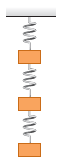
Three identical 6.40-kg masses are hung by three identical springs, as shown in Fig. E6.33. Each spring has a force constant of and was 12.0 cm long before any masses were attached to it. (a) Draw a free-body diagram of each mass.(b) How long is each spring when hanging as shown?Figure
A surgeon is using material from a donated heart to repair a patient’s damaged aorta and needs to know the elastic characteristics of this aortal material. Tests performed on a 16.0-cm strip of the donated aorta reveal that it stretches 3.75 cm when a 1.50-N pull is exerted on it.(a) What is the
A 30.0-kg crate is initially moving with a velocity that has magnitude 3.90 m s in a direction 37.0o west of north. How much work must be done on the crate to change its velocity to 5.62 m s in a direction 63.0o south of east?
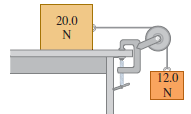
In Fig. E6.7 assume that there is no friction force on the 20.0-N block that sits on the tabletop. The pulley is light and frictionless.(a) Calculate the tension T in the light string that connects the blocks.(b) For a displacement in which the 12.0-N block descends 1.20 m, calculate the total work
(a) In the Bohr model of the atom, the ground-state electron in hydrogen has an orbital speed of 2190 km/s. What is its kinetic energy?(b) If you drop a 1.0-kg weight (about 2 lb) from a height of 1.0 m, how many joules of kinetic energy will it have when it reaches the ground?(c) Is it reasonable
A 1.50-kg book is sliding along a rough horizontal surface. At point A it is moving at 3.21 m s, and at point B it has slowed to 1.25 m s.(a) How much work was done on the book between A and B?(b) If –0.750 of work is done on the book from B to C, how fast is it moving at point C?(c) How fast
Adult cheetahs, the fastest of the great cats, have a mass of about 70 kg and have been clocked running at up to 72 mph (32 m/s).(a) How many joules of kinetic energy does such a swift cheetah have?(b) By what factor would its kinetic energy change if its speed were doubled?
You apply a constant force F = (–68.0 N)î + (36.0 N)ĵ to a 380-kg car as the car travels 48.0 m in a direction that is 240.0º counterclockwise from the +x-axis. How much work does the force you apply do on the car?
A boxed 10.0-kg computer monitor is dragged by friction 5.50 m up along the moving surface of a conveyor belt inclined at an angle of 36.9° above the horizontal. If the monitor’s speed is a constant 2.10 cm s, how much work is done on the monitor by(a) Friction,(b) Gravity, and(c) The normal
An 8.00-kg package in a mail-sorting room slides 2.00 m down a chute that is inclined at 53.0° below the horizontal. The coefficient of kinetic friction between the package and the chute’s surface is 0.40. Calculate the work done on the package by(a) Friction,(b) Gravity, and(c) The normal
You push your physics book 1.50 m along a horizontal tabletop with a horizontal push of 2.40 N while the opposing force of friction is 0.600 N. How much work does each of the following forces do on the book:(a) Your 2.40-N push,(b) The friction force,(c) The normal force from the tabletop, and(d)
A box with weight w is pulled at constant speed along a level floor by a force that is at an angle θ above the horizontal. The coefficient of kinetic friction between the floor and box is μk.(a) In terms of θ, μk, and w, calculate F.(b) For w = 400 N and μk = 0.25, calculate F
A 40.0-kg packing case is initially at rest on the floor of a 1500-kg pickup truck. The coefficient of static friction between the case and the truck floor is 0.30, and the coefficient of kinetic friction is 0.20. Before each acceleration given below, the truck is traveling due north at constant
A hammer is hanging by a light rope from the ceiling of a bus. The ceiling of the bus is parallel to the roadway. The bus is traveling in a straight line on a horizontal street. You observe that the hammer hangs at rest with respect to the bus when the angle between the rope and the ceiling of the
You are standing on a bathroom scale in an elevator in a tall building. Your mass is 64 kg. The elevator starts from rest and travels upward with a speed that varies with time according to u(t) = (3.0 m/s2)t + (0.20 m/s3)t2. When t = 4.0 s, what is the reading of the bathroom scale?
A 25,000-kg rocket blasts off vertically from the earth’s surface with a constant acceleration. During the motion considered in the problem, assume that g remains constant (see Chapter 13). Inside the rocket, a 15.0-N instrument hangs from a wire that can support a maximum tension of 45.0 N.(a)
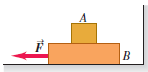
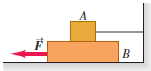
Block A in Fig. P5.73 weighs 2.40 N and block B weighs 3.60 N. The coefficient of kinetic friction between all surfaces is 0.300. Find the magnitude of the horizontal force necessary to drag block B to the left at constant speed(a) If A rests on B and moves with it (Fig. P5.73a).(b) If A is held at
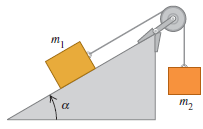
In Fig. P5.68 m1= 20.0 kg and α = 53.1o. The coefficient of kinetic friction between the block and the incline is μk= 0.40. What must be the mass of the hanging block if it is to descend 12.0 m in the first 3.00 s after the system is released from rest?Figure
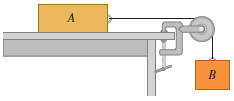
In Fig. P5.34 block A has mass m and block B has mass 6.00 kg. The coefficient of kinetic friction between block A and the tabletop is μk= 0.40. The mass of the rope connecting the blocks can be neglected. The pulley is light and friction less. When the system is released from
A 6.00-kg box sits on a ramp that is inclined at 37.0o above the horizontal. The coefficient of kinetic friction between the box and the ramp is μk = 0.30. What horizontal force is required to move the box up the incline with a constant acceleration of 4.20 m/s2?
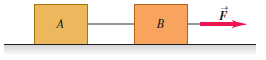
Two boxes connected by a light horizontal rope are on a horizontal surface, as shown in Fig. P5.35. The coefficient of kinetic friction between each box and the surface is μk= 0.30. One box (box B) has mass 5.00 kg, and the other box (box A) has mass m. A force F with magnitude 40.0 N
Showing 1900 - 2000
of 2042
First
7
8
9
10
11
12
13
14
15
16
17
18
19
20
21
Step by Step Answers

 Get 50% OFF
Claim Now
Get 50% OFF
Claim Now