New Semester
Started
Get
50% OFF
Study Help!
--h --m --s
Claim Now
Question Answers
Textbooks
Find textbooks, questions and answers
Oops, something went wrong!
Change your search query and then try again
S
Books
FREE
Study Help
Expert Questions
Accounting
General Management
Mathematics
Finance
Organizational Behaviour
Law
Physics
Operating System
Management Leadership
Sociology
Programming
Marketing
Database
Computer Network
Economics
Textbooks Solutions
Accounting
Managerial Accounting
Management Leadership
Cost Accounting
Statistics
Business Law
Corporate Finance
Finance
Economics
Auditing
Tutors
Online Tutors
Find a Tutor
Hire a Tutor
Become a Tutor
AI Tutor
AI Study Planner
NEW
Sell Books
Search
Search
Sign In
Register
study help
physics
university physics
University Physics with Modern Physics 13th edition Hugh D. Young, Roger A. Freedman, A. Lewis Ford - Solutions
If the person in Problem 34.56 chooses ordinary glasses over contact lenses, what power lens (in diopters) does she need to correct her vision if the lenses are 2.0 cm in front of the eye?Problem 34.56 A person can see clearly up close but cannot focus on objects beyond 75.0 cm. She opts for
A person can see clearly up close but cannot focus on objects beyond 75.0 cm. She opts for contact lenses to correct her vision.(a) Is she nearsighted or farsighted?(b) What type of lens (converging or diverging) is needed to correct her vision?(c) What focal length contact lens is needed, and what
Contact lenses are placed right on the eyeball, so the distance from the eye to an object (or image) is the same as the distance from the lens to that object (or image). A certain person can see distant objects well, but his near point is 45.0 cm from his eyes instead of the usual 25.0 cm.(a) Is
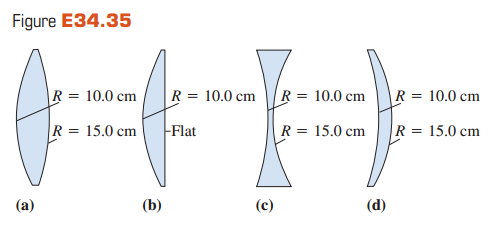
For each thin lens shown in Fig. E34.35, calculate the location of the image of an object that is 18.0 cm to the left of the lens. The lens material has a refractive index of 1.50, and the radii of curvature shown are only the magnitudes. Figure E34.35 R = 10.0 cm R = 10.0 cm |R = 10.0 cm R = 10.0
The cornea behaves as a thin lens of focal length approximately 1.8 cm, although this varies a bit. The material of which it is made has an index of refraction of 1.38, and its front surface is convex, with a radius of curvature of 5.0 mm.(a) If this focal length is in air, what is the radius of
The crystalline lens of the human eye is a double-convex lens made of material having an index of refraction of 1.44 (although this varies). Its focal length in air is about 8.0 mm, which also varies. We shall assume that the radii of curvature of its two surfaces have the same magnitude.(a) Find
A person is lying on a diving board 3.00 m above the surface of the water in a swimming pool. The person looks at a penny that is on the bottom of the pool directly below her. The penny appears to the person to be a distance of 8.00 m from her. What is the depth of the water at this point?
A person swimming 0.80 m below the surface of the water in a swimming pool looks at the diving board that is directly overhead and sees the image of the board that is formed by refraction at the surface of the water. This image is a height of 5.20 m above the swimmer. What is the actual height of
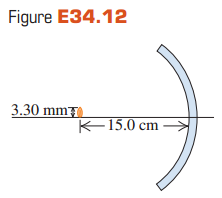
The thin glass shell shown in Fig. E34.12 has a spherical shape with a radius of curvature of 12.0 cm, and both of its surfaces can act as mirrors. A seed 3.30 mm high is placed 15.0 cm from the center of the mirror along the optic axis, as shown in the figure.(a) Calculate the location and height
A pencil that is 9.0 cm long is held perpendicular to the surface of a plane mirror with the tip of the pencil lead 12.0 cm from the mirror surface and the end of the eraser 21.0 cm from the mirror surface. What is the length of the image of the pencil that is formed by the mirror? Which end of the
Two protons are moving away from each other. In the frame of each proton, the other proton has a speed of 0.600c. What does an observer in the rest frame of the earth measure for the speed of each proton?
The maximum resolution of the eye depends on the diameter of the opening of the pupil (a diffraction effect) and the size of the retinal cells. The size of the retinal cells (about 5.0 μm in diameter) limits the size of an object at the near point (25 cm) of the eye to a height 50 μm of about (To
In a laboratory, light from a particular spectrum line of helium passes through a diffraction grating and the second-order maximum is at 18.9° from the center of the central bright fringe.The same grating is then used for light from a distant galaxy that is moving away from the earth with a speed
Although we have discussed single-slit diffraction only for a slit, a similar result holds when light bends around a straight, thin object, such as a strand of hair. In that case, a is the width of the strand. From actual laboratory measurements on a human hair, it was found that when a beam of
The VLBA (Very Long Baseline Array) uses a number of individual radio telescopes to make one unit having an equivalent diameter of about 8000 km. When this radio telescope is focusing radio waves of wavelength 2.0 cm, what would have to be the diameter of the mirror of a visible-light telescope
Monochromatic x rays are incident on a crystal for which the spacing of the atomic planes is 0.440 nm. The first-order maximum in the Bragg reflection occurs when the incident and reflected x rays make an angle of 39.4° with the crystal planes. What is the wavelength of the x rays?
When laser light of wavelength 632.8 nm passes through a diffraction grating, the first bright spots occur at ±17.8° from the central maximum.(a) What is the line density (in lines cm) of this grating?(b) How many additional bright spots are there beyond the first bright spots, and at what angles
In a setup similar to that of Problem 35.41, the glass has an index of refraction of 1.53, the plates are each 8.00 cm long, and the metal foil is 0.015 mm thick. The space between the plates is filled with a jelly whose refractive index is not known precisely, but is known to be greater than that
After an eye examination, you put some eye drops on your sensitive eyes. The cornea (the front part of the eye) has an index of refraction of 1.38, while the eye drops have a refractive index of 1.45. After you put in the drops, your friends notice that your eyes look red, because red light of
Eyeglass lenses can be coated on the inner surfaces to reduce the reflection of stray light to the eye. If the lenses are medium flint glass of refractive index 1.62 and the coating is fluorite of refractive index 1.432,(a) What minimum thickness of film is needed on the lenses to cancel light of
A certain atom has an energy level 3.50 eV above the ground state. When excited to this state, it remains 4.0 μs, on the average, before emitting a photon and returning to the ground state.(a) What is the energy of the photon? What is its wavelength?(b) What is the smallest possible uncertainty in
The silicon–silicon single bond that forms the basis of the mythical silicon-based creature the Horta has a bond strength of 3.80 eV. What wavelength of photon would you need in a (mythical) phasor disintegration gun to destroy the Horta?
(a) What accelerating potential is needed to produce electrons of wavelength 5.00 nm?(b) What would be the energy of photons having the same wavelength as these electrons?(c) What would be the wavelength of photons having the same energy as the electrons in part (a)?
A horizontal beam of laser light of wavelength 585 nm passes through a narrow slit that has width 0.0620 mm. The intensity of the light is measured on a vertical screen that is 2.00 m from the slit.(a) What is the minimum uncertainty in the vertical component of the momentum of each photon in the
An x ray with a wavelength of 0.100 nm collides with an electron that is initially at rest. The x ray’s final wavelength is 0.110 nm. What is the final kinetic energy of the electron?
The cathode-ray tubes that generated the picture in early color televisions were sources of x rays. If the acceleration voltage in a television tube is 15.0 kV, what are the shortest-wavelength x rays produced by the television? (Modern televisions contain shielding to stop these x rays.)
When ultraviolet light with a wavelength of 400.0 nm falls on a certain metal surface, the maximum kinetic energy of the emitted photo electrons is measured to be 1.10 eV. What is the maximum kinetic energy of the photoelectrons when light of wavelength 300.0 nm falls on the same surface?
(a) A molecule decreases its vibrational energy by 0.250 eV by giving up a photon of light. What wavelength of light does it give up during this process, and in what part of the electromagnetic spectrum does that wavelength of light lie?(b) An atom decreases its energy by 8.50 eV by giving up a
If the energy of the H2 covalent bond is -4.48 eV, what wavelength of light is needed to break that molecule apart? In what part of the electromagnetic spectrum does this light lie?
In terms of the ground-state energy, what is the energy E1,1,1, of the highest level occupied by an electron when 10 electrons are placed into a cubical box?
The energies for an electron in the K, L, and M shells of the tungsten atom are -69,500 eV, and -22,000 eV, respectively. Calculate the wavelengths of the Kα and Kβ x rays of tungsten.
For magnesium, the first ionization potential is 7.6 eV. The second ionization potential (additional energy required to remove a second electron) is almost twice this, 15 eV, and the third ionization potential is much larger, about 80 eV. How can these numbers be understood?
(a) Write out the ground-state electron configuration (1s2, 2s2,) for the carbon atom.(b) What element of next-larger Z has chemical properties similar to those of carbon? Give the ground-state electron configuration for this element.
Model a hydrogen atom as an electron in a cubical box with side length L. Set the value of L so that the volume of the box equals the volume of a sphere of radius a = 5.29 x 10⁻¹¹ m,, the Bohr radius. Calculate the energy separation between the ground and first excited levels, and compare the
A positive pion at rest decays into a positive muon and a neutrino.(a) Approximately how much energy is released in the decay? (Assume the neutrino has zero rest mass. Use the muon and pion masses given in terms of the electron mass in Section 44.1.)(b) Why can’t a positive muon decay into a
A proton and an antiproton annihilate, producing two photons. Find the energy, frequency, and wavelength of each photon(a) If the p and p̅ are initially at rest.(b) If the p and p̅ collide head-on, each with an initial kinetic energy of 830 MeV.
For the nuclear reaction given in Eq. (44.2) assume that the initial kinetic energy and momentum of the reacting particles are negligible. Calculate the speed of the α particle immediately after it leaves the reaction region.
The starship Enterprise, of television and movie fame, is powered by combining matter and antimatter. If the entire 400 kg antimatter fuel supply of the Enterprise combines with matter, how much energy is released? How does this compare to the U.S. yearly energy use, which is roughly 1.0 x 10²⁰ J?
An electron with a total energy of 20.0 GeV collides with a stationary positron.(a) What is the available energy? (b) If the electron and positron are accelerated in a collider, what total energy corresponds to the same available energy as in part (a)?
(a) A high-energy beam of alpha particles collides with a stationary helium gas target. What must the total energy of a beam particle be if the available energy in the collision is 16.0 GeV?(b) If the alpha particles instead interact in a colliding-beam experiment, what must the energy of each beam
How much energy is released when a μ- muon at rest decays into an electron and two neutrinos? Neglect the small masses of the neutrinos.
What is the mass (in kg) of the Z0? What is the ratio of the mass of the Z0 to the mass of the proton?
If a Σ+ at rest decays into a proton and a π0, what is the total kinetic energy of the decay products?
What is the total kinetic energy of the decay products when an upsilon particle at rest decays to τ + + τ–?
A parallel-plate vacuum capacitor has 8.38 J of energy stored in it. The separation between the plates is 2.30 mm. If the separation is decreased to 1.15 mm, what is the energy stored (a) If the capacitor is disconnected from the potential source so the charge on the plates remains
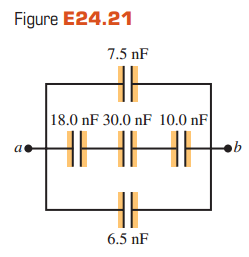
For the system of capacitors shown in Fig. E24.21, a potential difference of 25 V is maintained across ab. (a) What is the equivalent capacitance of this system between a and b? (b) How much charge is stored by this system? (c) How much charge does the 6.5-nF capacitor
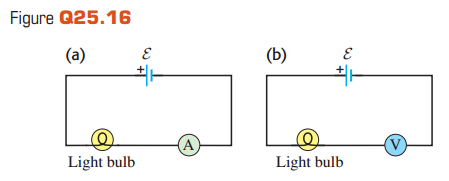
Will a light bulb glow more brightly when it is connected to a battery as shown in Fig. Q25.16a, in which an ideal ammeter A is placed in the circuit, or when it is connected as shown in Fig. 25.16b, in which an ideal voltmeter V is placed in the circuit? Explain your reasoning. Figure Q25.16 (a)
Electric eels generate electric pulses along their skin that can be used to stun an enemy when they come into contact with it. Tests have shown that these pulses can be up to 500 V and produce currents of 80 mA (or even larger). A typical pulse lasts for 10 ms. What power and how much energy are
A heart defibrillator is used to enable the heart to start beating if it has stopped. This is done by passing a large current of 12 A through the body at 25 V for a very short time, usually about 3.0 ms. (a) What power does the defibrillator deliver to the body,(b) How much energy is
A Nichrome heating element that has resistance 28.0Ω is connected to a battery that has emf 96.0 V and internal resistance . An aluminum 1.2Ω cup with mass 0.130 kg contains 0.200 kg of water. The heating element is placed in the water and the electrical energy dissipated in the resistance of
A resistor with resistance R is connected to a battery that has emf 12.0 V and internal resistance r = 0.40Ω. For what two values of R will the power dissipated in the resistor be 80.0 W?
Lightning strikes can involve currents as high as 25,000 A that last for about 40 μs. If a person is struck by a bolt of lightning with these properties, the current will pass through his body. We shall assume that his mass is 75 kg, that he is wet (after all, he is in a rainstorm) and therefore
In the Bohr model of the hydrogen atom, the electron makes 6.0 × 10¹⁵ rev/s around the nucleus. What is the average current at a point on the orbit of the electron?
A resistor with R1 = 25.0 Ω is connected to a battery that has negligible internal resistance and electrical energy is dissipated R1 by at a rate of 36.0 W. If a second resistor with R2 = 15.0 Ω is connected in series with R1, what is the total rate at which electri-cal energy is
You are working late in your electronics shop and find that you need various resistors for a project. But alas, all you have is a big box of 10.0-Ω resistors. Show how you can make each of the following equivalent resistances by a combination of your 10.0-Ω resistors: (a) 35 Ω. (b)
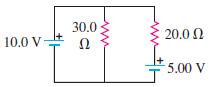
The batteries shown in the circuit in Fig. E26.24 have negligibly small internal resistances. Find the current through (a) The 30.0-Ω resistor; (b) The 20.0-Ω resistor; (c) The 10.0-V Figure E26.24 30.0 Ω 20.0 N 10.0 V 5.00 V
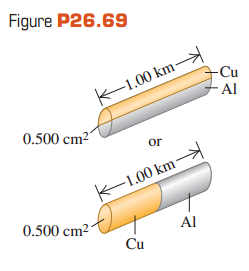
A 1.00-km cable having a cross-sectional area of 0.500 cm2is to be constructed out of equal lengths of copper and aluminum. This could be accomplished either by making a 0.50-km cable of each one and welding them together end to end or by making two parallel 1.00-km cables, one of each metal (Fig.
Three moles of an ideal gas are in a rigid cubical box with sides of length 0.200 m.(a) What is the force that the gas exerts on each of the six sides of the box when the gas temperature is 20.0°C?(b) What is the force when the temperature of the gas is increased to 100.0°C?
A metal tank with volume 3.10 L will burst if the absolute pressure of the gas it contains exceeds 100 atm.(a) If 11.0 mol of an ideal gas is put into the tank at a temperature of to what temperature can the gas be warmed before the tank ruptures? You can ignore the thermal expansion of the
A diver observes a bubble of air rising from the bottom of a lake (where the absolute pressure is 3.50 atm) to the surface (where the pressure is 1.00 atm). The temperature at the bottom is and the temperature at the surface is(a) What is the ratio of the volume of the bubble as it reaches the
The proportions of various gases in the earth’s atmosphere change somewhat with altitude. Would you expect the proportion of oxygen at high altitude to be greater or less than at sea level compared to the proportion of nitrogen? Why?
For carbon dioxide gas the constants in the van der Waals equation are α = 0.364 J · m3/mol2 and(a) If 1.00 mol of gas at 350 K is confined to a volume of find the pressure of the gas using the ideal-gas equation and the van der Waals equation.(b) Which equation gives a lower pressure? Why? What
If no real engine can be as efficient as a Carnot engine operating between the same two temperatures, what is the point of developing and using Eq. (20.14)?Eq. (20.14) Tc TH – Tc TH (efficiency of a Carnot engine) eCarnot TH
An electric motor has its shaft coupled to that of an electric generator. The motor drives the generator, and some current from the generator is used to run the motor. The excess current is used to light a home. What is wrong with this scheme?
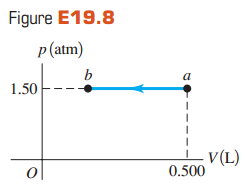
Figure E19.8 shows ap V-diagram for an ideal gas in which its absolute temperature at bis one-fourth of its absolute temperature at a.(a) What volume does this gas occupy at point b? (b) How many joules of work was done by or on the gas in this process? Was it done by or on the
In deriving the ideal-gas equation from the kinetic-molecular model, we ignored potential energy due to the earth’s gravity. Is this omission justified? Why or why not?
Consider a model of a hydrogen atom in which an electron is in a circular orbit of radius r = 5.29 × 10⁻¹¹ m around a stationary proton. What is the speed of the electron in its orbit?
At t = 0 a very small object with mass 0.400 mg and charge +9.00 μC is traveling at 125 m/s in the -x direction. The charge is moving in a uniform electric field that is in the +y -direction and that has magnitude E = 895 N/C. The gravitational force on the particle can be neglected. How far is
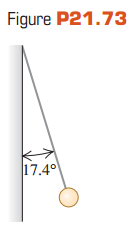
A small 12.3-g plastic ball is tied to a very light 28.6-cm string that is attached to the vertical wall of a room (Fig. P21.73). A uni-form horizontal electric field exists in this room. When the ball has been given an excess charge of -1.11 μC, you observe that it remains suspended,
A point charge is on the x-axis at x = 1.20 m. A second point charge Q is on the x-axis at -0.600. What must be the sign and magnitude of Q for the resultant electric field at the origin to be (a) 45.0 N/C in the +x direction, (b) 45.0 N/C in the -x direction?
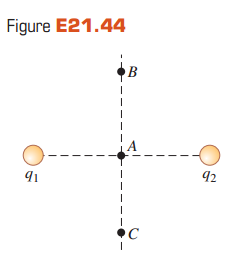
The two charges q1 and q2shown in Fig. E 21.44 have equal magnitudes. What is the direction of the net electric field due to these two charges at points A(midway between the charges), B, and C if(a) Both charges are negative, (b) Both charges are positive,(c) q1 is positive and q2 is
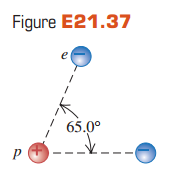
If two electrons are each 1.50 x 10⁻¹⁰m from a proton, as shown in Fig. E 21.37, find the magnitude and direction of the net electric force they will exert on the proton. Figure E21.37 65.0°
Suppose you had two small boxes, each containing 1.0 g of protons.(a) If one were placed on the moon by an astronaut and the other were left on the earth, and if they were connected by a very light (and very long!) string, what would be the tension in the string? Express your answer in newtons and
Neuronsare components of the nervous system of the body that transmit signals as electrical impulses travel along their length. These impulses propagate when charge suddenly rushes into and then out of a part of the neuron called an axon.Measurements have shown that, during the inflow part of this
An uncharged metal sphere hangs from a nylon thread. When a positively charged glass rod is brought close to the metal sphere, the sphere is drawn toward the rod. But if the sphere touches the rod, it suddenly flies away from the rod. Explain why the sphere is first attracted and then repelled.
Some critics of biological evolution claim that it violates the second law of thermodynamics, since evolution involves simple life forms developing into more complex and more highly ordered organisms. Explain why this is not a valid argument against evolution.
An insulating sphere of radius R = 0.160 m has uniform charge density p = +7.20 x 10⁻⁹ C/m3. A small object that can be treated as a point charge is released from rest just outside the surface of the sphere. The small object has positive charge q = 3.40 x 10⁻⁶ C. How much work does the electric
An electron is released from rest at a distance of 0.300 m from a large insulating sheet of charge that has uniform sur-face charge density .(a) How much work is done on the electron by the electric field of the sheet as the electron moves from its initial position to a point 0.050 m from the
At time t = 0 a proton is a distance of 0.360 m from a very large insulating sheet of charge and is moving parallel to the sheet with speed 9.70 × 10² m/s. The sheet has uniform surface charge density 2.34 × 10⁻⁹ C/m2. What is the speed of the proton at t = 5.00 × 10⁻⁸ s?
A very small object with mass 8.20 × 10⁻⁹ kg and positive charge 6.50 × 10⁻⁹ C is projected directly toward a very large insulating sheet of positive charge that has uniform surface charge density 5.90 × 10⁻⁸ C/m2. The object is initially 0.400 m from the sheet. What initial speed must the
As discussed in Section 22.5, human nerve cells have a net negative charge and the material in the interior of the cell is a good conductor. If a cell has a net charge of -8.65 pC, what are the magnitude and direction (inward or outward) of the net flux through the cell boundary?
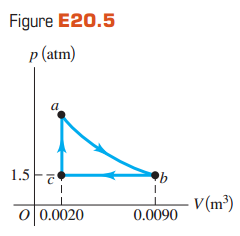
The pV-diagram in Fig. 20.5 shows a cycle of a heat engine that uses 0.250 mole of an ideal gas having y = 1.40.The curved part a of the cycle is adiabatic. (a) Find the pressure of the gas at point a.(b) How much heat enters this gas per cycle, and where does it happen? (c) How much heat
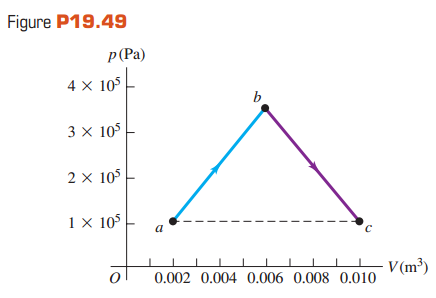
(a) One-third of a mole of He gas is taken along the path a b c shown as the solid line in Fig. P19.49. Assume that the gas may be treated as ideal. How much heat is transferred into or out of the gas? (b) If the gas instead went from state a to state c along the horizontal dashed line in Fig.
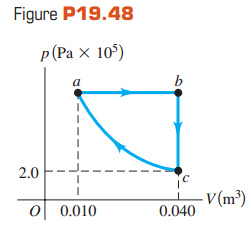
The graph in Fig. P19.48 shows a pV-diagram for 3.25 moles of ideal helium (He) gas. Part ca of this process is isothermal. (a) Find the pressure of the He at point a. (b) Find the temperature of the He at points a, b, and c. (c) How much heat entered or left the He during
One mole of ideal gas is slowly compressed to one-third of its original volume. In this compression, the work done on the gas has magnitude 600 J. For the gas, CP = 7R/2. (a) If the process is isothermal, what is the heat flow Q for the gas? Does heat flow into or out of the gas? (b) If
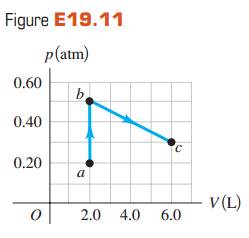
The process abc shown in the pV-diagram in Fig. E19.11 involves 0.0175 mole of an ideal gas. (a) What was the lowest temperature the gas reached in this process? Where did it occur? (b) How much work was done by or on the gas from a to b? From b to c? (c) If 215 J of heat was
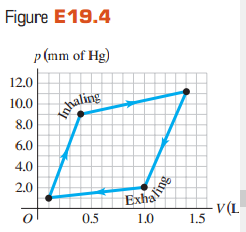
The graph in Fig. E19.4 shows a pV-diagram of the air in a human lung when a person is inhaling and then exhaling a deep breath. Such graphs, obtained in clinical practice, are normally somewhat curved, but we have modeled one as a set of straight lines of the same general shape. (Important:
The speed of propagation of a sound wave in air at 27oC is about 350 m/s. Calculate, for comparison,(a) vrms for nitrogen molecules(b) The rms value of vx at this temperature. The molar mass of nitrogen (N2) is 28.0 g/mol?
A hot-air balloon stays aloft because hot air at atmospheric pressure is less dense than cooler air at the same pres-sure. If the volume of the balloon 500.0 m3 is and the surrounding air is at 15.0°C, what must the temperature of the air in the balloon be for it to lift a total load of 290 kg (in
If deep-sea divers rise to the surface too quickly, nitrogen bubbles in their blood can expand and prove fatal. This phenomenon is known as the bends. If a scuba diver rises quickly from a depth of 25 m in Lake Michigan (which is fresh water), what will be the volume at the surface of an N2 bubble
If deep-sea divers rise to the surface too quickly, nitrogen bubbles in their blood can expand and prove fatal. This phenomenon is known as the bends. If a scuba diver rises quickly from a depth of 25 m in Lake Michigan (which is fresh water), what will be the volume at the surface of an N2 bubble
A physics lecture room has a volume of 216 m3.(a) For a pressure of 1.00 atm and a temperature of 27.0oC, use the ideal-gas law to estimate the number of air molecules in the room. Assume all the air is N2.(b) Calculate the particle density—that is, the number of molecules per cubic
A container with volume 1.48 L is initially evacuated. Then it is filled with 0.226 g of N2. Assume that the pressure of the gas is low enough for the gas to obey the ideal-gas law to a high degree of accuracy. If the root-mean-square speed of the gas molecules is 182 m/s, what is the pressure of
(a) Calculate the mass of nitrogen present in a volume of 3000 cm3 if the temperature of the gas is 22.0°C and the absolute pressure of 2.00 × 10⁻¹³ atm is a partial vacuum easily obtained in laboratories.(b) What is the density (in kg/m3) of the N2?
If a certain amount of ideal gas occupies a volume V at STP on earth, what would be its volume (in terms of V) on Venus, where the temperature is 1003°C and the pressure is 92 atm?
a. Calculate the change in air pressure you will experience if you climb a 1000-m mountain, assuming that the temperature and air density do not change over this distance and that they were 22°C and 1.2 kg/m3, respectively, at the bottom of the mountain. (Note that the result of Example 18.4
The coefficient of performance K = H/P is a dimension-less quantity. Its value is independent of the units used for H and P, as long as the same units, such as watts, are used for both quantities. However, it is common practice to express H in Btu h and P in watts. When these mixed units are used,
A refrigerator has a coefficient of performance of 2.25, runs on an input of 95 W of electrical power, and keeps its inside compartment at 5°C. If you put a dozen 1.0-L plastic bottles of water at 31°C into this refrigerator, how long will it take for them to be cooled down to 5°C? (Ignore any
A 4.50-kg block of ice at 0.00°C falls into the ocean and melts. The average temperature of the ocean is 3.50°C, including all the deep water. By how much does the melting of this ice change the entropy of the world? Does it make it larger or smaller?
A 10.0-L gas tank containing 3.20 moles of ideal He gas at 20.0°C is placed inside a completely evacuated, insulated bell jar of volume 35.0 L. A small hole in the tank allows the He to leak out into the jar until the gas reaches a final equilibrium state with no more leakage. (a) What is the
Showing 1600 - 1700
of 2042
First
7
8
9
10
11
12
13
14
15
16
17
18
19
20
21
Step by Step Answers

 Get 50% OFF
Claim Now
Get 50% OFF
Claim Now