New Semester
Started
Get
50% OFF
Study Help!
--h --m --s
Claim Now
Question Answers
Textbooks
Find textbooks, questions and answers
Oops, something went wrong!
Change your search query and then try again
S
Books
FREE
Study Help
Expert Questions
Accounting
General Management
Mathematics
Finance
Organizational Behaviour
Law
Physics
Operating System
Management Leadership
Sociology
Programming
Marketing
Database
Computer Network
Economics
Textbooks Solutions
Accounting
Managerial Accounting
Management Leadership
Cost Accounting
Statistics
Business Law
Corporate Finance
Finance
Economics
Auditing
Tutors
Online Tutors
Find a Tutor
Hire a Tutor
Become a Tutor
AI Tutor
AI Study Planner
NEW
Sell Books
Search
Search
Sign In
Register
study help
sciences
general chemistry
General Chemistry 11th Edition Darrell Ebbing, Steven D. Gammon - Solutions
Write the electron configurations of Bi and Bi3+.
Write the electron configurations of Sn and Sn2+.
Arrange the members of each of the following pairs in order of increasing radius and explain the order:a. Ca, Ca2+ b. P, P3−
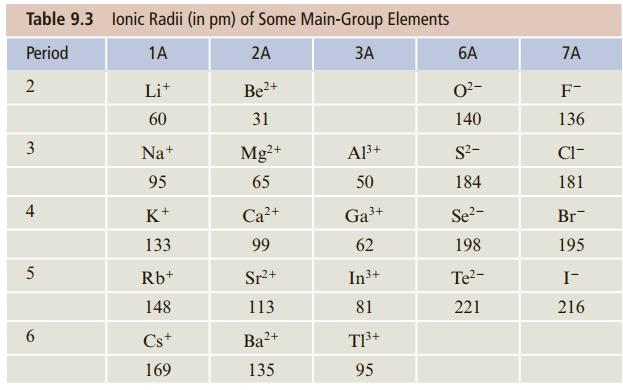
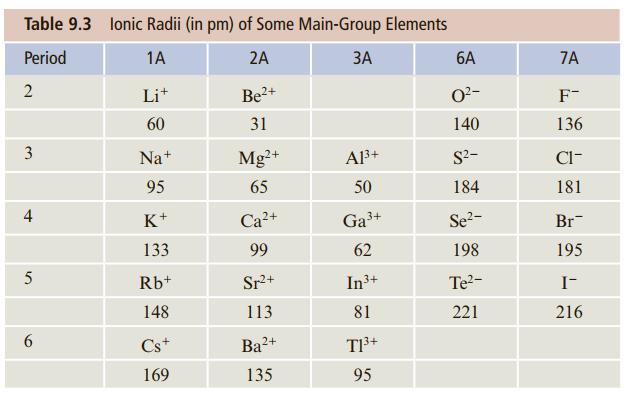
Without looking at Table 9.3, arrange the following in order of increasing ionic radius: As3−, Se2−, Br−. Explain how you arrived at this order. Table 9.3 lonic Radii (in pm) of Some Main-Group Elements Period 1A 2A ЗА 6A 7A 2 Lit 2+ O2- F- 60 31 140 136 3 Na+ Mg?+ A3+ S2- Cl- 95 65 50 184
Arrange the following in order of increasing ionic radius: F-, Na+, and N3-. Explain this order.
Arrange the following in order of increasing ionic radius: I−, Cs+, and Te2+. Explain this order.
Assuming that the atoms form the normal number of covalent bonds, give the molecular formula of the simplest compound of germanium and fluorine atoms.
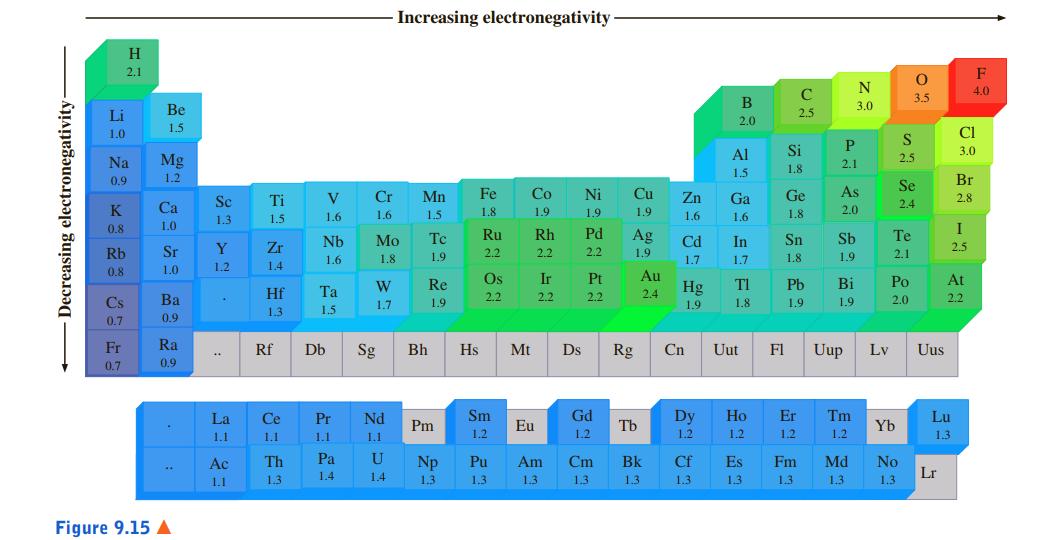
With the aid of a periodic table (not Figure 9.15), arrange the following in order of increasing electronegativity:a. Li, Na, Cs b. B, Be, Li c. S, Se, Cl Increasing electronegativity H 2.1 F N 4.0 C 3.5 B 3.0 Li Be 2.5 2.0 1.5 1.0 CI Al Si 3.0 Na Mg 2.1 2.5 1.5 1.8 0.9 1.2 Br Se V Cr Mn
Decide which of the following bonds is least polar on the basis of electronegativities of atoms: Cl—H, S—Si, Br—As.
Indicate the partial charges for the bonds given in Problem 9.58, using the symbols δ+ and δ-.Problem 9.58Decide which of the following bonds is least polar on the basis of electronegativities of atoms: Cl—H, S—Si, Br—As.
Write Lewis formulas for the following molecules:a. BrF b. PBr3 c. NOF
Write resonance descriptions for the following:a. CINO2 b. NO2-
Write Lewis formulas for the following:a. BeF2 b. BeF3- c. AlBr3
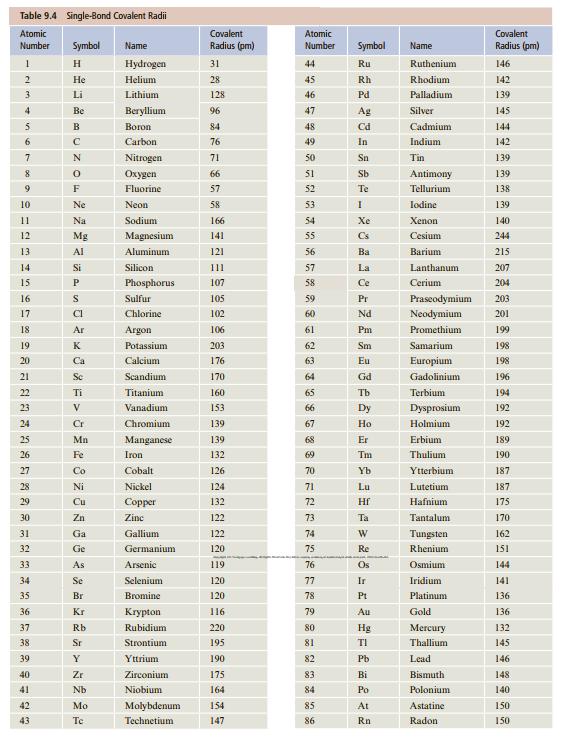
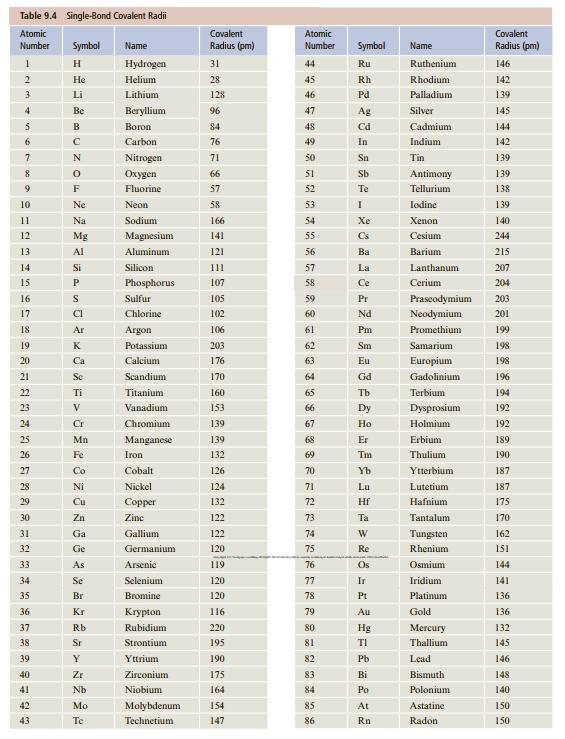
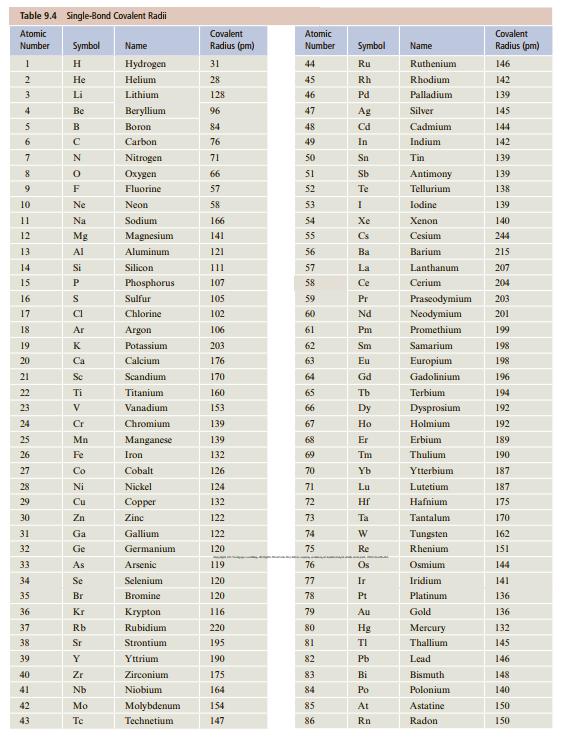
Use covalent radii (Table 9.4) to estimate the length of the P—F bond in phosphorus trifluoride, PF3. Table 9.4 Single-Bond Covalent Radii Atomic Covalent Atomic Covalent Number Symbol Name Radius (pm) Number Symbol Name Radius (pm) H. Hydrogen 31 44 Ru Ruthenium 146 Не Helium 28 45 Rh Rhodium
What do you expect for the B—Cl bond length in boron trichloride, BCl3, on the basis of covalent radii (Table 9.4)? Table 9.4 Single-Bond Covalent Radii Atomic Covalent Atomic Covalent Number Symbol Name Radius (pm) Number Symbol Name Radius (pm) H. Hydrogen 31 44 Ru Ruthenium 146 Не Helium 28
Calculate the C—Cl and C—C bond lengths in ethyl chloride, C2H5Cl, using values for the covalent radii from Table 9.4. How do these values compare with the experimental values: C—Cl, 177; C—C, 155 pm? Table 9.4 Single-Bond Covalent Radii Atomic Covalent Atomic Covalent Number Symbol Name
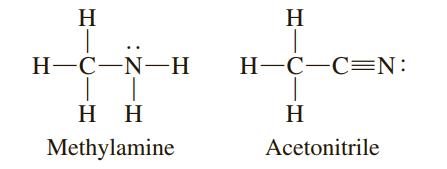
One of the following compounds has a carbon–nitrogen bond length of 116 pm; the other has a carbon–nitrogen bond length of 147 pm. Match a bond length with each compound. H H Н-С—N—Н H-C-C=N: H H H Methylamine Acetonitrile
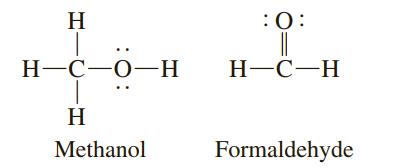
Which of the following two compounds has the shorter carbon–oxygen bond? H :0: Н-С—О—Н Н-С—Н H Methanol Formaldehyde
Give resonance descriptions for the following:a. C2O42- b. CH3NO2
Use bond enthalpies to estimate ∆H for the reaction2F2(g) + N2(g) → N2F4(g)
How did the Swedish chemist Alfred Nobel manage to tame the decomposition of nitroglycerin?
Which of the following Lewis symbols is (or are) not correct? [ Al·]** [:F:]- a [:0:1²- b C d Mg eSi.
Calculate the lattice energy of potassium fluoride, KF, using the Born–Haber cycle. Use thermodynamic data from Appendix C to obtain the enthalpy changes for each step.
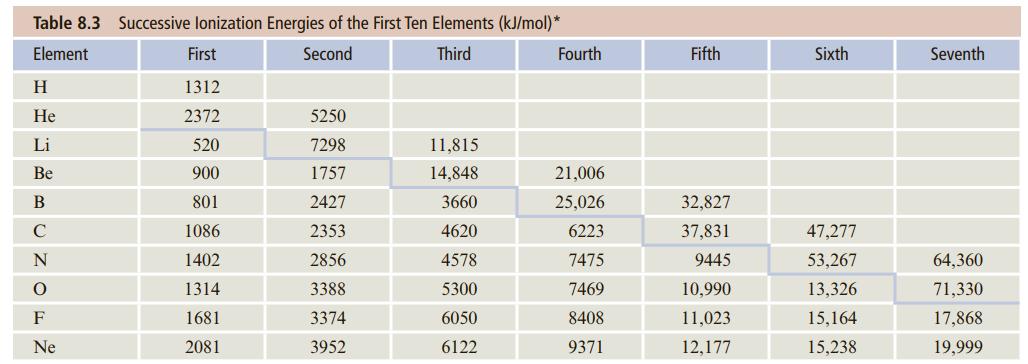
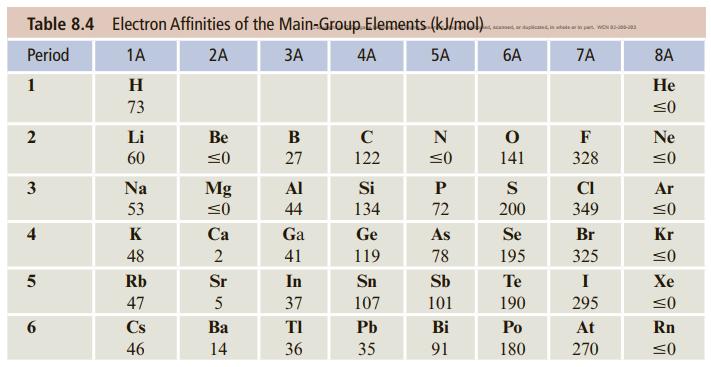
Draw a figure similar to Figure 9.2 but for the energetics of ionic bonding in KF. Use the ionization energy and electron affinity from values given in Tables 8.3 and 8.4 in Chapter 8. Calculate the sublimation energy from thermodynamic data (Appendix C). For the lattice energy, see Problem
Consider the following ions: Al3+, Mg2+, Na+, S2-, Cl-. Write down all possible formulas of ionic compounds between each of the oppositely charged ions. Of these compounds, note the ones with a metal-to-nonmetal ratio of one-to-one. Which compound do you expect has the highest melting point? Why?
Which of the following are isoelectronic with the potassium ion, K+? What are the electron configurations of these species?a. Ar b. Cl+ c. Kr d. Cl- e. Ca+
An ion M2+ has the configuration [Ar]3d2, and an atom has the configuration [Ar]4s2. Identify the ion and the atom.
Using the ionic radii given in Table 9.3, estimate the energy to form a mole of Na+F- ion pairs from the corresponding atomic ions. Table 9.3 lonic Radii (in pm) of Some Main-Group Elements Period 1A 2A ЗА 6A 7A 2 Lit 2+ O?- F- 60 31 140 136 3 Na+ Mg²+ Al3+ S?- Cl- 95 65 50 184 181 4 K+ Са+
Calculate the difference in electronegativities between the atoms in SrF2 and between the atoms in SnF2. Which substance would you expect to be more ionic in character? One of these compounds melts at 213°C, the other one at about 1400°C. What is the melting point of tin(II) fluoride?
Which of the following molecules possesses a double bond? If none do, so state. Which species has an atom with a nonzero formal charge?a. I2 b. SF4 c. COCl2 d. C2H4 e. CN−
Which of the following molecules contains only double bonds? If none do, so state.a. NCCN b. CO2 c. C2H4 d. O3 e. N2
Two fourth-period atoms, one of a transition metal, M, and the other of a main-group nonmetal, X, form a compound with the formula M2X3. What is the electron configuration of atom X if M is Fe? What is the configuration of X if M is Co?
In Section 9.8, several resonance formulas of BF3 were discussed. Which of these would be favored based on the concept of formal charge? Explain how you arrived at this answer. Does this answer agree with the chemistry described in the text?
Draw resonance formulas of the phosphoric acid molecule, (HO)3PO. Obtain formal charges for the atoms in these resonance formulas. From this result, which resonance formula would you expect to most closely approximate the actual electron distribution?
Write the electron-dot formula for the nitrous acid molecule, H—O—N—O (bond lines are drawn only to show how the atoms are bonded, not the multiplicity of the bonds). The experimental values for the nitrogenoxygen bonds in this molecule are 120 pm and 146 pm. Assign these values to the N—O
Using bond enthalpies, estimate the heat obtained in burning 10.0 g of methane gas, CH4, in oxygen gas, O2, to obtain carbon dioxide gas and water vapor.
A gaseous compound has the following composition by mass: C, 25.0%; H, 2.1%; F, 39.6%; O, 33.3%. Its molecular mass is 96.0 amu. Write the Lewis formula for the molecule.
According to the VSEPR model, what are the arrangements of two, three, four, five, and six valence-shell electron pairs about an atom?
Bromine trifluoride, BrF3, has a nonzero dipole moment. Indicate which of the following geometries are consistent with this information: a. Trigonal planar; b. Trigonal pyramidal; c. T-shaped.
Why is a lone pair expected to occupy an equatorial position instead of an axial position in the trigonal bipyramidal arrangement?
Which of the following would be expected to have a dipole moment of zero on the basis of symmetry? Explain. a. SOCl2 b. SiF4c. OF2
Why is it possible for a molecule to have polar bonds, yet have a dipole moment of zero?
What is the angle between two sp3 hybrid orbitals?
What is the difference between a sigma bond and a pi bond?
What factors determine the strength of interaction between two atomic orbitals to form a molecular orbital?
How does molecular orbital theory describe the bonding in the HF molecule?
According to the VSEPR model, the HiPiH bond angle in PH3 isa. 120° b. 109.5° c. 90°d. A little less than 120° e. A little less than 109.5°
Which of the following molecular geometries does the XeF5+ cation exhibit?a. Tetradralb. T-shapedc. Octahedrald. Square pyramidale. Trigonal bipyramidal
Which of the following would be a polar molecule?a. CO2 b. H2S c. CH4 d. SF6 e. BeF2
What is the bond order of NO?a. 1/2b. 1 c. 3/2 d. 3 e. 5/2
Use the electron-pair repulsion model to predict the geometry of the following molecules:a. GeCl2 b. AsCl3 c. SO3 d. XeO4
Predict the geometry of the following ions, using the electron-pair repulsion model.a. BrO3– b. AsO43– c. CO32– d. H3S+
Predict the geometries of the following ions, using the VSEPR model.a. GeF5– b. AsF6– c. BrF2– d. BrF4–
Describe the molecular orbital configurations of C2+, C2, and C22–. What are the bond orders of these species? Arrange the three species by increasing bond length. Arrange the species by increasing bond enthalpy. Explain these arrangements of bond length and bond enthalpy.
What mass of solution containing 6.50% sodium sulfate, Na2SO4, by mass contains 1.75 g Na2SO4?
What is the boiling point of a solution made by adding 6.69 g of magnesium chloride to 250.0 g of water? Use the formula of the salt to obtain i.
Name the geometries expected for the following ions, according to the electron-pair repulsion model.a. BrF6+ b. IF2– c. ICl4 d. IF4+
a. The molecule AsF3 has a dipole moment of 2.59 D. Which of the following geometries are possible: trigonal planar, trigonal pyramidal, or T-shaped? b. The molecule H2S has a dipole moment of 0.97 D. Is the geometry linear or bent?
a. The molecule BrF3 has a dipole moment of 1.19 D. Which of the following geometries are possible: trigonal planar, trigonal pyramidal, or T-shaped? b. The molecule TeCl4 has a dipole moment of 2.54 D. Is the geometry tetrahedral, seesaw, or square planar?
Which of the following molecules would be expected to have a dipole moment of zero because of symmetry?a. BeBr2 b. H2Se c. AsF3 d. SeF6
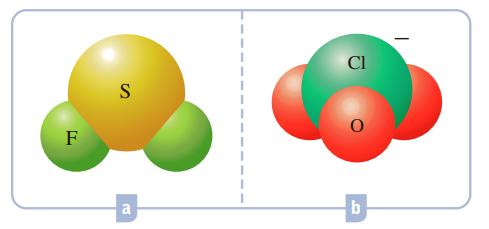
What hybrid orbitals would be expected for the central atom in each of the following molecules or ions? Cl F a b.
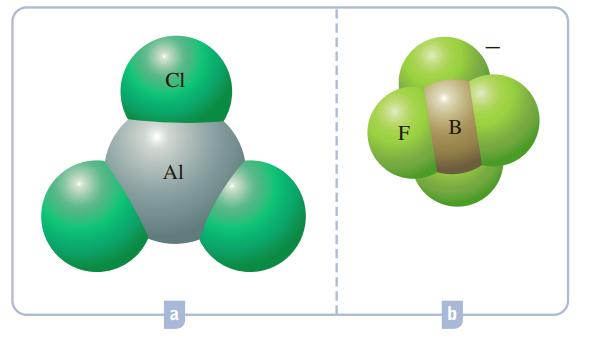
What hybrid orbitals would be expected for the central atom in each of the following molecules or ions? CI F B Al a
What hybrid orbitals would be expected for the central atom in each of the following molecules or ions?a. SeI2 b. NO3- c. BeCl2 d. ClO4-
What hybrid orbitals would be expected for the central atom in each of the following molecules or ions?a. PCl3 b. SiCl4 c. BeF2 d. SO2
a. Carbonyl fluoride, COF2, is an extremely poisonous gas used in organofluorine synthesis. Give the valence bond description of the carbonyl fluoride molecule. (Both fluorine atoms are attached to the carbon atom.) b. Nitrogen, N2, makes up about 80% of the earth’s atmosphere. Give the
Use molecular orbital theory to describe the bonding in the following. For each one, find the bond order and decide whether it is stable. Is the substance diamagnetic or paramagnetic?a. C2+ b. Be2+ c. Ne2
Hydrogen azide (also known as hydrazoic acid), HN3, is a covalent molecule in which the hydrogen atom (as a proton) is bonded to a nitrogen atom at one end of the azide ion (see previous problem). Draw the dominant resonance formula or formulas for this molecule. Describe the hybridization about
There are a number of known pentahalides of phosphorus. One of them is the trifluorodibromophosphorus compound, PF3Br2, an unstable liquid. Draw the Lewis electron-dot formula of PF3Br2. What is the geometry about the phosphorus atom? Describe the placement of fluorine and bromine atoms about the
If the HCl molecule were 100% ionic, the molecule would consist of a positive charge e and a negative charge –e separated by a distance d equal to the bond length. The experimental value of the bond length is 127 pm. Calculate the dipole moment for such a completely ionic molecule. The actual
A molecular compound is composed of 52.5% Xe, 19.2% O, and 28.3% Cl, by mass. If the molecular weight is 250.2 amu, what is the molecular formula? What is the Lewis formula? Predict the molecular geometry using the VSEPR model.
Consider two liquids, labeled A and B, that are both pure substances. Liquid A has relatively strong intermolecular forces when compared to liquid B. The molecular structures of A and B are similar. Which one of the statements regarding liquids A and B is false?a. Liquid A would have a higher
Describe how you could liquefy the following gases: a. Methyl chloride, CH3Cl (critical point, 144°C, 66 atm);b. Oxygen, O2 (critical point, −119°C, 50 atm).
Gases that cannot be liquefied at room temperature merely by compression are called “permanent” gases. How could you liquefy such a gas?
Why do molecular substances have relatively low melting points?
Describe the distinguishing characteristics of a crystalline solid and an amorphous solid.
Describe the face-centered cubic unit cell.
Describe the structure of thallium(I) iodide, which has the same structure as cesium chloride.
The triple point of a solid is at 5.2 atm and −57°C. Under typical laboratory conditions of P = 0.98 atm and T = 23°C, this solid willa. Remain solid indefinitely b. Boilc. Melt d. Sublimee. Condense
What is the coordination number of Cs+ in CsCl? of Na+ in NaCl? of Zn2+ in ZnS?
Under the right conditions, hydrogen gas, H2, can be liquefied. Which is the most important intermolecular force that is responsible for allowing hydrogen molecules to be liquefied?a. Hydrogen bondingb. Dipole–dipole interactionsc. London (dispersion) forcesd. Covalent bondse. Ion–dipole forces
An element crystallizes with a simple cubic lattice with atoms at all the lattice points. If the radius of the atom is 200. pm, what is the volume of the unit cell?a. 8.00 × 10⁶ pm3b. 6.40 × 10⁷ pm3c. 4.00 × 10⁴ pm3d. 1.60 × 10⁵ pm3e. 6.00 × 10⁷ pm3
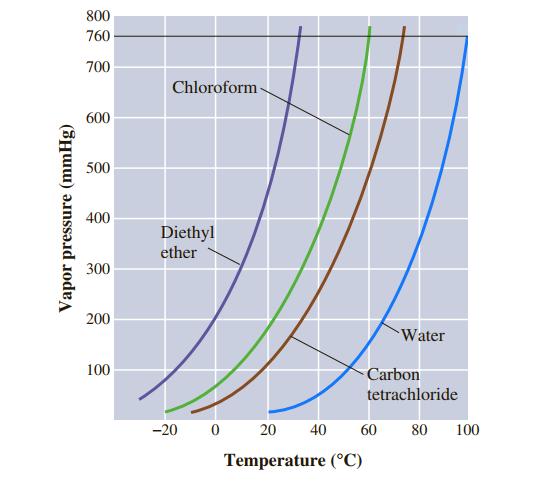
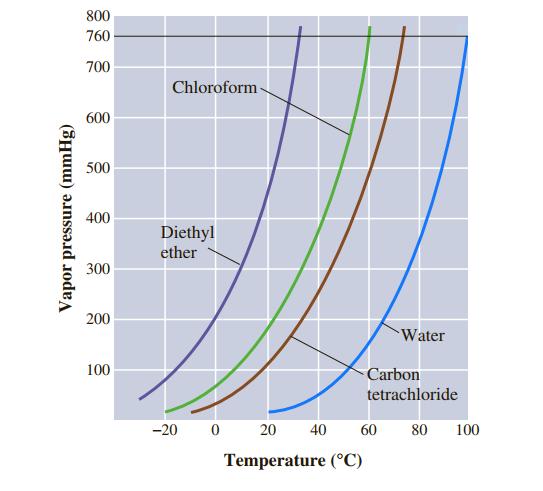
Use Figure 11.7 to estimate the boiling point of diethyl ether, (C2H5)2O, under an external pressure of 470 mmHg. 800 760 700 Chloroform- 600 500 400 Diethyl ether 300 200 Water 100 Carbon tetrachloride -20 20 40 60 80 100 Temperature (°C) Vapor pressure (mmHg)
Use Figure 11.7 to estimate the boiling point of carbon tetrachloride, CCl4, under an external pressure of 250 mmHg. 800 760 700 Chloroform- 600 500 400 Diethyl ether 300 200 Water 100 Carbon tetrachloride -20 20 40 60 80 100 Temperature (°C) Vapor pressure (mmHg)
Chloroform, CHCl3, a volatile liquid, was once used as an anesthetic but has been replaced by safer compounds. Chloroform boils at 61.7°C and has a heat of vaporization of 31.4 kJ/mol. What is its vapor pressure at 37.2°C?
Arrange the following substances in order of increasing magnitude of the London forces: SiCl4, CCl4, GeCl4.
Arrange the following substances in order of increasing magnitude of the London forces: CH4, C3H8, C2H6.
Methane, CH4, reacts with chlorine, Cl2, to produce a series of chlorinated hydrocarbons: methyl chloride (CH3Cl), methylene chloride (CH2Cl2), chloroform (CHCl3), and carbon tetrachloride (CCl4). Which compound has the highest vapor pressure at room temperature? Explain.
The halogens form a series of compounds with each other, which are called interhalogens. Examples are bromine chloride (BrCl), iodine bromide (IBr), bromine fluoride (BrF), and chlorine fluoride (ClF). Which compound is expected to have the highest boiling point at any given pressure? Explain.
Assume X has a body-centered cubic lattice with all atoms at the lattice points. The edge length of the unit cell is 379.0 pm. The atomic mass of X is 195.0 amu. Calculate the density of X.
The percent relative humidity of a sample of air is found as follows: (partial pressure of water vapor/vapor pressure of water) × 100. A sample of air at 27°C was cooled to 15°C, where moisture began to condense as dew. What was the relative humidity of the air at 27°C?
A sample of air at 21°C has a relative humidity of 55%. At what temperature will water begin to condense as dew?
The vapor pressure of water is 17.5 mmHg at 20.0°C and 355.1 mmHg at 80.0°C. Calculate the boiling point of water at 755.0 mmHg.
Consider the elements Al, Si, P, and S from the third row of the periodic table. In each case, identify the type of solid the element would form.
The elements in Problem 11.107 form the fluorides AlF3, SiF4, PF3, and SF4. In each case, identify the type of solid formed by the fluoride.Problem 11.107Consider the elements Al, Si, P, and S from the third row of the periodic table. In each case, identify the type of solid the element would form.
Strontium crystallizes as a face-centered cubic cell. What is the mass of a single unit cell of Sr?
Describe how you would adjust the temperature and pressure of a gas to convert it to the liquid state.
A cubic unit cell is found to have calcium ions at the corners, a titanium atom in the center of the cell, and oxide ions at the center of each face. What is the empirical formula of this compound?
How much heat is needed to vaporize 39.6 mL of liquid hydrogen cyanide, HCN, at 25.0°C? The density of the liquid is 0.687 g/mL. Use standard heats of formation, which are given in Appendix C.
How much heat is needed to vaporize 25.0 mL of liquid methanol, CH3OH, at 25.0°C? The density of the liquid is 0.787 g/mL. Use standard heats of formation, which are given in Appendix C.
How much heat must be added to 28.0 g of solid white phosphorus, P4, at 24.0°C to give the liquid at its melting point, 44.1°C? The heat capacity of solid white phosphorus is 95.4 J/(K∙ mol); its heat of fusion is 2.63 kJ/mol.
Showing 200 - 300
of 1219
1
2
3
4
5
6
7
8
9
10
11
12
13
Step by Step Answers

 Get 50% OFF
Claim Now
Get 50% OFF
Claim Now


![[ Al·]** [:F:]- a [:0:1²- b C d Mg eSi.](https://dsd5zvtm8ll6.cloudfront.net/si.question.images/images/question_images/1604/3/7/8/4385fa0df46609011604378436814.jpg)