New Semester
Started
Get
50% OFF
Study Help!
--h --m --s
Claim Now
Question Answers
Textbooks
Find textbooks, questions and answers
Oops, something went wrong!
Change your search query and then try again
S
Books
FREE
Study Help
Expert Questions
Accounting
General Management
Mathematics
Finance
Organizational Behaviour
Law
Physics
Operating System
Management Leadership
Sociology
Programming
Marketing
Database
Computer Network
Economics
Textbooks Solutions
Accounting
Managerial Accounting
Management Leadership
Cost Accounting
Statistics
Business Law
Corporate Finance
Finance
Economics
Auditing
Tutors
Online Tutors
Find a Tutor
Hire a Tutor
Become a Tutor
AI Tutor
AI Study Planner
NEW
Sell Books
Search
Search
Sign In
Register
study help
sciences
inorganic chemistry
Inorganic Chemistry 7th Edition Mark Weller, Tina Overton, Jonathan Rourke - Solutions
A mechanistic study of reaction between chloramine and sulfite has been reported (B.S. Yiin, D.M. Walker, and D.W. Margerum, Inorg. Chem., 1987, 26, 3435). Summarize the observed rate law and the proposed mechanism. Accepting the proposed mechanism, why should SO2(OH)− and HSO3− display
Tetramethyltellurium, Te(CH3)4, was prepared in 1989 (R.W. Gedrige, D.C. Harris, K.R. Higa, and R.A. Nissan, Organometallics, 1989, 8, 2817), and its synthesis was soon followed by the preparation of the hexamethyl compound (L. Ahmed and J.A. Morrison, J. Am. Chem. Soc., 1990, 112, 7411). Explain
Which of the solvents, ethylenediamine (which is basic and reducing) or SO2 (which is acidic and oxidizing), might not react with (a) Na2S4, (b) K2Te3
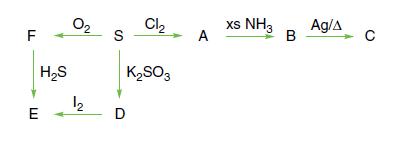
Identify the sulfur-containing compounds A, B, C, D, E, and F. F H₂S E 0₂ 1₂ S Cl₂ K₂SO3 D A xs NH3 B Ag/A C
The bonding in the square-planar ion E42+ is described. Explore this proposition in more detail by carrying out computations, using software of your choice, on S42+ with S–S bond distances of 200 pm (sulfur is recommended because its semiempirical parameters are more reliable than those of Se).
Rank the following species from the strongest reducing agent to the strongest oxidizing agent: SO42− , SO32− ,O3SO2SO32−.
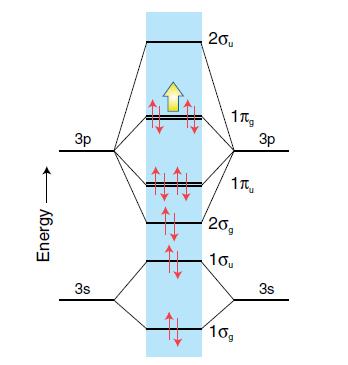
Use the molecular orbital diagram in Fig. 17.5 to determine the bond order of the Br2+ ion. Will the Br–Br bond be longer or shorter than that in the Br2 molecule?Figure 17.5. Energy Зр 3s 20₁ 1 1 20g 10, 10g 3p 3s
The nature of the sulfur cycle in ancient times has been investigated (J. Farquhar, H. Bao, and M. Thiemen, Science, 2000, 289, 756). What three factors influence the modern-day cycle? When did the authors establish that a significant change in the cycle had occurred and how were the differences
Predict which oxidation states of Mn will be reduced by sulfite ions in basic conditions.
H. Keppler has investigated the concentration of sulfur in volcano magma (Science, 1999, 284, 1652). In what forms is sulfur erupted from volcanoes? What concentration of sulfur was found in the magma erupted from Mount Pinatubo in 1991? Discuss whether this concentration was expected and how any
(a) Give the formula for Te(VI) in acidic aqueous solution and contrast it with the formula for S(VI). (b) Offer a plausible explanation for this difference.
Predict whether any of the following will be reduced by thiosulfate ions, SeO32−, in acidic conditions: VO2+, Fe3+, Cu+, Co3+.
SF4 reacts with BF3 to form [SF3][BF4]. Use VSEPR theory to predict the shapes of the cation and anion.
Tetramethylammonium fluoride (0.70 g) reacts with SF4(0.81 g) to form an ionic product. (a) Write a balanced equation for the reaction (b) Sketch the structure of the anion. (c) How many lines would be observed in the 19F-NMR spectrum of the anion?
Predict whether the following species will exhibit inorganic aromaticity: (a) S3N3−, (b) S4N3+, (c) S5N5.
Write a comparative account of the properties of sulfuric, selenic, and telluric acids.
Preferably without consulting reference material, write out the halogens as they appear in the periodic table, and indicate the trends in (a) Physical state (s, l, or g) at room temperature and pressure,(b) Electronegativity, (c) Hardness of the halide ion, (d) Colour.
The paper ‘The consequences of excess iodine’ by A. Leung and E Braverman (Nat. Rev., 2014, 10, 136) reviews the health implications of excess iodine ingestion. (a) What is the recommended daily intake of iodine? (b) What are the main dietary sources of iodine? (c) What is
Describe how the halogens are recovered from the naturally occurring halides and rationalize the approach in terms of standard potentials. Give balanced chemical equations and conditions where appropriate.
The phenomenon of the halogen bond has been known for over a century. In the paper ‘The halogen bond in solution’ (Chem. Soc. Rev., 2012, 41, 3547), M. Erdelyi reviews the current state of knowledge of the nature of the halogen bond. Describe what is meant by halogen bonding. Work on the
In their paper ‘Recent discoveries of polyhalogen anions— from bromine to fluorine’ (Z. Anorg. Allg. Chem., 2014, 640, 7, 1281), H. Haller and S. Riedel described the synthesis and structure elucidation of several new polyhalide ions. (a) Outline the synthetic strategies that enabled
Sketch a chloralkali cell. Show the half-cell reactions and indicate the direction of diffusion of the ions. Give the chemical equation for the unwanted reaction that would occur if OH− migrated through the membrane and into the anode compartment.
The potential of organofluoro compounds in materials chemistry is discussed in a paper by R. Berger and co-workers (Chem. Soc. Rev., 2011, 40, 3496). One group of compounds discussed is the fluorinated fullerenes. Give an equation for the reaction of the most commonly used fluorinated fullerene
Sketch the form of the vacant σ* orbital of a dihalogen molecule and describe its role in the Lewis acidity of the dihalogens.
The reaction of I− ions is often used to titrate ClO−, giving deeply coloured I3− ions, along with Cl− and H2O. Although never proved, it was once thought that the initial reaction proceeds by O atom transfer from Cl to I. However, it is now believed that the reaction proceeds by Cl atom
Which dihalogens are thermodynamically capable of oxidizing H2O to O2?
Until the work of K.O. Christe (Inorg. Chem., 1986, 25, 3721), F2 could be prepared only electrochemically. Give chemical equations for Christe’s preparation and summarize the reasoning behind it.
Nitrogen trifluoride, NF3, boils at −129°C and is a very weak Lewis base. By contrast, the lower molar mass compound NH3 boils at −33°C and is well known as a Lewis base.(a) Describe the origins of this very large difference in volatility. (b) Describe the probable origins of the
The use of templates to synthesize long-chain polyiodide ions has been described (A.J. Blake et al., Chem. Soc. Rev., 1998, 27, 195). (a) According to the authors, what is the longest polyiodide that has been characterized? (b) How does the nature of the cation influence the structure of
Based on the analogy between halogens and pseudohalogens, write (a) The balanced equation for the probable reaction of cyanogen, (CN)2, with aqueous sodium hydroxide;(b) The equation for the probable reaction of excess thiocyanate with the oxidizing agent MnO2(s) in acidic aqueous solution;(c)
Review published studies on the fluoridation of drinking water in your country. Summarize both the reasons for continuing fluoridation and the main concerns expressed by those opposed to it.
Given that 1.84 g of IF3 reacts with 0.93 g of [(CH3)4N]F to form a product X, (a) Identify X, (b) Use the VSEPR model to predict the shapes of IF3 and the cation and anion in X, (c) Predict how many 19F-NMR signals would be observed in IF3 and X.
Write a review of the environmental problems associated with the use of chlorine-based bleaches in industry, and suggest possible solutions.
Treatment of Br2 with ozone in CFCl3 at −50°C yields yellow crystals of an unstable diamagnetic compound. Identify this compound and predict the products obtained when it reacts with one mole equivalent of NaOH.
Write a review of the biological effects of excess iodine in the body. Discuss how iodine is used as a therapy for (a) An underactive(b) An overactive thyroid gland.
Use the VSEPR model to predict the shapes of SbCl5 and FClO3.
Indicate the product of the reaction between ClF5 and SbF5. Predict the shapes of the reactants and products.
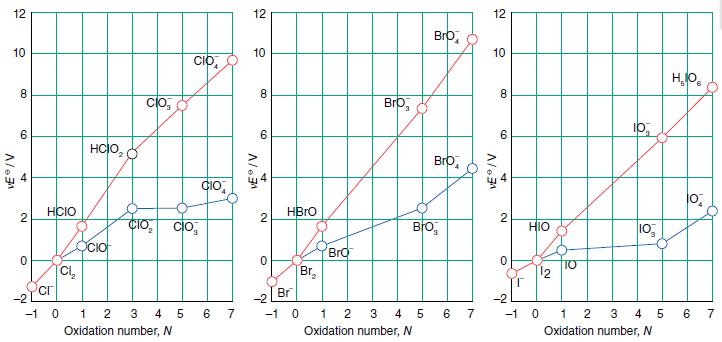
Use either the Frost diagram in Figure 17.14 or the Latimer diagrams in Resource section 3 to calculate the standard potentials for the following couples in basic solution:(a) ClO4−/ ClO− , (b) BrO4−/BrO− , (c) IO4− / IO−. Comment on the relative feasibilities of the reduction
Sketch all the isomers of the complexes [CrCl4F2]3− and [CrCl3F3]3−. Indicate how many fluorine environments would be indicated in the 19F-NMR spectrum of each isomer.
(a) Use the VSEPR model to predict the probable shapes of [IF6]+ and IF7. (b) Give a plausible chemical equation for the preparation of [IF6][SbF6].
Predict the shape of the doubly chlorine-bridged I2Cl6 molecule by using the VSEPR model, and assign the point group.
Predict the structure and identify the point group of ClO2F.
Predict whether each of the following solutes is likely to make liquid BrF3 act as a Lewis acid or a Lewis base: (a) SbF5,(b) SF6, (c) CsF.
Given the bond lengths and angles in I5−(5), describe the bonding in terms of two-centre and three-centre bonds. Can the structure be accounted for in terms of the VSEPR model?
Predict the appearance of the 19F-NMR spectrum of IF5+.
Predict whether each of the following compounds is likely to be dangerously explosive in contact with BrF3 and explain your answer: (a) SbF5, (b) CH3OH, (c) F2, (d) S2Cl2.
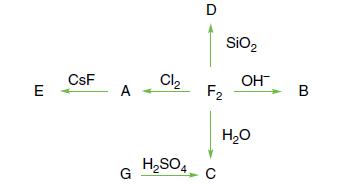
Identify all the compounds A to G. E CsF A G Cl₂ H₂SO4 D F₂ C SiO2₂ OH H₂O B
The formation of Br3− from a tetraalkylammonium bromide and Br2 is only slightly exergonic. Write an equation for the interaction of [NR4][Br3] with I2 in CH2Cl2 solution and give your reasoning.
Explain why CsI3(s) is stable with respect to decomposition but NaI3(s) is not.
Write plausible Lewis structures for (a) ClO2 (b) I2O6 and predict their shapes and the associated point group.
(a) Give the formulas and the probable relative acidities of perbromic acid and periodic acid. (b) Which is the more stable to decomposition liberating oxygen?
(a) Describe the expected trend in the standard potential of an oxoanion in a solution with decreasing pH. (b) Demonstrate this phenomenon by calculating the reduction potential of ClO4− at pH = 7 and comparing it with the tabulated value at pH = 0.
With regard to the general influence of pH on the standard potentials of oxoanions, explain why the disproportionation of an oxoanion is often promoted by low pH.
(a) For which of the following anions is disproportionation thermodynamically favourable in acidic solution: ClO−, ClO2−, ClO3−, and ClO4−? (b) For which of the favourable cases is the reaction very slow at room temperature?
Which of the following compounds present an explosion hazard?(a) NH4ClO4, (b) Mg(ClO4)2, (c) NaClO4, (d) [Fe(OH2)6][ClO4]2. Explain your reasoning.
Use standard potentials to predict which of the following will be oxidized by ClO− ions in acidic conditions: (a) Cr3+, (b) V3+, (c) Fe2+, (d) Co2+.
Many of the acids and salts corresponding to the positive oxidation numbers of the halogens are not listed in the catalogue of a major international chemical supplier: (a) KClO4 and KIO4 are available but KBrO4 is not, (b) KClO3, KBrO3, and KIO3 are all available, (c) NaClO2 and
Identify the incorrect statements among the following descriptions and provide correct statements:(a) Oxidation of the halides is the only commercial method of preparing the halogens from F2 to I2.(b) ClF4− and I5− are isolobal and isostructural.(c) Atom-transfer processes are common in the
In December 2015 the International Union of Pure and Applied Chemistry (IUPAC) and the International Union of Pure and Applied Physics (IUPAP) jointly announced their acceptance of the evidence that demonstrated the existence of element 118. What was the name and symbol of the element before it was
Which of the noble gases would you choose as (a) The lowest-temperature liquid refrigerant, (b) An electric discharge light source requiring a safe gas with the lowest ionization energy,(c) The least expensive inert atmosphere?
Argon has been found to react with CF32+ to form ArCF22+ (J. Phys. Chem. Lett. 2010, 1, 358). (a) What other Ar–C species are formed during the reaction? (b) What are the Ar–C and C–F bond lengths in the product? Give the point group of the dication.(c) Why do He and Ne not form
By means of balanced chemical equations and a statement of conditions, describe a suitable synthesis of (a) Xenon difluoride,(b) Xenon hexafluoride, (c) Xenon trioxide.
The paper ‘Exploring the effects on lipid bilayer induced by noble gases via molecular dynamics simulations’ (Nature, 2015, 5, 17235) discusses the anaesthetic properties of noble gases. Which noble gases cause anaesthesia? What is the order of their potency? What is the mode of action of noble
Given that the bond enthalpies of the Xe–F and the F–F bonds are 144 and 155 kJ mol−1 respectively, calculate the enthalpy of formation for XeF2.
In the paper ‘Predicted chemical bonds between rare gases and Au’ (J. Am. Chem. Soc., 1995, 117, 2067), P. Pyykkii used a computational study of the species RgAuRg+ and AuRg+ (where Rg refers to a ‘rare’ gas) to predict the bond energies and bond lengths of the Au–Rg bond. Why did the
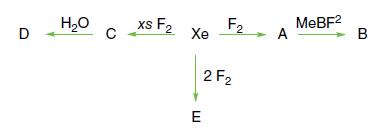
Identify the xenon compounds A, B, C, D, and E. D H₂O C xs F₂ Xe F2 2F₂ E A MeBF² B
Draw the Lewis structures of (a) XeOF4, (b) XeO2F2,(c) XeO62−.
The paper ‘Atypical compounds of gases which have been called “noble”’ (Chem. Soc. Rev., 2007, 36, 1632) provides a thorough account of the range of compounds formed by Group 18 elements. Among the compounds described are XeF5Cl, HXeOOXeH, and ClXeFXeCl+. Sketch the structures of these
Give the formula and describe the structure of a noble-gas species that is isostructural with (a) ICl4−, (b) IBr2−, (c) BrO3−,(d) ClF.
The first compound containing an Xe–N bond was reported by R.D. LeBlond and K.K. DesMarteau (J. Chem. Soc., Chem. Commun., 1974, 14, 554). Summarize the method of synthesis and characterization.
(a) Give a Lewis structure for XeF7−. (b) Speculate on its possible structures by using the VSEPR model and analogy with other xenon fluoride anions.
(a) Use the references in the paper by O.S. Jina, X.Z. Sun, and M.W. George (J. Chem. Soc., Dalton Trans., 2003, 1773) to produce a review of the use of matrix isolation in the characterization of organometallic noble-gas complexes.(b) How did the methods used by these authors differ from the usual
When [XeF][RuF6] reacts with excess F2 at elevated temperature the compound [XeF5][RuF6] is formed. Predict the shape of the cation and anion.
Iron is essential to all life forms. Assess the solubility of Fe in +2 and +3 oxidation states; combine this with likely stable oxidation state under normal conditions to assess the bioavailability of iron. Consider how the atmosphere changed as oxygenic photosynthesis took over (Box 16.1) and
In their paper ‘Xenon as a complex ligand: the tetra xenon gold(II) cation in AuXe42+ (Sb2F11−) 2’, S. Seidel and K. Seppelt (Science, 2000, 290, 117) describe the first synthesis of a stable noble-gas coordination compound. Give details of the synthesis and characterization of the compound.
Use molecular orbital theory to calculate the bond order of the diatomic species E2+ with E = He and Ne.
The synthesis and characterization of the XeOF5− anion has been described by A. Ellern and K. Seppelt (Angew. Chem., Int. Ed. Engl., 1995, 34, 1586). (a) Summarize the similarities between XeOF4 and IF5. (b) Give possible reasons for the differences in structure between XeOF5− and
Use VSEPR to predict the structures of (a) XeF3+, (b) XeF3−,(c) XeF5+, (d) XeF5−.
In their paper ‘Helium chemistry: theoretical predictions and experimental challenge’ (J. Am. Chem. Soc., 1987, 109, 5917), W. Koch and co-workers used quantum mechanical calculations to demonstrate that helium can form strong bonds with carbon in cations. (a) Give the range of bond
In their paper ‘Observation of superflow in solid helium’ (Science, 2004, 305, 1941), E. Kim and M. Chan described the observed superfluidity of solid helium. Define superfluidity, describe the experiment carried out by the authors to demonstrate the property, and summarize their explanation of
Predict the appearance of the 19F-NMR spectrum of XeF4.
Predict the appearance of the 129Xe-NMR spectrum of XeOF3+.
Predict the appearance of the 19F-NMR spectrum of XeOF4.
Describe and account for the trends in the ionic radii and the stability of high oxidation states upon moving from the second to the third row of the transition series.
What is the highest group oxidation state observed for the first-row transition metals? Give an example of a group oxidation state oxo species of this metal ion. What is the highest group oxidation state observed in the second and the third row? Contrast the stability down the group.
Discuss the benefits and the costs of using lightweight titanium alloys over the more conventional steel in (a) Motor cars (b) Aeroplanes.
Sketch the following ions: (a) Dichromate(VI), (b) Vanadyl,(c) Orthovanadate, (d) Manganate(VI).
Explain why TiO2, V2O5, and CrO3 are well-known compounds but FeO4 and Co2O9 have not been prepared.
TiO2 can be manufactured via the chloride process or the sulfate process. Outline the advantages and disadvantages of each of these processes in terms of the raw material required, the nature of the pigment produced, and the environmental impact of each process.
Which of the following is NOT true:(a) The chemistry of molybdenum is more similar to that of tungsten than that of chromium.(b) Higher oxidation states are most prevalent in the second and third rows of transition elements.(c) Transition metals have high atomic volumes and are therefore not very
Silica-supported compounds of chromium have been used as catalysts for olefin polymerization for many years. Write a review of this application of chromium chemistry. Include a discussion of the Phillips and Union Carbide systems and discuss one published paper on the topic from the past two years.
Look up the electron gain enthalpies for Cu, Ag, and Au and the ionization energies of the Group 1 metals. Discuss the likely stability of compounds M+M′−, where M = Group 1 metal, M′ = Group 11 metal.
Gold, platinum, and palladium are all known as precious metals. Review their uses in technology and other areas and discuss why the prices of gold, platinum, and palladium have varied over time.
Explain why isostructural HfO2 and ZrO2 have densities of 9.68 g cm−3 and 5.73 g cm−3, respectively.
In their paper ‘Shape control in gold nanoparticle synthesis’ (Chem. Soc. Rev., 2008, 37, 1783), M. Grzelczak and co-workers discuss the synthesis of gold nanoparticles with a range of morphologies. Describe the different morphologies summarized in this paper and outline the proposed growth
Discuss the historical production and use of gold nanoparticles. Account for the colour of the nanoparticles.
Many d-metal compounds are used as pigments. Apart from colour, what properties must a compound possess to be useful as a pigment?
Discuss the side effects of protiodide and the risks of overdose.
Consider the 6d elements Rf–Cn. Make predictions of the key features of their chemistry, were sufficient quantities ever to be isolated.
A paper published in 2014 had the title ‘Identification of an iridium-containing compound with a formal oxidation state of IX’ (Nature, 2014, 514, 475), and one published in 2016 had the title ‘Oxidation state 10 exists’ (Angew. Chem. Int. Ed., 2016, 55, 9004). Review these papers and
Showing 400 - 500
of 1950
1
2
3
4
5
6
7
8
9
10
11
12
13
14
15
Last
Step by Step Answers

 Get 50% OFF
Claim Now
Get 50% OFF
Claim Now