New Semester
Started
Get
50% OFF
Study Help!
--h --m --s
Claim Now
Question Answers
Textbooks
Find textbooks, questions and answers
Oops, something went wrong!
Change your search query and then try again
S
Books
FREE
Study Help
Expert Questions
Accounting
General Management
Mathematics
Finance
Organizational Behaviour
Law
Physics
Operating System
Management Leadership
Sociology
Programming
Marketing
Database
Computer Network
Economics
Textbooks Solutions
Accounting
Managerial Accounting
Management Leadership
Cost Accounting
Statistics
Business Law
Corporate Finance
Finance
Economics
Auditing
Tutors
Online Tutors
Find a Tutor
Hire a Tutor
Become a Tutor
AI Tutor
AI Study Planner
NEW
Sell Books
Search
Search
Sign In
Register
study help
sciences
inorganic chemistry
Inorganic Chemistry 7th Edition Mark Weller, Tina Overton, Jonathan Rourke - Solutions
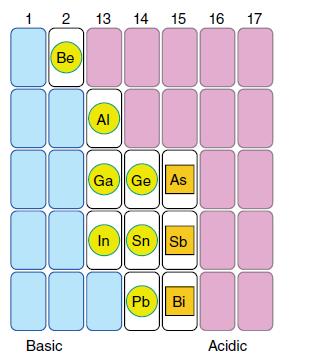
Aided by Fig. 5.5 (taking solvent levelling into account), identify which bases from the following lists are (a) Too strong to be studied experimentally; (b) Too weak to be studied experimentally; or (c) Of directly measurable base strength.(i) CO32−, O2−, ClO4−, and NO3− in water; (ii)
The Ka of ethanoic acid, CH3COOH, in water is 1.8 × 10⁻⁵. Calculate Kb of the conjugate base, CH3CO2−.
In a review article (Angew. Chem. Int. Ed., 2009, 48, 2100), E.J. Corey describes asymmetric catalysis by chiral boranes. Show how these chiral boranes, which are Lewis acids, are also able to direct Brønsted acidity.
The value of Kb for pyridine, C5H5N, is 1.8 × 10⁻⁹. Calculate Ka for the conjugate acid, C5H5NH+.
An article by Poliakoff and co-workers describes how a new industrial chemical process was initiated, in which conventional solvents were replaced by scCO2 (Green Chem., 2003, 5, 99). Explain the advantages and challenges of introducing such changes to traditional technology.
The effective proton affinity Ap′ of F− in water is 1150 kJ mol−1. Predict whether it will behave as an acid or a base in water.
The reversible reaction of CO2 gas with aqueous emulsions of long-chain alkyl amidine compounds has important practical applications. Describe the chemistry that is involved in this demonstration of ‘switchable surfactants’ (Science, 2006, 313, 958).
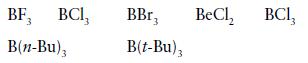
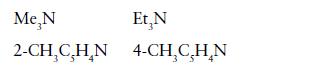
Select the compound on each line with the named characteristic and state the reason for your choice.(a) Strongest Lewis acid:(b) More basic towards B(CH3)3 BF, 3 BCI, B(n-Bu), BBr3 B(t-Bu) 3 BeCl₂ BC1₂
Draw the structures of chloric acid and chlorous acid and predict their pKa values using Pauling’s rules.
An article by Krossing and co-workers (J. Am. Chem. Soc., 2006, 128, 13427) explains the behaviour of ionic liquids in terms of a thermodynamic cycle approach. Describe the principles that are applied and summarize the predictions that are made.
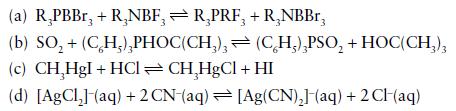
Using hard–soft concepts, which of the following reactions are predicted to have an equilibrium constant greater than 1? Unless otherwise stated, assume gas-phase or hydrocarbon solution and 25°C. (a) R₂PBBr, + R,NBF, R₂PRF, + R₂NBBr, 3 (b) SO₂ + (CH₂),PHOC(CH₂), (c) CH₂HgI + HCl
The aqueous solution pKa values for HOCN, H2NCN, and CH3CN are approximately 4, 10.5, and 20 (estimated), respectively. Explain the trend in these cyano derivatives of binary acids and compare them with H2O, NH3, and CH4. Is the CN group electron donating or withdrawing?
H3PO4, H3PO3, and H3PO2 all have a pKa value of 2, but the pKa values of HOCl, HClO2, and HClO3 are 7.5, 2.0, and −3.0, respectively. Explain this observation.
Arrange the following ions in order of increasing acidity in aqueous solution: Fe3+, Na+, Mn2+, Ca2+, Al3+, Sr2+.
Use Pauling’s rules to place the following acids in order of increasing acid strength: HNO2, H2SO4, HBrO3, and HClO4 in a nonlevelling solvent.
Which member of the following pairs is the stronger acid? Give reasons for your choice. (a) [Fe(OH2)6]3+ or [Fe(OH2)6]2+, (b) [Al(OH2)6]3+ or [Ga(OH2)6]3+, (c) Si(OH)4 or Ge(OH)4,(d) HClO3 or HClO4, (e) H2CrO4 or HMnO4, (f) H3PO4 or H2SO4.
Arrange the oxides Al2O3, B2O3, BaO, CO2, Cl2O7, SO3 in order from the most acidic through amphoteric to the most basic.
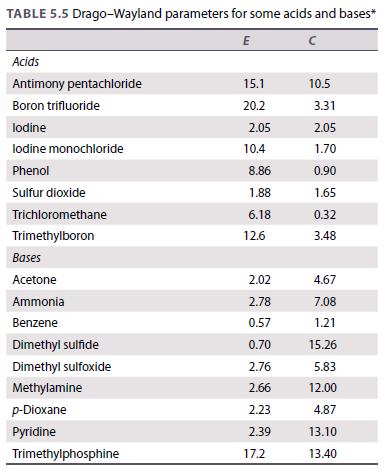
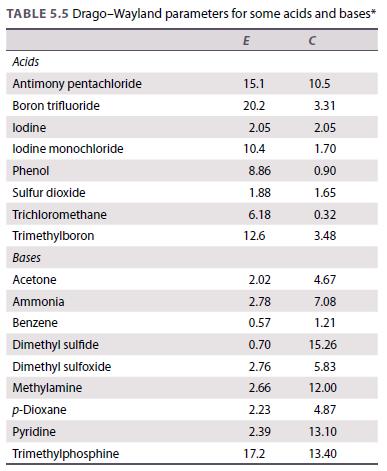
With the aid of the table of E and C values (Table 5.5), discuss the relative basicities of (a) Acetone and dimethyl sulfoxide, (b) Dimethyl sulfide and dimethyl sulfoxide. Comment on a possible ambiguity for dimethyl sulfoxide.Table 5.5. TABLE 5.5 Drago-Wayland parameters for some acids and
Arrange the acids HSO4−, H3O+, H4SiO4, CH3GeH3, NH3, HSO3F in order of increasing acid strength.
The ions Na+ and Ag+ have similar radii. Which aqua ion is the stronger acid? Why?
When a pair of aqua cations forms an M–O–M bridge with the elimination of water, what is the general rule for the change in charge per M atom on the ion?
Write balanced equations for the main reaction occurring when (a) H3PO4 and Na2HPO4 (b) CO2 and CaCO3 are mixed in aqueous media.
Hydrogen fluoride acts as an acid in anhydrous sulfuric acid and as a base in liquid ammonia. Give the equations for both reactions.
Explain why hydrogen selenide is a stronger acid than hydrogen sulfide.
Explain why the Lewis acidity of the silicon tetrahalides follows the trend:SiI4 < SiBr4 < SiCl4 < SiF4 whereas the trend for the boron trihalides follows the trend BF3 < BCl3 < BBr3 < BI3.
For each of the following processes, identify the acids and bases involved and characterize the process as complex formation or acid–base displacement. Identify the species that exhibit Brønsted acidity as well as Lewis acidity.(a) SO3 + H2O → HSO4− + H+(b) CH3[B12] + Hg2+ → [B12]+ +
Use the data in Table 5.5 to calculate the enthalpy change for the reaction of iodine with phenol.Table 5.5. TABLE 5.5 Drago-Wayland parameters for some acids and bases* E Acids Antimony pentachloride Boron trifluoride lodine lodine monochloride Phenol Sulfur
Identify the products from the reaction between the following pairs of reagents. In each case identify the species which are acting as a Lewis acid or a Lewis base in the reactions.(a) CsF + BrF3(b) ClF3 + SbF5(c) B(OH)3 + H2O(d) B2H6 + PMe3
The enthalpies of reaction of trimethylboron with NH3CH3, NH2, (CH3)2NH, and (CH3)3N are −58, −74, −81, and −74 kJ mol−1, respectively. Why is trimethylamine out of line?
Give the equation for the dissolution of SiO2 glass by HF and interpret the reaction in terms of Lewis and Brønsted acid–base concepts.
Aluminium sulfide, Al2S3, gives off a foul odour characteristic of hydrogen sulfide when it becomes damp. Write a balanced chemical equation for the reaction and discuss it in terms of acid–base concepts.
Describe the solvent properties that would (a) Favour displacement of Cl– by I– from an acid centre, (b) Favour basicity of R3As over R3N, (c) Favour acidity of Ag+ over Al3+, (d) Promote the reaction 2FeCl3 + ZnCl2 → Zn2+ + 2[FeCl4]−. In each case, suggest a
Catalysis of the acylation of aryl compounds by the Lewis acid AlCl3 was described. Propose a mechanism for a similar reaction catalysed by an alumina surface.
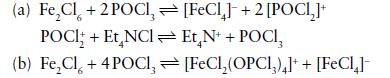
The complex anion [FeCl4]− is yellow whereas the species [Fe2Cl6] trapped in an argon matrix is reddish. Dissolution of 0.1 mol FeCl3(s) in 1 dm3 of either POCl3 or PO(OR)3 produces a reddish solution that turns yellow on dilution. Titration of the red solution in POCl3 with Et4NCl solutions
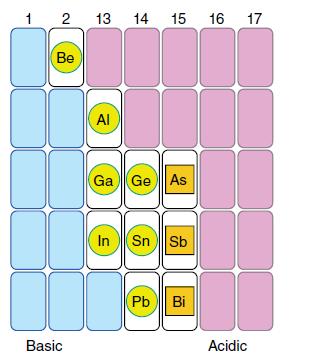
In the traditional scheme for the separation of metal ions from solution that is the basis of qualitative analysis, ions of Au, As, Sb, and Sn precipitate as sulfides but redissolve on addition of excess ammonium polysulfide. By contrast, ions of Cu, Pb, Hg, Bi, and Cd precipitate as sulfides but
Use acid–base concepts to comment on the fact that the only important ore of mercury is cinnabar, HgS, whereas zinc occurs in nature as sulfides, silicates, carbonates, and oxides.
Write balanced Brønsted acid–base equations for the dissolution of the following compounds in liquid hydrogen fluoride: (a) CH3CH2OH, (b) NH3, (c) C6H5COOH.
Is the dissolution of silicates in HF a Lewis acid–base reaction, a Brønsted acid–base reaction, or both?
Predict whether the equilibrium constants for the following reactions should be greater than 1 or less than 1: (a) CdI₂(s) + CaF₂(s) CdF₂(s) + Cal,(s) (b) [Cul 1¹-(aq) + [CuCl₂]³(aq) (c) NH;(aq) +H,O(l)=NH,(aq) [CuCl²-(aq) + [Cul 1³ (aq) + OH(aq)
The f-block elements are found as M(III) lithophiles in silicate minerals. What does this indicate about their hardness?
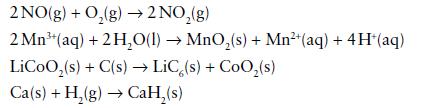
Assign oxidation numbers for each of the elements participating in the following reactions. 2NO(g) + O₂(g) → 2NO₂(g) 2 Mn³+ (aq) + 2H₂O(l) → MnO₂ (s) + Mn²+ (aq) + 4H*(aq) LiCoO₂ (s) + C(s) → LiC (s) + CoO₂ (s) Ca(s) + H₂(g) → CaH₂(s)
In the gas phase, the base strength of amines increases regularly along the series NH3 < CH3NH2 < (CH3)2NH < (CH3)3N. Consider the role of steric effects and the electron-donating ability of CH3 in determining this order. In aqueous solution, the order is reversed. What solvation effect is
The hydroxoacid Si(OH)4 is weaker than H2CO3. Write balanced equations to show how dissolving a solid M2SiO4 can lead to a reduction in the pressure of CO2 over an aqueous solution. Explain why silicates in ocean sediments might limit the increase of CO2 in the atmosphere.
The precipitation of Fe(OH)3 discussed in the chapter is used to clarify waste waters, because the gelatinous hydrous oxide is very efficient at the co precipitation of some contaminants and the entrapment of others. The solubility constant of Fe(OH)3 is Ks = [Fe3+][OH−]3 ≈ 1.0 × 10−38. As
The frequency of the symmetrical M–O stretching vibration of the octahedral aqua ions [M(OH2)6]2+ increases along the series, Ca2+ < Mn2+ < Ni2+. How does this trend relate to acidity?
An electrically conducting solution is produced when AlCl3 is dissolved in the basic polar solvent CH3CN. Give formulas for the most probable conducting species and describe their formation using Lewis acid–base concepts.
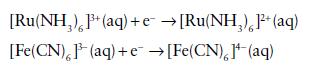
Explain why the standard potentials for the half-cell reactionsvary with temperature in opposite directions. [Ru(NH,),P+(aq)+e →[RuNH,),l(aq) [Fe(CN),(aq) +e →[Fe(CN), 1¹(aq)
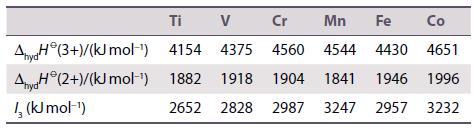
Using the data shown in the table, and given that the standard reduction potential for the Fe3+/Fe2+ couple in aqueous solution is +0.77 V vs SHE, calculate the standard reduction potentials for the remaining redox couples. Compare your answers with values given in Resource section 3, and comment
The compounds SO2 and SOCl2 can undergo an exchange of radioactively labelled sulfur. The exchange is catalysed by Cl− and SbCl5. Suggest mechanisms for these two exchange reactions with the first step being the formation of an appropriate complex.
Pyridine forms a stronger Lewis acid–base complex with SO3 than with SO2. However, pyridine forms a weaker complex with SF6 than with SF4. Explain the difference.
For parts (a), (b), and (c), state which of the two solutions has the lower pH:(a) 0.1 M Fe(ClO4)2(aq) or 0.1 M Fe(ClO4)3(aq)(b) 0.1 M Ca(NO3)2(aq) or 0.1 M Mg(NO3)2(aq)(c) 0.1 M Hg(NO3)2(aq) or 0.1 M Zn(NO3)2(aq)
Why are strongly acidic solvents (e.g. SbF5/HSO3F) used in the preparation of cations such as I2+ and Se82+, whereas strongly basic solvents are needed to stabilize anionic species such as S42− and Pb94−?
A standard procedure for improving the detection of the stoichiometric point in titrations of weak bases with strong acids is to use acetic acid as a solvent. Explain the basis of this approach.
Explain the following observations:(a) The heat of adduct formation of BEt3 with NMe3 is −72.3 kJ mol−1, whereas that of B(OMe)3 with the same amine is −31.5 kJ mol−1.(b) The heat of adduct formation of BMe3 with NMe3 is −75.2 kJ mol−1, whereas with N(SiH3)3 it is about +4 kJ mol−1.
Write equations to account for the acidity of CO2 and boric acid (B(OH)3), each dissolved in water.
Use standard potential data to suggest why permanganate (MnO4−) is not a suitable oxidizing agent for the quantitative estimation of Fe2+ in the presence of HCl but becomes so if sufficient Mn2+ and phosphate ion are added to the solution.
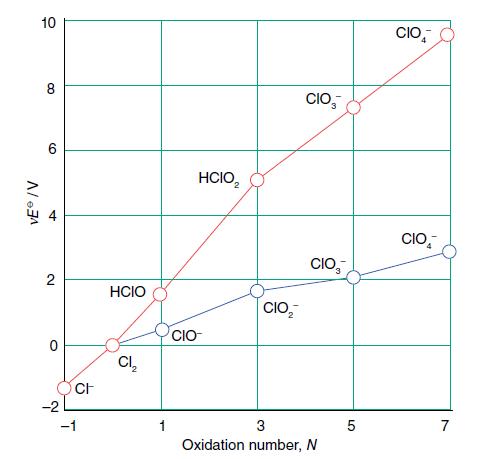
Answer the following questions using the Frost diagram in Fig. 6.20. (a) What are the consequences of dissolving Cl2 in aqueous basic solution? (b) What are the consequences of dissolving Cl2 in aqueous acid? (c) Is the failure of HClO2 to disproportionate in aqueous solution a thermodynamic or
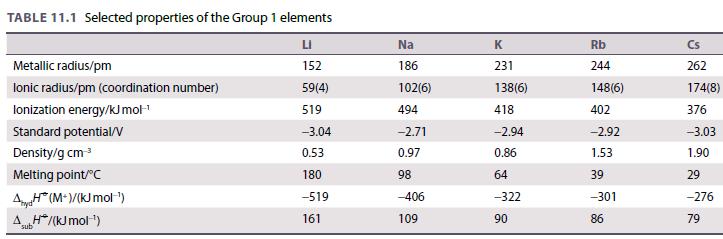
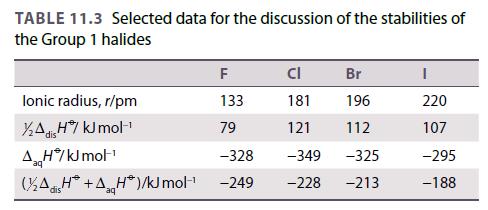
Use the data given in Tables 11.1 and 11.3 to calculate the enthalpies of formation for the Group 1 fluorides and chlorides. Plot the data and comment on the trends observed.Table 11.1.Table 11.3. TABLE 11.1 Selected properties of the Group 1 elements LI 152 59(4) 519 Metallic radius/pm Ionic
Explain the significance of reduction potentials in inorganic chemistry, highlighting their applications in investigations of stability, solubility, and reactivity in water.
Enterobactin (Ent) is a special ligand secreted by some bacteria to sequester Fe from the environment (Fe is an essential nutrient for almost all living species, see Section 26.6). The equilibrium constant for formation of [Fe(III)(Ent)] (1052 mol−1 dm3) is at least forty orders of magnitude
The reduction potential of an ion such as OH− can be strongly influenced by the solvent. (a) From the review article by D.T. Sawyer and J.L. Roberts (Acc. Chem. Res., 1988, 21, 469), describe the magnitude of the change in the potential of the OH/OH− couple on changing the solvent from
Balance the following redox reaction in acid solution: MnO4− + H2SO3 → Mn2+ + HSO4−. Predict the qualitative pH dependence on the net potential for this reaction (i.e. increases, decreases, remains the same).
Construct an Ellingham diagram for the thermal splitting of water (H2O(g) → H2(g) + ½ O2(g)) by using ΔrH⦵ = +260 kJ mol−1; ΔrS⦵ = +60 J K−1 mol−1 (you may assume that ΔrH⦵ is independent of temperature). Hence, calculate the temperature at which H2 may be obtained by spontaneous
By reference to the paper by K. Shah, B. Moghtaderi, and T. Wall (Energy Fuels, 2012, 26, 2038), discuss how the information represented in Ellingham diagrams can be used to identify metal oxides suitable for the production of pure O2 from air.
Write the Nernst equation for(a) The reduction of O2(g): O2(g) + 4H+(aq) + 4e− → 2H2O(l)(b) The reduction of Fe2O3(s): Fe2O3(s) + 6 H+(aq) + 6e− → 2Fe(s) + 3H2O(l)In each case express the formula in terms of pH. What is the potential for the reduction of O2 at pH = 7 and p(O2) = 0.20 bar
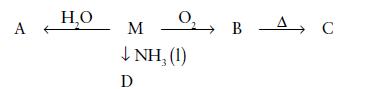
Identify the metal-containing compounds A, B, C, and D in the following array of reactions when (i) M is Li, (ii) M is Rb. A Н,0 0₂ M 4 NH (1) D В B 4 с
Why are Group 1 elements (a) Strong reducing agents,(b) Poor complexing agents?
It has been argued that a better diagonal relationship exists between Li and Ca than between Li and Mg (T.P. Hanusa, J. Chem. Educ., 1967, 64, 686). Summarize the arguments for and against this viewpoint.
Describe the processes involved in extracting caesium metal from natural minerals.
Francium has been described as ‘the last discovered natural element’ (J.-P. Adloff and G.B. Kauffman, The Chemical Educator, 2005, 10, 387). Discuss the justification for this statement. Summarize the evidence and claims for the first discovery of francium.
The auride anion, Au−, has a similar ionic radius to Br− at 196 pm. Predict structures for the ionic compounds CsAu and RbAu.
Under ambient conditions lithium and sodium adopt simple bcc structures. Under high pressures these alkali metals undergo a series of complex phase transitions to fcc and then lowersymmetry structures (M.I. McMahon et al., Proc. Natl. Acad. Sci. USA, 2007, 104, 17297; B. Rousseau et al., Eur. Phys.
Discuss the industrial uses of lithium and likely future demand for compounds of the metal. How are these demands likely to be met? A useful resource is the United States Geological Survey at https://minerals.usgs.gov/minerals/pubs/commodity/lithium/ (accessed January 2018).
Describe the origin of the diagonal relationship between Li and Mg.
By 2020 ‘gigafactories’ in Europe and the US should each produce lithium ion batteries with a capacity, per annum, of over 100 GWh. Review the chemistry involved in the development of commercial lithium ion batteries (J.B. Goodenough and K.-S. Park, J. Am. Chem. Soc., 2013, 135, 1167). Discuss
Explain why the standard electrode potentials of Li and Cs are almost identical despite the much lower first ionization energy of caesium. How might the standard electrode potential Li(s)/Li+ change in (i) Dimethyl sulfoxide, a strongly coordinating solvent,(ii) A weakly coordinating
Summarize the chemistry of sodium that is being researched for the development of rechargeable sodium ion batteries. See M.D. Slater, D Kim, E. Lee, and C.S. Johnson, Adv. Func. Mater., 2013, 23, 947.
Which of the following pairs is most likely to form the desired compound? Describe the periodic trend and the physical basis for your answer in each case. (a) Ethanoate ion or edta4− ion to react with Cs+. (b) Li+ or K+ to form a complex with 2.2.2-crypt.
Identify the incorrect phrase in each of the following statements; explain your answer in each case. (a) Sodium dissolves in ammonia and amines to produce the sodium cation and solvated electrons or the sodide ion. (b) Sodium dissolved in liquid ammonia will not react with NH4+ because of
Z. Jedlinski and M. Sokol describe the solubility of alkali metals in nonaqueous supramolecular systems (Pure Appl. Chem., 1995, 67, 587). They dissolved the metals in THF containing crown ethers or cryptands. Sketch the structure of the 18-crown-6 ligand. Give the equations proposed for the
Alkali metal halides can be extracted from aqueous solution by solid-phase ditopic salt receptors (see J.M. Mahoney, A.M. Beatty, and B.D. Smith, Inorg. Chem., 2004, 43, 7617). (a) What is a ditopic receptor? (b) What is the order of selectivity to extraction of the alkali metal ions in
Describe how you would prepare a pure sample of caesium ozonide starting from caesium metal, including its recrystallization from a suitable solvent.
Account for the fact that LiF and CsI have low solubility in water whereas LiI and CsF are very soluble.
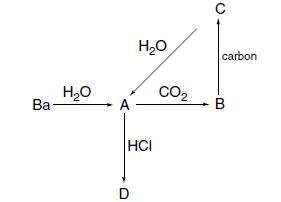
Identify the metal-containing compounds A, B, C, and D in this scheme: Ba- H₂O - A H₂O НСІ D CO₂ carbon B
The molecular geometries of crown ether derivatives play an important role in capturing and transporting alkali metal ions. K. Okano and co-workers (see K. Okano, H. Tsukube, and K. Hori, Tetrahedron, 2004, 60, 10877) studied stable conformations of 12-crown-O3N and its Li+ complex in aqueous and
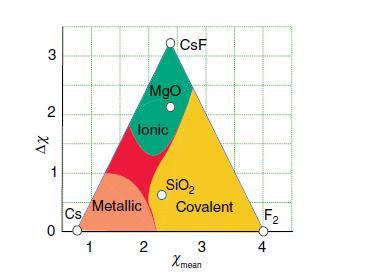
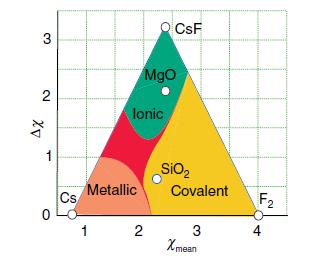
Using electronegativity values of 1.57 for Be and 0.79 for Cs and a Ketelaar triangle (Fig. 2.28), predict what type of compound might form between these elements.Figure 2.28. 3 2 ΔΧ 1 0 Cs Metallic 1 lonic MgO CsF 2 SiO₂ Covalent 3 Xmean F₂ 4
Which salts of francium would be the least soluble? How could francium be precipitated and isolated from solution that also contains sodium ions?
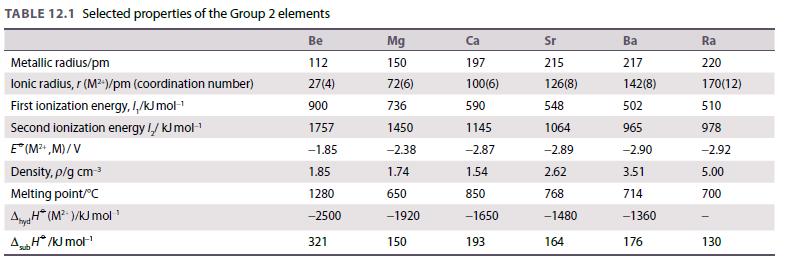
Use your knowledge of chemical trends in Group 2 chemistry and data from Table 12.1 to predict the chemistry of radium. Compare your predictions with experimental observations. See, for example, H.W. Kirby and M.L. Salutsky, The radiochemistry of radium. Nuclear Science Series, National Academy of
Explain why LiH has greater thermal stability than the other Group 1 hydrides, whereas solid LiHCO3 cannot be isolated, unlike the other Group 1 hydrogencarbonates.
Draw the structures of NaCl and CsCl, and give the coordination number of the metal in each case. Explain why the compounds adopt different structures.
What would you expect to happen to the structure of RbBr under the application of very high pressures?
Explain how the nature of the alkyl group affects the structure of lithium alkyls.
Marble and limestone buildings are eroded by contact with acid rain. Define the term ‘acid rain’ and discuss the origins of the acidity. Describe the processes by which the marble and limestone are attacked.
Explain why compounds of beryllium are mainly covalent whereas those of the other Group 2 elements are predominantly ionic.
Discuss the advantages and disadvantages of calcium looping for CO2 capture in comparison with amine scrubbing.
Why are the properties of beryllium more similar to aluminium and zinc than to magnesium?
In their paper ‘Noncovalent interaction of chemical bonding between alkaline earth cations and benzene?’ (Chem. Phys. Lett.,2001, 349, 113), X.J. Tan and co-workers carried out theoretical calculations of complexes formed between beryllium, magnesium, and calcium ions and benzene. To which
The melting points (°C) of the Group 2 chlorides are as follows: BeCl2, 405; MgCl2, 714; CaCl2, 772; SrCl2, 874; and BaCl2, 962. Account for the significantly lower temperature for BeCl2.
Discuss beryllium fluoride glasses, noting how the chemistry of BeF2 is analogous to that of SiO2.
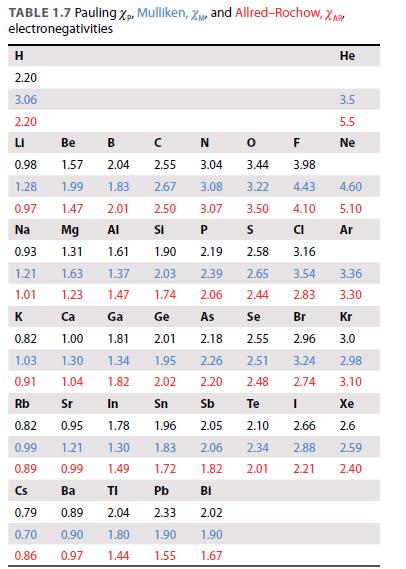
Use the data in Table 1.7 and the Ketelaar triangle in Fig. 2.28 to predict the nature of the bonding in BeBr2, MgBr2, and BaBr2.Table 1.7.Figure 2.28. TABLE 1.7 Pauling Xp. Mulliken, XM, and Allred-Rochow, XAR electronegativities H 2.20 3.06 2.20 LI Be 1.57 1.99 B с N 2.04 2.55 3.04 1.83 2.67
Showing 500 - 600
of 1950
1
2
3
4
5
6
7
8
9
10
11
12
13
14
15
Last
Step by Step Answers

 Get 50% OFF
Claim Now
Get 50% OFF
Claim Now