New Semester
Started
Get
50% OFF
Study Help!
--h --m --s
Claim Now
Question Answers
Textbooks
Find textbooks, questions and answers
Oops, something went wrong!
Change your search query and then try again
S
Books
FREE
Study Help
Expert Questions
Accounting
General Management
Mathematics
Finance
Organizational Behaviour
Law
Physics
Operating System
Management Leadership
Sociology
Programming
Marketing
Database
Computer Network
Economics
Textbooks Solutions
Accounting
Managerial Accounting
Management Leadership
Cost Accounting
Statistics
Business Law
Corporate Finance
Finance
Economics
Auditing
Tutors
Online Tutors
Find a Tutor
Hire a Tutor
Become a Tutor
AI Tutor
AI Study Planner
NEW
Sell Books
Search
Search
Sign In
Register
study help
sciences
inorganic chemistry
Inorganic Chemistry 7th Edition Mark Weller, Tina Overton, Jonathan Rourke - Solutions
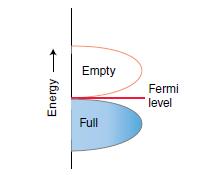
Graphite is a semimetal with a band structure of the type shown in Fig. 4.70. Reaction of graphite with potassium produces C8K while reaction with bromine yields C8Br. Assuming the graphite sheets remain intact and potassium and bromine enter the graphite structure as K+ and Br− ions,
Predict what type of intrinsic defect is most likely to occur in (a) Ca3N2, (b) HgS.
By considering which dopant ions produce the blue of sapphires, provide an explanation for the origin of the colour in the blue form of beryl known as aquamarine.
For which of the following compounds might significant levels of nonstoichiometry be found: aluminium oxide, vanadium carbide, manganese sulfide?
Explain why higher levels of defects are found in solids at high temperatures and close to their melting points. How would pressure affect the equilibrium number of defects in a solid?
By considering the effect on the lattice energies of incorporating large numbers of defects and the resultant changes in oxidation numbers of the ions making up the structure, predict which of the following systems should show nonstoichiometry over a large range of x: Zn1+xO, Fe1−xO, UO2+x.
Classify the following as n- or p-doped semiconductors: (a) Ga-doped Ge, (b) As-doped Si, (c) In0.49As0.51.
Would VO or NiO be expected to show metallic properties?
Describe the difference between a semiconductor and a semimetal.
Classify the following as to whether they are likely to show n- or p-type semiconductivity: Ag2S, VO2, CuBr.
What are the relationships between the unit cell parameters in the monoclinic crystal system? Draw a projection of a monoclinic cell viewed down the b axis and hence show that the packing of monoclinic unit cells will completely fill three-dimensional space.
Draw a cubic unit cell (a) In projection (showing the fractional heights of the atoms) and (b) As a three-dimensional representation that has atoms at the following positions: Ti atRemember that a cubic unit cell with an atom on the cell face, edge, or corner will have equivalent atoms displaced
Draw a tetragonal unit cell and mark on it a set of points that would define (a) A face-centred lattice (b) A body-centred lattice. Demonstrate, by considering two adjacent unit cells, that a tetragonal face-centred lattice of dimensions a and c can always be redrawn as a
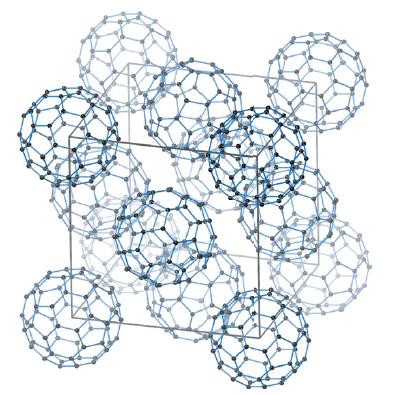
(a) Potassium reacts with C60 (Fig. 4.16) to give a compound in which all the octahedral and tetrahedral holes are filled by potassium ions. Derive a stoichiometry for this compound. (b) The reaction of C60 with excess potassium yields a material that has a body-centred arrangement of C60
(a) Draw a cubic unit cell with lattice points at (½,0,0), (0,½,0), (0,0,½), and (½,½,½). What is the lattice type of this unit cell and how many lattice points are contained within the unit cell? (b) Draw an orthorhombic unit cell with lattice points at (0,0,0) and (½,½,0). What is
Which of the following schemes for the repeating pattern of close-packed planes are not ways of generating close-packed lattices? (a) CBACBA . . ., (b) ABAC . . ., (c) ABBA . . ., (d) ABCBC . . ., (e) ABABC . . ., (f) ABCBCA . . ..
Determine the formulas of the compounds produced by (a) Filling a quarter of the tetrahedral holes with cations M in a hexagonal close-packed array of anions X; (b) Filling half the octahedral holes with cations M in a cubic close-packed array of anions X; (c) Filling a sixth of the
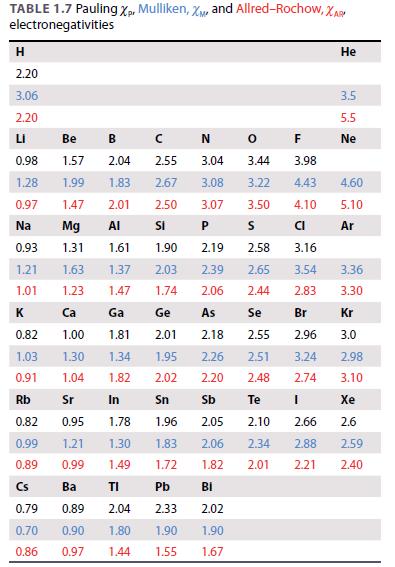
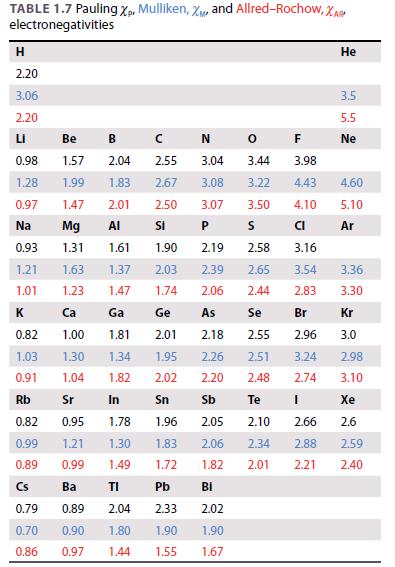
Classify the following materials using the electronegativity data in Table 1.7 and a Ketelaar triangle: (a) LiI, (b), BeBr2, (c) SnS, (d) RbSn.Table 1.7. TABLE 1.7 Pauling Xp, Mulliken, X, and Allred-Rochow,
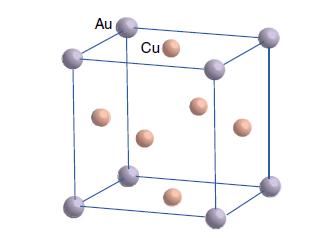
An alloy of copper and gold has the structure shown in Fig. 4.75. Calculate the composition of this unit cell. What is the lattice type of this structure? Given that 24-carat gold is pure gold, what carat gold does this alloy represent?Figure 4.75. Au Cu
Metallic copper adopts an fcc structure with density 8960 kg m−3. Draw the unit cell of copper and mark the shortest copper atom to copper atom distance. How many copper atoms are there in the unit cell? Use the density and mass of the unit cell to determine the lattice parameter for copper and
In the structure of MoS2, the S atoms are arranged in closepacked layers that repeat themselves in the sequence AAA . . .. The Mo atoms occupy holes with coordination number 6. Show that each Mo atom is surrounded by a trigonal prism of S atoms.
Draw the bcc unit cell of tungsten metal and add a second neighbouring unit cell. What, approximately, is the CN of a site in the face of the original unit cell? What would be the stoichiometry of a compound in which all these sites were filled with carbon? Calculate the two shortest W-C distances
Metallic lithium adopts a bcc structure with density of 535 kg m−3. What is the length of the edge of the unit cell?
Using a Ketelaar triangle, would you classify Sr2Ga (χ(Sr) = 0.95; χ(Ga) = 1.81) as an alloy or a Zintl phase?
Depending on temperature, RbCl can exist in either the rock-salt or caesium-chloride structure. (a) What is the coordination number of the cation and anion in each of these structures? (b) In which of these structures will Rb have the larger apparent ionic radius?
Consider the structure of caesium chloride. How many Cs+ ions occupy second-nearest-neighbour locations of a Cs+ ion? How many Cl− ions occupy the third-nearest-neighbour sites?
The ReO3 structure is cubic with a rhenium atom at each corner of the unit cell and one oxygen atom on each unit cell edge midway between the rhenium atoms. Sketch this unit cell and determine (a) The coordination numbers of the ions (b) The identity of the structure type that would be
Determine the composition of a compound based on the ReO3 structure, Exercise 4.17, where each of the oxide ions is replaced by a hydroxide ion [OH]−. Predict, based on commonly adopted oxidation states, which elements in the periodic table might have hydroxides that adopt this structure
Describe the coordination around the oxide ions in the perovskite structure, ABO3, in terms of coordination to the A- and B-type cations.
Obtain formulae (MXn or MnX) for structures derived from hole-filling in close-packed arrays with (a) Half the octahedral holes filled, (b) One-quarter of the tetrahedral holes filled, (c) Two-thirds of the octahedral holes filled. What are the average coordination numbers of M and X
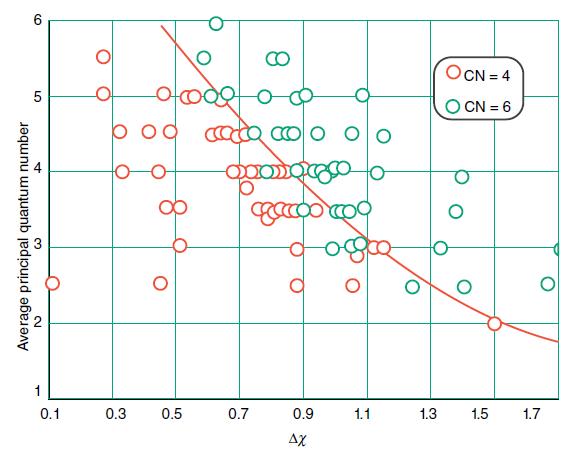
Use the structure map in Fig. 4.47 to predict the coordination numbers of the cations and anions in (a) LiF, (b) RbBr, (c) SrS, (d) BeO. The observed coordination numbers are (6,6) for LiF, RbBr, and SrS and (4,4) for BeO. Propose a possible reason for any discrepancies.Figure 4.47 Average
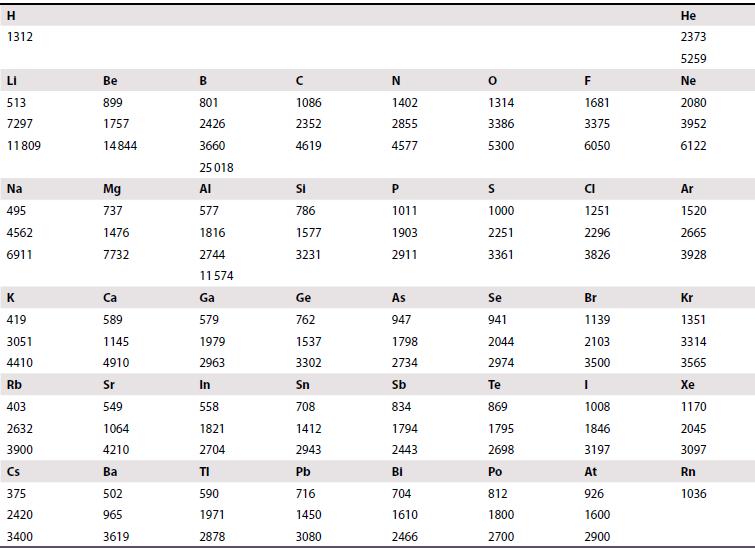
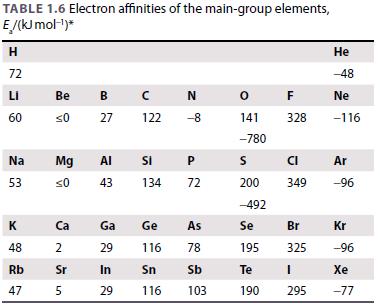
(a) Calculate the enthalpy of formation of the hypothetical compound KF2 assuming a CaF2 structure. Use the Born–Mayer equation to obtain the lattice enthalpy and estimate the radius of K2+ by extrapolation of trends in Table 1.4 and Resource section 1. Ionization enthalpies and electron gain
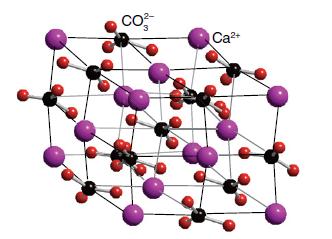
The structure of calcite (CaCO3) is shown in Fig. 4.76. Describe how this structure is related to that of NaCl.Figure 4.76. CO² Ca²+
The perovskite structure, ABX3, can be described as a closepacked array of the A and X ions together, with B-type cations in octahedral holes. What proportion of octahedral holes is filled?
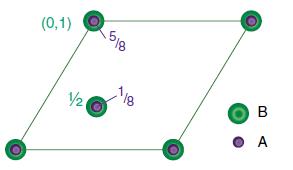
The projection representation of a unit cell of an ionic crystal of the binary compound ApBq is shown in Fig. 4.77. Determine the stoichiometry and the number of formula units in the unit cell. State the coordination number and coordination geometry of ions A and B. Give an example of a compound
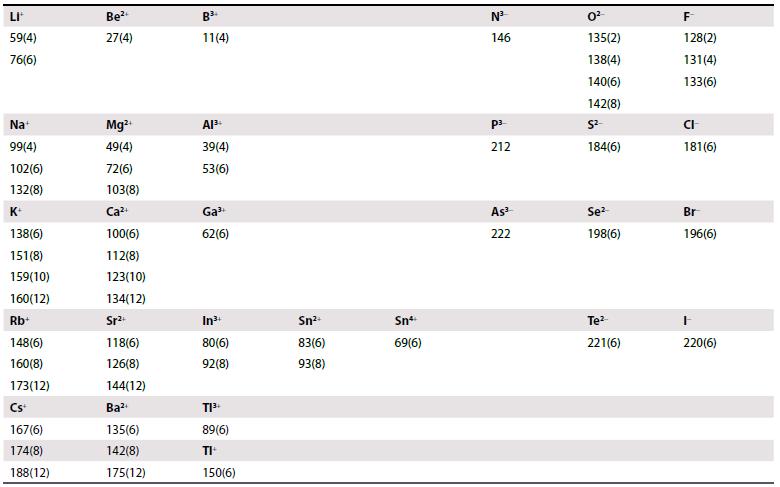
Use radius-ratio rules and the ionic radii given in Resource section 1 to predict structures of (a) UO2, (b) FrI, (c) BeS, (d) InP.
By considering the parameters that change in the Born–Mayer expression, estimate lattice enthalpies for MgO and AlN, given that MgO and AlN adopt the rock-salt structure with very similar lattice parameters to NaCl and A₁ H (NaCl) = 786 kJmol-¹.
Given the following data for the length of a side of the unit cell for compounds that crystallize in the rock-salt structure, determine the cation radii: MgSe (545 pm), CaSe (591 pm), SrSe (623 pm), BaSe (662 pm).
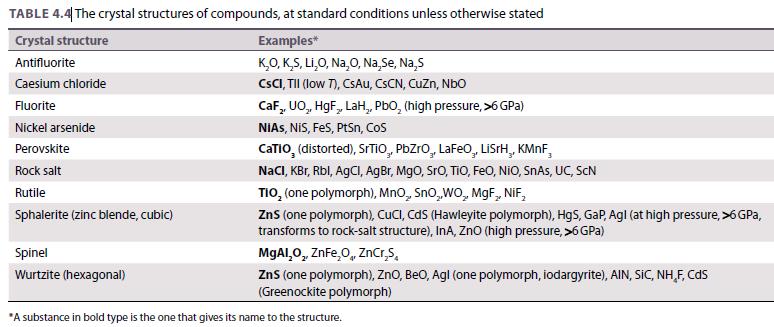
Describe how the structures of the following compounds could be described in terms of the simple structure types of Table 4.4 but with complex ions replacing simple monoatomic cations and anions. (a) K2PtCl6, (b) [Ni(H2O)6][SiF6], (c) CsCN (d) CsPF6. TABLE 4.4 The crystal structures of
What are the most significant terms in the Born–Haber cycle for the formation of Ca3N2?
Explain, by considering the magnitude of the key terms in the Born–Haber cycle that involve the halogen or halide ion, why AgF2 exists but AgCl2 does not.
On the basis of the factors that contribute to lattice enthalpies, place LiF, SrO, RbCl, AlP, NiO, and CsI, all of which adopt the rock-salt structure, in order of increasing lattice enthalpy.
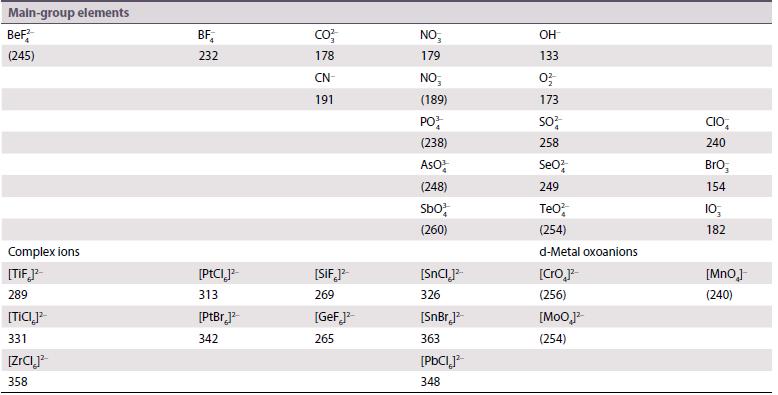
Use the Kapustinskii equation and the ionic and thermochemical radii given in Resource section 1 and Table 4.10, and r(Bk4+) = 96 pm to calculate lattice enthalpies of (a) BkO2,(b) K2SiF6, (c) LiClO4.Table 14.10. Main-group elements BeF² (245) Complex
Determine the first four terms in the expression for the Madelung constant calculation for the CsCl structure.
(a) Explain why lattice energy calculations based on the Born–Mayer equation reproduce the experimentally determined values to within 1 per cent for LiCl but only 10 per cent for AgCl, given that both compounds have the rock-salt structure. (b) Identify a pair of compounds containing M2+
Which member of each pair is likely to be more soluble in water: (a) BaSeO4 or CaSeO4, (b) NaF or NaBF4?
Reaction of AsCl3 with Cl2 at low temperature yields a product, believed to be AsCl5, which shows Raman bands at 437, 369, 295, 220, 213, and 83 cm−1. Detailed analysis of the 369 and 295 cm−1 bands shows them to arise from totally symmetric modes. Show that the Raman spectrum is consistent
Determine the symmetry elements of objects with the same shape as the boundary surface of (a) A p orbital, (b) A dxy orbital,(c) A dz2 orbital.
Show how you would use Raman and infrared spectroscopy to distinguish between regular octahedral and regular trigonal prismatic geometries of a six-coordinate species, ML6. Discuss the possible distortions that could occur in either case (you do not need to determine the symmetries of vibrations
In their article ‘Some observations on molecular orbital theory’ (J.F. Harrison and D. Lawson, J. Chem. Educ., 2005, 82, 1205) the authors discuss several limitations of the theory. What are these limitations? Sketch the MO diagram for Li2 given in the paper. Why do you think this version does
In valence bond theory, hypervalence is usually explained in terms of d-orbital participation in bonding. In the paper ‘On the role of orbital hybridisation’ (J. Chem. Educ., 2007, 84, 783) the author argues that this is not the case. Give a concise summary of the method used and the author’s
Draw feasible Lewis structures for (a) NO+, (b) ClO−,(c) H2O2, (d) CCl4, (e) HSO3−.
(a) Use a molecular orbital program or input and output from software supplied by your instructor to construct a molecular orbital energy-level diagram to correlate the MO (from the output) and AO (from the input) energies and indicate the occupancy of the MOs (in the manner of Fig. 2.17) for one
Develop an argument based on bond enthalpies for the importance of Si−O bonds, in preference to Si−Si or Si−H bonds, in substances common in the Earth’s crust. How and why does the behaviour of silicon differ from that of carbon?
Draw the resonance structures for CO32−.
The van Arkel–Ketelaar triangle has been in use since the 1940s. A quantitative treatment of the triangle was carried out by Gordon Sproul in 1994 (J. Phys. Chem., 1994, 98, 6699). How many scales of electronegativity and how many compounds did Sproul investigate? What criteria were used to
What shapes would you expect for the species (a) H2Se,(b) BF4− , (c) NH4+?
In their short article ‘In defense of the hybrid atomic orbitals’ (P.C. Hiberty, F. Volatron, and S. Shaik, J. Chem. Educ., 2012, 89, 575), the authors defend the continuing use of the concept of the hybrid atomic orbital. Summarize the criticisms that they are addressing and present an outline
What shapes would you expect for the species (a) SO3,(b) SO32− , (c) IF5
Use software to perform an MO calculation on H3 by using the H energy given in Problem 2.6 and H–H distances from NH3 (N–H length 102 pm, HNH bond angle 107°) and then carry out the same type of calculation for NH3. Use energy data for N2s and N2p orbitals from Problem 2.6. From the output,
What shapes would you expect for the species (a) IF6+, (b) IF3,(c) XeOF4
What shapes would you expect for the species (a) ClF3,(b) lCl4−, (c) I3−?
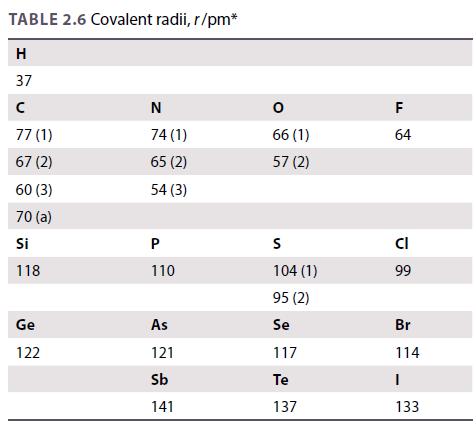
Use the covalent radii in Table 2.6 to calculate the bond lengths in (a) CCl4 (177 pm), (b) SiCl4 (201 pm), (c) GeCl4 (210 pm). (The values in parentheses are experimental bond lengths and are included for comparison.)Table 2.6. TABLE 2.6 Covalent radii, r/pm* H 37 с 77 (1) 67 (2) 60 (3) 70
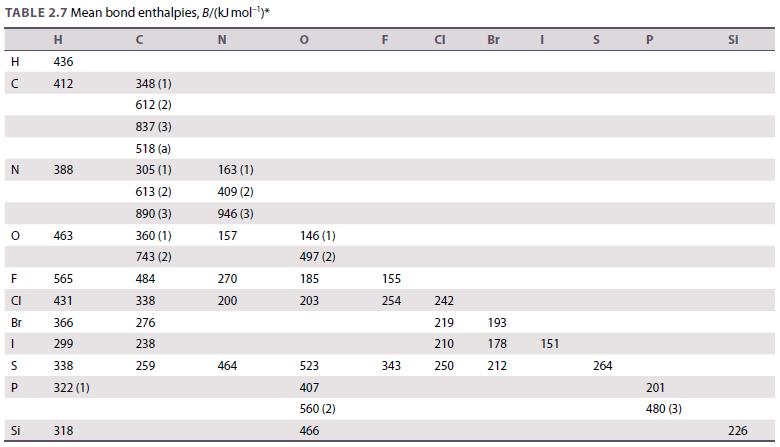
Use the data in Table 2.7 to calculate the standard enthalpy of the reaction 2 H2(g) + O2(g) → 2 H2O(g). The experimental value is −484 kJ. Account for the difference between the estimated and experimental values.Table 2.7. TABLE 2.7 Mean bond enthalpies, B/(kJ
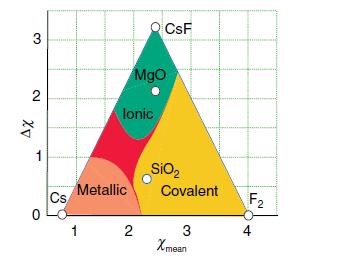
Use the Ketelaar triangle in Fig. 2.28 and the electronegativity values in Table 1.7 to predict what type of bonding is likely to dominate in (a) BCl3, (b) KCl, (c) BeO.Figure 2.28.Table 1.7. 3 2 ΔΧ 1 0 Cs Metallic 1 lonic MgO CsF 2 SiO₂ Covalent 3 Xmean F₂ 4 N
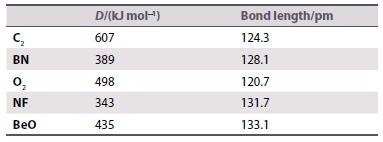
Rationalize the bond dissociation energy (D) and bond length data of the gaseous diatomic species given in the following table and highlight the atoms that obey the octet rule. C₂ BN NF BeO D/(kJ mol-¹) 607 389 498 343 435 Bond length/pm 124.3 128.1 120.7 131.7 133.1
In which of the species lCl6− and SF4 is the bond angle closest to that predicted by the VSEPR model?
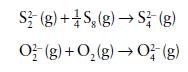
Predict the standard enthalpies of the reactionsby using mean bond enthalpy data. Assume that the unknown species O42− is a singly bonded chain analogue of S42− . S2(g) +S₂(g) → S2 (g) O2(g) + O₂(g) → 0² (g)
Solid phosphorus pentachloride is an ionic solid composed of PCl4+ cations and PCl6− anions, but the vapour is molecular. What are the shapes of the ions in the solid?
The effects of the nonbonding lone pair in the tin and lead anions in compounds such as Sr(MX3)2.5H2O (M = Sn or Pb, X = Cl or Br) have been studied by crystallography and by electronic structure calculations (I. Abrahams et al., Polyhedron, 2006, 25, 996). Briefly outline the synthetic method used
Given that B(Si=O) = 640 kJ mol−1, show that bond enthalpy considerations predict that silicon–oxygen compounds are likely to contain networks of tetrahedra with Si–O single bonds and not discrete molecules with Si–O double bonds.
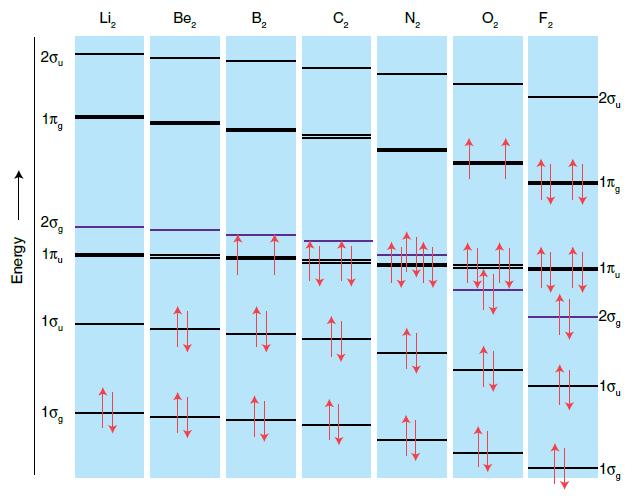
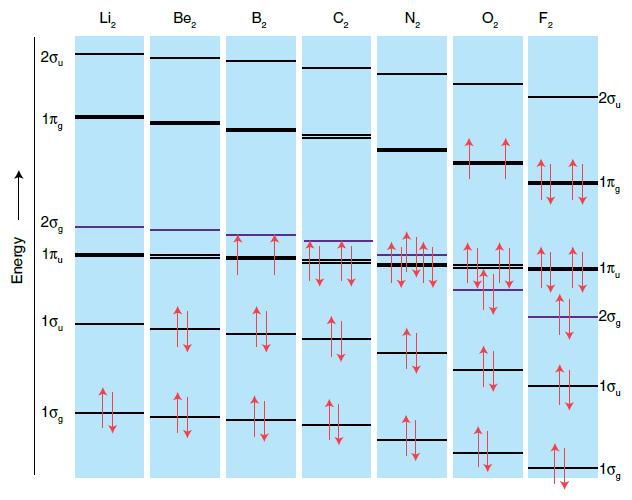
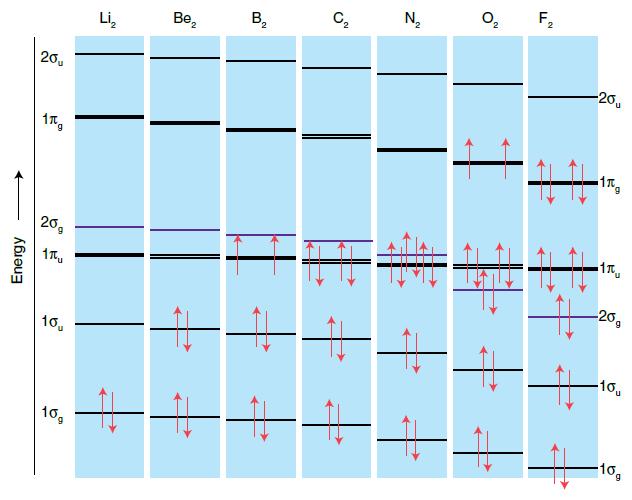
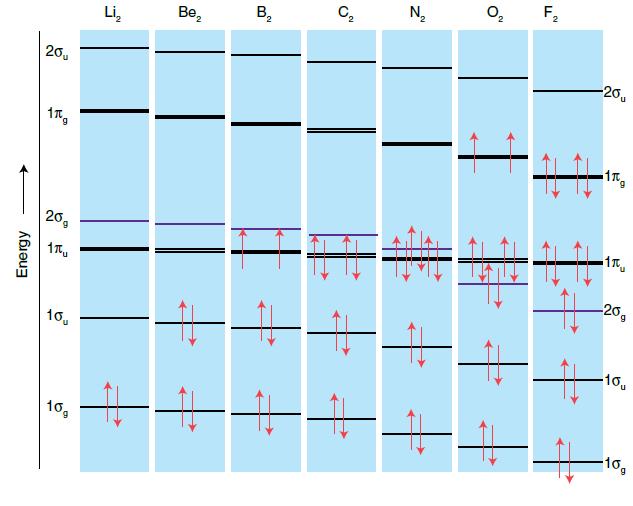
Use Fig. 2.17 to write the electron configurations of (a) Be2+,(b) B2−, (c) C2−, (d) F2+ and sketch the form of the HOMO in each case.Figure 2.17. Energy 20 1g 20 1. 100 10g Be2 B2 # # C2 N2 0% # F2 14414 → Z ← → -20 ・1 ・1 -20, -10, 18
The common forms of nitrogen and phosphorus are N2(g) and P4(s), respectively. Account for the difference in terms of the single and multiple bond enthalpies.
Determine the oxidation states of the element emboldened in each of the following species: (a) SO32−, (b) NO+,(c) Cr2O72− ,(d) V2O5, (e) PCl5.
Four elements arbitrarily labelled A, B, C, and D have electronegativities of 3.8, 3.3, 2.8, and 1.3, respectively. Place the compounds AB, AD, BD, and AC in order of increasing covalent character.
Predict the hybridization of orbitals required in (a) BCl3,(b) NH4+, (c) SF4, (d) XeF4.
Use molecular orbital diagrams to determine the number of unpaired electrons in (a) O2− , (b) O2+ , (c) BN, (d) NO2.
Sketch the interactions of the d orbitals that would give rise to σ and π molecular orbitals.
When acetylene (ethyne) is passed through a solution of copper(I) chloride a red precipitate of copper acetylide, CuC2, is formed. This is a common test for the presence of acetylene. Describe the bonding in the C22− ion in terms of molecular orbital theory and compare the bond order to that of
Draw and label a molecular orbital energy-level diagram for the gaseous homonuclear diatomic molecule dicarbon, C2. Annotate the diagram with pictorial representations of the molecular orbitals involved. What is the bond order of C2?
Draw a molecular orbital energy-level diagram for the gaseous heteronuclear diatomic molecule boron nitride, BN. How does it differ from that for C2?
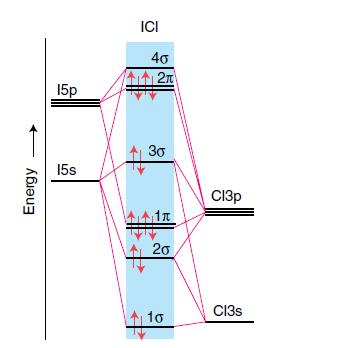
Assume that the MO diagram of IBr is analogous to that of ICl (Fig. 2.24). (a) What basis set of atomic orbitals would be used to generate the IBr molecular orbitals? (b) Calculate the bond order of IBr.Figure 2.24 Energy 150 15s ICI 40 2π 3G 1л 20 10 СІЗр Cl3s
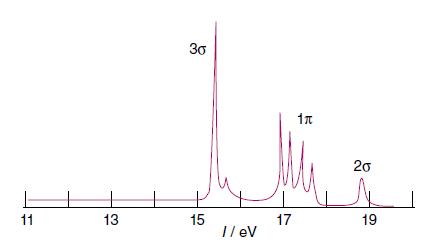
Assign the lines in the UV photoelectron spectrum of CO shown in Fig. 2.31 and predict the appearance of the UV photoelectron spectrum of the SO molecule.Figure 2.31. 11 13 30 15 // eV 17 1π 20 19
What are the expected changes in bond order and bond distance that accompany the following ionization processes? (a) 0₂ 0; +e; (b) N₂ +eN₂; (c) NO-NO+ + e
Determine the bond orders of (a) S2, (b) Cl2, (c) NO+ from their molecular orbital configurations and compare the values with the bond orders determined from Lewis structures. (NO has orbitals like those of O2.)
Use the VSEPR model to predict the structures of the following molecules or ions:In each case show the principal rotation axis and indicate any horizontal or vertical mirror planes. Which of the molecules have an inversion centre? BrF TeCl, Cl, (contains no I-I bonds) CIO,
From a consideration of their respective molecular orbital diagrams, sketch the forms of the frontier orbitals of C22−, N2, CO, and O2 and predict any likely consequences for chemical properties.
When an He atom absorbs a photon to form the excited configuration 1s12s1 (here called He*) a weak bond forms with another He atom to give the diatomic molecule HeHe*. Construct a molecular orbital description of the bonding in this species.
Construct and label molecular orbital diagrams for N2, NO, and O2 showing the principal linear combinations of atomic orbitals being used. Comment on the following bond lengths: N2 110 pm, NO 115 pm, O2 121 pm.
Do the hypothetical species (a) Square H42+, (b) Angular O32− have a duplet or octet of electrons? Explain your answer and decide whether either of them is likely to exist.
Consider a molecule IF3O2 (with I as the central atom). How many isomers are possible? Assign point group designations to each isomer.
Draw sketches to identify the following symmetry elements:(a) A C3 axis and a σv plane in the NH3 molecule, (b) A C4 axis and a σh plane in the square-planar [PtCl4]2− ion
How many isomers are there for ‘octahedral’ molecules with the formula MA3B3, where A and B are monoatomic ligands? What is the point group of each isomer? Are any of the isomers chiral? Repeat this exercise for molecules with the formula MA2B2C2.
Which of the following molecules and ions has (a) A centre of inversion, (b) An S4 axis: (i) CO2, (ii) C2H2, (iii) BF3, (iv) SO42−
Group theory is often used by chemists as an aid in the interpretation of IR spectra. For example, there are four NH bonds in NH4+ and four stretching modes are possible. There is the possibility that several vibrational modes occur at the same frequency, and hence are degenerate. A quick glance at
Determine the symmetry elements and assign the point group of (a) NH2Cl, (b) CO32−, (c) SiF4, (d) HCN, (e) SiFClBrI, (f) BF4− .
Determine whether the number of IR and Raman active stretching modes could be used to determine uniquely whether a sample of gas is BF3, NF3, or ClF3.
How many planes of symmetry does a benzene molecule possess? Which chloro-substituted benzene of formula C6HnCl6−n has exactly four planes of symmetry?
(a) Determine the point group of an SO32− ion. (b) What is the maximum degeneracy of a molecular orbital in this ion? (c) If the sulfur orbitals are 3s and 3p, which of them can contribute to molecular orbitals of this maximum degeneracy?
Construct an approximate molecular orbital energy diagram for a hypothetical planar form of NH3. You may refer to Resource section 4 to determine the form of the appropriate orbitals on the central N atom and on the triangle of H3 atoms. From a consideration of the atomic energy levels, place the N
Showing 800 - 900
of 1950
First
2
3
4
5
6
7
8
9
10
11
12
13
14
15
16
Last
Step by Step Answers

 Get 50% OFF
Claim Now
Get 50% OFF
Claim Now