New Semester
Started
Get
50% OFF
Study Help!
--h --m --s
Claim Now
Question Answers
Textbooks
Find textbooks, questions and answers
Oops, something went wrong!
Change your search query and then try again
S
Books
FREE
Study Help
Expert Questions
Accounting
General Management
Mathematics
Finance
Organizational Behaviour
Law
Physics
Operating System
Management Leadership
Sociology
Programming
Marketing
Database
Computer Network
Economics
Textbooks Solutions
Accounting
Managerial Accounting
Management Leadership
Cost Accounting
Statistics
Business Law
Corporate Finance
Finance
Economics
Auditing
Tutors
Online Tutors
Find a Tutor
Hire a Tutor
Become a Tutor
AI Tutor
AI Study Planner
NEW
Sell Books
Search
Search
Sign In
Register
study help
sciences
inorganic chemistry
Inorganic Chemistry 7th Edition Mark Weller, Tina Overton, Jonathan Rourke - Solutions
How is single-crystal neutron diffraction of use in inorganic chemistry?
A student forgot to label their samples of MgO and CaO; both are white, insoluble powders. How could they identify which sample is which without destroying them?
How may metal hydride materials, of interest for hydrogen storage applications, be characterized using the various analytical methods discussed?
The minimum size of crystal that can typically be studied using a laboratory single-crystal diffractometer is 50 × 50 × 50 μm3. The X-ray flux from a synchrotron source is expected to be 106 times the intensity of a laboratory source. Calculate the minimum size of a cubic crystal that could be
Discuss the information available from the following techniques in the analysis of inorganic pigments used in antique oil paintings: (i) Powder X-ray diffraction, (ii) Infrared and Raman spectroscopies, (iii) UV–visible spectroscopy, (iv) X-ray fluorescence.
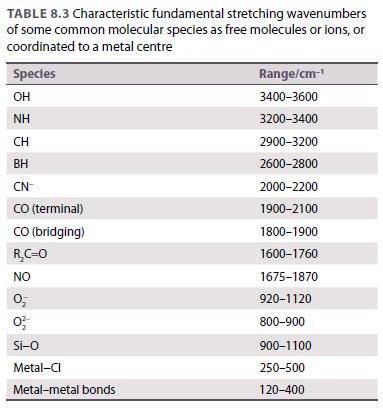
Use the data in Table 8.3 to estimate the O–O stretching wavenumber expected for a compound believed to contain the oxygenyl species O2+. Would you expect to observe this stretching vibration in (i) The IR spectrum or (ii) The Raman spectrumTable 8.3 TABLE 8.3 Characteristic fundamental
Why are the reported errors on the N–H bond lengths determined in (NH4)2SeO4 by single-crystal X-ray diffraction much larger than those on the Se–O bond lengths?
Discuss how hydrogen bonding in inorganic compounds can be characterized using infrared spectroscopy. How does the strength of a hydrogen bond affect (a) OH stretching modes (b) OH bending modes
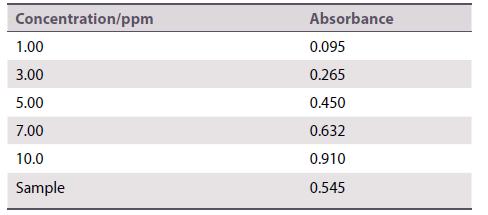
The iron content of a dietary supplement tablet was determined using atomic absorption spectrometry. A tablet (0.4878 g) was ground to a fine powder and 0.1123 g was dissolved in dilute sulfuric acid and transferred to a 50 cm3 volumetric flask. A 10 cm3 sample of this solution was taken and made
Strong hydrogen bonds can either be symmetric, as in the [F–H–F]− anion (with both F–H distances equal at 1.14 Å) or asymmetric as in KH2PO4 (where the O–H bond distance is 1.05 Å and H–O hydrogen bonding separation is 1.51 Å). How could you determine whether the hydrogen bond in the
How may a consideration of 31P chemical shifts and 1H coupling constants be used to distinguish the isomers of the octahedral complex [Rh(CCR)2H(PMe3)3]?
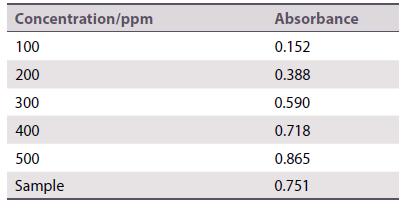
A sample of water from a reservoir was analysed for copper content. The sample was filtered and diluted 10-fold with deionized water. A set of standards was prepared with copper concentrations between 100 and 500 ppm. The standards and the sample were aspirated into an atomic absorption
(a) Calculate the wavelength associated with a neutron moving at 2.60 km s−1. Is this wavelength suitable for diffraction studies (mn = 1.675 × 10⁻²⁷ kg)? (b) For magnetic neutron diffraction studies long neutron wavelengths are often needed; calculate the velocity of a neutron that has
Discuss the importance of NMR spectroscopy in the development of Group 18 chemistry.
Discuss why the length of an O–H bond obtained from X-ray diffraction experiments averages 85 pm whereas that obtained in neutron diffraction experiments averages 96 pm. Would you expect to see similar effects with C–H bond lengths measured by these techniques?
Ionization techniques in mass spectrometry frequently induce fragmentation and other undesirable reactions. However, under some circumstances these reactions can be helpful. Using fullerenes as an example, discuss this phenomenon.
Explain why a Raman band assigned to the symmetric N–C stretching mode in N(CH3)3 shows a shift to lower frequency when 14N is substituted by 15N but no such shift is observed for the N–Si symmetric stretch in N(SiH3)3.
Discuss how EXAFS can be used to follow the isomerization of the spiked triangular cluster [Ru3Pt(μ-H)(μ4-η2-CCBut) (CO)9(dppe)] (dppe = 1,2 bis(diphenylphosphino)ethane) to the butterfly cluster [Ru3Pt(μ4-η2-C=CHBut)(CO)9(dppe)].
The ambidentate thiocyanate ligand (SCN−) can coordinate to a metal centre either through sulfur (SCN) or nitrogen (NCS), Chapter 7. Explain the following observed vibrational frequencies for the C–S bond (ν(CS)): K2[Co(SCN)4].4H2O, 850 cm−1; KSCN, 746 cm−1; K2[Pd(SCN)4], 730 cm−1.
Discuss how you would carry out the following analyses and determinations: (a) Calcium levels in breakfast cereal, (b) Mercury in shellfish, (c) The geometry of BrF5, (d) The number and type of organic ligands in a d-metal complex, (e) The number of coordinated ammonia
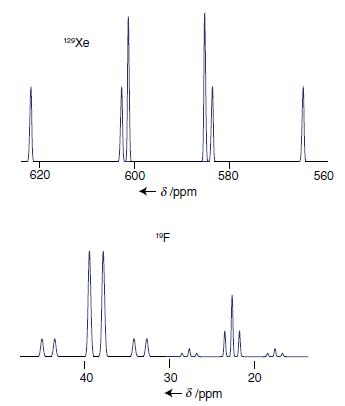
The 129Xe- and 19F-NMR spectra of [XeF3]+ are shown in Fig. 8.56. Interpret these spectra in light of the shape of [XeF3]+ predicted from VSEPR theory.Figure 8.56. 620 سد 129Xe | 40 600 ← - 6 /ppm 10F 580 سل السيد بلد ا 30 ← 8/ppm 20 560
Calculate the expected wavenumber for an N–D stretch given that N–H stretches are normally observed at 3400 cm−1.
Suggest reasons for the order of stretching frequencies observed with isoelectronic diatomic species: CN− > CO > NO+. Predict a position for the carbide anion [C2]2−, which is found in calcium carbide CaC2, in this series.
A sample from an effluent stream was analysed for phosphate levels. Dilute hydrochloric acid and excess sodium molybdate were added to a 50 cm3 sample of the effluent. The molybdophosphoric acid, H3PMo12O40, that was formed was extracted into two 10 cm3 portions of an organic solvent. A molybdenum
The particles sizes determined using powder X-ray diffraction data peak widths (using the Scherrer formula which is widely described in the literature) and those obtained from imaging using electron microscopy often differ, with electron microscopy normally yielding a larger value. Find out why
The 31P-NMR spectrum of PF3Cl2 consists of a doublet of triplets. Explain this observation.
Explain the observation that the 19F-NMR spectrum of the [XeF5]− anion consists of a central peak symmetrically flanked by two peaks, each of which is roughly one-sixth of the intensity of the central peak. Predict the form of the 129Xe-NMR spectrum for this ion. 129Xe, I = ½, 26.5 per cent
Explain why the 13C-NMR spectrum of [Fe3(CO)12] shows only a single peak at 212.5 ppm at room temperature while the IR spectrum shows the presence of both terminal and bridging carbonyl groups. How might the 13C-NMR spectrum change on cooling?
The 31P-MAS-NMR spectrum of solid PCl5 shows two resonances, one of which has a chemical shift similar to that found for 31P in the salt CsPCl6. Explain.
The solution 31P-NMR spectrum of P4S3 consists of a doublet and quartet with intensities in the ratio 3:1. Suggest a structure consistent with this pattern.
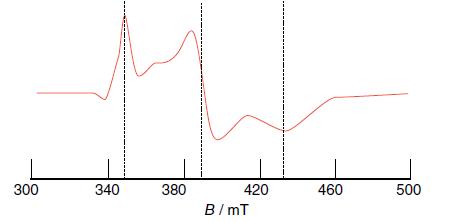
Determine the g values of the EPR spectrum shown in Fig. 8.57, measured for a frozen sample using a microwave frequency of 9.43 GHz.Figure 8.57 300 340 380 420 B/mT 460 500
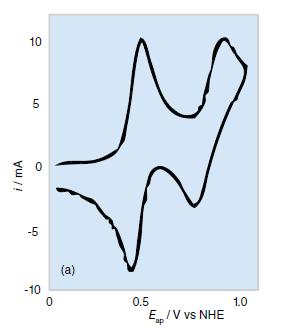
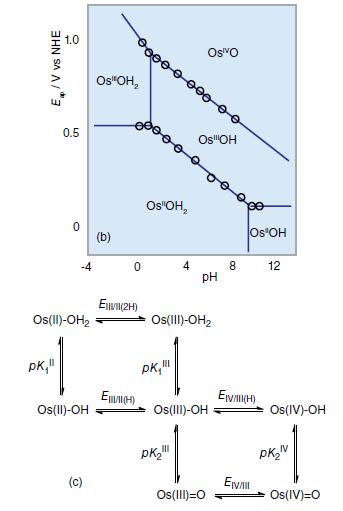
How would the cyclic voltammetry shown in Fig. 8.53a differ if (a) The Os(IV) complex decomposed rapidly; (b) Os(III) is oxidized in a single, rapid two-electron step to Os(V)?Figure 8.53a. i/mA 10 LO 5 O -5 -10 0 (a) 0.5 Ep/V vs NHE ap 1.0
Sketch the forms of the following solution phase NMR spectra (abundances shown as per cent):(a) The 1H-NMR spectrum of KBH4(b) The 1H- and 195Pt-NMR spectra of cis-[Pt(CO)2(H)Cl] 1H, I = ½, 100 per cent; 195Pt, I = ½, 34 per cent; 10B, I = 3; 20 per cent; 11B, I = 3/2; 80 per cent; no other
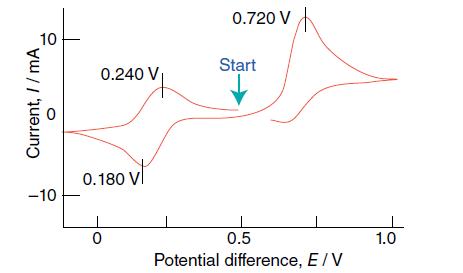
Interpret the cyclic voltammogram shown in Fig. 8.58, which has been recorded for an Fe(III) complex in aqueous solution.Figure 8.58. 10 Current, // mA Currer -10 0.240 V₁ 0.180 VI 0 0.720 V Start 0.5 Potential difference, E / V 1.0
Which technique is sensitive to the fastest processes, NMR or EPR?
The EPR spectrum of bis[tris(2-pyridyl)methane]copper(II) dinitrate is isotropic at 293 K, but is axial with g∥ > g⊥ at 150 K. Explain these observations by references to the EPR timescale and dynamic Jahn–Teller distortions that can occur in copper complexes.
Predict a value for the isomer shift for iron in the Mössbauer spectrum of Na3Fe(V)O4.
For a paramagnetic compound of a d-metal having one unpaired electron, outline the main difference you would expect between an EPR spectrum measured in aqueous solution at room temperature and one recorded for a frozen solution.
Some formally Fe(IV) compounds, such as CaFeO3, are believed to contain the iron as a mixture of Fe(III) and Fe(V). Predict the key features of the 57Fe Mössbauer spectra of this compound when described as (a) CaFe(IV)O3 (b) CaFe(III)0.5Fe(V)0.5O3, assuming iron is in a regular
How could the analysis of the XANES spectrum at the Fe K-edge help identify the iron oxidation state(s) present in CaFeO3 as discussed in Exercise 8.26?Data from Exercises 26.Some formally Fe(IV) compounds, such as CaFeO3, are believed to contain the iron as a mixture of Fe(III) and Fe(V). Predict
Addition of concentrated HCl to an aqueous solution of CoSO4.7H2O results in major changes to the Co K-edge EXAFS spectrum. Explain this observation.
Explain why, even though the average atomic mass of silver is 107.9mu, no peak at 108mu is observed in the mass spectrum of pure silver. Describe the expected form of the molecular ion peak in the mass spectra of (a) Methyl silver CH3Ag (b) Methylsilver tetramer, (CH3Ag)4.
What peaks should you expect to observe in the mass spectrum of [Mo(C6H6)(CO)3]?
Thermogravimetric analysis of a zeolite of composition CaAl2Si6O16.nH2O shows a mass loss of 25 per cent on heating to dryness. Determine n.
LiBH4 has been proposed as a possible hydrogen storage material. Heating LiBH4 on a thermobalance to 1000°C results in a weight loss of 18.5 per cent. Is all the hydrogen released during this decomposition?
Sodium carbonate, boron oxide, and silicon dioxide when heated together and quickly cooled produce a borosilicate glass. Explain why the powder diffraction pattern of this product shows no diffraction maxima. Heating the borosilicate glass in a DTA instrument shows an exothermic event at 500°C and
A cobalt(II) salt was dissolved in water and reacted with excess acetylacetone (2,4-pentanedione, CH3COCH2COCH3) and hydrogen peroxide. A green solid was formed that gave the following results for elemental analysis: C, 50.4 per cent; H, 6.2 per cent; Co, 16.5 per cent (all by mass). Determine the
Particle sizes in the range 50–1000 nm can be determined using powder X-ray diffraction as the particle size in this range is inversely correlated with diffraction peak width. How else could a particle size in this range be measured? What technique could be used to measure the size of particles
How would you determine the composition of a crystal obtained from the reaction of CuS, SnS, and ZnS in a sealed tube, without destroying it? The analysis shows the following atomic weight percentages, Cu 26.74 per cent, Zn 15.83 percent, Sn 10.90 per cent, and S 46.54 per cent. Determine the
Give the expected maximum stable oxidation state for (a) Ba,(b) As, (c) P, (d) Cl, (e) Ti, (f) Cr.
In January 2016 the International Union of Pure and Applied Chemistry (IUPAC) announced the discovery of four new elements with atomic numbers 113, 115, 117, and 118. These elements are very unstable and form isotopes of more stable elements by radioactive decay. Assuming that samples of these
With the exception of one member of the group, the elements form saline hydrides. They form oxides and peroxides and all the carbides react with water to liberate a hydrocarbon. Identify this group of elements.
In the paper ‘Diffusion cartograms for the display of periodic table data’ (J. Chem. Educ., 2011, 88, 1507), M.J. Winter describes a technique commonly used in geography to represent periodic trends. Write a critique of this method by comparing two of the cartograms with two of the figures used
The elements vary from metals through metalloids to nonmetals. They form fluorides in oxidation states +5 and +3 and the hydrides are all toxic gases. Identify this group of elements.
In the paper ‘What and how physics contributes to understanding the periodic law’ (Found. Chem., 2001, 3, 145), V. Ostrovsky describes the philosophical and methodological approaches taken by physicists to explain periodicity. Compare and contrast the approaches of physics and chemistry to
The elements are all metals. The most stable oxidation state at the top of the group is +3, the most stable at the bottom is +6. Identify the group of elements.
Use the following data to calculate average values of B(Se–F) in SeF4 and SeF6. Comment on your answers in view of the corresponding values for B(S-F) in SF, (+340 kJ mol-¹) and SF a (+329kJmol-¹): AH (Se) = +227 kJ mol, A H (F)= +159 kJmol-¹, AH (SeF,g)=-1030 kJ mol-¹, AH (SeF,g)=-850 kJ
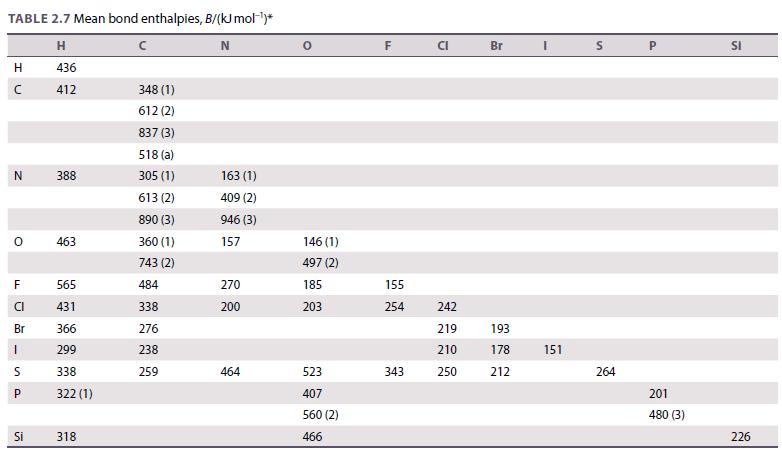
Use the bond enthalpy data in Table 2.7 to calculate the enthalpy of formation for NF3 and NCl3. Explain why NF3 is thermodynamically stable whereas NCl3 is unstable and reactive.Table 2.7. TABLE 2.7 Mean bond enthalpies, B/(kJ mol-¹)* H N 436 412 H с N O F LL 565 431 Br 366 1 299 338 322
P. Christiansen et al. describe ‘Relativistic effects in chemical systems’ in their 1985 paper (Annu. Rev. Phys. Chem., 2001, 36, 407). How did they define relativistic effects? Briefly summarize the most important consequences of relativistic effects in chemistry.
Draw a Born–Haber cycle for the formation of the hypothetical compound NaCl2. State which thermochemical step is responsible for the fact that NaCl2 does not exist.
Many models of the periodic table have been proposed since the version devised by Mendeleev. Review the more recent versions and discuss the theoretical basis for each one.
Predict how the inert-pair effect would manifest itself beyond Group 15 and compare your predictions with the chemical properties of the elements involved.
Summarize the relationship between ionic radii, ionization energy, and metallic character.
Which one of each of the following pairs has the higher first ionization energy: (a) Be or B, (b) C or Si, (c) Cr or Mn
Which one of each of the following pairs is the more electronegative: (a) Na or Cs, (b) Si or O
Classify each of the following hydrides as saline, molecular or metallic: (a) LiH, (b) SiH4, (c) B2H6, (d) UH3, (e) PdHx (x < 1).
Classify each of the following oxides as acidic, basic, or amphoteric: (a) Na2O, (b) P2O5 , (c) ZnO, (d) SiO2, (e) Al2O3,(f) MnO.
Place the following halides in order of increasing covalent character: CrF2, CrF3, CrF6.
Give the names of the ores from which (a) Mg, (b) Al,(c) Pb, (d) Fe are extracted.
Identify the Z + 8 element for P. Briefly summarize any similarities between the elements.
Identify the Z + 22 element for tin and summarize any similarities between them.
It has been suggested that hydrogen could be placed in Group 1, Group 14, or Group 17 of the periodic table. Give arguments for and against each of these positions.
In their article ‘Hydrogen storage in metal–organic frameworks’ (Chem. Soc. Rev., 2009, 38, 1294), Jeffrey Long and co-workers discuss some of the design principles for hydrogen storage materials. List the advantages and disadvantages of storing H2 by using weak rather than strong binding
Comment on the following radii of the H− ion calculated from structures of ionic compounds. LiH NaH KH CsH MgH, CaH₂ BaH₂ Radius/pm 114 129 134 139 109 106 111
Assign oxidation numbers to the elements in (a) H2S, (b) KH, (c) [ReH9]2−, (d) H2SO4, (e) H2PO(OH).
In his paper ‘The proper place for hydrogen’ (J. Chem. Educ., 2003, 80, 947), M.W. Cronyn argues that hydrogen should be placed at the head of Group 14 immediately above carbon. Summarize his reasoning.
Write balanced chemical equations for three major industrial preparations of hydrogen gas. Propose two different reactions that would be convenient for the preparation of hydrogen in the laboratory.
Spectroscopic evidence has been obtained for the existence of [Ir(C5H5)(H3)(PR3)]+, a complex in which one ligand is formally H3+. Devise a plausible molecular orbital scheme for the bonding in the complex, assuming that an angular H3 unit occupies one coordination site and interacts with the eg
Preferably without consulting reference material, construct the periodic table, identify the elements, and (a) Indicate positions of salt-like, metallic, and molecular hydrides, (b) Add arrows to indicate trends in ΔfG⊖ for the hydrogen compounds of the p-block elements, (c)
In their article ‘Reversible, metal-free hydrogen activation’ (Science 2006, 314, 1124), Douglas Stephan and co-workers describe how H2 is heterolytically cleaved at a molecule containing only main group elements. Explain the principles of this reaction, the procedures used to investigate the
Describe the expected physical properties of water in the absence of hydrogen bonding.
Which hydrogen bond would you expect to be stronger, S–H…O or O–H…S? Why?
Name and classify the following hydrogen compounds: (a) BaH2, (b) SiH4, (c) NH3, (d) AsH3, (e) PdH0.9, (f) HI.
Identify the compounds from Exercise 10.7 that provide the most pronounced example of the following chemical characteristics and give a balanced equation that illustrates each of the characteristics: (a) Hydridic character, (b) Brønsted acidity,(c) Variable composition, (d) Lewis
Divide the compounds in Exercise 10.7 into those that are solids, liquids, or gases at room temperature and pressure. Which of the solids are likely to be good electrical conductors?Data from Exercises 10.7.Name and classify the following hydrogen
Identify the reaction that is most likely to give the highest proportion of HD and give your reasoning:(a) H2 + D2 equilibrated over a platinum surface, (b) D2O + NaH,(c) electrolysis of HDO.
Identify the compound in the following list that is most likely to undergo radical reactions with alkyl halides, and describe the reason for your choice: H2O, NH3, (CH3)3SiH, (CH3)3SnH.
What is the trend in hydridic character of BH4−, AlH4−, and GaH4−? Which is the strongest reducing agent? Give the equations for the reaction of GaH4− with excess 1 M HCl(aq).
Describe the important physical differences and a chemical difference between each of the hydrogen compounds of the p-block elements in Period 2 with their counterparts in Period 3.
Stibane, SbH3 (ΔfH⦵= +145.1 kJ mol−1), decomposes above −45°C. Assess the difficulty in preparing a sample of BiH3 (ΔfH⦵= +277.8 kJ mol−1) and suggest a method for its preparation.
What type of substance is formed by the interaction of water and krypton at low temperatures and elevated krypton pressure? Describe the structure in general terms.
Sketch the approximate potential energy surfaces for the hydrogen bond between H2O and the Cl− ion and contrast this with the potential energy surface for the hydrogen bond in [FHF]−.
Dihydrogen is a familiar reducing agent, but it is also an oxidizing agent. Explain this statement, giving examples.
Comment on the observation that addition of hydrogen gas to the complex trans-[W(CO)3(PCy3)2] (Cy = cyclohexyl) results in formation of two complexes that are in equilibrium with one another. One complex has the tungsten centre in a formal W(0) oxidation state while the other is in a formal W(II)
Correct the faulty statements in the following description of hydrogen compounds. ‘Hydrogen, the lightest element, forms thermodynamically stable compounds with all of the nonmetals and most metals. The isotopes of hydrogen have mass numbers of 1, 2, and 3, and the isotope of mass number 2 is
What is the expected infrared stretching wavenumber of gaseous 3H35Cl given that the corresponding value for 1H35Cl is 2991 cm−1?
Infrared spectrometers can have optical windows made of NaCl, KBr, or CsI. What is the disadvantage of using CsI optics?
Recommend a specific cation for the quantitative precipitation of selenate ion, SeO42−, from water. Suggest two different cations, one that would have a soluble phosphate (PO43−) and the other a highly insoluble phosphate.
Which of the following pairs of isostructural compounds are likely to undergo thermal decomposition at lower temperature? Give your reasoning. (a) MgCO3 and CaCO3 (decomposition products MO + CO2). (b) CsI3 and N(CH3)4I3 (both compounds contain the [I3]− anion; decomposition products MI
The anion [ICl4]− may be synthesized by bubbling Cl2(g) through a solution of iodide ions. This complex anionic species can undergo decomposition, losing Cl2, to form initially [ICl2]− and eventually regenerating I−. Suggest a counter-ion you could use to crystallize [ICl4]− and prevent its
Showing 700 - 800
of 1950
1
2
3
4
5
6
7
8
9
10
11
12
13
14
15
Last
Step by Step Answers

 Get 50% OFF
Claim Now
Get 50% OFF
Claim Now