New Semester
Started
Get
50% OFF
Study Help!
--h --m --s
Claim Now
Question Answers
Textbooks
Find textbooks, questions and answers
Oops, something went wrong!
Change your search query and then try again
S
Books
FREE
Study Help
Expert Questions
Accounting
General Management
Mathematics
Finance
Organizational Behaviour
Law
Physics
Operating System
Management Leadership
Sociology
Programming
Marketing
Database
Computer Network
Economics
Textbooks Solutions
Accounting
Managerial Accounting
Management Leadership
Cost Accounting
Statistics
Business Law
Corporate Finance
Finance
Economics
Auditing
Tutors
Online Tutors
Find a Tutor
Hire a Tutor
Become a Tutor
AI Tutor
AI Study Planner
NEW
Sell Books
Search
Search
Sign In
Register
study help
sciences
inorganic chemistry
Inorganic Chemistry 5th Edition Catherine Housecroft - Solutions
Discuss the variation in stable oxidation states for the group 11 metals, using examples of metal halides, oxides and complexes to illustrate your answer.
‘The group 12 metals differ significantly from the d-block metals in groups 4–11’. Discuss this statement.
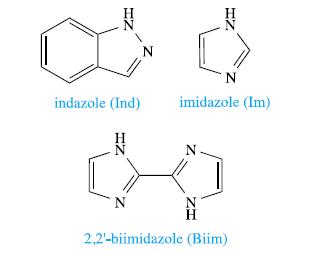
Two complexes that have entered clinical trials as anti-cancer drugs are [HIm][RuCl4(im)(DMSO)] and [HInd][RuCl4(Ind)2]. In the search for related active complexes, [RuCl2(DMSO)2(Biim)] and [RuCl3(DMSO)(Biim)] have been tested; the latter is more cytotoxic against selected human cancer cell lines
Studies of the heavier d-block metals are often used to introduce students to (a) Metal–metal bonding, (b) High coordination numbers, (c) Metal halido clusters (d) Polyoxometallates. Write an account of each topic, and include examples that illustrate why the first row
(a) The reaction of ReCl4 and PCl5 at 570K under vacuum gives [PCl4]2[Re2Cl10]. However, when ReCl5 reacts with an excess of PCl5 at 520 K, the products are [PCl4]3[ReCl6]2 and Cl2. Comment on the nature of [PCl4]3[ReCl6]2 and write equations for both reactions, paying attention to the oxidation
(a) ‘The salt [NH4]3[ZrF7] contains discrete ions with 7-coordinate Zr(IV). On the other hand, in a compound formulated as [NH4]3[HfF7], Hf(IV) is octahedral’. Comment on this statement and suggest possible structures for [ZrF7]3−.(b) 93Nb NMR spectroscopy has provided evidence for halide
Comment on the following statements in terms of the properties of the elements mentioned.(a) For many decades, tungsten was used to make filaments in incandescent light bulbs. Tungsten is used in preference to copper even though the electrical resistivity of tungsten is greater than that of
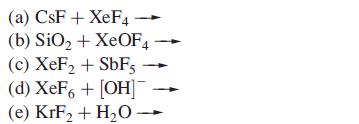
Suggest products for the following reactions (which are not necessarily balanced on the left-hand sides): (a) CsF+ XeF4 (b) SiO₂ + XeOF4 (c) XeF₂ + SbF5 (d) XeF6 + [OH] (e) KrF₂ + H₂O-
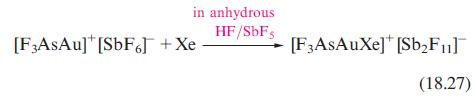
Equation 18.27 showed the preparation of [F3AsAuXe][Sb2F11] from [F3AsAu][SbF6]. Solid [F3AsAu][SbF6] contains a distorted [SbF6]− ion; one Sb–F bond is 193 pm, and five are in the range 185–189pm. The Au centre interacts with the F atom of the long Sb–F bond (Au–F = 212pm, compared with
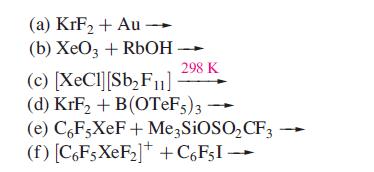
Suggest products for the following reactions, which are not necessarily balanced on the left-hand side: (a) KrF₂ + Au (b) XeO3 + RbOH → 298 K (c) [XeC1] [Sb₂F1] (d) KrF₂ + B (OTeF5)3 (e) C6F-XeF + Me,SiOSO₂ CF3 (f) [C6F5XeF₂]+ + С6F5I¬
(a) What is the fundamental difference between electrochromic, thermochromic and photochromic materials? (b) WO3 is widely used in electrochromic materials. Explain why WO3 is suited to this application. Give a brief description of how an electrochromic window based on WO3 works.(c) Both WO3-
Construct MO diagrams for He2 and [He2]+ and rationalize why the former is not known but the latter may be detected.
Confirm that the observed gas-phase structures of XeF2, XeF4 and XeF6 are consistent with the VSEPR model.
Rationalize the structure of [XeF8]2− (a square antiprism) in terms of the VSEPR model.
Why is XeCl2 likely to be much less stable than XeF2?
How would you attempt to determine values for(a) ΔfH°(XeF2, 298 K) (b) The Xe—F bond energy in XeF2?
Predict the structures of [XeO6]4−, XeOF2, XeOF4, XeO2F2, XeO2F4 and XeO3F2.
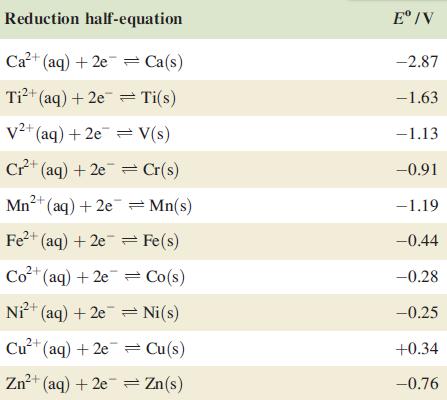
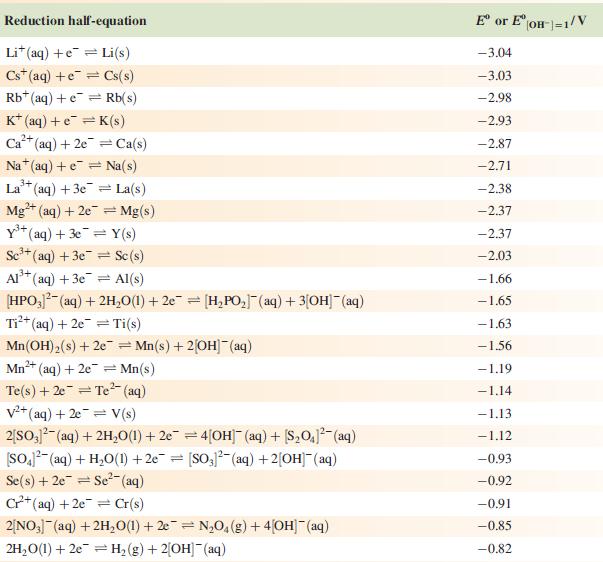
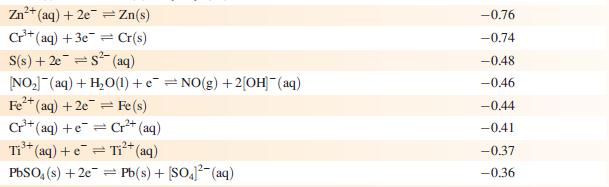
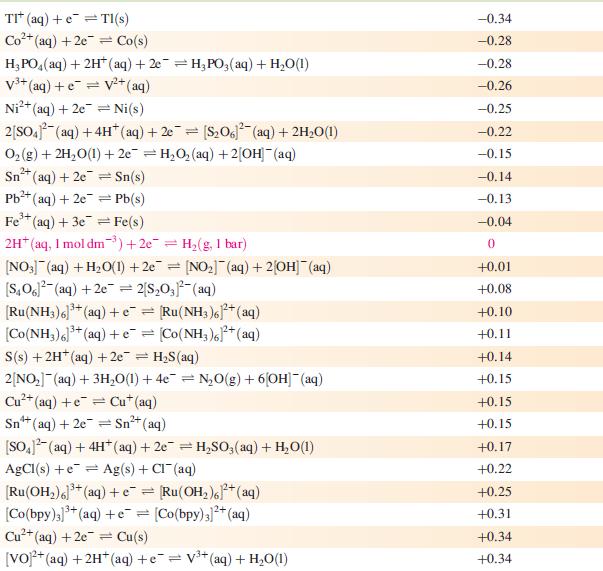
Comment on the reduction potential data in Table 19.1.Data from Table 19.1. Reduction half-equation Ca²+ (aq) + 2e Ca(s) Ti²+ (aq) + 2e Ti(s) V²+ (aq) +2e= V(s) Cr²+ (aq) +2e=Cr(s) Mn²+ (aq) + 2e = Mn(s) 2+ Fe²+ (aq) +2e = Fe(s) Co²+ (aq) + 2e Co(s) Ni²+ (aq) +2e=Ni(s) Cu²+ (aq) + 2e =
Write a brief account of the chemistry of the xenon fluorides.
(a) The reaction of XeF2 with RuF5 at 390K results in the formation of a compound, the Raman spectrum of which is similar to that of CsRuF6 but with an additional band at 600 cm–1. Rationalize these data.(b) When the product of the reaction in part (a) reacts with excess F2 at 620 K, a compound
The reaction of F2C=CClBF2 with XeF2 gives a product A for which the NMR spectroscopic data are as follows: 19F NMR δ/ppm –64.3 (s + d, J 8 Hz, 1F), –75.9 (s + d, J 138 Hz, 1F), −148.1 (non-binomial quartet, J 11 Hz); 129Xe NMR δ/ppm –3550 (dd, J 8 Hz, 138 Hz) (s = singlet, d = doublet,
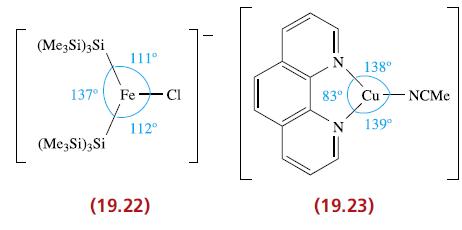
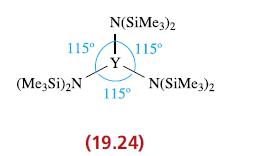
Structures 19.22–19.24 show bond angle data (determined by X-ray diffraction) for some complexes with low coordination numbers. Comment on these data, suggesting reasons for deviations from regular geometries. (Me3Si) 3 Si 111⁰ 137° Fe-CI (Me3Si) 3 Si 112° (19.22) N 83⁰ 138⁰ Cu NCMe N
(a) The 19F NMR spectrum of [Kr2F3][SbF6] in BrF5 at 207K contains a doublet (J = 347 Hz) and triplet (J = 347 Hz) assigned to the cation. Explain the origin of these signals.(b) Give examples that illustrate the role of E—F—Xe and E—F—Kr bridge formation (E = any element) in the solid
By referring to the following literature source, assess the safety precautions required when handling XeO4: M. Gerken and G.J. Schrobilgen (2002) Inorg. Chem., vol. 41, p. 198.
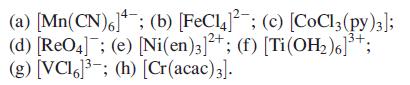
For each of the following complexes, give the oxidation state of the metal and its dn configuration: (a) [Mn(CN)6]; (b) [FeC¹4]¯¯; (c) [CoCl3 (py)3]; (d) [ReO4]; (e) [Ni(en)3]2+; (f) [Ti (OH₂)6]³+; (g) [VCI6³; (h) [Cr(acac) 3].
The vibrational modes of KrF2 are at 590, 449 and 233 cm−1. Explain why only the bands at 590 and 233 cm−1 are observed in the IR spectrum of gaseous KrF2.
Use MO theory to rationalize why the Xe—F bond strength in [XeF]+ is greater than in XeF2.
High-field NMR spectrometers, including those used for magnetic resonance imaging in hospitals, contain magnets with superconducting coils, e.g. NbTi which becomes superconducting at 9.5 K. (a) Why is liquid helium used to cool the magnet? (b) For He, ΔvapH(bp) = 0.1 kJ mol−1. To what
Discharge lamps are used throughout the world for lighting and advertising. Such a lamp consists of a sealed tube with a metal electrode at each end, and contains a gas (e.g. He, Ar, Ne) or vapour (Na, Hg). The atoms are excited by an electrical discharge. Explain the origin of the pale yellow glow
Comment on (a) The observation of variable oxidation states among elements of the s- and p-blocks, and(b) The statement that ‘variable oxidation states are a characteristic feature of any d-block metal’.
(a) Write down, in order, the metals that make up the first row of the d-block and give the ground state valence electronic configuration of each element.(b) Which triads of metals make up groups 4, 8 and 11 in the first three rows? (c) Which metals are collectively known as the platinum-group
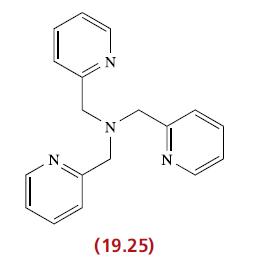
Suggest a structure for the complex [CuCl(19.25)]+ assuming that all donor atoms are coordinated to the Cu(II) centre. N N N (19.25) N
By referring to relevant sections earlier in the book, write a brief account of the formation of hydrides, borides, carbides and nitrides of the d-block metals.
What isomers would you expect to exist for the platinum(II) compounds: (a) [Pt (H₂NCH₂CHMENH₂)2] Cl₂, and (b) [Pt (H₂NCH₂CMе₂NH₂) (H₂NCH₂ CPh₂NH₂)] Cl₂?
Give a brief overview of properties that characterize a d-block metal.
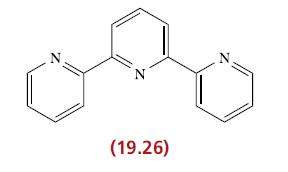
Structure 19.26 shows the ligand tpy (2,2':6',2''-terpyridine). What conformational changes does the ligand undergo when it coordinates to a metal ion? Comment on possible isomer formation in the following complexes: (a) [Ru(py)3Cl3],(b) [Ru(bpy)2Cl2]+(c) [Ru(tpy)Cl3]. (19.26)
Suggest why (a) High coordination numbers are not usual for first row d-block metals, (b) In early d block metal complexes the combination of a high oxidation state and high coordination number is common, (c) In first row d-block metal complexes, high oxidation states are stabilized
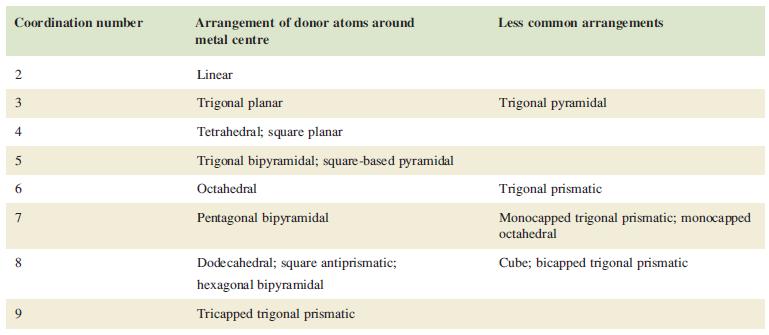
Within the Kepert model, what geometries do you associate with the following coordination numbers:(a) 2; (b) 3; (c) 4; (d) 5; (e) 6
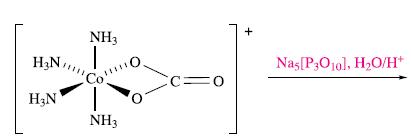
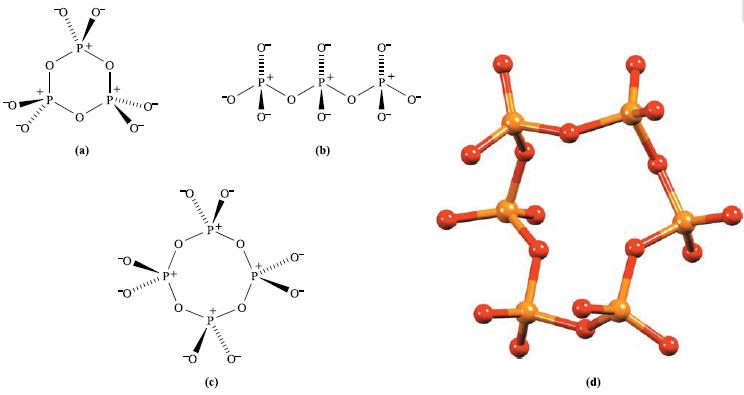
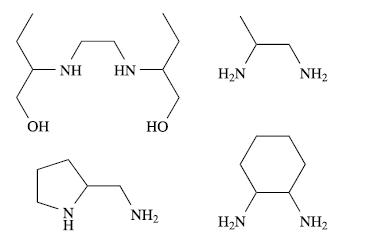
Consider the following reaction in which [P3O10]5− (see Fig. 15.21) displaces the carbonate ion to give a mixture of linkage isomers:(a) Suggest possible coordination modes for the [P3O10]5−ion in the products, given that an octahedral metal centre is retained. (b) How might the products
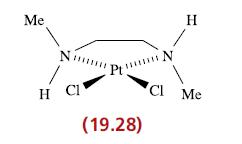
(a) Explain why complex 19.28 is chiral.(b) In each of the following reactions, the left-hand sides are balanced. Suggest possible products and give the structures of each complex formed.(c) What type of isomerism relates the Cr(III) complexes [Cr(en)3][Cr(ox)3] and [Cr(en)(ox)2][Cr(en)2(ox)]? Me H
Show that the trigonal bipyramid, square-based pyramid, square antiprism and dodecahedron belong to the point groups D3h, C4v, D4d and D2d respectively.
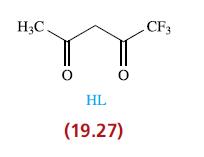
The conjugate base of 19.27 forms the complex [CoL3] which has mer-and fac-isomers. (a) Draw the structures of these isomers, and explain why the labels mer and fac are used. (b) What other type of isomerism does [CoL3] exhibit? (c) When a freshly prepared sample of [CoL3] is chromatographed,
(a) In the solid state, Fe(CO)5 possesses a trigonal bipyramidal structure. How many carbon environments are there?(b) Explain why only one signal is observed in the 13C NMR spectrum of solutions of Fe(CO)5, even at low temperature.
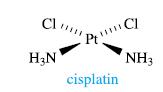
Interactions between DNA and metal complexes are the basis for the use of square planar platinum(II)-containing anti-cancer drugs. (a) Explain how the interaction of right-handed DNA with chiral complexes leads to diastereoisomeric species.(b) How does the replacement of the two NH3 ligands in
(a) The following complexes each possess one of the structures listed in Table 19.4. Use the point group to deduce each structure: [ZnCl4]2− (Td); [AgCl3]2− (D3h); [ZrF7]3− (C2v); [ReH9]2− (D3h); [PtCl4]2− (D4h); [AuCl2]− (D∞h).(b) How does the coordination environment of Cs+ in CsCl
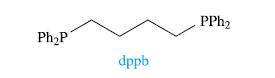
The reaction of [RuCl2(PPh3)(dppb)] with phen leads to the loss of PPh3 and the formation of an octahedral complex, X. The structure of dppb is as follows:The solution 31P{1H} NMR spectrum of a freshly made sample of X shows a singlet at δ 33.2 ppm. The sample is left standing in the light for a
What chemical tests would you use to distinguish between (a) [Co(NH3)5Br][SO4] and [Co(NH3)5(SO4)]Br, and (b) [CrCl2(OH2)4]Cl·2H2O and [CrCl(OH2)5]Cl2·H2O? (c) What is the relationship between these pairs of compounds?(d) What isomers are possible for (CrCl2(OH2)4]+?
How many different forms of [Co(en)3]3+ are possible in principle? Indicate how they are related as enantiomers or diastereoisomers.
State the types of isomerism that may be exhibited by the following complexes, and draw structures of the isomers: (a) [Co(en)2(ox)]+, (b) [Cr(ox)2(OH2)2]−,(c) [PtCl2(PPh3)2], (d) [PtCl2(Ph2PCH2CH2PPh2)] (e) [Co(en)(NH3)2Cl2]+.
Using spectroscopic methods, how would you distinguish between the pairs of isomers (a) cis and trans-[PdCl2(PPh3)2], (b) cis- and trans-[PtCl2(PPh3)2] (c) fac- and mer-[RhCl3(PMe3)3]?
One isomer of [PdBr2(NH3)2] is unstable with respect to a second isomer, and the isomerization process can be followed by IR spectroscopy. The IR spectrum of the first isomer shows absorptions at 480 and 460 cm−1 assigned to n(PdN) modes. During isomerization, the band at 460 cm−1 gradually
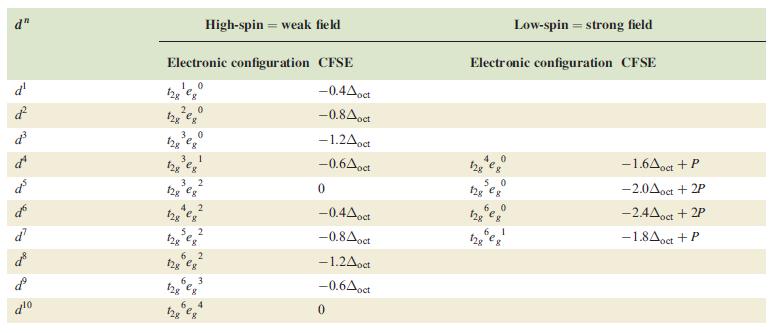
Verify the CFSE values in Table 20.3.Table 20.3 dn dº dlo 128 628 Electronic configuration CFSE 588 128 688 High-spin weak field 688 128 = 3 -0.44 oct -0.84 oct -1.24oct -0.64 oct 0 -0.44 oct -0.84 oct -1.24 oct -0.64 oct 0 Electronic configuration CFSE 128 seso Des 128 bes 128 128 0 Low-spin =
(a) In each of the following complexes, determine the overall charge, n, which may be positive or negative: [FeII(bpy)3]n, [CrIII(ox)3]n, [CrIIIF6]n, [NiII(en)3]n, [MnII(ox)2(OH2)2]n, [ZnII(py)4]n, [CoIIICl2(en)2]n.(b) If the bonding in [MnO4]− were 100% ionic, what would be the charges on the Mn
(a) Which of the following octahedral complexes are chiral: cis-[CoCl2(en)2]+, [Cr(ox)3]3−, trans-[PtCl2(en)2]2+, [Ni(phen)3]2+, [RuBr4(phen)]−, cis-[RuCl(py)(phen)2]+?(b) The solution 31P NMR spectrum of a mixture of isomers of the square planar complex [Pd(SCN)2(Ph2PCH2PPh2)] shows one broad
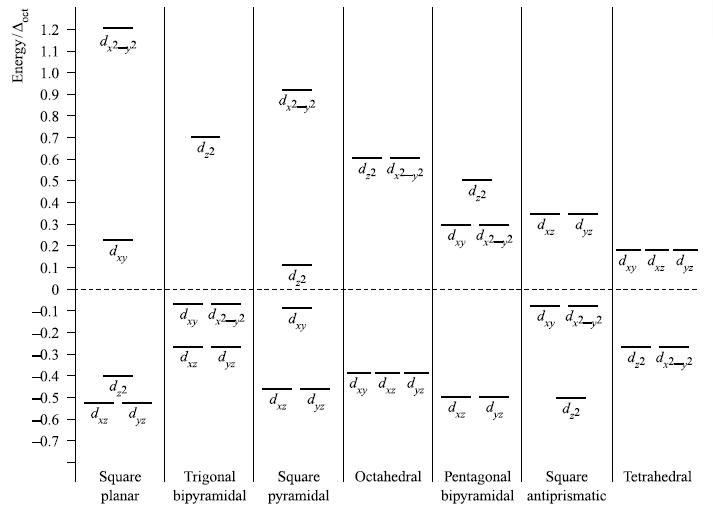
(a) Explain the forms of the d orbital splitting diagrams for trigonal bipyramidal and square pyramidal complexes of formula ML5 shown in Fig. 20.11. (b) What would you expect concerning the magnetic properties of such complexes of Ni(II)?Figure 20.11.
Outline how you would apply crystal field theory to explain why the five d-orbitals in an octahedral complex are not degenerate. Include in your answer an explanation of the ‘barycentre’.
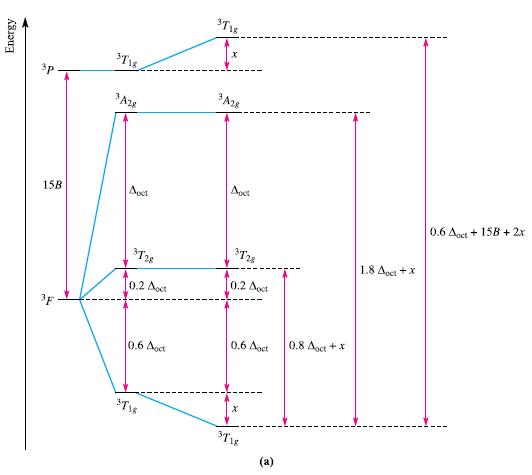
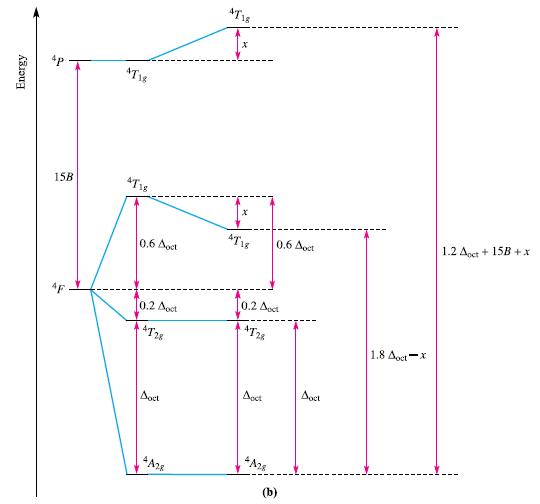
Describe how you could use Fig. 20.23 to determine Δoct and the Racah parameter B from the energies of absorptions observed in the spectrum of an octahedral d3 ion. What are the significant limitations of this method?Figure 20.23. Energy 3p 15B 3F 3A28 Auct 3728 0.2 Aoct 0.6 Дост 3818 3718 3
The absorption spectrum of [Ti(OH2)6]3+ exhibits a band with λmax = 510 nm. What colour of light is absorbed and what colour will aqueous solutions of [Ti(OH2)6]3+ appear?
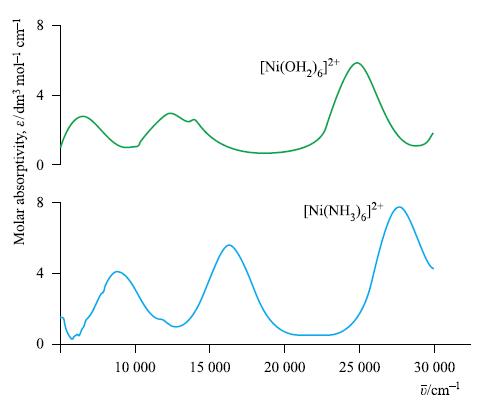
(a) On Fig. 20.21, convert the wavenumber scale to nm.(b) Which part of the scale corresponds to the visible range? (c) What would you predict are the colours of [Ni(OH2)6]2+ and [Ni(NH3)6]2+. (d) Are the spectra in Fig. 20.21 consistent with the relative positions of H2O and NH3 in the
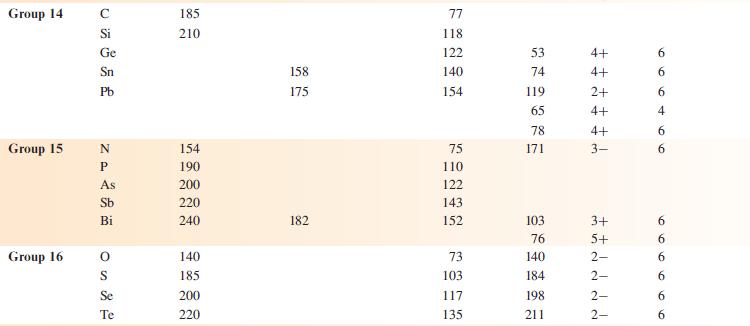
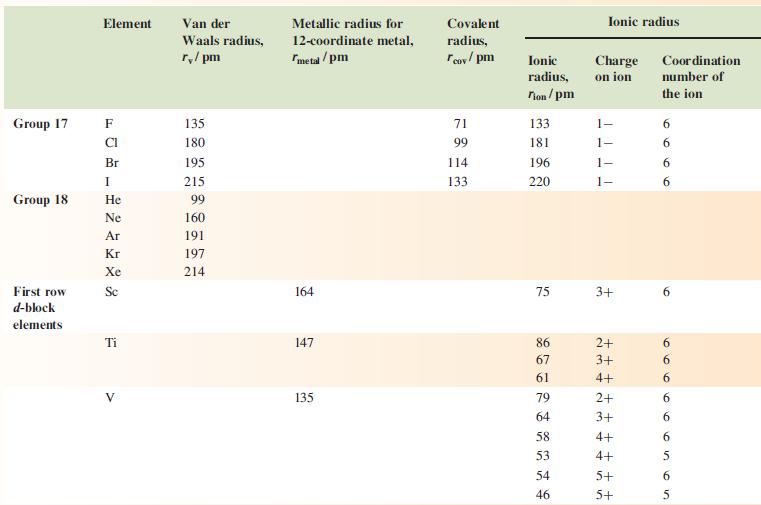
(a) Using data from Appendix 6, plot a graph to show how the ionic radii of high-spin, 6-coordinate M2+ ions of the first row of the d-block vary with the dn configuration. Comment on factors that contribute to the observed trend. (b) Briefly discuss other properties of these metal ions that show
Draw the structures of the following ligands, highlight the donor atoms and give the likely modes of bonding (e.g. monodentate):(a) en; (b) bpy;(c) [CN]−; (d) [N3]−; (e) CO; (f) phen; (g) [ox]2−;(h) [NCS]−; (i) PMe3.
Arrange the following ligands in order of increasing field strength: Br−, F−, [CN]−, NH3, [OH]−, H2O.
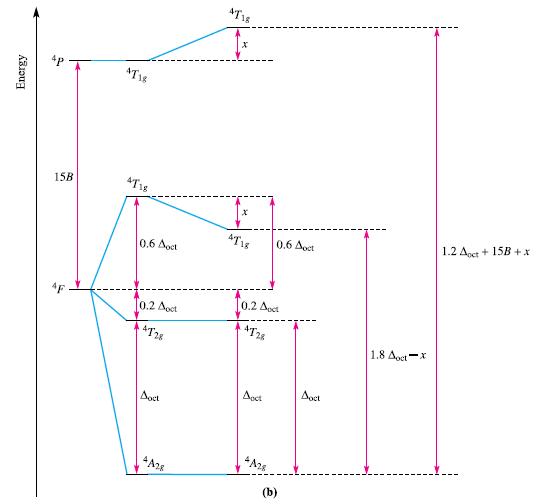
The electronic absorption spectrum of [Co(OH2)6]2+ exhibits bands at 8100, 16000 and 19400 cm–1.(a) Assign these bands to electronic transitions.(b) The value of Δoct for [Co(OH2)6]2+ listed in Table 20.2 is 9300 cm–1. What value of Δoct would you obtain using the diagram in Fig. 20.23b? Why
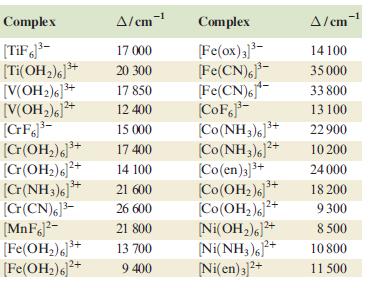
For which member of the following pairs of complexes would Δoct be the larger and why: (a) [Cr(OH2)6]2+ and [Cr(OH2)6]3+ ; (b) [CrF6]3− and [Cr(NH3)6]3+;(c) [Fe(CN)6]4− and [Fe(CN)6]3−; (d) [Ni(OH2)6]2+ and [Ni(en)3]2+; (e) [MnF6]2− and [ReF6]2−;(f) [Co(en)3]3+ and
(a) Explain why there is no distinction between low and high-spin arrangements for an octahedral d8 metal ion. (b) Discuss the factors that contribute to the preference for forming either a high- or a lowspin d4 complex.(c) How would you distinguish experimentally between the two
Use data from Appendix 11 to predict qualitatively the outcome of the following experiment at 298 K:Cr is dissolved in excess of molar HClO4 and the solution is shaken in air.Data from Appendix 11The concentration of each aqueous solution is 1 mol dm−3 and the pressure of a gaseous component is 1
In each of the following complexes, rationalize the number of observed unpaired electrons (stated after the formula): (a) [Mn(CN)6]4−(1);(b) [Mn(CN)6]2− (3); (c) [Cr(en)3]2+ (4);(d) [Fe(ox)3]3− (5); (e) [Pd(CN)4]2− (0);(f) [CoCl4]2− (3); (g) [NiBr4]2− (2).
(a) What do you understand by the nephelauxetic effect? (b) Place the following ligands in order of increasing nephelauxetic effect: H2O, I−, F−, en, [CN]−, NH3.
Discuss each of the following observations:(a) The [CoCl4]2− ion is a regular tetrahedron but [CuCl4]2− has a flattened tetrahedral structure.(b) The electronic absorption spectrum of [CoF6]3−contains two bands with maxima at 11500 and 14500 cm−1.
The 3p2 configuration of an Si atom gives rise to the following terms: 1S0, 3P2, 3P1, 3P0 and 1D2. Use Hund’s rules to predict the relative energies of these terms, giving an explanation for your answer.
With reference to the 3F, 1D, 3P, 1G and 1S terms of a d2 configuration, explain how you can use term symbols to gain information about allowed electronic transitions.
What term or terms arise from a d10 configuration, and what is the ground state term? Give an example of a first row d-block metal ion with this configuration.
What are the limitations of the Russell–Saunders coupling scheme?
Which of the following ions are diamagnetic:Rationalize your answer. (a) [Co(OH₂)6]³+, (b) [CoF³, (c) [NiF², (d) [Fe(CN)6]³, (e) [Fe(CN)6], (f) [Mn(OH₂)6]²+?
Deduce possible J values for a 3F term. What is the degeneracy of each of these J levels, and what happens when a magnetic field is applied? Sketch an energy level diagram to illustrate your answer, and comment on its significance to EPR spectroscopy
In an octahedral field, how will the following terms split, if at all: (a) 2D, (b) 3P (c) 3F
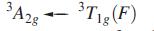
(a) Set up a table of microstates to show that the ground term for the d1 ion is the singlet 2D. What are the components of this term in a tetrahedral field? (b) Repeat the process for a d2 ion and show that the ground and excited terms are the 3F and 3P. What are the components of these terms
Discuss each of the following observations:(a) Although Co2+ (aq) forms the tetrahedral complex [CoCl4]2− on treatment with concentrated HCl, Ni2+ (aq) does not form a similar complex.(b) E° for the half-reaction:depends on the pH of the solution, being most positive in strongly acidic
(a) How many ‘d–d’ bands would you expect to find in the electronic absorption spectrum of an octahedral Cr(III) complex? (b) Account for the observation that the colour of trans-[Co(en)2F2]+is less intense than those of cis-[Co(en)2F2]+ and trans-[Co(en)2Cl2]+.
(a) Explain clearly why, under the influence of an octahedral crystal field, the energy of the dz2 orbital is raised whereas that of the dxz orbital is lowered. State how the energies of the other three d orbitals are affected. With respect to what are the orbital energies raised or lowered?(b)
Comment on the following statements concerning electronic absorption spectra.(a) [OsCl6]3– and [RuCl6]3– exhibit LMCT bands at 282 and 348 nm, respectively.(b) [Fe(bpy)3]2+ is expected to exhibit an MLCT rather than an LMCT absorption.
Rationalize why the absorption spectrum of an aqueous solution of [Ti(OH2)6]2+ (stable under acidic conditions) exhibits two well-separated bands (430 and 650 nm) assigned to ‘d–d’ transitions, whereas that of an aqueous solution of [Ti(OH2)6]3+ consists of one absorption (λmax = 490
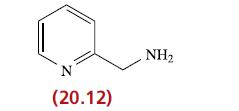
Ligand 20.12 forms an octahedral complex, [Fe(20.12)3]2+. (a) Draw diagrams to show what isomers are possible. (b) [Fe(20.12)3]Cl2 exhibits spin crossover at 120 K. Explain clearly what this statement means. N (20.12) NH₂
(a) The values of εmax for the most intense absorptions in the electronic spectra of [CoCl4]2− and [Co(OH2)6]2+ differ by a factor of about 100. Comment on this observation and state which complex you expect to exhibit the larger value of εmax.(b) In the electronic absorption spectrum of a
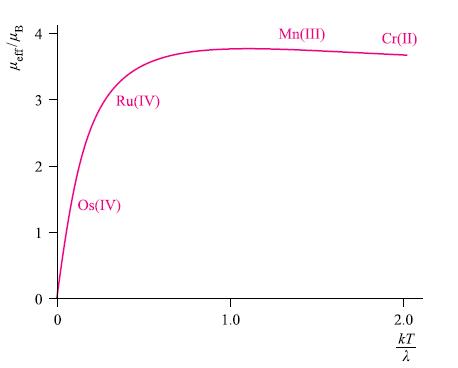
(a) A Kotani plot for the t2g1 configuration consists of a curve similar to that in Fig. 20.29, but levelling off at μeff ≈ 1:8 μB when kT/λ ≈ 1:0. Suggest two metal ions that you might expect to possess room temperature values of μeff(i) On the near horizontal part of the curve (ii) On
Values of the Racah parameter B for free gaseous Cr3+, Mn2+ and Ni2+ ions are 918, 960 and 1041 cm–1, respectively. For the corresponding hexaaqua ions, values of B are 725, 835 and 940 cm–1. Suggest a reason for the reduction in B on forming each complex ion.
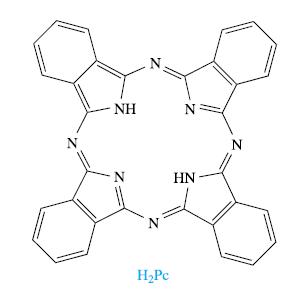
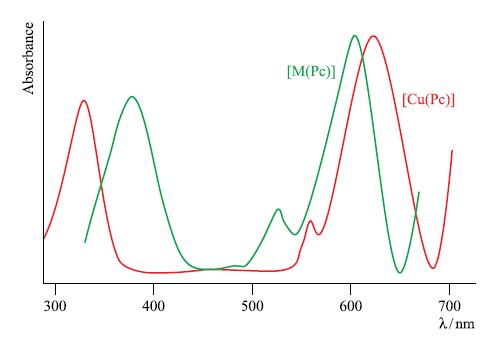
The structure of phthalocyanine is shown below:The complex [Cu(Pc)] is an important commercial pigment and its electronic absorption spectrum is shown in Fig. 20.40. The absorption spectrum represented by the green line in Fig. 20.40 arises from another metal(II) phthalocyanine complex,
Find x in the formulae of the following complexes by determining the oxidation state of the metal from the experimental values of μeff : (a) [VClx(bpy)], 1.77μB; (b) Kx[V(ox)3], 2.80 μB; (c) [Mn(CN)6]x−, 3.94 μB. What assumption have you made and how valid is it?
Explain why in high-spin octahedral complexes, orbital contributions to the magnetic moment are only important for d1, d2, d6 and d7 configurations.
The observed magnetic moment for K3[TiF6] is 1.70 μB. (a) Calculate μ(spin-only) for this complex.(b) Why is there a difference between calculated and observed values?
Comment on the observations that octahedral Ni(II) complexes have magnetic moments in the range 2.9–3.4 μB, tetrahedral Ni(II) complexes have moments up to ≈ 4:1 μB, and square planar Ni(II) complexes are diamagnetic.
For which of the following ions would you expect the spin-only formula to give reasonable estimates of the magnetic moment: (a) [Cr(NH3)6]3+, (b) [V(OH2)6]3+, (c) [CoF6]3−? Rationalize your answer.
Values of Δoct for [Ni(OH2)6]2+ and high-spin [Mn(OH2)6]3+ have been evaluated spectroscopically as 8500 and 21000 cm−1 respectively. Assuming that these values also hold for the corresponding oxide lattices, predict whether NiIIMn2IIIO4 should have the normal or inverse spinel structure. What
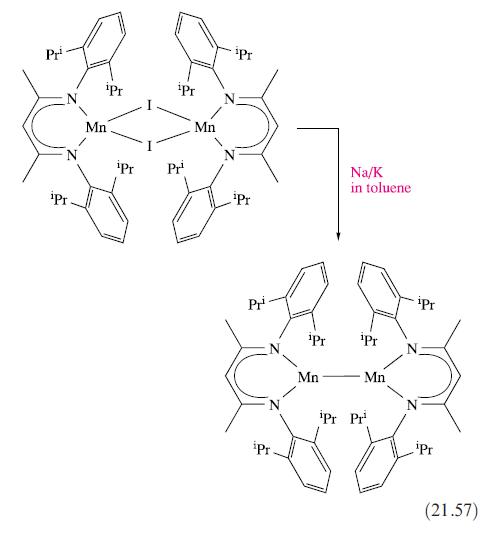
Comment on the modes of bonding of the ligands in the Mn(II) complexes listed at the end of Section 21.8, drawing attention to any conformational restrictions.Data from Section 21.8 Pr Pr iPr Mn iPr iPr Pr¹ Mn Pr ¹Pr Pr N iPr ¹Pr Mn Na/K in toluene Pr Mn iPr Pr Pr ipr (21.57)
(a) Which of the following complexes would you expect to suffer from a Jahn–Teller distortion: [CrI6]4−, [Cr(CN)6]4−, [CoF6]3− and [Mn(ox)3]3−? Give reasons for your answers.(b) [Et4N]2[NiBr4] is paramagnetic, but K2[PdBr4] is diamagnetic. Rationalize these observations.(c) Using a simple
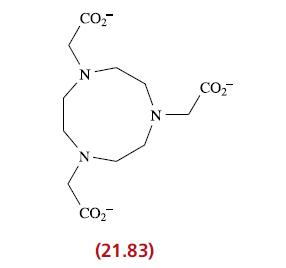
Suggest the formula and structure of the mononuclear complex formed between Cr3+ and ligand 21.83. Comment on possible isomerism. CO₂ N CO₂ N (21.83) CO₂
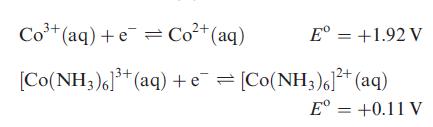
How would you attempt to (a) Estimate the crystal field stabilization energy of FeF2,(b) Determine the overall stability constant of [Co(NH3)6]3+ in aqueous solution given that the overall formation constant for [Co(NH3)6]2+ is 105, and: Co+(aq)+e=Cot(aq) Eº = +1.92 V [Co(NH3)6]³+ (aq) + e¯ =
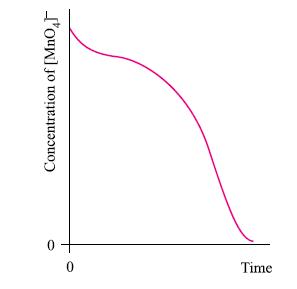
Figure 21.44 shows the change in concentration of [MnO4]− with time during a reaction with acidified oxalate ions. (a) Suggest a method of monitoring the reaction. (b) Explain the shape of the curve.Figure 21.44 Time Concentration of [MnO4]
(a) Explain the origins of MLCT and LMCT absorptions in the electronic spectra of d-block metal complexes. Give examples to illustrate your answer.(b) Explain what information can be obtained from a Tanabe–Sugano diagram.
Write out, in sequence, the first row d-block elements and give the valence electronic configuration of each metal and of its M2+ ion.
Showing 1200 - 1300
of 1950
First
6
7
8
9
10
11
12
13
14
15
16
17
18
19
20
Step by Step Answers

 Get 50% OFF
Claim Now
Get 50% OFF
Claim Now