New Semester
Started
Get
50% OFF
Study Help!
--h --m --s
Claim Now
Question Answers
Textbooks
Find textbooks, questions and answers
Oops, something went wrong!
Change your search query and then try again
S
Books
FREE
Study Help
Expert Questions
Accounting
General Management
Mathematics
Finance
Organizational Behaviour
Law
Physics
Operating System
Management Leadership
Sociology
Programming
Marketing
Database
Computer Network
Economics
Textbooks Solutions
Accounting
Managerial Accounting
Management Leadership
Cost Accounting
Statistics
Business Law
Corporate Finance
Finance
Economics
Auditing
Tutors
Online Tutors
Find a Tutor
Hire a Tutor
Become a Tutor
AI Tutor
AI Study Planner
NEW
Sell Books
Search
Search
Sign In
Register
study help
sciences
inorganic chemistry
Inorganic Chemistry 5th Edition Catherine Housecroft - Solutions
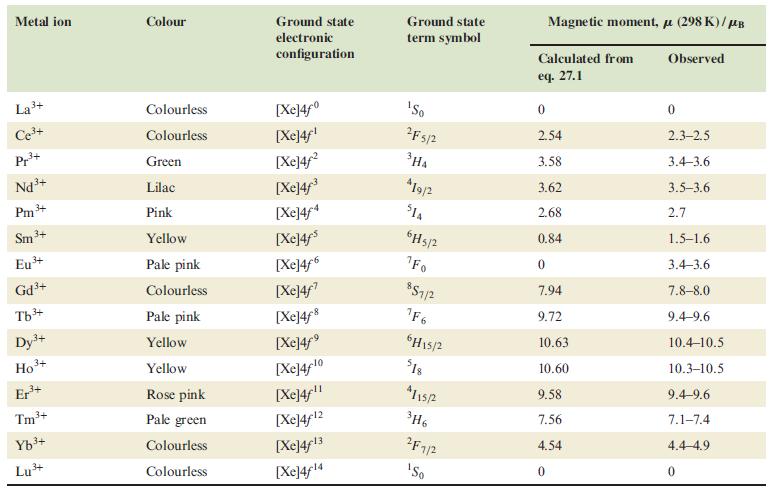
(a) Table 27.3 lists the ‘calculated’ value of μeff for Eu3+ as 0. On what basis is this value calculated? Explain why observed values of μeff for Eu3+ are greater than zero.(b) The complex UO2Cl2(THF)3 contains one labile THF ligand and readily forms a diuranium complex, A, that contains
(a) Give a brief account of the formation of Ln—C σ-bonds and of complexes containing cyclopentadienyl ligands, and comment on the roles of coordinating solvents.(b) Suggest products for the reactions of SmCl3 and SmI2 with K2C8H8.
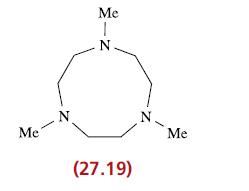
(a) The reaction of ScCl3·nTHF with one equivalent of ligand 27.19 yields a neutral compound A in which the metal is octahedrally sited. A reacts with three equivalents of MeLi to give B. Suggest structures for A and B. What is the oxidation state of the metal in each compound?(b) The complex
25.00 cm3 of a solution X containing 21.4 g U(VI) dm−3 was reduced with Zn amalgam, decanted from the amalgam, and after being aerated for 5 min, was titrated with 0.1200moldm−3 Ce(IV) solution; 37.5cm3 of the latter was required for reoxidation of the uranium to U(VI). Solution X (100cm3) was
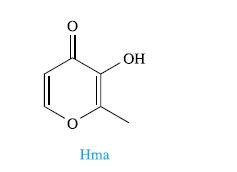
Lanthanoid metal ions, Ln3+, can exchange with, and mimic the function of, Ca2+ ions in the human body. Lanthanum carbonate is administered as chewable tablets under the tradename of Fosrenol® to patients with particularly high levels of phosphate ions in the blood. However, there are significant
Discuss the following statements:(a) Thorium forms iodides of formulae ThI2, ThI3 and ThI4.(b) In the solid state, salts of [UO2]2+ contain a linear cation.(c) Reactions of NaOR with UCl4 lead to monomeric U(OR)4 complexes.
(a) What Th-containing products would you expect from the reactions of (η5-Cp)3ThCl with (i) Na[(η5-Cp)Ru(CO)2, (ii) LiCHMeEt,(iii) LiCH2Ph (b) What advantage does (η5-C5Me5)2ThCl2 have over (η5-Cp)2ThCl2 as a starting material? (c) How might (η5-C5Me5)UI2(THF)3 react with
(a) Suggest a method of preparing U(η3-C3H5)4.(b) How might U(η3-C3H5)4 react with HCl?(c) (η5-C5Me5)(η8-C8H8)ThCl is dimeric, but its THF adduct is a monomer. Draw the structures of these compounds, and comment on the role of coordinating solvents in stabilizing other monomeric organothorium
Discuss the following:(a) Many actinoid oxides are non-stoichiometric, but few lanthanoid oxides are.(b) The ion [NpO6]5− can be made in aqueous solution only if the solution is strongly alkaline.(c) A solution containing Pu(IV) undergoes negligible disproportionation in the presence of an excess
Give a short account of aspects of the organometallic compounds formed by the lanthanoids and actinoids and highlight major differences between families of organometallic complexes of the d- and f-block metals.
Comment on each of the following statements.(a) Ln2+ complexes are strong reducing agents.(b) In the solid state, Cp2YbF(THF) exists as a bridged dimer, while Cp2YbCl(THF) and Cp2YbBr(THF) are monomeric.(c) In [Th(NO3-O;O')3{(C6H11)2SO}4]+ [Th(NO3-O;O')5{(C6H11)2SO}2]−, the sulfoxide ligands are
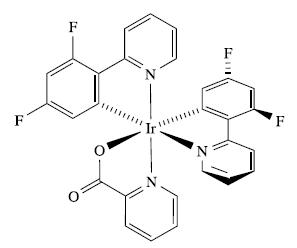
(a) What is electroluminescence?(b) Draw a schematic representation of an OLED device that involves the use of the complex shown below. Describe the function of each of the layers in the diagram that you have drawn. F F F
If Ag electrodes are placed in contact with and on either side of a piece of bulk AgI (mp 831 K) heated at 450 K, and current is passed through the cell for a given period, it is found that one electrode gains mass and the other loses mass. Rationalize these observations.
Comment on the following values of electrical conductivities: Na β-alumina, 3 × 10⁻² Ω−1 cm−1(at 298 K); Li3N, 5 × 10⁻³ Ω−1 cm−1 (at 298 K); NaCl, 10−15 Ω−1 cm−1 (at 300 K). Would you expect these values to be direction-independent with respect to the crystal under study?
A type of solid state battery consists of lithium and V6O13 electrodes separated by a solid polymer electrolyte. Suggest how this battery might operate.
Discuss the variation in electrical conductivities along the series TiO, VO, MnO, FeO, CoO and NiO.
(a) What is meant by a degenerate semiconductor and why is this relevant to TCOs?(b) Give examples of TCOs, detailing the doping that is used in the materials.
(a) Outline the principle of operation of a dyesensitized solar cell.(b) Why should an ideal dye in a DSC absorb light over the whole visible range with high values of εmax?
If only the fluorescent excited states are harvested for light emission in an OLED, the maximum efficiency of the device is 25%. Explain why this is. What can be done to overcome the problem?
(a) The structure of YBa2Cu3O7 can be described as consisting of rock salt and perovskite layers. Describe the origin of this description.(b) Why is the potential replacement of NbTi by high-temperature superconducting components in MRI equipment of commercial interest?
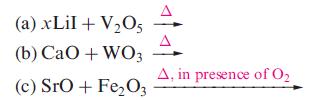
Suggest likely products in the following reactions; (the reactions as shown are not necessarily balanced): (a) xLiI + V₂05 (b) CaO + WO3 (c) SrO + Fe₂O3 A, in presence of 0₂
(a) MOCVD with Al(OiPr)3 as the precursor can be used to deposit α-Al2O3. Outline the principle of MOCVD, commenting on the required properties of the precursors.(b) Fibres of InN can be grown at 476K by the following reaction; nano-sized metal droplets act as catalytic sites for the formation of
(a) Describe the structure of the Chevrel phase PbMo6S8.(b) What gives rise to the superconductivity exhibited by PbMo6S8?
Explain what is meant by ‘doping’ using as your examples (a) MgO doping of ZrO2, (b) LaF3 doping of CaF2, (c) B doping of Si, (d) As doping of Si.
(a) Describe the layered structure of FeSe.(b) How are the structures of NaFeAs and LaOFeAs related to that of FeSe?(c) Whereas LaOFeAs is not superconducting, LaO1−xFxFeAs is a superconductor and the value of Tc depends on x. Comment on this statement.
(a) Describe the relationship between the structures of MgB2 and graphite.(b) How does the electronic structure of MgB2 differ from that of graphite, and how does this affect the properties of the materials?
Suggest possible solid state precursors for the formation of the following compounds by pyrolysis reactions: (a) BiCaVO5; (b) The Mo(VI) oxide CuMo2YO8; (c) Li3InO3; (d) Ru2Y2O7.
Give a brief outline of a typical CVD process and give examples of its use in the semiconductor industry.
Briefly discuss each of the following.(a) Precursors for, and composition and uses of, CVD wear-resistant coatings.(b) The production of GaAs thin films.(c) The advantages of using LEDs over traditional glass-reflector cat’s eyes for road-lane markings.(d) Problems in developing CVD methods for
Rationalize the following statement: a graphene sheet consists of two interpenetrating triangular sublattices, and the unit cell of graphene contains two C atoms.
Graphene is insoluble in common solvents. Describe ways in which the material can be solubilized.
The properties of graphene nanoribbons depend upon their edge structure. What are the different edge structures and how do they arise?
(a) Explain how single-walled carbon nanotubes are classified in zigzag and armchair tubes.(b) What inherent properties of single-walled carbon nanotubes make those formed by arc discharge or laser vaporization methods unsuitable for immediate applications?(c) Give examples of how the problems
(a) Describe the structure of lithium nitride and explain how it is able to function as a lithium ion conductor. The structures of Li3P and Li3As are analogous to that of the nitride. How do you expect the degree of ionic character in these compounds to vary?(b) Epitaxial MgB2 films can be grown
Legislation requires the phasing out of incandescent lighting. How does inorganic chemistry contribute to the development of solid state lighting?
Give a summary of how conventional superconductors have impacted on our lives. Include both scientific and more general applications.
Describe the construction and operation of a lithiumion battery. Give examples of applications including those in the motor vehicle industry.
Describe how carbon fibres are manufactured. Summarize the properties and applications of carbon fibres and carbon–carbon composites.
For a [4Fe–4S] protein, the following series of redox reactions are possible; each step is a 1-electron reduction or oxidation:(a) Which of these couples are accessible under physiological conditions? (b) Which couple represents the HIPIP system? (c) How do the redox potentials of the HIPIP and
Give brief descriptions of the following: (a) Peptide;(b) Naturally occurring amino acids; (c) Metalloprotein;(d) Apoprotein; (e) Haem unit.
Give an account of the storage and transport of metalloproteins in mammals. How does the uptake of iron by aerobic microorganisms differ from that in mammals?
[CrL3]3− where H2L = 1;2-(HO)2C6H4 is a model complex for enterobactin. How is the model related to enterobactin, and what is the reason for chromium-for-iron substitution?
Model compounds are often used to model iron– sulfur proteins. Comment on the applicability of the following models, and on the data given.(a) [Fe(SPh)4]2− as a model for rubredoxin; observed values of μeff are 5.85 μB for the oxidized form of the model compound and 5.05 μB for the reduced
Comment on the following observations:(a) Thioneins bind Cd2+ in cysteine-rich pockets.(b) [Cu4(SPh)6]2− is a model for the Cu-containing metallothionein in yeast.(c) Imidazole and tris(pyrazolyl)borate derivatives are often used to model histidine-binding sites.
(a) Briefly describe the mode of binding of O2 to the iron centre in one haem unit of haemoglobin. (b) What are ‘picket fence’ porphyrins and why are they used in model studies of O2 binding to myoglobin or haemoglobin? (c) The binding of O2 to haemoglobin exhibits a
Compare the modes of binding of O2 to the metal centres in (a) Myoglobin, (b) Haemerythrin(c) Haemocyanin. Indicate what supporting experimental evidence is available for the structures you describe.
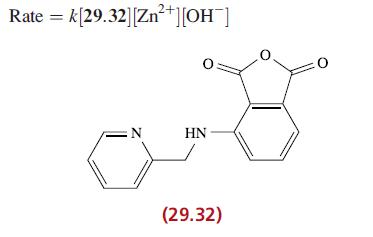
The hydrolysis of the acid anhydride 29.32 by [OH]− is catalysed by Zn2+ ions. The rate equation is of the form:It is also known that the addition of Zn2+ does not accelerate hydrolysis by H2O or attack by other nucleophiles. Suggest a mechanism for this reaction. Rate = k [29.32][Zn²+
Differentiate between Type 1, Type 2 and Type 3 copper centres in blue copper proteins, giving both experimental and structural distinctions.
Describe the structure of the copper site in plastocyanin and discuss the features of both the metal centre and metal-binding site that allow it to function as an electron-transfer site.
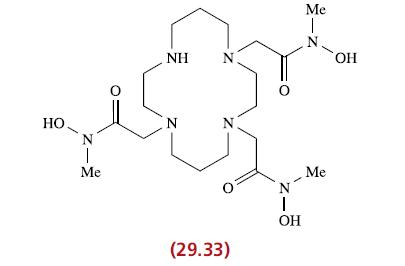
Compound 29.33, H4L, is a model for the siderophore desferrioxamine. It binds Fe3+ to give the complex [Fe(HL)]. What features does 29.33 have in common with desferrioxamine? Suggest a reason for the choice of the macrocyclic unit in ligand 29.33. Suggest a structure for [Fe(HL)].
Ascorbate oxidase contains four copper centres. Discuss their coordination environments, and classify the centres as Type 1, 2 or 3. What is the function of ascorbate oxidase and how do the copper centres facilitate this function?
Comment on the following observations:(a) ‘Blue copper proteins’ are not always blue.(b) Two different metalloproteins, both containing [4Fe–4S] ferredoxins bound to the protein chain by Cys ligands, exhibit reduction potentials of +350 and +490 mV.(c) The toxicity of CO is associated with
What is the mitochondrial electron-transfer chain, and what role do quinones play in the chain?
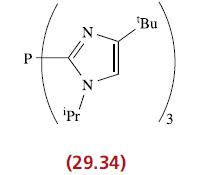
Compound 29.34 reacts with Zn(ClO4)2·6H2O to give a complex [Zn(29.34)(OH)]+ that is a model for the active site of carbonic anhydrase. Suggest a structure for this complex. What properties does 29.34 possess that (a) mimic the coordination site in carbonic anhydrase and (b) control the
Comment on the similarities and differences between a [2Fe–2S] ferredoxin and Rieske protein, in terms of both structure and function.
(a) Outline the similarities and differences between the haem units in deoxymyoglobin and cytochrome c. (b) What function does cytochrome c perform in mammals?
(a) What is the function of cytochrome c oxidase?(b) Describe the four active metal-containing sites in cytochrome c oxidase and the proposed way in which they work together to fulfil the role of the metalloprotein.
Discuss the role of Zn2+ as an example of a Lewis acid at work in a biological system.
Why is metal substitution used to investigate the metal binding site in carbonic anhydrase? Discuss the type of information that might be forthcoming from such a study.
(a) The structure of a bacterial protein reported in 2001 showed that the active site contains a Zn4(Cys)9(His)2 cluster. To what family does this metalloprotein belong, and why is the binding site atypical?(b) Cytochrome P-450 is a monooxygenase. Outline its function, paying attention to the
(a) Comment on the relevance of studying complexes such as [Fe(CN)4(CO)2]2− and [Fe(CO)3(CN)3]− as models for the active sites of [NiFe]- and [FeFe]-hydrogenases.(b) Describe the structure of the FeMo cofactor in nitrogenase. Until 2002, when a central ligand was located in the FeMo cofactor,
(a) Whereas the stability constant, K, for the equilibrium:is of the order of 10, that for the equilibrium:is of the order of 3000. Rationalize this observation.(b) Photosystem II operates in conjunction with cytochrome b6f . The crystal structure of cytochrome b6f from the alga Chlamydomonas
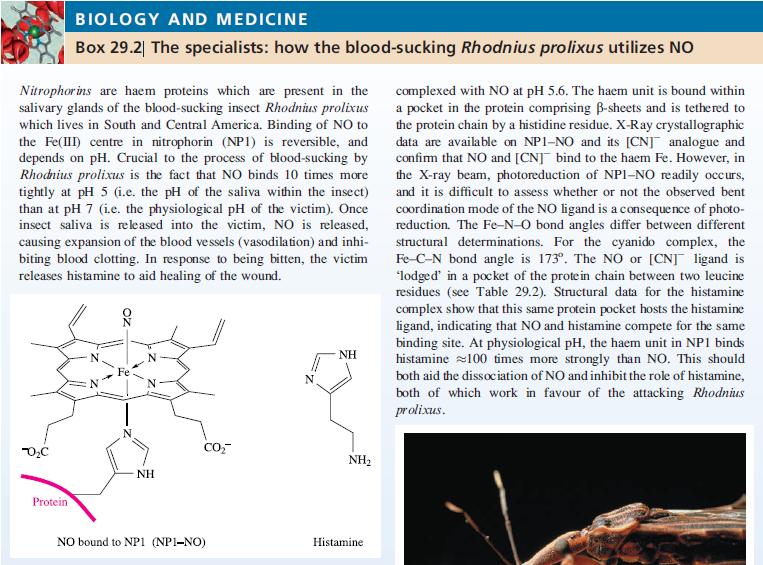
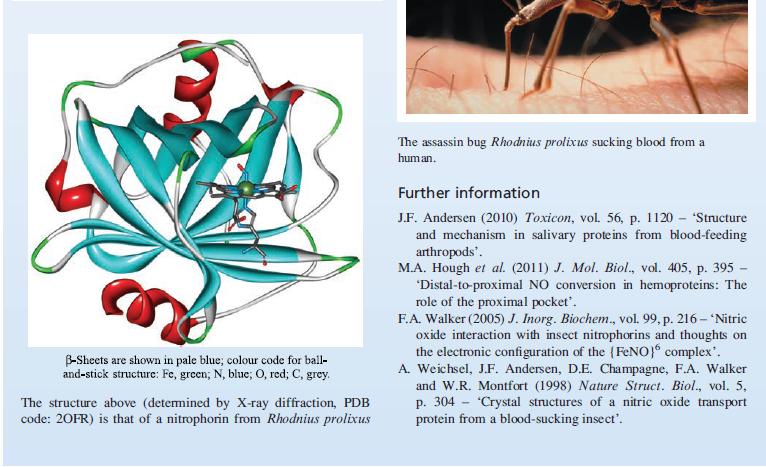
Give an explanation for the following observations (part d assumes Box 29.2 has been studied):(a) Both haemoglobin and cytochromes contain haem-iron;(b) Cytochrome c oxidase contains more than one metal centre;(c) Each sub-unit in deoxyhaemoglobin contains 5-coordinate Fe(II), but in cytochrome c,
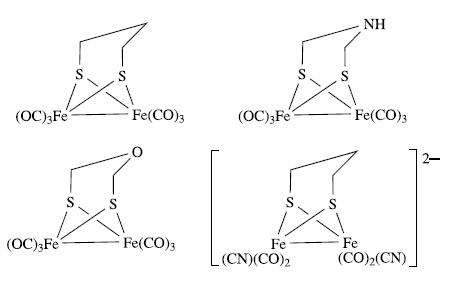
(a) The compounds shown below are models for the active site of [FeFe]-hydrogenase. How are the models related to the active site and what problems does a crystallographer face when trying to identify the active site?(b) The molecular mass of myoglobin is ≈16950. The positive mode electrospray
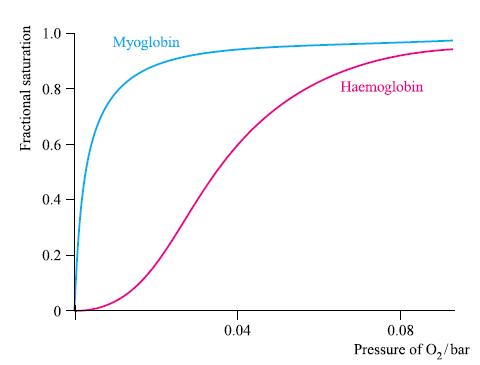
(a) What is meant by the cooperative binding of O2 by haemoglobin? (b) Use Fig. 29.8 to explain what would happen in your body if your blood contained myoglobin in place of haemoglobin.Figure 29.8. Fractional saturation 1.0 0.8 0.6 0.4 J 0 T T IL 0.2- Myoglobin 0.04 Haemoglobin 0.08 Pressure of
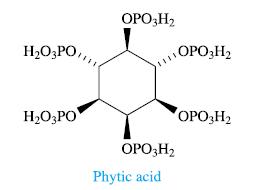
Cereal grains contain high levels of phytic acid. Why is phytic acid an inhibitor of iron uptake by the human body? H₂O3PO, H₂O3PO OPO3H₂ OPO3H2 Phytic acid OPO 3H2 OPO3H₂
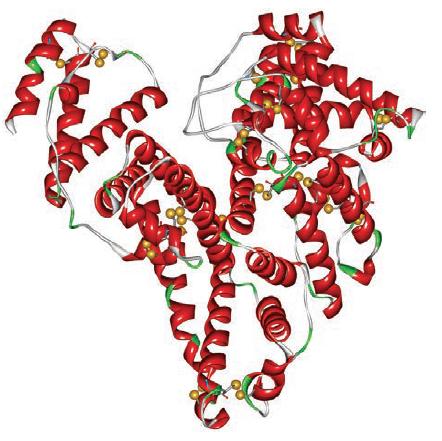
Sources of Cd include welding emissions, electronic components and NiCd batteries. EU and US legislations are now in place to reduce our exposure to Cd. Once absorbed into the body, Cd is targeted by metallothioneins, cysteine, the tripeptide glutathione and the protein albumin (Fig. 29.32) and is
Which organisms utilize: haemoglobin; [NiFe]-hydrogenases; rubredoxins; plastocyanins? Describe the active centre in each metalloprotein and the role that it plays.
Comment on each of the following:(a) Zeolite 5A (effective pore size 430 pm) is used to separate a range of n- and iso-alkanes.(b) Zeolite ZSM-5 catalyses the isomerization of 1,3-to 1,4-Me2C6H4 (i.e. m- to p-xylene), and the conversion of C6H6 to EtC6H5.
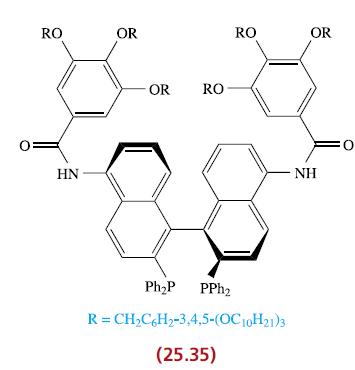
Ligand 25.35 has been designed for use in Ru-based catalysts for hydrogenation reactions in an EtOH/hexane solvent system. These solvents separate into two phases upon the addition of a small amount of water.(a) For what types of hydrogenations would this catalyst be especially useful? Rationalize
(a) One proposed method for removing NO from motor vehicle emissions is by catalytic reduction using NH3 as the reducing agent. Bearing in mind the regulated, allowed emissions, write a balanced equation for the redox reaction and show that the oxidation state changes balance.(b) In the presence of
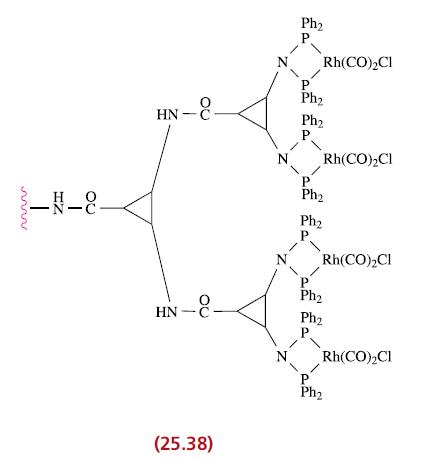
There is interest in ‘dendritic’ molecules, i.e. those with ‘branched arms’ that diverge from a central core. The supported dendritic catalyst 25.38 can be used in hydroformylation reactions, and shows high selectivity for branched over linear aldehyde products.(a) Is 25.38 likely to be the
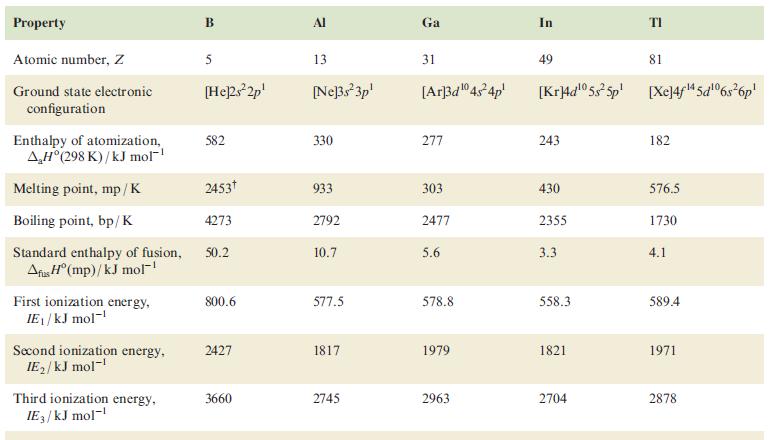
How may the standard enthalpy of the unknown salt Xe+F− be estimated?
The reactions of (η5-C5Me5)GeCl with GeCl2 or SnCl2 lead to the compound [A]+ [B]− or [A]+ [C]− respectively. The solution 1H NMR spectrum of [A][C] contains a singlet at δ 2.14 ppm, and the 13C NMR spectrum shows two signals at δ 9.6 and 121.2 ppm. The mass spectra of the compounds exhibit
For the catalysed hydrocyanation of buta-1,3-diene:(a step in the manufacture of nylon-6,6), the catalyst precursor is NiL4 where L = P(OR)3. Consider the addition of only the first equivalent of HCN.(a) Some values of K for:are 6 × 10⁻¹⁰ for R = 4-MeC6H4, 3 × 10⁻⁵ for R = iPr and 4 × 10⁻²
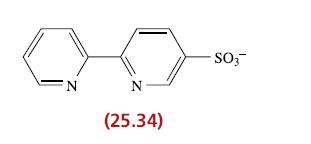
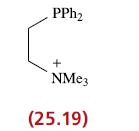
(a) Ligand 25.19 is used in biphasic catalysis. The IR spectrum of Fe(CO)4(PPh3) shows strong absorptions at 2049, 1975 and 1935 cm−1, while that of [Fe(CO)4(25.19)]+ exhibits bands at 2054, 1983 and 1945 cm−1. What can you deduce from these data?(b) Which of the complexes [X][Ru(25.34)3] in
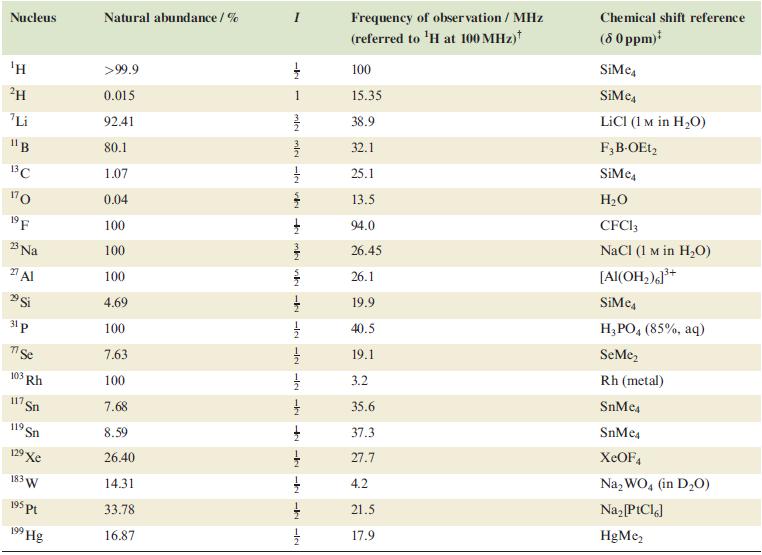
By using specific examples, illustrate how heteronuclear NMR spectroscopy can be used for the routine characterization of main group organometallic compounds. [Tables 4.3, 11.1, 13.1, 14.1 and 15.2 provide relevant nuclear spin data.]Table 4.3.Table 11.1.Table 13.1.Table 14.1.Table 15.2.
The forward reaction in eq. 25.34 is exothermic. What are the effects of(a) Increased pressure and(b) Increased temperature on the yield of SO3? (c) In trying to optimize both the yield and rate of formation of SO3, what problem does the Contact process encounter and how is it overcome?Equation
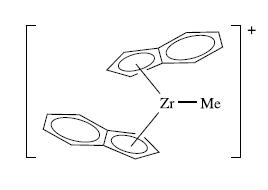
(a) Why is it easier to investigate the Cossee–Arlman mechanism using metallocene alkene polymerization catalysts rather than Ziegler–Natta catalysts?(b) The zirconium complex shown below is an active catalyst for the polymerization of RCH=CH2. Draw a scheme to illustrate the mechanism of this
The hydroformylation of pent-2-ene using Co2(CO)8 as the catalyst was found to give rise to three aldehydes in a ratio 35 :12 : 5. Show how the three products arose, and suggest which was formed in the most and which in the least amount.
(a) The hydrogenation of propene is catalysed by RhCl(PPh3)3 or HRh(CO)(PPh3)3. Outline the mechanisms by which these reactions occur, indicating clearly what the active catalyst is in each case.(b) HRuCl(PPh3)3 is a very active catalyst for the hydrogenation of alkenes. However, at high catalyst
Give a brief discussion of the use of homogeneous catalysis in selected industrial manufacturing processes.
Describe briefly why a clean nickel surface (fcc structure) should not be regarded as comprising a perfect close-packed array of atoms. Indicate the arrangements of atoms that an adsorbate might encounter on the surface, and suggest possible modes of attachment for CO.
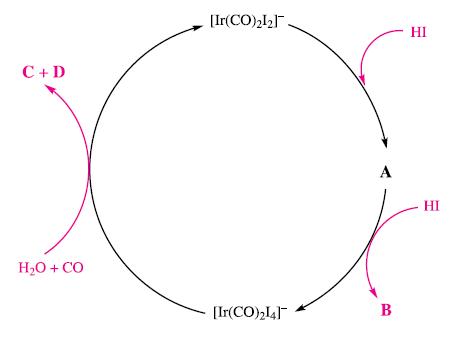
The first step in the Cativa process is the reaction between MeI and cis-[Ir(CO)2I2]−. However, the catalyst may also react with HI and this step initiates a water gas shift reaction that competes with the main catalytic cycle. (a) What chemical is manufactured in the Cativa process? Why is this
(a) What advantages are there to using Rh supported on γ-Al2O3 as a catalyst rather than the bulk metal?(b) In a catalytic converter, why is a combination of platinum-group metals used?
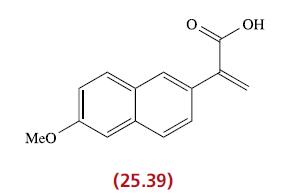
What roles do inorganic catalysts play in the following manufacturing processes: (a) Production of aldehydes from alkenes, (b) Polymerization of propene, (c) Production of acetic anhydride,(d) Hydrogenation of compound 25.39 to produce the drug (S)-Naproxen? State whether homogeneous or
(a) Outline how the gaseous reaction between N2 and H2 proceeds in the presence of a heterogeneous catalyst, and state why a catalyst is needed for the commercial production of NH3.(b) Suggest why V and Pt are poor catalysts for the reaction between N2 and H2, and give a possible reason why Os
(a) Summarize the structural features of importance in a Ziegler–Natta catalyst comprising TiCl4 supported on MgCl2.(b) What is the role of the ethyl aluminium compounds which are added to the catalyst?(c) Explain how a Ziegler–Natta catalyst facilitates the conversion of ethene to a
(a) Equation 14.47 shows the reaction of Na with CCl4. From the following data, confirm the value of ΔrGº = –1478 kJ mol−1 at 298 K. Data: ΔfG°(NaCl, s) = –384 kJ mol−1; ΔfHº (CCl4, l) = –128.4 kJ mol−1; Sº(CCl4, l) = 214 JK−1 mol−1; Sº(C, gr) = +5.6 JK−1 mol−1; Sº(Cl2,
Give a brief discussion of the use of heterogeneous catalysis in selected industrial manufacturing processes.
(a) Give formulae for compounds that are coordination isomers of(b) What other types of isomerism could be exhibited by any of the complex ions given in your answer to part (a)? [Co(bpy) 3]³+ [Fe(CN)6]³-.
Summarize the operation of a three-way catalytic converter, including comments on (a) The addition of cerium oxides, (b) The light-off temperature,(c) Optimum air–fuel ratios(d) Catalyst ageing.
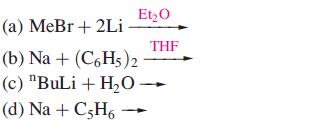
Suggest products of the following reactions: Et₂0 (a) MeBr + 2Li (b) Na + (C6H5) 2 (c) "BuLi + H₂O → (d) Na + C5H6 THF
Measures taken to control atmospheric pollution include (a) Scrubbing industrial waste gases to remove SO2, (b) Reduction of NO in motor vehicle emissions. Explain how these are achieved and write balanced equations for relevant reactions. Are they catalytic processes?
In 2014, ≈31 Mt of sulfuric acid was manufactured worldwide. The importance of H2SO4 is reflected in the fact that its consumption in a given country is a direct indicator of that country’s industrial growth.(a) Give examples of commercial uses of H2SO4.(b) Starting from relevant feedstocks,
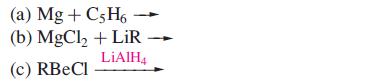
Suggest products of the following reactions, which are not necessarily balanced on the left-hand side: (a) Mg + C5H6 - (b) MgCl₂ + LiR LiAlH4 (c) RBeCl
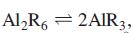
(a) For the equilibrium comment on the fact that values of K are 1:52 × 10−8 for R = Me, and 2.3 × 10⁻⁴ for R = Me2CHCH2. (b) Describe the bonding in Al2Me6, Al2Cl6 and Al2Me4(μ-Cl)2. Al₂R6 = 2AIR3,
(a) A black precipitate forms when H2S is added to an aqueous solution of a Cu(II) salt. The precipitate redissolves when Na2S is added to the solution. Suggest a reason for this observation.(b) In the presence of small amounts of water, the reaction of SO2 with CsN3 leads to Cs2S2O5 as a
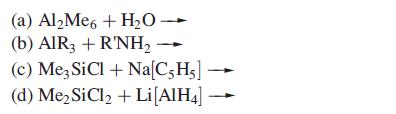
Suggest products of the following reactions, which are not necessarily balanced on the left-hand side: (a) Al₂Me6+ H₂O (b) AIR3 + R'NH₂ (c) Me3 SiCl + Na[C5H5] (d) Me₂ SiCl₂ + Li [AIH4]
(a) BrO has been detected in the emission gases from volcanoes (N. Bobrowski et al. (2003) Nature, vol. 423). Construct an MO diagram for the formation of BrO from Br and O atoms. Comment on any properties and bonding features of BrO that you can deduce from the diagram.(b) [Cl2O2]+ is
Showing 1000 - 1100
of 1950
First
4
5
6
7
8
9
10
11
12
13
14
15
16
17
18
Last
Step by Step Answers

 Get 50% OFF
Claim Now
Get 50% OFF
Claim Now