New Semester
Started
Get
50% OFF
Study Help!
--h --m --s
Claim Now
Question Answers
Textbooks
Find textbooks, questions and answers
Oops, something went wrong!
Change your search query and then try again
S
Books
FREE
Study Help
Expert Questions
Accounting
General Management
Mathematics
Finance
Organizational Behaviour
Law
Physics
Operating System
Management Leadership
Sociology
Programming
Marketing
Database
Computer Network
Economics
Textbooks Solutions
Accounting
Managerial Accounting
Management Leadership
Cost Accounting
Statistics
Business Law
Corporate Finance
Finance
Economics
Auditing
Tutors
Online Tutors
Find a Tutor
Hire a Tutor
Become a Tutor
AI Tutor
AI Study Planner
NEW
Sell Books
Search
Search
Sign In
Register
study help
sciences
inorganic chemistry
Inorganic Chemistry 7th Edition Mark Weller, Tina Overton, Jonathan Rourke - Solutions
Use Wade’s rules to predict a structure for (a) B5H11,(b) B5H9, (c) B4H7−, (d) [B6H6]2−.
Hydrolysis of 1 mol of a borohydride yields 15 mol of H2 and 6 mol of B(OH)3. Identify the compound and suggest a structure.
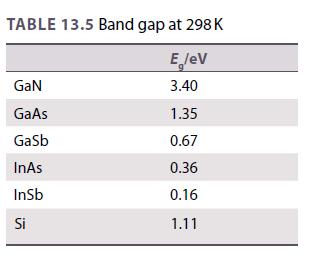
Use the data in Table 13.5 to estimate a band gap for the semiconductor GaP. Use this to calculate the wavelength of light that is emitted when an electron drops from the conduction band to the valence band. Is this consistent with the observed green light of gallium phosphide LEDs?Table 13.5.
Starting with B10H14 and other reagents of your choice, give the equations for the synthesis of [Fe(nido-B9C2H11)2]2−, and sketch the structure of this species.
11B-NMR is an excellent spectroscopic tool for inferring the structures of boron compounds. With 11B–11B coupling ignored, it is possible to determine the number of attached H atoms by the multiplicity of a resonance: BH gives a doublet, BH2 a triplet, and BH3 a quartet. B atoms on the closed
The structure of B2O3 is formed from vertex linked BO3 planar triangular units while in Al2O3 aluminium ions adopt solely octahedral coordination to oxygen. Explain these observations on the preferred Group 13 element coordination geometries.
Predict the product of the reactions of BCl3 with (i) Water (ii) Dimethyl sulfide (CH3)2S.
BF3 reacts with CsF to form CsBF4 while there is no reaction between BBr3 and CsBr. Explain these observations.
(a) What are the similarities and differences in the structures of layered BN and graphite? (b) Contrast their reactivity with Na, air, and Br2. (c) Suggest a rationalization for the differences in structure and reactivity.
Under what conditions could you convert hexagonal BN to cubic BN?
Devise a synthesis for the borazines (a) Ph3N3B3Cl3(b) Me3N3B3H3, starting with BCl3 and other reagents of your choice. Draw the structures of the products.
Identify the incorrect statements in the following description of Group 13 chemistry and provide corrections along with explanations of the principle or chemical generalization that applies:(a) All the elements in Group 13 are nonmetals.(b) The increase in chemical hardness on going down the group
Indium forms a chloride of the stoichiometry In5Cl9. Rewrite this formula in terms of the oxidation states commonly adopted by indium. Describe the bonding in this compound given that it has been stated that it adopts the same structure type as Cs3Tl2Cl9.
Indium tin oxide has important applications as a transparent conducting oxide. Which oxide(s) could be doped with Al2O3 to produce a material with similar properties?
Determine the position of the compound Rb2In3 on a Ketelaar diagram and hence predict the type of bonding in this phase. By comparison with known structural motifs from boride cluster chemistry suggest a possible indium-containing unit if the formula is rewritten as Rb4In6.
Correct any inaccuracies in the following descriptions of Group 14 chemistry:(a) None of the elements in this group is a metal.(b) At very high pressures, diamond is a thermodynamically stable phase of carbon.(c) Both CO2 and CS2 are weak Lewis acids and the hardness increases from CO2 to CS2.(d)
The chemical properties of flerovium, element 114, are predicted to be significantly different from those of the other members of Group 14 (P. Schwerdtfeger and M. Seth, J. Nucl. Radiochem. Sci., 2002, 3, 133). Specifically, the only oxidation state exhibited by Fl will be +2 and the element will
The lightest p-block elements often display different physical and chemical properties from the heavier members. Discuss the similarities and differences by comparison of:(a) The structures and electrical properties of carbon and silicon(b) The physical properties and structures of the oxides of
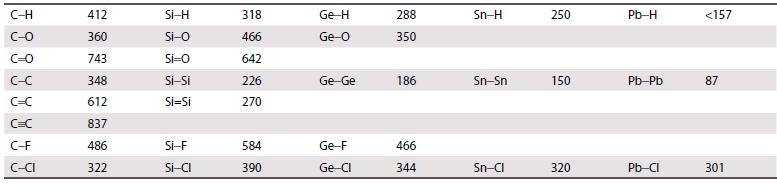
Use the data in Table 14.2 and the additional bond enthalpy data given here to calculate the enthalpy of hydrolysis of CCl4 and CBr4. Bond enthalpies/kJ mol−1: O–H = 463, H–Cl = 431, H–Br = 366.Table 14.2.
Discuss the solid-state chemistry of silicon in silicates with reference to how the various structures can be built up from SiO4 tetrahedra linked into polymeric anions, chains, rings, sheets, and three-dimensional networks.
Silicon forms the chlorofluorides SiCl3F, SiCl2F2, and SiClF3. Sketch the structures of these molecules. What are their point groups?
One of your friends is studying English and is taking a course in science fiction. A common theme in the sources is silicon-based life forms. Your friend wonders why silicon should be chosen and why all life is carbon-based. Prepare a short article that presents arguments for and against
As well as Ge3F8 compounds with the stoichiometries Ge5F12 and Ge7F16 have been reported. Explain how these seemingly unusual stoichiometries can arise for germanium.
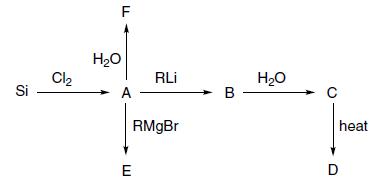
Identify the compounds A to F. Si Cl₂ H₂O FL A RLi RMgBr E B H₂O D heat
Karl Marx remarked in Das Kapital that ‘If we could succeed, at a small expenditure of labour, in converting carbon into diamonds, their value might fall below that of bricks.’ Review current methods of synthesizing diamonds and discuss why these developments have not resulted in a large
Explain why CH4 burns in air whereas CF4 does not. The enthalpy of combustion of CH4 is −888 kJ mol−1 and the C–H and C–F bond enthalpies are −412 and −486 kJ mol−1, respectively.
(a) Summarize the trends in relative stabilities of the oxidation states of the elements of Group 14, and indicate the elements that display the inert-pair effect. (b) With this information in mind, write balanced chemical reactions or NR (for no reaction) for the following combinations, and
In their paper ‘Mesoporous silica nanoparticles in biomedical applications’, Li Zongxi et al. (Chem. Soc. Rev., 2012, 41, 2590) discuss the utility of mesoporous silica nanoparticles (MSNPs) as supports for the delivery of therapeutic drugs in the body. What are the properties of MSNPs that
Describe the types of bonding in the structures of SiF4 and PbF2. Explain why these are so different.
In the paper ‘Developing drug molecules for therapy with carbon monoxide’ (Chem. Soc. Rev., 2012, 41, 3571), the authors discuss the use of carbon monoxide as a therapeutic agent for treating diseased tissue. Outline the problems associated with using CO as a therapeutic agent and how the
SiF4 reacts with (CH3)4NF to form [(CH3)4N][SiF5]. (a) Use the VSEPR rules to determine the shape of the cation and anion in the product. (b) Account for the fact that the 19F-NMR spectrum shows two fluorine environments.
One way of addressing the effects of CO2 emissions on the atmosphere is to use it as a chemical feedstock in the production of useful chemicals, fuels and polymers (M. Aresta and A. Dibenedetto, Dalton Trans., 2007, 2975; C.-H. Huang and C.-S. Tan, Aerosol Air Qual. Res., 2014, 14, 480). Summarize
Draw the structure and determine the charge on the cyclic anion [Si4O12]n−.
The paper ‘Metallacarboranes and their interactions: theoretical insights and their applicability’ (P. Farràs et al., Chem. Soc. Rev., 2012, 41, 3445) discusses the properties of metallacarboranes and how they can be analysed using computational methods. Outline the properties of
Predict the appearance of (i) The 119Sn-NMR spectrum(ii) The 31P-NMR spectrum of (CH3)3SnPH2, (trimethylstannyl) phosphine.
The combination of mesoporosity with semiconductivity would produce materials with interesting properties. A synthesis of such a material was discussed in ‘Hexagonal mesoporous germanium’ by S. Gerasimo et al. (Science, 2006, 313, 5788). Summarize the expected advantages of such a material and
Many potentially useful semiconducting materials for photovoltaic applications contain Group 14 elements in sulfides. Examples include Cu2ZnSnS4 (CZTS) and SnS which have been studied because they contain nontoxic elements that are relatively abundant on Earth. Describe the structures and
Hybrid organic-inorganic lead and tin iodide perovskites are potential low cost, solution-synthesized semiconductors for solar cell applications (T.M. Brenner, D.A. Egger, L. Kronik, G. Hodes, and D. Cahen, Nat. Rev. Mater., 2016, 1, Article 15007). Summarize the recent advances made with these
In ‘An atomic seesaw switch formed by tilted asymmetric Sn–Ge dimers on a Ge (001) surface’ (Science, 2007, 315, 1696), K. Tomatsu et al. describe the synthesis and operation of a molecular switch. Describe how such molecular switches operate and summarize their current and potential
Explain why PbI4 is unknown while reaction of Pb with fluorine yields PbF4.
Why does silicon occur naturally in silicates while the major ore of lead is the sulfide galena, PbS?
Give balanced chemical equations and conditions for the recovery of silicon and germanium from their ores.
(a) Describe the trend in band gap energy, Eg, for the elements carbon (diamond) to tin (grey). (b) Explain whether the electrical conductivity of silicon increases or decreases when its temperature is changed from 20°C to 40°C.
Preferably without consulting reference material, draw a periodic table and indicate the elements that form saline, metallic, and metalloid carbides.
Account for the variation in the following band gaps (Eg/eV) for compounds of Group 15 elements. BN (cubic) 7.5 GaN 3.37 GaP 2.26 GaAs 1.42 GaSb 0.72
Describe the preparation, structure, and classification of (a) KC8, (b) CaC2, (c) K3C60.
Write balanced chemical equations for the reactions of K2CO3 with HCl(aq) and of Na4SiO4 with aqueous acid.
Explain why silicon can exhibit six-fold coordination in [SiF6]2− but the [SiCl6]2− anion is unknown.
Describe in general terms the nature of the [SiO3]n2n− ion present in jadeite.
Three SiO4 units can link together to form a short chain of composition [Si3O10]8− or a cyclic unit of stoichiometry [Si3O9]6−. How could 29Si NMR be used to distinguish these two polymeric anions?
Describe the physical properties of pyrophyllite and muscovite mica and explain how these properties arise from the composition and structures of these closely related aluminosilicates.
There are major commercial applications for semicrystalline and amorphous solids, many of which are formed by Group 14 elements or their compounds. List four different examples of amorphous or partially crystalline solids described in this chapter and briefly state their useful properties.
The layered silicate compound CaAl2(Al2Si2)O10(OH)2 contains a double aluminosilicate layer, with both Si and Al in four-coordinate sites. Sketch an edge-on view of a reasonable structure for the double layer, involving only vertex sharing between the SiO4 and AlO4 units. Discuss the likely sites
Describe the key compositional and structural features of ‘silly putty’.
List the elements in Group 15 and indicate the ones that are(a) Diatomic gases, (b) Nonmetals, (c) Metalloids, (d) True metals. Indicate those elements that display the inert-pair effect.
Write a short review of the uses of bismuth compounds in the treatment of gastric ulcers.
Predict the chemical properties of element 115, moscovium.
A paper published by J. Lee and co-workers (Sci. Rep., 2015, 5, 11512) describes the existence of two-dimensional honeycomb sheet and ribbon forms of the Group 15 elements. (a) What methods did the authors use to explore these structures? (b) Which Group 15 element was most reluctant to
Why does P display a much wider range of allotropy than N?
The structure of a butterfly-shaped P4 unit has been reported by J. Bresien and co-workers (Dalton Trans., 2016, 45, 1998). (a) Sketch the P4 unit. (b) Give one example of a bicyclic tetraphosphene synthesized from P4 with a Lewis acid and one synthesized via self-assembly of P1
Nitrous oxide has been discovered to play a crucial role in biological systems. A paper published by A.W. Carpenter and M.H. Schoenfisch (Chem. Soc. Rev., 2012, 41, 3742) discusses therapeutic applications of NO. Outline the main applications and drawbacks of gaseous NO as a therapeutic agent.
(a) Give complete and balanced chemical equations for each step in the synthesis of H3PO4 from hydroxyapatite to yield (a) high-purity phosphoric acid(b) Fertilizer-grade phosphoric acid. (c) Account for the large difference in cost between these two methods.
Describe sewage treatment methods that result in a decrease in phosphate levels in wastewater. Outline a laboratory method that could be used to monitor phosphate levels in water.
Ammonia can be prepared by (a) The hydrolysis of Li3N(b) The high-temperature, high-pressure reduction of N2 by H2. Give balanced chemical equations for each method starting with N2, Li, and H2, as appropriate. (c) Account for the lower cost of the second method.
A compound containing five-coordinate nitrogen has been characterized (A. Frohmann, J. Riede, and H. Schmidbaur, Nature, 1990, 345, 140). Describe (a) The synthesis, (b) The structure of the compound, (c) The bonding.
Show with an equation why aqueous solutions of NH4NO3 are acidic.
Two articles (A. Lykknes and L. Kvittingen, Arsenic: not so evil after all?, J. Chem. Educ., 2003, 80, 497; J. Wang and C.M. Chien, Arsenic in drinking water: a global environmental problem, J. Chem. Educ., 2004, 81, 207) present opposing perspectives on the toxic nature of arsenic. Use these
Carbon monoxide is a good ligand and is toxic. Why is the isoelectronic N2 molecule not toxic?
A paper published by N. Tokitoh et al. (Science, 1997, 277, 78) gives an account of the synthesis and characterization of a stable bismuthene, containing Bi=Bi double bonds. Give the equations for the synthesis of the compound. Name and sketch the structure of the steric protecting group that was
Explain why NF3 has weak electron donor properties whereas PF3 is a good ligand in metal complexes. How can the existence of NOF3 be explained?
On account of their slow reactions at electrodes, the potentials of most redox reactions of nitrogen compounds cannot be measured in an electrochemical cell. Instead, the values must be determined from other thermodynamic data. Illustrate such a calculation by using to calculate the standard
A paper published by Y. Zhang et al. (Inorg. Chem., 2006, 45, 10446) describes the synthesis of phosphazene cations as precursors for polyphosphazenes. Polyphosphazenes are prepared by ring-opening polymerization of the cyclic (NPCl2)3 and the reaction is initiated by phosphazene cations. Discuss
Compare and contrast the formulas and stabilities of the oxidation states of the common nitrogen chlorides with the phosphorus chlorides.
In their paper ‘Catalytic reduction of dinitrogen to ammonia at single molybdenum center’ (Science, 2003, 301, 5629), D. Yandulov and R. Schrock describe the catalytic conversion of nitrogen to ammonia at room temperature and atmospheric pressure. Discuss why this development could be important
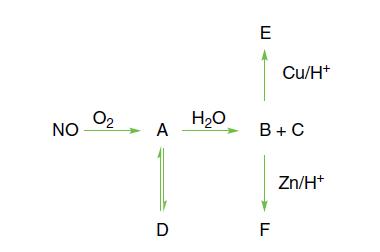
Identify the nitrogen compounds A, B, C, D, and E. NO 0₂ A D H₂O E Cu/H+ B + C F Zn/H+
Use the VSEPR model to predict the probable shapes of(a) PCl4+, (b) PCl4−, (c) AsCl5, (d) SbF52−, (e) SbF6−.
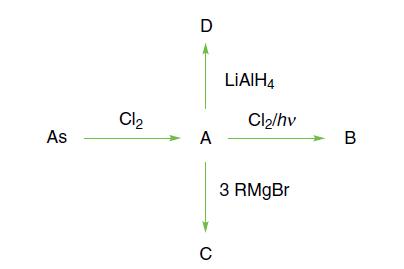
Identify the compounds A, B, C, and D. As Cl₂ D A C LIAIH4 Cl₂/hv 3 RMgBr B
Explain why compounds of Bi(III) typically have the metal atom in a distorted geometry.
Give balanced chemical equations for each of the following reactions: (a) Oxidation of P4 with excess oxygen, (b) Reaction of the product from part (a) with excess water, (c) Reaction of the product from part (b) with a solution of CaCl2, and name the product.
Starting with NH3(g) and other reagents of your choice, give the chemical equations and conditions for the synthesis of (a) HNO3, (b) NO2−, (c) NH2OH, (d) N3−.
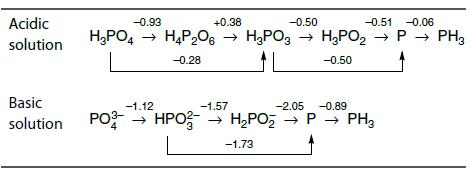
Use the Latimer diagrams to determine which species of N and P disproportionate in acid conditions. Acidic solution -0.93 +0.38 -0.50 -0.51 -0.06 H₂PO4 → H4P₂06 → H3PO3 → H₂PO₂ → P→ PH3 -0.28 -0.50 Basic -1.57 -2.05 -0.89 solution PO3- HPO → H₂PO₂ → H₂PO₂ → P→
Write the balanced chemical equation corresponding to the standard enthalpy of formation of P4O10(s). Specify the structure, physical state (s, l, or g), and allotrope of the reactants. Does either of the reactants differ from the usual practice of taking as reference state the most stable form of
Are reactions of NO2− as an oxidizing agent generally faster or slower when pH is lowered? Give a mechanistic explanation for the pH dependence of NO2− oxidations.
When equal volumes of nitric oxide (NO) and air are mixed at atmospheric pressure a rapid reaction occurs, to form NO2 and N2O4. However, nitric oxide from an automobile exhaust, which is present in the parts per million concentration range, reacts slowly with air. Give an explanation for this
Give balanced chemical equations for the reactions of the following reagents with PCl5 and indicate the structures of the products: (a) Water (1:1), (b) Water in excess, (c) AlCl3,(d) NH4Cl.
(a) Use standard potentials to calculate the standard potential of the disproportionation of H2O2 in acid solution. (b) Is Cr2+ a likely catalyst for the disproportionation of H2O2? (c) Given the Latimer diagramin acidic solution, calculate ΔrG⊖ for the disproportionation of hydrogen
Explain how you could use 31P-NMR to distinguish between PF3 and POF3.
Calculate the standard potential of the reaction of H3PO2 with Cu2+. Are HPO22− and H2PO22− useful as oxidizing or as reducing agents?
The tetrahedral P4 molecule may be described in terms of localized 2c,2e bonds. Determine the number of skeletal valence electrons and from this decide whether P4 is closo, nido, or arachno. If it is not closo, determine the parent closo polyhedron from which the structure of P4 could be formally
Sketch the two possible geometric isomers of the octahedral [AsF4Cl2]− and explain how they could be distinguished by 19F-NMR.
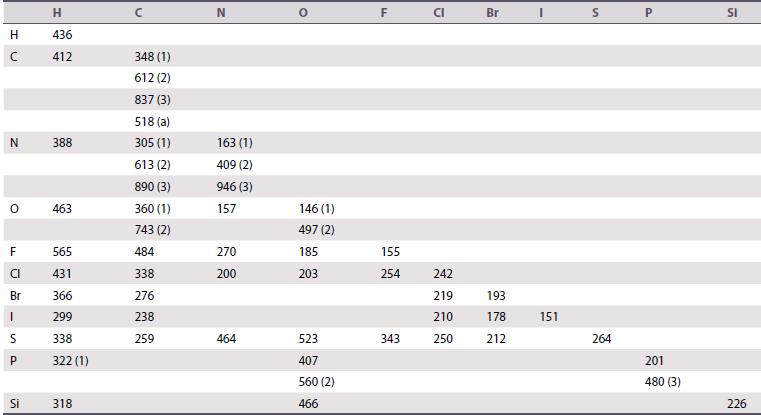
Explain why SF6 is a very stable molecule whereas OF6 is unknown. Make use of the bond enthalpy data given in Table 2.7.Table 2.7. H с N 0 F CI Br | S P LL Si H 436 412 388 463 565 431 366 299 338 322 (1) 318 348 (1) 612 (2) 837 (3) 518 (a) 305 (1) 613 (2) 890 (3) 360 (1) 743
State whether the following oxides are acidic, basic, neutral, or amphoteric: CO2, P2O5, SO3, MgO, K2O, Al2O3, CO.
The isolation and characterization of a Se–Se species with a three-electron sigma bond was described in a paper by Zhang and co-workers (Nat. Commun., 2014, 5, 4127). (a) Who first proposed the possibility of a three-electron sigma bond? (b) Sketch the orbital interaction diagram for
The bond lengths in O2, O2+ , and O2−2 are 121, 112, and 149 pm, respectively. Describe the bonding in these molecules in terms of molecular orbital theory and use this description to rationalize the differences in bond lengths.
In their paper ‘Spiral chain O4 form of dense oxygen’ (Proc. Natl. Acad. Sci. U.S.A., 2012, 109, 3, 751), L. Zhu and co-workers describe their predicted chain structure for oxygen. Under what conditions is this structure predicted to exist? Which other Group 16 elements form this structure? How
The article ‘Oxygen, sulfur, selenium, tellurium and polonium’ by L. Myongwon Lee and I. Vargas-Baca (Annu. Rep. Prog. Chem., Sect. A: Inorg. Chem., 2012, 108, 113) summarizes highlights from the 2011 literature on the chemistry of the Group 16 elements. Use the references in this paper
Correct any inaccuracies in the following statements and, after correction:(a) Elements in the middle of Group 16 are easier to oxidize to the group oxidation number than are the lightest and heaviest members.(b) In its ground state, O2 is a triplet and it undergoes Diels–Alder electrophilic
In their paper ‘Formation of tellurium nanotubes through concentration depletion at the surfaces of seeds’ (Adv. Mater., 2002, 14, 279), B. Mayers and Y. Xia describe the synthesis of tellurium nanotubes. Describe how their method differs from those used to produce carbon nanotubes. What were
In November 2006 the former KGB agent Alexander Litvinenko was found to have been poisoned by radioactive polonium-210. Write a review of the chemical and radiological properties of Po and discuss its toxicity.
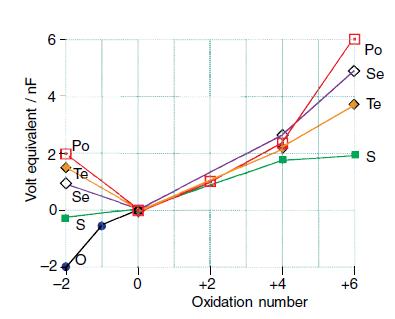
Discuss the trends in stabilities of oxidation states for Group 16 elements at pH = 0, as represented by the Frost diagram in Fig. 16.5, and state the likely nature of the species prevailing for each entry.Figure 16.5. Volt equivalent / nF 6- 25 Po E -2 Te Se S 1 0 +2 +4 Oxidation
Showing 300 - 400
of 1950
1
2
3
4
5
6
7
8
9
10
11
12
13
14
15
Last
Step by Step Answers

 Get 50% OFF
Claim Now
Get 50% OFF
Claim Now