New Semester
Started
Get
50% OFF
Study Help!
--h --m --s
Claim Now
Question Answers
Textbooks
Find textbooks, questions and answers
Oops, something went wrong!
Change your search query and then try again
S
Books
FREE
Study Help
Expert Questions
Accounting
General Management
Mathematics
Finance
Organizational Behaviour
Law
Physics
Operating System
Management Leadership
Sociology
Programming
Marketing
Database
Computer Network
Economics
Textbooks Solutions
Accounting
Managerial Accounting
Management Leadership
Cost Accounting
Statistics
Business Law
Corporate Finance
Finance
Economics
Auditing
Tutors
Online Tutors
Find a Tutor
Hire a Tutor
Become a Tutor
AI Tutor
AI Study Planner
NEW
Sell Books
Search
Search
Sign In
Register
study help
sciences
inorganic chemistry
Inorganic Chemistry 7th Edition Mark Weller, Tina Overton, Jonathan Rourke - Solutions
Define the terms (a) Turnover frequency, (b) Selectivity, (c) Catalyst, (d) Catalytic cycle, (e) Catalyst support.
Chlorofluorocarbons (CFCs) were developed as novel, safe refrigerants. What refrigerants were they designed to replace and what were their hazards? What were the problems associated with CFCs? Review the latest compounds used as refrigerants.
Show how reaction of MeCOOMe with CO under conditions of the Monsanto ethanoic acid process can lead to ethanoic anhydride.
The addition of promoters can further enhance the rate of a catalysed reaction. Describe how the promoters allowed the iridium-based Cativa process to compete with the rhodium-based process in the carbonylation of methanol.
Define the terms risk and hazard.
Briefly outline the different industrial processes that have been used to manufacture acetic anhydride. Discuss the green credentials of each process.
What is the green chemistry safety principle?
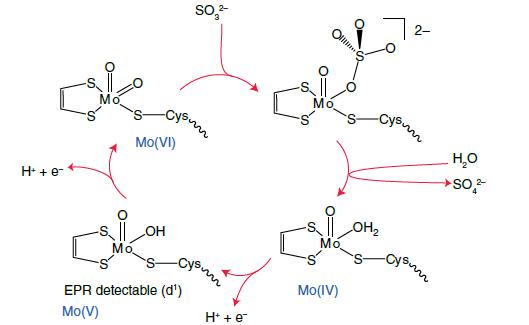
Apart from direct O-atom transfer (Fig. 26.50), another mechanism proposed for Mo enzymes is indirect O-atom transfer, also known as coupled electron-proton transfer. In this mechanism, shown in Fig. 26.69 for sulfite oxidase, the O atom that is transferred originates instead from an uncoordinated
J.A. Botas et al. discuss the catalytic conversion of vegetable oils into hydrocarbons suitable for use as biofuels (Catal. Today, 2012, 195, 59). What are the most important features of catalysts that are used for these reactions? How was the incorporation of transition metals expected to modify
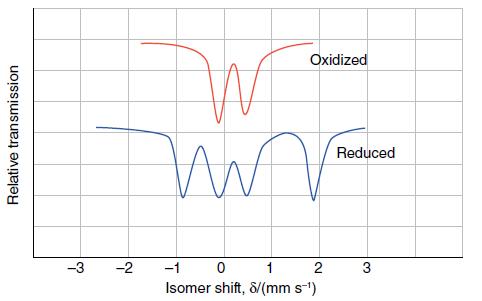
Figure 26.68 shows Mössbauer spectra of a sample of ferredoxin from chloroplasts at 77 K. Interpret the data with regard to the oxidation states an spin states of the two Fe atoms and comment on the electron delocalization at this temperature.Figure 26.68. Relative transmission -3 -2 m Oxidized -1
Why is real-time, in-process monitoring beneficial to green chemical processes?
Ionic liquids can be used as catalysts as well as solvents. Write a review on the use of ionic liquids as catalysts.
Sensors are increasingly being used in situ to monitor reactions and effluent streams in industry. What are the advantages and disadvantages of using in situ sensors compared to traditional laboratory analysis?
Ultimately, the overall ‘green’ credentials of any process can only be evaluated through life cycle analysis (LCA). Identify what components would be considered in the LCA of the synthesis of ammonia via the Haber–Bosch process.
Predict the properties of Na+, Ca2+, and Cl– binding sites that would be important for providing selectivity in their respective transmembrane ion transporters.
In an article on the detection of Zn(II) that is released from neuronal tissue (brain, nerves) following trauma, E. Tomat and S.J. Lippard describe the development of special ligands that are highly selective for Zn and allow it to be imaged by a technique called confocal microscopy (Curr. Opin.
Calcium-binding proteins can be studied by using lanthanoid ions (Ln3+). Compare and contrast the coordination preferences of the two types of metal ion and suggest techniques in which lanthanoid ions would be useful.
In justifying research into small molecule catalysts for producing NH3 from N2, it is sometimes stated that nitrogenase is an ‘efficient’ enzyme: how true is this statement? Comment critically on the argument that ‘knowing the 3D structure of nitrogenase has not enlightened us as to its
In zinc enzymes, ‘spectroscopically silent’ Zn(II) can often be replaced by Co(II) with high retention of activity. Explain the principles by which this substitution can be exploited to obtain structural and mechanistic information.
‘In Mo enzymes, the bond between a terminal oxo anion and Mo(VI) is usually written as a double bond, whereas it is more correctly assigned as a triple bond.’ Discuss this statement. Suggest how a terminal oxido ligand influences the reactivity of other coordination sites on the Mo atom and
Compare and contrast the acid–base catalytic activities of Zn(II), Fe(III), and Mg(II).
Propose physical methods that would allow you to determine whether a reactive intermediate isolated by rapid freeze quenching contains Fe(V).
The structure of the P-cluster in nitrogenase differs significantly between oxidized and reduced states. Comment on this observation in the light of proposals that it participates in long-range electron transfer.
Microorganisms can synthesize the acetyl group (CH3CO–) by direct combination of methyl groups with CO. Make some predictions about the metals that are involved.
Comment on the implications of discovering, by microwave detection, substantial levels of O2 on a planet in another solar system.
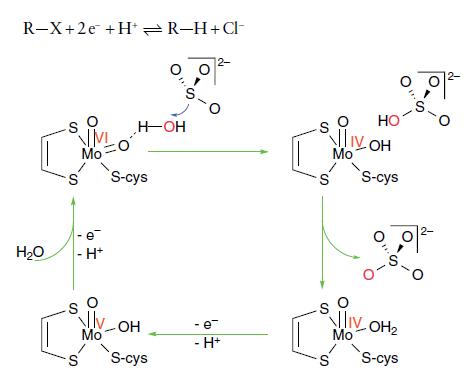
Reductive dehalogenases are cobalamin-containing enzymes which catalyse the replacement of a halogen atom by a hydrogen atom in organic molecules (X is typically Cl). With reference to the principles of halogen bonding and the properties of cobalamins, propose an outline mechanism for
Compounds of Au(III) are under investigation as anticancer drugs. Predict some of the similarities and contrasts with Pt(II) compounds.
In their article ‘Targeting and delivery of platinum-based anticancer drugs’ (Chem. Soc. Rev. 2012, 42, 202), X. Wang and Z. Guo review the expanding field of nanoparticle-based drug delivery. Summarize the various ways that metal-containing drugs are attached to nanostructures and the
Copper bracelets have long been thought to have beneficial effects for rheumatism sufferers. Without surmising on the possible molecular mechanism of action at the target site, describe the chemical principles that are likely to determine how Cu enters the body and is delivered to tissues.
Write an essay on the different ways that metallocenes are being used in medicine.
Boranocarbonate ([H3BCO2]2–) is a promising CORM which is stable in alkali but decomposes slowly to release CO once introduced to neutral or mildly acidic solutions such as the bloodstream. Predict the products of decomposition of boranocarbonate and propose a mechanism.
Write a short essay on selected elements of the periodic table with regard to their medical uses.
Comment, from a chemistry angle, on the ways that Ga(III) compounds might act as drugs through the inhibition of certain types of Fe-containing enzyme.
Identify particular chemical properties of bismuth that suit it for its special role in treating gastric ailments, noting that the stomach environment is highly acidic.
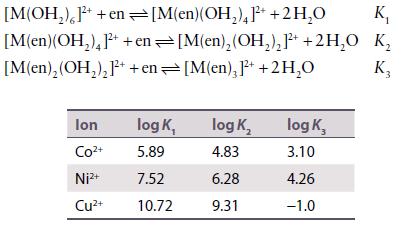
In Problem 7.12 we looked at the successive formation constants for 1,2-diaminoethane complexes of three different metals. Using the same data, discuss the effect of the metal on the formation constant. How might the Irving–Williams series provide insight into these formation constants?Data from
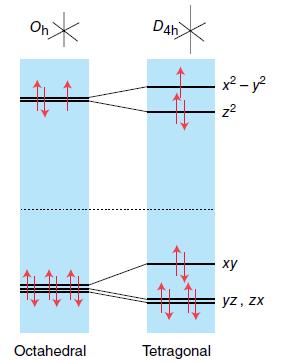
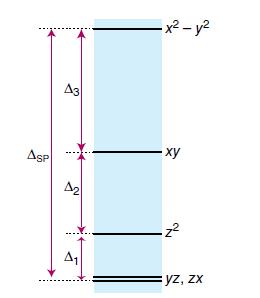
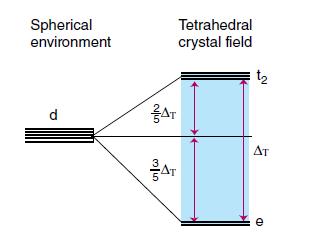
Starting with Fig. 20.12, show how, using a crystal-field approach, an extreme tetragonal distortion leads to the orbital energy-level diagram in Fig. 20.10. Perform a similar analysis for two-coordinate linear complexes.Figure 20.12.Figure 20.10. опж Octahedral DAN -x² - y² -
Determine the configuration (in the form t2gx egy or ext2y , as appropriate), the number of unpaired electrons, and the ligandfield stabilization energy in terms of ΔO or ΔT and P for each of the following complexes. Use the spectrochemical series to decide, where relevant, which are likely to be
In a fused magma liquid from which silicate minerals crystallize, the metal ions can be four-coordinate. In olivine crystals, the M(II) co-ordination sites are octahedral. Partition coefficients, which are defined as Kp = [M(II)]olivine/[M(II)]melt, follow the order Ni(II) > Co(II) > Fe(II)
Both H− and P(C6H5)3 are ligands of similar field strength, high in the spectrochemical series. Recalling that phosphines act as π acceptors, is π-acceptor character required for strong-field behaviour? What orbital factors account for the field strength of each ligand?
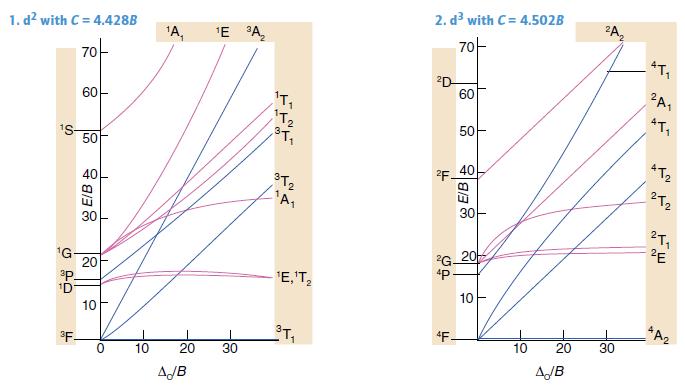
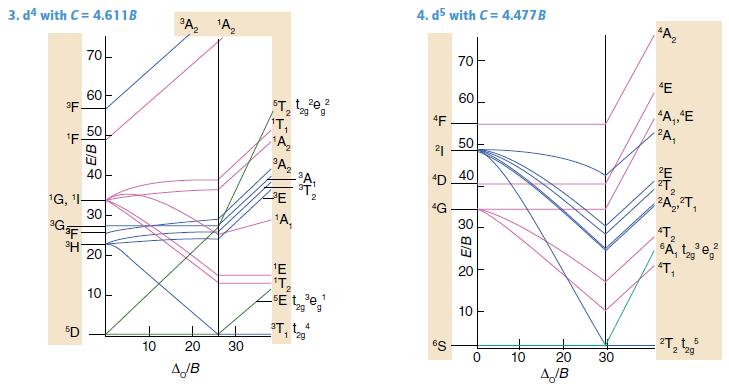
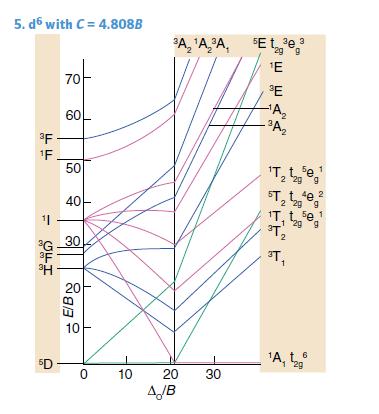
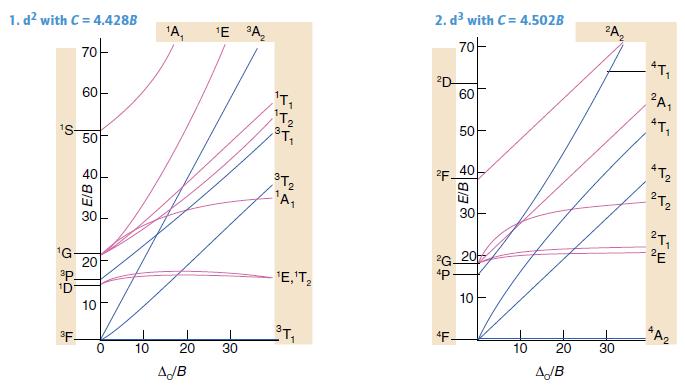
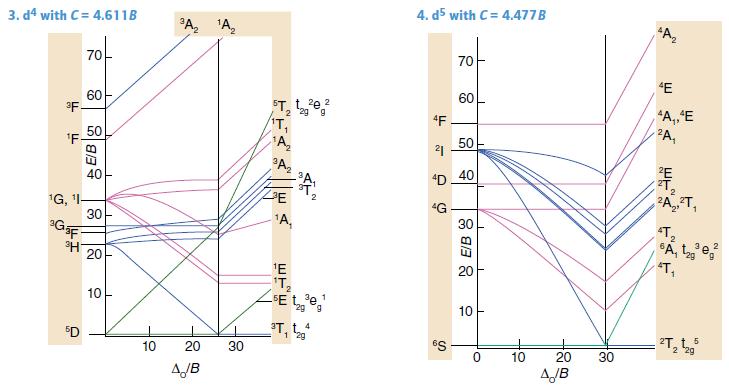
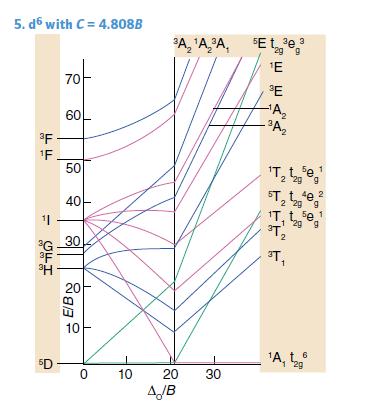
Write the d-orbital configurations and use the Tanabe–Sugano diagrams (Resource section 6) to identify the ground term of (a) Low-spin [Rh(NH3)6]3+, (b) [Ti(OH2)6]3+, (c) High-spin [Fe(OH2)6]3+.Data from Resources section 6. 1. d² with C =
Estimate the spin-only contribution to the magnetic moment for each complex in Exercise 20.1.Data from Exercises 20.1Determine the configuration (in the form t2gx egy or ext2y , as appropriate), the number of unpaired electrons, and the ligandfield stabilization energy in terms of ΔO or ΔT and P
Using the Tanabe–Sugano diagrams in Resource section 6, estimate ΔO and B for (a) [Ni(OH2)6]2+ (absorptions at 8500, 15400, and 26000 cm−1) (b) [Ni(NH3)6]2+ (absorptions at 10750, 17500, and 28200 cm−1).Data from Resources section 6. 1. d² with C =
By considering the splitting of the octahedral orbitals as the symmetry is lowered, draw the symmetry-adapted linear combinations and the molecular orbital energy-level diagram for σ bonding in a trans-[ML4X2] complex. Assume that the ligand X is lower in the spectrochemical series than L.
Match each of the magnetic moments, 3.8, 0, 1.8, 5.9 (in μB), with one of the species: [Fe(CN)6]3−, [Fe(H2O)6]3+, [CrO4]2−, [Cr(H2O)6]3+.
Draw the appropriate symmetry-adapted linear combinations and the molecular orbital diagram for σ bonding in a square-planar complex. The point group is D4h. Take note of the small overlap of the ligand with the dz2 orbital. What is the effect of π bonding?
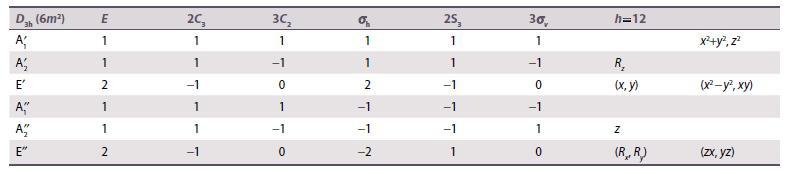
Consider a trigonal prismatic six-coordinate ML6 complex with D3h symmetry. Use the D3h character table (Resources section 4) to divide the d orbitals of the metal into sets of defined symmetry type. Assume that the ligands are at the same angle relative to the xy-plane as in a tetrahedral
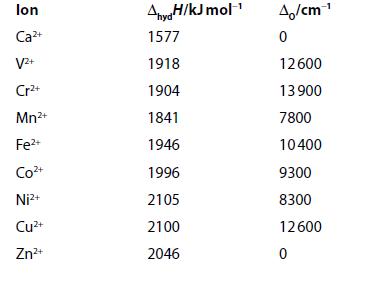
Enthalpies of hydration and values of the ligand-field splitting parameter, ΔO, are given for some octahedrally coordinated ions. (a) Plot the enthalpies of hydration against the number of d electrons. (b) Calculate LFSE in terms of ΔO for high-spin configuration. Use the given values of ΔO to
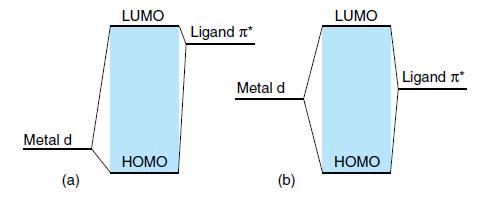
MLCT bands can be recognized by the fact that the energy is a sensitive function of the polarity of the solvent (because the excited state is more polar than the ground state). Two simplified molecular orbital diagrams are shown in Fig. 20.45. (a) Is a case with a ligand π level higher than the
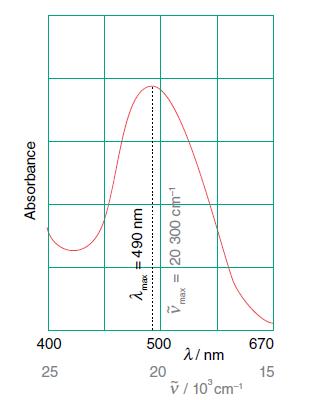
The spectrum of d1 Ti3+(aq) is attributed to a single electronic transition eg ← t2g. The band shown in Fig. 20.3 is not symmetric and suggests that more than one state is involved. Suggest how to explain this observation using the Jahn–Teller effect.Figure 20.3. Absorbance 400 25 490
Solutions of the complexes [Co(NH3)6]2+, [Co(OH2)6]2+ (both Oh), and [CoCl4]2− are coloured. One is pink (absorbs blue light), another is yellow (absorbs violet light), and the third is blue (absorbs red light). Considering the spectrochemical series and the relative magnitudes of ΔT and ΔO,
For each of the following pairs of complexes, identify the one that has the larger LFSE:(a) [Cr(OH2)6]2+ or [Mn(OH2)6]2+(b) [Fe(OH2)6]2+ or [Fe(OH2)6]3+(c) [Fe(OH2)6]3+ or [Fe(CN)6]3–(d) [Fe(CN)6]3– or [Ru(CN)6]3–(e) Tetrahedral [FeCl4]2− or tetrahedral [CoCl4]2−
Interpret the variation, including the overall trend across the 3d series, of the following values of oxide lattice enthalpies (in kJ mol−1). All the compounds have the rock-salt structure: CaO (3460), TiO (3878), VO (3913), MnO (3810), FeO (3921), CoO (3988), NiO (4071).
In a trigonal bipyramidal complex the axial and equatorial sites have different steric and electronic interactions with the central metal ion. Consider a range of some common ligands and decide which coordination site in a trigonal bipyramidal complex they would favour.
Vanadium(IV) species that have the V=O group have quite distinct spectra. What is the d-electron configuration of V(IV)? The most symmetrical of such complexes are [VOL5] with C4v symmetry, with the O atom on the z-axis. What are the symmetry species of the five d orbitals in [VOL5] complexes? How
A neutral macrocyclic ligand with four donor atoms produces a red diamagnetic low-spin d8 complex of Ni(II) if the anion is the weakly coordinating perchlorate ion. When perchlorate is replaced by two thiocyanate ions, SCN−, the complex turns violet and is high-spin with two unpaired electrons.
Bearing in mind the Jahn–Teller effect, predict the structure of [Cr(OH2)6]2+.
Consider spin-crossover complexes and identify the features that a complex would need for it to be used in (a) A practical pressure sensor (b) A practical information-storage device.
Consider the molecular orbital diagram for a tetrahedral complex (based on Fig. 20.8) and the relevant d-orbital configuration, and show that the purple colour of [MnO4]− ions cannot arise from a ligand-field transition. Given that the wavenumbers of the two transitions in [MnO4]− are 18 500
Consider the octahedral [NiF6]3− ion. What spin state and magnetic moment could it have? How would the Jahn-Teller effect affect the two spin states, and how might this complicate an interpretation of the UV/vis absorption spectrum? How has evidence from the magnetic moment and absorption
Write the Russell–Saunders term symbols for states with the angular momentum quantum numbers (L,S): (a) (0, 5/2),(b) (3, 3/2), (c) (2, 1/2), (d) (1,1).
Identify the ground term from each set of terms: (a) 1P, 3P, 3F, 1G; (b) 3P, 5D, 3H, 1I, 1G; (c) 6S, 4P, 4G, 2I.
Give the Russell–Saunders terms of the configurations: (a) 4s1, (b) 3p2. Identify the ground term.
The gas-phase ion V3+ has a 3F ground term. The 1D and 3P terms lie, respectively, 10642 and 12920 cm−1 above it. The energies of the terms are given in terms of Racah parameters as E(3F) = A − 8B, E(3P) = A + 7B, E(1D) = A − 3B + 2C. Calculate the values of B and C for V3+.
Match each of the extinction coefficients, εmax, <1, 10, 100, >104 (in dm3 mol−1 cm−1), with one of the species: [MnO4]− in H2O; Fe3+(aq) in 1.0 M HClO4; Co2+(aq) in 1.0 M HClO4; [CoCl4]2− in 10 M HCl.
The spectrum of [Co(NH3)6]3+ has a very weak band in the red and two moderate intensity bands in the visible to near-UV. How should these transitions be assigned?
The Racah parameter B is 460 cm−1 in [Co(CN)6]3− and 615 cm−1 in [Co(NH3)6]3+. Consider the nature of bonding with the two ligands and explain the difference in nephelauxetic effect.
An approximately ‘octahedral’ complex of Co(III) with ammine and chlorido ligands gives two bands with εmax between 60 and 80 dm3 mol−1 cm−1, one weak peak with εmax = 2 dm3 mol−1 cm−1, and a strong band at higher energy with εmax = 2 × 10⁴ dm3 mol−1 cm−1. What do you suggest
Ordinary bottle glass appears nearly colourless when viewed through the wall of the bottle but visibly coloured (green) when viewed from the end so that the light has a long path through the glass. The colour is associated with the presence of Fe3+ in the silicate matrix. Explain this observation.
Solutions of [Cr(OH2)6]3+ ions are pale greeny-blue but the chromate ion, [CrO4]2−, is an intense yellow. Characterize the origins of the transitions and explain the relative intensities.
Classify the symmetry type of the d orbitals in a tetragonal C4v symmetry complex, such as [CoCl(NH3)5]2+, where the Cl lies on the z-axis.(a) Which orbitals will be displaced from their position in the octahedral molecular orbital diagram by π interactions with the lone pairs of the Cl−
The rate constants for the formation of [CoX(NH3)5]2+ from [Co(NH3)5(OH2)]3+ for X = Cl− ,Br− ,N−3, and SCN− differ by no more than a factor of 2. What is the mechanism of the substitution?
Given NaBH4, a hydrocarbon of your choice, and appropriate ancillary reagents and solvents, give formulas and conditions for the synthesis of (a) B(C2H5)3, (b) Et3NBH3.
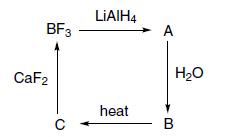
Identify the B-containing compounds A, B, and C. BF3 CaF2 C LiAlH4 heat A H₂O B
The relative positons of tetrahedral and octahedral holes between close-packed layers may be described using the PTOT system, where P represents a close-packed layer, and T and O the tetrahedral and octahedral holes, respectively. Use this description and the formation of ‘stuffed’ PTOT
Discuss the similarities in the chemistry of Tl(I) to those of the alkali metals and particularly that of potassium.
Give a balanced chemical equation and conditions for the recovery of boron.
Use suitable molecular-orbital software to calculate the wavefunctions and energy levels for closo-[B6H6]2−. From that output, draw a molecular orbital energy diagram for the orbitals primarily involved in B–B bonding and sketch the form of the orbitals. How do these orbitals compare
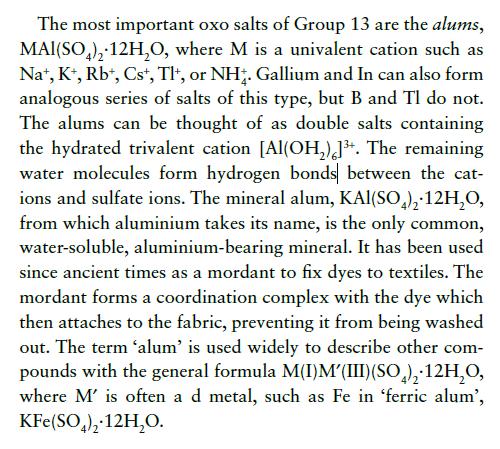
How would you expect the Group 13 element to hydrogen bond enthalpy to change as the group is descended? Hence explain the nonexistence of TlH3. The most important oxo salts of Group 13 are the alums, MAI(SO4)₂-12H₂O, where M is a univalent cation such as Na+, K+, Rbt, Cst, Tl, or NH. Gallium
Explain the important role of cryolite, Na3AlF6, in the extraction of aluminium metal.
In his paper ‘Covalent and ionic molecules: why are BeF2 and AlF3 high melting point solids whereas BF3 and SiF4 are gases?’ (J. Chem. Educ., 1998, 75, 923), R.J. Gillespie makes a case for the classification of the bonding in BF3 and SiF4 as predominantly ionic. Summarize his arguments and
Why does a droplet of mercury cause aluminium to react rapidly with air?
Nanotubes of C and BN have been synthesized by C. Colliex et al. (Science, 1997, 278, 653). (a) What are the advantageous properties of these nanotubes over carbon analogues?(b) Outline the method used for the preparation of these compounds. (c) What was the main structural feature of the
Diborane has been used as a rocket propellant. Calculate the energy released from 1.00 kg of diborane given the following values of The combustion reaction is B2H6(g) + 3O2(g) → 3H2O(g) + B2O3(s). What would be the problem with diborane as a fuel? A.HⓇ/kJ mol-¹: B₂H = 31, H₂O = -242,
Describe the bonding in (a) BF3, (b) AlCl3, (c) B2H6, (d) TlF.
M. Montiverde discusses ‘Pressure dependence of the superconducting temperature of MgB2’ (Science, 2001, 292, 75). (a) Describe the bases of the two theories that have been postulated to explain the superconductivity of MgB2. (b) How does the Tc of MgB2 vary with pressure? What
Arrange the following in order of increasing Lewis acidity: BF3, BCl3, AlCl3. In the light of this order, write balanced chemical reactions (or no reaction) for:(a) BF3N(CH3)3 + BCl3 →(b) BH3CO + BBr3 →
Thallium tribromide (1.11 g) reacts quantitatively with 0.257 g of NaBr to form a product A. Deduce the formula of A. Identify the cation and anion.
Shuji Nakamura was awarded the 2014 Nobel Prize for Physics in part for his invention of blue LEDs based on gallium nitride. Discuss the chemistry of gallium nitride including its synthesis, structures adopted and semiconducting chemistry (including the doped forms).
In their paper ‘New structural motifs in metallaborane chemistry: synthesis, characterization, and solid-state structures of [(Cp*W)3(μ-H)B8H8], [(Cp*W)2B7H9], and [(Cp*Re)2B7H7] (Cp* = η5-C5Me5)’ (Organometallics, 1999, 18, 853), A.S. Weller, M. Shang, and T.P. Fehlner discuss the synthesis
Does B2H6 survive in air? If not, write the equation for the reaction.
Predict how many different boron environments would be present in the proton-decoupled 11B-NMR of (a) B5H11, (b) B4H10.
Predict the products from the hydroboration of (a) (CH3)2 C=CH2, (b) CH=CH.
Using BCl3 as a starting material and other reagents of your choice, devise a synthesis for the Lewis acid chelating agent, F2B–C2H4–BF2.
Determine the point group of a B2Cl4 molecule in (a) The gas phase (staggered) (b) The solid (planar) structures.
Give the IUPAC names of (a) B10H14,(b) [B12H12]2−, (c) Arachno-[B12H14]2−.
Give balanced chemical equations for the synthesis of 1,2-B10C2H10(Si(CH3)3)2 starting with decaborane(14) and other reagents of your choice.
Draw the B12 unit that is a common motif of boron structures; take a viewpoint along a C2 axis.
Which boron hydride would you expect to be more thermally stable, B6H10 or B6H12? Give a generalization by which the thermal stability of a borane can be judged.
How many skeletal electrons are present in B5H9?
(a) From its formula, classify B10H14 as closo, nido, or arachno. (b) Use Wade’s rules to determine the number of framework electron pairs for decaborane(14). (c) Verify by detailed accounting of valence electrons that the number of cluster valence electrons of B10H14 is the same as
Showing 200 - 300
of 1950
1
2
3
4
5
6
7
8
9
10
11
12
13
14
15
Last
Step by Step Answers

 Get 50% OFF
Claim Now
Get 50% OFF
Claim Now