New Semester
Started
Get
50% OFF
Study Help!
--h --m --s
Claim Now
Question Answers
Textbooks
Find textbooks, questions and answers
Oops, something went wrong!
Change your search query and then try again
S
Books
FREE
Study Help
Expert Questions
Accounting
General Management
Mathematics
Finance
Organizational Behaviour
Law
Physics
Operating System
Management Leadership
Sociology
Programming
Marketing
Database
Computer Network
Economics
Textbooks Solutions
Accounting
Managerial Accounting
Management Leadership
Cost Accounting
Statistics
Business Law
Corporate Finance
Finance
Economics
Auditing
Tutors
Online Tutors
Find a Tutor
Hire a Tutor
Become a Tutor
AI Tutor
AI Study Planner
NEW
Sell Books
Search
Search
Sign In
Register
study help
sciences
inorganic chemistry
Inorganic Chemistry 7th Edition Mark Weller, Tina Overton, Jonathan Rourke - Solutions
P.C. Junk and J.W. Steed (J. Chem. Soc., Dalton. Trans., 1999, 407) prepared crown ether complexes from the nitrates of Mg, Ca, Sr, and Ba. Outline the general procedure that was used for the syntheses. Sketch the structures of the two crown ethers used. Comment on the structures of the complexes
Why does beryllium fluoride form a glass when cooled from a melt?
The aluminosilicates form a large group of minerals based on linked AlO4 and SiO4 tetrahedra which includes many clay and zeolite minerals whose compositions may be written Mx+[AlxSi1−xO4]x−. Discuss the occurrence of the BeO4 unit in natural minerals. To what extent has it proved possible to
Dissolution of MgCl2⋅6H2O in water gives a solution with a pH of 6 while dissolution of BaCl2⋅2H2O gives a neutral pH solution. Explain these observations.
An experiment was carried out to determine the hardness of domestic water. A few drops of pH = 10 buffer were added to a 100 cm3 sample of the water. This sample was titrated against 0.01 M edta(aq) using Eriochrome Black T indicator and gave a titre of 33.8 cm3. Under these circumstances both Mg2+
Calculate the weight per cent of hydrogen in each of the Group 2 hydrides. Why is MgH2 being investigated as a hydrogen storage material while BeH2 is not?
The synthesis of an Mg(I) compound has been reported (Science, 2007, 318, 1754). Describe how this synthesis was carried out and how this unusual Group 2 oxidation state was stabilized.
By considering the rock-salt structure and the distances and charges around one central ion, show that the first six terms of the Na+ Madelung series areDiscuss methods for showing that this series converges to 1.748 by reference to R.P. Grosso, J.T. Fermann, and W.J. Vining, J. Chem. Educ., 2001,
Explain why Group 1 hydroxides are much more corrosive to metals than those of most Group 2 hydroxides.
Discuss the bonding in the C–Be–C unit of zero valent beryllium compounds (M. Arrowsmith et al., Nat. Chem., 2016, 8, 890).
What are the advantages of using Ba(OH)2 over NaOH as base in analytical acid-base titrations, especially when the solutions have to be handled in air?
The Kapustinskii equation shows that lattice enthalpies are inversely proportional to the interionic distances. Later work has shown that further simplification of the Kapustinskii equation allows lattice enthalpies to be estimated from the molecular (formula) unit volume (the unit cell volume
‘Nature is adept at controlling mineralisation processes to produce single crystals and polycrystalline and amorphous structures with remarkable morphologies and mechanical properties’ (F. Meldrum, Int. Mater. Rev., 2003, 48, 187; F. Meldrum and H Cölfen, Chem. Rev., 2008, 108, 4332). Calcium
Which of the salts, MgSeO4 or BaSeO4, would be expected to be more soluble in water?
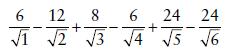
2.4 per cent of all global CO2 emissions (35 billion tonnes in 2016) derive from cement production. Assuming all this CO2 is derived from the decomposition of CaCO3 calculate the annual level of CaO production for the cement industry.
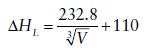
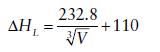
The following linear correlation, sometimes referred to as Bartlett’s relationship, has been found between lattice enthalpy (kJ mol−1) and the inverse cube root of the formula unit volume V (in nm3) for 1:1 MX salts.Show that this expression is related to the Kapustinskii equation. Formula unit
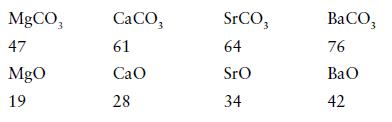
The analysis undertaken in Problem 4.8 may be extended to give the ‘isomegethic rule’ which states that ‘The formula unit volumes, Vm, of isomeric ionic salts are approximately the same’; see H.D.B. Jenkins et al., Inorg. Chem., 2004, 43, 6238, and L. Glasser, J. Chem. Educ., 2011, 88, 581.
How can Ra be separated from solutions containing the other Group 2 metal cations?
Which Group 2 salts are used as drying agents and why?
Predict structures for BeTe and BaTe using an ionic radius for Te2− of 207 pm.
The two Grignard compounds C2H5MgBr and 2,4,6-(CH3)3C6H2MgBr both dissolve in THF. What differences would be expected in the structures of the species formed in these solutions?
Predict the products of the following reactions:(a) MgCl2 + LiC2H5 →(b) Mg + (C2H5)2Hg →(c) Mg + C2H5HgCl →
Both ccp and hcp have identical close-packed volumes, but the calculated Gibbs free energy of the two arrangements shows that ccp is more stable by 0.002–0.012 kJ mol−1 at room temperature (L.V. Woodcock, Nature, 1997, 385, 141, P.G. Bolhuis, D. Frenkel, S-C Mau and D.A. Huse, Nature, 1997,
Calculate the number of atoms present in a cubic gold nanoparticle of dimensions 2 × 2 × 2 nm3; gold adopts an fcc unit cell with lattice parameter of 400 pm. Discuss how the size of silver and gold nanoparticles affects their colour and how this has led to their historical application in stained
Nanocrystals with dimensions of 1–10 nm are of increasing importance in technological applications. The calculation of the Madelung constant for a particular structure type requires the summation of an infinite series of terms, and this method is not applicable to a crystal of nanometre
Discuss the thermodynamic factors behind the observation that CuO is a well-known, stable oxide of Cu(II) but AgO is a mixed-valence oxide, Ag(I)Ag(III)O2. See D. Tudela, J. Chem. Educ., 2008, 85, 863. AgF2 is a stable compound of Ag(II); discuss what factors might contribute to the stability of
Discuss the ‘water-bottle’ analogy in interpreting the electronic properties of metallic, insulating and semiconducting solids (P.F. Weller, J. Chem. Educ., 1967, 44, 391).
‘Band theory is less helpful than Mott–Hubbard theory ... in explaining conductivity and semi conductivity to introductory students’ (S.J. Hawkes, J. Chem. Educ., 2012, 89, 694). Describe the Mott–Hubbard model and its applications in explaining how metallic behaviour can arise in solids.
Sketch an outline of the s and p blocks of the periodic table and indicate on it the elements that form (a) Strongly acidic oxides(b) Strongly basic oxides,(c) Show the regions for which amphoterism is common.
A paper by Gillespie and Liang entitled ‘Superacid solutions in hydrogen fluoride’ (J. Am. Chem. Soc., 1988, 110, 6053) discusses the acidity of various solutions of inorganic compounds in HF. (a) Give the order of acid strength of the pentafluorides determined during the
Identify the conjugate bases corresponding to the following acids: [Co(NH3)5(OH2)]3+, HSO4−, CH3OH, H2PO4−, Si(OH)4, HS−.
In the reaction of t-butyl bromide with Ba(NCS)2, the product is 91 per cent S-bound tBu–SCN. However, if Ba(NCS)2 is impregnated into solid CaF2, the yield is higher and the product is 99 per cent t-Bu–NCS. Discuss the effect of alkaline earth metal salt support on the hardness of the ambident
Identify the conjugate acids of the bases C5H5N (pyridine), HPO42−, O2−, CH3COOH, [Co(CO)4]−, CN−.
In their paper ‘The strengths of the hydrohalic acids’ (J. Chem. Educ., 2001, 78, 116), R. Schmid and A. Miah discuss the validity of literature values of the pKa values for HF, HCl, HBr, and HI. (a) On what basis have the literature values been estimated? (b) To what is the low acid
Calculate the equilibrium concentration of H3O+ in a 0.10 M solution of butanoic acid (Ka = 1.86 × 10⁻⁵). What is the pH of this solution?
Superacids are well established but superbases also exist and are usually based on hydrides of Group 1 and Group 2 elements. Write an account of the chemistry of superbases.
In their article ‘Variability of the cell potential of a given chemical reaction’ (J. Chem. Educ., 2004, 81, 84), L.H. Berka and I. Fishtik conclude that E⦵ for a chemical reaction is not a state function because the half-reactions are arbitrarily chosen and may contain different numbers of
Use standard potentials as a guide to write equations for the main net reaction that you would predict in the following experiments: (a) N2O is bubbled into aqueous NaOH solution, (b) Zinc metal is added to aqueous sodium triiodide,(c) I2 is added to excess aqueous HClO3.
Predict the form of the 19F-NMR and the 77Se-NMR spectra of 77SeF4. For 77Se, I = 1/2.
Discuss how the equilibriumcan be shifted by complexation with chloride ions. Cu²+ (aq) + Cu(s) = 2 Cu+ (aq)
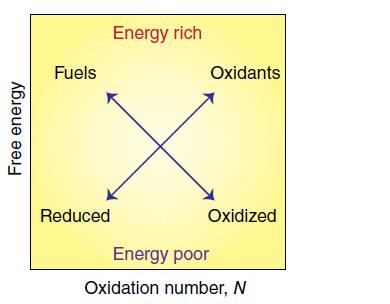
In their article ‘Enzymes and bio-inspired electrocatalysts in solar fuel devices’ (Energy Environ. Sci., 2012, 5, 7470), Woolerton et al. use a generic Frost diagram (Fig. 6.21) to illustrate the concept of chemical energy storage and release. So-called ‘energy-rich substances’ are
Calculate the equilibrium constant of the reactionfrom the standard potentials Aut(aq) + 2 CN- (aq) [Au(CN)₂](aq)
From the following Latimer diagram (which does not correspond to standard conditions), calculate the value of E⦵ for the reaction 2HO2(aq) → O2(g) + H2O2(aq).Comment on the thermodynamic tendency of HO2 to undergo disproportionation. 0₂- -0.125 →HO₂- +1.510 →H₂O₂
Using the following Latimer diagram, which shows the standard potentials for sulfur species in acid solution (pH = 0), construct a Frost diagram and calculate the standard potential for the HSO4−/S8(s) couple. $₂0²- +0.60 +1.96 +0.16 HSO +0.14 S- →H₂S → H₂SO3 +0.40 S₂0 ²/3- >
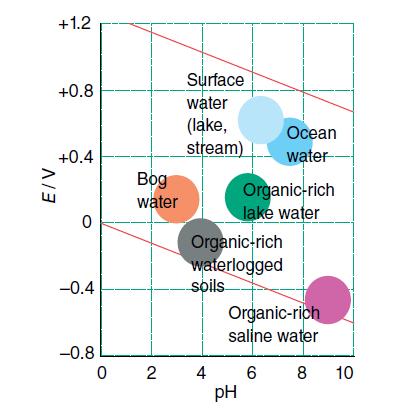
Use Fig. 6.12 to find the approximate potential of an aerated lake at pH = 6. With this information and Latimer diagrams from Resource section 3, predict the species at equilibrium for the elements (a) Iron, (b) Manganese, (c) Sulfur.Figure 6.12.
Draw a Frost diagram for mercury in acid solution, given the following Latimer diagram:Comment on the tendency of any of the species to act as an oxidizing agent, a reducing agent, or to undergo disproportionation. Hg2+ 0.911 2+ Hg²+ 0.796 Hg
Using the following aqueous acid solution reduction potentials E⦵ (Pd2+,Pd) = +0.915 V and E⦵ ([PdCl4]2−,Pd) = +0.60 V, calculate the equilibrium constant for the reaction Pd²+ (aq) + 4 Cl(aq) [PdCl]-(aq) in 1 M HCl(aq).
In their article ‘A thermochemical study of ceria: exploiting an old material for new modes of energy conversion and CO2 mitigation’ (Philos. Trans. R. Soc. London, 2010, 368, 3269), Chueh and Haile describe a way to convert water into H2 and O2 using CeO2. Explain the chemical and
Adding NaOH to an aqueous solution containing Ni2+ results in precipitation of Ni(OH)2. The standard potential for the Ni2+/Ni couple is −0.25 V and the solubility product Ksp = [Ni2+] [OH−]2 = 1.5 × 10⁻¹⁶. Calculate the electrode potential at pH = 14.
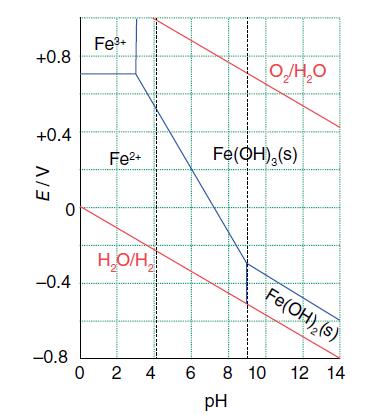
In Fig. 6.11, which of the boundaries depend on the choice of Fe2+ concentration as 10−5 mol dm−3?Figure 6.11. +0.8 +0.4 E/V -0.4 -0.8 Fe3+ Fe2+ H,O/H, 024 Fe(OH),(s) Fe(OH), (s) 6 8 10 12 14 pH
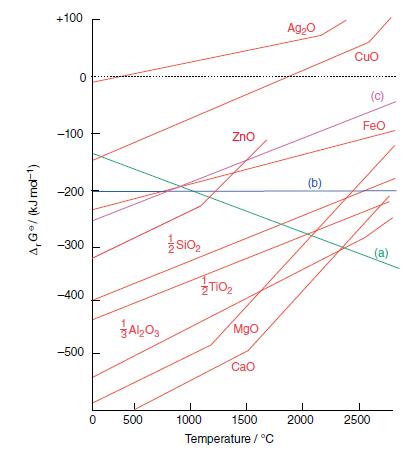
Consult the Ellingham diagram in Fig. 6.16 and determine if there are any conditions under which aluminium might be expected to reduce MgO. Comment on these conditions.Figure 6.16. A,G*/ (kJ md-¹) +100 0 -100 -200 -300 -400 -500 0 A1203 500 SIO₂ 1000 ZnO TiO₂ Mgo CaO 1500 Temperature /
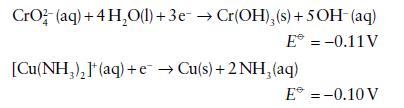
Given the following standard potentials in basic solutionand assuming that a reversible reaction can be established on a suitable catalyst, calculate E⦵, ΔrG⦵, and K for the reductions of(a) CrO42− (b) [Cu(NH3)2]+ in basic solution. Comment on why ΔrG⦵ and K are so different between the
Characterize the condition of acidity or basicity that would most favour the following transformations in aqueous solution:(a) Mn2+ → MnO4−, (b) ClO4− → ClO3−, (c) H2O2 → O2, (d) I2 → 2I−.
Use the Latimer diagram for chlorine to determine the potential for reduction of ClO4− to Cl2. Write a balanced equation for this half-reaction.
Calculate the reduction potential at 25°C for the conversion of MnO4− to MnO2(s) in aqueous solution at pH = 9.00 and 1M MnO4−(aq) given that E⦵ (MnO4−/MnO2) = +1.69 V.
The ligand edta forms stable complexes with hard acid centres. How will complexation with edta affect the reduction of M2+ to the metal in the 3d series?
Explain why water with high concentrations of dissolved carbon dioxide and open to atmospheric oxygen is very corrosive towards iron.
The standard potentials for phosphorus species in aqueous solution at pH = 0 and pH = 14 are provided in Resource section 3.(a) Account for the difference in reduction potentials between pH 0 and pH 14.(b) Construct a single Frost diagram showing both sets of data.(c) Phosphine (PH3) can be
The species Fe2+ and H2S are important at the bottom of a lake where O2 is scarce. If the pH = 6, what is the maximum value of E characterizing the environment?
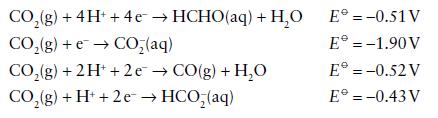
Reduction potentials for half-cell reactions of simple carbon species measured in aqueous solution at pH 7.0, 25°C, are as follows.(a) Assign carbon oxidation numbers to each of the species involved.(b) Construct a Frost diagram, making HCHO the reference point at the origin.(c) Identify the redox
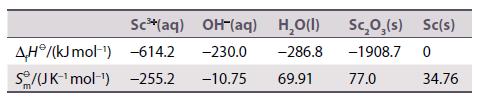
Many of the tabulated data for standard potentials have been determined from thermochemical data rather than direct electrochemical measurements of cell potentials. Carry out a calculation to illustrate this approach for the half-reaction Sc₂O₂ (s) + 3H₂O(l) +6e2Sc(s) + 6OH-(aq).
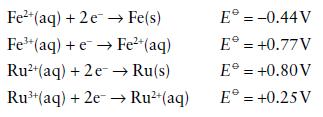
Data shown below refer to redox couples for the Group 8 elements Fe and Ru.(a) Comment on the relative stability of Fe2+ and Ru2+ in acidic aqueous solution.(b) Give a balanced equation for the reaction that would occur if iron filings were to be added to an acidified aqueous solution of an Fe3+
The following Latimer diagrams show the standard reduction potentials E⦵/V for some oxidation states of iron in acid and alkaline solution:(a) Plot a Frost diagram showing the states of Fe under acid and alkaline conditions.(b) Calculate the standard potential for the Fe3+/Fe couple in
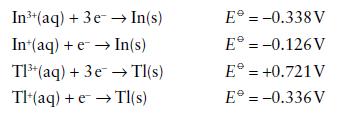
Standard potentials at 25°C for indium and thallium in aqueous solution (pH = 0) are given below.Use the data to construct a Frost diagram for the two elements and discuss the relative stabilities of the species. In³+(aq) + 3eIn(s) In (aq) +eIn(s) Tl³+ (aq) + 3e Tl(aq) + e → Tl(s) Tl(s) E E =
The Latimer diagram for vanadium species in acidic (pH = 0) solution is:Using these data:(a) Calculate the potential for the reduction of VO2+(aq) to V(s) and write a balanced chemical equation for this process.(b) Construct a Frost diagram for vanadium at pH = 0.(c) Calculate the equilibrium
The compound Na2IrCl6 reacts with triphenylphosphine in diethylene glycol in an atmosphere of CO to give trans-[IrCl(CO)(PPh3)2], known as ‘Vaska’s compound’. Excess CO gives a five coordinate species and treatment with NaBH4 in ethanol gives [IrH(CO)2(PPh3)2]. Derive a formal name for
Name and draw structures of the following complexes:(a) [Ni(CN)4]2−, (b) [CoCl4]2−, (c) [Mn(NH3)6]2+.
A pink solid has the formula CoCl3.5NH3.H2O. A solution of this salt is also pink and rapidly gives 3 mol AgCl on titration with silver nitrate solution. When the pink solid is heated, it loses 1 mol H2O to give a purple solid with the same ratio of NH3:Cl:Co. The purple solid, on dissolution and
Give formulas for (a) Chloridopentaamminecobalt(III) chloride, (b) Hexaaquairon(3+) nitrate, (c) Cis-dichloridobis(1,2- diaminoethane)ruthenium(II), (d) μ-hydroxidobis(pentaamminechromium(III)) chloride.
The hydrated chromium chloride that is available commercially has the overall composition CrCl3·6H2O. On boiling a solution, it becomes violet and has a molar electrical conductivity similar to that of [Co(NH3)6]Cl3. By contrast, another form of CrCl3·6H2O is green and has a lower molar
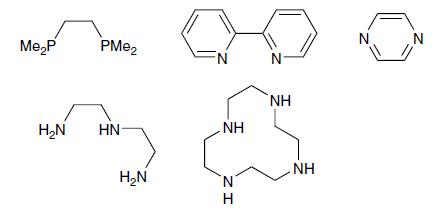
What is the denticity of the following molecules? Which could act as bridging ligands? Which could act as chelating ligands? Me₂P PMe₂ H₂N HN H₂N FN .ΝΗ ZI N H N NH NH N
Name the octahedral complex ions (a) cis-[CrCl2(NH3)4]+,(b) trans-[Cr(NH3)2(κN-NCS)4]−, (c) [Co(C2O4)(en)2]+.
The complex first denoted β-[PtCl2(NH3)2] was identified as the trans isomer. (The cis isomer was denoted α.) It reacts slowly with solid Ag2O to produce [Pt(NH3)2(OH2)2]2+. This complex does not react with 1,2-diaminoethane to give a chelated complex. Name and draw the structure of the diaqua
(a) Sketch the two structures that describe most four coordinate complexes. (b) In which structure are isomers possible for complexes of formula MA2B2?
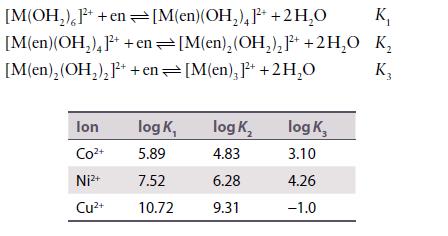
The equilibrium constants for the successive reactions of 1,2-diaminoethane with Co2+, Ni2+, and Cu2+ are as follows:Discuss whether these data support the generalizations in the text about successive formation constants. How do you account for the very low value of K3 for Cu2+? [M(OH₂) 1²+ +
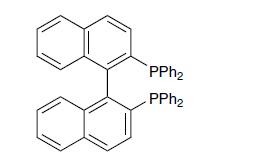
BINAP is a chelating diphosphine ligand shown below. Discuss the reasons for the observed chirality of BINAP, and of its complexes. PPh₂ PPh₂
Sketch the two structures that describe most five-coordinate complexes. Label the two different sites in each structure.
When cobalt(II) salts are oxidized by air in a solution containing ammonia and sodium nitrite, a yellow solid, [Co(NO2)3(NH3)3], can be isolated. In solution it is nonconducting; treatment with HCl gives a complex that, after a series of further reactions, can be identified as
(a) Sketch the two structures that describe most six coordinate complexes. (b) Which one of these is rare?
The reaction of [ZrCl4(dppe)] with Mg(CH3)2 gives [Zr(CH3)4(dppe)]. NMR spectra indicate that all methyl groups are equivalent. Draw octahedral and trigonal prism structures for the complex and show how the conclusion from NMR supports the trigonal prism assignment (P.M. Morse and G.S. Girolami, J.
Explain the meaning of the terms monodentate, bidentate, and tetradentate.
The resolving agent d-cis[Co(NO2)2(en)2]Br can be converted to the soluble nitrate by grinding in water with AgNO3. Outline the use of this species for resolving a racemic mixture of the d and l enantiomers of K[Co(edta)]. (The l-[Co(edta)]− enantiomer forms the less soluble diastereomer.
What type of isomerism can arise with ambidentate ligands? Give two examples.
Show how the coordination of two MeHNCH2CH2NH2 ligands to a metal atom in a square-planar complex results in not only cis and trans but also optical isomers. Identify the mirror planes in the isomers that are not chiral.
Use a group-theory analysis to assign point groups to the all cis and all trans isomers of [MA2B2C2]; use the character tables associated with each to determine whether they are chiral or not.
Draw the structures of representative complexes that contain the ligands (a) en, (b) ox2−, (c) phen, (d) 12-crown-4,(e) tren, (f) terpy, (g) edta4−.
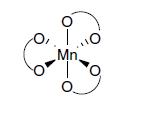
Which isomer is the following tris(acac) complex? O, I Mn. O
The two compounds [RuBr(NH3)5]Cl and [RuCl(NH3)5]Br are what types of isomers?
For which of the following tetrahedral complexes are isomers possible? Draw all the isomers. [CoBr2Cl2]−, [CoBrCl2(OH2)], [CoBrClI(OH2)].
For which of the following square-planar complexes are isomers possible? Draw all the isomers. [Pt(NH3)2(ox)],[PdBrCl(PEt3)2], [Ir(CO)H(PR3)2], [Pd(gly)2].
How may the aromatic character of a chelate ring provide additional stabilization of a complex?
For which of the following octahedral complexes are isomers possible? Draw all the isomers. [FeCl(OH2)5]2+, [IrCl3(PEt3)3], [Ru(bpy)3]2+, [CoCl2(en)(NH3)2]+, [W(CO)4(py)2].
What are rotaxanes, and how do they differ from pseudorotaxanes? Discuss how coordination chemistry might be used to synthesize such molecules.
How many isomers are possible for an octahedral complex of general formula [MA2BCDE]? Draw all that are possible.
Which of the following complexes are chiral? (a) [Cr(ox)3]3−,(b) cis-[PtCl2(en)], (c) cis-[RhCl2(NH3)4]+, (d) [Ru(bpy)3]2+,(e) fac-[Co(NO2)3(dien)], (f) mer-[Co(NO2)3(dien)]. Draw the enantiomers of the complexes identified as chiral and identify the plane of symmetry in
Draw and label both Λ and Δ isomers of the [Ru(en)3]2+ cation.
The stepwise formation constants for complexes of NH3 with [Cu(OH2)6]2+(aq) are log Kf1 = 4.15, log Kf2 = 3.50, log Kf3 = 2.89, log Kf4 = 2.13, and log Kf5 = −0.52. Suggest a reason why Kf5 is so different.
The stepwise formation constants for complexes of NH2CH2CH2NH2 (en) with [Cu(OH2)6]2+(aq) are log Kf1 = 10.72 and log Kf2 = 9.31. Compare these values with those of ammonia given in Exercise 7.19 and suggest why they are different.Data from Exercises 7.19.The stepwise formation constants for
Discuss the importance of X-ray crystallography in inorganic chemistry. See, for example, W.P. Jensen, G.J. Palenik, and I.-H. Suh, The history of molecular structure determination viewed through the Nobel Prizes, J. Chem. Educ., 2003, 80, 753.
The synthesis of the spinel Mg2TiO4 can be achieved by heating TiO2 with MgO at 1400°C over a period of several days. How would powder X-ray diffraction be able to demonstrate that the reaction had gone to completion?
Showing 600 - 700
of 1950
1
2
3
4
5
6
7
8
9
10
11
12
13
14
15
Last
Step by Step Answers

 Get 50% OFF
Claim Now
Get 50% OFF
Claim Now