New Semester
Started
Get
50% OFF
Study Help!
--h --m --s
Claim Now
Question Answers
Textbooks
Find textbooks, questions and answers
Oops, something went wrong!
Change your search query and then try again
S
Books
FREE
Study Help
Expert Questions
Accounting
General Management
Mathematics
Finance
Organizational Behaviour
Law
Physics
Operating System
Management Leadership
Sociology
Programming
Marketing
Database
Computer Network
Economics
Textbooks Solutions
Accounting
Managerial Accounting
Management Leadership
Cost Accounting
Statistics
Business Law
Corporate Finance
Finance
Economics
Auditing
Tutors
Online Tutors
Find a Tutor
Hire a Tutor
Become a Tutor
AI Tutor
AI Study Planner
NEW
Sell Books
Search
Search
Sign In
Register
study help
sciences
solid state materials chemistry
Solid State Materials Chemistry 1st Edition Patrick M. Woodward, Pavel Karen, John S. O. Evans, Thomas Vogt - Solutions
Nitridized steel is hard yet brittle, and this means that the bulk of a steel object must remain free of nitrogen. Assuming D = 10−9 cm2/s for interstitial diffusion of nitrogen in steel at 700 °C, estimate the minimum thickness of the above steel blade such that the nitrogen concentration at
At 700 °C, an YBa2Cu3O7−δ sphere of 2 cm radius is abruptly exposed to 1 bar O2 gas. Assuming DO = 10−5 cm2/s and diffusion as the rate-controlling process, calculate how long it will take before 90% of the total oxidation change occurs 1 mm below the surface. Under these conditions, the
Give a brief definition of the terms phase (P), component (C), and degrees of freedom (F) in the condensed matter phase rule P + F = C + 1.
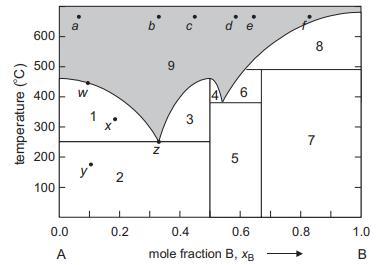
Refer to the phase diagram depicted below. (a) State which four phases are stable at 100 °C. (b) What is the name given to the horizontal line separating region 2 from 1 and 3?(c) What are the approximate melting points of A, AB, and B? (d) What happens if you try and melt solid AB2? (e) State
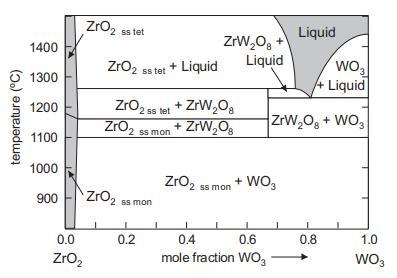
Using the phase diagram of Figure 4.8: (a) State how you would attempt to prepare a solid polycrystalline sample of ZrW2O8. (b) State how you would attempt to grow single crystals of ZrW2O8.Figure 4.8 temperature (C) 1400 1300 1200 1100 1000 900 0.0 ZrO ZrO ss tet ZrO2 ss tet + Liquid ZrO2 ss
In the system Al2O3–BaO, five phases stable above 1300 °C were identified: AlO3, Al12 BaO19, Al-BaO4, Al-Ba306, and BaO. Each was found to melt congruently at 2072 C, 1900 C, 1811 C, 1616 C, and 1918 C, respectively. Eutectics form at XBO=0.11, 0.32, 0.66, and 0.87 (relative to Al2O3) with
Perovskite chemists searching in the CaO–TiO2 system initially found four phases stable above 1300 °C: CaO, Ca,Ti07, CaTiO3, and TiO. CaO, CaTiO3, and TiO were reported to melt congruently at 2600 C, 1970 C, and 1830 C and Ca3TiO, to melt incongruently at 1750 C. Eutectics were reported at XTio
Use the phase rule to explain how a mixture of Ni and NiO can be used to provide a controlled low oxygen partial pressure in a closed system.
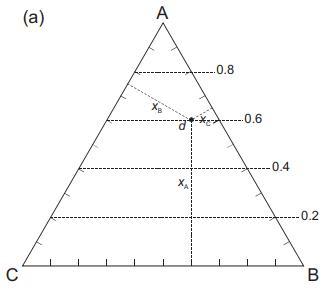
If the height of the triangle in Figure 4.10a is 1, prove that the distances xA, xB, and xC must sum to 1. Write an expression for the total area of triangle ABC in terms of constituent triangles such as ABd.Figure 4.10 a (a) A ..0.8 --0.6 -0.4 -0.2 B
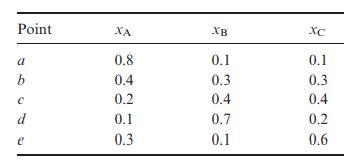
Plot the following compositions on a triangular composition diagram. Comment on the compositions of points a, b, and c and of points d, c, and e. Point a b C d e XA 0.8 0.4 0.2 0.1 0.3 XB 0.1 0.3 0.4 0.7 0.1 XC 0.1 0.3 0.4 0.2 0.6
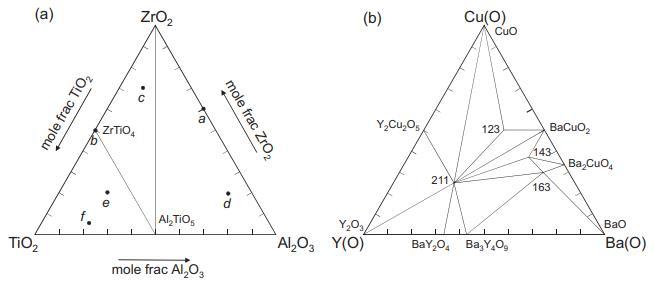
State the compounds you would expect to form and their relative phase fractions when oxide mixtures corresponding to points a–f in Figure 4.11 are reacted under equilibrium conditions.Figure 4.11 (a) TiO mole frac TiO ZrTiO ZrO AlTiOs 200 mole frac AlO3 mole frac ZrO d I (b) Y03, AlO3 Y(0)
State whether symmetry decreases or increases at the water-to-ice phase transition.
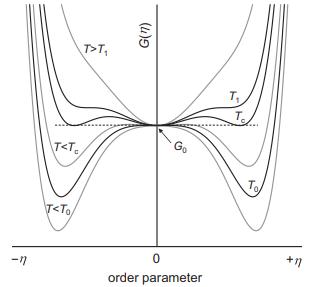
For a ferromagnetic second-order phase transition, assume that the relative magnetization M can be used as the order parameter in G(M) = G0 + ½AM2 + ¼BM4 . Sketch the temperature dependence of M on Tc.
Prove that for a tricritical transition η = [(Tc - T)/Tc]¼.
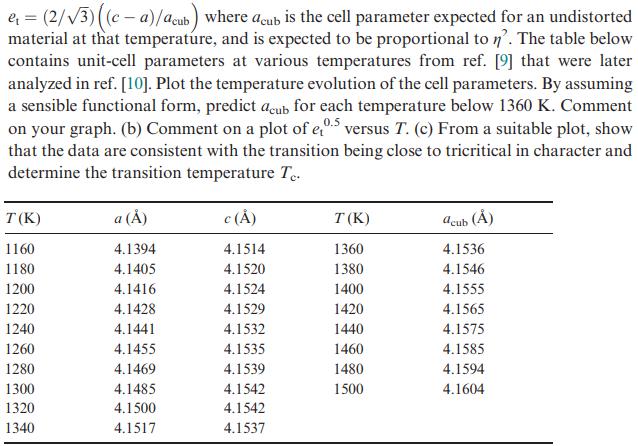
On cooling the cubic perovskite SrZrO3 (space group Pm3m) from high temperature, it undergoes a phase transition to the tetragonal space group I4/mcm. At the phase transition, the c cell parameter doubles and a increases by √2. The strain et is related to the difference in a and c parameters
Consider the infinite series for the Madelung constant of the NaCl-type structure. Its convergence depends on how the successive terms are chosen. As written in Equation (5.2), each successive shell contains ions of the same type (either cations or anions). (a) Calculate the sum of this series for
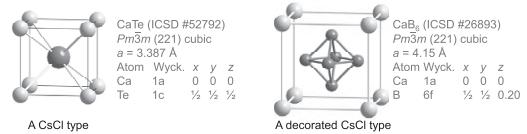
Taking into account both attractive and repulsive interactions, derive an equation analogous to Equation (5.2) for the CsCl structure (Figure 1.40). Include the first four terms in the Madelung series. Hint: You may find this easier to do in terms of the cell edge a, and then convert to the
CaO adopts the NaCl-type structure with a = 4.80 Å. (a) Use the Born–Mayer equation to calculate the lattice-formation energy for CaO. (b) How well does this estimate agree with the value of −3414 kJ/mol determined from the Born–Haber cycle? (c) Calculate the size of the repulsive term as a
MgO adopts the NaCl-type structure with a = 4.22 Å. (a) Use the Born–Mayer equation to calculate the lattice-formation energy for MgO. (b) Given this estimate of the lattice energy, construct a Born–Haber cycle and estimate the second electron gain enthalpy of oxygen, O− (g) + e− →
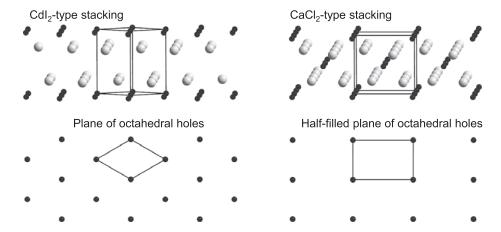
Why are there no examples of fluorides with the CdI2 or CdCl2 structures (Figure 1.28)?Figure 1.28 Cdl-type stacking Plane of octahedral holes CaCl-type stacking Half-filled plane of octahedral holes
With the exception of helium, all noble gases solidify at low temperature. The lack of ionic or covalent bonding means that atoms are held together by dispersion forces alone. Given the melting points of the noble gases; Ne = 24 K, Ar = 84 K, Kr = 116 K, Xe = 161 K, what can you say about the
Classify each of the following statements about nodes in orbital wavefunctions as true or false: (a) s orbitals have no nodes. (b) The orbital wavefunction always changes sign at a node. (c) The number of nodal planes is determined by the principal quantum number.
What are the values of the principal and orbital angular-momentum quantum numbers for each of the following orbitals? How many radial nodes and nodal planes does each orbital possess? (a) 4s orbital, (b) 5d orbital, (c) 4f orbital, (d) 2p orbital.
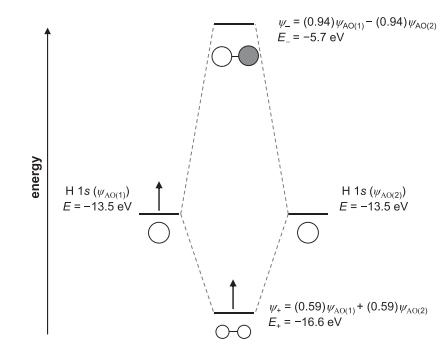
Use the MO diagram of oxygen to determine the oxygen–oxygen bond order in the peroxide ion, O22 . Will the O–O distance in peroxide be longer or shorter than in O2?MO diagram energy H 1s ((1)) E = -13.5 eV Ho _= (0.94) WAO(1)- (0.94) WAO(2) E = -5.7 eV To H 1S (WA(Z)) E = -13.5 eV W+= (0.59)
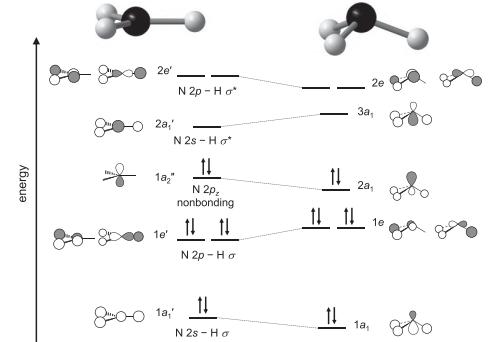
Construct an MO diagram for trigonal-planar BH3 by analogy with the MOs for trigonal-planar NH3 in Figure 5.26. Use this diagram to determine the degeneracy and orbital character of the HOMO and the LUMO.Figure 5.26 energy 2e' 2a, 1a" 1e' 8-0-0 1a, N2p-Ho* N 2s-Ho* 11 N 2p nonbonding 14 14 N2p - H
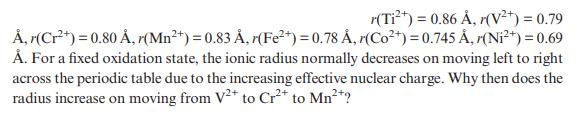
Consider these six-coordinate ionic radii for divalent, first-row transition-metal ions: r(Ti+) = 0.86 , r(V+) = 0.79 , r(Cr+) = 0.80 , r(Mn+) = 0.83 , r(Fe+) = 0.78 , r(Co+) = 0.745 , (Ni+) = 0.69 . For a fixed oxidation state, the ionic radius normally decreases on moving left to right across the
For which d-electron counts are there distinct HS and LS states of an octahedrally coordinated transition-metal ion?
In each of the following pairs, one species contains a transition metal in the HS state and the other in the LS state. Indicate the complex that is most likely to contain the LS ion. (a) FeCl3 and RulCl3, (b) [Col (NH3)6]+ and [ColC14].
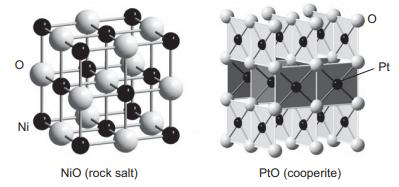
NiO adopts the cubic NaCl-type structure while PtO adopts the cooperite structure shown below. (a) What factor do you think is responsible for the differing crystal chemistry preferences of these two compounds? Consider the splitting and occupation of the d orbitals for each compound. (b) Which
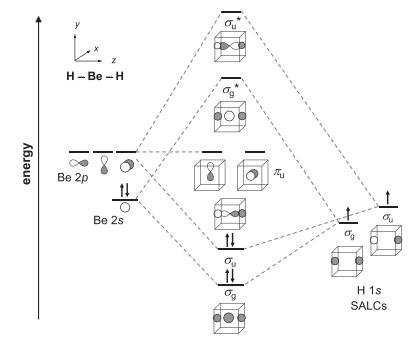
Construct an MO diagram for a linear H2O molecule by analogy with BeH2 in Figure 5.17. (a) Determine the degeneracy and orbital character of the HOMO and the LUMO. (b) Identify the orbitals on oxygen that participate in bonding to hydrogen. (c) Now distort the molecule by bending the H–O–H bond
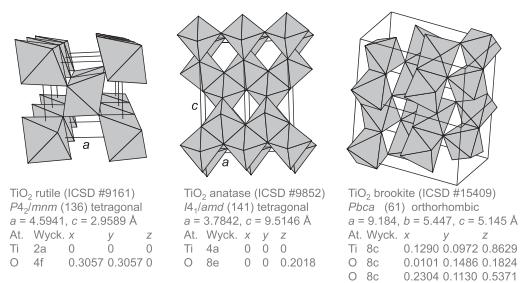
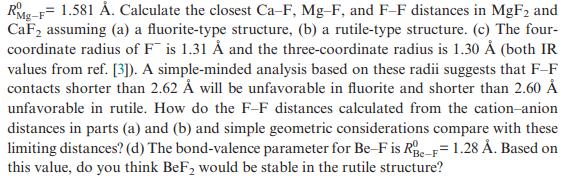
MgF2 adopts the rutile structure (Figure 1.45) with a = 4.62 Å and c = 3.04 Å. The bondvalence parameter R0 MgF = 1.581 Å.(a) Use the bond-valence method to predict the length of the Mg–F bonds.(b) Use the Born–Mayer equation to estimate the latticeformation energy for MgF2.(c) Comment on
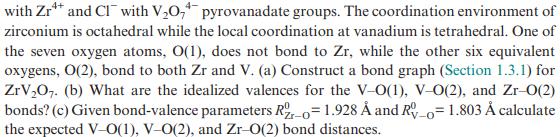
The structure of ZrV2O7 can be derived from the structure of NaCl by replacing Na+ with Zr** and CI with V0, pyrovanadate groups. The coordination environment of zirconium is octahedral while the local coordination at vanadium is tetrahedral. One of the seven oxygen atoms, O(1), does not bond to
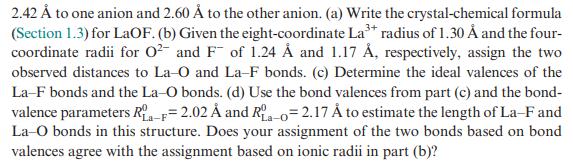
In LaOF, which has a structure closely related to fluorite, each lanthanum is surrounded by four oxide and four fluoride ions. Although X-ray-diffraction studies cannot easily distinguish oxygen from fluorine, two bond distances are seen in the crystal structure: 2.42 to one anion and 2.60 to the
The bond-valence parameters for Ca–F and Mg–F bonds are R0 CaF= 1.842 Å and
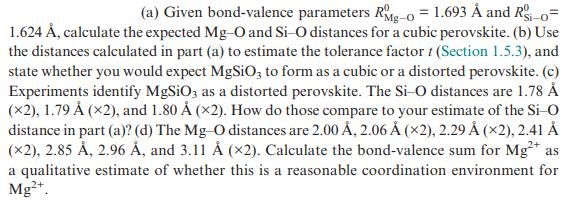
MgSiO3 is of interest to geologists because it is abundant in the Earth’s mantle. Silicon is normally tetrahedrally coordinated by oxygen, but, at the high pressures found in the mantle, silicon becomes octahedrally coordinated and a perovskite structure is formed. (a) Given bond-valence
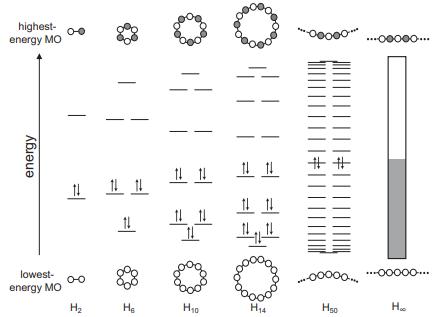
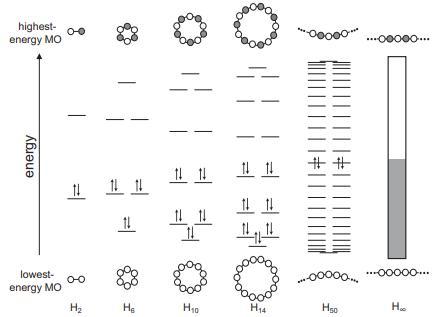
MO diagrams for cyclic HN molecules are shown in Figure 6.1. The AO phases are shown for the lowest- and highest-energy MOs but not for the intermediate MOs.(a) Sketch out the intermediate MOs indicating the phase of each AO for a cyclic H6 molecule. Determine the number of nodal planes for each of
MO diagrams for cyclic HN molecules are shown in Figure 6.1. (a) Sketch out the MOs and their relative energies for a square H4 molecule. Determine the number of nodal planes for each MO. (b) This molecule is prone to a first-order Jahn–Teller distortion. How will the distortion change the shape
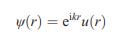
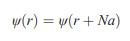
Show that the Bloch function given in Equation (6.1) meets the requirement that the electron density, ρ(r) = ψ2(r) = ψ*(r)ψ(r), must be periodic according to Equation (6.2).Equation (6.1)Equation (6.2) w(r) = ekru(r)
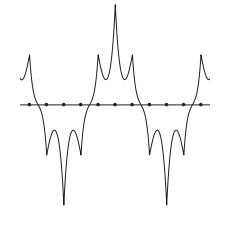
The first Brillouin zone of an infinite chain of H atoms has an infinite number of crystal orbitals, each with a different value of k. (a) State the limiting values of k within the first Brillouin zone. (b) The figure below shows the real part of the wavefunction for a crystal orbital ψ(r) with a
State whether each of the following statements is true or false. (a) As the magnitude of k increases, the momentum of the electron also increases. (b) As the magnitude of k increases, the wavelength of the corresponding wavefunction also increases. (c) As the size of the unit cell increases, the
Consider an infinite 1D chain of equally spaced fluorine atoms. (a) Sketch the band structure of this chain. Include all four valence orbitals (2s, 2px, 2py, 2pz) in the diagram and indicate the position of the Fermi level (assume the chain propagates in the z direction). (b) Sketch a DOS plot. (c)
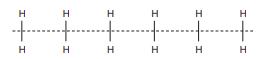
Consider an infinite 1D chain of H2 molecules where the molecular axis is oriented perpendicular to the chain direction, as shown below. (a) How many bands are there in the band structure? (b) Sketch the crystal orbitals for each band at k = 0 and k = π/a. (c) Sketch out the band structure of this
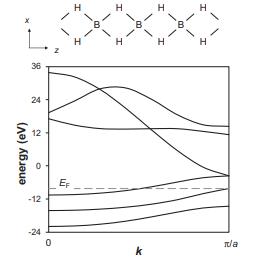
Consider the infinite 1D chain formed by placing boron atoms between the H2 molecules from Problem 6.7 to form an infinite chain (shown below) where the B–H distance is 1.27 Å while B–B and H–H are both 1.8 Å. The calculated band structure for this chain is shown below.(a) Which of the
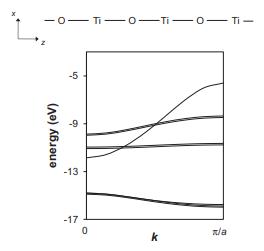
Consider the band structure for an infinite 1D chain of equally spaced titanium and oxygen atoms shown below, with an overall stoichiometry of TiO. In this calculation, only the Ti 3d orbitals and the O 2p orbitals have been taken into account. (a) Identify the orbital making the largest
Consider the electronic structure of α-Po. (a) Sketch the crystal orbitals for the py band at Γ, X, and R. (b) Sketch the crystal orbitals for the px, py, and pz bands at M. (c) Order the px, py, and pz bands from lowest to highest energy at Γ, X, M, and R.
NbN crystallizes with the NaCl type structure. Sketch out an MO diagram for octahedrally coordinated niobium and use it to sketch a DOS plot for NbN. Indicate the relative area of the σ*, π*, and N 2p sets of bands, and mark the approximate position of the Fermi level in your DOS sketch. Would
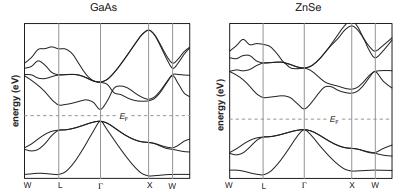
GaAs (Eg = 1.4 eV) and ZnSe (Eg = 2.6 eV) are isoelectronic with Ge. Their band structures are shown below. Are they direct- or indirect-gap semiconductors? energy (ev) W L GaAs r X W energy (eV) W ZnSe T X W
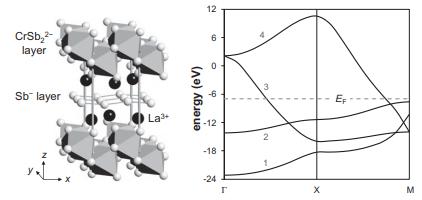
Consider LaCrSb3, whose structure is shown below (left). To a reasonable approximation, this structure can be described as independent CrSb22− layers and Sb− layers separated by La3+ ions [3]. If we neglect subtle distortions, the Sb− layer can be approximated as a 2D square lattice of Sb−
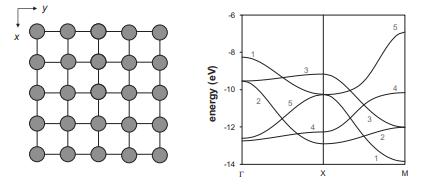
A 2D square lattice of 3d transition-metal atoms 2.3 Å apart has the band structure shown below (the contributions of the 4s and 4p orbitals have been omitted to simplify the analysis).(a) Considering orbital overlap for each of the five 3d orbitals at Γ, X, and M, characterize the
The perovskite LaRhO3 is a semiconductor. (a) What is the orbital character of the valence band? (b) What is the orbital character of the conduction band? (c) Will a hypothetical cubic LaRhO3 be a direct- or indirect-gap semiconductor?
BaZrO3 and CaZrO3 are perovskites with similar Zr–O distances. While BaZrO3 is cubic, CaZrO3 is orthorhombically distorted by octahedral tilting. Which of these two compounds will have a larger band gap? Explain your reasoning. The Zr–O–Zr angle is 180° in BaZrO3 and 146° (on average) in
Show that the expressions given in the text for the critical temperature of a first-order phase transition [Equation (4.19)] and for the abrupt order parameter change of η = ±(3B/4C)½ at Tc are consistent with the definition that the three minima in the Gibbs energy curve are equal to G0 at
Show that the entropy and enthalpy changes for a first-order phase transition are given by ΔS = −3aB/8C and ΔH = −3aBTc/8C.
Sketch the Brouwer diagram for Al-doped NiO with dominant ionic defects.Brouwer diagram VNI h ionic defects dominate reduction [v] = [VNI stoichiometric range oxidation h Ni electronic defects dominate reduction [e] = [h*] stoichiometric range h oxidation
Sketch the Brouwer diagram for Li-doped NiO with dominant electronic defects.Brouwer diagram VNI h ionic defects dominate reduction [v] = [VNI stoichiometric range oxidation h Ni electronic defects dominate reduction [e] = [h*] stoichiometric range h oxidation
Consider a stoichiometric metal oxide in equilibrium with its dominant electronic defects. Which of these two defects will increase its fraction upon an acceptor or donor doping under the same conditions?
Consider a stoichiometric metal oxide of dominant Schottky defects in equilibrium. Which of these two defects will increase its fraction upon either an acceptor or donor doping under the same conditions?
State the limiting slope of the metal-vacancy fraction versus pO2 in the oxidative non stoichiometry range for (a) Cu2O (b) Cr2O3, both of Schottky intrinsic defects.
Consider an idealized pure CuO with anion-Frenkel compensation and dominant electronic defects. What are the slopes of the essentially linear functions in the three limiting regions of the plot of defect fractions versus pO2? Sketch the Brouwer diagram.Brouwer diagram VNI h ionic defects dominate
In fact, pure PbO may show an anti-Schottky disorder. What differences does this bring to the results of Problem 3.6?Problem 3.6Consider pure PbO with anion-Frenkel compensation and dominant ionic defects. What are the slopes of the essentially linear dependences in the three limiting regions of
Consider pure PbO with anion-Frenkel compensation and dominant ionic defects. What are the slopes of the essentially linear dependences in the three limiting regions of the plot of defect fractions versus pO2? Sketch the Brouwer diagram.Brouwer diagram VNI h ionic defects dominate reduction [v]=
Use chemistry or physics to suggest whether ionic or electronic defects will dominate in pure ZrO2 at high temperatures.
Recast Table 3.4 into one valid for a hypothetical MO oxide with cation-Frenkel intrinsic defects.Table 3.4 Process Schottky Ionization Oxidation Reduction Reaction equation nilVNI" + vo nil e + h O2(g) 2VN + 4h + 200* 2002vo + 4e' + O2(g) Reaction quotient Ks = [VNII[VO] K = [e'][h'] Kox = [VNITh
State the type of intrinsic defects would you predict in fluorite-type CeO2 and UO2.
Name the following defects in TiO2 and write their Kröger–Vink symbols: Al and Nb dopants at the Ti site; F and N dopants at the O site; oxygen and titanium atoms out of their regular sites.
Write Kröger–Vink symbols for the following fully charged point defects in NiO: metal vacancy, oxygen vacancy, lithium acceptor, aluminum donor.
Assume that the defect structure of a crystal of Fe1−xO can be described in terms of V13T4 clusters arranged such that they have a cubic cell with a = 2.7 × aFeO, and that on average 50% of these cells contain a defect cluster. Calculate the value of x.
Sketch a V4T cluster for the Fe1−xO structure showing both O and vacant Fe sites. Indicate the nearest shell of occupied octahedral Fe sites relative to the vacant site. State how many of these sites must on average be occupied by Fe3+ to achieve electroneutrality. Write down the Kröger–Vink
A sample of Fe1−xO has a measured density of 5491 kg/m3 and cell parameter of 4.281 Å. Estimate the composition based on these two observations.
Assuming that the unit-cell parameter of Fe1−xO is given by Vegard’s law as a = 4.3325 − 0.4103x Å, calculate the experimental density for (a) The hypothetical stoichiometric FeO, (b) An Fe-deficient material with an Fe:O ratio of 1.075.
Assuming the presence of a V12T4 defect cluster of the type shown in Figure 2.13, it is possible to build an ordered superstructure for Fe1−xO using a 5a × 5a × 10a unit cell. This supercell would contain 16 vacancy clusters. Calculate the composition.Figure 2.13 O (a) (b) (c) (d)
A mixture of WO3 and MoO3 was heated with a small excess of W and Mo metals to give a blue single-phase product containing 25.09% O by mass and a 1:1 W:Mo ratio. Determine the empirical formula of the product and suggest its structure type.
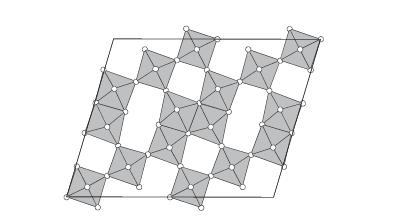
Like tungsten oxides, molybdenum oxides show a variety of crystallographic shear structures. The unit cell for one of them is shown here:The octahedra also share corners with octahedra in identical layers above and below the plane of the paper. What is the composition of this compound? What is the
At high temperature, Cu3Au has a disordered fcc structure with space group Fm3m. On cooling, an ordering transition occurs and the low-temperature structure has space group Pm3m with Au at 0 0 0 (Wyckoff site 1a) and Cu at ½ ½ 0 (3c). (a) Sketch the low- and high-temperature structures. (b) Is
At high temperatures, BaTiO3 has the cubic perovskite structure. On cooling, it undergoes a series of phase transitions in which the Ti atom moves away from the center of the TiO6 octahedron, and there are changes in the space group and unit-cell parameters causing the ferroelectric behavior
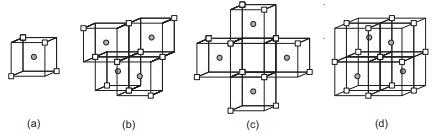
Suggest what type of twinning might occur in: (a) An orthorhombic structure with two cell edges approximately equal; (b) A structure with a monoclinc cell with β = 90.1°; (c) An orthorhombic structure with cell parameters a = 3.92 Å, b = 11.21 Å, c = 7.88 Å; (d) A structure with a
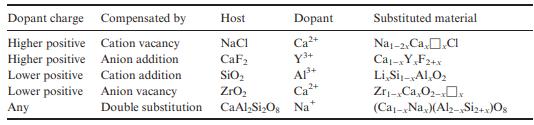
State the Kröger–Vink notation for the predominant defects in each of the materials in Table 2.2.Table 2.2 Dopant charge Compensated by Higher positive Higher positive Lower positive Lower positive Any Cation vacancy Anion addition Cation addition Anion vacancy Double substitution Host Dopant
Using the cell-parameter information, calculate the cell parameter expected for In0.76Ga0.24P0.47As0.53. Would this composition be lattice matched to any of the four possible end members: InP, GaP, InAs, or GaAs?
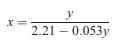
Using the cell parameters quoted, confirm the form of Equation (2.9).Equation (2.9) X= y 2.21 -0.053y
GaAs1−xPx has a unit-cell parameter of 5.59 Å. Calculate x and estimate the band gap(Eg) of the material, given aGaAs = 5.65 , Eg = 1.42 eV; aGap = 5.45 , E = 2.24 eV.
NbO has an NaCl-related structure, a cell parameter of 4.21 Å and a density of 7.27 g/cm3. Calculate the percentage of vacant sites in the material. Draw a sketch of how the vacancies can be arranged in an ordered way so as to give square-planar coordination of Nb. What is the O coordination?
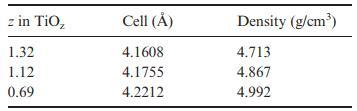
The table below gives cell parameters and densities for a range of TixOy materials. Determine the defects present in each. From a graph of your results, estimate x for a 1:1 stoichiometric sample TixOx. z in TiO 1.32 1.12 0.69 Cell () 4.1608 4.1755 4.2212 Density (g/cm) 4.713 4.867 4.992
TiO with a 1:1 ratio of Ti:O was synthesized and found to have a NaCl-related structure with a = 4.1831 Å and an experimental density of 4927 kg/m3. Comment on these values.
Suggest oxidation states for the metal ions in each of the following materials: (a) TiS2, Lio.7 TiS2; (b) LaMnO3, Lao.8Sro.2 MnO3, Lao.5Cao.5MnO3; (c) LaCuO4, La1.85Ba0.15 CuO4, LaCuO4.075; and (d) BaPbO3, BaBiO3, Ba0.6K0.4BiO3.
A brown sample of zinc oxide was found to have the hexagonal wurtzite structure with a = b = 3.2495 Å, c = 5.2069 Å (α = β = 90°;γ = 120°). Chemical analysis gave 80.765% Zn by mass. Density measurements gave 5810 kg/m3. Determine the formula of the material and state whether it contains
Suggest oxidation states for the metal ions in each of the following materials: (a) FeO, Feo.8720, Fe3O4, FeS2; (b) FeTe, Fe1 Te; (c) LaOFeAs, LaO0.9Fo.1 FeAs; and (d) YBaFeO5, NdBaFeO5.5, and NdBaC006.
A sample of nonstoichiometric nickel oxide (A) was found to contain 77.70% Ni by mass. (a) Calculate the empirical formula of A and state the two alternatives for the intrinsic defect that would on its own give rise to this formula. (b) A has the NaCl-type structure and an experimental density of
Derive the equations given in the text for the number of defects at equilibrium, neq, for Schottky and Frenkel defects. You will find the following expressions useful: for large x, d In(x!)=xln(x) - x, ((c-x)In(c-x)) = -In(c x) 1, and (xln(x)) = In(x) + 1. dx
Assuming a unit-cell parameter of 5.62 Å, estimate the equilibrium number of Schottky defects in a 1 mm3 grain of NaCl at 300 K and at 700 K.
Calculate the fractional number of vacancy sites in Cu at (a) 300 K, (b) 800 K,(c) Its melting point (1357 K).
Given that Cu adopts a ccp structure with a cubic cell parameter of 3.615 Å, confirm that the equilibrium number of vacancies in a 1 cm3 sample at 1000 °C is around 1019. Note the need to convert between k, in J/K, and R, in J/(K mol), when using molar quantities: NAk = R.
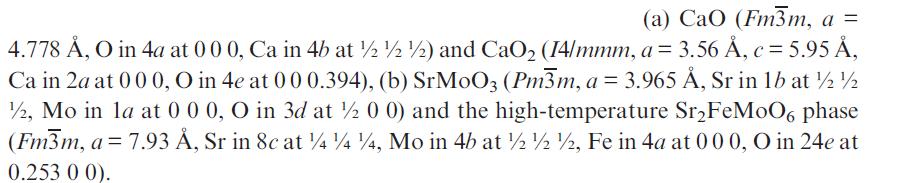
Identify the type of derivative network relationship between: (a) CaO (Fm3m, a = 4.778 , 0 in 4a at 0 0 0, Ca in 4b at 2) and CaO (14/mmm, a = 3.56 , c = 5.95 , Ca in 2a at 0 0 0, 0 in 4e at 0 0 0.394), (b) SrMoO3 (Pm3m, a = 3.965 , Sr in 16 at /21/2 1/2, Mo in la at 0 0 0, O in 3d at /2 0 0)
Write down crystal-chemical formulas for two-site binary compounds CrN, Cr2O3, and CrO2 with octahedrally coordinated chromium.
State the Bravais lattice and write down the crystallographic point-group symbol for a structure of space-group symbol: (a) C2/m, (b) Fmm2, (c) I4/mmm, (d) P312, (e) R3m, (f) P6m2, (g) F23, (h) P213, (i) Ia3d.
Suggest the bonding present in the Zintl phase CaIn2. Verify your suggestions with the ICSD and a structure-drawing program.
Suggest the bonding present in the Zintl phase KIn.
Suggest the bonding present in the Zintl phase LiAs.
Use VECA modified for the stable 18-electron configuration of Kr to justify the network of Cu tetrahedra in MgCu2.
What is the formula of the infinite alumosilicate anion in sodalite?
Give the Niggli formula for a cyclosilicate anion containing 3 Si.
Showing 200 - 300
of 329
1
2
3
4
Step by Step Answers

 Get 50% OFF
Claim Now
Get 50% OFF
Claim Now






![(a) FeCl3 and RulCl3, (b) [Col (NH3)6]+ and [ColC14].](https://dsd5zvtm8ll6.cloudfront.net/images/question_images/1705/7/6/8/16165abf4e12de241705768159405.jpg)
![VNI h ionic defects dominate reduction [v]= [VNI stoichiometric range oxidation h Ni electronic defects](https://dsd5zvtm8ll6.cloudfront.net/images/question_images/1705/7/4/1/36365ab8c331e9151705741359969.jpg)