New Semester
Started
Get
50% OFF
Study Help!
--h --m --s
Claim Now
Question Answers
Textbooks
Find textbooks, questions and answers
Oops, something went wrong!
Change your search query and then try again
S
Books
FREE
Study Help
Expert Questions
Accounting
General Management
Mathematics
Finance
Organizational Behaviour
Law
Physics
Operating System
Management Leadership
Sociology
Programming
Marketing
Database
Computer Network
Economics
Textbooks Solutions
Accounting
Managerial Accounting
Management Leadership
Cost Accounting
Statistics
Business Law
Corporate Finance
Finance
Economics
Auditing
Tutors
Online Tutors
Find a Tutor
Hire a Tutor
Become a Tutor
AI Tutor
AI Study Planner
NEW
Sell Books
Search
Search
Sign In
Register
study help
sciences
solid state physics essential concepts
Solid State Physics Essential Concepts 2nd Edition David W. Snoke - Solutions
Confirm, using the values of the fundamental constants and converting units, the value of the superconductor flux quantumΦ0, equal to 2.1 × 10⁻¹¹ T-cm2.
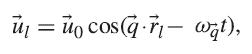
Suppose that instead of the form (3.2.2), we use the form which has no imaginary part, and therefore corresponds to a real wave in the medium. Show that this implies that the scattered wave will be shifted in frequency either up or down by the frequency ω(vector)q, that is, energy can be
Determine the envelope function A(x, t) of a Gaussian wavepacket with frequency ω and wavenumber k propagating in a one-dimensional medium (e.g., an optical pulse in a fiber optic) when ∂2ω/∂k2 is significant (i.e., approximate ω(k) to second order, instead of only to first order as in
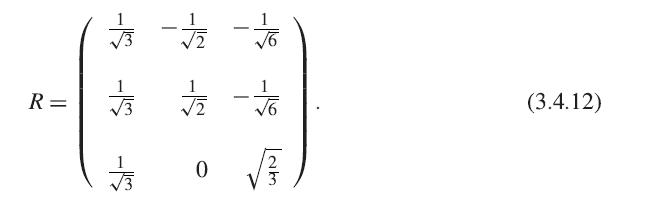
Show explicitly that the rotation matrix (3.4.12) corresponds to the two successive rotations given in the text, that is, that it is the rotation that transforms the [100]-axis into the [111]-axis. R= 삶 0 √6 | 23 (3.4.12)
Write down the Christoffel electromagnetic equation for a wave traveling in the direction (x̂ + ŷ)/√2 for a crystal with dielectric tensor (3.5.23). € = €1 0 0 0 €2 0 0 0 €3 (3.5.23)
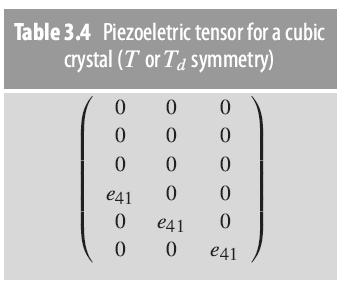
GaAs has cubic symmetry, leading to the piezoelectric tensor shown in Table 3.4, with e41 = 1.6×10⁻⁵ C/cm2.The elastic constants of GaAs are C11= 11.8 × 10¹¹ dyne/cm2, C12 = 5.3 × 10¹¹ dyne/cm2, and C44 = 5.9 × 10¹¹ dyne/cm2. For a voltage of 5 V applied in the [100] direction across a slab
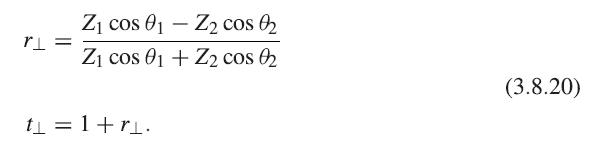
Another simple case of acoustic waves is the case of longitudinal waves incident normal to a surface, in which case there is no coupling to transverse waves. Show that in this case the equations (3.8.20) also apply, with Z = √ρC11. ri Z₁ cos 0₁ Z₂ cos 0₂ Z₁ cos 01 + Z2 cos ₂ t₁ =
The optical mode vibrational frequency of GaAs is 8 THz. In the linear chain model, knowing the masses of the Ga and As atoms from the periodic table, what does this imply for the force constant of the springs between the atoms? (Assume the two force constants are equal.) What does this imply for
Prove the statement above, that if the potential energy of the system is quadratic, of the formthen the elastic constant matrix Cijlm must be symmetric with respect to interchanging the first two indices with the last two indices. U V = Σσίες, (3.4.18)
Prove that the determinant of the wave equation matrix for a uniaxial crystal is that given in (3.5.27). This can be easily done with a program like Mathematica. (x² − u²0²2 ) ( (²² + x² m² 0 ²2 + k²n²60²2 - ² 1² 6² ) = ( - no 2.29 2,2@ zn c2 c2 none 0. (3.5.27)
Assuming that we can model the potential energy of the bond between two hydrogen atoms with the Lennard–Jones potential,what values do you find for A and B, given the experimentally determined values of the depth of the potential minimum ΔE = 4.7 eV, and the mean interatomic distance x0 = 0.74
Using the transfer matrix method, determine the reflectivity spectrum, |E(r)|2/|E(i) |2 vs k, for a periodic stack of 20 layers, alternating with d1 = 500 nm, n1 = 3, and d2 = 750 nm, n2 = 2, surrounded by air on both sides. Do you see a photonic band gap, that is, a range of frequencies with no
(a) GaAs is a piezoelectric material with piezoelectric constant e = 1.6 × 10⁻⁵ C/cm2. What pressure is generated on the crystal by a potential drop of 5 V applied across a slab of GaAs with thickness 1 mm?(b) The relevant compliance constant of GaAs is S = 1.7×10⁻¹² cm2/dyne. How much does
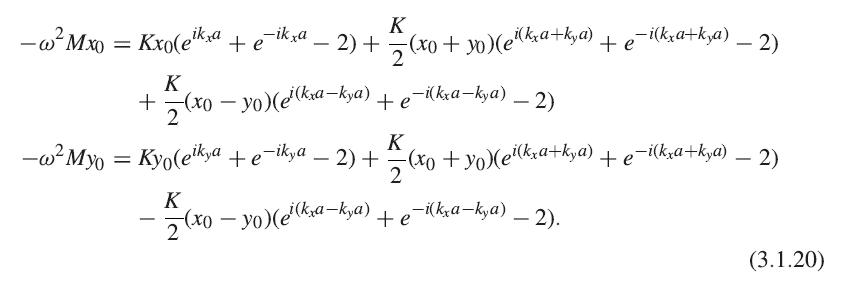
Use the matrix solver in a program like Mathematica to solve (3.1.20) for a general k(vector) , and plot ω versus k, for k(vector) in two different directions in the plane. Determine the polarization vector of the two modes in each case. K - 2) + -(xo + yo)(e¹(kxa+kya) + e¯i(kxa+k‚a) —
(a) In the T = 0 approximation, the total number of particles that corresponds to a Fermi energy EF is given byCalulate the area density of the particles needed to have a Fermi energy of EF = 100 meV for a two-dimensional isotropic electron gas with effective mass m = m0, where m0 is the free
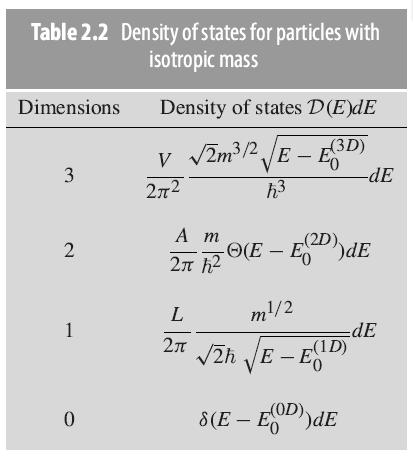
Calculate the density of states for the one-dimensional case and show that your result agrees with that given in Table 2.2. Table 2.2 Density of states for particles with isotropic mass Dimensions 3 2 1 0 Density of states D(E)dE v √2m³/2 √E-E3 (3D) 2π² A m 2π h2 L 2π (2D), OCE -
Calculate the total number of free electrons that can occupy a single Landau level for magnetic field 10 T in a solid cube with dimension 1 cm, if the conducting electrons have effective mass 0.1m0, at temperature T = 1 K.
In the case of modulation doping, donor electrons can fall down from states in the barrier into a quantum-confined state in the quantum well. The Fermi level in the barrier material is nearly the same as the barrier conduction band level. Draw a schematic of the band bending in the case of a wide
In many semiconductors such as GaAs, the conduction band has a conduction band minimum at zone center, and an indirect gap with higher energy at another minimum, at a critical point on the zone boundary. The zone-center minimum is typically called the Г-valley, while the other, indirect minima are
Calculate explicitly the magnetic moment of a two-dimensional system with a half-filled lowest Landau level.
Show that in the case when U(x) = 0 and uk = 1, that is, the states are plane waves ψ = ei(kx−ωt) in a vacuum, and both k and ω are time-dependent, the solution of (2.8.14) for k = 0 at t = 0 implies k = qEt/h̄ and ω = (qEt)2/6h̄m.Show that this implies that the average value of the energy,
What kind of current and voltage sensitivity is required to observe the integer quantum Hall effect? To answer this, suppose that a typical structure is 1 micron in width, and a Hall voltage of 10 μV is observed. What current does this correspond to, in amperes, for the first Landau level?
Prove that the wave function (2.9.38) is an eigenstate of the total angular momentum operator for N particles. N (2₁,..., ZN) x (2n - Zm)'. n
Quantum dots are rarely exactly symmetric. Suppose that a QD is rectangular with a length of 7.5 nm, width of 8 nm, and height of 6 nm. Compute the lowest five confined state energies of an electron in this dot, for an electron effective mass of 0.1 times the vacuum electron mass, assuming infinite
Calculate the Coulomb potential energy of two electrons separated by 10 nm, in a solid with dielectric constant of 10. How does this energy compare to the typical energy level spacing of 10–100 meV in nanostructures?
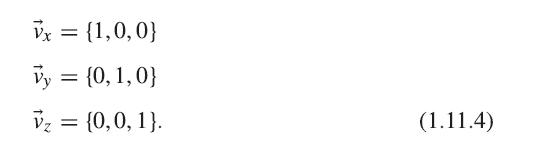
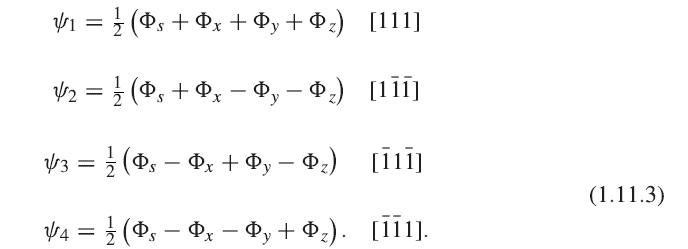
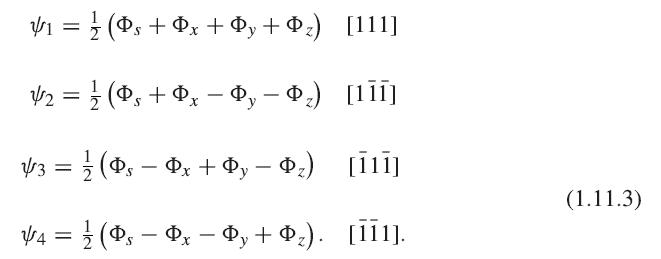
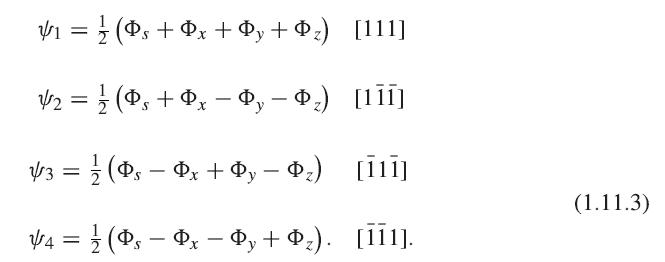
The unperturbed p-orbitals point along the following vectors:We could imagine forming an orbital that points in the [111] direction by the linear combination Φx + Φy + Φz, and [11̅1̅] as Φx − Φy − Φz , etc. Show that if we form four orbitals in the sp3 directions given in (1.11.3),
Calculate the excitonic Bohr radius expected in the semiconductor ZnO, which has an average dielectric constant of 8.3, conduction-band effective mass of 0.275m0, and effective hole mass of 0.59m0, where m0 is the vacuum electron mass.
A MESFET (metal–semiconductor FET) is made using a Schottky barrier at a metal-doped semiconductor junction instead of an oxide barrier, as in a MOSFET, or p–n junction as in a JFET. For an n-doped channel, the drain and source are connected to the conducting channel using n+ doped regions, and
Draw a schematic of the bands for a metal–semiconductor junction in which the metal has a Fermi level that lies (a) Below, and (b) Above the energy of the acceptors in a p-type semiconductor.
(a) Calculate the band bending depth d for a p–n junction in the semiconductor GaAs, with doping concentration n = 1016 cm−3 and dielectric constant ϵ = 14ϵ0, using (2.6.6).(b) Suppose that instead of having equal doping concentrations, the p-type side is doped at concentation n = 5 × 10¹⁶
Determine the value of the chemical potential in the case when both the conduction and valence band are simple isotropic bands, and the hole effective mass is four times the conduction band effective mass, in the limit of low temperature, kBT ≪ Eg.
(a) Compute the root-mean-squared velocity of a Fermi gas at T = 0 as a function of the density.(b) What is the root-mean-squared magnitude of the wave vector k in cm−1 for a T = 0 Fermi gas of free electrons with density 1022 cm−3 and effective mass mc = 0.1m0, where m0 is the free electron
Show that the exact relation between density and average interparticle spacing is given byand not simply r̄ = n−1/3, as is often assumed. To do this, first define Q(r)dr as the probability that the nearest neighbor of a particle lies between r and r+dr, and P(r) as the probability of there being
The effective mass of free carriers can be measured using cyclotron resonance. The resonance frequency (also known as the cyclotron frequency) of a charged particle in a magnetic field is, in MKS units,where q is the charge and m is the effective mass of the particle. If a material is placed in a
If the free electrons in a semiconductor have effective mass mc = 0.1m0, where m0 is the mass of the electron in vacuum, what is their average speed at T = 300K? If the free holes in the same material have effective mass mv = 1.5m0, what is their average speed at the same temperature? Assume a
Prove the formula (1.9.44) for the electron momentum in the case of a band described by the k · p approximations (1.9.36) and (1.9.39). (元): = m FVE, (1.9.44)
In the case of degenerate, isotropic bands in one dimension, Löwdin second-order perturbation theory says that the energies of the bands are given by the eigenvalues of the following matrix:where i and j run over the range of degenerate states with energy En, and l is summed over all other states
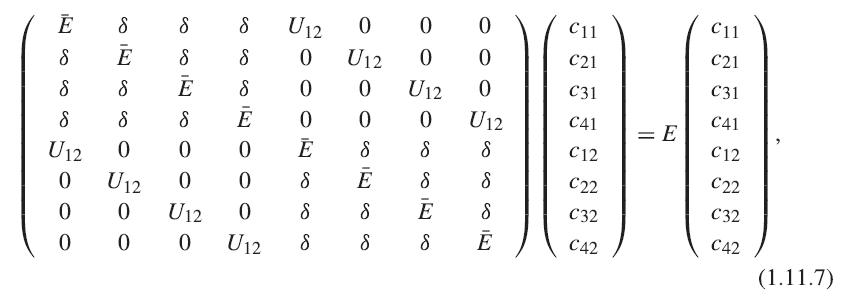
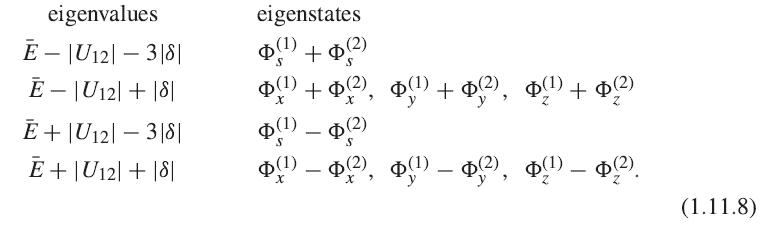
Show that the eigenstates of (1.11.7) are those given in (1.11.8). To do this, you will need to first find the eigenvectors of (1.11.7) in terms of the eight sp3 states, then use (1.11.3) to write these in terms of the original atomic states. Finally, show that the degenerate eigenstates involving
Show that if the original atomic orbitals are orthonormal, then the linear combinations of (1.11.3) are also orthonormal. V/1 = ½ (Þs + Þx + Þy+Þz) [111] V/₂ = 1/2 (0₁ + 0 x - Øy-0₂) [111] V3 = 1/2 (0s - Qx + Øy [īlī] [111]. - dx + Þy - 0₂) V4 = ½ (0s - Ox - Þy +
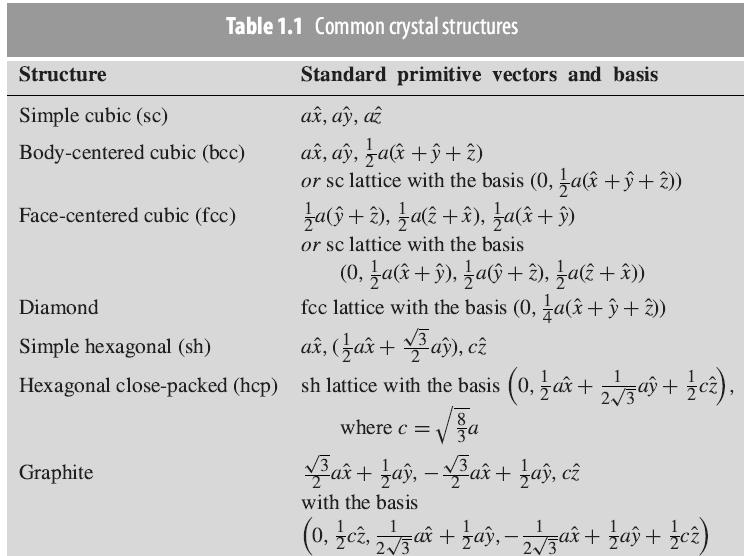
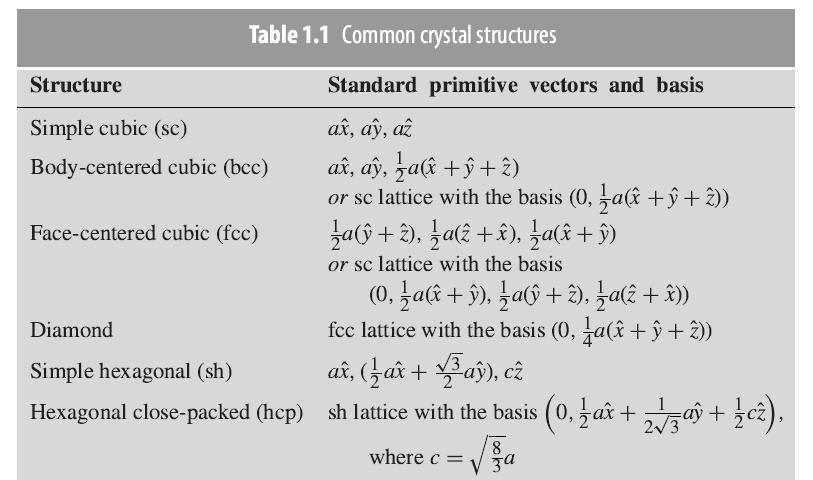
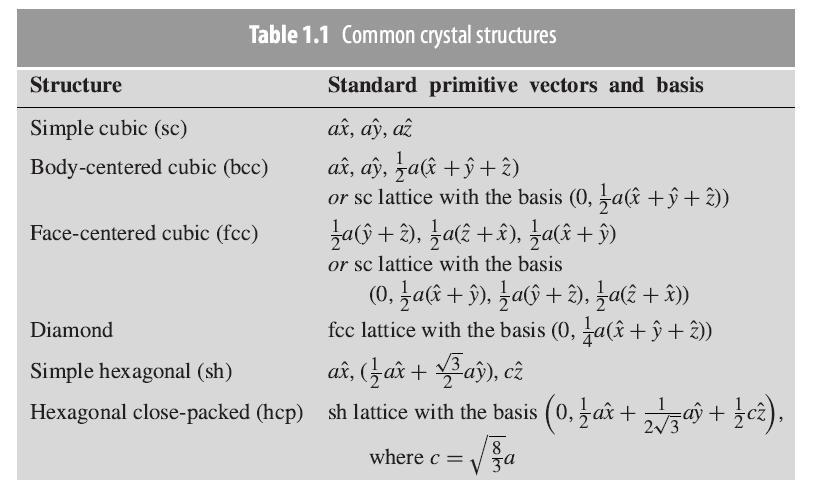
Calculate the energy band arising from a single orbital in a two-dimensional simple hexagonal lattice (see Table 1.1), using the tight-binding approximation, and plot the energy as a function of kx and ky. Assume that there is one coupling energy U12 for all nearest neighbors and set all other
As a follow-up to Exercise 1.4.6, show that the special point at which the gap energy goes to zero in (1.9.19) for the graphene lattice is one of the corners of the Wigner–Seitz cell for the Brillouin zone in reciprocal space.Data from Exercise 1.4.6:A graphene lattice, or “honeycomb”
Using the arguments of this section, can you give a reasonable explanation why the elements F and Cl are gases, that is, why a molecule of two F or Cl atoms would be very weakly bound? In particular, without knowing details of the molecular states, why would you expect F2 to have about half the
(a) Show explicitly that parity rules give the spin–orbit term (1.13.18) for U(r(vector)) antisymmetric in the x- and y-directions and symmetric in the z-directions.(b) What would this term be if U(r(vector)) had an antisymmetric term only in the x-direction? (a) HS = SO 2Uxxoz
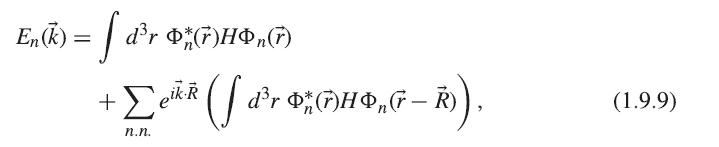
Show that for the Hamiltonian H = −(h̄2/2m)∇2 + U(r(vector)), an equivalent way of writing (1.9.9) iswhere En(0) is the unperturbed atomic orbital energy and U0(r(vector)) is the potential energy function of a single atom. In other words, the band energy depends on the difference of the
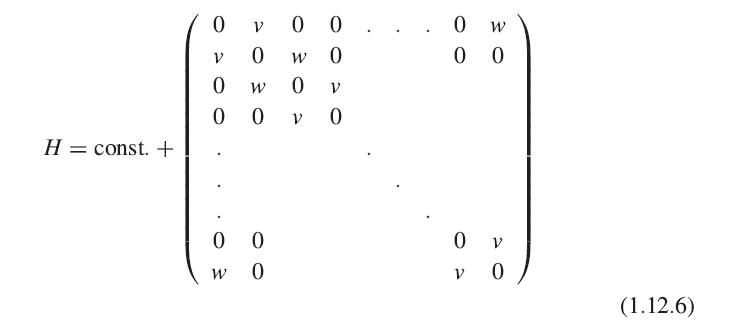
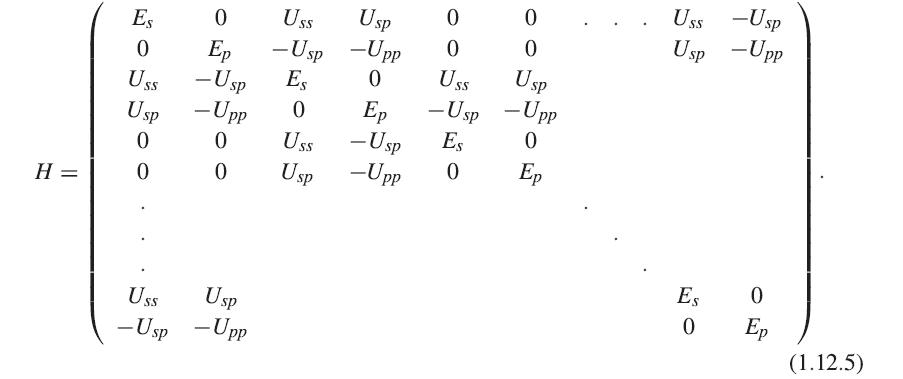
The Su–Schrieffer–Heeger (SSH) linear chain model also has two orbitals per unit cell, but envisions these as two different atoms with only one relevant atomic orbital on each. Each atom couples differently to its neighbors on the right and on the left, with coupling terms v and w,
Suppose that two identical, neighboring atoms have substantial overlap of one s-orbital and one p-orbital (we can assume, for example, that the p-orbitals in the x-direction overlap, and that the other two p-orbitals of the two atoms, pointing in the y- and z-directions, have very little
Suppose that a band energy is given byDetermine the spectral line shape N(Ekin) for angle-resolved photoemission from this band, following the approach for the parabolic band discussed in this section. En(k)=-E0+ U₁2 (cos ka + cos kya + cos k₂a). (1.10.10)
Show that the Wannier functions centered at different lattice sites are orthogonal, that is, [ ď³ r ¢G – Rm)øn G — Rm³ ) = 8nx'8mm² - - (1.9.11)
Prove explicitly using parity that HSO has the form given in (1.13.7), for three degenerate p-orbitals and a central potential U(r). Hso = Uo 0 ἱστ - ioy –ίστ 0 iox ίσω –ίσχ 0 (1.13.7)
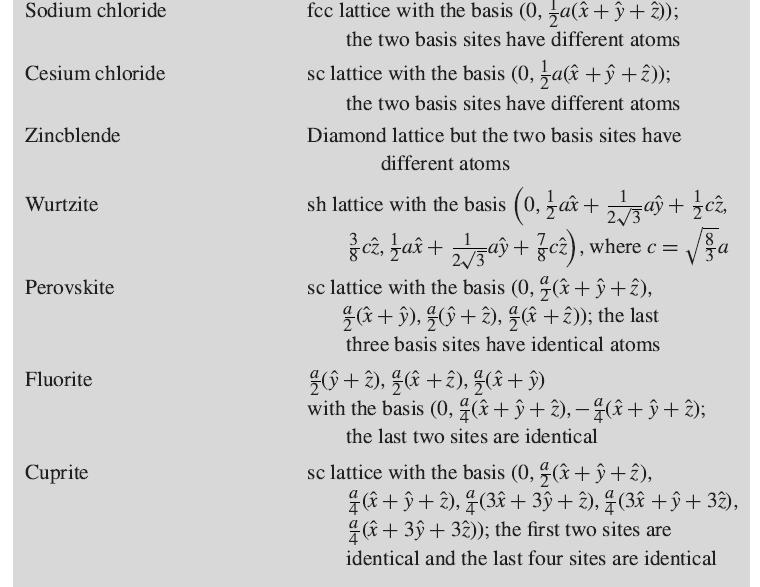
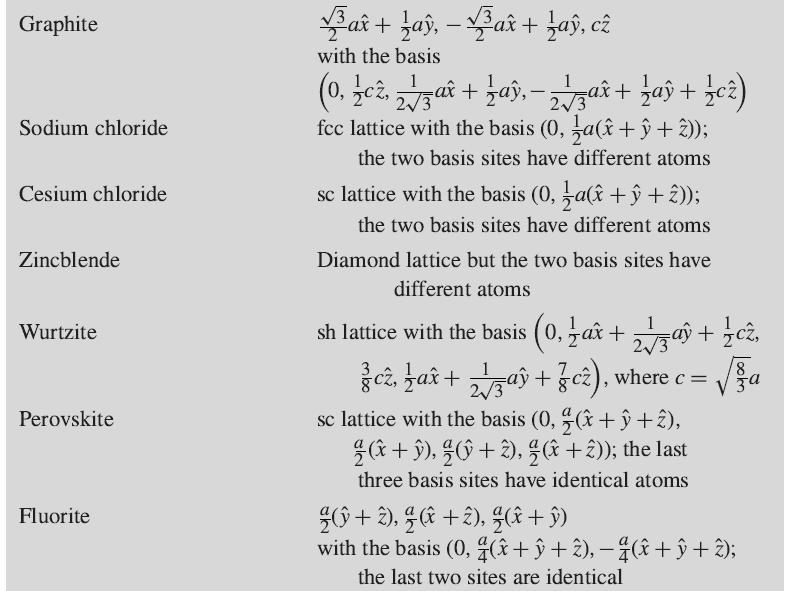
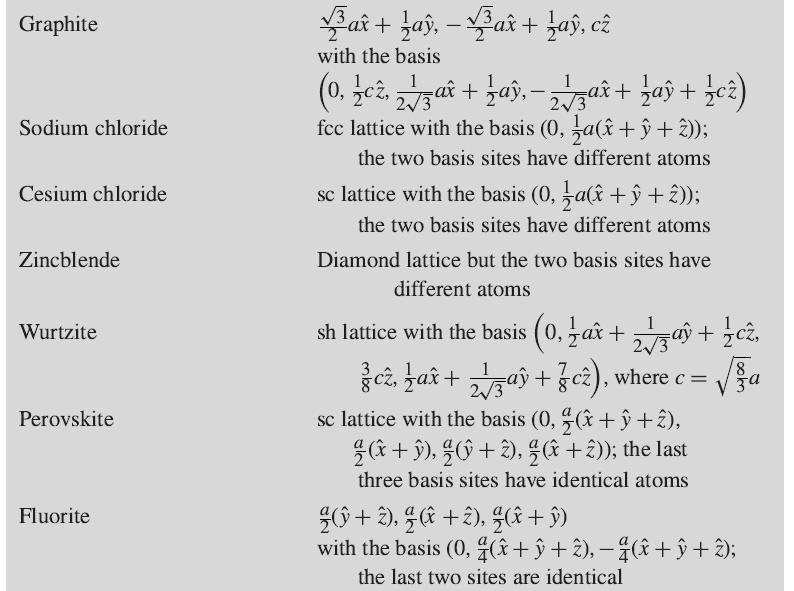
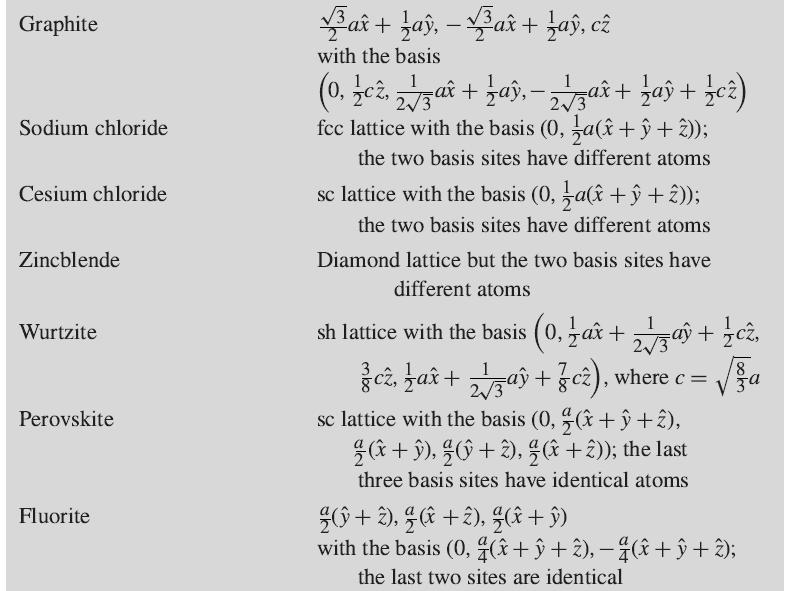
Prove that in the wurtzite structure, each atom is equidistant from its four nearest neighbors.
Use a program like Mathematica to create diagrams analogous to Figures 1.13 and 1.14 showing the location of the atoms for the last four crystal structures from Table 1.1. (In Mathematica, it is simple to create a set of spheres of radius r centered at points {x1, y1, z1}, {x2, y2, z2}, . .. using
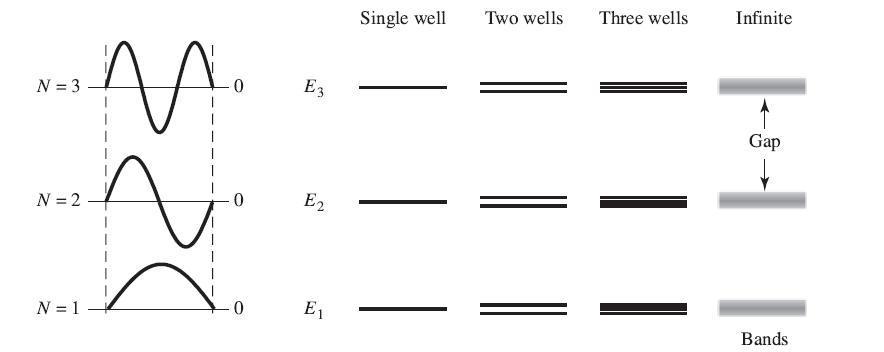
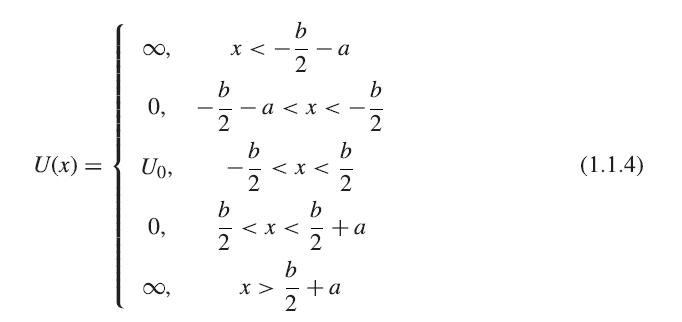
Use Mathematica to solve the system of equations (1.1.1) and (1.1.4)– (1.1.6) for two coupled wells, for the case 2mU0/h̄2 = 20, a = 1, and b = 0.1. The calculation can be greatly simplified by assuming that the solution has the form ψ1(x) = A1 sin(Kx) + B1 cos(Kx), ψ2(x) = A2(eκx ±
(a) Show that in the case of two identical atoms, the eigenstates of the LCAO model are the symmetric and antisymmetric linear combinationswhere the plus sign corresponds to the bonding state and the negative sign corresponds to the antibonding state. To simplify the problem, assume U12 is real.(b)
Verify the algebra leading to (1.2.5) and (1.2.6). Mathematica can be very helpful in simplifying the algebra. (K² - K²) 2K K - sinh(kb) sin(Ka) + cosh(kb)cos(Ka) = cos(k(a +b)). (1.2.5)
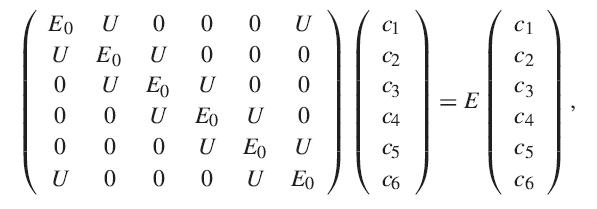
Suppose we have a ring with six identical atoms. This is a periodic sytem in one dimension, so the Bloch theorem applies. According to the LCAO approximation, discussed in Section 1.1.2, we write the wave function as a linear combination of the unperturbed atomic wave orbitals. This allows us to
Determine the cell function unk(x) for the lowest band of the Kronig–Penney model in the limit b → 0, with a = 1, 2mU0b/h̄2 = 100, and h̄2/2m = 1, for k = π/2a. What is the solution of the wave function in a flat potential?
For the cubic crystal, there is a plane that contains all of the symmetry directions [100], [011], and [111]. Find the Miller indices of this plane. Sketch this plane in the cube and show the above symmetry directions.
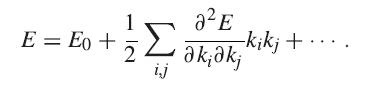
Show that if a band has a minimum but is not isotropic, that is,that the density of states near k(vector) = 0 is still proportional to √(E − E0). In this case, the Taylor expansion isThis gives a matrix for the quadratic term, which can always be diagonalized. E = Eo + Ak² + Bk² + Ck²,
Construct the Brillouin zone for a three-dimensional simple cubic lattice, and use the theorems from this section to find the vector coordinates of the critical points in k-space.
Find the zero-point energy, that is, E = h̄2K2/2m, at k = 0, using (1.2.6) in the limit b → 0 and U0 → ∞ and U0b finite but small. To do this, use the approximations for sinKa ≃ Ka and cos Ka ≃ 1 − 1/2 (Ka)2, assuming Ka is very small at k = 0. k²b 2K sin(Ka) + cos(Ka) = cos
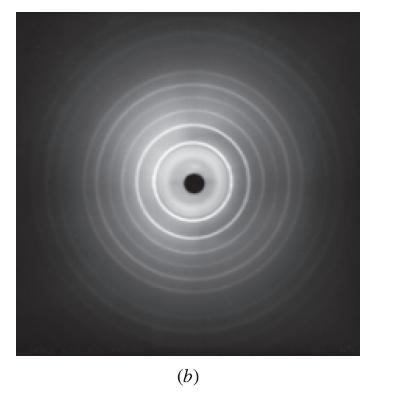
Determine the relative radius of the smallest five rings in a mono-chromatic powder diffraction measurement of a cubic crystal like that shown in Figure 1.18(b). Assume that the image plane is orthogonal to the input radiation. (b)
Show that the density of states in an isotropic two-dimensional system near a band minimum or maximum does not depend on the energy of the electrons. The volume per state in k-space is A/(2π)2, where A is the total area of the two-dimensional system.
Prove that you get the same reciprocal lattice peaks from a bcc crystal, whether you view it as a single Bravais lattice or as a simple cubic Bravais lattice with a two-site basis and the accompanying structure factor. (See Table 1.1.)Notice that n+ Σ' (;)-Σ + Σ' (n + 3) 2 n η
Find the first gap energy at ka = π using (1.2.6) in the limit b → 0 and U0b is small. You should write approximations for sinKa and cos Ka near Ka = π, that is, Ka ≃ π + (ΔK)a, where ±K is small. You should find that you get an equation in terms of K that is factorizable into two terms
Plot the density of states for the lowest three bands of the one-dimensional Kronig–Penney model discussed in Section 1.2, for h̄2/2m = 1, a = 1, b = 0, and U0b = 1. You will need to solve for ∂E/∂ k numerically, as we had to do for E(k) in the Kronig–Penney model.
(a) Show that the volume of a Bravais lattice primitive cell is(b) Prove that the reciprocal lattice primitive vectors satisfy the relationWith part (a) this proves that the volume of the reciprocal lattice cell is (2π)3/Vcell.(c) Show that the reciprocal lattice of the reciprocal lattice is the
Use Mathematica to plot Re k as a function of E = h̄2K2/2m using Equation 1.2.6. Assume that you have a set of units such that h̄2/2m = 1, set a = 1, and choose various values of U0b from 0.1 to 3. This plot is just the Kronig– Penney reduced zone diagram turned on its side. Plot the first
Show that the reciprocal lattice of a simple hexagonal lattice (see Table 1.1) is also a simple hexagonal, with lattice constants 2π/c and 4π/√3a, rotated through 30° about the c-axis with respect to the real-space lattice. Table 1.1 Common crystal structures Structure Simple cubic
(a) A graphene lattice, or “honeycomb” lattice, is the same as the graphite lattice (see Table 1.1) but consists of only a two-dimensional sheet with lattice vectorsand a two-atom basis including only the graphite basis vectors in the z = 0 plane. Show that the reciprocal lattice vectors of
Showing 200 - 300
of 269
1
2
3
Step by Step Answers

 Get 50% OFF
Claim Now
Get 50% OFF
Claim Now