New Semester
Started
Get
50% OFF
Study Help!
--h --m --s
Claim Now
Question Answers
Textbooks
Find textbooks, questions and answers
Oops, something went wrong!
Change your search query and then try again
S
Books
FREE
Study Help
Expert Questions
Accounting
General Management
Mathematics
Finance
Organizational Behaviour
Law
Physics
Operating System
Management Leadership
Sociology
Programming
Marketing
Database
Computer Network
Economics
Textbooks Solutions
Accounting
Managerial Accounting
Management Leadership
Cost Accounting
Statistics
Business Law
Corporate Finance
Finance
Economics
Auditing
Tutors
Online Tutors
Find a Tutor
Hire a Tutor
Become a Tutor
AI Tutor
AI Study Planner
NEW
Sell Books
Search
Search
Sign In
Register
study help
engineering
mechanical engineering
Vector Mechanics For Engineers Statics And Dynamics 8th Edition Ferdinand Beer, E. Russell Johnston, Jr., Elliot Eisenberg, William Clausen, David Mazurek, Phillip Cornwell - Solutions
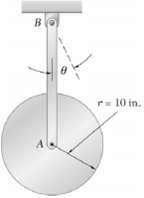
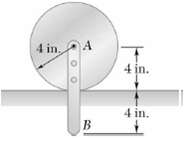
A uniform disk of radius 10 r = in. is attached at A to a 26-in. rod AB of negligible weight which can rotate freely in a vertical plane about B. If the rod is displaced 2? from the position shown and released, determine the magnitude of the maximum velocity of point A, assuming that the disk (a)
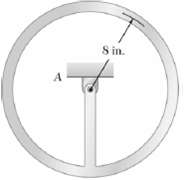
A homogeneous rod of weight per unit length equal to 0.3 lb/ft is used to form the assembly shown, which rotates freely about pivot A in a vertical plane. Knowing that the assembly is displaced 2? clockwise from its equilibrium position and released, determine its angular velocity and angular
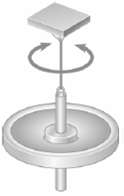
A period of 4.1 s is observed for the angular oscillations of a 450-g gyroscope rotor suspended from a wire as shown. Knowing that a period of 6.2 s is obtained when a 50-mm-diameter steel sphere is suspended in the same fashion, determine the centroidal radius of gyration of the rotor. (Density of
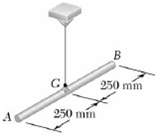
A 3-kg slender rod is suspended from a steel wire which is known to have a torsional spring constant 1.95 K = N ?? m/rad. If the rod is rotated through 180? about the vertical and then released, determine (a) The period of oscillation, (b) The maximum velocity of end A of the rod.
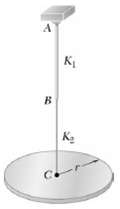
A 4-lb circular disk of radius r = 40 in. is suspended at its center C from wires AB and BC soldered together at B. The torsional spring constants of the wires are K1 =3 lb ?? ft/rad for AB and K2 = 1.5 lb ?? ft/rad for BC. Determine the period of oscillation of the disk about the axis AC.
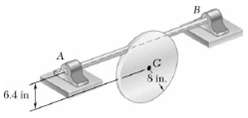
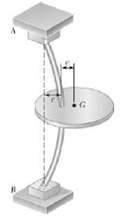
A 120-lb uniform circular plate is welded to two elastic rods which have fixed ends at supports A and B as shown. The torsional spring constant of each rod is 150 lb ft/?? t/rad, and the system is in equilibrium when the plate is vertical. Knowing that the plate is rotated 2? about axis AB and
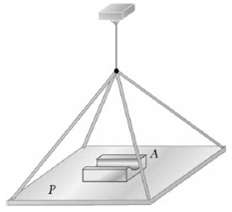
A horizontal platform P is held by several rigid bars which are connected to a vertical wire. The period of oscillation of the platform is found to be 2.2 s when the platform is empty and 3.8 s when an object A of uniform moment of inertia is placed on the platform with its mass center directly
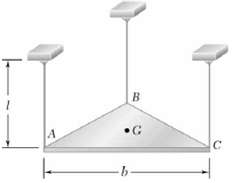
A uniform equilateral triangular plate of side b is suspended from three vertical wires of the same length l. Determine the period of small oscillations of the plate when (a) It is rotated through a small angle about a vertical axis through its mass center G, (b) It is given a small horizontal
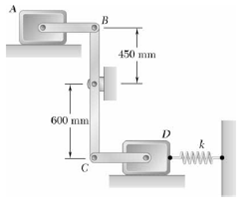
Two blocks, each of mass 1.5 kg, are attached to links which are pin-connected to bar BC as shown. The masses of the links and bar are negligible, and the blocks can slide without friction. Block D is attached to a spring of constant k = 720 N/m. Knowing that block A is moved 15 mm from its
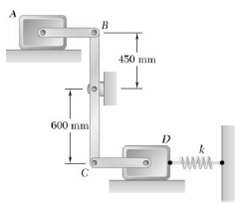
Two blocks, each of mass 1.5 kg, are attached to links which are pin-connected to bar BC as shown. The masses of the links and bar are negligible, and the blocks can slide without friction. Block D is attached to a spring of constant k = 720N/m. Knowing that block A is at rest when it is struck
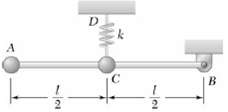
Two small spheres, A and C, each of mass m, are attached to rod AB, which is supported by a pin and bracket at B and by a spring CD of constant k. Knowing that the mass of the rod is negligible and that the system is in equilibrium when the rod is horizontal, determine the frequency of the small
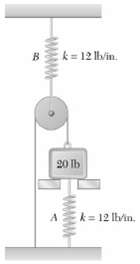
A 20-lb block is attached to spring A and connected to spring B by a cord and pulley. The block is held in the position shown with both springs un-stretched when the support is removed and the block is released with no initial velocity. Neglecting friction and the masses of the pulley and the
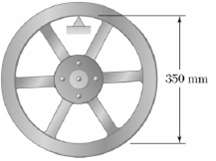
The inner rim of a 38-kg flywheel is placed on a knife edge, and the period of its small oscillations is found to be 1.26 s. Determine the centroidal moment of inertia of the flywheel.
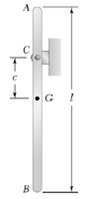
A uniform rod AB can rotate in a vertical plane about a horizontal axis at C located at a distance c above the mass center G of the rod. For small oscillations determine the value of c for which the frequency of the motion will be maximum.
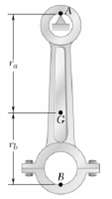
A connecting rod is supported by a knife edge at point A; the period of its small oscillations is observed to be 0.895 s. The rod is then inverted and supported by a knife edge at point B and the period of its small oscillations is observed to be 0.805 s. Knowing that ra + rb = 10.5in.,
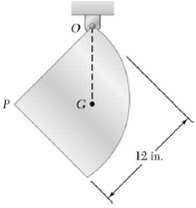
A thin uniform plate cut into the shape of a quarter circles can rotate in a vertical plane about a horizontal axis at point O. Determine the period of small oscillations of the plate.
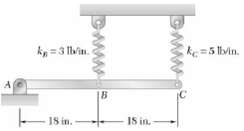
A uniform rod ABC weighs 6 lb and is attached to two springs as shown. If end C is given a small displacement and released, determine the frequency of vibration of the rod.
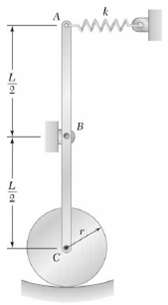
A uniform disk of radius r and mass m can roll without slipping on a cylindrical surface and is attached to bar ABC of length L and negligible mass. The bar is attached to a spring of constant k and can rotate freely in the vertical plane about point B, knowing that end A is given a small
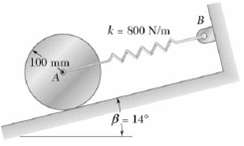
A 7-kg uniform cylinder can roll without sliding on an incline and is attached to a spring AB as shown. If the center of the cylinder is moved 10 mm down the incline and released, determine (a) The period of vibration, (b) The maximum velocity of the center of the cylinder.
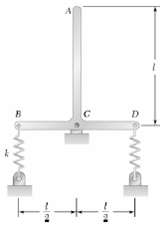
Two uniform rods, each of mass m = 0.6kg and length l = 160 mm, are welded together to form the assembly shown. Knowing that the constant of each spring is k = 120 N/m and that end A is given a small displacement and released, determine the frequency of the resulting motion.
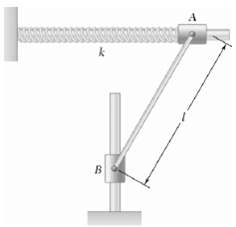
A slender 10-kg bar AB of length l = 0.6 m is connected to two collars of negligible weight. Collar A is attached to a spring of constant k = 1.5kN/m and can slide on a horizontal rod, while collar B can slide freely on a vertical rod. Knowing that the system is in equilibrium when bar AB is
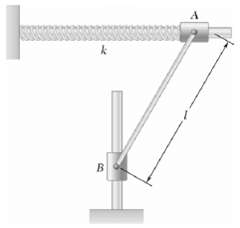
A slender 5-kg bar AB of length l = 0.6 m is connected to two collars, each of mass 2.5 kg. Collar A is attached to a spring of constant k = 1.5kN/m and can slide on a horizontal rod, while collar B can slide freely on a vertical rod. Knowing that the system is in equilibrium when bar AB is
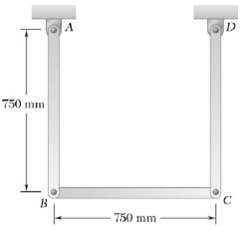
Three identical 3.6-kg uniform slender bars are connected by pins as shown and can move in a vertical plane. Knowing that bar BC is given a small displacement and released, determine the period of vibration of the system.
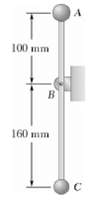
A 0.7-kg sphere A and a 0.5-kg sphere C are attached to the ends of a 1-kg rod AC which can rotate in a vertical plane about an axis at B. Determine the period of small oscillations of the rod.
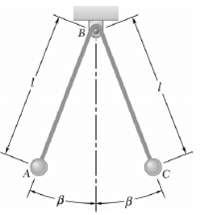
Spheres A and C, each of weight W, are attached to the ends of a homogeneous rod of the same weight W and of length 2l which is bent as shown. The system is allowed to oscillate about a frictionless pin at B. Knowing g that β = 40? and l = 25 in., determine the frequency of small oscillations.
The 3-lb rod AB is bolted to a 5-lb disk. Knowing that the disk rolls without sliding, determine the period of small oscillations of the system.
Two 6-kg uniform disks are attached to the 9-kg rod AB as shown. Knowing that the constant of the spring is 5kN/m and that the disks roll without sliding, determine the frequency of vibration of the system.
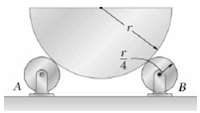
A half section of a uniform cylinder of radius r and mass m rests on two casters A and B, each of which is a uniform cylinder of radius r/4 and mass m/8. Knowing that the half cylinder is rotated through a small angle and released and that no slipping occurs, determine the frequency of small
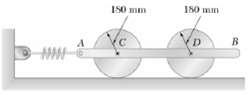
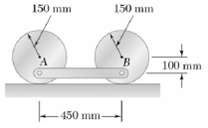
The 10-kg rod AB is attached to two 4-kg disks as shown. Knowing that the disks roll without sliding, determine the frequency of small oscillations of the system.
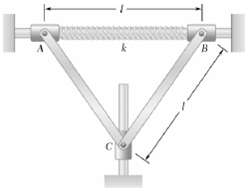
Three collars, each of mass m, are connected by pins to bars AC and BC, each of length l and negligible mass. Collars A and B can slide without friction on a horizontal rod and are connected by a spring of constant k. Collar C can slide without friction on a vertical rod, and the system is in
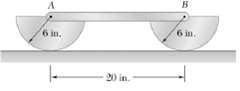
Two 6-lb uniform semicircular plates are attached to the 4-lb rod AB as shown. Knowing that the plates roll without sliding, determine the period of small oscillations of the system.
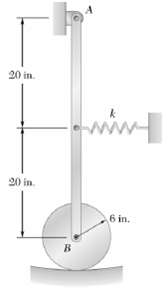
A uniform 6-lb disk can roll without slipping on a cylindrical surface and is attached to a 4-lb uniform slender bar AB. The bar is attached to a spring of constant k = 20 lb/ft and can rotate freely in the vertical plane about point A. Knowing that end B is given a small displacement and released,
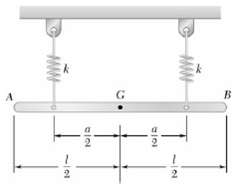
A slender rod of mass m and length l is suspended from two vertical springs, each of constant k as shown. The rod is in equilibrium when it is given a small rotation about a horizontal axis through G and released. Determine the frequency of small oscillations.
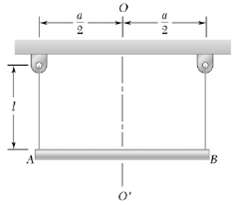
A section of uniform pipe is suspended from two vertical cables attached at A and B. Determine the frequency of oscillation when the pipe is given a small rotation about the centroidal axis OO?? and released.
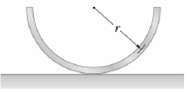
A half section of pipe is placed on a horizontal surface, rotated through a small angle, and then released. Assuming that the pipe section rolls without sliding, determine the period of oscillation
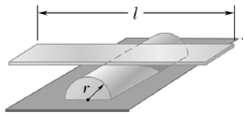
A thin plate of length l rests on a half cylinder of radius r. Derive an expression for the period of small oscillations of the plate.
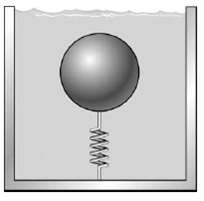
(a) Neglecting fluid friction, determine the period of vibration of the shell when it is displaced vertically and then released. (b) Solve part a, assuming that the tank is accelerated upward at the constant rate of 2 24ft/s2.
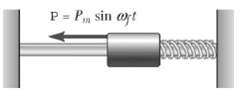
A 4-kg collar can slide on a frictionless horizontal rod and is attached to a spring of constant 450 N/m. It is acted upon by a periodic force of magnitude P = Pm sin ωft where Pm = 13N. Determine the amplitude of the motion of the collar if (a) ωf = 5 rad/s, (b) ωf = 10 rad/s.
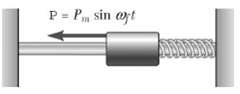
A 4-kg collar can slide on a frictionless horizontal rod and is attached to a spring of constant k. It is acted upon by a periodic force of magnitude P = Pm sin, ωft where 9 Pm = N and 5 ωf = rad/s. Determine the value of the spring constant k knowing that the motion of the collar has an
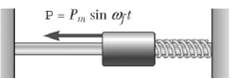
A collar of mass m which slides on a frictionless horizontal rod is attached to a spring of constant k and is acted upon by a periodic force of magnitude P = Pm sin ωft. Determine the range of values of ωf for which the amplitude of the vibration exceeds three times the static deflection caused
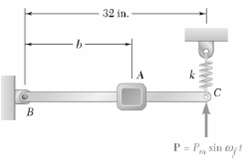
A small 40-lb block A is attached to the rod BC of negligible mass which is supported at B by a pin and bracket and at C by a spring of constant k = 140 lb/ft. The system can move in a vertical plane and is in equilibrium when the rod is horizontal. The rod is acted upon at C by a periodic force P
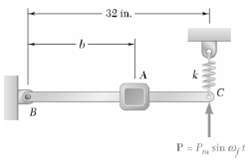
A small 40-lb block A is attached to the rod BC of negligible mass which is supported at B by a pin and bracket and at C by a spring of constant k = 140 lb/ft. The system can move in a vertical plane and is in equilibrium when the rod is horizontal. The rod is acted upon at C by a periodic force P
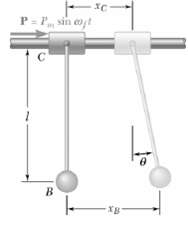
The 1.2-kg bob of a simple pendulum of length l = 600 mm is suspended from a 1.4-kg collar C. Knowing that the collar is acted upon by a periodic force P = Pm sin ωft, where Pm = 0.5N and ωf = 3rad/s, determine the amplitude and phase of the motion of the bob.
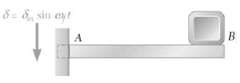
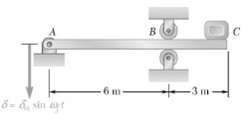
A cantilever beam AB supports a block which causes a static deflection of 40 mm at B. Assuming that the support at A undergoes a vertical periodic displacement δ = δm sin ωft, where δm = 10mm, determine the range of values of f ω for which the amplitude of the motion of the block will be less
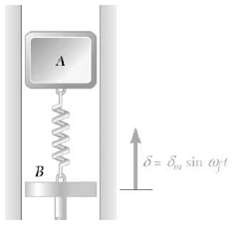
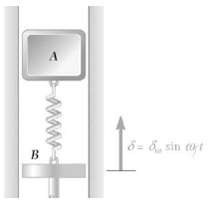
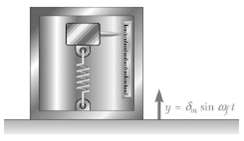
A 2-kg block A slides in a vertical frictionless slot and is connected to a moving support B by means of a spring AB of constant k = 117N/m. Knowing that the displacement of the support is δ = δm sin ωft where δm = 100mm and ωf = 5rad/s, determine (a) The amplitude of the motion of the
A 16-lb block A slides in a vertical frictionless slot and is connected to a moving support B by means of a spring AB of constant 130 lb/k = ft. Knowing that the displacement of the support is δ = δm sin ωft where δm = 6in., determine the range of values of f ω for which the amplitude of the
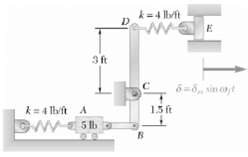
A 5-lb block A is attached to a spring of constant k = 4 lb/ft and a bar BCD of negligible weight. The bar is connected at D to a moving support E by means of an identical spring. Knowing that the support E undergoes a displacement δ = δm sin ωft where δm = 0.2in and ωf = 10 rad/s
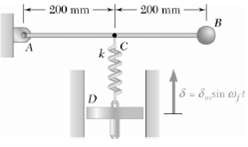
A small 2-kg sphere B is attached to the bar AB of negligible mass which is supported at A by a pin and bracket and connected at C to a moving support D by means of a spring of constant k = 3.6kN/m. Knowing that support D undergoes a vertical displacement δ = δm sin ωft, where δm = 3 mm and ωf
A beam ABC is supported by a pin connection at A and by rollers at B. A 120-kg block placed on the end of the beam causes a static deflection of 15 mm at C. Assuming that the support at A undergoes a vertical periodic displacement δ = δm sin ωft where δm = 10mm and ωf = 18rad/s, and the
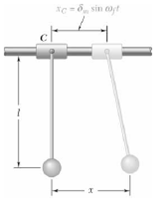
A simple pendulum of length l is suspended from a collar C which is forced to move horizontally according to the relation xc = δm sin ωft. Determine the range of values of ωf for which the amplitude of the motion of the bob is less than δm. (Assume
In Prob. 19.110, determine the range of values of ωf for which the amplitude of the motion of the bob exceeds 2δm.
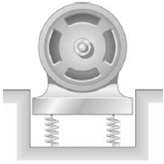
A 200-kg motor is supported by springs having a total constant of 215kN/m. The unbalance of the rotor is equivalent to a 30-g mass located 200 mm from the axis of rotation. Determine the range of allowable values of the motor speed if the amplitude of the vibration is not to exceed 1.5 mm.
A motor of mass 18 kg is supported by four springs, each of constant 40kN/m. The motor is constrained to move vertically, and the amplitude of its motion is observed to be 1.5 mm at a speed of 1200 rpm. Knowing that the mass of the rotor is 4 kg, determine the distance between the mass center of
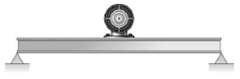
A 360-lb motor is bolted to a light horizontal beam. The unbalance of its rotor is equivalent to a 0.9-oz weight located 7.5 in. from the axis of rotation, and the static deflection of the beam due to the weight of the motor is 0.6 in. The amplitude of the vibration due to the unbalance can be
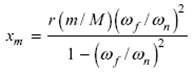
A motor of mass M is supported by springs with an equivalent spring constant k. The unbalance of its rotor is equivalent to a mass m located at a distance r from the axis of rotation. Show that when the angular velocity of the rotor is ωf, the amplitude xm of the motion of the motor is where ωn =
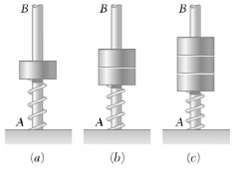
Rod AB is rigidly attached to the frame of a motor running at a constant speed. When a collar of mass m is placed on the spring, it is observed to vibrate with an amplitude of 15 mm. When two collars, each of mass m, are placed on the spring, the amplitude is observed to be 18 mm. What amplitude of
Solve Prob. 19.116, assuming that the speed of the motor is changed and that one collar has an amplitude of 9 mm and two collars have an amplitude of 3 mm.
The unbalance of the rotor of a 400-lb motor is equivalent to a 0.8-oz weight located 6 in. from the axis of rotation. Knowing that the motor is supported by four springs, each of constant 5 kips/ft, determine the range of allowable values of the motor speed if the maximum vertical acceleration of
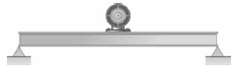
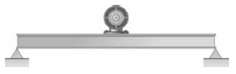
A counter-rotating eccentric mass exciter consisting of two rotating 3.5-oz weights describing circles of radius r at the same speed but in opposite senses is placed on a machine element to induce a steady-state vibration of the element. The total weight of the system is 600 lb, the constant of
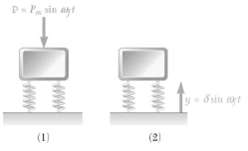
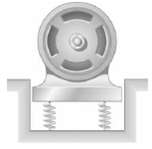
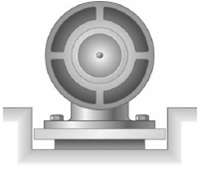
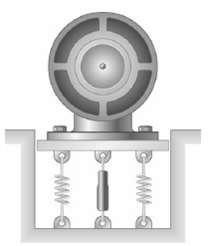
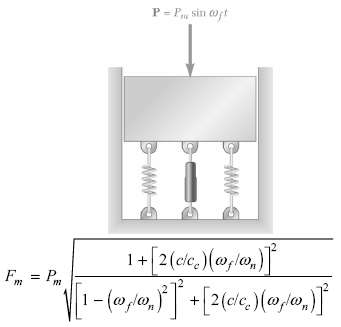
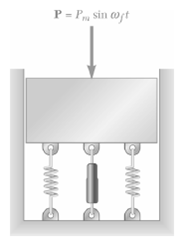
Figures (1) and (2) show how springs can be used to support a block in two different situations, in Fig. (1) They help decrease the amplitude of the fluctuating force transmitted by the block to the foundation, In Fig. (2) They help decrease the amplitude of the fluctuating displacement transmitted
A 27-kg disk is attached with an eccentricity e = 150μm to the midpoint of a vertical shaft AB which revolves at a constant angular velocity ωf. Knowing that the spring constant k for horizontal movement of the disk is 580kN/m, determine (a) The angular velocity ωf at which resonance will
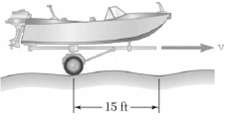
A small trailer and its load have a total weight of 500 lb. The trailer is supported by two springs, each of constant 350 lb/ft, and is pulled over a road, the surface of which can be approximated by a sine curve with an amplitude of 2 in. and a wavelength of 15 ft (that is, the distance between
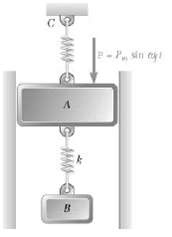
Block A can move without friction in the slot as shown and is acted upon by a vertical periodic force of magnitude P = Pm sin ωft where ωf = 2 rad/s and Pm = 5lb. A spring of constant k is attached to the bottom of block A and to a 44-lb block B. Determine (a) The value of the constant k which
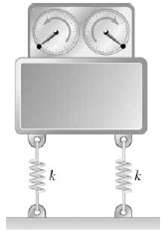
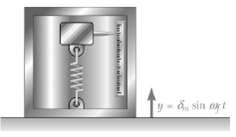
A vibrometer used to measure the amplitude of vibrations consists of a box containing a mass-spring system with a known natural frequency of 150 Hz. The box is rigidly attached to a surface which is moving according to the equation y = δm sin ωft. If the amplitude zm of the motion of the mass
A certain accelerometer consists essentially of a box containing a mass-spring system with a known natural frequency of 1760 Hz. The box is rigidly attached to a surface which is moving according to the equation y = δm sin ωft. If the amplitude zm of the motion of the mass relative to the box
Show that in the case of heavy damping (c > cc), a body never passes through its position of equilibrium O(a) If it is released with no initial velocity from an arbitrary position, or(b) If it is started from O with an arbitrary initial velocity.
Show that in the case of heavy damping (c > cc), a body released from an arbitrary position with an arbitrary initial velocity cannot pass more than once through its equilibrium position.
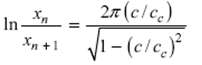
In the case of light damping, the displacements x1, x2, x3, shown in Fig. 19.11, may be assumed equal to the maximum displacements. Show that the ratio of any two successive maximum displacements xn and xn + 1 is constant and that the natural logarithm of this ratio, called the logarithmic
In practice, it is often difficult to determine the logarithmic decrement of a system with light damping defined in Prob. 19.128 by measuring two successive maximum displacements. Show that the logarithmic decrement can also be expressed pressed as (1/k) In (xn/xn + k), where k is the number of
In a system with light damping (c < cc), the period of vibration is commonly defined as the time interval τd = 2π/ωd corresponding to two successive points where the displacement-time curve touches one of the limiting curves shown in Fig. 19.11. Show that the interval of time(a) Between a
Successive maximum displacements of a spring-mass-dashpot system similar to that shown in Fig. 19.10 are 1.25, 0.75, and 0.45 in. Knowing that W = 36 lb and k = 175 lb/ft, determine(a) The damping factor c/cc,(b) The value of the coefficient of viscous damping c.
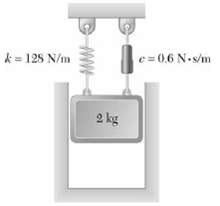
A 2-kg block is supported by a spring of constant k = 128 N/m and a dashpot with a coefficient of viscous damping c = 0.6 N ?? s/m. The block is in equilibrium when it is struck from below by a hammer which imparts to the block an upward velocity of 0.4 m/s. Determine (a) The logarithmic
The barrel of a field gun weighs 1800 lb and is returned into firing position after recoil by a recuperator of constant c = 1320 lb ⋅ s/ft. Determine(a) The constant k which should be used for the recuperator to return the barrel into firing position in the shortest possible time without any
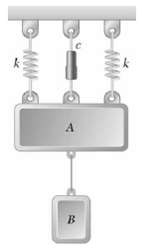
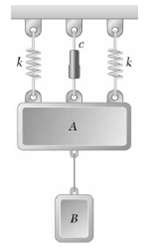
A 0.9-kg block B is connected by a cord to a 2.4-kg block A which is suspended as shown from two springs, each of constant 180 k = N/m, and a dashpot of damping coefficient c = 7.5N ?? s/m. Knowing that the system is at rest when the cord connecting A and B is cut, determine the minimum tension
A 0.9-kg block B is connected by a cord to a 2.4-kg block A which is suspended as shown from two springs, each of constant k = 180 N/m, and a dashpot of damping coefficient c = 60N ?? s/m. Knowing that the system is at rest when the cord connecting A and B is cut, determine the velocity of block A
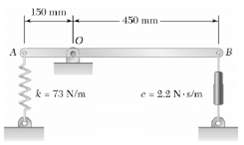
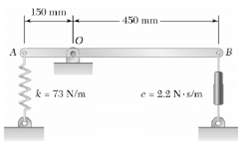
A 1.8-kg uniform rod is supported by a pin at O and a spring at A and is connected to a dashpot at B. Determine (a) The differential equation of motion for small oscillations, (b) The angle that the rod will form with the horizontal 2.5 s after end B has been pushed 23 mm down and released.
A 1.8-kg uniform rod is supported by a pin at O and a spring at A and is connected to a dashpot at B. Determine (a) The differential equation of motion for small oscillations, (b) The angle that the rod will form with the horizontal 2.5 s after end B has been pushed 23 mm down and released.
A platform of weight 200lb, supported by two springs each of constant k = 250 lb/in., is subjected to a periodic force of maximum magnitude equal to 125lb. Knowing that the coefficient of damping is 9lb ??s/in., determine (a) The natural frequency in rpm of the platform if there were no
Solve Prob. 19.138, assuming that the coefficient of damping is increased to 12lb ⋅ s/in.
In the case of the forced vibration of a system, determine the range of values of the damping factor c/cc for which the magnification factor will always decrease as the frequency ratio ωf/ωn increases.
Show that for a small value of the damping factor c/cc, the maximum amplitude of a forced vibration occurs when ωf ≈ ωn and that the corresponding value of the magnification factor is ½ (cc/c)
A 36-lb motor is bolted to a light horizontal beam which has a static deflection of 0.075 in. due to the weight of the motor. Knowing that the unbalance of the rotor is equivalent to a weight of 0.64 oz located 6.25 in. from the axis of rotation, determine the amplitude of the vibration of the
A 45-kg motor is bolted to a light horizontal beam which has a static deflection of 6 mm due to the weight of the motor. The unbalance of the motor is equivalent to a mass of 110 g located 75 mm from the axis of rotation. Knowing that the amplitude of the vibration of the motor is 0.25 mm at a
Solve Prob. 19.113, assuming that a dashpot having a coefficient of damping c = 350N ?? s/m has been connected to the motor and to the ground.
The unbalance of the rotor of a 180-kg motor is equivalent to a mass of 85 g located 150 mm from the axis of rotation. The pad which is placed between the motor and the foundation is equivalent to a spring of constant k = 7.5kN/m in parallel with a dashpot of constant c. Knowing that the magnitude
A 200-lb motor is supported by two springs, each of constant 15 kips/ft, and is connected to the ground by a dashpot having a coefficient of damping c = 490lb ?? s/ft. The motor is constrained to move vertically, and the amplitude of its motion is observed to be 0.10 in. at a speed of 1200 rpm.
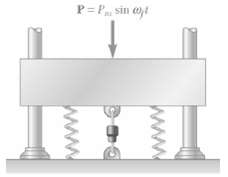
A machine element is supported by springs and is connected to a dashpot as shown. Show that if a periodic force of magnitude P = Pm sin ωft is applied to the element, the amplitude of the fluctuating force transmitted to the foundation is.
A 91-kg machine element supported by four springs, each of constant 175 N/m, is subjected to a periodic force of frequency 0.8 Hz and amplitude 89 N. Determine the amplitude of the fluctuating force transmitted to the foundation if(a) A dashpot with a coefficient of damping c = 365 N ‹…
For a steady-state vibration with damping under a harmonic force, show that the mechanical energy dissipated per cycle by the dashpot is E = πcx2mωf, where c is the coefficient of damping, xm is the amplitude of the motion, and ωf is the circular frequency of the harmonic force.
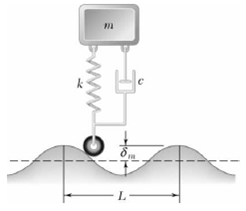
The suspension of an automobile can be approximated by the simplified spring-dashpot system shown.(a) Write the differential equation defining the vertical displacement of the mass m when the system moves at a speed v over a road with a sinusoidal cross section of amplitude δm and
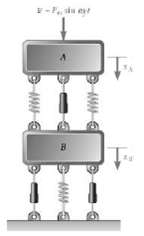
Two blocks A and B, each of mass m, are supported as shown by three springs of the same constant k. Blocks A and B are connected by a dashpot and block B is connected to the ground by two dashpots, each dashpot having the same coefficient of damping c. Block A is subjected to a force of magnitude P
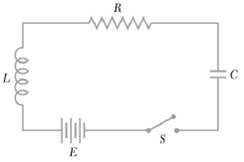
Express in terms of L, C, and E the range of values of the resistance R for which oscillations will take place in the circuit shown when switch S isclosed.
Consider the circuit of Prob. 19.152 when the capacitor C is removed. If switch S is closed at time t = 0, determine(a) The final value of the current in the circuit,(b) The time t at which the current will have reached (1 − 1/e) times its final value. (The desired value of t is known as the time
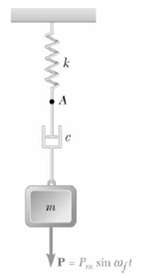
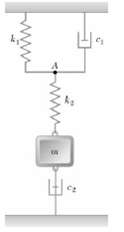
Draw the electrical analogue of the mechanical system shown.
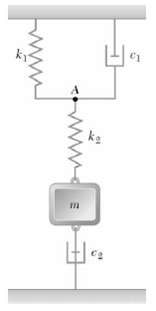
Draw the electrical analogue of the mechanical system shown.
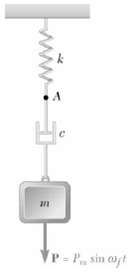
Write the differential equations defining (a) The displacements of the mass m and of the point A, (b) The charges on the capacitors of the electrical analogue.
Write the differential equations defining (a) The displacements of the mass m and of the point A, (b) The charges on the capacitors of the electrical analogue.
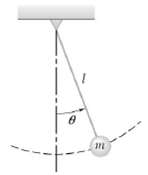
The bob of a simple pendulum of length l = 40 in. is released from rest when θ = +5?. Assuming simple harmonic motion, determine 1.6 s after release (a) The angle θ, (b) The magnitudes of the velocity and acceleration of the bob.
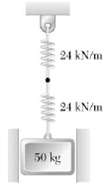
A 50-kg block is supported by the spring arrangement shown. The block is moved vertically downward from its equilibrium position and released. Knowing that the amplitude of the resulting motion is 60 mm, determine (a) The period and frequency of the motion, (b) The maximum velocity and maximum
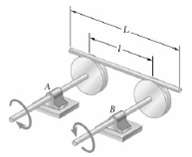
A rod of mass m and length L rests on two pulleys A and B which rotate in opposite directions as shown. Denoting by μk the coefficient of kinetic friction between the rod and the pulleys, determine the frequency of vibration if the rod is given a small displacement to the right and released.
Showing 11900 - 12000
of 18200
First
113
114
115
116
117
118
119
120
121
122
123
124
125
126
127
Last
Step by Step Answers

 Get 50% OFF
Claim Now
Get 50% OFF
Claim Now