New Semester
Started
Get
50% OFF
Study Help!
--h --m --s
Claim Now
Question Answers
Textbooks
Find textbooks, questions and answers
Oops, something went wrong!
Change your search query and then try again
S
Books
FREE
Study Help
Expert Questions
Accounting
General Management
Mathematics
Finance
Organizational Behaviour
Law
Physics
Operating System
Management Leadership
Sociology
Programming
Marketing
Database
Computer Network
Economics
Textbooks Solutions
Accounting
Managerial Accounting
Management Leadership
Cost Accounting
Statistics
Business Law
Corporate Finance
Finance
Economics
Auditing
Tutors
Online Tutors
Find a Tutor
Hire a Tutor
Become a Tutor
AI Tutor
AI Study Planner
NEW
Sell Books
Search
Search
Sign In
Register
study help
engineering
mechanical engineering
Fundamentals of Heat and Mass Transfer 6th Edition Incropera, Dewitt, Bergman, Lavine - Solutions
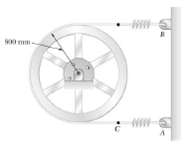
A 270-kg flywheel has a diameter of 1.2 m and a radius of gyration of 0.5 m. A belt is placed over the rim and attached to two springs, each of constant k = 13kN/m. The initial tension in the belt is sufficient to prevent slipping. If the end C of the belt is pulled 25 mm to the right and released,
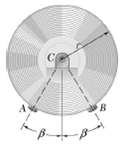
Two small weights w are attached at A and B to the rim of a uniform disk of radius r and weight W. Denoting by 0 τ the period of small oscillations when β = 0, determine the angle β for which the period of small oscillations is 2τ0.
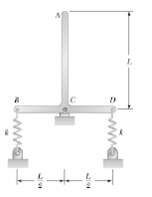
Two uniform rods, ds, each of weight W = 24 lb and length L = 40 in., are welded together to form the assembly shown. Knowing that the constant of each spring is k = 50 lb/ft and that end A is given a small displacement and released, determine the frequency of the resulting motion.
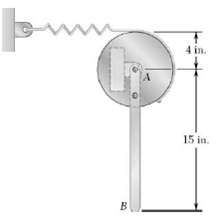
A 6-lb slender rod AB is bolted to a 10-lb uniform disk. A spring of constant 25 lb/ft is attached to the disk and is un-stretched in the position shown. If end B of the rod is given a small displacement and released, determine the period of vibration of the system.
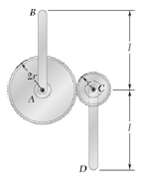
Two uniform rods AB and CD, each of length l and mass m, are attached to gears as shown. Knowing that the mass of gear C is m and that the mass of gear A is 4m, determine the period of small oscillations of the system.
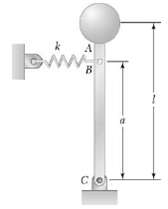
An inverted pendulum consisting of a sphere of weight W and a bar ABC of length l and negligible weight is supported by a pin and bracket at C. A spring of constant k is attached to the bar at B and is un-deformed when the bar is in the vertical position shown. Determine (a) The frequency of small
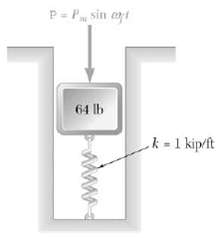
A 64-lb block is attached to a spring of constant 1 kip/k = /ft and can move without friction in a vertical slot as shown. It is acted upon by a periodic force of magnitude P = Pmsin ωft where ωf= 10rad/s. Knowing that the amplitude of the motion is 0.75 in., determine Pm.
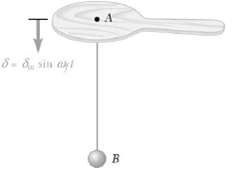
A 360-g ball is connected to a paddle by means of an elastic cord AB of constant k = 70 N/m. Knowing that the paddle is moved vertically according to the relation δ = δm sin ωft with an amplitude δm = 200mm and a frequency ff = 0.5Hz, determine the steady-state amplitude of the motion of the
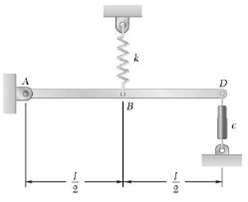
A uniform rod of mass m is supported by a pin at A and a spring of constant k at B and is connected at D to a dashpot of damping coefficient c. Determine in terms of m, k, and c, for small oscillations, (a) The differential equation of motion, (b) The critical damping coefficient cc.
Consider a gasoline engine for a car as an SSSF device where air and fuel enters at the surrounding conditions 25oC, 100 kPa and leaves the engine exhaust manifold at 1000 K, 100 kPa as products assumed to be air. The engine cooling system removes 750 kJ/kg airs through the engine to the ambient.
In a fire-tube boiler, hot products of combustion flowing through an array of thin-walled tubes are used to boil water flowing over the tubes. At the time of installation, the overall heat transfer coefficient was 400 W/m2 ∙ K. After 1 year of use, the inner and outer tube surfaces are fouled,
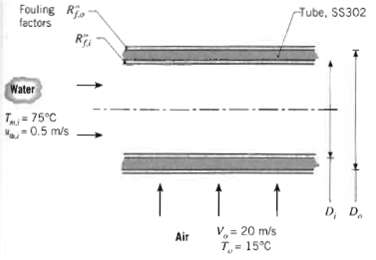
A type-302 stainless steel tube of inner and outer diameters Di = 22 mm and Do = 27 mm, respectively, is used in a cross-flow heat exchanger. The fouling factors, R''f, for the inner and outer surfaces are estimated to be 0.0004 and 0.0002 m2 ? K/W, respectively (a) Determine the overall heat
A shell-and-tube heat exchanger is to heat an acidic liquid that flows in un-finned tubes of inside and outside diameters Di = 10 mm and Do = 11 mm, respectively. A hot gas flows on the shell side. To avoid corrosion of the tube material, the engineer may specify either a Ni-Cr-Mo
A steel tube (k = 50 W/m ∙ K) of inner and outer diameters Di = 20 mm and Do = 26 mm. respectively, is used to transfer heat from hot gases flowing over the tube (hh = 200 W/m2 ∙ K) to cold water flowing through the tube (hc = 8000 W/m2 ∙ K). What is the cold-side overall heat transfer
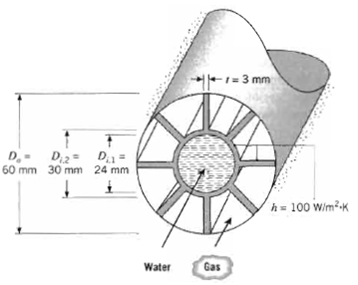
A heat recovery device involves transferring energy from the hot flue gases passing through an annular region to pressurized water flowing through the inner tube of the annulus. The inner tube has inner and outer diameters of 24 and 30 mm and is connected by eight struts to an insulated outer tube
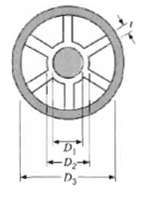
A novel design for a condenser consists of a tube of thermal conductivity 200W/m ? K with longitudinal fins snugly fitted into a larger tube. Condensing refrigerant at 45?C flows axially through the inner tube, while water at a flow rate of 0.012 kg/s passes through the six channels around the
The condenser of a steam power plant contains N = 1000 brass tubes (kt = 110 W/m ∙ K), each of inner and outer diameters, Di = 25 mm and Do = 28 mm. respectively. Steam condensation on the outer surfaces of the tubes is characterized by a convection coefficient of ho = 10,000 W/m2 ∙ K.(a) If
Thin-walled aluminum tubes of diameter D = 10 mm are used in the condenser of an air conditioner. Under normal operating conditions, a convection coefficient of hi = 5000 W/m2 ∙ K is associated with condensation on the inner surface of the tubes, while a coefficient of ho = 100 W/m2 ∙ K is
A finned-tube, cross-flow heat exchanger is to use the exhaust of a gas turbine to heat pressurized water. Laboratory measurements are performed on a prototype version of the exchanger, which has a surface area of 10 m2, to determine the overall heat transfer coefficient as a function of operating
Water at a rate of 45.500 kg/h is heated from 80 to 150°C in a heat exchanger having two shell passes and eight tube passes with a total surface area of 925 m2. Hot exhaust gases having approximately the same thermo physical properties as air enter at 350oC and exit at 175°C. Determine the
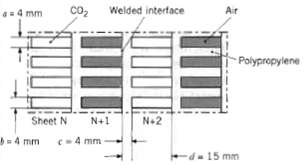
A novel heat exchanger concept consists of a large number of extruded polypropylene sheets (k = 0.17 W/m ? K), each having a fin-like geometry, that are subsequently stacked and melted together to form the heat exchanger core. Besides being inexpensive, the heat exchanger can be easily recycled at
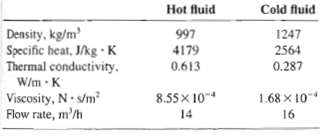
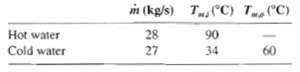
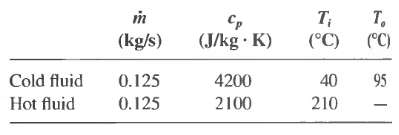
The properties and flow rates for the hot and cold fluids of a heat exchanger are shown in the following table. Which fluid limits the heat transfer rate of the exchanger? Explain yourchoice.
A process fluid having a specific heat of 3500 J/kg ∙ K and flowing at 2 kg/s is to be cooled from 80°C to 50°C with chilled water, which is supplied at a temperature of 15°C and a flow rate of 2.5 kg/so Assuming an overall heat transfer coefficient of 2000 W/m2 ∙ K, calculate the required
A shell-and-tube exchanger (two shells, four tube passes) is used to heat 10,000 kg/h of pressurized water from 35 to 120°C with 5000 kg/h pressurized water entering the exchanger at 300°C. If the overall heat transfer coefficient is 1500 W/m2 ∙ K, determine the required heat exchanger area.
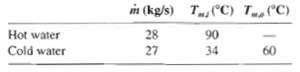
Consider the heat exchanger of Problem 11.14. After several years of operation, it is observed that the outlet temperature of the cold water reaches only 95°C rather than the desired 120°C for the same flow rates and inlet temperatures of the fluids. Determine the cumulative (inner and outer
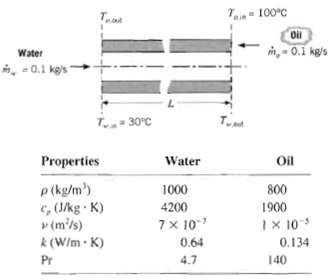
A counter flow, concentric tube heat exchanger is designed to heat water from 20 to 80°C using hot oil, which is supplied to the annuls at 160°C and discharged at 140°C. The thin-walled inner tube has a diameter of Di = 20 mm. and the overall heat transfer coefficient is 500 W/m2 ∙ K. The
Consider the counter flow, concentric tube heat exchanger of Example 11.1. The designer wishes to consider the effect of the cooling water flow rate on the tube length. All other conditions, including the outlet oil temperature of 60°C, remain the same.(a) From the analysis of Example 11.1, we saw
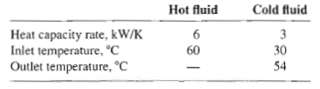
Consider a concentric tube heat exchanger with an area of 50 m2 operating under the following conditions: (a) Determine the outlet temperature of the hot fluid (b) Is the heat exchanger operating in counter flow or parallel flow, or can't you tell from the available information? (c) Calculate the
For a senior project, a student was given the assignment to design a heat exchanger that meets the following specifications: Like many real-world situations, the customer hasn't revealed, or doesn't know, additional requirements that would allow you to proceed directly to a final configuration. At
A concentric tube heat exchanger for cooling lubricating oil is comprised of a thin-walled inner tube of 25-mm diameter carrying water and an outer tube of 45-mm diameter carrying the oil. The exchanger operates in counter flow with an overall heat transfer coefficient of 60 W/m2 ? K and the
A counter flow, concentric tube heat exchanger used for engine cooling has been in service for an extended period of time. The heat transfer surface area of the exchanger is 5 m2, and the design value of the overall convection coefficient is 38 W/m2 ∙ K. During a test run, engine oil flowing at
A shell-and-tube heat exchanger must be designed to heat 2.5 kg/s of water from 15 to 85°C. The heating is to be accomplished by passing hot engine oil, which is available at 160°C, through the shell side of the exchanger. The oil is known to provide an average convection coefficient of ho = 400
For a senior project, a student was given the assignment to design a heat exchanger that meets the following specifications: Like many real-world situations, the customer hasn't revealed, or doesn't know, additional requirements that would allow you to proceed directly to a final configuration. At
Hot air for a large-scale drying operation is to be produced by routing the air over a tube bank (unmixed), while products of combustion are routed through the tubes. The surface area of the cross-flow heat exchanger is A = 25 m2, and for the proposed operating conditions, the manufacturer
In a dairy operation, milk at a flow rate of 250 liter/hour and a cow-body temperature of 38.6°C must be chilled to a safe-to-store temperature of 13°C or less. Ground water at 10°C is available at a flow rate of 0.72m3/h. The density and specific heat of milk are 1030 kg/m 3 and 3860 J/kg
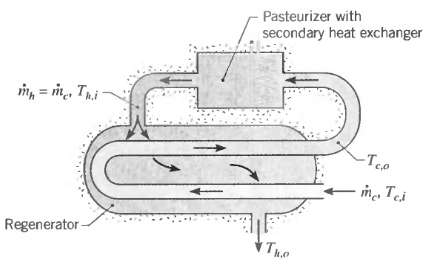
A shell-and-tube heat exchanger with one shell pass and two tube passes is used as a regenerator, to preheat milk before it is pasteurized. Cold milk enters the regenerator at Tc,i = 5?C, while hot milk, which has completed the pasteurization process, enters at Th,i = 70?C. After leaving the
The compartment heater of an automobile exchanges heat between warm radiator fluid and cooler outside air, the flow rate of water is large compared to the air, and the effectiveness, ε, of the heater is known to depend on the flow rate of air according to the relation, ε ~ m–0.2 air.(a) If the
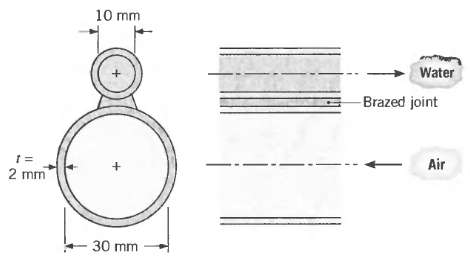
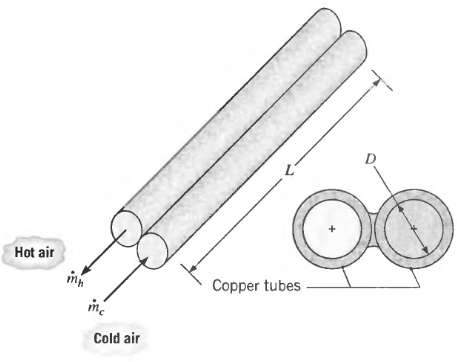
A counter flow, twin-tube heat exchanger is made by brazing two circular nickel tubes, each 40 m long, together as shown below. Hot water flows through the smaller tube of 10-mm diameter and air at atmospheric pressure flows through the larger tube of 30-mm diameter. Both tubes have a wall
A twin-tube, counter flow heat exchanger operates with balanced flow rates of 0.003 kg/s for the hot and cold airstreams. The cold stream enters at 280 K and must be heated to 340 K using hot air at 360 K. The average pressure of the airstreams is 1 atm and the maximum allowable pressure drop for
A 5-m-long, twin-tube, counter flow heat exchanger, such as that illustrated in Problem 11 .29, is used to heat air for a drying operation. Each tube is made from plain carbon steel (k = 60 W/m ∙ K) and has an inner diameter and wall thickness of 50 mm and 4 mm, respectively. The thermal
Hot water for an industrial washing operation is produced by recovering heat from the flue gases of a furnace. A cross-flow heat exchanger is used, with the gases passing over the tubes and the water making a single pass through the tubes. The steel tubes (k = 60 W/m ∙ K) have inner and outer
A single-pass, cross-flow heat exchanger uses hot exhaust gases (mixed) to heat water (unmixed) from 30 to 80°C at a rate of 3 kg/s. The exhaust gases, having thermo physical properties similar to air, enter and exit the exchanger at 225 and 100°C, respectively. If the overall heat transfer
Consider the fluid conditions and overall heat transfer coefficient of Problem 11.32 for a concentric tube heat exchanger operating in parallel flow. The thin-walled separator tube has a diameter of 100 mm.(a) Determine the required length for the exchanger.(b) Assuming water flow inside the
A cross-flow heat exchanger used in a cardio-pulmonary bypass procedure cools blood flowing at 5 liter/min from a body temperature of 37°C to 25°C in order to induce body hypothermia, which reduces metabolic and oxygen requirements. The coolant is ice water at 0°C, and its flow rate is adjusted
Saturated steam at 0.14bar is condensed in a shell-and-tube heat exchanger with one shell pass and two tube passes consisting of 130 brass tubes, each with a length per pass of 2 m. The tubes have inner and outer diameters of 13.4 and 15.9 mm, respectively. Cooling water enters the tubes at 20°C
A feed water heater that supplies a boiler consists of a shell-and-tube heat exchanger with one shell pass and two tube passes. One hundred thin-walled tubes each have a diameter of 20 mm and a length (per pass) of 2 m. Under normal operating conditions water enters the tubes at 10 kg/s and 290 K
Saturated steam at 110°C is condensed in a shell-and-tube heat exchanger (1 shell pass; 2, 4,... tube passes) with a UA value of 2.5 kW/K. Cooling water enters at 40°C.(a) Calculate the cooling water flow rate required to maintain a heat rate of 150 kW.(b) Assuming that VA is independent of flow
A shell-and-tube heat exchanger (1 shell pass, 2 tube passes) is to be used to condense 2.73 kg/s of saturated steam at 340 K. Condensation occurs on the outer tube surfaces, and the corresponding convection coefficient is 10,000 W/m2 ∙ K. The temperature of the cooling water entering the tubes
Saturated water vapor leaves a steam turbine at a flow rate of 1.5 kg/s and a pressure of 0.51 bar. The vapor is to be completely condensed to saturated liquid in a shell-and-tube heat exchanger that uses city water as the cold fluid. The water enters the thin-walled tubes at 17°C and is to leave
A two-fluid heat exchanger has inlet and outlet temperatures of 65 and 40°C for the hot fluid and 15 and 30°C for the cold fluid. Can you tell whether this exchanger is operating under counter flow or parallel-flow conditions? Determine the effectiveness of the heat exchanger.
The human brain is especially sensitive to elevated temperatures. The cool blood in the veins leaving the face and neck and returning to the heart may contribute to thermal regulation of the brain by cooling the arterial blood flowing to the brain. Consider a vein and artery running between the
Consider a very long, concentric tube heat exchanger having hot and cold water inlet temperatures of 85 and 15°C. The flow rate of the hot water is twice that of the cold water. Assuming equivalent hot and cold water specific heats, determine the hot water outlet temperature for the following
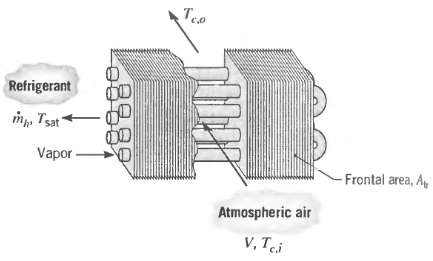
A plate-fin heat exchanger is used to condense a saturated refrigerant vapor in an air-conditioning system. The vapor has a saturation temperature of 45?C and a condensation rate of 0.015 kg/s is dictated by system performance requirements. The frontal area of the condenser is fixed at Afr = 0.25
A shell-and-tube heat exchanger is to heat 10,000 kg/h of water from 16 to 84°C by hot engine oil flowing through the shell. The oil makes a single shell pass, entering at 160°C and leaving at 94°C, with an average heat transfer coefficient of 400 W/m2 ∙ K. The water flows through 11 brass
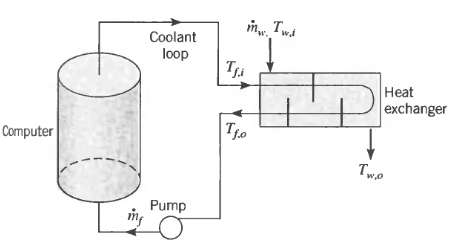
In a supercomputer, signal propagation delays are reduced by resorting to high-density circuit arrangements which are cooled by immersing them in a special dielectric liquid. The fluid is pumped in a closed loop through the computer and an adjoining shell-and-tube heat exchanger having one shell
A shell-and-tube heat exchanger consists of 135 thin-walled tubes in a double-pass arrangement, each of 12.5-mm diameters with a total surface area of 47.5 m2. Water (the tube-side fluid) enters the heat exchanger at 15°C and 6.5 kg/s and is heated by exhaust gas entering at 200°C and 5 kg/s. The
An ocean thermal energy conversion system is being proposed for electric power generation. Such a system is based on the standard power cycle for which the working fluid is evaporated, passed through a turbine, and subsequently condensed. The system is to be used in very special locations for which
A single-pass, cross-flow heat exchanger with both fluids unmixed is being used to heat water (mc = 2 kg/s. cp = 4200 J/kg ∙ K) from 20°C to 100°C with hot exhaust gases (cp = 1200 J/kg ∙ K) entering at 320°C. What mass flow rate of exhaust gases is required? Assume that VA is equal to its
Saturated process steam at 1 atm is condensed in a shell-and-tube heat exchanger (one shell, two tube passes). Cooling water enters the tubes at 15°C with an average velocity of 3.5 m/s. The tubes are thin-walled and made of copper with a diameter of 14 mm and length of 0.5 m. The convective heat
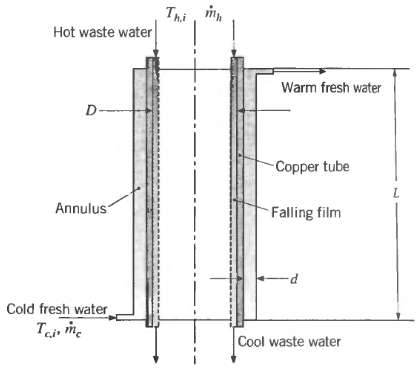
The chief engineer at a university that is constructing a large number of new student dormitories decides to install a counter flow concentric tube heat exchanger on each of the dormitory shower drains. The thin-walled copper drains are of diameter Di = 50 mm. Wastewater from the shower enters the
A shell-and-tube heat exchanger with single shell and tube passes (Figure) is used to cool the oil of a large marine engine. Lake water (the shell-side fluid) enters the heat exchanger at 2 kg/s and 15°C, while the oil enters at ] kg/s and 140°e. The oil flows through 100 copper tubes, each 500
A shell-and-tube heat exchanger with one shell pass and 20 tube passes uses hot water on the tube side to heat oil on the shell side. The single copper tube has inner and outer diameters of 20 and 24 mm and a length per pass of 3 m. The water enters at 87°C and 0.2 kg/s and leaves at 27°C. Inlet
The oil in an engine is cooled by air in a cross-flow heat exchanger where both fluids are unmixed. Atmospheric air enters at 30°C and 0.53 kg/s. Oil at 0.026 kg/s enters at 75°C and flows through a tube of 10-mm diameter. Assuming fully developed flow and constant wall heat flux, estimate the
It is proposed that the exhaust gas from a diesel powered electric generation plant be used to generate steam in a shell-and-tube heat exchanger with one shell and one tube pass. The steel tubes have a thermal conductivity of 40 W/m ∙ K. an inner diameter of 50 mm, and a wall thickness of 4 mm.
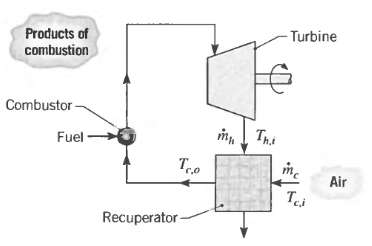
A re-cooperator is a heat exchanger that heats air used in a combustion process by extracting energy from the products of combustion. It can be used to increase the efficiency of a gas turbine by increasing the temperature of air entering the combustor. Consider a system for which the re-cooperator
A concentric tube heat exchanger uses water, which is available at 15°C, to coo] ethylene glycol from 100 to 60°C. The water and glycol flow rates are each 0.5 kg/s. What are the maximum possible heat transfer rate and effectiveness of the exchanger? Which is preferred, a parallel-flow or counter
Water is used for both fluids (unmixed) flowing through a single-pass, cross-flow heat exchanger. The hot water enters at 90°C and 10,000 kg/h, while the cold water enters at 10°C and 20,000 kg/h. If the effectiveness of the exchanger is 60%, determine the cold water exit temperature.
A cross-flow heat exchanger consists of a bundle of 32 tubes in a 0.6-m2 duct. Hot water at 150°C and a mean velocity of 0.5 m/s enters the tubes having inner and outer diameters of 10.2 and 12.5 mm. Atmospheric air at 10°C enters the exchanger with a volumetric flow rate of 1.0 m3/s. The
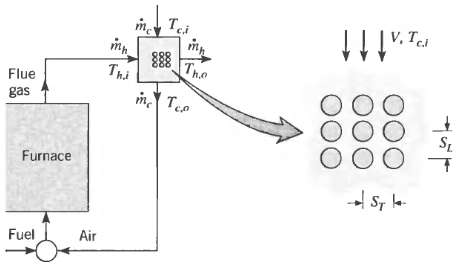
Exhaust gas from a furnace is used to preheat the combustion air supplied to the furnace burners. The gas, which has a flow rate of 15 kg/s and an inlet temperature of 1100 K, passes through a bundle of tubes, while the air, which has a flow rate of 10 kg/s and an inlet temperature of 300 K, is in
A re-cooperator is a heat exchanger that heats the air used in a combustion process by extracting energy from the products of combustion (the flue gas). Consider using a single-pass, cross-flow heat exchanger as a re-cooperator. Eighty (80) silicon carbide ceramic tubes (k = 20 W/m ? K) of inner
Consider operation of the furnace-re-cooperator combination of problem under conditions for which chemical energy is converted to thermal energy in the combustor at a rate of q comb = 2.0 x 10⁶ Wand energy is transferred from the combustion gases to the load in the furnace at a rate of q load = 1.4
A shell-and-tube heat exchanger consisting of one shell pass and two tube passes is used to transfer heat from an ethylene glycol-water solution (shell side) supplied from a rooftop solar collector to pure water (tube side) used for household purposes. The tubes are of inner and outer diameters Di
Consider a concentric tube heat exchanger characterized by a uniform overall heat transfer coefficient and operating under the following conditions: What is the maximum possible heat transfer rate? What is the heat exchanger effectiveness? Should the heat exchanger be operated in parallel flow or
Consider a concentric tube heat exchanger with hot and cold water inlet temperatures of 200 and 35°C, respectively. The flow rates of the hot and cold fluids are 42 and 84 kg/h, respectively. Assume the overall heat transfer coefficient is 180 W/m2 ∙ K.(a) What is the maximum heat transfer rate
The floor space of any facility that houses hell-and-tube heat exchangers must be sufficiently large so the tube bundle can be serviced easily. A rule of thumb is that the floor space must be at least 2.5 times the length of the tube bundle so that the bundle can be completely removed from the
Consider the influence of a finite sheet thickness in Example 11.2, when there are 40 gaps.(a) Determine the exterior dimension, L, of the heat exchanger core for a sheet thickness of t = 0.8 mm for pure aluminum (k al = 237 W/m ∙ K) and polyvinylidene fluoride (PVDF, kpv = 0.17 W/m ∙ K)
Hot exhaust gases are used in a shell-and-tube exchanger to heat 2.5 kg/s of water from 35 to 85°C. The gases assumed to have the properties of air, enter at 200°C and leave at 93°C. The overall heat transfer coefficient is 180 W/m2 ∙ K, using the effectiveness-NTU method calculate the area of
In open heart surgery under hypothermic conditions, the patient's blood is cooled before the surgery and re-warmed afterward. It is proposed that a concentric tube, counter flow heat exchanger of length 0.5 m be used for this purpose, with the thin-walled inner tube having a diameter of 55 mm. The
Ethylene glycol and water, at 60 and 10°C, respectively, enter a shell-and-tube heat exchanger for which the total heat transfer area is 15 m2. With ethylene glycol and water flow rates of 2 and 5 kg/s, respectively, the overall heat transfer coefficient is 800 W/m2 ∙ K.(a) Determine the rate of
A boiler used to generate saturated steam is in the form of an un-finned, cross-flow heat exchanger, with water flowing through the tubes and a high-temperature gas in cross flow over the tubes. The gas, which has a specific heat of 1120 J/kg ∙ K and a mass flow rate of 10 kg/s, enters the heat
Waste heat from the exhaust gas of an industrial furnace is recovered by mounting a bank of un-finned tubes in the furnace stack. Pressurized water at a flow rate of 0.025 kg/s makes a single pass through each of the tubes, while the exhaust gas, which has an upstream velocity of 5.0 m/s, moves in
A heat exchanger consists of a bank of 1200 thin-walled tubes with air in cross flow over the tubes. The tubes are arranged in-line, with 40 longitudinal rows (along the direction of airflow) and 30 transverse rows. The tubes are 0.07 m in diameter and 2 m long, with transverse and longitudinal
In analyzing thermodynamic cycles involving heat exchangers, it is useful to express the heat rate in terms of an overall thermal resistance R, and the inlet temperatures of the hot and cold fluids, the heat transfer rate can also be expressed in terms of the rate equations.(a) Derive a relation
The power needed to overcome wind and friction drag associated with an automobile traveling at a constant velocity of 25 m/s is 9 kW.(a) Determine the required heat transfer area of the radiator if the vehicle is equipped with an internal combustion engine operating at an efficiency of 35%. (Assume
An air conditioner operating between indoor and outdoor temperatures of 23 and 43°C, respectively, removes 5 kW from a building. The air conditioner can be modeled as a reversed Carnot heat engine with refrigerant as the working fluid. The efficiency of the motor for the compressor and fan is 80%,
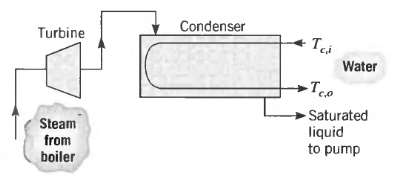
In a Rankine power system, 1.5 kg/s of steam leaves the turbine as saturated vapor at 0.51 bar. The steam is condensed to saturated liquid by passing it over the tubes of a shell-and-tube heat exchanger, while liquid water, having an inlet temperature of Tc,i = 280 K, is passed through the tubes.
Consider a Rankine cycle with saturated steam leaving the boiler at a pressure of 2MPa and a condenser pressure of 10 kPa.(a) Calculate the thermal efficiency of the ideal Rankine cycle for these operating conditions.(b) If the net reversible work for the cycle is 0.5 MW, calculate the required
Consider the Rankine cycle of Problem 11.77, which rejects 2.3 MW to the condenser, which is supplied with a cooling water flow rate of 70 kg/s at 15°C.(a) Calculate VA, a parameter that is indicative of the size of the condenser required for this operating condition.(b) Consider now the situation
Consider the compact heat exchanger conditions of Example 11.6. After extended use, fouling factors of 0.0005 and 0.001 m2 ∙ K/W are associated with the water- and gas-side conditions, respectively. What is the gas-side overall heat transfer coefficient?
Consider the heat exchanger core geometry and frontal area prescribed in Example 11.6. The exchanger must heat 2 kg/s of water from 300 to 350 K, using 1.25 kg/s of combustion gases entering at 700 K. Using the overall heat transfer coefficient determined in the example, find the required heat
Consider the conditions of Example 11.6, but with the continuous fin arrangement of figure used in lieu of the circular fins of figure. The heat exchanger core is fabricated from aluminum, and the tubes have an inside diameter of 8.2 mm. An inside convection coefficient of 1500 W/m2 ∙ K may
A cooling coil consists of a bank of aluminum (k = 237 W/m ∙ K) finned tubes having the core configuration of figure and an inner diameter of 13.8 mm. The tubes are installed in a plenum whose square cross section is 0.4 m on a side, thereby providing a frontal area of 0.16 m2. Atmospheric air at
A cooling coil consists of a bank of aluminum (k = 237 W/m ∙ K) finned tubes having the core configuration of figure and an inner diameter of 13.8 mm. The tubes are installed in a plenum whose square cross section is 0.4 m on a side, thereby providing a frontal area of 0.16 m2. Atmospheric air at
A steam generator consists of a bank of stainless steel (k = 15 W/m ∙ K) tubes having the core configuration of figure and an inner diameter of 13.8 mm. The tubes are installed in a plenum whose square cross section is 0.6 m on a side, thereby providing a frontal area of 0.36 m2. Combustion
A steam generator consists of a bank of stainless steel (k = 15 W/m ∙ K) tubes having the core configuration of figure and an inner diameter of 13.8 mm. The tubes are installed in a plenum whose square cross section is 0.6 m on a side, thereby providing a frontal area of 0.36 m2. Combustion
What is the irradiation at surfaces A2, A3, and A4 of Example 12.1 due to emission from A1?
What is the irradiation at surfaces A2, A3, and A4 of Example 12.1 due to emission from A1? Discuss.
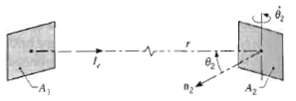
A small stationary surface of area A1 = 10?4 m2 emits diffusely with a total intensity of Ic = 100 W/m2 ? sr. A second surface of equivalent area A2 = 10?4 m2 is located at a fixed distance of r = 0.5 m from A1. The connecting line between the two surfaces remains perpendicular o A1, while A2
A furnace with an aperture of 20-mm diameter and emissive power of 3.72 x 10⁵ W/m2 is used to calibrate a heat flux gage having a sensitive area of 1.6 x 10⁻⁵ m2.(a) At what distance, measured along a normal from the aperture, should the gage be positioned to receive irradiation of 1000 W/m2?(b) If
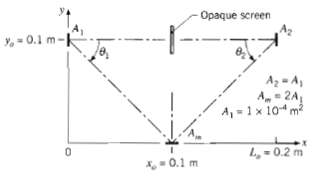
A small radiant source A1 emits diffusely with an intensity I1 = 1.2 x 10⁵ W/m2 ? sr. The radiation detector A2 is aligned normal to the source at a distance of Lo = 0.2 m. An opaque screen is positioned midway between A1 and A2 to prevent radiation from the source reaching the detector. The small
Showing 12000 - 12100
of 18200
First
114
115
116
117
118
119
120
121
122
123
124
125
126
127
128
Last
Step by Step Answers

 Get 50% OFF
Claim Now
Get 50% OFF
Claim Now