New Semester
Started
Get
50% OFF
Study Help!
--h --m --s
Claim Now
Question Answers
Textbooks
Find textbooks, questions and answers
Oops, something went wrong!
Change your search query and then try again
S
Books
FREE
Study Help
Expert Questions
Accounting
General Management
Mathematics
Finance
Organizational Behaviour
Law
Physics
Operating System
Management Leadership
Sociology
Programming
Marketing
Database
Computer Network
Economics
Textbooks Solutions
Accounting
Managerial Accounting
Management Leadership
Cost Accounting
Statistics
Business Law
Corporate Finance
Finance
Economics
Auditing
Tutors
Online Tutors
Find a Tutor
Hire a Tutor
Become a Tutor
AI Tutor
AI Study Planner
NEW
Sell Books
Search
Search
Sign In
Register
study help
engineering
mechanical engineering
Vector Mechanics For Engineers Statics And Dynamics 8th Edition Ferdinand Beer, E. Russell Johnston, Jr., Elliot Eisenberg, William Clausen, David Mazurek, Phillip Cornwell - Solutions
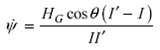
Show that for an axisymmetrical body under no force, the rates of precession and spin can be expressed, respectively, as φ = HG/I and where HG is the constant value of the angular momentum of the body.
(a) Show that for an axisymmetrical body under no force, the rate of precession can be expressed as where ω2 is the rectangular component of ω along the axis of symmetry of the body. (b) Use this result to check that the condition (18.44) for steady precession is satisfied by an axisymmetrical
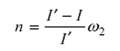
Show that the angular velocity vector ω of an axisymmetrical body under no force is observed from the body itself to rotate about the axis of symmetry at the constant rate where ω2 is the rectangular component of ω along the axis of symmetry of the body.
For an axisymmetrical body under no force, prove(a) That the rate of retrograde precession can never be less than twice the rate of spin of the body about its axis of symmetry,(b) That in Fig. 18.24 the axis of symmetry of the body can never lie within the space cone.
Using the relation given in Prob. 18.119, determine the period of precession of the north pole of the earth about the axis of symmetry of the earth. The earth may be approximated by an oblate spheroid of axial moment of inertia I and of transverse moment of inertia I′ = 0.99671I. (Note: Actual
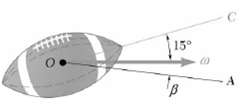
The angular velocity vector of a football which has just been kicked is horizontal, and its axis of symmetry OC is oriented as shown. Knowing that the magnitude of the angular velocity is 200 rpm and that the ratio of the axial and transverse moments of inertia is I/I'= 1/3, determine (a) The
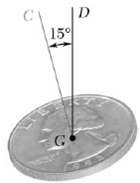
A coin is tossed into the air. It is observed to spin at the rate of 600 rpm about an axis GC perpendicular to the coin and to process about the vertical direction GD. Knowing that GC forms an angle of 15? with GD, determine (a) The angle that the angular velocity ω of the coin forms with GD, (b)
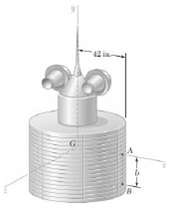
An 800-lb geostationary satellite is spinning with an angular velocity ω0 = (1.5 rad/s)j when it is hit at B by a 6-oz meteorite traveling with a velocity v0 = ?? (1600 ft/s)i + (1300 ft/s)j + (4000 ft/s)k relative to the satellite. Knowing that b = 20 in. and that the radii of gyration of the
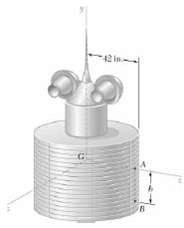
Solve Prob. 18.124, assuming that the meteorite hits the satellite at A instead of B. Problem 18.124: An 800-lb geostationary satellite is spinning with an angular velocity ω0 = (1.5 rad/s)j when it is hit at B by a 6-oz meteorite traveling with a velocity v0 = ??(1600 ft/s)i + (1300 ft/s)j +
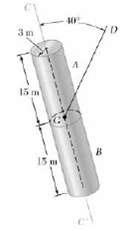
A space station consists of two sections A and B of equal masses, which are rigidly connected. Each section is dynamically equivalent to a homogeneous cylinder of length 15 m and radius 3 m. Knowing that the station is processing about the fixed direction GD at the constant rate of 2 rev/h,
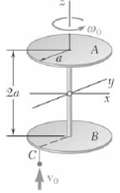
Solve Sample Prob. 18.6 assuming that the meteorite strikes the satellite at C with a velocity v0 = (2000m/s)i.
After the motion determined in Sample Prob. 18.6 has been established, the rod connecting disks A and B of the satellite breaks, and disk A moves freely as a separate body. Knowing that the rod and the z axis coincide when the rod breaks, determine the precession axis, the rate of precession, and
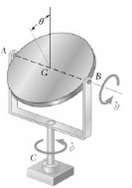
A homogeneous disk of mass m is connected at A and B to a fork-ended shaft of negligible mass which is supported by a bearing at C. The disk is free to rotate about its horizontal diameter AB and the shaft is free to rotate about a vertical axis through C. Initially the disk lies in a vertical
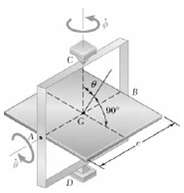
A homogeneous square plate of mass m and side c is held at points A and B by a frame of negligible mass which is supported by bearings at points C and D. The plate is free to rotate about AB, and the frame is free to rotate about the vertical CD. Knowing that, initially, θ0 = 45?, θ0 = 0, and φ0
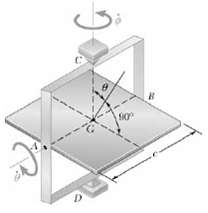
A homogeneous square plate of mass m and side c is held at points A and B by a frame of negligible mass which is supported by bearings at points C and D. The plate is free to rotate about AB, and the frame is free to rotate about the vertical CD. Initially the plate lies in the plane of the frame
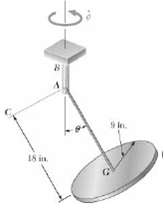
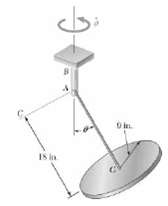
A homogeneous disk of radius 9 in. is welded to a rod AG of length 18 in. and of negligible weight which is connected by a clevis to a vertical shaft AB. The rod and disk can rotate freely about a horizontal axis AC, and shaft AB can rotate freely about a vertical axis. Initially rod AG is
A homogeneous disk of radius 9 in. is welded to a rod AG of length 18 in. and of negligible weight which is connected by a clevis to a vertical shaft AB. The rod and disk can rotate freely about a horizontal axis AC, and shaft AB can rotate freely about a vertical axis. Initially rod AG is
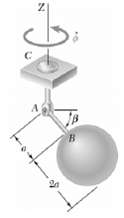
A homogeneous sphere of mass m and radius a is welded to a rod AB of negligible mass, which is connected by a clevis to a vertical shaft AC. The rod and sphere can rotate freely about a horizontal axis at A, and shaft AC can rotate freely about a vertical axis. The system is released in the
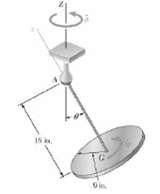
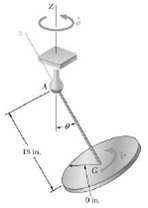
A homogeneous disk of radius 9 in. is welded to a rod AG of length 18 in. and of negligible weight which is supported by a ball and socket at A. The disk is released with a rate of spin 0 50 rad/ψ = s, with zero rates of precession and notation, and with rod AG horizontal (θ0 = 90?).
A homogeneous disk of radius 9 in. is welded to a rod AG of length 18 in. and of negligible weight which is supported by a ball and socket at A. The disk is released with a rate of spin ψ0, counterclockwise as seen from A, with zero rates of precession and notation, and with rod AG horizontal (θ0
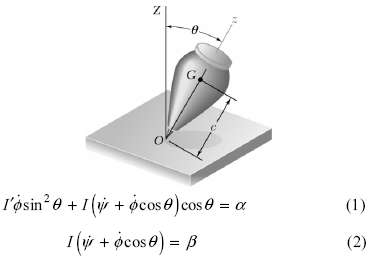
The top shown is supported at the fixed point O. Denoting by φ , θ, and ψ the Eulerian angles defining the position of the top with respect to a fixed frame of reference, consider the general motion of the top in which all Eulerian angles vary. (a) Observing that ΣMZ = 0 and 0, ΣMZ = and
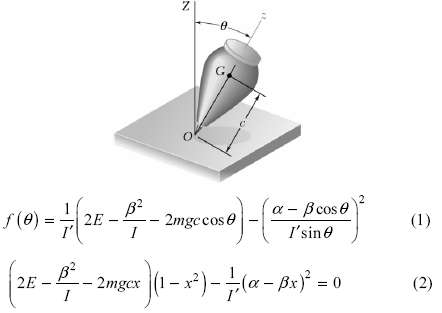
(a) Applying the principle of conservation of energy, derive a third differential equation for the general motion of the top of Prob. 18.137. (b) Eliminating the derivatives φ and ψ from the equation obtained and from the two equations of Prob. 18.137, show that the rate of notation θ is defined
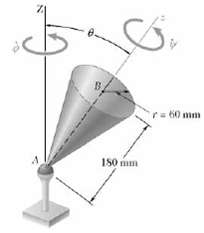
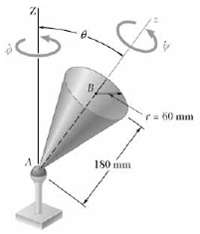
A solid cone of height 180 mm with a circular base of radius 60 mm is supported by a ball and socket at A. The cone is released from the position θ0 = 30? with a rate of spin ψ0 = 300 rad/s, a rate of precession φ0 = 20 rad/s, and a zero rate of notation. Determine (a) The maximum value of θ in
A solid cone of height 180 mm with a circular base of radius 60 mm is supported by a ball and socket at A. The cone is released from the position θ0 = 30? with a rate of spin ψ0 = 300 rad/s, a rate of precession φ0 = ??4 rad/s, and a zero rate of notation. Determine (a) The maximum value of θ
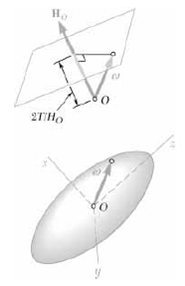
Consider a rigid body of arbitrary shape which is attached at its mass center O and subjected to no force other than its weight and the reaction of the support at O.(a) Prove that the angular momentum HO of the body about the fixed point O is constant in magnitude and direction, that the kinetic
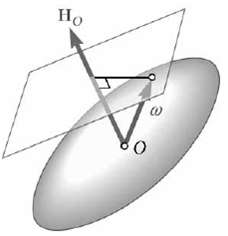
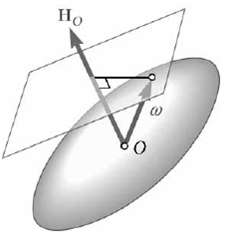
Referring to Prob. 18.141, (a) Prove that the Poinsot ellipsoid is tangent to the invariable plane, (b) Show that the motion of the rigid body must be such that the Poinsot ellipsoid appears to roll on the invariable plane.
Referring to Prob. 18.141, (a) Prove that the Poinsot ellipsoid is tangent to the invariable plane, (b) Show that the motion of the rigid body must be such that the Poinsot ellipsoid appears to roll on the invariable plane.
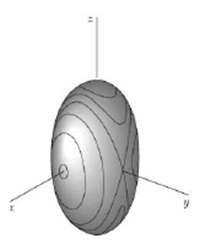
Refer to Probs. 18.141 and 18.142. (a) Show that the curve (called polhode) described by the tip of the vector ω with respect to a frame of reference coinciding with the principal axes of inertia of the rigid body is defined by the equations and that the curve can, therefore, be obtained by
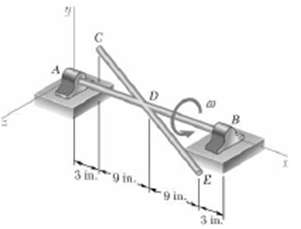
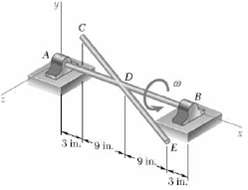
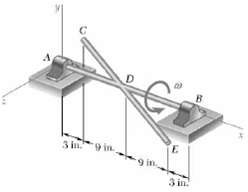
Two uniform rods AB and CE, each of weight 3 lb and length 24 in., are welded to each other at their midpoints. Knowing that this assembly has an angular velocity of constant magnitude ω = 12 rad/s, determine the magnitude and direction of the angular momentum HD of the assembly about D.
Determine the kinetic energy of the assembly of Prob. 18.145.
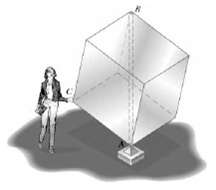
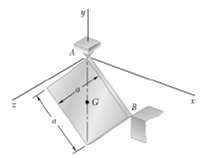
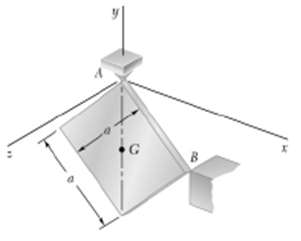
One of the sculptures displayed on a university campus consists of a hollow cube made of six aluminum sheets, each 1.5 m × 1.5 m, welded together and reinforced with internal braces of negligible mass. The cube is mounted on a fixed base A and can rotate freely about its vertical diagonal AB. As
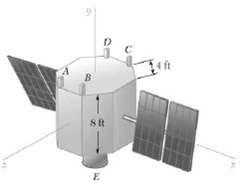
A 5000-lb probe in orbit about the moon is 8 ft high and has octagonal bases of sides 4 ft. The coordinate axes shown are the principal centroidal axes of inertia of the probe, and its radii of gyration are kx = 2.45 ft, ky = 2.65 ft, and kz = 2.55 ft. The probe is equipped with a main 125-lb
A square plate of side a and mass m supported by a ball-and-socket joint at A is rotating about the y axis with a constant angular velocity ω = ω0j when an obstruction is suddenly introduced at B in the xy plane. Assuming the impact at B is perfectly plastic (e = 0), determine immediately after
Determine the impulse exerted on the plate of Prob. 18.149 during the impact by (a) The obstruction at B, (b) The support at A.
Determine the rate of change HD of the angular momentum HD of the assembly of Prob. 18.145, assuming that at the instant considered the assembly has an angular velocity ω = (12 rad/s)i and an angular acceleration α = ?? (96 rad/s2)i.
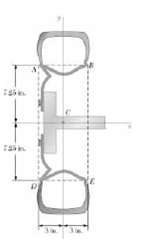
When the 40-lb wheel shown is attached to a balancing machine and made to spin at a rate of 750 rpm, it is found that the forces exerted by the wheel on the machine are equivalent to a force-couple system consisting of a force F = (36.2 lb)j applied at C and a couple Mc = (10.85 lb ??? ft)k, where
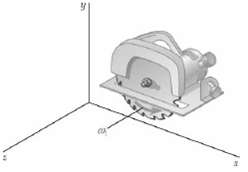
The blade of a portable saw and the rotor of its motor have a total mass of 1.75 kg and a combined radius of gyration of 30 mm. Knowing that the blade rotates as shown at the rate 2500 ω1 = rpm, determine the magnitude and direction of the couple M that a worker must exert on the handle of the saw
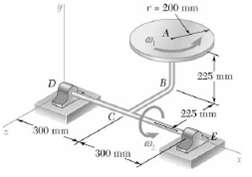
A homogeneous disk of mass m = 3 kg rotates at the constant rate ω1 = 16 rad/s with respect to arm ABC, which is welded to shaft DCE rotating at the constant rate ω2 = 8 rad/s. Determine the dynamic reactions at D and E.
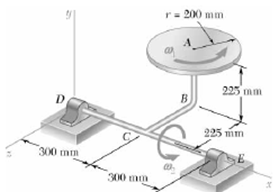
It is assumed that at the instant shown shaft DCE of Prob. 18.154 has an angular velocity ω2 = (8 rad/s)i and an angular acceleration α2 = (6 rad/s2)i. Recalling that the disk rotates with a constant angular velocity ω1 = (16 rad/s) j, determine (a) The couple that must be applied to shaft DCE
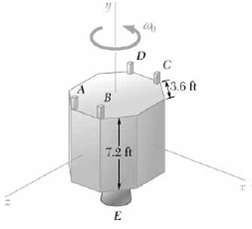
A 5-kip satellite is 7.2 ft high and has octagonal bases of sides 3.6 ft. The coordinate axes shown are the principal centroidal axes of inertia of the satellite, and its radii of gyration are kx = kz = 2.7 ft and ky = 2.94 ft. The satellite is equipped with a main 125-lb thruster E and four 5-lb
A particle moves in simple harmonic motion. Knowing that the amplitude is 18 in. and the maximum velocity is ft/s6 determined the maximum acceleration of the particle and the period of its motion.
A particle moves in simple harmonic motion. Knowing that the maximum velocity is 200 mm/s and the maximum acceleration is 4 m/s2 determine the amplitude and frequency of the motion.
Determine the amplitude and maximum acceleration of a particle which moves in simple harmonic motion with a maximum velocity of 4 ft/s and a frequency of 6 Hz.
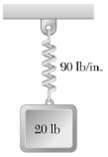
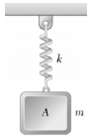
A 20-lb block is initially held so that the vertical spring attached as shown is un-deformed. Knowing that the block is suddenly released from rest, determine (a) The amplitude and frequency of the resulting motion, (b) The maximum velocity and maximum acceleration of the block.
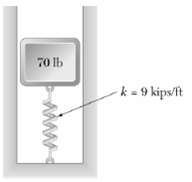
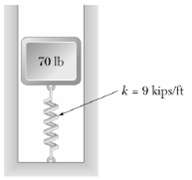
A 70-lb block is attached to a spring and can move without friction in a slot as shown. The block is in its equilibrium position when it is struck by a hammer which imparts to the block an initial velocity of 10ft/s. Determine (a) The period and frequency of the resulting motion, (b) The amplitude
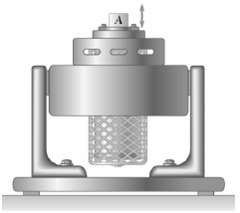
An instrument package A is bolted to a shaker table as shown. The table moves vertically in simple harmonic motion at the same frequency as the variable-speed motor which drives it. The package is to be tested at a peak acceleration ion of 50 m/s2. Knowing that the amplitude of the shaker table is
A simple pendulum consisting of a bob attached to a cord oscillates in a vertical plane with a period of 1.3s. Assuming simple harmonic motion and knowing that the maximum velocity of the bob is 0.4m/s, determine(a) The amplitude of the motion in degrees,(b) The maximum tangential acceleration of
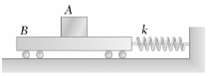
A 10-lb block A rests on a 40-lb plate B which is attached to an un-stretched spring of constant k = 60 lb/ft. Plate B is slowly moved 2.4 in. to the left and released from rest. Assuming that block A does not slip on the plate, determine (a) The amplitude and frequency of the resulting motion, (b)
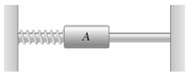
A 4-lb collar is attached to a spring of constant 6 lb/in. and can slide without friction on a horizontal rod. The collar is at rest when it is struck with a mallet and given an initial velocity of 55 in/s determine the amplitude and the maximum acceleration of the collar during the resulting
The motion of a particle is described by the equation x = 60 cos 10πt + 45 sin (10πt − π/3), where x is expressed in millimeters and t in seconds. Determine(a) The period of the resulting motion,(b) Its amplitude,(c) Its phase angle.
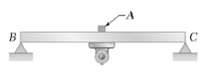
A variable-speed motor is rigidly attached to beam BC. The rotor is slightly unbalanced and causes the beam to vibrate with a frequency equal to the motor speed. When the speed of the motor is less than 600 rpm or more than 1200 rpm, a small object placed at A is observed to remain in contact with
A 1.4-kg block is supported as shown by a spring of constant k = 400 N/m which can act in tension or compression. The block is in its equilibrium position when it is struck from below by a hammer which imparts to the block an upward velocity of 2.5 m/s. Determine (a) The time required for the block
In Prob. 19.12, determine the position, velocity, and acceleration of the block 0.90 s after it has been struck by the hammer.
A 70-lb block attached to a spring of constant k = 9 kips/ft can move without friction in a slot as shown. The block is given an initial 15-in. displacement downward from its equilibrium position and released. Determine 1.5 s after the block has been released (a) The total distance traveled by the
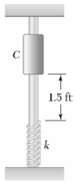
A 10-lb collar C is released from rest in the position shown and slides without friction on a vertical rod until it hits a spring of constant k = 50 lb/ft which it compresses. The velocity of the collar is reduced to zero, and the collar reverses the direction of its motion and returns to its
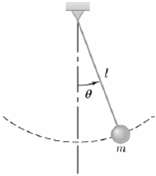
The bob of a simple pendulum of length l = 1.2 m is moving with a velocity of 180 mm/s to the right at time t = 0 when θ = 0. Assuming simple harmonic motion, determine at t = 1.5 s (a) The angle θ, (b) The magnitudes of the velocity and acceleration of the bob.
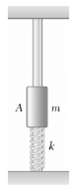
A 10-lb collar rests on but is not attached to the spring shown. It is observed that when the collar is pushed down 9 in. or more and released, it loses contact with the spring. Determine (a) The spring constant, (b) The position, velocity, and acceleration of the collar 0.16 s after it has been
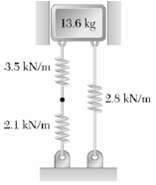
A 13.6-kg block is supported by the spring arrangement shown. If the block is moved from its equilibrium 44 mm vertically downward and released, determine (a) The period and frequency of the resulting motion, (b) The maximum velocity and acceleration of the block.
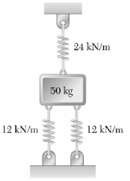
A 50-kg block is supported by the spring arrangement shown. The block is moved vertically downward from its equilibrium position and released. Knowing that the amplitude of the resulting motion is 60 mm, determine (a) The period and frequency of the motion, (b) The maximum velocity and maximum
A 10-lb block, attached to the lower end of a spring whose upper end is fixed, vibrates with a period of 6.8 s. Knowing that the constant k of the spring is inversely proportional to its length, determine the period of a 6-lb block which is attached to the center of the same spring if the upper and
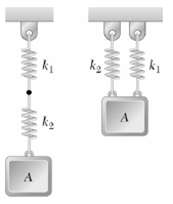
Two springs of constants k1 and k2 are connected in series to a block A that vibrates in simple harmonic motion with a period of 5. When the same two springs are connected in parallel to the same block, the block vibrates with a period of 2s. Determine the ratio k1/k2 of the two spring constants.
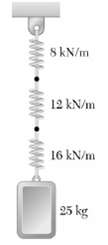
A 25-kg block is supported by the spring arrangement shown. If the block is moved vertically downward from its equilibrium position and released, determine (a) The period and frequency of the resulting motion, (b) The maximum velocity and acceleration of the block if the amplitude of the motion is
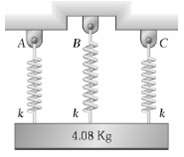
A 4.08-kg block is supported as shown by three springs, each of which has a constant k. In the equilibrium position the tensions in springs A, B, and C are 12N, 16N, and 12N, respectively. The block is moved vertically downward 12.5mm from its equilibrium position and released from rest. Knowing
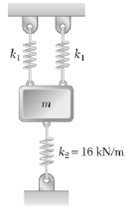
The period of vibration of the system of three springs and a block is observed to be 0.2s. After the lower spring of constant k2 = 16kN/m is removed from the system the period is observed to be 0.25s. Determine (a) The mass m, (b) The spring constant k1.
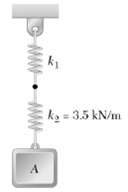
The period of vibration of the system shown is observed to be 0.2 s. After the spring of constant k2 = 3.5kN/m is removed and block A is connected to the spring of constant k1, the period is observed to be 0.12 s. Determine (a) The constant k1 of the remaining spring, (b) The mass of block A.
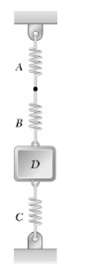
The 100-lb block D is supported as shown by three springs, each of which has a constant k. The period of vertical vibration is to remain unchanged when the block is replaced by a 120-lb block, spring A is replaced by a spring of constant kA, and the other two springs are unchanged. Knowing that the
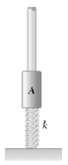
The period of small oscillations of the system shown is observed to be 1.6s. After a 14-lb collar is placed on top of collar A, the period of oscillation is observed to be 2.1s. Determine (a) The weight of collar A, (b) The spring constant k.
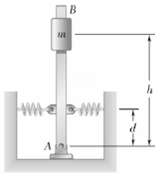
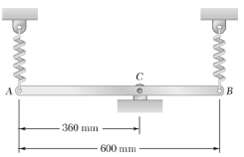
Rod AB is attached to a hinge at A and to two springs, each of constant k. If h = 700 mm, d = 300 mm, and m = 20 kg, determine the value of k for which the period of small oscillations is (a) 1 s, (b) Infinite. Neglect the mass of the rod and assume that each spring can act in either tension or
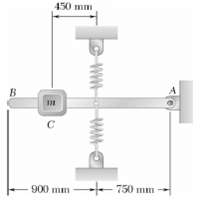
Rod AB is attached to a hinge at A and to two springs, each of constant 1.35 k = kN/m. (a) Determine the mass m of the block C for which the period of small oscillations is 4 s. (b) If end B is depressed 60 mm and released, determine the maximum velocity of block C. Neglect the mass of the rod and
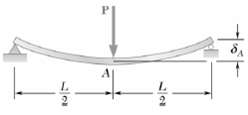
From mechanics of materials it is known that for a simply supported beam of uniform cross section a static load P applied at the center will cause a deflection δA = PL3/48EI, where L is the length of the beam, E is the modulus of elasticity, and I is the moment of inertia of the cross-sectional
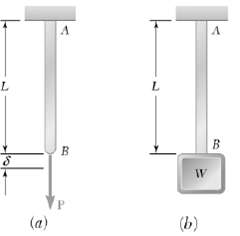
(a) The equivalent spring constant of the rod, (b) The frequency of the vertical vibrations of a block of weight W = 16 lb attached to end B of the same rod.
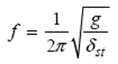
Denoting by δst the static deflection of a beam under a given load, show that the frequency of vibration of the load is Neglect the mass of the beam, and assume that the load remains in contact with the beam.
The force-deflection equation for a nonlinear spring fixed at one end is F= 4x½ where F is the force, expressed in Newton’s, applied at the other end and x is the deflection expressed in meters.(a) Determine the deflection x0 if a 100-g block is suspended from the spring and is at rest.(b)
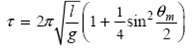
Expanding the integrand in Eq. (19.19) of Sec. 19.4 into a series of even powers of sin φ and integrating, show that the period of a simple pendulum of length l may be approximated by the formula where θm is the amplitude of the oscillations.
Using the formula given in Prob. 19.34, determine the amplitude θm for which the period of a simple pendulum is 1 percent longer than the period of the same pendulum for small oscillations.
Using the data of Table 19.1, determine the period of a simple pendulum of length l = 800 mm(a) For small oscillations,(b) For oscillations of amplitude θm = 30°,(c) For oscillations of amplitude θm = 90°.
Using the data of Table 19.1, determine the length in inches of a simple pendulum which oscillates with a period of 3s and an amplitude of θm = 60°.
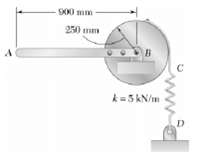
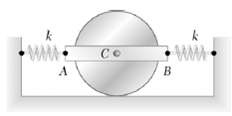
The 9-kg uniform rod AB is attached to springs at A and B, each of constant 850 N/m, which can act in tension or compression. If the end A of the rod is depressed slightly and released, determine (a) The frequency of vibration, (b) The amplitude of the angular motion of the rod, knowing that the
A 7.5-kg slender rod AB is riveted to a 6-kg uniform disk as shown. A belt is attached to the rim of the disk and to a spring which holds the rod at rest in the position shown. If end A of the rod is moved 20 mm down and released, determine (a) The period of vibration, (b) The maximum velocity of
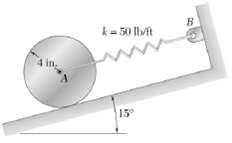
A 20-lb uniform cylinder can roll without sliding on an incline and is attached to a spring AB as shown. If the center of the cylinder is moved 0.5 in. down the incline from the equilibrium position and released from rest, determine (a) The period of vibration, (b) The maximum velocity of the
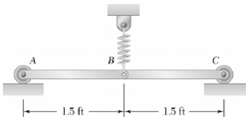
Two identical 6-lb uniform rods are hinged at point B and attached to a spring of constant k = 23lb/in. The rods are guided by small wheels of negligible weight and the system is in equilibrium when the rods are horizontal as shown. Knowing that point B is depressed 0.8 in. and released,
A 1.2-kg uniform rod AB is attached to a hinge at A and to two springs, each of constant 450 k = N/m. (a) Determine the mass m of block C for which the period of small oscillations is 0.6s. (b) If end B is depressed 60 mm and released, determine the maximum velocity of block C.
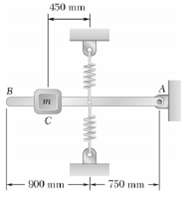
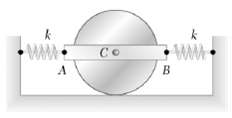
A 6-kg uniform cylinder can roll without sliding on a horizontal surface and is attached by a pin at point C to the 4-kg horizontal bar AB. The bar is attached to two springs, each of constant k = 5kN/m as shown. Knowing that the bar is moved 12 mm to the right of the equilibrium position and
A 6-kg uniform cylinder is assumed to roll without sliding on a horizontal surface and is attached by a pin at point C to the 4-kg horizontal bar AB. The bar is attached to two springs, each of constant k = 3.5kN/m as shown. Knowing that the coefficient of static friction between the cylinder and
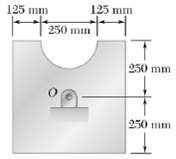
A semicircular hole is cut in a uniform square plate which is attached to a frictionless pin at its geometric center O. Determine (a) The period of small oscillations of the plate, (b) The length of a simple pendulum which has the same period.
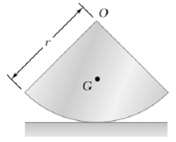
Determine the period of small oscillations of a uniform quarter-circular cylinder of radius 0.3 r = m which rolls without slipping.
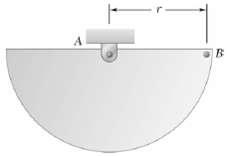
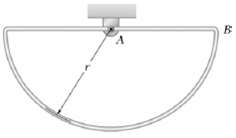
For the uniform semicircular plate of radius r, determine the period of small oscillations if the plate (a) Is suspended from point A as shown, (b) Is suspended from a pin located at point B.
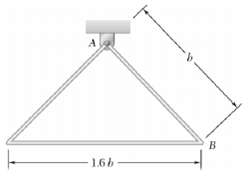
A thin homogeneous wire is bent into the shape of an isosceles triangle of side??s b, b, and 1.6b. Determine the period of small oscillations if the wire (a) Is suspended from point A as shown, (b) Is suspended from point B.
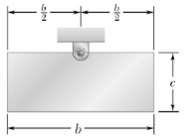
A uniform rectangular plate is suspended from a pin located at the midpoint of one edge as shown. Considering the dimension b constant, determine (a) The ratio c/b for which the period of oscillation of the plate is minimum, (b) The ratio c/b for which the period of oscillation of the plate is the
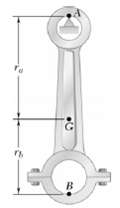
The period of small oscillations about A of a connecting rod is observed to be 1.03s. Knowing that the distance ra = 160 mm, determine the centroidal radius of gyration of the connecting rod.
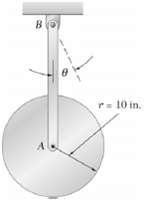
A uniform disk of radius 10 r = in. is attached at A to a 26-in. rod AB of negligible weight which can rotate freely in a vertical plane about B. Determine the period of small oscillations (a) If the disk is free to rotate in a bearing at A, (b) If the rod is riveted to the disk at A.
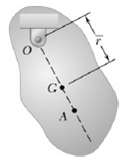
A compound pendulum is defined as a rigid slab which oscillates about a fixed point O, called the center of suspension. Show that the period of oscillation of a compound pendulum is equal to the period of a simple pendulum of length OA, where the distance from A to the mass center G is GA = k??2r.
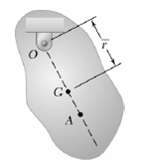
A rigid slab oscillates about a fixed point O. Show that the smallest period of oscillation occurs when the distance r from point O to the mass center G is equal to k.
Show that if the compound pendulum of Prob. 19.52 is suspended from A instead of O, the period of oscillation is the same as before and the new center of oscillation is located at O.
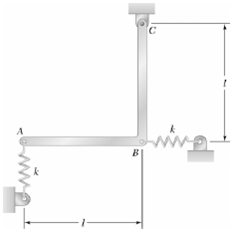
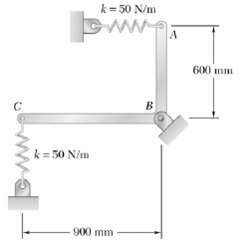
Two uniform rods, each of mass m and length l, are welded together to form an L-shaped assembly. The assembly is constrained by two springs, each of constant k, and is in equilibrium in a vertical plane in the position shown. Determine the frequency of small oscillations of the system.
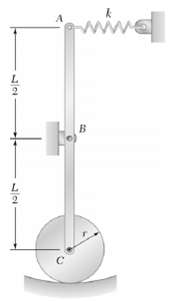
A uniform disk of radius r and mass m can roll without slipping on a cylindrical surface and is attached to bar ABC of length L and negligible mass. The bar is attached at point A to a spring of constant k and can rotate freely about point B in the vertical plane. Knowing that end A is given a
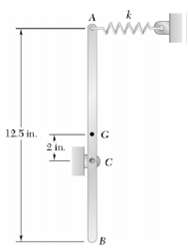
The 16-lb uniform bar AB is hinged at C and is attached at A to a spring of constant 50 k = lb/ft. If end A is given a small displacement and released, determine (a) The frequency of small oscillations, (b) The smallest value of the spring constant k for which oscillations will occur.
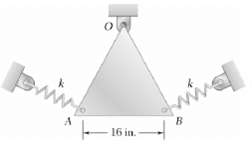
A 20-lb uniform equilateral triangular plate is suspended from a pin located at one of its vertices and is attached to two springs, each of constant k = 14 lb/ft. Knowing that the plate is given a small angular displacement and released, determine the frequency of the resulting vibration.
A 3-kg uniform arm ABC is supported by a pin at B and is attached to identical springs at A and C. The system is in equilibrium in a vertical plane in the position shown. Knowing that point C is pushed down 15 mm and released, determine the angular acceleration of the arm 0.7 s later.
A homogeneous wire bent to form the figure shown is attached to a pin support at A. Knowing that 320 r = mm and that point B is pushed down 30 mm and released, determine the magnitude of the acceleration of B, 10 s later.
Showing 11800 - 11900
of 18200
First
112
113
114
115
116
117
118
119
120
121
122
123
124
125
126
Last
Step by Step Answers

 Get 50% OFF
Claim Now
Get 50% OFF
Claim Now