New Semester
Started
Get
50% OFF
Study Help!
--h --m --s
Claim Now
Question Answers
Textbooks
Find textbooks, questions and answers
Oops, something went wrong!
Change your search query and then try again
S
Books
FREE
Study Help
Expert Questions
Accounting
General Management
Mathematics
Finance
Organizational Behaviour
Law
Physics
Operating System
Management Leadership
Sociology
Programming
Marketing
Database
Computer Network
Economics
Textbooks Solutions
Accounting
Managerial Accounting
Management Leadership
Cost Accounting
Statistics
Business Law
Corporate Finance
Finance
Economics
Auditing
Tutors
Online Tutors
Find a Tutor
Hire a Tutor
Become a Tutor
AI Tutor
AI Study Planner
NEW
Sell Books
Search
Search
Sign In
Register
study help
physics
mechanics
Fundamentals of Physics 8th Extended edition Jearl Walker, Halliday Resnick - Solutions
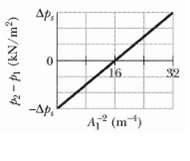
Fresh water flows horizontally from pipe section 1 of cross-sectional area Al into pipe section 2 of cross-sectional area A2. Figure gives a plot of the pressure difference p2 ?? p1 versus the inverse area squared A1-2 that would be expected for a volume flow rate of a certain value if the water
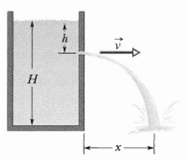
Figure shows a stream of water flowing through a hole at depth h = 1.0 cm in a tank holding water to height H = 40 cm. (a) At what distance x does the stream strike the floor? (b) At what depth should a second hole be made to give the same value of x? (c) At what depth should a hole be made to
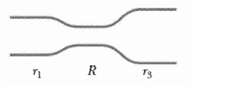
In Figure water flows steadily from the left pipe section (radius r1 = 2.00R), through the middle section (radius R), and into the right section (radius r3 = 3.00R). The speed of the water in the middle section is 0.500 m/s. What is the net work done on 0.400 m3 of the water as it moves from the
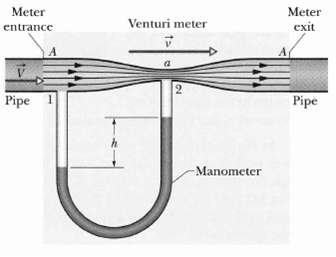
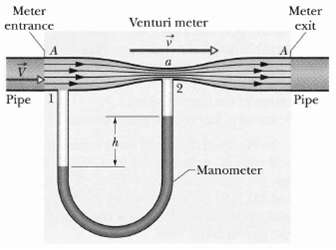
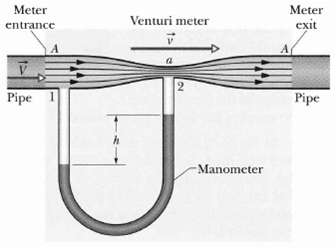
A venturi meter is used to measure the flow speed of a fluid in a pipe. The meter is connected between two sections of the pipe (Figure); the cross-sectional area A of the entrance and exit of the meter matches the pipe's cross-sectional area. Between the entrance and exit, the fluid flows from the
Consider the venturi tube of Problem and Figure without the manometer. Let A equal 5a. Suppose the pressure pt at A is 2.0 atm. Compute the values of (a) The speed V at A and (b) The speed v at that makes the pressure p2 at an equal to zero. (c) Compute the corresponding volume flow rate if the
A liquid of density 900 kg/m3 flows through a horizontal pipe that has a cross-sectional area of 1.90 x 10⁻² m2 in region A and a cross-sectional area of 9.50 x 10⁻² m2 in region B. The pressure difference between the two regions is 7.20 x 10³ Pa. What are?(a) The volume flow rate and(b) The mass
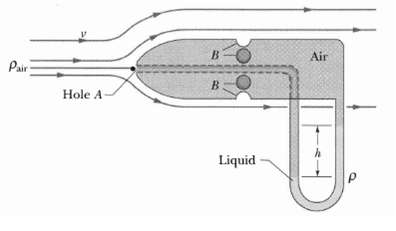
A Pitot tube (Figure) is used to determine the airspeed of an airplane. It consists of an outer tube with a number of small holes B (four are shown) that allow air into the tube; that tube is connected to one arm of a U-tube. The other arm of the U-tube is connected to hole A at the front end of
A Pitot tube (Problem) on a high-altitude aircraft measures a differential pressure of 180 Pa. What is the aircraft's airspeed if the density of the air is 0.031kg/m3?
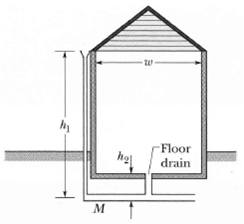
A very simplified schematic of the rain drainage system for a home is shown in Figure. Rain falling on the slanted roof runs off into gutters around the roof edge; it then drains through downspouts (only one is shown) into a main drainage pipe M below the basement, which carries the water to an
A glass ball of radius 2.00 cm sits at the bottom of a container of milk that has a density of 1.03 g/cm3. The normal force on the ball from the container's lower surface has magnitude 9.48 x 10⁻² N. What is the mass of the ball?
When you cough, you expel air at high speed through the trachea and upper bronchi so that the air will remove excess mucus lining the pathway. You produce the high speed by this procedure: You breathe in a large amount of air, trap it by closing the glottis (the narrow opening in the larynx),
Figure shows a modified U-tube: the right arm is shorter than the left arm. The open end of the right arm is height d = 10.0 cm above the laboratory bench. The radius through out the tube is 1.50 cm. Water is gradually poured into the open end of the left arm until the water begins to flow out the
Caught in an avalanche, a skier is fully submerged in flowing snow of density 96 kg/m3. Assume that the average density of the skier, clothing, and skiing equipment is 1020 kg/m3. What percentage of the gravitational force on the skier is offset by the buoyant force from the snow?
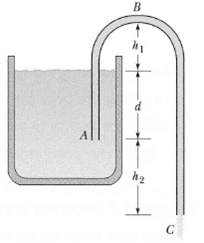
Figure shows a siphon, which is a device for removing liquid from a container. Tube ABC must initially be filled, but once this has been done, liquid will flow through the tube until the liquid surface in the container is level with the tube opening at A. The liquid has density 1000 kg/m3 and
Suppose that your body has a uniform density of 0.95 times that of water.(a) If you float in a swimming pool, what fraction of your body's volume is above the water surface? Quicksand is a fluid produced when water is forced up into sand, moving the sand grains away from one another so they are no
If a bubble in sparkling water accelerates upward at the rate of 0.225 m/s2 and has a radius of 0.500 mm, what is its mass? Assume that the drag force on the bubble is negligible.
What is the acceleration of a rising hot-air balloon if the ratio of the air density outside the balloon to that inside is 1.39? Neglect the mass of the balloon fabric and the basket.
A tin can has a total volume of 1200 cm3 and a mass of 130 g. How many grams of lead shot of density 11.4 g/cm3 could it carry without sinking in water?
A simple open U-tube contains mercury. When 11.2 cm of water is poured into the right arm of the tube, how high above its initial level does the mercury rise in the left arm?
An object hangs from a spring balance. The balance registers 30 N in air, 20 N when this object is immersed in water, and 24 N when the object is immersed in another liquid of unknown density. What is the density of that other liquid?
In an experiment, a rectangular block with height h is allowed to float in four separate liquids. In the first liquid, which is water, it floats fully submerged. In liquids A, B, and C, it floats with heights h/2, 2h/3, and h/4 above the liquid surface, respectively. What are the relative densities
About one-third of the body of a person floating in the Dead Sea will be above the waterline. Assuming that the human body density is 0.98 g/cm3, find the density of the water in the Dead Sea. (Why is it so much greater than 1.0 g/cm3?)
To set a speed record in a measured (straight-line) distance d, a race car must be driven first in one direction (in time 11) and then in the opposite direction (in time t2). (a) To eliminate the effects of the wind and obtain the car's speed vc in a windless situation, should we flnd the average
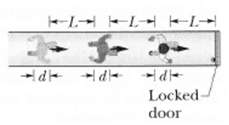
Panic escape. Figure 2-22 shows a general situation in which a stream of people attempt to escape through an exit door that turns out to be locked. The people move toward the door at speed vS: 3.50 m/s, are each d = 0.25 m in depth, and are separated by L = 1.75 m. The arrangement in Fig.2-22
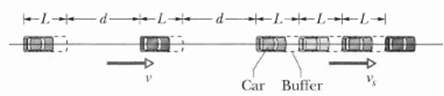
Traffic shock wave, an abrupt slowdown in concentrated traffic can travel as a pulse, termed a shock wave, along the line of cars, either downstream (in the traffic direction) or upstream, or it can be stationary. Figure 2-23 shows a uniformly spaced line of cars moving at speed v - 25.0m/s toward
From t = 0 to t = 5.00 min, a man stands still, and from t = 5.00 min to t = 10.0 min, he walks briskly in a straight line at a constant speed of 2.20 m/s. What are (a) His average velocity vavg and (b) His average acceleration aavg in the time interval 2.00 min to 8.00 min? What are (c) Vavg and
Catapulting mushrooms, certain mushrooms launch their spores by a catapult mechanism. As water condenses from the air onto a spore that is attached to the mushroom, a drop grows on one side of the spore and a film grows on the other side. The spore is bent over by the drop's weight, but when the
A certain elevator cab has a total run of 190 m and a maximum speed of 305 m/min, and it accelerates from rest and then back to rest at l.22m/s2.(a) How far does the cab move while accelerating to full speed from rest?(b) How long does it take to make the nonstop 190 m run, starting and ending at
The brakes on your car can slow you at a rate of 5.2m/s2.(a) If you are going 137 km/h and suddenly see a state trooper, what is the minimum time in which you can get your car under the 90 km/h speed limit? (The answer reveals the futility of braking to keep your high speed from being detected with
A car traveling 56.0 km/h rs 24.0 m from a barrier when the driver slams on the brakes, the car hits the barrier 2.00 s later.(a) What is the magnitude of the car's constant acceleration before impact?(b) How fast is the car traveling at impact?
A car moves along an x axis through a distance of 900 m, starting at rest (at x = 0) and ending at rest (at x = 900 m). Through the first I of that distance, its acceleration rs + 2.25m/s2, through the next i of that distance, its acceleration is -0.750 m/s2. What are?(a) Its travel tirne through
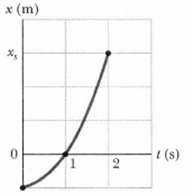
Figure 2-25 depicts the motion of a particle moving along an x axis with a const ant acceleration. The figure's vertical scaling is set by x = 6.0 m.What are the(a) Magnitude and(b) Direction of the particle'sacceleration?
(a) If the maximum acceleration that is tolerable for passengers in a subway train is 1.34 m/s2 and subway stations are located 806 m apart, what is the maximum speed a subway train can attain between stations?(b) What is the travel time between stations?(c) If a subway train stops for 20 s at each
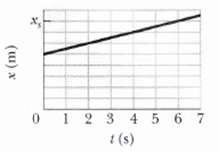
Cars A and B move in the same direction in adjacent lanes. The position x of car A is given in Figure, from time t = 0 to t = 7 .0 s. The figure's vertical scaling is set by xs = 32.0 m. At t = 0, cat B is at x = 0, with a velocity of 12 m/s and a negative constant acceleration as.(a) What must
You are driving toward a traffic signal when it turns yellow. Your speed is the legal speed limit of v0 = 55km/h; your best deceleration rate has the magnitude a = 5.18m/s2. Your best reaction time to begin braking is T = 0.75s. To avoid having the front of your car enter the intersection after the
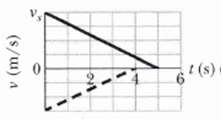
As two trains move along a track, their conductors suddenly notice that they are headed toward each other. Figure 2-27 gives their velocities v as functions of time t as the conductors slow the trains. The figure's vertical scaling is set by vs = 40.0 m/s. The slowing processes begin when the
In Fig. 2-28, a red car and a green car, identical except for the color, move toward each other in adjacent lanes and parallel to an x axis. At time t = 0, the red car is at xr = 0 and the green car is at xg = 220m. If the red car has a constant velocity of 20 km/h, the cars pass each other at x =
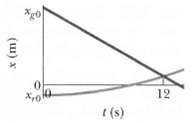
Figure shows a red car and a green car that move toward each other. Figure is a graph of their motion, showing the positions xg0 = 270 m and xr0 = ?? 35.0 m at time t = 0. The green car has a constant speed of 20.0 m/s and the red car begins from rest. What is the acceleration magnitude of the
You are arguing over a cell phone while trailing an unmarked police car by 25 m; both your car and the police car are traveling at 110 km/h. Your argument diverts your attention from the police car for 2.0 s (long enough for you to look at the phone and yell,"I won't do that!").At the beginning of
Raindrops fall 1700m from a cloud to the ground.(a) If they were not slowed by air resistance, how fast would the drops the moving when they struck the ground? (b) Would it be safe to walk outside during a rainstorm?
At a construction site a pipe wrench struck the ground with a speed of 24 m/s.(a) From what height was it inadvertently dropped?(b) How long was it falling?(c) Sketch graphs of y, v, and a versus t for the wrench.
A hoodlum throws a stone vertically downward with an initial speed of 12.0 m/s from the roof of a building, 30.0 m above the ground. (a) How long does it take the stone to reach the ground? (b) What is the speed of the stone at impact?
(a) With what speed must a ball be thrown vertically from ground level to rise to a maximum height of 50 m?(b) How long will it be in the air?(c) Sketch graphs of y, v, and a versus t for the ball. On the first two graphs, indicate the time at which 50 m is reached.
When startled, on armadillo will leap upward. Suppose it rises 0.544 m in the first 0.200 s. (a) What is its initial speed as it leaves the ground? (b) What is its speed at the height of 0.544 m? (c) How much higher does it go?
A hot-air balloon is ascending at the rate of 12 m/s and is 80 m above the ground when a package is dropped over the side. (a) How long does the package take to reach the ground? (b) With what speed does it hit the ground?
A bolt is dropped from a bridge under construction, falling 90 m to the valley below the bridge.(a) In how much time does it pass through the last 20% of its fall? What is its speed?(b) When it begins that last 20% of its fall and(c) When it reaches the valley beneath the bridge?
A key falls from a bridge that is 45 m above the water. It falls directly into a model boat, moving with constant velocity that is 12 m from the point of impact when the key is released. What is the speed of the boat?
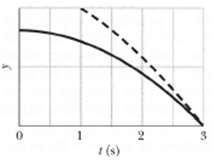
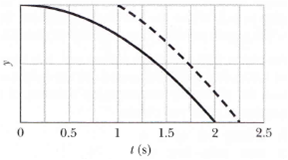
At time t = 0, apple 1 is dropped from a bridge onto a roadway beneath the bridge; somewhat later, apple 2 is thrown down from the same height. Figure gives the vertical positions y of the apples versus t during the falling, until both apples have hit the roadway. With approximately what speed is
As a runaway scientific balloon ascends at 19.6 m/s, one of its instrument packages breaks free of a harness and o free-falls. Figure gives the vertical velocity of the package versus time, from before it breaks free to when it reaches the ground.(a) What maximum height above the break-free point
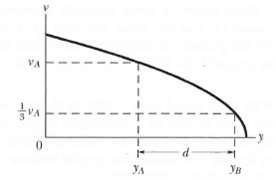
Figure shows the speed v versus height y of a ball tossed directly upward, along a y axis. Distance d is 0.40 m. The speed at height yA is vA. The speed at height yB is 1/3 vA. What is speedvA?
A ball of moist clay falls 15.0 m to the ground. It is in contact with the ground for 20.0 ms before stopping.(a) What is the magnitude of the average acceleration of the ball during the time it is in contact with the ground? (Treat the ball as a particle.) (b) Is the average acceleration up or
A stone is dropped into a river from a bridge 43.9 m above the water. Another stone is thrown vertically down 1.00 s after the first is dropped. The stones strike the water at the same time. (a) What is the initial speed of the second stone?(b) Plot velocity versus time on a graph for each stone,
To test the quality of a tennis ball, you drop it onto the floor from a height of 4.00 m. It rebounds to a height of 2.00 m. If the ball is in contact with the floor for 12.0 ms,(a) What is the magnitude of its average acceleration during that contact and(b) Is the average acceleration up or down?
A rock is thrown vertically upward from ground level at time t = 0. At t = 1.5 s it passes the top of a tall tower, and 1.0 s later it reaches its maximum height. What is the height of the tower?
Water drips from the nozzle of a shower onto the floor 200 cm below. The drops fall at regular (equal) intervals of time, the first drop striking the floor at the instant the fourth drop begins to fall. When the first drop strikes the floor, how far below the nozzle are the (a) Second and (b) Third
An object falls a distance h from rest. If it travels 0.50h in the last 1.00 s, find (a) The time and (b) The height of its fall.(c) Explain the physically unacceptable solution of the quadratic equation in t that you obtain.
A drowsy cat spots a flowerpot that sails first up and then down past an open window. The pot is in view for a total of 0.50 s, and the top-to-bottom, height of the window is 2.00 m. How high above the window top does the flowerpot go?
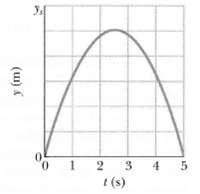
A ball is shot vertically upward from the surface of another planet. A plot of y versus t for the ball is shown in Figure, where y is the height of the ball above its starting point and t = 0 at the instant the ball is shot. The figure's vertical scaling is set by ys = 30.0 m. What are the
A steel ball is dropped from a building's roof and passes a window, taking 0.125 s to fall from the top to the bottom of the window, a distance of 1.2Am. It then falls to a sidewalk and bounces back past the window, moving from bottom to top in 0.125 s. Assume that the upward flight is an exact
A basketball player grabbing a rebound jumps 76.0 cm vertically. How much total time (ascent and descent) does the player spend? (a) In the top 15.0 cm of this jump and(b) In the bottom 15.0cm? Do your results explain why such players seem to hang in the at at the top of a jump?
In Sample Problem 2-9, at maximum head acceleration, what is the speed of?(a) The head and(b) The torso?
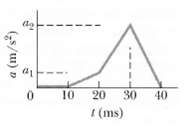
A salamander of the genus Hydro-mantes captures prey by launching its tongue as a projectile: The skeletal part of the tongue is shot forward, unfolding the rest of the tongue, until the outer portion lands on the prey, sticking to it. Figure shows the acceleration magnitude a versus time t for the
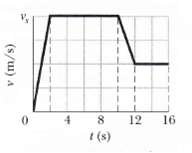
How far does the runner whose velocity-time graph is shown in Figure travel in 16 s? The figure's vertical scaling is set by vs = 8.0m/s.
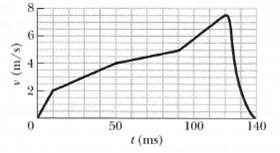
In a forward punch in karate, the fist begins at rest at the waist and is brought rapidly forward until the arm is fully extended. The speed v(t) of the fist is given in Figure for someone skilled in karate. How far has the fist moved at? (a) Time t = 50 ms and (b) When the speed of the fist
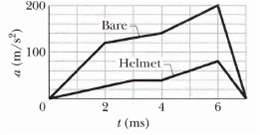
When a soccer ball is kicked toward a player and the player deflects the ball by "heading" it, the acceleration of the head during the collision can be significant. Figure 2-38 gives the measured acceleration a(t) of a soccer player's head for a bare head and a helmeted head, starting from rest. At
Two particles move along an x axis. The position of particle 1 is given by x = 6.00t2 + 3.00t + 2.00 (in meters and seconds); the acceleration of particle 2 is given by a = – 8.00t (in meters per seconds squared and seconds) and, at t = 0, its velocity is 20 m/s. When the velocities of the
At the instant the traffic light turns green, an automobile starts with a constant acceleration a of 2.2m/s2. At the same instant a truck, traveling with a constant speed of 9.5 m/s, overtakes and passes the automobile. (a) How far beyond the traffic signal will the automobile overtake the truck?
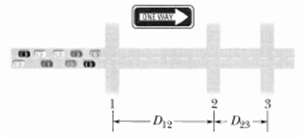
Figure shows part of a street where traffic flow is to be controlled to allow a platoon of cars to move smoothly along the street. Suppose that the platoon leaders have just reached intersection 2, where the green appeared when they were distance d from the intersection. They continue to travel al
In an arcade video game, a spot is programmed to move across the screen according to x = 9.00t – 0.750/3, where x is distance in centimeters measured from the left edge of the screen and t is time in seconds. When the spot reaches a screen edge, at either x = 0 or x = 15.0 cm, t is reset to 0 and
A lead ball is dropped in a lake from a diving board 5.20 m above the water. It hits the water with a certain velocity and then sinks to the bottom with this same constant velocity. It reaches the bottom 4.80 s after it is dropped.(a) How deep is the lake? What are the(b) Magnitude and(c) Direction
The single cable supporting an unoccupied construction elevator breaks when the elevator is at rest at the top of a 120-m-high building.(a) With what speed does the elevator strike the ground?(b) How long is it falling?(c) What is its speed when it passes the halfway point on the way down?(d) How
Two diamonds begin a free fall from rest from the same height, 1.0 s apart. How long after the first diamond begins to fall will the two diamonds be 10 m apart?
If a baseball pitcher throws a fastball at a horizontal speed of 160 km/h, how long does the ball take to reach home plate I8.4 m away?
A proton moves along the x axis according to the equation x = 50t + 10t2, where x is in meters and t is in seconds. Calculate(a) The average velocity of the proton during the first 3.0 s of its motion,(b) The instantaneous velocity of the proton at t = 3.0 s, and(c) The instantaneous acceleration
A motorcycle is moving at 30m/s when the rider applies the brakes, giving the motorcycle a constant deceleration. During the 3.0 s interval immediately after braking begins, the speed decreases to 15 m/s. What distance does the motorcycle travel from the instant braking begins until the motorcycle
A pilot flies horizontally at 1300km/h, at height h = 35 m above initially level ground. However, at time t = 0, the pilot begins to fly over ground sloping upward at angle θ = 4.3o (Figure). If the pilot does not change the airplane's heading, at what time / does the plane strike the ground?
A shuffleboard disk is accelerated at a constant rate from rest to a speed of 6.0 m/s over a 1.8 m distance by a player using a cue. At this point the disk loses contact with the cue and slows at a constant rate of 2.5m/s2 until it stops.(a) How much time elapses from when the disk begins to
The head of a rattlesnake can accelerate at 50 m/s2 in striking a victim. If a car could do as well, how long would it take to reach a speed of 100 km/h from rest?
A jumbo jet must reach a speed of 360 km/h on the runway for takeoff. What is the lowest constant acceleration needed for takeoff from a 1.80 km runway?
An automobile driver increases the speed at a constant rate from 25km/h to 55km/h in 0.50 min. A bicycle rider speeds up at a constant rate from rest to 30 km/h in 0.50 min. What are the magnitudes of?(a) The driver's acceleration and(b) The rider's acceleration?
To stop a car, first you require a certain reaction time to begin braking; then the car slows at a constant rate. Suppose that the total distance moved by your car during these two phases is 56.7 m when its initial speed is 80.5 km/h, and 24.4 m when its initial speed is 483 km/h. What are?(a) Your
A red train traveling at 72km/h and a green train traveling at 144km/h arc headed toward each other along a straight, level track. When they are 950 m apart, each engineer sees the other's train and applies the brakes. The brakes slow each train at the rate of 1.0 m/s2. Is there a collision? If so,
At time t = 0, a rock climber accidentally allows a piton to fall freely from a high point on the rock wall to the valley below him. Then, after a short delay, his climbing partner, who is 10 m higher on the wall, throws a piton downward. The positions y of the pitons versus r during the falling is
A rock is shot vertically upward from the edge of the top of a tall building. The rock reaches its maximum height above the top of the building 1.60 s after being shot. Then, after barely missing the edge of the building as it falls downward, the rock strikes the ground 6.00 s after it is launched.
A particle's acceleration along an x axis is a = 5.0t, with t in seconds and a in meters per second squared. At t = 2.0 s, its velocity is + 17m/s. What is its velocity at t = 4.0 s?
A train started from rest and moved with constant acceleration. At one time it was traveling 30 m/s, and 160 m farther on it was traveling 50 m/s. Calculate (a) The acceleration, (b) The time required to travel the L60 m mentioned, (c) The time required to attain the speed of 30 m/s, and (d) The
A hot rod can accelerate from 0 to 60 km/h in 5.4 s.(a) What is its average acceleration, in m/s2, during this time?(b) How far will it travel during the 5.4 s, assuming its acceleration is constant? (c) From rest, how much time would it require to go a distance of 0.25 km if its acceleration could
A rocket-driven sled running on a straight, level track is used to investigate the effects of large accelerations on humans. One such sled can attain a speed of 1600 km/h in 1.8 s, starting from rest. Find(a) The acceleration (assumed constant) in terms of g and(b) The distance traveled.
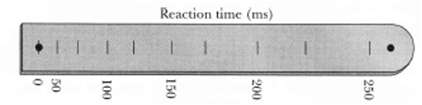
Figure shows a simple device for measuring your reaction time. It consists of a cardboard strip marked with a scale and two large dots. A friend holds the strip vertically, with thumb and forefinger at the dot on the right in Fig. 2-42. You then position your thumb and forefinger at the other dot
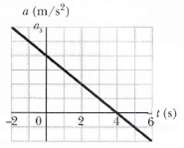
Figure gives the acceleration a versus time t for a particle moving along an x axis. The a-axis scale is set by a, = 12.0 m/s2. At t = ?? 2.0 s, the particle's velocity is 7.0 m/s. What is its velocity at t = 6.0s?
A mining cart is pulled up a hill at 20 km/h and then pulled back down the hill at 35 km/h through its original level. (The time required for the cart's reversal at the top of its climb is negligible.) What is the average speed of the cart for its round trip, from its original level back to its
On average, an eye blink lasts about 100ms. How far does a MiG-25 "Fox bat" fighter travel during a pilot's blink it the plane's average velocity is 3400 km/h?
When the legal speed limit for the New York Thruway was increased from 55 mi/h to 65 mi/h, how much time was saved by a motorist who drove the 700 km between the Buffalo entrance and the New York City exit at the legal speed limit?
A motorcyclist who is moving along an x axis directed toward the east has an acceleration given by a - (6.1 – 1.2t) m/s2 for 0 < t < 6.0 s. At t = 0, the velocity and position of the cyclist arc 2.7 m/s and 7.3 m.(a) What is the maximum speed achieved by the cyclist? (b) What total distance does
A certain juggler usually tosses balls vertically to a height H. To what height must they be tossed if they are to spend twice as much time in the air?
A car moving with constant acceleration covered the distance between two points 60.0 m apart in 6.00s, its speed as it passed the second point was 15.0m/s(a) What was the speed at the first point?(b) What was the magnitude of the acceleration?(c) At what prior distance from the first point was the
A rock is dropped from a 100-m-high cliff. How long does it take to fall?(a) The first 50 m and(b) The second 50 m?
Two subway stops are separated by 1100 m. If a subway train accelerates at + 1.2m/s2 from rest through the first half of the distance and decelerates at – 1.2m/s2 through the second half, what are(a) Its travel time and(b) Its maximum speed?(c) Graph x, v, and a versus t for the trip.
A certain sprinter has a top speed of 11.0 m/s. If the sprinter starts from rest and accelerates at a constant rate, he is able to reach his top speed in a distance of 12.0 m. He is then able to maintain this top speed for the remainder of a 100m race. (a) What is his time for the 100 m race? (b)
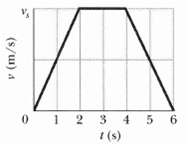
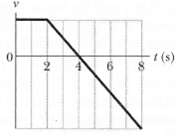
A particle starts from the origin at t = 0 and moves along the positive x axis. A graph of the velocity of the particle as a function of the time is shown in Figure; the v-axis scale is set by vs = 4.0 m/s. (a) What is the coordinate of the particle at t = 5.0 s? (b) What is the velocity of the
Showing 5600 - 5700
of 21795
First
50
51
52
53
54
55
56
57
58
59
60
61
62
63
64
Last
Step by Step Answers

 Get 50% OFF
Claim Now
Get 50% OFF
Claim Now



.PNG)