New Semester
Started
Get
50% OFF
Study Help!
--h --m --s
Claim Now
Question Answers
Textbooks
Find textbooks, questions and answers
Oops, something went wrong!
Change your search query and then try again
S
Books
FREE
Study Help
Expert Questions
Accounting
General Management
Mathematics
Finance
Organizational Behaviour
Law
Physics
Operating System
Management Leadership
Sociology
Programming
Marketing
Database
Computer Network
Economics
Textbooks Solutions
Accounting
Managerial Accounting
Management Leadership
Cost Accounting
Statistics
Business Law
Corporate Finance
Finance
Economics
Auditing
Tutors
Online Tutors
Find a Tutor
Hire a Tutor
Become a Tutor
AI Tutor
AI Study Planner
NEW
Sell Books
Search
Search
Sign In
Register
study help
physics
mechanics
Fundamentals of Physics 8th Extended edition Jearl Walker, Halliday Resnick - Solutions
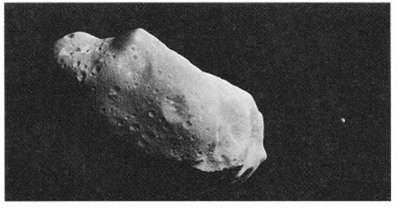
In 1993 the spacecraft Galileo sent home an image (Figure) of asteroid 243 Ida and a tiny orbiting moon (now known as Dactyl), the first confirmed example of an asteroid-moon system. In the image, the moon, which is 1.5 km wide, is 100 km from the center of the asteroid, which is 55 km long. The
In a certain binary-star system, each star has the same mass as our Sun, and they revolve about their center of mass. The distance between them is the same as the distance between Earth and the Sun. What is their period of revolution in years?
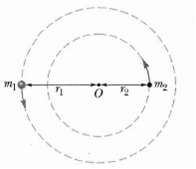
Hunting a black hole observations of the light from a certain star indicate that it is part of a binary (two-star) system. This visible star has orbital speed v = 270 km/s, orbital period T = 1.70 days, and approximate mass m1 = 6Ms where M, is the Sun's mass, 1.99 x 1030 kg. Assume that the
A 20 kg satellite has a circular orbit with a period of 2.4 h and a radius of 8.0 x l06 m around a planet of unknown mass. If the magnitude of the gravitational acceleration on the surface of the planet is 8.0 m/s2, what is the radius of the planet?
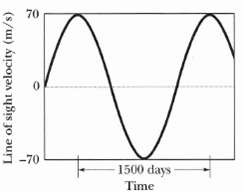
The presence of an unseen planet orbiting a distant star can sometimes be inferred from the motion of the star ab we see it. As the star and planet orbit the center of mass of the star-planet system, the star moves toward and away from us with what is called the line of sight velocity, a motion
Three identical stars of mass M form an equilateral triangle that rotates around the triangle's center as the stars move in a common circle about that center. The triangle has edge length L. What is the speed of the stars?
Two Earth satellites, A and B, each of mass m, are to be launched into circular orbits about Earth's center. Satellite A is to orbit at an altitude of 6370 km. Satellite B is to orbit at an altitude of 19110 km. The radius of Earth RE is 6370 km.(a) What is the ratio of the potential energy of
An asteroid, who’s mass is 2.0 x 10⁻⁴ times the mass of Earth, revolves in a circular orbit around the Sun at a distance that is twice Earth's distance from the Sun.(a) Calculate the period of revolution of the asteroid in years.(b) What is the ratio of the kinetic energy of the asteroid to the
A satellite orbits a planet of unknown mass in a circle of radius 2.0 x l07 m. The magnitude of the gravitational force on the satellite from the planet is F = 80 N.(a) What is the kinetic energy of the satellite in this orbit?(b) What would F be if the orbit radius were increased to 3.0 x 10⁷ m?
(a) At what height above Earth's surface is the energy required to lift a satellite to that height equal to the kinetic energy required for the satellite to be in orbit at that height?(b) For greater heights, which is greater, the energy for lifting or the kinetic energy for orbiting?
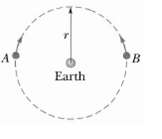
In Figure two satellites, A and B, 125 kg move in the same circular orbit of radius r = 7.78 x 10⁶ m around Earth but in opposite senses of rotation and therefore on a collision course. (a) Find the total mechanical energy EA + EB of the two satellites + Earth system before the collision. (b) If
A satellite is in a circular Earth orbit of radius r. The area A enclosed by the orbit depends on r2 because A = πr2. Determine how the following properties of the satellite depend on r:(a) Period,(b) Kinetic energy,(c) Angular momentum, and(d) Speed.
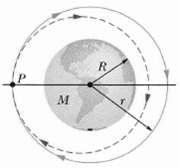
One way to attack a satellite in Earth orbit is to launch a swarm of pellets in the same orbit as the satellite but in the opposite direction. Suppose a satellite in a circular orbit 500 km above Earth's surface collides with a pellet having mass 4.0 g(a) What is the kinetic energy of the pellet in
What are?(a) The speed and(b) The period of a 220 kg satellite in an approximately circular orbit 640 km above the surface of Earth? Suppose the satellite loses mechanical energy at the average rate of 1.4 x 10⁵ J per orbital revolution. Adopting the reasonable approximation that the satellite's
Two small spaceships, each with mass m = 2000 kg, are in the circular Earth orbit of Figure at an altitude h of 400 km. Igor, the commander of one of the ships, arrives at any fixed point in the orbit 90 s ahead of Picard, the commander of the other ship. What are the? (a) Period T0 and (b) Speed
In Figure the scale on which the 60 kg physicist stands reads 220 N. How long will the cantaloupe take to reach the floor if the physicist drops it (from rest relative to himself) at a height of 2.1 m above the floor?
The mysterious visitor that appears in the enchanting story The Little Prince was said to come from a planet that "was scarcely any larger than a house!" Assume that the mass per unit volume of the planet is about that of Earth and that the planet does not appreciably spin. Approximate(a) The
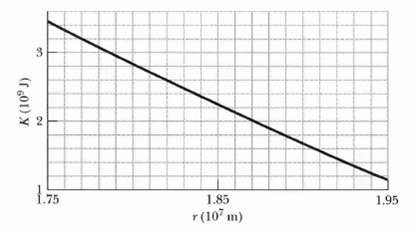
Figure is a graph of the kinetic energy K of an asteroid versus its distance r from Earth's center, as the asteroid falls directly in toward that center. (a) What is the (approximate) mass of the asteroid? (b) What is its speed at r = 1.945 x 10⁷m?
The radius Rh of a black hole is the radius of a mathematical sphere, called the event horizon that is centered on the black hole. Information from events inside the event horizon cannot reach the outside world. According to Einstein's general theory of relativity, Rh = 2GM/c2, where M is the mass
Sphere A with mass 80 kg is located at the origin of an xy coordinate system; sphere B with mass 60 kg is located at coordinates (0.25m, 0); sphere C with mass 0.20 kg is located in the first quadrant 0.20 m from A and0.15 m from B. In unit-vector notation, what is the gravitational force on C due
A satellite is in elliptical orbit with a period of 8.00 x l04 s about a planet of mass 7.00 x 1024 kg. At aphelion, at radius 4.5 x 10⁷ m, the satellite's angular speed is 7.158 x 10⁻⁵ rad/s. What is its angular speed at perihelion?
In a shuttle craft of mass m: 3000 kg, Captain Jane way orbits a planet of mass M = 9.50 x 1025 kg, in a circular orbit of radius r = 4.20 x 10⁷ m. What are?(a) The period of the orbit and(b) The speed of the shuttle craft? Jane way briefly fires a forward-pointing thruster, reducing her speed by
A typical neutron star may have a mass equal to that of the Sun but a radius of only 10 km.(a) What is the gravitational acceleration at the surface of such a star?(b) How fast would an object be moving if it fell from rest through a distance of 1.0 m on such a star? (Assume the star does not
Four uniform spheres, with masses mA = 40 kg, mB = 35 kg, mC = 200 kg, and mD = 50 kg, have (x, y) coordinates of (0, 50 cm), (0, 0), (-80 cm, 0), and (40 cm, 0), respectively. In unit-vector notation, what is the net gravitational force on sphere B due to the other spheres?
(a) In Problem, remove sphere A and calculate the gravitational potential energy of the remaining three-particle system.(b) Lt A is then put back in place, is the potential energy of the four-particle system more or less than that of the system in (a)?(c) In (a), is the work done by you to remove A
A very early, simple satellite consisted of an inflated spherical aluminum balloon 30 m in diameter and of mass 20kg. Suppose a meteor having a mass of 7.0 kg passes within 3.0 m of the surface of the satellite. What is the magnitude of the gravitational force on the meteor from the satellite at
A uniform solid sphere of radius R produces a gravitational acceleration of ar on its surface. At what distance from the sphere's center are there points(a) Inside and(b) Outside the sphere where the gravitational acceleration is ag/3?
A projectile is fired vertically from Earth's surface with an initial speed of 10 km/s neglecting air drag how far above the surface of Earth will it go?
A 50 kg satellite circles planet Cruton every 6.0 h. The magnitude of the gravitational force exerted on the satellite by Cruton is 80 N.(a) What is the radius of the orbit?(b) What is the kinetic energy of the satellite?(c) What is the mass of planet Cruton?
In a double-star system, two stars of mass 3.0 x 1030 kg each rotate about the system's center of mass at radius 1.0 x 10¹¹ m.(a) What is their common angular speed?(b) If a meteoroid passes through the system's center of mass perpendicular to their orbital plane, what minimum speed must it have at
An object lying on Earth's equator is accelerated(a) Toward the center of Earth because Earth rotates,(b) Toward the Sun because Earth revolves around the Sun in an almost circular orbit, and(c) The center of our galaxy because the Sun moves around the galactic center. For the latter, the period is
The masses and coordinates of three spheres are as follows: 20kg, x = 0.50 m, y = 1.0 m; 40 kg, x = – 1.0 m, y = – 1.0 m; 60 kg, x = 0m, y = – 0.50 m. What is the magnitude of the gravitational force on a 20 kg sphere located at the origin due to these three spheres?
With what speed would mail pass through the center of Earth if falling in the tunnel of Sample Problem?
The orbit of Earth around the Sun is almost circular: The closest and farthest distances are 1.47 x 10⁸ km and 1.52 x 10⁸ km respectively. Determine the corresponding variations in(a) Total energy,(b) Gravitational potential energy,(c) Kinetic energy, and(d) Orbital speed.
A spaceship is on a straight-line path between Earth and the Moon. At what distance from Earth is the net gravitational force on the spaceship zero?
An object of mass m is initially held in place at radial distance r = 3RE from the center of Earth, where Rs is the radius of Earth. Let M e be the mass of Earth. A force is applied to the object to move it to a radial distance r = 4RE, where it again is held in place. Calculate the work done by
The fastest possible rate of rotation of a planet is that for which the gravitational force on material at the equator just barely provides the centripetal force needed for the rotation. (Why?)(a) Show that the corresponding shortest period of rotation is T = √3π/Gp’ where p is the uniform
(a) If the legendary apple of Newton could be released from rest at a height of 2 m from the surface of a neutron star with a mass 1.5 times that of our Sun and a radius of 20 km, what would be the apple's speed when it reached the surface of the star?(b) If the apple could rest on the surface of
Some people believe that the positions of the planets at the time of birth influence the newborn. Others deride this belief and claim that the gravitational force exerted on a baby by the obstetrician is greater than the force exerted by the planets. To check this claim, calculate the magnitude of
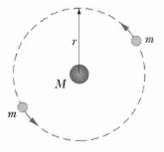
A certain triple-star system consists of two stars, each of mass m, revolving in the same circular orbit of radius r around a central star of mass M (Figure).The two orbiting stars are always at opposite ends of a diameter of the orbit. Derive an expression for the period of revolution of the stars.
A 150.0 kg rocket moving radially outward from Earth has a speed of 3.70 km/s when its engine shuts off 200 km above Earth's surface.(a) Assuming negligible air drag, find the rocket's kinetic energy when the rocket is 1000 km above Earth's surface.(b) What maximum height above the surface is
Planet Raton with a mass of 7.0 x 1024 kg and a radius of 1600 km gravitationally attracts a meteorite that is initially at rest relative to the planet, at a distance great enough to take as infinite. The meteorite falls toward the planet. Assuming the planet is airless, find the speed of the
Two 20 kg spheres are fixed in place on a y axis, one at y = 0.40 m and the other at y = -0.40 m. A 10 kg ball is then released from rest at a point on the x axis that is at a great distance (effectively infinite) from the spheres. If the only forces acting on the ball are the gravitational forces
A satellite of mass 125 kg is in a circular orbit of radius 7.00 x 10⁶ m around a planet. If the period is 8050 s, what is the mechanical energy of the satellite?
In his 1865 science fiction novel From the Earth to the Moon, Jules Verne described how three astronauts are shot to the Moon by means of a huge gun. According to Verne, the aluminum capsule containing the astronauts is accelerated by ignition of nitrocellulose to a speed of 11 km/s along the gun
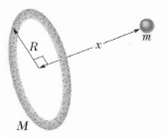
Several planets (Jupiter, Saturn, and Uranus) are encircled by rings, perhaps composed of material that failed to form a satellite. In addition, many galaxies contain ring-like structures. Consider a homogeneous thin ring of mass M and outer radius R (Figure). (a) What gravitational attraction does
Four identical 1.5 kg particles are placed at the corners of a square with side’s equal to 20 cm. What is the magnitude of the net gravitational force on any one of the particles due to the others?
We watch two identical astronomical bodies, A and B, each of mass m, fall toward each other from rest because of the gravitational force on each from the other. Their initial center-to-center separation is Ri. Assume that we are in an inertial reference frame that is stationary with respect to the
What is the percentage change in the acceleration of Earth toward the Sun when the alignment of Earth, Sun, and Moon changes from an eclipse of the Sun (with the Moon between Earth and Sun) to an eclipse of the Moon (Earth between Moon and Sun)?
A planet requires 300 (Earth) days to complete its circular orbit around its sun, which has a mass of 6.0 x 1030 kg. What are the planets?(a) Orbital radius and(b) Orbital speed?
A particle of comet dust with mass m is a distance R from Earth's center and a distance r from the Moon's center. If Earth's mass is ME and the Moon's mass is Mm, what is the sum of the gravitational potential energy of the particle - Earth system and the gravitational potential energy of the
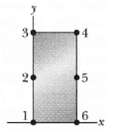
Because g varies so little over the extent of most structures, any structure's center of gravity effectively coincides with its center of mass. Here is a fictitious example where g varies more significantly. Figure shows an array of six particles, each with mass m, fixed to the edge of a rigid
An archer's bow is drawn at its midpoint until the tension in the string is equal to the force exerted by the archer. What is the angle between the two halves of the string?
A rope of negligible mass is stretched horizontally between two supports that are 3.44 m apart. When an object of weight 3160 N is hung at the center of the rope, the rope is observed to sag by 35.0 cm. What is the tension in the rope?
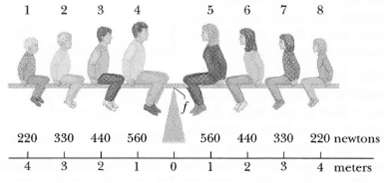
A Physics Brady Bunch, whose weights in Newton??s are indicated in Figure, is balanced on a seesaw. What is the number of the person who causes the largest torque about the rotation axis at fulcrum f directed? (a) Out of the page and (b) Into the page?
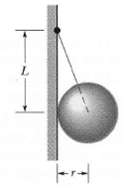
In Figure a uniform sphere of mass m = 0.85 kg and radius r = 4.2 cm is held in place by a massless rope attached to a frictionless wall a distance L = 8.0 cm above the center of the sphere. Find (a) The tension in the rope and (b) The force on the sphere from the wall.
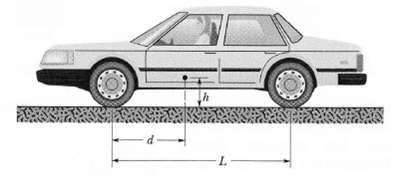
An automobile with a mass of 1360 kg has 3.05 m between the front and rear axles. Its center of gravity is located 1.780 m behind the front axle. With the automobile on level ground, determine the magnitude of the force from the ground on(a) Each front wheel (assuming equal forces on the front
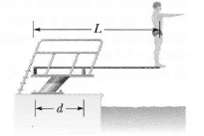
A diver of weight 580 N stands at the end of a diving board of length L = 4.5 m and negligible mass (Figure). The board is fixed to two pedestals separated by distance d = 1.5 m. Of the forces acting on the board, what are the (a) Magnitude and (b) Direction (up or down) of the force from the left
A scaffold of mass 60 kg and length 5.0 m is supported in a horizontal position by a vertical cable at each end. A window washer of mass 80 kg stands at a point l.5 m from one end. What is the tension in?(a) The nearer cable and(b) The farther cable?
A75 kg window cleaner uses a 10 kg ladder that is 5.0 m long. He places one end on the ground 2.5 m from a wall, rests the upper end against a cracked window, and climbs the ladder. He is 3.0 m up along the ladder when the window breaks. Neglect friction between the ladder and window and assume
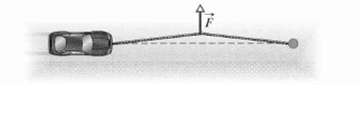
In Figure a man is trying to get his car out of mud on the shoulder of a road. He ties one end of a rope tightly around the front bumper and the other end tightly around a utility pole l8 m away. He then pushes sideways on the rope at its midpoint with a force of 550 N, displacing the center of the
A meter stick balances horizontally on a knife-edge at the 50.0 cm mark. With two 5.00 g coins stacked over the 12.0 cm mark, the stick is found to balance at the 45.5 cm mark. What is the mass of the meter stick?
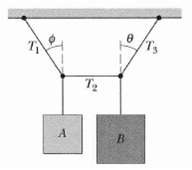
The system in Figure is in equilibrium, with the string in the center exactly horizontal. Block A weighs 40 N block B weighs 50 N, and angle θ is 35?. Find (a) Tension 21, (b) Tension 72, (c) Tension 23, and (d) Angle θ.
Forces F1, F2, and F3 act on the structure of Figure shown in an overhead view. We wish to put the structure in equilibrium by applying a fourth force, at a point such as P. The fourth force has vector components Fh and Fv. We are given that a = 2.0 m, b = 3.0 m, c = 10 m, F1 = 20 N, F2 = 10 N, and
A uniform cubical crate is 0.750 m on each side weighs 500 N. It rests on a floor with one edge against a small, fixed obstruction. At what least height above the must a horizontal force of magnitude 350 N be applied to the crate to tip it?
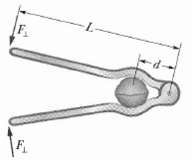
To crack a certain nut in a nutcracker, forces with magnitudes of at least 40 N must act on its shell from both sides. For the nutcracker of Figure with distances L = 12 cm and d = 2.6 cm, what are the force components F, (perpendicular to the handles) corresponding to that 40N?
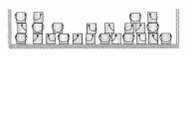
In Figure a horizontal scaffold, of length 2.00 m and uniform mass 50.0 kg, is suspended from a building by two cables. The scaffold has dozens of paint cans stacked on it at various points. The total mass of the paint cans is 75.0 kg. The tension in the cable at the right is 722 N. How far
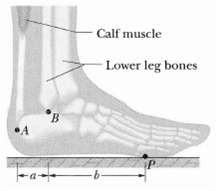
Figure shows the anatomical structures in the lower leg and foot that are involved in standing on tiptoe, with the heel raised slightly off the floor so that the foot effectively contacts the floor only at point P. Assume distance a = 5.0 cm, distance b = 15 cm, and the person's weight W = 900 N.
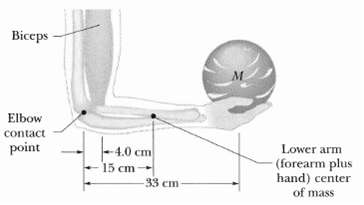
A bowler holds a bowling ball (M = 7.2kg) in the palm of his hand (Figurer). His upper arm is vertical; his lower arm (1.8 kg) is horizontal. What is the magnitude of? (a) The force of the biceps muscle on the lower arm and (b) The force between the bony structures at the elbow contact point?
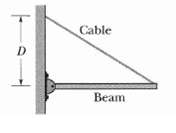
In Figure a uniform beam of weight 500 N and length 3.0 m is suspended horizontally. On the left it is hinged to a wall on the right it is supported by a cable bolted to the wall at distance D above the beam. The least tension that will snap the cable is 1200 N. (a) What value of D corresponds to
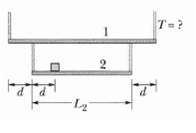
In Figure horizontal scaffold 2, with uniform mass m2 = 30.0 kg and length L2 = 2.00 m, hangs from horizontal scaffold 1, with uniform mass m1 = 50.0 kg. A 20.0 kg box of nails lies on scaffold Z, centered at distance d = 0.500 m from the left end. What is the tension T in the cable indicated?
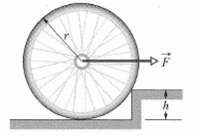
In Figure, what magnitude of (constant) force F applied horizontally at the axle of the wheel is necessary to raise the wheel over an obstacle of height h = 3.00 cm? The wheel's radius is r = 6.00 cm, and its mass is m = 0.800kg.
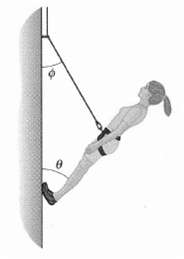
In Figure a climber with a weight of 533.8 N is held by a belay rope connected to her climbing harness and belay device; the force of the rope on her has a line of action through her center of mass. The indicated angles are θ = 40.0? and Φ = 30.0?. If her feet are on the verge of sliding on the
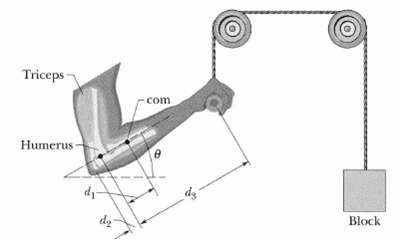
In Figure a 15 kg block is held in place via a pulley system. The person's upper arm is vertical; the forearm is at angle 0 = 30? with the horizontal. Forearm and hand together have a mass of 2.0 kg, with a center of mass at distance d1 =15 cm from the contact point of the forearm bone and the
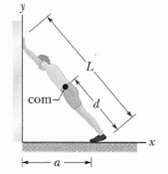
In Figure a climber leans out against a vertical ice wall that has negligible friction. Distance a is 0.914 m and distance L is 2.10 m. His center of mass is distance d = 0.940 m from the feet-ground contact point. If he is on the verge of sliding, what is the coefficient of static friction between
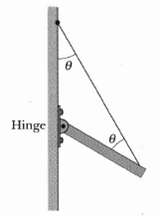
In Figure one end of a uniform beam of weight 222 N is hinged to a wall; the other end is supported by a wire that makes angles θ = 30.0?s with both wall and beam. Find (a) The tension in the wire and the (b) Horizontal and (c) Vertical components of the force of the hinge on the beam.
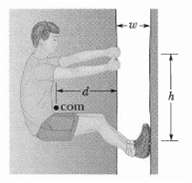
In Figure a 55 kg rock climber is in a lie-back climb along a fissure, with hands pulling on one side of the fissure and feet pressed against the opposite side. The fissure has width w = 0.20 m, and the center of mass of the climber is a horizontal distance d = 0.40 m from the fissure. The
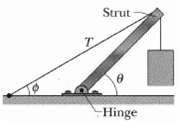
The system in Figure is in equilibrium. A concrete block of mass 225 kg hangs from the end of the uniform strut of mass 45.0 kg. For angles Φ = 30.0? and 0 = 45.0?, find (a) The tension T in the cable and the (b) Horizontal and (c) Vertical components of the force on the strut from the hinge.
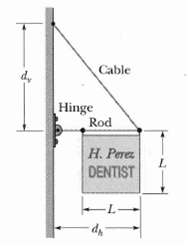
In Figure a 50.0 kg uniform square sign, of edge length L = 2.00 m, is hung from a horizontal rod of length dh = 3.00 m and negligible mass. A cable is attached to the end of the rod and to a point on the wall at distance d = 4.00 m above the point where the rod is hinged to the wall. (a) What is
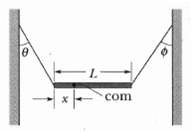
In Figure a non uniform bar is suspended at rest in a horizontal position by two massless cords. One cord makes the angle Φ = 53.1? with the vertical. If the length L of the bar is 6.10 m, compute the distance x from the left end of the bar to its center of mass.
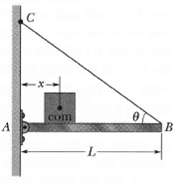
In Figure suppose the length L of the uniform bar is 3.00 m and its weight is 200 N. Also, let the block's weight W = 300 N and the angle θ = 30.0?. The wire can withstand a maximum tension of 500 N. (a) What is the maximum possible distance x before the wire breaks? With the block placed at this
A door has a height of 2.1 m along a y axis that extends vertically upward and a width of 0.91 m along an x axis that extends outward from the hinged edge of the door. A hinge 0.30 m from the top and a hinge 0.30 m from the bottom each support half the door's mass, which is 27 kg. In unit-vector
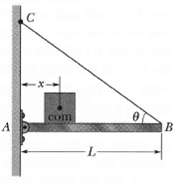
In Figure a thin horizontal bar AB of negligible weight and length L is hinged to a vertical wall at A and supported at B by a thin wire BC that makes an angle θ with the horizontal A block of weight W can be moved anywhere along the bar; its position is defined by the distance x from the wall to
A cubical box is filled with sand and weighs 890N. We wish to "roll" the box by pushing horizontally on one of the upper edges.(a) What minimum force is required?(b) What minimum coefficient of static friction between box and floor is required?(c) If there is a more efficient way to roll the box,
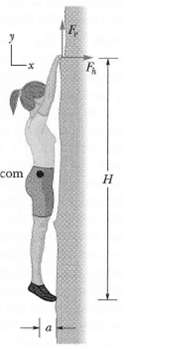
Figure shows a 70 kg climber hanging by only the crimp hold of one hand on the edge of a shallow horizontal ledge in a rock wall. (The fingers are pressed down to gain purchase.) Her feet touch the rock wall at distance H = 2.0 m directly below her crimped fingers but do not provide any support.
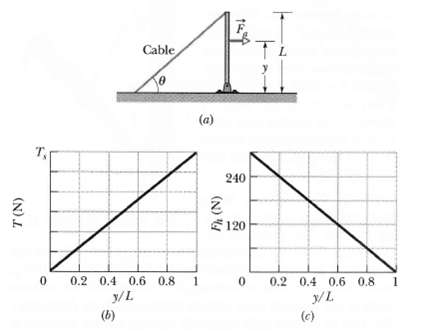
Figure shows a vertical uniform beam of length t is hinged at its lower end. A horizontal force F is applied to the beam at distance y from the lower end. The beam remains vertical because of a cable attached at the upper end; at angle θ with the horizontal Figure gives the tension Z in the cable
In Figure the driver of a car on a horizontal road makes an emergency stop by applying the brakes so that all four wheels lock and skid along the road. The coefficient of kinetic friction between tires and road is 0.40. The separation between the front and rear axles is L = 4.2 m, and the center of
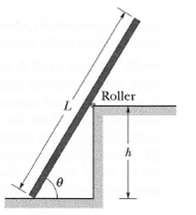
In Figure, a uniform plank, with a length L of 6.10 m and a weight of 445 N rest on the ground and against a frictionless roller at the top of a wall of height h = 3.05 m. The plank remains in equilibrium for any value of θ > 70? but slips if θ
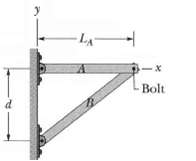
In Figure uniform beams A and B are attached to a wall with hinges and loosely bolted together (there is no torque of one on the other). Beam A has length LA = 2.40 m and mass 54.0 kg; beam B has mass 68.0 kg. The two hinge points are separated by distance d = 1.80 m. In unit-vector notation, what
A crate, in the form of a cube with edge lengths of 1.2 m, contains a piece of machinery; the center of mass of the crate and its contents is located 0.30 m above the crate's geometrical center. The crate rests on a ramp that makes an angle θ with the horizontal. As θ is increased from zero, an
In Sample Problem, let the coefficient of static friction μs between the ladder and the pavement be 0.53. How far (in percent) up the ladder must the fire fighter go to put the ladder on the verge of sliding?
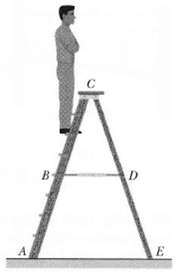
For the stepladder shown in Figure sides AC and CE are each 2.44 m long and hinged at C. Bar BD is a tie-rod 0.762 m long, halfway up. A man weighing 854 N climbs 1.80 m along the ladder. Assuming that the floor is frictionless and neglecting the mass of the ladder, Find (a) The tension in the
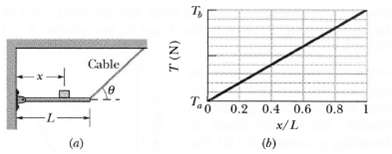
Figure shows a horizontal uniform beam of mass m6 and length L that is supported on the left by a hinge attached to a wall and on the right by a cable at angle θ with the horizontal A package of mass mp is positioned on the beam at a distance x from the left end. The total mass mb + mp = 61.22 kg.
A horizontal aluminum rod 4.8 cm in diameter projects 5.3 cm from a wall. A 1200 kg object is suspended from the end of the rod. The shear modulus of aluminum is 3.0 x 10¹⁰ N/m2. Neglecting the rod's mass, find(a) The shear stress on the rod and(b) The vertical deflection of the end of the rod.
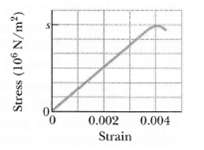
Figure shows the stress - strain curve for a material. The scale of the stress axis is f set by, s = 300, in units of 106 N/m2. What are? (a) The Young's modulus and (b) The approximate yield strength for this material?
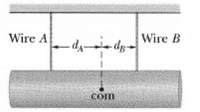
In Figure, a 103 kg uniform log hangs by two steel wires, A and B, both of radiuses 1.20 mm. Initially, wire A was 2.50 m long and 2.00 mm shorter than wire B. The log is now horizontal. What are the magnitudes of the forces on it from? (a) Wire A and (b) Wire B? (c) What is the ratio dA/dB?
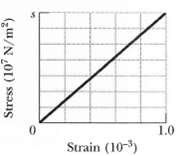
Figure shows the stress versus strain plot for an aluminum wire that is stretched by a machine pulling in opposite directions at the two ends of the wire. The scale of the stress axis is set by s = 7.0, in units of 107 N/m2.The wire have an initial length of 0.800 m and an initial cross-sectional
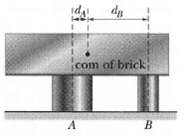
In Figure a lead brick rests horizontally on cylinders A and B. The areas of the top faces of the cylinders are related by AA = 2AB; the Young??s moduli of the cylinders are related by EA = 2EB. The cylinders had identical lengths before the brick was placed on them. What fraction of the brick's
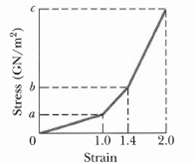
Figure shows an approximate plot of stress versus strain for a spider-web thread, out to the point of breaking at a strain of 2.00. The vertical axis scale is set by a = 0.12 GN/m2, b = 0.30 GN/m2, and c = 0.80 GN/m2. Assume that the thread has an initial length of 0.80 cm, an initial
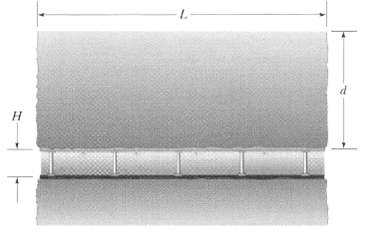
A tunnel of length L = 150 m, height H = 7.2 m, and width 5.8 m (with a flat roof) is to be constructed at distance d = 60 m beneath the ground. (See Figure) The tunnel roof is to be supported entirely by square steel column; each with a cross-sectional area of 960 cm2. The mass of 1.0 cm3 of the
Showing 5400 - 5500
of 21795
First
48
49
50
51
52
53
54
55
56
57
58
59
60
61
62
Last
Step by Step Answers

 Get 50% OFF
Claim Now
Get 50% OFF
Claim Now