New Semester
Started
Get
50% OFF
Study Help!
--h --m --s
Claim Now
Question Answers
Textbooks
Find textbooks, questions and answers
Oops, something went wrong!
Change your search query and then try again
S
Books
FREE
Study Help
Expert Questions
Accounting
General Management
Mathematics
Finance
Organizational Behaviour
Law
Physics
Operating System
Management Leadership
Sociology
Programming
Marketing
Database
Computer Network
Economics
Textbooks Solutions
Accounting
Managerial Accounting
Management Leadership
Cost Accounting
Statistics
Business Law
Corporate Finance
Finance
Economics
Auditing
Tutors
Online Tutors
Find a Tutor
Hire a Tutor
Become a Tutor
AI Tutor
AI Study Planner
NEW
Sell Books
Search
Search
Sign In
Register
study help
physics
mechanics
Fundamentals of Ethics for Scientists and Engineers 1st Edition Edmund G. Seebauer, Robert L. Barry - Solutions
A car starting at x = 50 m accelerates from rest at a constant rate of 8 m/s2.(a) How fast is it going after 10 s?(b) How far has it gone after 10 s?(c) What is its average velocity for the interval 0 ≤ t ≤ 10 s?
An object with an initial velocity of 5 m/s has a constant acceleration of 2 m/s2. When its speed is 15 m/s, how far has it traveled?
An object with constant acceleration has velocity v = 10 m/s when it is at x = 6 m and v = 15 m/s when it is at x = 10 m. What is its acceleration?
An object has constant acceleration a = 4 m/s2. At t = 0, its velocity is 1 m/s and it is at x = 7 m. How fast is it moving when it is at x = 8 m? What is t at that point?
If a rifle fires a bullet straight up with a muzzle speed of 300 m/s, how high will the bullet rise?
A test of the prototype of a new automobile shows that the minimum distance for a controlled top from 98 km/h to zero is 50 m. Find the acceleration, assuming it to be constant, and express your answer as a fraction of the free-fall acceleration due to gravity. How long does the car take to stop?
A ball is thrown upward with an initial velocity of 20 m/s. (a) How long is the ball in the air? (b) What is the greatest height reached by the ball? (c) When is the ball 15 m above the ground?
A particle moves with constant acceleration of 3 m/s2. At t = 4 s, it is at x = 100 m; at t = 6 s, it has a velocity v = 15 m/s. Find its position at t = 6 s.
A bullet traveling at 350 m/s strikes a telephone pole and penetrates a distance of 12 cm before stopping.(a) Estimate the average acceleration by assuming it to be constant.(b) How long did it take for the bullet to stop?
A plane landing on an aircraft carrier has just 70 m to stop. If its initial speed is 60 m/s,(a) What is the acceleration of the plane during landing, assuming it to be constant?(b) How long does it take for the plane to stop?
An automobile accelerates from rest at 2 m/s2 for 20 s. The speed is then held constant for 20 s, after which there is an acceleration of -3 m/s2 until the automobile stops. What is the total distance traveled?
In the Blackhawk landslide in California, a mass of rock and mud fell 460 m down a mountain and then traveled 8 km across a level plain on a cushion of compressed air. Assume that the mud dropped with the free-fall acceleration due to gravity and then slid horizontally with constant
A load of bricks is being lifted by a crane at a steady velocity of 5 m/s when one brick falls off 6 m above the ground.(a) Sketch x(t) to show the motion of the free brick.(b) What is the greatest height the brick reaches above the ground?(c) How long does it take to reach the ground?(d) What is
An egg with a mass of 50 g rolls off a table at a height of 1.2 m and splatters on the floor. Estimate the average acceleration of the egg while it is in contact with the floor.
To win publicity for her new CD release, Sharika, the punk queen, jumps out of an airplane without a parachute. She expects a stack of loose hay to break her fall. If she reaches a speed of 120 km/h prior to impact, and if a 35 g deceleration is the greatest deceleration she can withstand, how high
A bolt comes loose from underneath an elevator that is moving upward at a speed of 6 m/s. The bolt reaches the bottom of the elevator shaft in 3 s. (a) How high up was the elevator when the bolt came loose? (b) What is the speed of the bolt when it hits the bottom of the shaft?
An object is dropped from a height of 120 m. Find the distance it falls during its final second in the air.
An object is dropped from a height H. During the final second of its fall, it traverses a distance of 38 m. What was H?
A stone is thrown vertically from a cliff 200 m tall. During the last half second of its flight the stone travels a distance of 45 m. Calculate the initial velocity of the stone.
An object in free fall from a height H traverses 0.4H during the first second of its descent. Determine the average speed of the object during free fall.
A bus accelerates at 1.5 m/s2 from rest for 12 s. It then travels at constant speed for 25 s, after which it slows to a stop with an acceleration of -1.5 m/s2.(a) How far did the bus travel? (b) What was its average velocity?
A basketball is dropped from a height of 3 m and rebounds from the floor to a height of 2 m. (a) What is the velocity of the ball just as it reaches the floor? (b) What is its velocity just as it leaves the floor?(c) Estimate the magnitude and direction of its average acceleration during
A rocket is fired vertically with an upward acceleration of 20 m/s2. After 25 s, the engine shuts off and the rocket continues as a free particle until it reaches the ground. Calculate (a) The highest point the rocket reaches, (b) The total time the rocket is in the air, (c) The
A flowerpot falls from the ledge of an apartment building. A person in an apartment below, coincidentally holding a stopwatch, notices that it takes 0.2 s for the pot to fall past his window, which is 4 m high. How far above the top of the window is the ledge from which the pot fell?
Sharika arrives home late from a gig, only to find herself locked out. Her roommate and bass player Chico is practicing so loudly that he can't hear Sharika's pounding on the door downstairs. One of the band's props is a small trampoline, which Sharika places under Chico's window. She bounces
In a classroom demonstration, a glider moves along an inclined air track with constant acceleration a. It is projected from the start of the track (x = 0) with an initial velocity v0. At time t = 8 s, it is at x = 100 cm and is moving along the track at velocity v = -15 cm/s.
A rock dropped from a cliff falls one-third of its total distance to the ground in the last second of its fall. How high is the cliff?
A typical automobile has a maximum deceleration of about 7 m/s2; the typical reaction time to engage the brakes is 0.50 s. A school board sets the speed limit in a school zone to meet the condition that all cars should be able to stop in a distance of 4 m.(a) What maximum speed should be allowed
Two trains face each other on adjacent tracks. They are initially at rest 40 m apart. The train on the left accelerates rightward at 1.4 m/s2. The train on the right accelerates leftward at 2.2 m/s2. How far does the train on the left travel before the two trains pass?
Two stones are dropped from the edge of a 60-m cliff, the second stone 1.6 s after the first. How far below the cliff is the second stone when the separation between the two stones is 36 m?
A motorcycle policeman hidden at an intersection observes a car that ignores a stop sign, crosses the intersection, and continues on at constant speed. T he policeman starts off in pursuit 2.0 s after the car has passed the stop sign, accelerates at 6.2 m/s2 until his speed is 110 km/h , and then
At t = 0, a stone is dropped from a cliff above a lake; 1.6 seconds later another stone is thrown downward from the same point with an initial speed of 32 m/s. Both stones hit the water at the same instant. Find the height of the cliff.
A passenger train is traveling at 29 m/s when the engineer sees a freight train 360 m ahead traveling on the same track in the same direction. The freight train is moving at a speed of 6 m/s. If the reaction time of the engineer is 0.4 s, what must be the deceleration of the passenger train if a
After being forced out of farming, Lou has given up on trying to find work locally and is about to “ride the rails” to look for a job. Running at his maximum speed of 8 m/s, he is a distance d from the train when it begins to accelerate from rest at 1.0 m/s2. (a) If d = 30 m and Lou
A train pulls away from a station with a constant acceleration of 0.4 m/s2. A passenger arrives at the track 6.0 s after the end of the train has passed the very same point. What is the slowest constant speed at which she can run and catch the train? Sketch curves for the motion of passenger and
Lou applies for a job as a perfume salesman. He tries to convince the boss to try his daring, aggressive promotional gimmick: dousing prospective customers as they wait at bus stops. A hard ball is to be thrown straight upward with an initial speed of 24 m/s. A thin-skinned ball filled with perfume
Ball A is dropped from the top of a building at the same instant that ball B is thrown vertically upward from the ground. When the balls collide, they are moving in opposite directions, and the speed of A is twice the speed of B. At what fraction of the height of the building does the collision
Solve Problem 87 if the collision occurs when the balls are moving in the same direction and the speed of A is 4 times that of B.
The Sprint missile, designed to destroy incoming ballistic missiles, can accelerate at 100g. If an ICBM is detected at an altitude of 100 km moving straight down at a constant speed of 3 × 10⁴ km/h and the Sprint missile is launched to intercept it, at what time and altitude will the interception
When a car traveling at speed v1 rounds a corner, the driver sees another car traveling at a slower speed v2 a distance d ahead.(a) If the maximum acceleration the driver’s brakes can provide is a, show that the distance d must be greater than (v1 - v2)2/(2a) if a collision is to be
The velocity of a particle is given by v = 6t + 3, where t is in seconds and v is in meters per second. (a) Sketch v(t) versus t, and find the area under the curve for the interval t = 0 to t = 5 s. (b) Find the position function x(t). Use it to calculate the
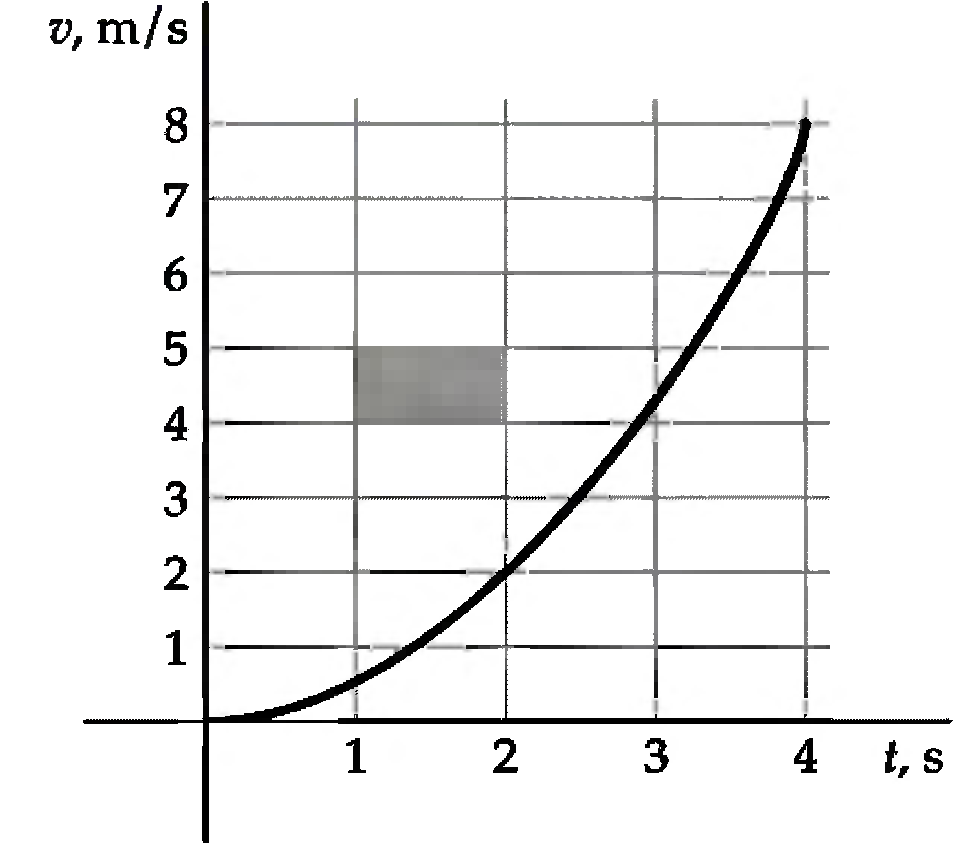
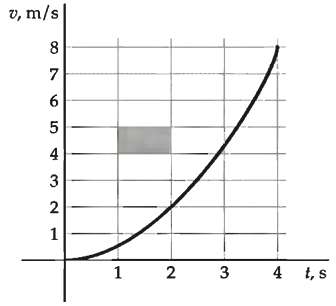
Figure shows the velocity of a particle versus time. (a) What is the magnitude in meters of the area of the rectangle indicated? (b) Find the approximate displacement of the particle for the one- second intervals beginning at t = 1 s and t = 2 s. (c) What is the approximate average
The velocity of a particle is given by v = 7t2 − 5, where t is in seconds and v is in meters per second. Find the general position function x(t).
The equation of the curve shown in Figure is v = 0.5t2 m/s. Find the displacement of the particle for the interval 1 s ? t ? 3 s by integration, and compare this answer with y our answer for Problem 92. Is the average velocity equal to the mean of the initial and final velocities for this case
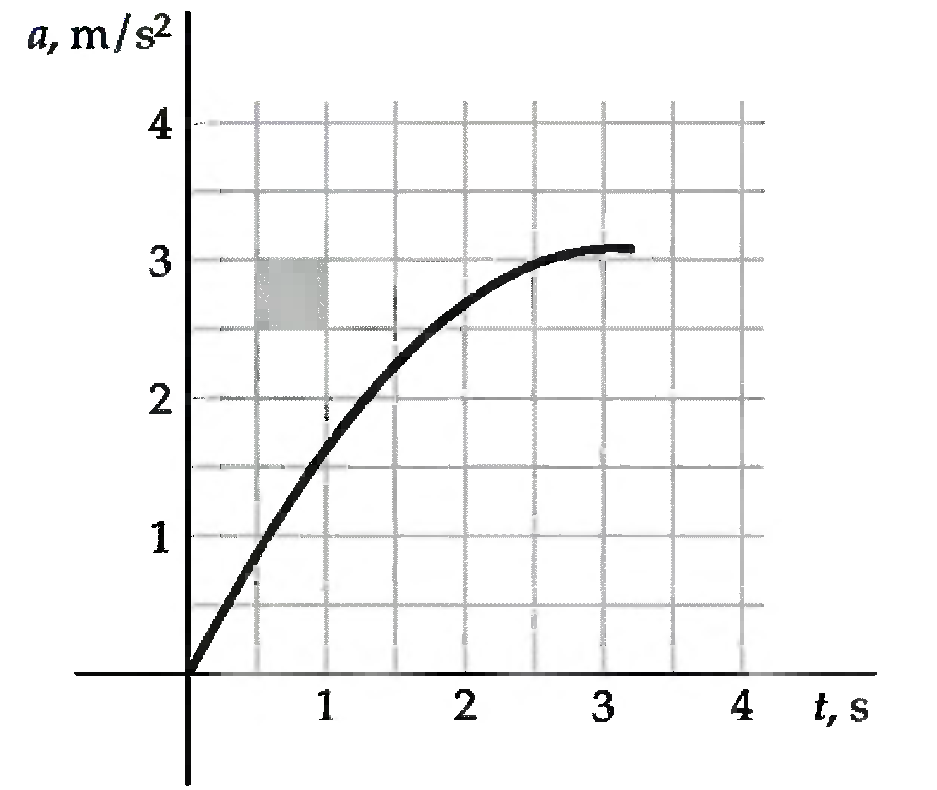
Figure shows the acceleration of a particle versus time. (a) What is the magnitude of the area of the rectangle indicated? (b) The particle starts from rest at t = 0. Find the velocity at t = 1s, 2s, and 3s by counting the rectangles under the curve. (c) Sketch the curve v(t) versus
Figure is a graph of v versus t for a particle moving along a straight line. The position of the particle at time t = 0 is x0 = 5m. (a) Find x for various times t by counting squares, and sketch x versus t. (b) Sketch the acceleration a versus t.
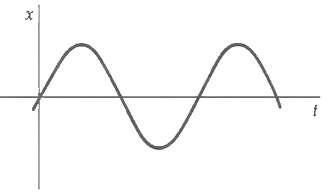
Figure 2-33 shows a plot of x versus t for a body moving along a straight line. Sketch rough graphs of v versus t and a versus t for thismotion.
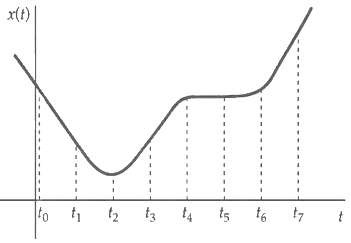
Figure shows the position of a car plotted as a function of time. At which times t0 to t7 is the velocity (a) Negative? (b) Positive? (c) Zero? At which times is the acceleration (a) Negative? (b) Positive? (c) Zero?
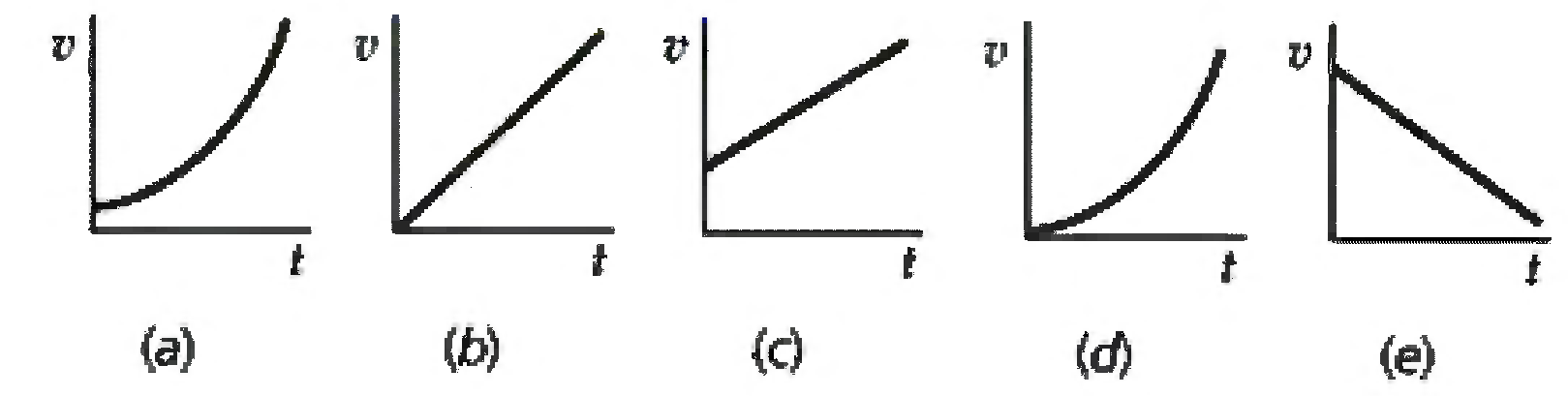
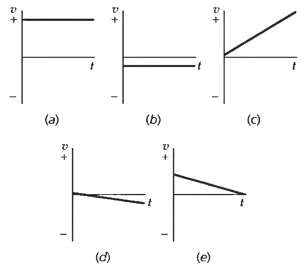
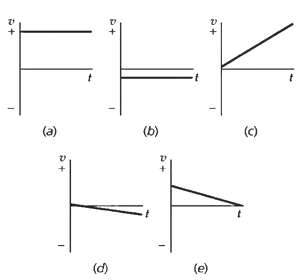
Sketch v-versus-t curves for each of the following conditions:(a) Acceleration is zero and constant while velocity is not zero.(b) Acceleration is constant but not zero.(c) Velocity and acceleration are both positive.(d) Velocity and acceleration are both negative.(e) Velocity is positive and
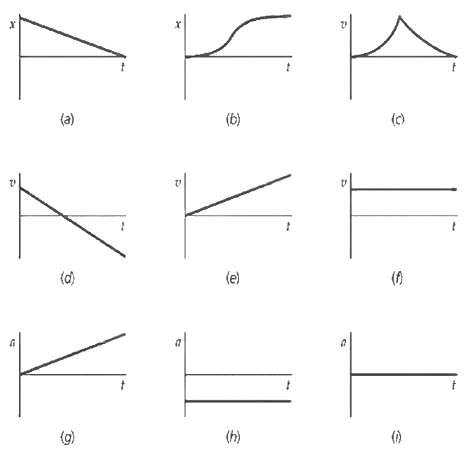
Figure shows nine graphs of position, velocity, and acceleration for objects in linear motion. Indicate the graphs that meet the following conditions: (a) Velocity is constant. (b) Velocity has reversed its direction. (c) Acceleration is constant. (d) Acceleration is not constant. Which graphs of
Two cars are being driven at the same speed v, one behind the other, with a distance d between them. The first driver jams on her brakes and decelerates at a rate a = 6 m/s2. The second driver sees the brake lights of the first driver and reacts, decelerating at the same rate starting 0.5 s
The velocity of a particle in meters per second is given by v = 7 - 4t, where t is in seconds. (a) Sketch v(t) versus t, and find the area between the curve and the t axis from t = 2 s to t = 6 s. (b) Find the position x(t) by integration, and use it to find the displacement
Estimate how high a ball or small rock can be thrown if it is thrown straight up.
The cheetah can run as fast as v1 = 100 km/h, the falcon can fly as fast as v2 = 250 km/h, and the sailfish can swim as fast as v3 = 120 km/ h. The three of them run a relay with each covering a distance L at maximum speed. What is the average speed v of this triathlon team?
In 1997, the men's world record for the 50-m freestyle was held by Tom Jager of the United States, who covered d = 50 min t = 21.81s. Suppose Jager started from rest at a constant acceleration a, and reached his maximum speed in 2.00 s, which he then kept constant until the finish line. Find
The click beetle can project itself vertically with an acceleration of about a = 400g (an order of magnitude more than a human could stand). The beetle jumps by " unfolding" its legs, which are about d = 0.6 cm long. How high can the click beetle jump? How long is the beetle in the air? (Assume
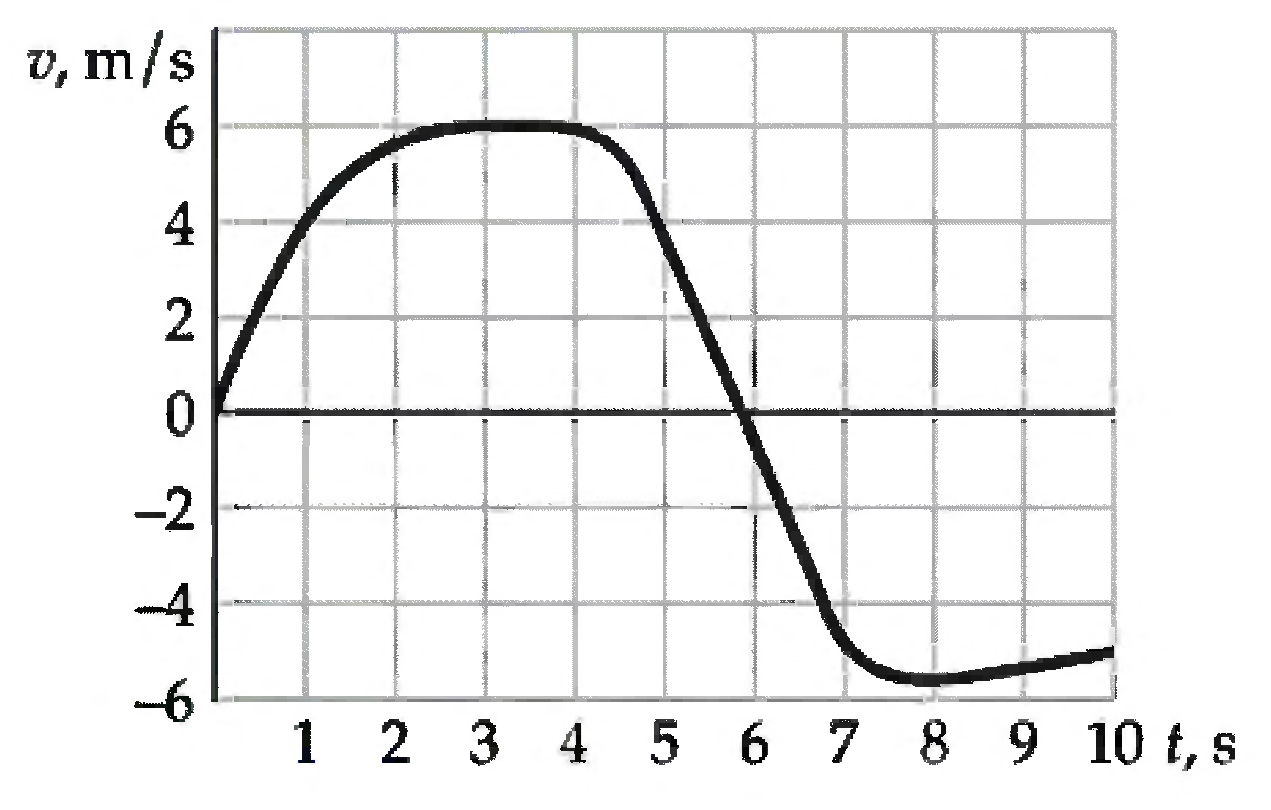
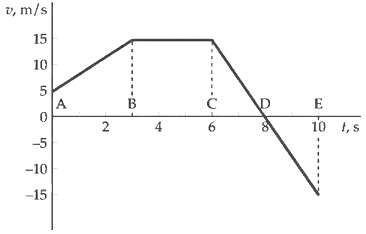
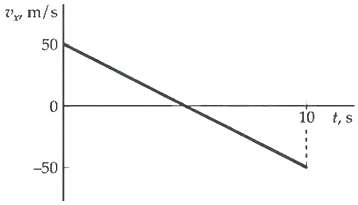
The one-dimensional motion of a particle is plotted in Figure. (a) What is the acceleration in the intervals AB, BC, and CE? (b) How far is the particle from its starting point after 10 s? (c) Sketch the displacement of the particle as a function of time; label instants A, B, C, D, and E on your
Consider the velocity graph in Figure. Assuming x = 0 at t = 0, write correct algebraic expressions for x(t), v(t), and a(t) with appropriate numerical values inserted for allconstants.
Starting at one station, a subway train accelerates from rest at a constant rate of 1.0 m/s2 for half the distance to the next station, then slows down at the same rate for the second half of the journey. The total distance between stations is 900 m. (a) Sketch a graph of the velocity v as a
The acceleration of a certain rocket is given by a = Ct, where C is a constant.(a) Find the general position function x(t).(b) Find the position and velocity at t = 5s if x = 0 and v = 0 at t = 0 and C = 3m/s3.
A physics professor demonstrates his new "anti-gravity parachute" by exiting from a helicopter at an altitude of 1500 m with zero initial velocity. For 8 s he falls freely. Then he switches on the "parachute" and falls with a constant upward acceleration of 15 m/s2 until h is downward speed reaches
Without telling Sally, Joe made travel arrangements that include a stopover in Toronto to visit Joe’s old buddy. Sally doesn’t like Joe’s buddy and wants to change their tickets. She hops on a courtesy motor scooter and begins accelerating at 0.9 m/s2 toward the ticket counter to make
A speeder races past at 125 km/h. A patrol car pursues from rest with a constant acceleration of 8 km/h·s until it reaches its maximum speed of 190 km/h, which it maintains until it catches up with the speeder. (a) How long until the patrol car catches the speeder if it starts moving just as
When the patrol car in Problem 122 (traveling at 190 km/h) pulls to within 100 m behind the speeder (traveling at 125 km/h), the speeder sees the police car and slams on his brakes, locking the wheels. (a) Assuming that each car can brake at 6 m/s2 and that the driver of the police car brakes
The speed of a good base runner is 9.5 m/s. The distance between bases is 26 m, and the pitcher is about 18.5 m from home plate. If a runner on first base edges 2 m off the base and takes off for second the instant the ball leaves the pitcher’s hand, what is the likelihood that the runner will
Repeat Problem 124, but with the runner attempting to steal third base, starting from second base with a lead of 3 m.
Urgently needing the cash prize, Lou enters the Rest-to-Rest auto competition, in which each contestant's car begins and ends at rest, covering a distance L in as short a time as possible. The intention is to demonstrate mechanical and driving skills, and to consume the largest amount of fossil
The acceleration of a badminton birdie falling under the influence of gravity and a resistive force, such as air resistance, is given by a = dv/dt = g - bv, where g is the free-fall acceleration due to gravity and b is a constant that depends on the mass and shape of the birdie and on the
Suppose acceleration is a function of x, where a(x) = 2x – m/s2.(a) If the velocity at x = 1m is zero, what is the velocity at x = 3 m? (b) How long does it take to travel from x = m to x = 3m?
Suppose that a particle moves in a straight line such that, at any time t, its position, velocity, and acceleration all have the same numerical value. Give the position x as a function of time.
An object moving in a straight line doubles its velocity each second for the first 10 s. Let the initial speed be 2 m/s. (a) Sketch a smooth function v(t) that gives the velocity. (b) What is the average velocity over the first 10 s?
In a dream, you find that you can run at superhuman speeds, but there is also a resistant force that reduces your speed by one-half for each second that passes. Assume that the laws of physics still hold in your dreamworld, and that your initial speed is 1000 m/s.(a) Sketch a smooth function v(t)
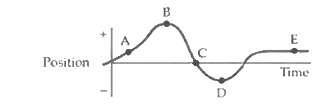
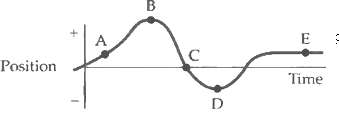
(Multiple Choice) (1) The diagram in Figure tracks the path of an object moving in a straight line. At which point is the object farthest from its starting point? (a) A (b) B (c) C (d) D (e) E (2) An object moves along the x axis as shown in Figure. At which point or points is the magnitude of
(Multiple Choice)(1)At t = 0, object A is dropped from the roof of a building. At the same instant, object B is dropped from a window 10 m below the roof. During their descent to the ground the distance between the two objects (a) Is proportional to t. (b) Is proportional to t2. (c)
Multiple Choice) (1) On a graph showing position on the vertical axis and time on the horizontal axis, a parabola that opens upward represents (a) A positive acceleration. (b) A negative acceleration. (c) No acceleration. (d) A positive followed by a negative acceleration. (e) A negative followed
Can the magnitude of the displacement of a particle be less than the distance traveled by the particle along its path? Can its magnitude be more than the distance traveled? Explain.
Give an example in which the distance traveled is a significant amount yet the corresponding displacement is zero.
A bear walks northeast for 12 m and then east for 12 m. Show each displacement graphically, and find the resultant displacement vector.
(a). A man walks along a circular arc from the position x = 5m, y = 0 to a final position x = 0, y = 5m. What is his displacement?(b). A second man walks from the same initial position along the x axis to the origin and then along the y axis to y = 5 m and x = 0. What is his displacement?
A circle of radius 8m has its center on the y axis at y = 8 m. You start at the origin and walk along the circle at a steady speed, returning to the origin exactly 1 min after you started. (a) Find the magnitude and direction of your displacement from the origin 15, 30, 45, and 60 s after you
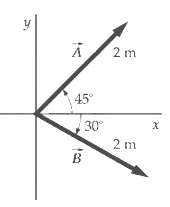
For the two vectors A and B in Figure, find the following graphically: (a) A + B (b) A - B (c) 2A + B (d) B - A (e) 2B -SA
A scout walks 2.4 km due east from camp, then turns left and walks 2.4 km along the arc of a circle centered at the campsite, and finally walks 1.5 km directly toward camp. (a) How far is the scout from camp at the end of his walk? (b) In what direction is the scout's position relative to
Can a component of a vector have a magnitude greater than the magnitude of the vector? Under what circumstances can a component of a vector have a magnitude equal to the magnitude of the vector?
Can a vector be equal to zero and still have one or more components not equal to zero?
Are the components of C = A + B necessarily larger than the corresponding components of either A or B?
Find the rectangular components of the following vectors which lie in the xy plane, and make an angle θ with the x axis (Figure) if(a) A = 10m, θ = 30°;(b) A = 5m, θ = 45°;(c) A = 7km, θ = 60°;(d) A = 5km, θ = 90°;(e) A = 15km/s, θ = 150°;(f) A = 10m/s, θ = 240°; and(g) A = 8 m/s2, θ
Vector A has a magnitude of 8 m at an angle of 37o with the x axis; vector B = 3 m i - 5 m j; vector C = -6 m i + 3 m j. Find the following vectors: (a) D = A + C;(b) E = B - A;(c) F = A - 2B + 3C;(d) A vector G such that G - B = A + 2C + 3G.
Find the magnitude and direction of the following vectors:(a) A = 5 i + 3 j;(b) B = 10 i - 7 j;(c) C = -2 i - 3 j + 4 k.
Find the magnitude and direction of A, B, and A + B for (a) A = -4 i - 7 j, B = 3 i - 2j,(b) A = 1 i - 4 j, B = 2 i + 6 j.
Describe the following vectors using the unit vectors i and j:(a) A velocity of 10 m/s at an angle of elevation of 60o;(b) A vector A of magnitude A = 5 m and q = 225o;(c) A displacement from the origin to the point. x = 14 m, y = -6 m.
For the vector A = 3 i + 4 j, find any three other vectors B that also lie in the xy plane and have the property that A = B but A ≠ B. Write these vectors in terms of their components and show them graphically.
If A = 5 i - 4 j and B = -7.5 i + 6 j, write an equation relating A to B.
The faces of a cube of side 3 m are parallel to the coordinate planes with one corner at the origin. A fly begins at the origin and walks along three edges until it is at the far corner. Write the displacement vector of the fly using the unit vectors i, j, and k, and find the magnitude of this
For an arbitrary motion of a given particle, does the direction of the velocity vector have any particular relation to the direction of the position vector?
Give examples in which the directions of the velocity and position vectors are (a) Opposite,(b) The same,(c) Mutually perpendicular.
How is it possible for a particle moving at constant speed to be accelerating? Can a particle with constant velocity be accelerating at the same time?
Consider the path of a particle as it moves in space.(a) How is the velocity vector related geometrically to the path of the particle?(b) Sketch a curved path and draw the velocity vector for the particle for several positions along the path.
A dart is thrown straight up. After it leaves the player’s hand, it steadily loses speed as it gains altitude until it lodges in the ceiling of the game room. Draw the dart’s velocity vector at times t1 and t2, where Δt = t2 - t1 is small. From your drawing find the direction of the change in
As a bungee jumper approaches the lowest point in her drop, she loses speed as she continues to move downward. Draw the velocity vectors of the jumper at times t1 and t2, where Δt = t2 - t1 is small. From your drawing find the direction of the change in velocity Δv = v2 - v1, and thus the
After reaching the lowest point in her jump at time tlow, the bungee jumper in the previous problem then moves upward, gaining speed for a short time until gravity again dominates her motion. Draw her velocity vectors at times t1 and t2, where Δt = t2 - t1 is small and t1 < tlow < t2. From
Showing 5900 - 6000
of 21795
First
53
54
55
56
57
58
59
60
61
62
63
64
65
66
67
Last
Step by Step Answers

 Get 50% OFF
Claim Now
Get 50% OFF
Claim Now