New Semester
Started
Get
50% OFF
Study Help!
--h --m --s
Claim Now
Question Answers
Textbooks
Find textbooks, questions and answers
Oops, something went wrong!
Change your search query and then try again
S
Books
FREE
Study Help
Expert Questions
Accounting
General Management
Mathematics
Finance
Organizational Behaviour
Law
Physics
Operating System
Management Leadership
Sociology
Programming
Marketing
Database
Computer Network
Economics
Textbooks Solutions
Accounting
Managerial Accounting
Management Leadership
Cost Accounting
Statistics
Business Law
Corporate Finance
Finance
Economics
Auditing
Tutors
Online Tutors
Find a Tutor
Hire a Tutor
Become a Tutor
AI Tutor
AI Study Planner
NEW
Sell Books
Search
Search
Sign In
Register
study help
physics
mechanics
Fundamentals of Ethics for Scientists and Engineers 1st Edition Edmund G. Seebauer, Robert L. Barry - Solutions
A stationary radar operator determines that a ship is 10 km south of him. An hour later the same ship is 20 km southeast. If the ship moved at constant speed and always in the same direction, what was its velocity during this time?
A particle’s position coordinates (x, y) are (2 m, 3 m) at t = 0; (6 m, 7 m) at t = 2 s; and (13 m, 14 m) at t = 5 s. (a) Find vav from t = 0 to t = 2 s. (b) Find vav from t = 0 to t = 5 s.
A ball is thrown directly upward. Consider the 2-s time interval Δt = t2 - t1, where t1 is 1 s before the ball reaches its highest point and t2 is 1 s after it reaches its highest point. For the time interval Δt, find(a) The change in speed,(b) The change in velocity,(c) The average acceleration.
Initially, a particle is moving due west with a speed of 40 m/s; 5 s later it is moving north with a speed of 30 m/s.(a) What was the change in the magnitude of the particle’s velocity during this time? (b) What was the change in the direction of the velocity? (c) What are the magnitude
At t = 0, a particle located at the origin has a velocity of 40 m/s at Ө = 45o. At t = 3 s, the particle is at x = 100 m and y = 80 m with a velocity of 30 m/s at Ө = 50o. Calculate (a) The average velocity and (b) The average acceleration of the particle during this interval.
A particle moves in the xy plane with constant acceleration. At time zero, the particle is at x = 4 m, y = 3 m, and has velocity v = 2 m/s i - 9 m/s j. The acceleration is given by the vector a = 4 m/s2 i + 3 m/s2 j. (a) Find the velocity vector at t = 2 s. (b) Find the position vector at
A particle has a position vector given by r = 30t i + (40t - 5t2) j, where r is in meters and t in seconds. Find the instantaneous-velocity and instantaneous-acceleration vectors as functions of time t.
A particle has a constant acceleration of a = (6 i + 4 j) m/s2. At time t = 0, the velocity is zero and the position vector is r0 = 10 m i. (a) Find the velocity and position vectors at any time t. (b) Find the equation of the particle’s path in the xy plane, and sketch the path.
Mary and Robert decide to rendezvous on Lake Michigan. Mary departs in her boat from Petoskey at 9:00 a.m. and travels due north at 8 mi/h. Robert leaves from his home on the shore of Beaver Island, 26 miles 30° west of north of Petoskey, at 10:00 a.m. and travels at a constant speed of 6 mi/h. In
A plane flies at a speed of 250 km/h relative to still air. There is a wind blowing at 80 km/h in the northeast direction at exactly 45° to the east of north.(a) In what direction should the plane head so as to fly due north?(b) What is the speed of the plane relative to the ground?
A swimmer heads directly across a river, swimming at 1.6 m/s relative to still water. She arrives at a point 40 m downstream from the point directly across the river, which is 80 m wide.(a) What is the speed of the river current?(b) What is the swimmer's speed relative to the shore?(c) In what
A small plane departs from point A heading for an airport at point B 520 km due north. The airspeed of the plane is 240 km/h and there is a steady wind of 50 km/h blowing northwest to southeast. Determine the proper heading for the plane and the time of flight.
Two boat landings are 2.0 km apart on the same bank of a stream that flows at 1.4 km/h. A motorboat makes the round trip between the two landings in 50 min. What is the speed of the boat relative to the water?
A model airplane competition has the following rules: Each plane must fly to a point 1 km from the start and then back again. The winner is the plane with the shortest round-trip time. The contestants are free to launch their planes in any direction, so long as the plane travels exactly 1 km out
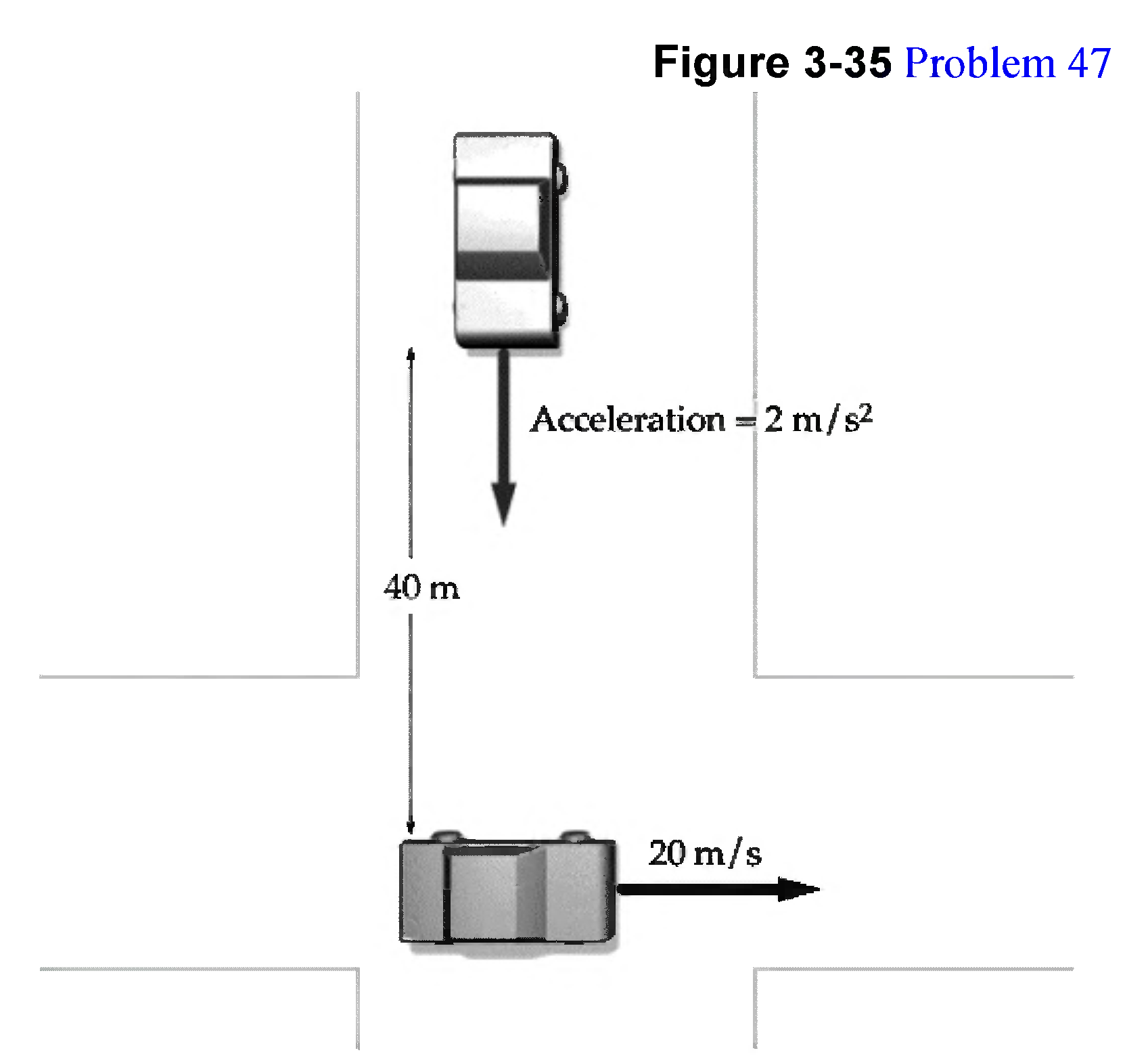
Car A is traveling east at 20 m/s. As car A crosses the intersection shown in Figure, car B starts from rest 40 m north of the intersection and moves south with a constant acceleration of 2 m/s2. (a) What is the position of B relative to A 6 s after A crosses the intersection? (b) What is
Bernie is showing Margaret his new boat and its autonavigation feature, of which he is particularly proud. “That island is 1 km east and 3 km north of this dock. So I just punch in the numbers like this, and we get ourselves a refreshment and enjoy the scenery." Forty-five minutes later, they
Airports A and B are on the same meridian, with B 624 km south of A. Plane P departs airport A for B at the same time that an identical plane, Q, departs airport B for A. A steady 60 km/h wind is blowing from the south 30° east of north. Plane Q arrives at airport A 1 h before plane P arrives at
What is the acceleration of a projectile at the top of its flight?
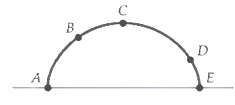
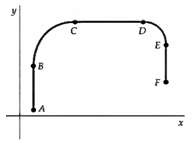
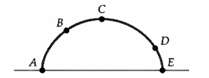
Referring to Figure (a) At which point(s) is the speed the greatest? (b) At which point(s) is the speed the lowest? (c) At which two points is the speed the same? Is the velocity the same at thosepoints?
A bullet is fired horizontally with an initial velocity of 245 m/s. The gun is 1.5 m above the ground. How long is the bullet in the air?
A pitcher throws a fast ball at 140 km/h toward home plate, which is 18.4 m away. Neglecting air resistance (not a good idea if you are the batter), find how far the ball drops because of gravity by the time it reaches home plate.
A projectile is launched with speed v0 at an angle of Ө0 with the horizontal. Find an expression for the maximum height it reaches above its starting point in terms of v0, Ө0, and g.
A projectile is fired with an initial velocity of 30 m/s at 60° above horizontal. At the projectile’s highest point, what is its velocity? Its acceleration?
A projectile is fired with initial speed v at an angle 30° above the horizontal from a height of 40 m above the ground. The projectile strikes the ground with a speed of 1.2v. Find v.
If the tree in Example 3-11 is 50 m away and the monkey hangs from a branch 10 m above the muzzle position, what is the minimum initial speed of the dart if it is to hit the monkey before hitting the ground?
A projectile is fired with an initial speed of 53 m/s. Find the angle of projection such that the maximum height of the projectile is equal to its horizontal range.
A ball thrown into the air lands 40 m away 2.44 s later. Find the direction and magnitude of the initial velocity.
Show that if an object is thrown with speed v0 at an angle θ above the horizontal, its speed at some height h is independent of θ.
At half its maximum height, the speed of a projectile is three-fourths its initial speed. What is the angle of the initial velocity vector with respect to the horizontal?
Wally and Luke advertise their circus act as "The Human Burrs---Trapeze Artists for the New Millennium." Their specialty involves wearing padded Velcro suits that cause them to stick together when they make contact in midair. While working on their act, Wally is shot from cannon with a speed of 20
A cargo plane is flying horizontally at an altitude of 12 km with a speed of 900 km/h when a battle tank falls out of the rear loading ramp.(a) How long does it take the tank to hit the ground?(b) How far horizontally is the tank from where it fell off when it hits the ground?(c) How far is the
A cannon barrel is elevated at an angle of 45°. The cannon fires a ball with a speed of 300 m/s.(a) What height does the ball reach?(b) How long is the ball in the air?(c) What is the horizontal range of the cannon?
A stone thrown horizontally from the top of a 24-m tower hits the ground at a point 18 m from the base of the tower.(a) Find the speed at which the stone was thrown.(b) Find the speed of the stone just before it hits the ground.
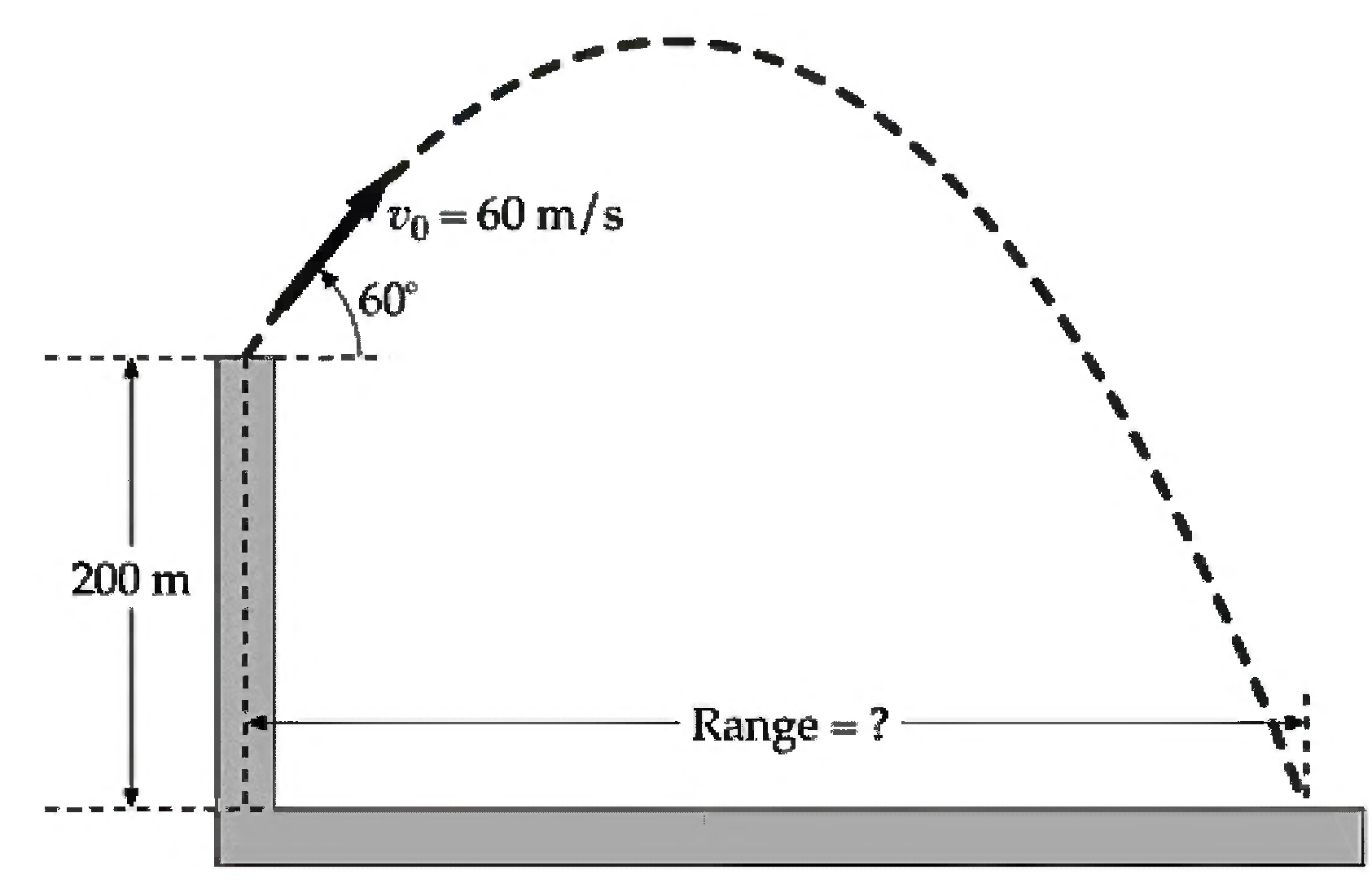
A projectile is fired into the air from the top of a 200-m cliff above a valley (Figure). Its initial velocity is 60 m/s at 60° above the horizontal. Where does the projectile land?
The range of a projectile fired horizontally from a cliff is equal to the height of the cliff. What is the direction of the velocity vector when the projectile strikes the ground?
Find the range of the projectile of Problem 60.
Compute dR/dθ from Equation 3-22 and show that setting dR/dθ = 0 gives θ = 45° for the maximum range.
A rock is thrown from the top of a 20-m building at an angle of 53o above the horizontal. If the horizontal range of the throw is equal to the height of the building, with what speed was the rock thrown? What is the velocity of the rock just before it strikes the ground?
A stone is thrown horizontally from the top of an incline that makes an angle ф with the horizontal. If the stone's initial speed is v, how far down the incline will it land?
A flock of seagulls has decided to mount an organized response to the human overpopulation of their favorite beach. One tactic popular among the innovative radicals is bombing the sunbathers with clams. A gull dives with a speed of 16 m/s, at an angle of 40° below the horizontal. He releases a
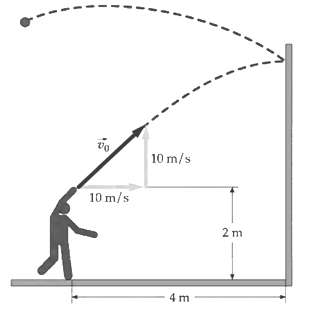
A girl throws a ball at a vertical wall 4 m away (Figure). The ball is 2 m above the ground when it leaves the girl's hand with an initial velocity of When the ball hits the wall, the horizontal component of its velocity is reversed; the vertical component remains unchanged. Where does the ball hit
A boy uses a slingshot to project a pebble at a shoulder-height target 40 m away. He finds that to hit the target he must aim 4.85 m above the target. Determine the velocity of the pebble on leaving the slingshot and the time of flight.
The distance from the pitcher's mound to home plate is 18.4 m. The mound is 0.2 m above the level of the field. A pitcher throws a fast ball with an initial speed of 37.5 m/s. At the moment the ball leaves the pitcher's hand, it is 2.3 m above the mound. What should the angle between and the
Suppose the puck in Example is struck in such a way that it just clears the Plexiglas wall when it is at its highest point. Find v0y, the time t to reach the wall, and v0x, v0, and θ0 for this case.
The coach throws a baseball to a player with an initial speed of 20 m/s at an angle of 45° with the horizontal. At the moment the ball is thrown, the player is 50 m from the coach. At what speed and in what direction must the player run to catch the ball at the same height at which it was released?
Carlos is on his trail bike, approaching a creek bed that is 7 m wide. A ramp with an incline of 10° has been built for daring people who try to jump the creek. Carlos is traveling at his bike's maximum speed; 40 km/h. (a) Should Carlos attempt the jump or emphatically hit the
It's the bottom of the ninth with two outs and the winning runs on base. You hit a knee-high fastball that just clears the leaping third baseman's glove. He is standing 28 m from you and his glove reaches to 3.2 m above the ground. The flight time to that point is 0.64 s. Assume that the ball's
Noobus is a death-defying squirrel with miraculous jumping abilities. Running to the edge of a flat rooftop, she leaps horizontally with a speed of 6 m/s. If she just clears the 3-m gap between the houses and lands on the neighbor's roof, what is her speed upon landing?
If a bullet that leaves the muzzle of a gun at 250 m/s is to hit a target 100 m away at the level of the muzzle, the gun must be aimed at a point above the target. How far above the target is this point?
A baseball just clears a 3-m wall that is 120 m from home plate. If the ball leaves the bat at 45o and 1.2 m above the ground, what must its initial speed be?
A baseball is struck by a bat, and 3 s later it is caught 30 m away.(a) If the baseball was 1 m above the ground when it was struck and caught, what was the greatest height it reached above the ground?(b) What were the horizontal and vertical components of its velocity when it was struck?(c) What
A baseball player hits a baseball that drops into the stands 22 m above the playing field. The ball lands with a velocity of 50 m/s at an angle of 35° below the horizontal.(a) If the batter contacted the ball 1.2 m above the playing field, what was the velocity of the ball upon leaving the bat?(b)
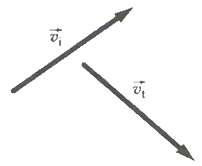
The initial and final velocities of an object are as shown in Figure. Indicate the direction of the average acceleration.
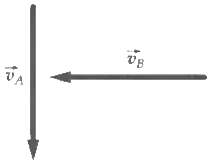
The velocities of objects A and B are shown in Figure. Draw a vector that represents the velocity of B relative to A.
A vector A(t) has a constant magnitude but is changing direction in a uniform way. Draw the vectors A(t + Δt) and A(t) for a small time interval Δt, and find the difference ΔA = A(t + Δt) - A(t) graphically. How is the direction of ΔA related to A for small time intervals?
The automobile path shown in Figure is made up of straight lines and arcs of circles. The automobile starts from rest at point A. After it reaches point B, it travels at constant speed until it reaches point E. It comes to rest at point F. (a) At the middle of each segment (AB, BC, CD, DE, and EF),
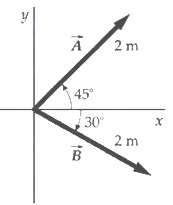
The displacement vectors A and B in Figure both have a magnitude of 2 m. (a) Find their x and y components. (b) Find the components, magnitude, and direction of the sum A + B. (c) Find the components, magnitude, and direction of the difference A -B.
Aplane is inclined at an angle of 30° from the horizontal. Choose the x axis pointing down the slope of the plane and the y axis perpendicular to the plane. Find the x and y components of the acceleration of gravity, which has the magnitude 9.81 m/s2 and points vertically down.
Two vectors A and B lie in the xy plane. Under what conditions does the ratio A/B equal Ax/Bx?
The position vector of a particle is given by r = 5t i + 10t j, where t is in seconds and r is in meters.(a) Draw the path of the particle in the xy plane.(b) Find v in component form and then find its magnitude.
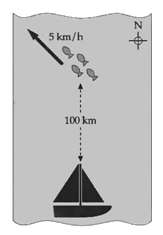
Off the coast of Chile, a spotter plane sees a school of tuna swimming at a steady 5 km/h northwest (Figure). The pilot informs a fishing trawler located 100 km due south of the fish. The trawler sails at full steam along the best straight-line course and intercepts the tuna after 4 h. How fast did
A worker on the roof of a house drops her hammer, which slides down the roof at a constant speed of 4 m/s. The roof makes an angle of 30° with the horizontal, and its lowest point is 10 m from the ground. What is the horizontal distance traveled by the hammer after it leaves the roof of the house
A freight train is moving at a constant speed of 10 m/s. A ma n standing on a flatcar throws a ball into the air and catches it as it falls. Relative to the flatcar, the initial velocity of the ball is 15 m/s straight up. (a) What are the magnitude and direction of the initial velocity of the
Estimate how far you can throw a ball if you throw it(a) Horizontally while standing on level ground;(b) At θ = 45° while standing on level ground;(c) Horizontally from the top of a building 12 m high;(d) At θ = 45 ° from the top of a building 12m high.
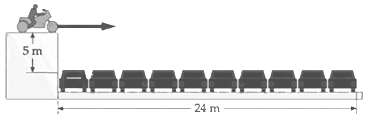
A stunt motorcyclist wants to jump over 10 cars parked side by side below a horizontal launching ramp, as shown in Figure. With what minimum horizontal speed v0 must the cyclist leave the ramp in order to clear the top of the lastcar?
In 1978, Geoff Capes of Great Britain threw a heavy brick a horizontal distance of 44.5 m. Find the velocity of the brick at the highest point of its flight.
In 1940, Emanuel Zacchini flew about 53 m as a human cannonball, a record that remains unbroken. His initial velocity was 24.2 m/s at an angle θ. Find θ and the maximum height h Emanuel achieved during the record flight.
A particle moves in the xy plane with constant acceleration. At t = 0 the particle is at r1 = 4 m i + 3 m j, with velocity v1. At t = 2 s the particle has moved to r2 = 10 m i - 2 m j, and its velocity has changed to v2 = (5 i - 6 j) m/s. (a) Find v1. (b) What is the acceleration of the
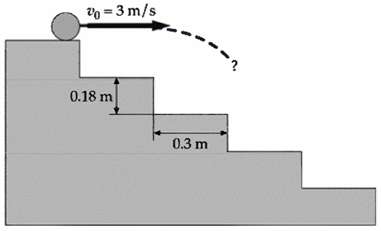
A small steel ball is projected horizontally off the top landing of a long rectangular staircase (Figure). The initial speed of the ball is 3 m/s. Each step is 0.18 m high and 0.3 m wide. Which step does the ball strike first?
As a car travels down a highway at 25 m/s, a passenger flips out a can at a 45° angle of elevation in a plane perpendicular to the motion of the car. The initial speed of the can relative to the car is 10 m/s. The can is released at a height 1.2 m above the road. (a) Write the initial
Suppose you can throw a ball a distance x0 when standing on level ground. How far can you throw it from a building of height h = x0 if you throw it at (a) 0°? (b) 30°? (c) 45°?
A baseball hit toward center field will land 72 m away unless caught first. At the moment the ball is hit, the center fielder is 98 m away. He uses 0.5 s to judge the flight of the ball, then races to catch it. The ball’s speed as it leaves the bat is 35 m/s. Can the center fielder catch the ball
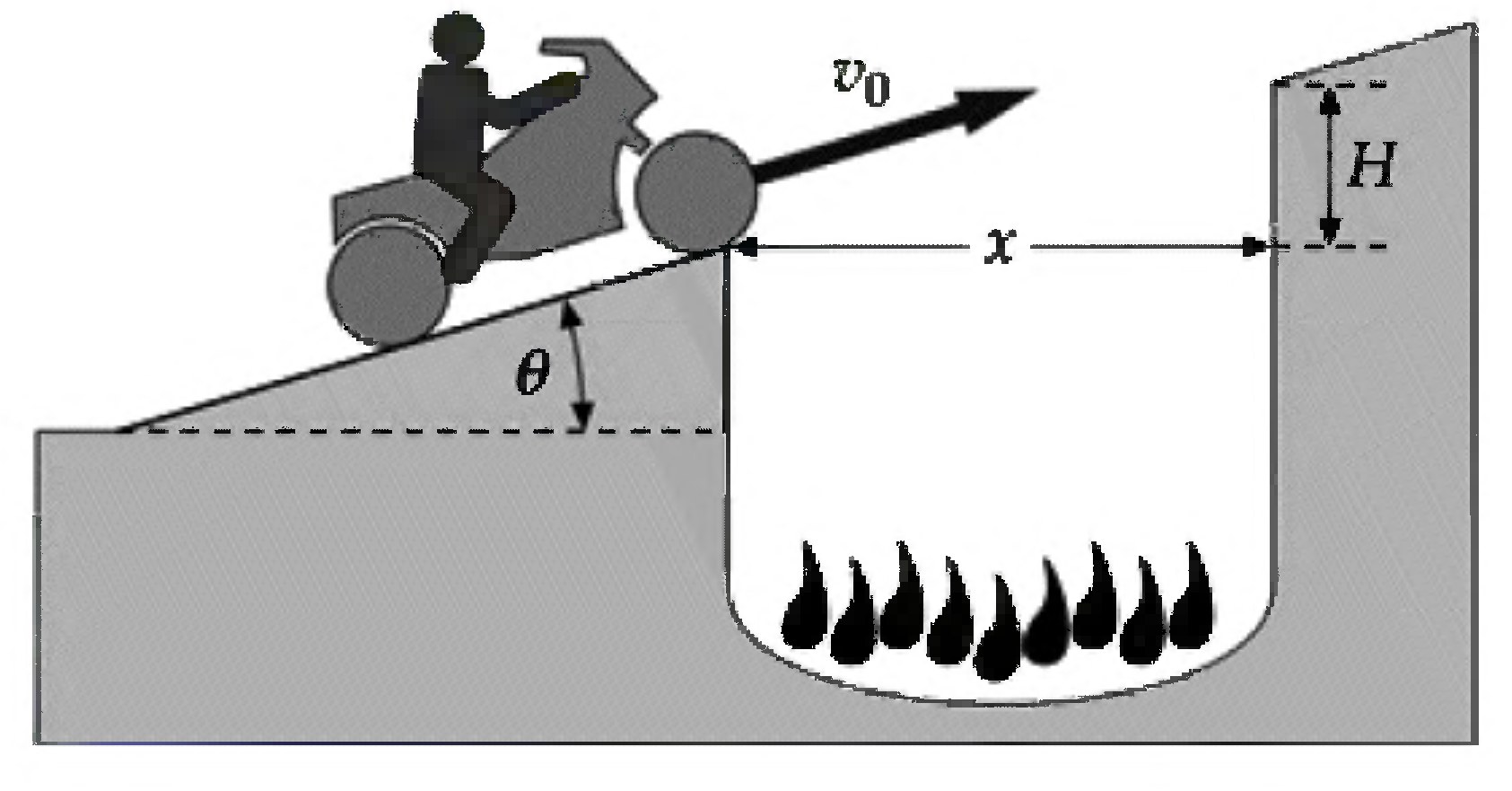
Darlene is a stunt motorcyclist in a traveling circus. For the climax of her show, she takes off from the ramp at angle θ, clears a fiery ditch of width x, and lands on an elevated platform (height H) on the other side (Figure). Darlene notices, however, that night after night, the circus owner
A small boat is headed for a harbor 32 km northwest of its current position when it is suddenly engulfed in heavy fog. The captain maintains a compass bearing of northwest and a speed of 10 km/h relative to the water. Three hours later, the fog lifts and the captain notes that he is now exactly 4.0
Galileo showed that, if air resistance is neglected, the ranges for projectiles whose angles of projection exceed or fall short of 45° by the same amount are equal. Prove Galileo's result.
Two balls are thrown with equal speeds from the top of a cliff of height H. One ball is thrown upward at an angle α above the horizontal. The other ball is thrown downward at an angle β below the horizontal. Show that each ball strikes the ground with the same speed, and find that speed in terms
(Multiple Choice)(1)The magnitude of the displacement of a particle is ___ the distance the object has traveled. (b) Smaller than(c) Either larger or smaller(d) The same as(e) Smaller than or equal to(2)The components of a vector are Ax = −10 m and Ay = 6 m. What angle does this vector make with
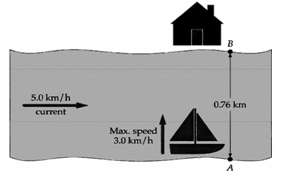
(Multiple Choice) (1) A river is 0.76 km wide. The banks are straight and parallel (Figure 3-34). The current is 5.0 km/h and is parallel to the banks. A boat has a maximum speed of 3 km/h in still water. The pilot of the boat wishes to go on a straight line from A to B, where AB is perpendicular
How can you tell if a particular reference frame is an inertial reference frame?
Suppose you find that an object in a particular frame has an acceleration when there are no forces acting on it. How can you use this information to find an inertial reference frame?
If an object has no acceleration in an inertial reference frame, can you conclude that no forces are acting on it?
If only a single force acts on an object, must the object accelerate in an inertial reference frame? Can it ever have zero velocity?
If an object is acted upon by a single known force, can you tell in which direction the object will move using no other information?
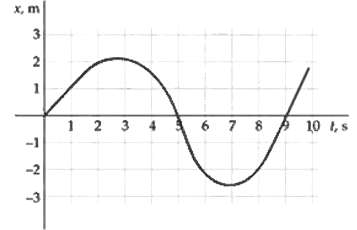
Figure shows the position x versus time t of a particle moving in one dimension. During what time intervals is there a net force acting on the particle? Give the direction (+ or -) of the net force during these time intervals.
(a) An object experiences an acceleration of 3 m/s2 when a certain force F0 acts on it. What is its acceleration when the force is doubled? (b) A second object experiences an acceleration of 9 m/s2 under the influence of the force F0. What is the ratio of the masses of the two
A tugboat tows a ship with a constant force F1. The increase in the ship's speed in a 10-s interval is 4 km/h. When a second tugboat applies a second constant force F2 in the same direction, the speed increases by 16 km/h in a 10-s interval. How do the magnitudes of the two forces compare?
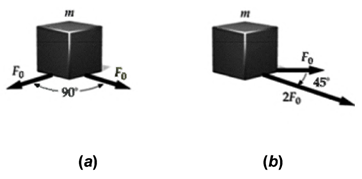
A force F0 causes an acceleration of 3 m/s2 when it acts on an object of mass m sliding on a frictionless surface. Find the acceleration of the same object in the circumstances shown in Figure a and b.
A force F = 6 N i - 3 N j acts on an object of mass 1.5 kg. Find the acceleration a. What is the magnitude a?
A single force of 12 N acts on a particle of mass m. The particle starts from rest and travels in a straight line a distance of 18 m in 6s. Find m.
To drag a 75-kg log along the ground at constant velocity, you have to pull on it with a horizontal force of 250 N. (a) What is the resistive force exerted by the ground? (b) What force must you exert if you want to give the log an acceleration of 2 m/s2?
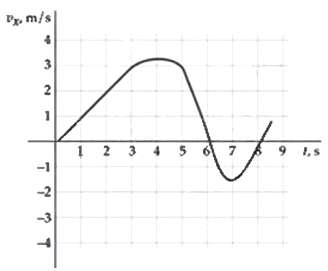
Figure shows a plot of vx versus t for an object of mass 8 kg moving in a straight line. Make a plot of the net force acting on the object as a function of time.
A 4-kg object is subjected to two forces, F1 = 2 N i - 3 N j and F2 = 4 n i - 11 N j. The object is at rest at the origin at time t = 0. (a) What is the object’s acceleration? (b) What is its velocity at time t = 3 s? (c) Where is the object at time t = 3 s?
Suppose an object were sent far out in space, away from galaxies, stars, or other bodies. How would its mass change? Its weight?
How would an astronaut in apparent weightlessness be aware of her mass?
Under what circumstances would your apparent weight be greater than your true weight?
Find the mass of a 165-lb man in kilograms.
After watching a space documentary, Lou speculates that there is money to be made by combining the phenomenon of weightlessness in space with the widespread longing for weight loss in the general population. Researching the matter, he learns that the gravitational force on a mass m at a height h
Caught without a map again, Hayley lands her spacecraft on an unknown planet. Visibility is poor, but she finds someone on a local communications channel and asks for directions to Earth. "You're already on Earth," is the reply, "Wait there and I'll be right over." Hayley is suspicious, however, so
Dean reads in his physics book that when two people pull on the end of a rope in a tug-of-war, the forces exerted by each on the other are equal and opposite, according to Newton's third law. Misunderstanding the law tragically, Dean runs out to challenge Hugo the Large, convinced that the laws of
A 2.5-kg object hangs at rest from a string attached to the ceiling.(a) Draw a diagram showing all forces acting on the object and indicate each reaction force.(b) Do the same for each force acting on the string.
Showing 6000 - 6100
of 21795
First
54
55
56
57
58
59
60
61
62
63
64
65
66
67
68
Last
Step by Step Answers

 Get 50% OFF
Claim Now
Get 50% OFF
Claim Now