New Semester
Started
Get
50% OFF
Study Help!
--h --m --s
Claim Now
Question Answers
Textbooks
Find textbooks, questions and answers
Oops, something went wrong!
Change your search query and then try again
S
Books
FREE
Study Help
Expert Questions
Accounting
General Management
Mathematics
Finance
Organizational Behaviour
Law
Physics
Operating System
Management Leadership
Sociology
Programming
Marketing
Database
Computer Network
Economics
Textbooks Solutions
Accounting
Managerial Accounting
Management Leadership
Cost Accounting
Statistics
Business Law
Corporate Finance
Finance
Economics
Auditing
Tutors
Online Tutors
Find a Tutor
Hire a Tutor
Become a Tutor
AI Tutor
AI Study Planner
NEW
Sell Books
Search
Search
Sign In
Register
study help
physics
particle physics
Principles And Practice Of Physics 2nd Edition Eric Mazur - Solutions
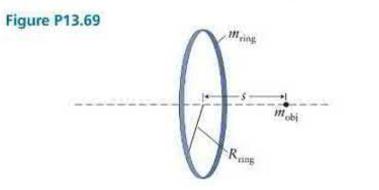
A uniform ring of mass \(m_{\text {ring }}\) and radius \(R_{\text {ting }}\) is shown in Figure P13.69. A small object of mass \(m_{\mathrm{obi}}\) sits a separation distance \(s\) from the ring on the line that is perpendicular to the plane of the ring and passes through the ring's center. Obtain
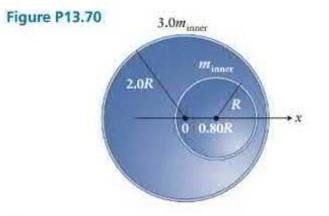
Two uniform spherical shells are located such that their centers are along the \(x\) axis in Figure P13.70. The inner shell has mass \(m_{\text {inner }}\) and radius \(R\), and its center is at \(x=0.80 R\). The outer shell has mass \(3.0 m_{\text {inner }}\) and radius \(2.0 R\), and its center
A thin disk of radius \(R\) has mass \(m_{\text {disk }}\) uniformly distributed over its area. (a) Derive an expression for the magnitude of the gravitational force this disk exerts on a particle of mass \(m_{\text {part }}\) located a distance \(y\) directly above the center of the disk. (b) If
In a system of \(N\) particles, how many terms are there in the expression for the gravitational potential energy of the system?
You equip a rocket with enough fuel to reach escape speed from Earth. If you plan to launch the rocket from just above ground level, does it matter whether you launch it vertically, at an angle, or horizontally?
What is the value of the acceleration \(g_{V_{\text {enus }}}\) due to gravity at the surface of Venus?
Is there any position in the elliptical orbit of a satellite where the tangential component of the acceleration is greater than the component perpendicular to the tangential component? If so, what conditions on the orbit must there be for such a position to exist?
The gravitational vector field \(\vec{g}(\vec{r})\) is defined as the gravitational force exerted on a small object located at a particular position \(\vec{r}\) divided by that object's mass. (a) Sketch the gravitational vector field produced by Earth at a sampling of positions around Earth. Make
Some writers of fiction have placed human beings on asteroids or other "planetoids" whose radius, in the illustrations accompanying the stories, seems not too much greater than the height of the people themselves! What would the density of such a celestial body have to be for the human to feel a
You wish to put a satellite in orbit around Earth. (a) Which takes more energy per kilogram of satellite: launching the satellite from the ground to a height of \(1600 \mathrm{~km}\) above the ground or placing the satellite into orbit once it has reached that altitude? (b) Repeat for an orbit
Unable to sleep, you crawl out of bed one evening and stare out your window at the night sky, finding Jupiter and sitting back to contemplate its grandcur. Remembering your physics, you imagine yourself at some height above the apparent surface of Jupiter, experiencing a gravitational force that
After seeing an old movie, you become concerned about a large asteroid that could be gravitationally attracted to Earth from very far away. You realize that long ago such an asteroid's speed relative to Earth's might have been very small, and thus you are able to calculate the relative speed it has
You are working on a project to plot the course of a spy satellite. The satellite has a polar orbit (which means it passes over both of Earth's poles during each orbit), and it is outfitted with a camera carrying a wide-angle lens that can "sec" strips of land up to \(2500 \mathrm{~km}\) wide. The
While helping an astronomy professor, you discover a binary star system in which the two stars are in circular orbits about the system's center of mass. From their color and brightness, you determine that each star has the same mass as our Sun. The orbital period of the pair is 24. 3 days, based on
Scientists still are not entirely sure whether the universe is open (which means it will keep expanding forever) or closed (which means it will eventually fall back in on itself in a "Big Crunch"). What determines whether it is open or closed is basically the same thing we calculate to determine
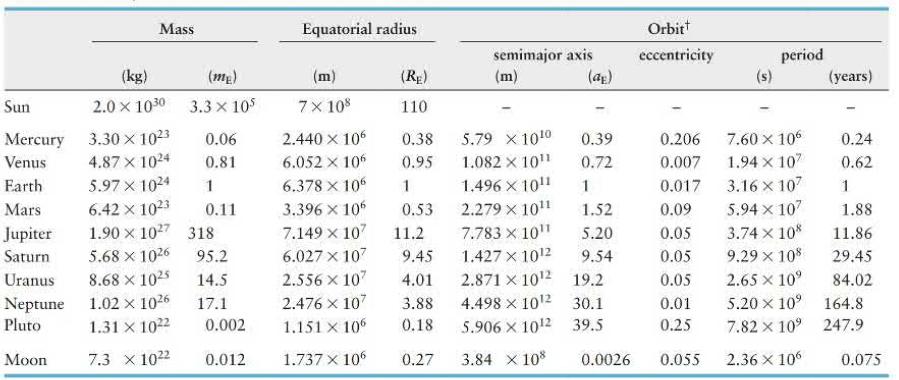
Compare the gravitational force exerted by Earth on you with \((a)\) that exerted by a person standing \(1 \mathrm{~m}\) away from you and (b) that exerted by Earth on Pluto.
Of all the objects in Table 13.1, Pluto has the orbit with the greatest eccentricity. (a) What is the ratio of the orbit's semiminor axis \(b\) to its semimajor axis \(a\) ? (b) What is the ratio of Pluto's speed at perihelion to its speed at aphelion?Data from Table 13.1 Mass Equatorial radius
Cavendish is said to have "weighed Earth" because his determination of \(G\) provided the first value for the planet's mass \(m_{\mathrm{E}}\). Given that the radius of Earth is about \(6400 \mathrm{~km}\) and given the value of \(G\) in Eq. 13.5, determine \(m_{\mathrm{F}}\).Data from Eq. 13.5 G =
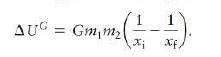
The distance between Earth's surface and an object of mass \(m\) is changed by an amount \(\Delta x\). Show that when \(x \approx R_{\mathrm{E}}\) and \(\Delta x \ll R_{\mathrm{E}}\), where \(R_{\mathrm{E}}\) is the radius of Earth, the general expression for gravitational potential energy, Eq.
A satellite of mass \(m_{\text {sat }}\) is in an elliptical orbit around a star of mass \(m_{\text {star }} \gg m_{\text {sat }}\). If the mechanical energy of the starsatellite system is \(E_{\text {mech }}\) and the magnitude of the angular momentum of the satellite about the star is \(L\), what
Determine the ratio of Earth's gravitational force exerted on a \(1.0-\mathrm{kg}\) object at the following positions to that at sea level: (i) the top of Mt. Everest, altitude \(8848 \mathrm{~m}\); (ii) a shuttle orbiting at \(200 \mathrm{~km}\); (iii) the orbit of the Moon. Is the
The orbital period of Jupiter around the Sun is 11. 86 times that of Earth. What is the ratio of their distances to the Sun?
If the speed of a planet in its orbit around the Sun changes, how can the planet's angular momentum be constant?
A brick of unknown mass is placed on a spring scale. When in equilibrium, the scale reads 13. 2 N. Which of the following statements is/are true? (i) Earth always exerts a gravitational force of \(13.2 \mathrm{~N}\) on the brick. (ii) The normal force the scale exerts on the brick is \(13.2
Draw a free-body diagram of an individual experiencing weightlessness in an elevator. What must the elevator's acceleration be for this to occur?
If you were to travel in a vertical circle, at what point in the circle would you be most likely to experience weightlessness?
Which of the following are events?(a) The local television station's newscast runs from 11:00 to 11:30 p.m.(b) The ceremonial first pitch is thrown at a baseball game in Omaha, Nebraska.(c) The Perseid meteor shower is seen across the eastern coast of North America.(d) A rainstorm lasts all day in
You are in a rocket moving away from Earth at onethird the speed of light relative to Earth. A friend is on Earth, and an astronaut in another rocket is moving toward Earth at one-third the speed of light (in the Earth reference frame), on a path collinear with your path. If each of you records the
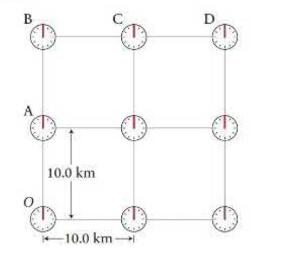
A set of atomic clocks is placed on a square grid as shown in Figure P14.3. In order to synchronize these clocks, you set the time on each to a certain reading before they are allowed to run. Clock \(O\) starts first, and at precisely 12:00 noon, it sends out a light pulse in all directions. Each
Events 1 and 2 are exploding firecrackers that each emit light pulses. In the reference frame of the detector, event 1 leaves a char mark at a distance \(3.40 \mathrm{~m}\) from the detector, and event 2 leaves a similar mark at a distance \(2.10 \mathrm{~m}\) from the detector. If the two events
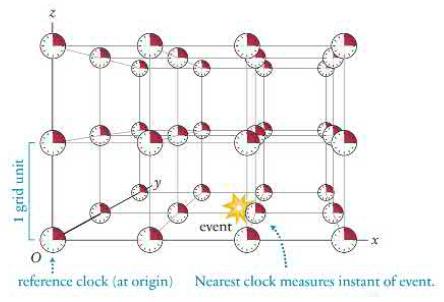
Consider the grid of clocks in Figure 14.6. Do observers stationed at clocks far from the reference clock read earlier, later, or the same time as the time on the reference clock \((a)\) if the clocks are to be synchronized after a pulse is sent out activating them but this pulse has not yet been
Observers A and B are both at rest in the Earth reference frame, in different parts of a large city, awaiting the start of a fireworks show. They want to synchronize their atomic clocks for some experiments to be conducted later that evening. A and B plan to start their clock displays at an agreed
Observer A is stationary in the Earth reference frame, and pilot \(\mathrm{B}\) is flying toward pilot \(\mathrm{A}\) at relative speed \(v_{\mathrm{AB}}\). What speed does observer \(A\) measure for the speed of the light emitted by a signal light on pilot B's ship?
Alarm clock 1 is positioned at \(x=-d\) and alarm clock 2 at \(x=+d\) in reference frame \(\mathrm{A}\). According to a clock in reference frame \(\mathrm{A}\), both go off at \(t=0\). An observer in reference frame \(B\), which is moving relative to \(A\), measures alarm clock 2 as going off
You are traveling toward a large fixed mirror at a constant relative speed \(0.20 c_{0}\). At \(t=0\), when the mirror is a distance \(d\) from you (measured in your reference frame), you emit a light pulse from a lantern and then detect the reflected light pulse \(0.80 \mu\) s later. What is the
You are in a jet helicopter traveling horizontally at \(180 \mathrm{~m} / \mathrm{s}\) relative to Earth. At one instant you observe the light pulses from two lightning strikes, one directly ahead of the helicopter and one directly behind it.(a) Can you say that the strikes occurred simultaneously
Consider a lightweight, straight, rigid rod that has a proper length of \(1 \times 10^{6} \mathrm{~m}\). If you rotate the rod at 100 turns/s about a perpendicular axis through its center, at what speed do the ends of the rod move? What prevents such a case from occurring?
Observer A on Earth sees spaceship B moving at speed \(v=0.600 c_{0}\) away from Earth and spaceship C moving at the same speed in the opposite direction. Observer A determines that both ships simultaneously sent out a radio signal at 12:00:00 noon and another signal at 12:05:00 p.m., making the
An astronaut takes what he measures to be a \(10-\) min nap in a space station orbiting Earth at \(8000 \mathrm{~m} / \mathrm{s}\). A signal is sent from the station to Earth at the instant he falls asleep, and a second signal is sent to Earth the instant he wakes. Does an observer on Farth measure
Standing somewhere between two vertical mirrors, you hold a lantern and at \(t=0\) emit a light pulse that travels in all directions. You observe the pulse reflected from the mirror on your right at \(t=2.5 \mu \mathrm{s}\) and from the mirror on your left at \(t=6.5 \mu \mathrm{s}\). What is the
A spaceship of proper length \(\ell=100 \mathrm{~m}\) travels in the positive \(x\) direction at a speed of \(0.800 c_{0}\) relative to Earth. An identical spaceship travels in the negative \(x\) direction along a parallel course at the same speed relative to Earth. At \(t=0\), an observer on Earth
A spacecraft traveling away from Earth at relative speed \(0.850 c_{0}\) sends a radio message when it is \(65,000,000 \mathrm{~km}\) away from Earth in the Earth reference frame. When the signal is received, Earth-based engineers immediately send a reply to the spacecraft. What do these engineers
Spaceships A, B, and C in Figure P14.18 all have the same proper length and all fly with the same speed according to an observer on Earth. Rank the lengths of the three ships as measured by an observer in ship A, longest first.Data from Figure P14.18 A B
The boundary of a lunar base is a square \(1 \mathrm{~km}\) wide and \(1 \mathrm{~km}\) long in the Moon reference frame. Spaceship A flies at high relative speed close to the Moon parallel to the edge that we shall call the length of the field. Crew A measures the length and width, and reports
What is the kinetic energy of a pin in your reference frame if you measure its inertia to be three times its mass?
A golf ball hit from a tee accelerates from rest to a speed of \(40.0 \mathrm{~m} / \mathrm{s}\) relative to the Earth reference frame. By what percent does the mass of the ball increase as it is hit?
One end of a vertical spring of spring constant \(k=1500 \mathrm{~N} / \mathrm{m}\) is attached to the floor. You compress the spring so that it is \(2.40 \mathrm{~m}\) shorter than its relaxed length, place a \(1.00-\mathrm{kg}\) ball on top of the free end, and then release the system at \(t=0\).
You pick up your physics book from the floor and put it on your desk. In the Earth reference frame, which of the following quantities have changed for the system made up of Earth and the book: mass, energy, inertia, kinetic energy?
Observer A is on Earth looking at the Moon, and observer B is on the Moon looking at Earth. Which of the following quantities do the observers agree on for the Earth-Moon system: inertia, energy, mass, kinetic energy?
A bullet is fired from a rifle (event 1 ) and then strikes a soda bottle, shattering it (event 2 ). Is there some inertial reference frame in which event 2 precedes event 1 ? If so, does the existence of this reference frame violate causality?
Classify the space-time interval between each pair of events as timelike, spacelike, or lightlike: (a) A sunspot erupts on the surface of the Sun and is seen on Earth \(500 \mathrm{~s}\) later. (b) A supernova explodes and is noticed \(8.00 \times 10^{20} \mathrm{~m}\) away after \(8.45 \times
Calculate the Lorentz factor for an object moving relative to Earth at(a) \(60 \mathrm{mi} / \mathrm{h}\),(b) \(0.34 \mathrm{~km} / \mathrm{s}\) (speed of sound in air),(c) \(28 \times 10^{3} \mathrm{~km} / \mathrm{h}\) (orbital speed of the International Space Station),(d) 0.1 c0,(e) 0. 3 c0,
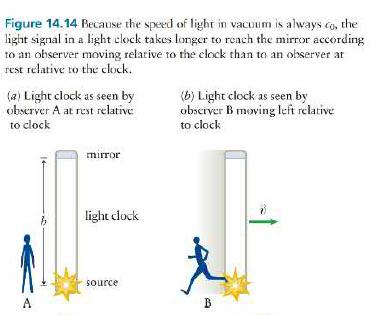
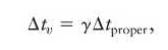
You measure the period of light clock \(A\) to be \(T\) as it moves relative to you with a speed \(0<v_{A}<0.5 c_{0}\). You measure the period of an identical light clock (clock B) to be \(3 T\) as it moves relative to you with speed \(v_{\mathrm{B}}=2 v_{\mathrm{A}}\). Determine numerical
A space station sounds an alert signal at time intervals of 1. 00 h. Spaceships A and B pass the station, both moving at \(0.400 c_{0}\) relative to the station but in opposite directions. How long is the time interval between signals(a) according to an observer on \(\mathrm{A}\) and \((b)\)
A certain muon detector counts 600 muons per hour at an altitude of \(1900 \mathrm{~m}\) and 380 muons per hour at sea level. Given that the muon half-life at rest is \(1.5 \times 10^{-6} \mathrm{~s}\), determine the speed of the muons relative to Earth, assuming they all have the same speed.
Planets \(\mathrm{A}\) and \(\mathrm{B}\) are 10 light years apart in the reference frame of planet A. (One light year is the distance light travels in one year.) A deep-space probe is launched from \(\mathrm{A}\), and \(5 \mathrm{y}\) later (in reference frame A) a similar probe is launched from
Section 14. 3 describes how the number of muons reaching Farth's surface is greater than the number expected based on the muon half-life of \(1.5 \times 10^{-6} \mathrm{~s}\). How fast, relative to Earth, must muons be moving in order for onc of every million muons to pass through a distance equal
One cosmonaut orbited Earth for 437 days, as measured by Earth clocks. His speed of orbit was \(7700 \mathrm{~m} / \mathrm{s}\) relative to Earth during this time interval. Assume two clocks were synchronized on Earth, and one went into space with the cosmonaut while the other remained on Earth.
A cosmic ray traveling at \(0.400 c_{0}\) relative to Earth passes observer A (event 1) and then a short time interval later passes observer B (event 2). The observers are at rest, \(8.00 \mathrm{~km}\) apart in the Earth reference frame. What are (a) the proper length and (b) the proper time
An elementary particle is launched from Earth toward the Regulus system, 77. 5 light years distant. At what speed relative to Earth must this particle travel to make this trip in \(10 \mathrm{y}\) in the reference frame of the particle?
Spaceships A and B pass a space station at the same instant, the two ships moving in opposite directions at the same speed of \(0.600 c_{0}\) relative to the station. What is the Lorentz factor associated with the relative motion of the ships?
Two elementary particles pass each other moving in opposite directions, each moving at speed \(0.800 c_{0}\) relative to Earth. What is the speed of one particle relative to the other?
The radius of Earth is \(6370 \mathrm{~km}\) in the Farth reference frame. In the reference frame of a cosmic ray moving at \(0.800 c_{0}\) relative to Earth, how wide does Earth seem (a) along the flight direction and (b) perpendicular to the flight direction?
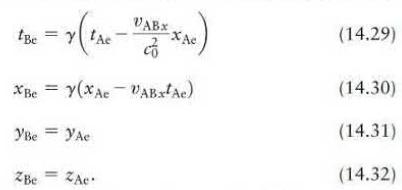
Show that the Lorentz transformation equations (Eqs. 14. 29-14.32) reduce to the Galilean transformation equations in the limit \(v_{\mathrm{AB}} \ll c_{0}\).Data from Eqs. 14. 29-14.32 VABX tBe Ae XAe (14.29) XBe y(xAe VABxAe) == YBe YAe ZBe Ac (14.30) (14.31) (14.32)
An elementary particle moving away from Earth reaches its destination after two wecks (in the reference frame of the particle) traveling at \(0.9990 c_{0}\) relative to Earth. How far has it traveled in \((a)\) its reference frame and \((b)\) the Earth reference frame?
Describe the shape of the Moon as measured by an observer in a reference frame traveling past the Moon at a relative speed of (a) 1000 m / s,(b) 0. 50 c0, and(c) 0.95 c0.
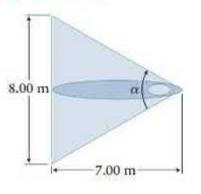
When at rest in the Earth reference frame, the delta-wing spaceship in Figure P14.43 is \(7.00 \mathrm{~m}\) long and has a wingspan of \(8.00 \mathrm{~m}\).(a) What is the opening angle \(\alpha\) of its wings? \((b)\) If the same ship is moving forward at \(0.700 c_{0}\) relative to Earth, what
Standing at rest in the Earth reference frame, you observe two events, also at rest in that reference frame, occurring at these coordinates: event 1: \(x_{1}=10 \mathrm{~km}, y_{1}=5.0 \mathrm{~km}\), \(z_{1}=0, t_{1}=20 \mu \mathrm{s} ;\) event \(2: x_{2}=30 \mathrm{~km}, y_{2}=5.0 \mathrm{~km}\),
Use the Lorentz transformation equations (Eq. 14. 29-14.32) to prove that the space-time interval \(s^{2}\) between two events is Lorentz-invariant, which means it has the same value for all possible inertial reference frames.Data from Eqs. 14. 29-14.32 VABX tBe Ae XAe (14.29) XBe y(xAe VABxAe) ==
An elementary particle travels at \(0.840 c_{0}\) across a solar system that has a diameter of \(8.14 \times 10^{12} \mathrm{~m}\) (both measurements in the reference frame \(S\) of the solar system).(a) What value does an observer in reference frame \(S\) measure for the time interval needed for
A space colony defines the origin of a coordinate system in reference frame \(\mathrm{C}\), and you are at rest in this reference frame at position \(x=+3.000 \times 10^{5} \mathrm{~km}\). A ship passes the colony moving in the positive \(x\) direction at \(0.482 c_{0}\) in reference frame
Observer \(\mathrm{O}\) at the origin of a coordinate system is at rest relative to two equidistant space stations located at \(x=+3.00 \times 10^{6} \mathrm{~km}\left(\right.\) station A) and \(x=-3.00 \times 10^{6} \mathrm{~km}\) (station B) on the \(x\) axis. In reference frame \(\mathrm{O}\),
A spaceship travels at \(0.610 c_{0}\) away from Earth. When the ship is \(3.47 \times 10^{11} \mathrm{~m}\) away in the Earth reference frame, the ship clock is set to \(t=0\) and a message (light signal) is sent to its ground crew on Earth. When this message is received, the ground crew
According to an observer at rest in the Earth reference frame, ship A travels in one direction at speed \(0.862 c_{0}\) while ship B moves in the opposite direction at \(0.717 c_{0}\). Ship A sends out a shuttle module \(M\) that travels to ship B at speed \(0.525 c_{0}\) relative to A. For every
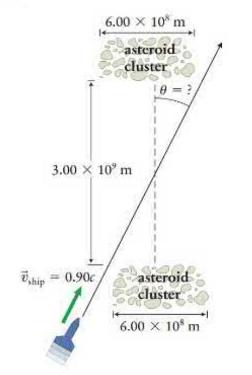
Two asteroid clusters at rest with respect to each other are \(3.00 \times 10^{9} \mathrm{~m}\) apart, and both measure \(6.00 \times 10^{8} \mathrm{~m}\) across in the reference frame of the clusters. A pilot in a spaceship moving at \(0.900 c_{0}\) relative to the cluster reference frame is
Determine the magnitude of the momentum of a muon in a reference frame in which the muon moves with speed \(0.500 c_{0}\). The mass of a muon is 207 times the mass of an electron.
An electron accelerates from \(0.700 c_{0}\) to \(0.900 c_{0}\) in the Earth reference frame. In this reference frame, by what factor do \((a)\) its mass and \((b)\) its inertia increase?
(a) What is the magnitude of the momentum of an electron in a reference frame in which it is moving at \(0.500 c_{0}\) ? (b) At what speed must the electron move in a reference frame in which it has twice the momentum you calculated in part \(a\) ?
Object A, mass \(4.24 \times 10^{5} \mathrm{~kg}\), is at rest in reference frame \(\mathrm{A}\), and object \(\mathrm{B}\), mass \(7.71 \times 10^{4} \mathrm{~kg}\), moves at \(0.875 c_{0}\) in this reference frame. (a) What does an observer at rest in A measure for the momentum of B? (b) What
A uniform 200-kg cube that has a volume of \(8.00 \mathrm{~m}^{3}\) (measured when the cube is at rest in the Earth reference frame) travels perpendicular to a pair of its faces at \(0.672 c_{0}\) relative to Earth. (a) What is the mass density of the cube according to an observer at rest on Earth?
Muons are formed \(10.0 \mathrm{~km}\) above Earth's surface. What magnitude of momentum (in the Earth reference frame) must they have immediately after formation in order for only one of every 10,000 of them to reach the ground? The mass of a muon is 207 times the mass of an electron.
Two chunks of rock, each having a mass of \(1.00 \mathrm{~kg}\), collide in space. Just before the collision, an observer at rest in the reference frame of a nearby star determines that rock \(\mathrm{A}\) is moving toward the star at \(0.500 c_{0}\) and rock \(\mathrm{B}\) is moving away from the
In the Farth reference frame, a \(150 \mathrm{~kg}\) probe travels at \(0.860 c_{0}\) while a \(250-\mathrm{kg}\) probe travels at \(0.355 c_{0}\) in the opposite direction. What are the velocities of the probes in the zero-momentum reference frame?
At what speed must a particle move in your reference frame so that its kinetic energy is equal to its internal energy?
Particles A, B, and C each have mass \(m\), and their energies are \(E_{\mathrm{A}}=E, E_{\mathrm{B}}=2 E\), and \(E_{\mathrm{C}}=3 E\). Rank the particles, largest first, in order of \((a)\) Lorentz factor, \((b)\) kinetic energy, \((c)\) speed, and \((d)\) magnitude of momentum.
What is the internal energy of an electron moving at \(0.750 c_{0}\) in the Farth reference frame?
Uranium-238 decays to thorium and helium according to the reaction \({ }^{238} \mathrm{U} \rightarrow{ }^{234} \mathrm{Th}+{ }^{4} \mathrm{He}\). How much energy is released when \(1.00 \mathrm{~kg}\) of uranium-238 decays? Compare this amount with the energy released when \(1.00 \mathrm{~kg}\) of
Assume that 437 days is a reasonable limit for how long a human can endure constant-velocity space travel. Proxima Centauri, the star closest to our Sun, is 4. 24 light years away from Earth. If you wanted to fly to Proxima Centauri within the 437-day limit in a rocket of mass \(2.00 \times 10^{6}
A particle of mass \(m_{\text {orig }}\), initially at rest in the Earth reference frame, decays into two particles 1 and 2 that have masses \(m_{1}\) and \(m_{2}\), respectively. Use conservation of energy, conservation of momentum, and Eq. 14. 57, \(E^{2}-\left(c_{0} p\right)^{2}=\left(m
Which of the following forms of energy contribute to the mass of a gas molecule: \((a)\) energy due to the molecule rotating about its center of mass, \((b)\) energy due to compression of atoms in the molecule, \((c)\) energy due to the molecule's translational motion relative to Earth?
At the Large Hadron Collider in Switzerland, two highenergy protons collide to create new particles. Prior to collision, each proton is accelerated to an energy of \(7000 \mathrm{GeV}\) in the Earth reference frame. (a) What is the speed of each proton? (b) What is the maximum mass possible for any
An electron \(\mathrm{e}^{-}\)and positron \(\mathrm{e}^{+}\)moving at the same speed in the Earth reference frame collide head-on and produce a proton \(\mathrm{p}\) and an antiproton \(\overline{\mathrm{p}}\). The electron and positron have the same mass. The proton and antiproton also have the
Antihydrogen is the only antimatter element that has been produced in the laboratory, albeit just a few atoms at a time. Each antihydrogen atom consists of a positron in orbit around an antiproton and has the same atomic mass as hydrogen. If an antihydrogen atom collides with a hydrogen atom, they
Galaxy A moves away from galaxy \(\mathrm{B}\) at \(0.600 c_{0}\) relative to B. A spaceship leaves a planet in galaxy A traveling at \(0.500 c_{0}\) relative to galaxy \(\mathrm{A}\). If the direction in which the ship travels is the same as the direction in which \(\mathrm{A}\) is moving away
A tree that is \(32.6 \mathrm{~m}\) tall leans \(26.0^{\circ}\) from the vertical in the Farth reference frame. How tall is the tree, and at what angle does it lean, in the reference frame of a cosmic ray muon moving parallel to the tree at a speed of \(0.382 c_{0}\) relative to Earth?
Consider a searchlight on the ground that casts a spot on a cloud \(1000 \mathrm{~m}\) overhead. If the searchlight is rotated rapidly-say, \(30^{\circ}\) in \(1 \mu \mathrm{s}\)-how fast does the spot move in the Earth reference frame? Is this a violation of special relativity?
Two events occur at different locations on Farth and are simultaneous in the reference frame of an observer standing on Earth halfway between the events. Are these events simultaneous in any other inertial reference frame?
Pilot \(\mathrm{A}\) is seated in the middle of a ship that has a proper length of \(250 \mathrm{~m}\), and pilot B is seated in the middle of an identical ship. Pilot B passes A at a speed that A measures to be \(0.580 c_{0}\). How long does it take B's ship to pass pilot \(\mathrm{A}(a)\)
Relative to Earth, spaceship A travels at \(0.732 c_{0}\) away from Earth, and spaceship B travels at \(0.914 c_{0}\) toward Earth along the same straight line. (a) How fast does A move according to an observer aboard \(\mathrm{B}\) ? (b) At \(t=0\) the two ships are separated by \(4.5 \times
A proton \(\mathrm{p}_{1}\) moving in the Earth reference frame collides with a proton \(p_{2}\) that is at rest in that reference frame. The collision creates a particle that has mass \(m\) and an internal energy 40 times the internal energy of a proton: \(m c_{0}^{2}=40 m_{\mathrm{p}}
Showing 3400 - 3500
of 4962
First
28
29
30
31
32
33
34
35
36
37
38
39
40
41
42
Last
Step by Step Answers

 Get 50% OFF
Claim Now
Get 50% OFF
Claim Now