New Semester
Started
Get
50% OFF
Study Help!
--h --m --s
Claim Now
Question Answers
Textbooks
Find textbooks, questions and answers
Oops, something went wrong!
Change your search query and then try again
S
Books
FREE
Study Help
Expert Questions
Accounting
General Management
Mathematics
Finance
Organizational Behaviour
Law
Physics
Operating System
Management Leadership
Sociology
Programming
Marketing
Database
Computer Network
Economics
Textbooks Solutions
Accounting
Managerial Accounting
Management Leadership
Cost Accounting
Statistics
Business Law
Corporate Finance
Finance
Economics
Auditing
Tutors
Online Tutors
Find a Tutor
Hire a Tutor
Become a Tutor
AI Tutor
AI Study Planner
NEW
Sell Books
Search
Search
Sign In
Register
study help
physics
particle physics
Principles And Practice Of Physics 2nd Edition Eric Mazur - Solutions
Is it possible for the kinetic energy of an object to remain constant even when the vector sum of the forces exerted on the object is not zero? If yes, give an example. If no, explain why not.
To be rescued from the roof of a burning building, a \(70-\mathrm{kg}\) man must be able to jump straight up and catch hold of a rope ladder hanging from a helicopter. He has to raise his center of mass \(2.00 \mathrm{~m}\) above the roof to do so. (a) If he crouches down such that his center of
About how much work does a trash collector do in the course of an 8-hour shift?
A constant, nondissipative external force is applied to a solid block, and it is found that the rate at which energy is delivered by the force is constant as the block moves horizontally. What does this imply for the motion of the block?
An object is suspended from the ceiling by a spring aligned along a vertical \(x\) axis, with upward defined as the positive \(x\) direction. When the spring is at its relaxed length, the object is at the origin of the axis. The object is pulled down to position \(-x_{1}\), held at rest, and
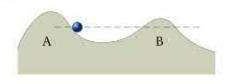
You are midway up hill A in Figure P9.75. Across the valley is the shorter hill \(B\), the summit of which is slightly higher than your present spot. You want to roll a ball so that it crests hill B. To get the ball moving, you can roll it either up or down hill A, giving the ball the same initial
A \(10-\mathrm{kg}\) dog jumps up in the air to catch a ball. The dog's center of mass is normally \(0.20 \mathrm{~m}\) above the ground, and he is \(0.50 \mathrm{~m}\) long. The lowest he can get his center of mass is \(0.10 \mathrm{~m}\) above the ground, and the highest he can get it before he
Assume that when you stretch your torso vertically as much as you can, your center of mass is \(1.0 \mathrm{~m}\) above the floor. The maximum force you can exert on the floor in pushing off is 2. 3 times the gravitational force Earth exerts on you. How low do you have to crouch in order to jump
The \(2000-\mathrm{kg}\) cab of a freight elevator is rated to carry a maximum load of \(1200 \mathrm{~kg}\), but a careless worker fills the cab with freight that has a combined inertia of \(1400 \mathrm{~kg}\). The worker then raises the cab \(3.1 \mathrm{~m}\) at a steady \(2.0 \mathrm{~m} /
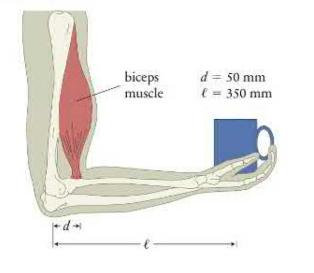
Taking a sip of coffee one day, you start thinking about the effort it takes to do so. Your forearm is a type of lever. As shown in Figure P9.79, the biceps muscle is attached to the forearm bone about \(50 \mathrm{~mm}\) in front of the elbow joint. The cup of coffee in your hand is \(350
You are planning to jump off a bridge with a bungee cord tied to your ankles. The bridge deck is \(150 \mathrm{~m}\) above the water, and the cord spring constant is \(40 \mathrm{~N} / \mathrm{m}\). Because you must fall the length of the unstretched cord before it begins to stretch, you realize
A ball of inertia \(m_{b}\) is relcased from rest and falls vertically. What is the ball's final kinetic energy after a displacement \(\Delta x=x_{\mathrm{f}}-x_{i}\) ?
A \(60-\mathrm{kg}\) person jumps off a chair and lands on the floor at a speed of \(1.2 \mathrm{~m} / \mathrm{s}\). Once his feet touch the floor surface, he slows down with constant acceleration by bending his knees. During the slowing down, his center of mass travels \(0.25 \mathrm{~m}\).
A brick of inertia \(m\) compresses a spring of spring constant \(k\) so that the free end of the spring is displaced from its relaxed position. What is the work done by the brick on the spring during the compression?
A \(0.50-\mathrm{kg}\) wood block initially traveling at \(1.0 \mathrm{~m} / \mathrm{s}\) slides \(0.50 \mathrm{~m}\) on a horizontal floor before coming to rest. What is the average rate at which thermal energy is generated?
A car requires \(300 \mathrm{~kJ}\) of energy to overcome air resistance and maintain a constant speed of \(20 \mathrm{~m} / \mathrm{s}\) over a distance of \(1.0 \mathrm{~km}\). What is the force of air resistance exerted on the car?
A piece of salami is squashed between two pieces of bread. Is there one interaction between the salami and bread or more than one?
Explain why you cannot cause Earth to accelerate very much, even if you jump up and down on it.
Sketch curves, to the same scale, of kinetic energy versus time for an elastic collision between cart A, originally moving with speed \(v\), and cart \(\mathrm{B}\), originally at rest, when (a) \(m_{\mathrm{b}}=m_{\mathrm{A}}\), (b) \(m_{\mathrm{b}}=2 m_{\mathrm{A}}\), and (c)
Two objects of inertias \(m_{1}\) and \(m_{2}\) start from rest and then interact with each other (assume neither is interacting with any other object). (a) What is the ratio of their \(x\) components of velocity at any instant? (b) What is the ratio of their kinetic energies at any instant?
Two toy cars \(\left(m_{1}=0.200 \mathrm{~kg}\right.\) and \(\left.m_{2}=0.250 \mathrm{~kg}\right)\) are held together rear to rear with a compressed spring between them. When they are released, the cars are free to roll away from the ends of the spring. If you measure the acceleration of the
You are at the swimming pool and want to make a splash. You climb the ladder to the high diving board, take a big bounce, and produce a prodigious splash. Describe the changes in kinetic and potential energy involved in this motion, beginning when you start to climb and ending when you hit the
You throw a stone straight up and then catch it as it falls. Draw the energy bar diagrams for the stone-Earth system(a) just after the stone leaves your hand\((b)\) at the top of the stone's path, and(c) just before the stone is back in your hand.
A ring is attached at the center of the underside of a trampoline. A sneaky teenager crawls under the trampoline and uses the ring to pull the trampoline slowly down while his \(75-\mathrm{kg}\) mother is sleeping on it. When he releases the trampoline, she is launched upward. As she passes through
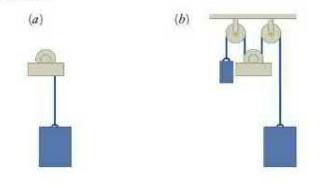
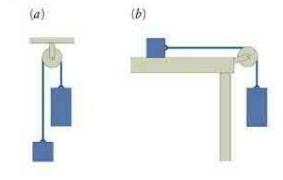
An elevator might be raised and lowered directly by a winch, as in Figure P7.9a, or the mechanism might include a counterweight that moves up when the elevator moves down, as in Figure P7.9b. In which case is the change in the gravitational potential energy of the Earthelevator-winch system
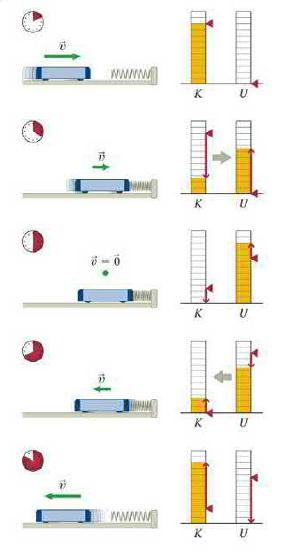
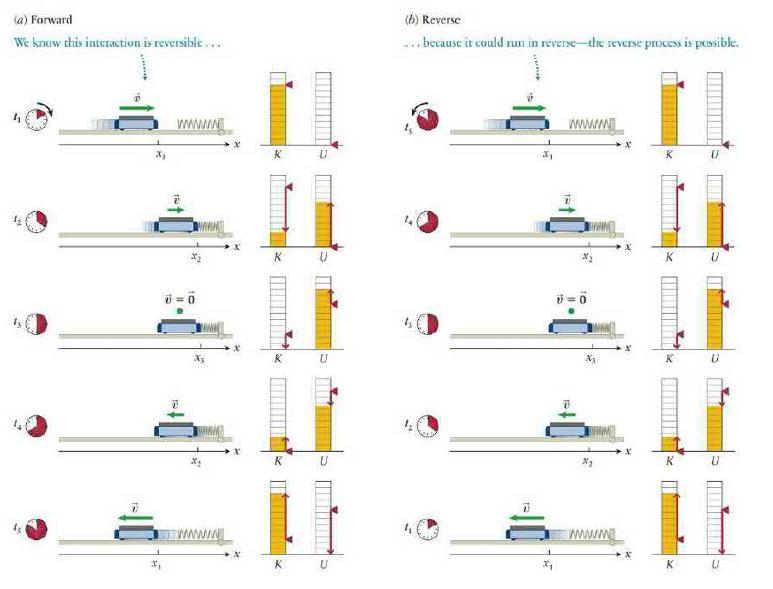
Figures 7. 7 and 7. 25 suggest that potential energy in a nondissipative interaction builds up and then diminishes. Is this always the case?Data from 7. 7Data from Figure 7. 25 wwww wwww K U K U K K U
Two blocks are held together with a compressed spring between them on the surface of a slippery table. One block has three times the inertia of the other. When the blocks are released, the spring pushes them away from each other. What is the ratio of their kinetic energies after the release?
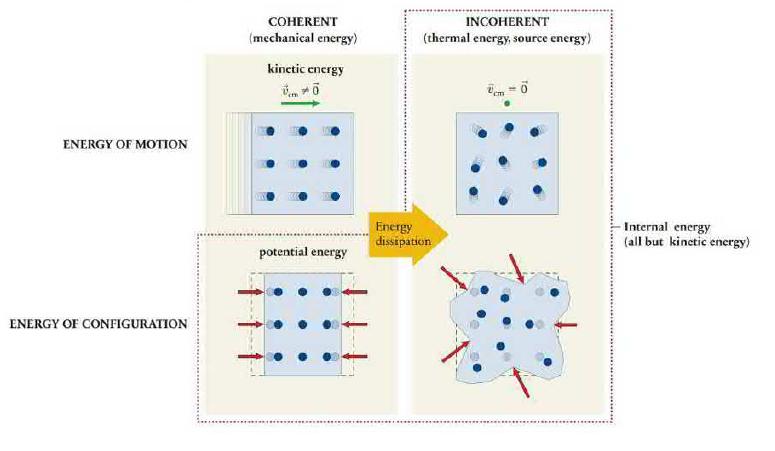
A trampoline's springs are what allow you to bounce, and if you bounce long enough, the springs get warm. Using Figure 7. 10 as a guide, classify the energy in the springs that accounts for \((a)\) the bouncing and \((b)\) the heating up.(c) Where does this energy come from?Data from Figure 7.
You throw a baseball straight up, and because of air resistance some of the ball's energy is converted to thermal energy during the whole trip. Which takes longer: the trip up or the trip down?
An arrow is shot into a hollow pipe resting on a horizontal table and flies out the other end. While the arrow travels in the pipe, its feathers brush against the walls of the pipe. (a) Which type of collision is the arrow-pipe interaction: elastic, inelastic, or totally inelastic? (b) Is there an
(a) When you stretch a Slinky spring a moderate amount and then release it, it returns to its original state, and all the potential energy stored by the stretching is converted to another form. If you stretch too much, however, you can permanently bend the spring. Where does the stored potential
Mattresses are often a linked set of coil springs. Using Figure 7. 10 as a guide, classify the energy that you give the mattress in each of these cases: (a) You slide the mattress from one side of a room to the other side. (b) You jump on the mattress several times. (c) You run your fingers along
Make a graph of the kinetic energy, potential energy, and incoherent energy versus time for \((a)\) a moving billiard ball colliding with a stationary billiard ball, and(b) a moving ball of cookic dough colliding with, and sticking to, an identical but stationary ball of cookie dough.
When a steel ball and a soft rubber ball are dropped from the same height onto a concrete surface, the steel ball bounces higher. When they are dropped onto packed sand, however, the rubber ball bounces higher. Explain the difference.
When an \(800 \mathrm{~kg}\) compact car accelerates from rest to \(27 \mathrm{~m} / \mathrm{s}\), it consumes \(0.0606 \mathrm{~L}\) of gasoline, and \(1.0 \mathrm{~L}\) of gasoline contains approximately \(3.2 \times 10^{7} \mathrm{~J}\) of energy. What is the efficiency of the car (in other
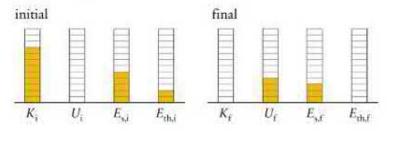
(a) Figure P7.21 shows initial and final energy bars for a closed system. Adjust the height of any two energy bars in the final version, on the right, so that the diagram does not violate what we know about energy. (There are numerous ways for you to do this.) (b) Describe an interaction that would
Two objects initially moving at velocities that have \(x\) components \(v_{1 x}\) and \(v_{2 x}\) collide totally inelastically. (a) Show that the ratio of the kinetic energy dissipated in the interaction is(b) What does the minus sign in the expression in part \(a\) mean?
If, on the atomic scale, "contact" between two objects is in fact not physical contact, does that have implications for the contact between atoms in a piece of copper?
Suppose you and a friend stand within an arm's length of each other and throw a ball back and forth. Describe a method to model an attractive interaction based on throwing the ball.
(a) When you throw a ball to a friend, at what instant does your momentum change: at the beginning, middle, or end of the ball's flight? (b) At which of these three instants does your friend's momentum change?
Consider the interactions involved when \((a)\) you use a TV remote control to change the channel, and \((b)\) you use your cell phone to text your friend. Classify each interaction as long range or short range.
Suppose that, instead of two types of electrically charged particles in the universe, there was only one type. What would you expect to happen to the structure of the universe if the particles produced \((a)\) an attractive interaction and \((b)\) a repulsive interaction?
Explain why friction is not considered a fundamental interaction.
Suppose that the range of the strong interaction were suddenly increased by 20 orders of magnitude, with all other interactions unchanged. Describe the changes that might occur in the structure of our world.
Picture two objects, A and B, taking part in some interaction involving gauge particles. If object A radiates gauge particles uniformly in all directions, how does the strength of the interaction depend on the distance from A to \(B\) ? Assume that the gauge particles do not interact with one
On a low-friction track, a \(0.66-\mathrm{kg}\) cart initially going at \(1.85 \mathrm{~m} / \mathrm{s}\) to the right collides with a cart of unknown inertia initially going at \(2.17 \mathrm{~m} / \mathrm{s}\) to the left. After the collision, the \(0.66-\mathrm{kg}\) cart is going at \(1.32
Two children on ice skates pull toward each other on a rope held taut between them. The inertia of one child is \(30 \mathrm{~kg}\), and the inertia of the other is \(25 \mathrm{~kg}\).(a) If at one instant the \(30-\mathrm{kg}\) child is accelerating at \(1.0 \mathrm{~m} / \mathrm{s}^{2}\) to the
A \(0.010-\mathrm{kg}\) bullet is fired from a \(5.0-\mathrm{kg}\) gun with a muzzle velocity of \(250 \mathrm{~m} / \mathrm{s}\). (a) While the bullet is traveling in the barrel, what is the ratio of the acceleration of the gun to the acceleration of the bullet as a function of time? (b) What is
A \(1500-\mathrm{kg}\) car going at \(6.32 \mathrm{~m} / \mathrm{s}\) collides with a \(3000-\mathrm{kg}\) truck at rest. If the collision is totally inelastic and takes place over an interval of \(0.203 \mathrm{~s}\), what is the average acceleration of each vehicle? Are the ratio of accelerations
A glob of putty thrown to the right bounces off a 0. 500 \(\mathrm{kg}\) cart initially at rest on a low-friction track. The collision takes \(0.15 \mathrm{~s}\), and the coefficient of restitution is 0. 64. The cart has a final velocity of \(1.0 \mathrm{~m} / \mathrm{s}\) to the right, and the
An \(8.20-\mathrm{kg}\) object is sliding across the ice at \(2.34 \mathrm{~m} / \mathrm{s}\). An internal explosion occurs, splitting the object into two equal chunks and adding \(16 \mathrm{~J}\) of kinetic energy to the system. What is the average acceleration of the two chunks if the explosive
A railroad car that has an inertia of \(5.04 \times 10^{4} \mathrm{~kg}\) is moving to the right at \(4.25 \mathrm{~m} / \mathrm{s}\) when it collides and couples with three identical railroad cars that are already coupled together and moving in the same direction at \(2.09 \mathrm{~m} /
A \(90-\mathrm{kg}\) halfback on a football team runs head-on into a \(120-\mathrm{kg}\) opponent at an instant when neither has his feet on the ground. The halfback is initially going west at \(10 \mathrm{~m} / \mathrm{s}\), and his opponent is initially going east at \(4.37 \mathrm{~m} /
You are watching a hockey game on your digital video recorder. Your team's goalie is at rest when he catches a \(0.16 \mathrm{~kg}\) puck moving straight toward him. The announcer says it was a \(40-\mathrm{m} / \mathrm{s}\) slap shot, based on radar gun data. Normally the goalie would be braced,
Two objects, one red and one yellow, start from rest and interact with each other along an \(x\) axis. (a) If \(m_{\text {red }}<m_{\text {yellow, }}\) what are the ratios of their changes in momentum, velocity, and kinetic energy? (b) Compare these ratios with the ratio of their accelerations.
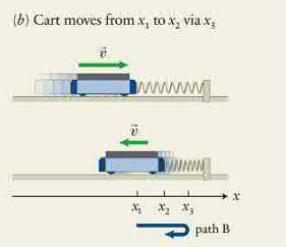
Draw a bar diagram representing the various kinds of energy for the cart-spring system in Figure \(7.26 b\) when the end of the cart attached to the spring is at locations \(x_{1}, x_{2}\), and \(x_{3}\).Data from Figure 7.26 b (b) Cart moves from x, to x, via xx wwwwww xxx path B
The potential energy of an interaction is given by \(U(x)=a x^{2}\), where \(a=+6.4 \mathrm{~J} / \mathrm{m}^{2}\). (a) If the initial speed of a \(0.82-\mathrm{kg}\) object in this system is \(2.23 \mathrm{~m} / \mathrm{s}\) at \(x=0\), how far does the object travel before it reaches a speed of
Suppose we have a block mounted on a spring and define the zero point for the elastic potential energy of the system to be the relaxed position (meaning the block is positioned such that the spring is neither compressed nor stretched). What is the appropriate sign of the elastic potential energy
A \(0.36-\mathrm{kg}\) cart and a \(0.12-\mathrm{kg}\) cart are held together with a compressed spring between them. When they are released, the \(0.36-\mathrm{kg}\) cart moves at \(1.1 \mathrm{~m} / \mathrm{s}\) to the right. How much elastic potential energy was stored in the spring before the
A \(0.530-\mathrm{kg}\) cart moving at \(0.922 \mathrm{~m} / \mathrm{s}\) to the right collides elastically with a \(0.25-\mathrm{kg}\) cart initially at rest. The \(0.25-\mathrm{kg}\) cart then moves off rapidly and compresses a spring before the \(0.530-\mathrm{kg}\) cart can catch it again. At
A low-friction track is set up with a spring on the right end. In the middle of the track, a \(2.0-\mathrm{kg}\) cart moving to the right at \(5.0 \mathrm{~m} / \mathrm{s}\) overtakes a \(3.0-\mathrm{kg}\) cart moving to the right at \(2.0 \mathrm{~m} / \mathrm{s}\). After the collision, the
For a certain interaction, the potential energy in joules is given by \(U(x)=a x+b x^{2}\), where \(a=+4.0 \mathrm{~J} / \mathrm{m}\) and \(b=-2.0 \mathrm{~J} / \mathrm{m}^{2}\). If, at some instant, a \(10-\mathrm{kg}\) object taking part in this interaction has an \(x\) component of velocity of
You release a block from the top of a long, slippery inclined plane of length \(\ell\) that makes an angle \(\theta\) with the horizontal. The magnitude of the block's acceleration is \(g \sin \theta\). (a) For an \(x\) axis pointing down the incline and having its origin at the release position,
On a low-friction track, a \(0.36-\mathrm{kg}\) cart initially moving to the right at \(2.05 \mathrm{~m} / \mathrm{s}\) collides elastically with a \(0.12-\mathrm{kg}\) cart initially moving to the left at \(0.13 \mathrm{~m} / \mathrm{s}\). The \(0.12-\mathrm{kg}\) cart bounces off the
A \(70-\mathrm{kg}\) woman walks to the top of the Empire State Building, \(380 \mathrm{~m}\) above street level. What is the change in the gravitational potential energy of the system comprising the woman and Earth?
At graduation, you toss your mortarboard cap straight up at some initial speed \(v\). How fast is it moving when it comes back down to your hands if you \((a)\) ignore air resistance and \((b)\) include it? How do you know?
An office worker has his lunch on the 53rd floor of an office building. In which case is the gravitational potential energy of the lunch-Earth system greatest: \((a)\) the worker carried the lunch up to the 53rd floor in the elevator, \((b)\) he carried it up the stairs to the 53rd floor, or (c)
A \(0.0135-\mathrm{kg}\) bullet is fired from ground level directly upward. If its initial speed is \(300 \mathrm{~m} / \mathrm{s}\) and we could ignore air resistance, how high does it go?
A typical loaded commercial jet airplane has an inertia of \(2.1 \times 10^{5} \mathrm{~kg}\). (a) Based on the time intervals involved, which do you expect to require more energy: getting the plane up to cruising speed or getting it up to cruising altitude? (b) How much energy does it take to get
Two 2. 4-kg blocks are connected by a string draped over the edge of a slippery table, so that one block is on the table and the other is just hanging off the edge. A restraint holds the block on the table in place, and the string is \(0.50 \mathrm{~m}\) long. After the restraint is removed, what
A \(30-\mathrm{kg}\) child jumps to the ground from the top of a fence that is \(2.0 \mathrm{~m}\) high. You analyze the problem using upward as the positive \(x\) direction. (a) Taking \(x=0\) to be at the bottom of the fence, what are the initial potential energy of the child-Earth system and the
You lean out of your dorm window, which is \(12 \mathrm{~m}\) above the ground, and toss a \(0.12 \mathrm{~kg}\) ball up to a friend at a window \(11 \mathrm{~m}\) above you. (a) What is the slowest initial speed at which you can throw the ball so that he just catches it? (b) If you throw the ball
Two blocks are hung by a string draped over a pulley, a \(1.0-\mathrm{kg}\) block on the left and a \(3.0-\mathrm{kg}\) block on the right. The two blocks start out at rest and at the same height. (a) What is the change in the gravitational potential energy of the system of blocks and Earth when
You drop a rubber ball from a height of \(3.0 \mathrm{~m}\). It bounces off a concrete surface to a height of \(2.7 \mathrm{~m}\). (a) What is the coefficient of restitution for this collision? (b) You want to get the ball to bounce upward to a height of \(7.3 \mathrm{~m}\). From the same starting
You throw a \(0.52-\mathrm{kg}\) target upward at \(15 \mathrm{~m} / \mathrm{s}\). When it is at a height of \(10 \mathrm{~m}\) above the launch position and moving downward, it is struck by a \(0.323-\mathrm{kg}\) arrow going \(25 \mathrm{~m} / \mathrm{s}\) upward. Assume the interaction is
A uniform chain of inertia \(m\) and length \(\ell\) is lying on a slippery table. When one quarter of its length hangs over the edge, the chain begins to slip off. How fast is it moving when the last bit of it slips off the table? (Ignore friction.)
A uniform chain of inertia \(m\) and length \(\ell\) is lying on a slippery table. When just the tip hangs over the edge, the chain begins to slip off. (Ignore friction.) Calculate the speed of the chain as a function of time. (\(\int \frac{d x}{r}=\int d t\). What's the connection between \(x\)
Two blocks are connected by a string draped over a small pulley. The smaller block has half the inertia of the larger block. For which configuration, \((a)\) or \((b)\), in Figure P7.63 are the speeds of the blocks greatest after the larger block has descended a distance \(d\) ? Ignore friction
Gravity-powered roller coasters have a motorized chain assembly that hauls the cars up to the top of the first hill. No additional source energy is supplied for the rest of the trip. What is the maximum possible height for all subsequent hills?
You drop a ball from rest from a window \(12 \mathrm{~m}\) above the ground, and just before it hits the ground its speed is recorded to be \(14.6 \mathrm{~m} / \mathrm{s}\). What percentage of the ball's kinetic energy is dissipated due to air resistance?
A \(5.3-\mathrm{kg}\) steel ball is dropped from a height of \(20 \mathrm{~m}\) into a box of sand and sinks \(0.20 \mathrm{~m}\) into the sand before stopping. How much energy is dissipated through the interaction with the sand?
Two cars collide inelastically on a city street. For the two-car system, which of the following are the same in any inertial reference frame: \((a)\) the kinetic energy, (b) the momentum, (c) the amount of energy dissipated, (d) the momentum exchanged?
A \(0.70-\mathrm{kg}\) basketball dropped on a hardwood floor rises back up to \(65 \%\) of its original height. (a) If the basketball is dropped from a height of \(1.5 \mathrm{~m}\), how much energy is dissipated in the first bounce? (b) How much energy is dissipated in the fourth bounce? (c) To
An \(80 \mathrm{~kg}\) man standing on a frozen lake tosses a 0. 500 \(\mathrm{kg}\) football to his dog. (a) If the ball leaves his hands at \(15 \mathrm{~m} / \mathrm{s}\) relative to Earth, what minimum source energy did the man supply? (b) His \(20-\mathrm{kg}\) dog, standing still, catches the
A \(2.2 \mathrm{~kg}\) measuring instrument is mounted on a balloon by your scientific team for atmospheric studies. At the top of its flight, the instrument is released from the balloon and falls most of the way back to Earth before a parachute opens. You are told that the magnitude of the
A nursety rhyme goes "Humpty Dumpty sat on a wall, Humpty Dumpty had a great fall. All the king's horses and all the king's men couldn't put Humpty Dumpty together again." (a) Describe the energy of the Earth-HD system before, during (including the instant just before impact), and after the fall.
A small block of wood of inertia \(m_{\text {block }}\) is released from rest a distance \(b\) above the ground, directly above your head. You decide to shoot it with your pellet gun, which fires a pellet of inertia \(m_{\text {pellet }}\). After the block has fallen a distance \(d\), the pellet
Is the collision between two billiard balls a nondissipative interaction? (What does the fact that you can hear the collision tell you?)
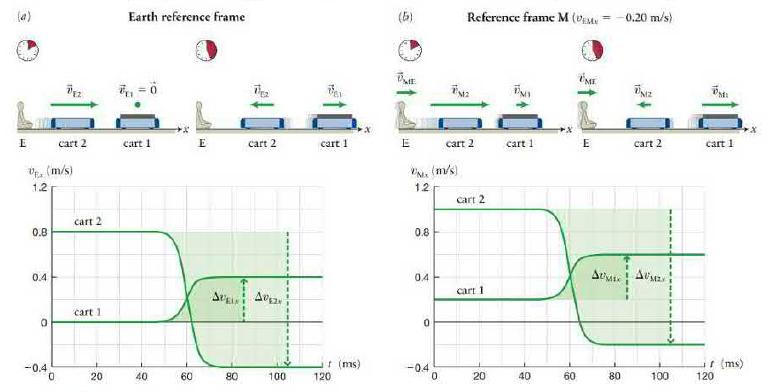
Draw before and after energy bars for the collision shown in Figure \(6.8 a\) and \(6.8 b\).Data from Figure 6.8 (a) Earth reference frame (b) Reference frame M (DEM == 0.20 m/s) = 0 FM2 ME NIZ E cart 2 cart 1 E cart 2 cart 1 E cart 2 cart 1 E cart 2 cart 1 V (m/s) "N. (m/s) 1.2 1.2 cart 2 0.8 cart
The observation deck of the Washington Monument is \(152 \mathrm{~m}\) above the ground. How many king-sized candy bars, each supplying 1. 3 MJ of source energy, must an \(80-\mathrm{kg}\) man consume to replenish the energy he expends in climbing the 825 stairs up to the observation deck?
You drop a ball from some height. At which position do you expect its speed to be one-half the speed at which it cventually hits the ground: higher than the midpoint of the path, at the midpoint, or lower than the midpoint? Does air resistance change your answer?
Is it impossible to convert incoherent energy to coherent energy? Can you think of an example where thermal energy can (at least partially) be converted to coherent energy?
People unenlightened about physics sometimes fire a gun straight up into the air to celebrate big events. By discussing the forms of energy at each stage of the process, explain why this is a bad idea.
Two \(1.20-\mathrm{kg}\) carts on a low-friction track are rigged with magnets so that the carts repel each other when they approach each other. One cart has an initial velocity of \(+0.323 \mathrm{~m} / \mathrm{s}\), and the other has an initial velocity of \(-0.147 \mathrm{~m} / \mathrm{s}\).
Wind turns a windmill that stores energy in a battery. Assume that the windmill turns at a constant rate while the battery is charging. The battery is then used to run a toy car that moves at a constant speed until the battery goes dead. Draw bar diagrams representing a sequence of instants that
You and your bike collide at \(12 \mathrm{~m} / \mathrm{s}\) into the back of a car stopped at a red light. The car does not have its brakes applied and so is jolted forward. The driver immediately leaps out crying, "Whiplash!" Facing a day in court, you have to determine the acceleration of the
An amusement park commissions your company to design a roller coaster. Your company specializes in an approach in which the cars are accelerated on a horizontal section of track by magnetic motors rather than being hauled up to the top of a hill and released. The park officials would like the
A \(1.00-\mathrm{kg}\) cart has attached to its front end a device that explodes when it hits anything, releasing a quantity of energy \(E\). This cart is moving to the right with speed \(v\) when it collides head-on with a \(2.00-\mathrm{kg}\) cart traveling to the left at the same speed \(v\).
A small car and a heavy truck moving at equal speeds in opposite directions collide head-on in a totally inelastic collision. Compare the magnitudes of \((a)\) the changes in momentum and \((b)\) the average accelerations of the car and the truck.
A ball is pressed down on a spring and then released from rest. The spring launches the ball upward. Identify the energy conversions that occur between the instant the ball is released and the instant it reaches the highest point of its trajectory.
Showing 4000 - 4100
of 4962
First
34
35
36
37
38
39
40
41
42
43
44
45
46
47
48
Last
Step by Step Answers

 Get 50% OFF
Claim Now
Get 50% OFF
Claim Now