New Semester
Started
Get
50% OFF
Study Help!
--h --m --s
Claim Now
Question Answers
Textbooks
Find textbooks, questions and answers
Oops, something went wrong!
Change your search query and then try again
S
Books
FREE
Study Help
Expert Questions
Accounting
General Management
Mathematics
Finance
Organizational Behaviour
Law
Physics
Operating System
Management Leadership
Sociology
Programming
Marketing
Database
Computer Network
Economics
Textbooks Solutions
Accounting
Managerial Accounting
Management Leadership
Cost Accounting
Statistics
Business Law
Corporate Finance
Finance
Economics
Auditing
Tutors
Online Tutors
Find a Tutor
Hire a Tutor
Become a Tutor
AI Tutor
AI Study Planner
NEW
Sell Books
Search
Search
Sign In
Register
study help
physics
particle physics
Principles And Practice Of Physics 2nd Edition Eric Mazur - Solutions
You are consulting for an episode of Stars Wars, Part XVI. As this episode opens, starship Orion zooms past a space station at \(t=0\) ship's time, traveling at a constant \(0.6000 c_{0}\) relative to the station. When the Orion's clock reads \(t=1000 \mathrm{~s}\), her sensors detect a hostile
Your boss wants you to construct a spring that, when compressed, experiences a mass increase of \(1 / 10,000\) of \(1 \%\). He has no idea whether this is possible, but you decide to write a report listing desirable parameters (spring mass, spring constant, load mass), discussing problems you might
The Iorentz. Cup spaceship race is won by the pilot who can travel \(1.00 \times 10^{9} \mathrm{~m}\) in the shortest time interval. The rules state that the start and finish lines must be \(10^{9} \mathrm{~m}\) apart in the ships' reference frame, but the time interval is measured by an observer
You are flying in a plane, and a friend is on the ground. Which of you measures the proper time interval between(a) the beginning and end of a brief in-flight video program and \((b)\) two successive signals from a warning light on a tall building along your flight path?
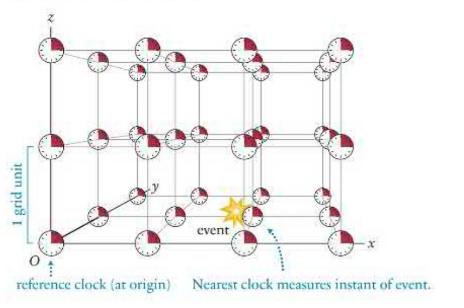
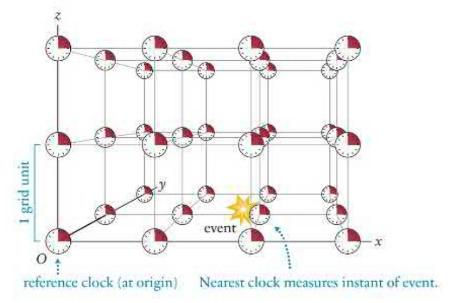
Suppose you want to synchronize the network of clocks in Figure 14.6 by emitting a single light pulse at the origin. This signal triggers each clock to start running from some initial setting. If it takes the signal \(1 \mathrm{~s}\) to travel along one grid unit and if the reference clock is set
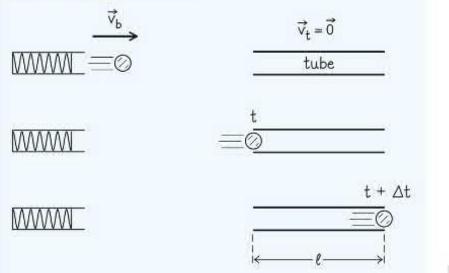
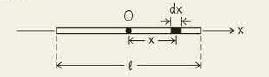
Consider a spring-loaded device that ejects a ball at some unknown everyday speed \(v_{\mathrm{b}}\). To measure this speed, you measure the time interval it takes the ball to pass through a stationary tube of known length \(\ell\) (Figure 14.8). Now suppose the tube is moving at speed \(v_{t}\)
You are flying in a plane, and a friend is on the ground. Who measures a shorter duration of \((a)\) a nap you take and(b) a nap your friend takes?
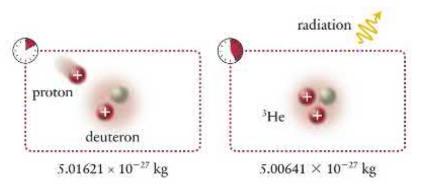
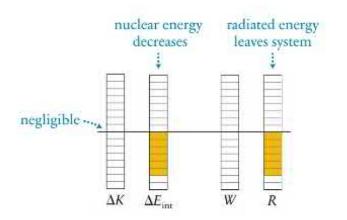
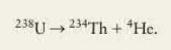
(a) In the nuclear reaction illustrated in Figure 14.21, what amount of mass is "lost"? (b) What is the ratio of energy decrease to mass loss as a result of the reaction? (c) Show that the units of your answer to part \(b\) are equivalent to \(\mathrm{m}^{2} / \mathrm{s}^{2}\).Data from Figure
You are on an airplane flying at a steady \(250 \mathrm{~m} / \mathrm{s}\) at cruising altitude. At noon the pilot announces that you are passing over the center of London and exactly \(6.0 \mathrm{~h}\) later, according to your watch, comes on the address system to say that you are passing over
An electron moving at \(0.80 c_{0}\) relative to the Earth reference frame travels the \(100-\mathrm{m}\) length of a building. What is the length of the building according to an observer moving along with the electron?
A proton strikes an air molecule in Earth's atmosphere, creating a muon \(6.0 \mathrm{~km}\) above the ground. The muon travels toward Earth at nearly \(c_{0}\) and decays just before reaching the ground. An observer traveling along with the muon determines that it lives for \(2.2 \times 10^{-6}
By what factor does the inertia of an electron increase(a) as the electron is accelerated from rest to \(\frac{1}{3} c_{0}\) and \((b)\) as its speed is increased by another \(20 \%\) ?(c) Does the mass of the electron change as it is accelerated?
A fast-moving electron collides head-on with a proton moving at \(0.60 c_{0}\) as measured in the Earth reference frame. What is the electron's initial speed if the two particles combine to form a system that after the collision is at rest in the Earth reference frame? The mass of the proton is
A uranium nucleus \({ }^{238} \mathrm{U}\) at rest decays to a thorium nucleus \({ }^{234} \mathrm{Th}\) by emitting an alpha particle (which is a helium nucleus \({ }^{4} \mathrm{He}\) ):The mass of the uranium atom is \(m_{\mathrm{U}}=395.292632 \times\) \(10^{-27} \mathrm{~kg}\), the mass of the
Two protons, each of mass \(m_{\mathrm{p}}=1.67 \times 10^{-27} \mathrm{~kg}\), collide to produce a particle that has a mass 300 times the mass of each proton. What is the minimum kinetic energy that one of the protons must have in order to create this particle if the other proton is initially at
Imagine you are at the origin of Figure 14.6, where, as in Exercise 14.2, a light pulse takes \(1 \mathrm{~s}\) to travel one grid unit. When your clock reads 12:00:05, what do you observe as the reading on the clocks at positions \((3,0)\) and \((0,2)\) ?Data from Figure 14.6Data from Exercise
Which of the following statements are true when we compare a moving light clock and one at rest in the Earth reference frame? (i) The signal in the moving clock travels a greater distance during one cycle. (ii) The signal in the moving clock takes more time to complete one cycle. (iii) The cycle
Standing near the finish line at a race track, you measure the time interval between two cars as they cross the finish line. Is the time interval between these events as measured by the driver in the second car the same as, greater than, or less than the time interval you measure?
A particle of mass \(m\) is moving at speed \(v\) toward an identical particle that is at rest in the Earth reference frame. Is the inertia of the particles in their zero-momentum reference frame greater than, equal to, or less than \(m\) ?
An observer on the ground observes a car moving past a gate and notes that the car is longer than the gate. For an observer in the car, which of the following are possibilities? (i) The gate is longer than the car. (ii) The gate is the same length as the car. (iii) The gate is shorter than the
Consider the roller-coaster car in Problem 37. At what minimum value of the starting height \(b\) above the ground must the car begin its journey if it is to remain on the track at the top of the loop?Data from Problem 37A roller-coaster car initially at a position on the track a height \(h\) above
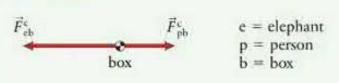
For the free-body diagram in question 2 , list the objects in the environment of the box.Data from question 2The free-body diagram of a box subjected to forces is shown in Figure 8. 13. Because we are concerned about only the horizontal motion, the forces in the vertical direction have been
Determine the rotational coordinate of the following objects for the indicated choices of rotational coordinate system. (a) The tip of the hour hand of a clock at 4:30 p.m., when zero is at noon on the same day and \(\vartheta\) increases in the clockwise direction. (b) A faucet after being turned
Determine the direction of the average acceleration in each of the following situations: (a) A car goes over the top of a hill at constant speed. (b) A runner slows down after crossing a finish line on level ground. (c) A cyclist makes a left turn while coasting at constant speed on a horizontal
A cube lies on a turntable initially rotating at constant speed. The rotational speed of the turntable is slowly increased, and at some instant the cube slides off the turntable. Explain why this happens.
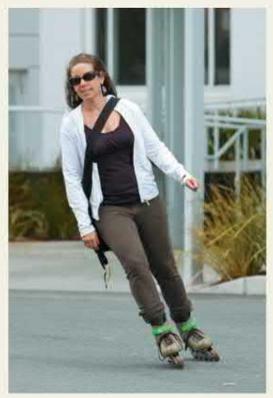
A woman is rollerblading to work and, running late, rounds a corner at full speed, sharply leaning into the curve (Figure 11.25). If, during the turn, she goes along the arc of a circle of radius \(4.5 \mathrm{~m}\) at a constant speed of \(5.0 \mathrm{~m} / \mathrm{s}\), what angle \(\theta\) must
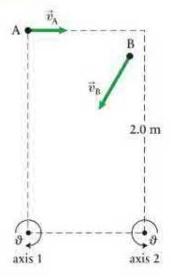
Determine the angular momenta of objects A and B in Figure 11.29 relative to (a) axis 1 and (b) axis 2. The inertia of the objects are \(m_{\mathrm{A}}=2.0 \mathrm{~kg}\) and \(m_{\mathrm{B}}=0.50 \mathrm{~kg}\), and their speeds are \(v_{\mathrm{A}}=0.60 \mathrm{~m} / \mathrm{s}\) and
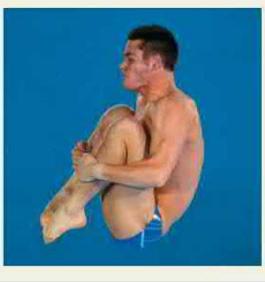
Divers increase their spin by tucking in their arms and legs (Figure 11.32). Suppose the outstretched body of a diver rotates at 1.2 revolutions per second before he pulls his arms and knees into his chest, reducing his rotational inertia from \(9.4 \mathrm{~kg} \cdot \mathrm{m}^{2}\) to \(3.1
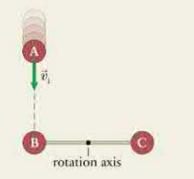
In Figure 11.33, two identical pucks B and C, each of inertia \(m\), are connected by a rod of negligible inertia and length \(\ell\) that is free to rotate about a fixed axis through its center. A third identical puck \(\mathrm{A}\), initially moving at speed \(v_{\mathrm{v}}\), strikes the
Calculate the rotational inertia of a hoop of inertia \(m\) and radius \(R\) about an axis perpendicular to the plane of the hoop and passing through its center.
Calculate the rotational inertia of a uniform solid rod of inertia \(m\) and length \(\ell\) about an axis perpendicular to the long axis of the rod and passing through its center.
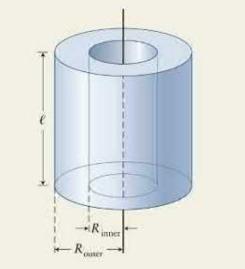
Calculate the rotational inertia of a uniform hollow-core cylinder of inner radius \(R_{\text {inner }}\), outer radius \(R_{\text {outer }}\), length \(\ell\), and inertia \(m\) about an axis parallel to the cylinder's length and passing through its center, as in Figure 11.38.Data from Figure
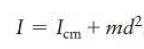
Use the parallel-axis theorem to calculate the rotational inertia of a uniform solid rod of inertia \(m\) and length \(\ell\) about an axis perpendicular to the length of the rod and passing through one end.Data from parallel-axis theorem I 1 = 1cm + md
Which of the following is in translational equilibrium? (a) An object whose center of mass is undergoing circular motion at constant speed. (b) A wheel spinning about an axis through its center of mass.
Figure 11.20 shows the velocities \(\vec{v}_{\mathrm{i}}\) and \(\vec{v}_{\mathrm{f}}\) of a point on the rim of an object at two instants \(t_{i}\) and \(t_{t}\) for four different motions. For each case, determine the change in velocity \(\Delta \vec{v}\) and the direction of the average
Why doesn't the acceleration in question 2 point toward the center of the circle in all cases?Data from question 2Figure 11.20 shows the velocities \(\vec{v}_{\mathrm{i}}\) and \(\vec{v}_{\mathrm{f}}\) of a point on the rim of an object at two instants \(t_{i}\) and \(t_{t}\) for four different
Describe the interaction responsible for providing a centripetal acceleration for \((a)\) a car rounding a level curve, \((b)\) a car rounding a banked curve, \((c)\) a coin rotating on a turntable,(d) a ball swung through a horizontal circle by a string that sweeps out a cone,(e) the Moon
A ball attached to a string (the far end of which is fixed) rolls in a horizontal circle. Under which conditions is the string more likely to break: \((a)\) when the speed of the ball is increased for a given radius or \((b)\) when the length of the string is increased for a given speed?
To open a stuck jar lid, wearing rubber gloves sometimes works. Why does that help?
You are using a steel crowbar to lift a big rock, with a smaller stone as a fulcrum at the center of the crowbar, but you are not quite able to lift the rock. What can you change about this setup to lift the rock?
The specifications for tightening the bolts on a car engine's valve cover are given in terms of torque rather than in terms of how much force should be exerted on the tightening wrench. Why is torque a better specification here?
When the wrench you are working with does not loosen a nut, you can sometimes succeed by slipping a length of pipe over the end of the wrench and pushing at the end of the pipe. Why does this work?
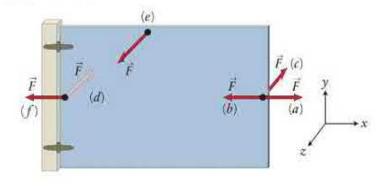
In which cases illustrated in Figure P12.5 does pushing in the way and at the location shown cause a torque about a vertical axis passing through the hinges? The dot shows the point of application of the force in each case, and the dashed lines help indicate the line of action of each force. Forces
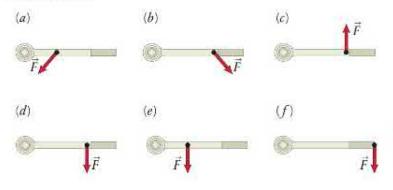
Rank, from greatest to smallest, the magnitudes of the torques about the wrench head in Figure P12.6 caused by exerting the same force at the different positions shown.Data from Figure P12.6 (a) (b) (d) (e) S () (c)
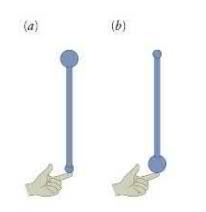
Which way is easier to balance the asymmetrical baton of Figure P12.7 on your finger? Explain your choice.Data from Figure P12.7 (9) (D)
Explain why, when a car makes a sharp turn on an unbanked road, the wheels on the inside of the turn tend to come off the ground.
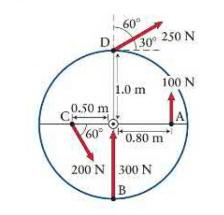
Figure P12.9 is a top view of a hand-driven carousel in a park. Four parents of the children riding on the device each push on the carousel in different ways. The forces exerted by each of the four parents and the positions at which the forces are exerted are labeled A-D. Rank the parents' pushes
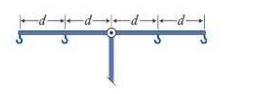
The uniform rod shown in Figure P12.10 is fixed to an axis going through its center, so that it is free to rotate clockwise or counterclockwise. It has four hooks: one at each end of the rod and one halfway between the center (axis) and each end. You need to hang four objects from this rod, with
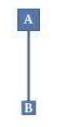
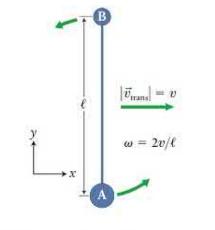
A very thin bar of length \(\ell\) and negligible inertia connects two blocks \(\mathrm{A}\) and \(\mathrm{B}\) that have inertias \(4 m\) and \(m\), respectively (Figure P12.11). When this rod-block system is made to spin with no translational motion and no mechanical pivor, each block moves
The system shown in Figure P12.12 consists of two balls \(A\) and \(B\) connected by a thin rod of negligible mass. Ball A has three times the inertia of ball \(\mathrm{B}\) and the distance between the two balls is \(\ell\). If the system has a translational velocity of \(v\) in the \(x\)
Put your index fingers about \(1 \mathrm{~m}\) apart and rest a meterstick or similar object on top of them. Then, while holding the meterstick parallel to the floor, slowly draw your fingers toward each other. You will find that first one finger slips easily under the stick, then the other finger,
To change a light bulb, you climb halfway up a stepladder. Draw an extended free-body diagram for the ladder.
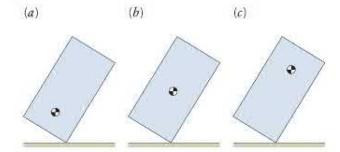
Which refrigerator in Figure \(\mathrm{P} 12.15\) is in the greatest danger of tipping over? Note positions of center of mass.Data from Figure P12.15 (a) (b) (c)
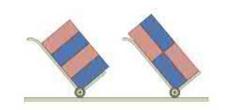
Which configuration of the four uniform boxes in Figure P12.16 makes the hand-truck easier to handle? Explain your answer.Data from Figure P12.16
A father and son are carrying a sofa down the stairs, with the son leading. Consider the sofa's center of mass to be at the geometric center. (a) Draw an extended freebody diagram for the sofa. (b) Who carries the greater share of the load? (c) Would your answer to part \(b\) be the same if the men
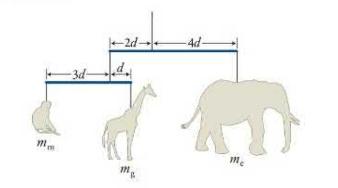
In the mobile in Figure P12.18, what are the inertias of the giraffe and of the elephant in terms of the inertia \(m_{\mathrm{m}}\) of the monkey?Data from Figure P12.18 -3d- -2d- -4d- m m
A painter leans a ladder at some angle against a smooth wall, with the foot of the ladder resting on wall-to-wall carpeting. Why might the ladder slip as he climbs it?
You are pushing a cart across the room, and the cart has wheels at the front and the back. Your hands are placed on top of the cart at the center (left to right) of the top edge, pushing horizontally. There is friction between the wheels and the floor. Is the normal force between the floor and the
The top of a ladder of inertia \(m\) rests against a smooth wall, and the foot rests on the ground. The coefficient of static friction between ground and ladder is \(\mu_{s}\). What is the smallest angle between the ground and the ladder such that the ladder does not slip?
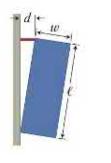
A square clock of inertia \(m\) is hung on a nail driven into a wall (Figure P12.22). The length of each side of the square is \(\ell\), the thickness is \(w\), and the top back edge of the clock is a distance \(d\) from the wall. Assume that the wall is smooth and that the center of mass of the
Beginning mechanics sometimes are taught a rule for tightening and untightening bolts: Righty-tighty, leftyloosey. Explain why this memory device works.
What is the direction of the rotational velocity vector of the jar lid when you open a jar of pickles?
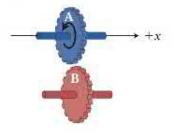
Gear A in Figure P12.25 is spinning such that its rotational velocity vector points in the negative \(x\) direction. It is lowered so that its edge comes in contact with the edge of gear B. What is the direction of the rotational velocity caused by the force that A exerts on B?Data from Figure
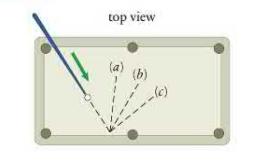
An experienced pool player can control the placement of a ball after it hits an edge bumper by putting spin, or "English," on the ball. This is accomplished by aiming the cue stick so that it hits the ball either left or right of the ball's center. Suppose a player gives a ball English by hitting
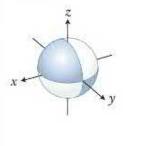
The beach ball shown in Figure P12.27 undergoes a rotation of \(90^{\circ}\) around the \(x\) axis and then a rotation of \(90^{\circ}\) around the \(y\) axis. A second, identically colored ball undergoes first the rotation of \(90^{\circ}\) around the \(y\) axis and then the \(90^{\circ}\)
Why do quarterbacks throw the football with significant spin about its long axis?
A \(1.5-\mathrm{m}\) uniform rod is being used to balance two buckets of paint, each of inertia \(m\), one at each end of the rod. (a) Where is the pivot located? (b) If paint is removed from one bucket until its inertia is \(m / 4\), where must the pivot now be placed in order to keep the rod
A \(0.20-\mathrm{kg}\) turntable of radius \(0.20 \mathrm{~m}\) spins about a vertical axis through its center. A constant rotational acceleration causes the turntable to accelerate from 0 to 28 revolutions per second in \(8.0 \mathrm{~s}\). Calculate(a) the rotational acceleration and \((b)\) the
A \(44-\mathrm{kg}\) child runs at \(3.0 \mathrm{~m} / \mathrm{s}\) tangent to a stationary \(180-\mathrm{kg}\) playground merry-go-round that has a radius of \(1.2 \mathrm{~m}\). The child then jumps on and grabs hold, causing the merry-go-round to rotate. Determine the resulting rotational
Standing on the edge of a rotating playground carousel, you take sight on the center of the carousel and walk directly toward that position. (a) What happens to the rotational speed of the carousel as you walk? (b) In the system consisting of only the carousel (a nonisolated system), any change in
Standing with your toes touching the base of a wall, press your nose to the wall and try to stand on tiptoe. What happens and why?
Draw the angular momentum vector for a tetherball, taking as your origin the center of the pole. Is the angular momentum constant? If not, what force causes the torque that changes the angular momentum?
Imagine that an asteroid \(1 \mathrm{~km}\) in diameter collides with Earth. Estimate the maximum fractional change in the length of the day due to this collision.
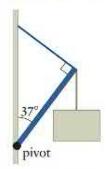
You want to hang a \(10-\mathrm{kg}\) sign that advertises your new business. To do this, you use a pivot to attach the base of a \(5.0-\mathrm{kg}\) beam to a wall (Figure P12.36). You then attach a cable to the beam and to the wall in such a way that the cable and beam are perpendicular to each
The top end of a two-by-four piece of lumber that is \(3.0 \mathrm{~m}\) long is leaned at a height of \(1.8 \mathrm{~m}\) against a smooth wall so that the bottom end makes an angle of \(37^{\circ}\) with the floor. If this board has an inertia of \(4.6 \mathrm{~kg}\), what are(a) the normal force
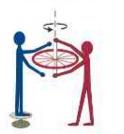
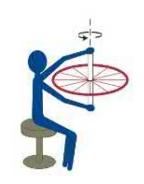
Your physics instructor calls you up to the front of the class to be a demonstration assistant. She has you stand on a turntable that is free to rotate and hands you a spinning bicycle wheel, as shown in Figure P12.38. Letting go of the top of the wheel's axle, you then stop its spinning with your
Helicopters have a small tail rotor as well as the large main rotor. Why is the tail rotor needed?
A \(35-\mathrm{kg}\) child stands on the edge of a \(400-\mathrm{kg}\) playground merry-go-round that is turning at the rate of 1 rev every \(2.2 \mathrm{~s}\). He then walks to the center of the platform. If the radius of the platform is \(1.5 \mathrm{~m}\), what is its rotational speed once he
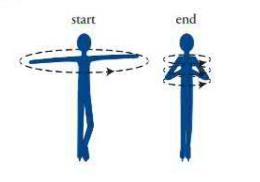
An ice figure skater starts out spinning at 0.85 revolution per second with her arms outstretched, as shown in Figure P12.41. She wears lightly weighted bracelets to enhance the spin-up effect when she pulls her arms in. (a) Calculate her final rotational speed if her rotational inertia is \(3.6
A \(25-\mathrm{kg}\) child starts at the center of a playground merrygo-round that has a radius of \(2.0 \mathrm{~m}\) and rotational inertia of \(500 \mathrm{~kg} \cdot \mathrm{m}^{2}\) and walks out to the edge. If the merry-go-round has a rotational speed of \(0.20 \mathrm{~s}^{-1}\) when she is
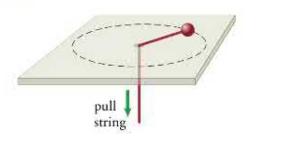
In the setup in Figure P12.43, does pulling the string downward while the ball is revolving make the following properties of the ball increase, decrease, or stay the same: (a) angular momentum, (b) rotational speed, (c) rotational kinetic energy?Data from Figure P12.43 pull string
Your physics instructor has you sit on a chair that is free to rotate and hands you a spinning bicycle wheel (Figure P12.44). What happens when you flip the wheel over so that the end of the axle that initially pointed up now points down?Data from Figure P12.44
A putty ball of inertia \(m\) moving at speed \(v_{\mathrm{i}}\) slides on a slick horizontal surface along a path that is perpendicular to the long axis of a rod of length \(\ell\) and inertia \(2 m\) that is at rest on the surface. The ball collides with one end of the rod and sticks to it.(a)
A \(4.5-\mathrm{kg}\) bowling ball is perched on a concrete ledge directly below your dorm room window, with the side of the ball opposite the holes touching the wall. Wanting to hold the ball in place so that it doesn't roll off and land on somebody, you manage to hook one of the holes with a wire
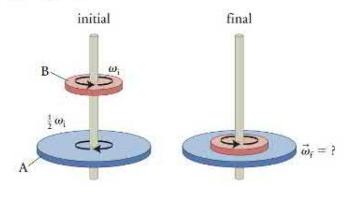
Disk A in Figure \(P 12.47\) has radius \(R_{\mathrm{A}}\) and thickness \(h\) and is initially rotating clockwise, as viewed from above, at \(\omega_{\mathrm{i}} / 2\). Disk \(\mathrm{B}\), made of the same material as \(\mathrm{A}\), has radius \(R_{\mathrm{B}}=R_{\mathrm{A}} / 2\) and thickness
A \(25-\mathrm{kg}\) ladder of length \(5.0 \mathrm{~m}\) leans against a smooth wall and makes an angle of \(50^{\circ}\) with the ground. A \(75-\mathrm{kg}\) man starts to climb the ladder. If the coefficient of static friction between ground and ladder is 0.50 , what distance along the ladder
An object rolls without slipping onto a surface where the coefficient of friction between object and surface is twice as great as that needed to prevent slipping. Describe the subsequent motion.
To get better acceleration, you want to reduce the inertia of your bicycle. You have your choice of spending \(\$ 45\) on only one of three light-alloy items, each reducing the inertia of your bicycle by the same amount: a new seat post, a new set of pedals, or a new set of wheel rims. Which is the
A \(3.0-\mathrm{kg}\) solid ball rolls without slipping down a ramp inclined to the horizontal at an angle of \(30^{\circ}\). What are (a) the acceleration of the ball's center of mass and (b) the magnitude of the frictional force exerted on the ball?
A \(5.0-\mathrm{kg}\) solid cylinder of radius \(0.25 \mathrm{~m}\) is free to rotate about an axle that runs along the cylinder length and passes through its center. A thread wrapped around the cylinder is pulled straight from the cylinder so as to unwrap with a steady tensile force of \(20
A disk and a hoop roll down an inclined plane. If the plane is inclined at an angle of \(30^{\circ}\) from the horizontal, what is the minimum coefficient of friction required so that neither object slips?
A \(2.0-\mathrm{kg}\) solid cylinder of radius \(0.45 \mathrm{~m}\) rolls without slipping down a ramp inclined at an angle of \(60^{\circ}\) to the vertical. Calculate (a) the acceleration of the cylinder's center of mass,(b) the cylinder's rotational acceleration, and(c) the time interval
Two cans of pumpkin roll down a loading dock ramp. They have identical inertias, but one of them has a larger radius (and a shorter length) than the other. Which one, if either, makes it down the ramp first?
You deliver a horizontal impulse to a cue ball with a cue stick while playing pool. If the ball is to roll without slipping, at what height \(h\) above its center (in terms of its radius \(R\) ) must you strike it?
Two balls of the same radius and same inertia roll down an inclined plane, starting from rest. One ball is hollow, and the other is solid. What is the ratio of the time intervals the two balls require to reach the bottom?
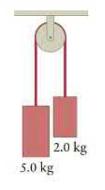
In the Atwood machine shown in Figure \(\mathrm{P} 12.58\), the pulley radius is \(0.10 \mathrm{~m}\), and the rotational inertia of the pulley is \(0.15 \mathrm{~kg} \cdot \mathrm{m}^{2}\). Calculate \((a)\) the acceleration of the blocks, \((b)\) the tension in the cord on the left, and \((c)\)
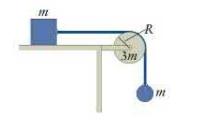
A block of inertia \(m\) sits on a smooth surface (Figure P12.59). A light string is attached to it and placed over a solid pulley of inertia \(3 m\) and radius \(R\), and a ball of inertia \(m\) is attached to the free end of the string. (a) If there is no slippage between string and pulley,
A \(320 \mathrm{~g}\) can of soup is \(10.8 \mathrm{~cm}\) tall and has a radius of \(3.19 \mathrm{~cm}\). (a) Calculate the can's rotational inertia about its axis of symmetry, assuming the can to be a solid cylinder. (b) When released from rest at the top of a ramp that is \(3.00 \mathrm{~m}\)
A \(0.20 \mathrm{~kg}\) solid cylinder is released from rest at the top of a ramp \(1.0 \mathrm{~m}\) long. The cylinder has a radius of \(0.15 \mathrm{~m}\), and the ramp is at an angle of \(15^{\circ}\) with the horizontal. What is the rotational kinetic energy of the cylinder when it reaches the
A solid \(50-\mathrm{kg}\) cylinder has a radius of \(0.10 \mathrm{~m}\). What \(\mathrm{min}-\) imum work is required to get the cylinder rolling without slipping at a rotational speed of \(20 \mathrm{~s}^{-1}\) ?
Showing 3500 - 3600
of 4962
First
29
30
31
32
33
34
35
36
37
38
39
40
41
42
43
Last
Step by Step Answers

 Get 50% OFF
Claim Now
Get 50% OFF
Claim Now