New Semester
Started
Get
50% OFF
Study Help!
--h --m --s
Claim Now
Question Answers
Textbooks
Find textbooks, questions and answers
Oops, something went wrong!
Change your search query and then try again
S
Books
FREE
Study Help
Expert Questions
Accounting
General Management
Mathematics
Finance
Organizational Behaviour
Law
Physics
Operating System
Management Leadership
Sociology
Programming
Marketing
Database
Computer Network
Economics
Textbooks Solutions
Accounting
Managerial Accounting
Management Leadership
Cost Accounting
Statistics
Business Law
Corporate Finance
Finance
Economics
Auditing
Tutors
Online Tutors
Find a Tutor
Hire a Tutor
Become a Tutor
AI Tutor
AI Study Planner
NEW
Sell Books
Search
Search
Sign In
Register
study help
physics
particle physics
Principles And Practice Of Physics 2nd Edition Eric Mazur - Solutions
The intensity level at the front of a library reading room is \(70 \mathrm{~dB}\) when 120 students are in the room and \(20 \mathrm{~dB}\) when the room is empty. What do you expect the intensity level to be when 60 students are in the room?
A typical car horn has an intensity level of \(90 \mathrm{~dB}\) at a distance of \(1.0 \mathrm{~m}\). (a) What is the intensity level of 16 cars all honking their horns at an intersection on a city street? (b) What is the power output of the combined horns at a distance of \(5.0 \mathrm{~m}\) ?
On a whale-watching expedition, your underwater sound detector picks up a whale sound that has an intensity of \(9.0 \mu \mathrm{W} / \mathrm{m}^{2}\). (a) What is the intensity level \(\beta\) of this sound? (b) If your detector tells you that you are \(2.3 \mathrm{~km}\) from the whale, what is
A frequency generator (a device that produces sinusoidal signals whose frequency and amplitude can be independently set) is used to power a horn. The frequency is set to \(2000 \mathrm{~Hz}\), and for a particular amplitude the sound intensity is measured to be \(0.050 \mathrm{~W} /
Suppose that two coherent, spherical sound sources, 1 and 2 , each generate the same amount of power \(P\). The distance between the sources is \(2 \lambda\). Point \(\mathrm{R}\) is on a line of maximum destructive interference, and the distance between \(R\) and source 1 is equal to \(9
Your bedroom is \(8.0 \mathrm{~m}\) away from the living room. When requested by your parents to turn down your stereo, you do, and the intensity level where they are sitting in the living room drops from \(50 \mathrm{~dB}\) to \(45 \mathrm{~dB}\). What is the change in the power of the sound
If two superimposed frequencies differ by more than about \(20 \mathrm{~Hz}\), what do you hear?
Two oboe players are next to each other on the stage. One is playing a \(350-\mathrm{Hz}\) note, and the other is playing a \(355-\mathrm{Hz}\) note. What is the beat frequency heard by the audience?
Two tuba players in a marching band appear to your trained ear to be playing the correct note, \(196 \mathrm{~Hz}\), but there is an annoying warble that you interpret as being four beats per second. What are the frequencies of the notes played by the two tubas?
The lowest frequency a certain sound receiver can detect is \(760 \mathrm{~Hz}\). If the receiver detects a frequency of \(762 \mathrm{~Hz}\). that is then mixed with an unknown frequency, also detectable by the receiver, and you hear four beats per second, what is the unknown frequency?
You have four electronic audio generators, A, B, C, and D, all producing tones near \(1200 \mathrm{~Hz}\) that are easily audible but not distinguishable by ear. When you increase the frequency of generator \(\mathrm{A}\) a little, the beat frequencies between A and B, A and C, and A and D all
One tuning fork vibrates at a frequency of \(528 \mathrm{~Hz}\), and a second one vibrates at \(524 \mathrm{~Hz}\), but you don't know which is which. After applying a small piece of modeling clay to the end of one fork, you notice that the beat frequency has increased. On which fork did you put
Three tenors are giving a concert at an outdoor amphitheater. What are the possible beat frequencies if tenor 1 holds a \(262-\mathrm{Hz}\) note while tenor 2 holds a \(264.3-\mathrm{Hz}\) note and tenor 3 holds a \(258-\mathrm{Hz}\) note?
When two frequencies are added together, the beat frequency and the average frequency are an octave apart. What is the ratio of the original frequencies?
Two violin strings, each having a linear mass density of \(0.0014 \mathrm{~kg} / \mathrm{m}\) and under the same \(100-\mathrm{N}\) tension, have the same fundamental frequency of \(660 \mathrm{~Hz}\). If the tension in one of the strings is changed to \(102 \mathrm{~N}\) and both strings vibrate
During a fire drill in your dormitory, you notice that the sound waves from the two alarms on your floor interfere with each other; you hear five beats every two seconds. (a) If the average of the two frequencies is \(3500 \mathrm{~Hz}\), what are the frequencies of the two alarms? (b) If your room
What happens to the magnitude of the Doppler shift you hear in the whistle of a passing train if you increase the distance between you and the tracks?
While driving down the road, you spot a friend standing on the sidewalk. You honk your horn at him while driving \(70 \mathrm{~km} / \mathrm{h}\). Your horn emits a frequency of \(360 \mathrm{~Hz}\). What frequency does your friend hear \((a)\) as you approach and \((b)\) after you pass by?
The electric bells at your school buzz with a frequency of \(400 \mathrm{~Hz}\). If you are late for class and riding your bike down a hill toward the school at a constant speed of \(4.47 \mathrm{~m} / \mathrm{s}\), what is the frequency of the sound you hear?
At the racetrack, you estimate that the whine of the cars changes by one octave as the cars pass. About how fast are the cars going?
How fast do you have to travel away from a stationary sound source in order for the frequency to be shifted by (a) \(1 \%,(b) 10 \%\), and (c) a factor of 2 ?
While you watch a parade, a band on a float passes you. You detect the frequency of a note played on a flute to be \(352 \mathrm{~Hz}\) when the float is coming toward you and \(347 \mathrm{~Hz}\) after the float passes you. At what speed is the float traveling?
You and a friend are riding bikes, you moving at \(9.72 \mathrm{~km} / \mathrm{h}\) and she moving at \(7.20 \mathrm{~km} / \mathrm{h}\). She is behind you and turns on her electric horn, which has a frequency of \(300 \mathrm{~Hz}\). (a) What frequency do you hear? (b) What frequency is heard by a
While you are driving on a straight road at \(97 \mathrm{~km} / \mathrm{h}\), a police car traveling in the opposite direction comes toward you with the siren blaring, and the frequency you hear is \(310 \mathrm{~Hz}\). Starting when the two of you are \(200 \mathrm{~m}\) apart, it takes you \(3.00
A car traveling west at \(90 \mathrm{~km} / \mathrm{h}\) along a road running parallel to a railroad track approaches a train traveling east at \(65 \mathrm{~km} / \mathrm{h}\). If the train's whistle emits a frequency of \(400 \mathrm{~Hz}\), what is the frequency heard by the driver of the car
A foghorn that emits a frequency of \(150 \mathrm{~Hz}\) is mounted on a buoy in the bay. If a ship approaches the buoy at \(21.2 \mathrm{~km} / \mathrm{h},\)(a) what frequency does the captain of the ship hear?(b) Hearing the foghorn is a signal for the captain to slow his ship. After passing the
Two airplanes simulating a dogfight are headed right for each other, plane A moving at \(285 \mathrm{~km} / \mathrm{h}\) and plane B moving at \(295 \mathrm{~km} / \mathrm{h}\). The electronic machine gun on A can emit 300 rounds per minute, with each round accompanied by a sound pulse. (a) How
You stand in your yard and hold a battery-powered buzzer that is emitting a frequency of \(560 \mathrm{~Hz}\) as a friend stands next to you. (a) What frequency does your friend hear if you throw the buzzer away from you with a speed of \(18.0 \mathrm{~m} / \mathrm{s}\) ? (b) You and your friend
A dog whistle has a frequency of \(21 \mathrm{kHz}\), which is above the high end of the audible range for humans. At what minimum speed and in what direction must you travel in order to just hear the whistle?
During trials of a new submarine, its speed is measured with an underwater sonar gun anchored to the ocean floor. The gun emits sound waves at a frequency \(f\), and these waves reflect off the surface of the submarine and return to the source at a frequency \(f^{\prime} eq f\). If the submarine is
A device that both emits and receives sound waves is traveling at \(80 \mathrm{~km} / \mathrm{h}\). The emitted waves have a frequency of \(700 \mathrm{~Hz}\). If the waves are reflected off a stationary flat surface in front of the device, what frequency is detected by the device?
Two students standing \(54.9 \mathrm{~m}\) apart are tossing around footballs designed to whistle while they are airborne. (a) When student A throws her football toward student B at \(16.0 \mathrm{~m} / \mathrm{s}\), it emits a frequency of \(680 \mathrm{~Hz}\). What frequency is heard by student
A supersonic jet airplane flying horizontally and passing directly overhead creates a shock wave that makes an angle of \(47^{\circ}\) with the horizontal. What is the speed of the airplane?
As a boat travels at \(48.0 \mathrm{~km} / \mathrm{h}\) across the surface of a still lake, the waves it creates in the water have a speed of \(20.1 \mathrm{~km} / \mathrm{h}\). What is the angle of the shock wave created by the waves?
A speedboat traveling at \(73.0 \mathrm{~km} / \mathrm{h}\) causes a shock wave that makes an angle of \(14.3^{\circ}\) with the path of the boat. At what speed are the waves moving through the water?
Two jets flying at the same altitude pass over your head simultancously, one traveling at Mach 1. 5 and the other at Mach 2. 5. Which plane's sonic boom do you hear first?
While attending an air show, you observe a fighter jet traveling horizontally at a speed of Mach 1. 30. At the instant you hear the sonic boom, what is the angle between your line of sight to the jet and the horizontal?
Many years ago, test pilots accelerating through Mach 1 reported that the ride was pretty rough just before Mach 1 but smoothed out suddenly as Mach 1 was breached. How can you account for this?
Concerned about being disturbed by sonic booms, residents near an Air Force base located along a seacoast submit a petition asking that all jet aircraft from the base head out to sea before attaining Mach 1 and proceed inland only after they have reached supersonic speed. What do you think of the
A woman standing on the ground observes a jet directly overhead flying at an altitude of \(20,000 \mathrm{~m}\). If the jet has a speed of Mach 2 and its shock wave makes an angle of \(30^{\circ}\) with the horizontal, how long will it be until she hears the sonic boom?
At a pistol range, a microphone is placed between a shooter and the target so that when a bullet is fired we can hear its sonic boom. A bullet passes by the microphone at a speed of Mach 2. 1. The microphone picks up the sonic boom \(0.0021 \mathrm{~s}\) after the bullet passes above the
A jet flying directly over you at an altitude of \(3000 \mathrm{~m}\) produces a shock wave. If the angle of the shock wave is \(42^{\circ}\).(a) how long will it be until the sonic boom reaches you, and (b) how far does the jet travel during this time interval?
At White Sands, New Mexico, a car powered by a rocket engine passes you while you are standing still. If you hear the sonic boom \(0.045 \mathrm{~s}\) after the car passes and the angle of the shock wave is \(37.0^{\circ}\), what is your perpendicular distance from the path of the car?
What does an observer hear on the ground before and after a sonic boom caused by a jet passing overhead?
Is a second sonic boom generated when a plane reaches a speed of Mach 2?
Two test pilots are flying in a jet trainer going faster than Mach 1. Can the pilot in the front of the cockpit hear the pilot in back?
Two guitar strings, 1 and 2 , plucked simultaneously produce standing waves described by\[\begin{aligned}& D_{1}=A \sin (a x) \cos (b t) \\& D_{2}=A \sin (q x) \cos (d t),\end{aligned}\]with \(a=14.5 \mathrm{~m}^{-1}, b=2512 \mathrm{~s}^{-1}, q=19.3 \mathrm{~m}^{-1}\), and \(d=2575
A race car traveling at \(350 \mathrm{~km} / \mathrm{h}\) passes a spectator in the stands. If the spectator has an air horn that emits a sound of frequency \(400 \mathrm{~Hz}\), what is the range of frequencies of the sound heard by the driver of the car?
Which type of conic section (circle, ellipse, parabola, or hyperbola) is formed by the nodal-line pattern produced by two coherent sources of two-dimensional waves?(For a given nodal line, the difference in distance between any point on it and the two sources is the same for all points.)
Why is the high-frequency "tweeter" on a stereo speaker usually much smaller than the low-frequency "woofer"?
You are standing beneath a Ferris wheel when two children riding in cars on opposite sides of the wheel both scream at \(600 \mathrm{~Hz}\). Your well-trained ears notice a beat frequency that is maximum when one child is moving directly toward you and the other is moving directly away from you.
You have tickets for an outdoor rock concert, fourth row from the stage. However, at that distance the intensity level is \(100 \mathrm{~dB}\), too loud to be enjoyable. You decide to move to a row where the intensity level is a more moderate \(80 \mathrm{~dB}\). Fortunately, turning around and
You want to build a portable device that can detect pirate radio stations broadcasting at about \(50 \mathrm{~W}\) of power a few miles from your beachfront home. You have a \(0.60-\mathrm{m}\) diameter bowl you might use as antenna dish, but you are worried that your amplifier input will require a
Your car is third in line at a railroad crossing as a train moving at a constant speed approaches, with its whistle blowing constantly. To keep yourself from going crazy with the noise, you begin thinking about the relative difference between the frequency you hear and the frequency the engineer
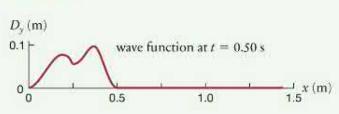
Given the wave function for \(t=0.50 \mathrm{~s}\) shown in Figure 16. 25, draw the displacement curves of particles at \(x=0\) and \(x=1.0 \mathrm{~m}\) as the wave passes them. If the leading edge of the wave was at \(x=0\) at time \(t=0\), what is the speed of the wave?Data from Figure 16. 25 D,
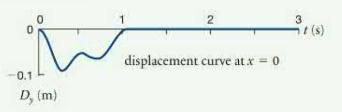
Given the displacement curve shown in Figure 16. 26 for a bead at \(x=0\) on a string as a wave moving toward the right with a speed of \(2.0 \mathrm{~m} / \mathrm{s}\) passes, draw the wave function at \(t=2.0 \mathrm{~s}\).Data from Figure 16. 26 0.1 D, (m) 1 2 displacement curve at x = 0 3 (s)
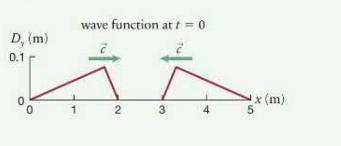
The two pulses shown in Figure 16. 27 are traveling in opposite directions; both have a speed of \(1.0 \mathrm{~m} / \mathrm{s}\). Draw the sum of the two pulses at \(t=1.0 \mathrm{~s}, t=2.0 \mathrm{~s}\), and \(t=3.0 \mathrm{~s}\).Data from Figure 16. 27 D, (m) 0.1 wave function at t=0 0 2 3 4 5
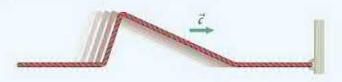
Consider a triangular wave pulse approaching the fixed end of a string (Figure 16.18). Sketch the shape of the string(a) when a point halfway up the leading edge of the pulse has reached the fixed end and \((b)\) when the peak of the pulse has reached the fixed end.Data from Figure 16.18
Let the triangular wave pulse of Figure 16.18 approach the free end of a string. Sketch the shape of the string(a) when a point halfway up the leading edge of the incident pulse has reached the fixed end and \((b)\) when the peak of the pulse has reached the fixed end.Data from Figure 16.18
(a) Consider the time-dependent wave function \[D_{y}=f(x, t)= \begin{cases}b(x-c t) & \text { for } 01.0 \mathrm{~m},\end{cases}\]where \(b=0.80\) and \(c=2.0 \mathrm{~m} / \mathrm{s}\). Plot the time-independent wave function for a few values of \(t\) to verify that the function corresponds to a
You use a hammer to give a sharp horizontal blow to a \(10-\mathrm{kg}\) lead brick suspended from the ceiling by a wire that is \(5.0 \mathrm{~m}\) long. It takes \(70 \mathrm{~ms}\) for the pulse generated by the sudden displacement of the brick to reach the ceiling. What is the mass of the wire?
A wire with linear mass density \(\mu=0.0500 \mathrm{~kg} / \mathrm{m}\) is held taut with a tension of 100 N. At what rate must energy be supplied to the wire to generate a traveling harmonic wave that has a frequency of \(500 \mathrm{~Hz}\) and an amplitude of \(5.00 \mathrm{~mm}\) ?
Show that a sinusoidal traveling wave of the form \(f(x, t)=A \sin (k x-\omega t)\) satisfies the wave equation for any value of \(k\) and \(\omega\).
Is it possible for the same medium to carry both a longitudinal and a transverse wave? If so, give an example. If not, explain why not.
Suppose you have a light spring stretched out and one end is attached to a wall. With this setup, you can move the free end in any of three directions \((x, y, z)\). If the spring lies along, say, the \(z\) axis, which type of wave-transverse or longitudinal-do you create when you move the free end
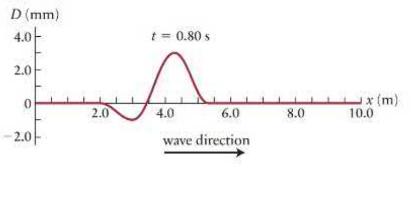
Figure P16.3 is a snapshot at \(t=0.80 \mathrm{~s}\) of a wave pulse traveling on a string. Construct \((a)\) the wave function at \(t=1.1 \mathrm{~s}\) and \((b)\) the displacement curve for the position \(x=3.0 \mathrm{~m}\). Assume that the wave pulse was created at the origin at \(t=0\).Data
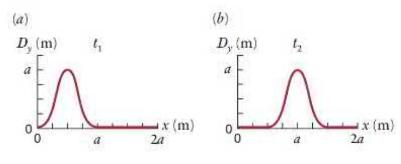
The graphs in Figure P16.4 show the displacement caused by a wave moving along a string at two instants, (a) \(t_{1}\) and (b) \(t_{2}\). Let \(v_{\mathrm{av}}\) denote the average speed of a piece of string during the time interval between \(t_{1}\) and \(t_{2}\). Compare the wave speed \(c\) to
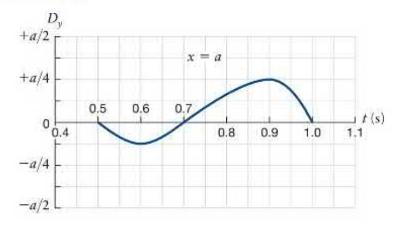
Figure P16.5 shows the displacement curve for the particle located at \(x=a\) as a wave moves to the right along a string. If the wave advances a distance \(a\) each second, draw the wave function at the instant \(t=0\).Data from P16.5 D +a/2 +a/4 0 -a/4 -a/2 x=a 0.5 0.6 0.7 t(s) 0.4 0.8 0.9 1.0 1.1
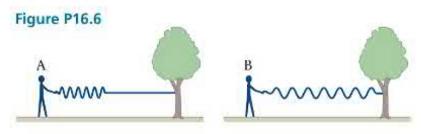
Identical ropes were tied to two trees, and two men, A and \(B\), started shaking the free ends at the same instant a short while ago (Figure P16.6). Which rope has the greater tension? Which man is shaking with the greater frequency?Data from P16.6 Figure P16.6 A www B jimmy
What is the definition of frequency for a nonharmonic periodic wave?
You and a friend each have one rope. You tie the two ropes together and stand as far apart as possible, each holding one end of the new longer rope and pulling to put it under tension. You then begin moving your arm in such a way as to produce a harmonic wave with a wavelength of \(1.0
You are watching a ship being loaded with large crates. The ship is held in place by several long steel cables attached to the dock. At one point, a crate bumps one of the cables and sends a wave pulse along the cable. The pulse moves rather slowly up to the bow of the ship. A few minutes later
A harmonic wave is made to travel along a string when you move your hand up and down. The wave has a specific period \(T_{1}\), wavelength \(\lambda_{1}\), amplitude \(A_{1}\), and speed \(c_{1}\), and also causes a certain transverse speed \(v(x, t)\) of the particles that make up the rope. If you
Water parks often have a pool with a wave-making machine at one end, consisting of a piston that pushes water back and forth. There are some places in the pool where the waves make inner-tube riders bounce up and down wildly, but other places where the water hardly moves. Explain what is happening.
Suppose wave pulses in an aquarium are produced by a mechanical motor that moves a bob up and down at the surface. If the setup uses a \(10-\mathrm{W}\) motor and has a period of \(1.5 \mathrm{~s}\) between bobs, how much kinetic energy is in each outgoing pulse?
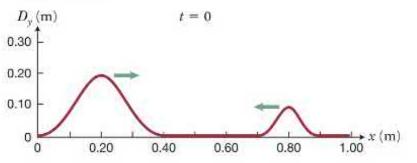
Figure P16.13 shows two waves in a rope approaching each other at instant \(t=0\). For any instant after \(t=0\), determine the maximum displacement that occurs \((a)\) at \(x=0,(b)\) at \(x=0.90 \mathrm{~m}\), and \((c)\) anywhere along the rope.Data from P16.13 Dy (m) 0.30 0.20 0.10 1-0 0 x (m) 0
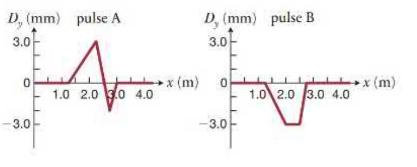
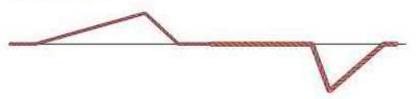
The two wave pulses in Figure P16.14 are traveling on the same string at \(t=1.0 \mathrm{~s}\). Sketch the shape of the string at this instant.Data from P16.14 D, (mm) pulse A 3.0 0 3.0 1.0 2.0 3.0 4.0 D, (mm) pulse B 3.0 x (m) 0 x (m) 1.0 2.0 3.0 4.0 -3.0
Suppose two waves, identical except for the direction of travel, approach each other in a medium that obeys Hooke's law. At certain instants, the waves interfere constructively at all positions. At one such instant, when their peaks align, determine the kinetic energy of the wave function that
A harmonic wave traveling along a light string approaches a splice to a heavier string, as shown in Figure P16.16. Which changes as the wave crosses the boundary: wavelength, frequency, both, or neither?Data from P16.16 www
A transverse wave in a swimming pool reaches the concrete side and is reflected. Determine whether the reflected wave is inverted.
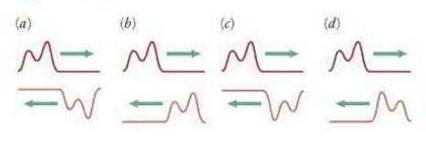
A rope is attached to a tree trunk and made taut, and then a pulse traveling rightward is sent along the rope. For each case depicted in Figure P16.18, determine whether or not the reflected pulse is depicted correctly.Data from P16.18 (a) (b) (c) (d) MMM= M= WMW-M M= W= M-
Figure P16.19 shows two strings of different linear mass densities, connected and held taut, at some instant. At some earlier instant, only one pulse existed on one of the strings. (a) Determine which string carried the initial pulse, and (b) sketch the approximate shape of the strings at the
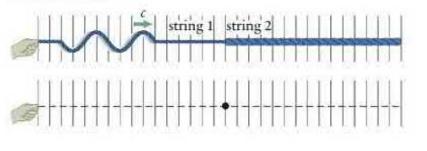
You shake the end of a taut string, creating two periods of a traveling sinusoidal wave, as shown in Figure P16.20. The string you are shaking (string 1) is connected to a second, much more massive, string (string 2 ). The wave speeds on the two strings differ by a factor of 2 . (a) On the
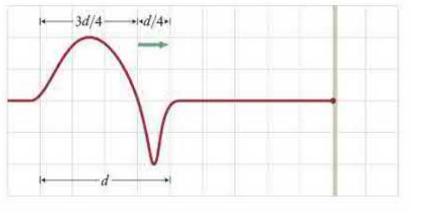
Figure P16.21 shows a pulse as it approaches a fixed end of a rope. Draw the shape of the rope halfway through the reflection (that is, when half of the pulse length is still moving to the right and the other half of the pulse has already been reflected).Data from P16.21 3d/4-d/4
Walking along the beach, you notice that a new wave reaches the shore every \(4.0 \mathrm{~s}\), and you estimate the wave crests to be \(2.5 \mathrm{~m}\) apart. At what wave speed \(c\) are the waves moving?
While on a sailboat at anchor, you notice that 12 waves pass its bow every minute. If the waves have a speed of \(6.0 \mathrm{~m} / \mathrm{s}\), what is the distance between two adjacent wave crests?
Participating in a human rally wave at a football game, you have to stand up every \(15 \mathrm{~s}\). (a) What is the wave frequency? (b) If the stadium is oval and the inner circumference of the oval is \(0.56 \mathrm{~km}\), what is the wave speed? Assume that the main wave pulse spans 30 people
(a) Plot the time-independent wave function for the traveling pulse described by the time-dependent wave function\[D_{y}(x, t)=\frac{a}{b^{2}+(x-a)^{2}}\]with \(a=5.0 \mathrm{~m}^{3}, b=1.0 \mathrm{~m}\), and \(c=2.0 \mathrm{~m} / \mathrm{s}\) for \(t=0\), \(1.0 \mathrm{~s}, 2. 0 \mathrm{~s}\), and
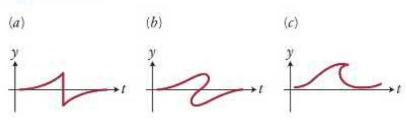
What is wrong with each displacement curve in Figure P16.26?Data from P16.26 (a) (b) (c)
At \(t=0\), a wave pulse has a shape given by the timeindependent wave function\[f(x)=\frac{a}{b^{2}+x^{2}}\]where \(a=0.030 \mathrm{~m}^{3}\) and \(b=2.0 \mathrm{~m}\). (a) If the pulse travels in the positive \(x\) direction at a wave speed of \(1.75 \mathrm{~m} / \mathrm{s}\), write the
A wave traveling along a string is described by\[f(x, t)=a \sin (\pi b x+q t),\]with \(a=30 \mathrm{~mm}, b=0.33 \mathrm{~m}^{-1}\), and \(q=10.47 \mathrm{~s}^{-1}\). (a) Calculate the amplitude, wavelength, period, and speed of the wave. (b) Compute the \(y\) component of the displacement of the
A wave is described by the equation\[f(x)=a \sin (b x),\]with \(a=0.095 \mathrm{~m}\) and \(b=2.25 \mathrm{~m}^{-1}\). (a) Calculate its wavelength. (b) If the wave has a speed of \(17.0 \mathrm{~m} / \mathrm{s}\), what is its frequency \(f\) ? (c) What is the angular frequency \(\omega\) of the
As an earthquake starts, you are standing \(150 \mathrm{~km}\) (as the wave travels) from the epicenter. A geophysicist near the epicenter immediately telephones you to let you know that the transverse wave from the earthquake is on its way to you and that it is described by the equation\[f(x, t)=a
The motion of a wave traveling along an \(x\) axis is given by\[f(x, t)=a \sin [b x+q t \mid,\]with \(a=6.00 \mathrm{~m}, b=\pi \mathrm{cm}^{-1}\), and \(q=12.0 \mathrm{~s}^{-1}\). Determine the direction of travel and the wave speed.
A plucked violin string carries a traveling wave given by the equation\[f(x, t)=a \sin \left[b(x-c t)+\phi_{\mathrm{i}}\right],\]with \(a=0.00580 \mathrm{~m}, b=33.05 \mathrm{~m}^{-1}\), and \(c=245 \mathrm{~m} / \mathrm{s}\). (a) If \(f(0,0)=0\), what is \(\phi_{1}\) ? (b) Determine the simple
A wave that was produced by a harmonic oscillator and is traveling along a string is described by the equation\[f(x, t)=a \sin |b(x-c t)|,\]with \(a=46 \mathrm{~mm}, b=4 \pi \mathrm{m}^{-1}\), and \(c=45 \mathrm{~m} / \mathrm{s}\). Calculate the \((a)\) wavelength, \((b)\) angular frequency
The amplitude of a wave traveling on a string is \(0.250 \mathrm{~m}\). The \(80.0-\mathrm{Hz}\) wave is traveling in the positive \(x\) direction at a wave speed of \(17.5 \mathrm{~m} / \mathrm{s}\). (a) Determine its wavelength, and write the equation for its timeindependent wave function. (b)
Watching your fish swim in their tank, you notice that when one fish repeatedly jumps, it causes a standing wave given by the time-independent function\[f(x)=a \sin (b x),\]with \(a=0.015 \mathrm{~m}\) and \(b=19.6 \mathrm{~m}^{-1}\). If the tank is \(0.96 \mathrm{~m}\) long, determine the
After tying one end of a rope to a stationary object, you flick the free end so as to cause a sinusoidal standing wave that has a maximum displacement of \(0.50 \mathrm{~m}\) and a wavelength of \(1.33 \mathrm{~m}\). Write the time-dependent wave function in terms of the wave speed.
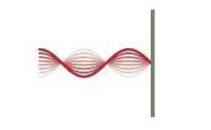
When one end of a string is tied to a pole and the other end is moved with frequency \(f\), the standing wave pattern shown in Figure P16.37 is created. What is the smallest frequency at which the string can be moved to produce any standing wave?Data from P16.37
Showing 3000 - 3100
of 4962
First
24
25
26
27
28
29
30
31
32
33
34
35
36
37
38
Last
Step by Step Answers

 Get 50% OFF
Claim Now
Get 50% OFF
Claim Now