New Semester
Started
Get
50% OFF
Study Help!
--h --m --s
Claim Now
Question Answers
Textbooks
Find textbooks, questions and answers
Oops, something went wrong!
Change your search query and then try again
S
Books
FREE
Study Help
Expert Questions
Accounting
General Management
Mathematics
Finance
Organizational Behaviour
Law
Physics
Operating System
Management Leadership
Sociology
Programming
Marketing
Database
Computer Network
Economics
Textbooks Solutions
Accounting
Managerial Accounting
Management Leadership
Cost Accounting
Statistics
Business Law
Corporate Finance
Finance
Economics
Auditing
Tutors
Online Tutors
Find a Tutor
Hire a Tutor
Become a Tutor
AI Tutor
AI Study Planner
NEW
Sell Books
Search
Search
Sign In
Register
study help
physics
particle physics
Particle Physics 4th Edition Brian R. Martin, Graham Shaw - Solutions
Draw the lowest-order quark diagrams for the processes:(a) e+ + e− → K+ + K−, (b) J/ψ → μ+ + μ−,(c) J/ψ → ηc + γ.
A hypothetical spin-1 bottomonium resonance Î¥ with mass 9 GeV/c2is observed in the reaction e+eˆ’†’ μ+μˆ’and in the total electron€“ positron annihilation cross-section. The resonance is too narrow for its width to be
Draw the lowest-order Feynman diagrams that contribute to the processes:(a) g + q → g + q, (b) q + q̅ → g + g, (c) q + q̅ → g + γ.
Make a rough estimate of the relative magnitude of the static potential between two quarks separated by distances of 0.1 fm and 0.001 fm.
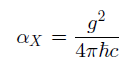
Estimate the relative magnitudes of the static potential between (a) A quark€“antiquark pair (b) Two protons, both separated by a distance of 3 fm, given that the value of the dimensionless Yukawa coupling (1.31) for the ppÏ€0 vertex is about 14. Comment briefly on
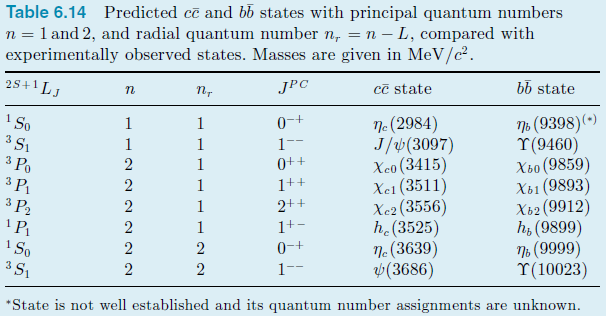
Would you expect the widths of three chi states listed in Table 6.14 to be bigger, smaller or about the same as the widths of the J/ψ(3097) and ψ(3686)? Check your answer with the experimental widths given in the PDG tables. Table 6.14 Predicted cc and bb states with principal
Two identical particles can scatter elastically by both single photon and single Z0 exchange. Calculate the typical squared energy– momentum transfer q2 between them for a distance of closest approach of (a) 1 fm and (b) 10−3fm in their centre-of-mass frame. Assuming that the intrinsic
Show that mesons with the quantum numbers (7.8) are forbidden in the simple quark model.Equation 7.8B = Q = S = C = B̃ = 0
Table 5.3 lists the allowed combinations of strangeness S and isospin I for mesons composed of light quarks u, d, s in the simple quark model. What are the allowed combinations for tetraquarks composed of light quarks? What are the allowed values of the electric charge Q for tetraquarks with
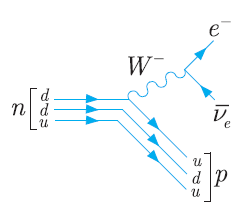
Draw two quark diagrams corresponding to the decay sequence (7.10b), given that the b quark couples to lighter quarks almost exclusively via the vertex bcW analogous to the udW vertex of Figure 3.1.Equation 7.10bΛ0b†’ Kˆ’ + p + J/ψ.Figure 3.1 пd и и и
Draw quark diagrams for the decay sequence (7.10c), assuming P+c is the charmonium–pentaquark state P+c = uudcc̅.Equation 7.10cΛ0b → K− + P+c ; P+c → J/ψ + p
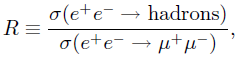
Estimate the cross-section ratio R, defined by (7.18), at total centreof- mass energies ECM= 2.8, 5 and 15 GeV, assuming that there are no resonance peaks at these energies and that (7.22) remains approximately valid even at energies as low as 2.8 GeV. How would you expect R to change when the
Perform the angular integration in (8.5) and use the result (a) To show that GE (q2) is a function of q2 only (b) To derive (8.9) for the root-mean-square charge radius rE.
Show that the scattering variable ν defined by (8.28) reduces to (8.30) in the rest frame of the proton. Hence show that the scaling variable (8.29) lies in the range 0 ≤ x ≤ 1 if the lepton masses are neglected.
A cylindrical proportional chamber has a central anode wire of radius 0.02 mm and an outer cathode of radius 10mm with a voltage of 500 volts applied between them. What is the electric field at the surface of the anode? If the threshold for ionisation by collision is 750 kV/m and the mean free path
Estimate the minimum length of a gas Ċerenkov counter that could be used in the threshold mode to distinguish between pions and kaons with momentum 20 GeV/c. Assume that 200 photons need to be radiated to ensure a high probability of detection. Assume also that the radiation covers the whole
Two particles of masses m1 and m2, and common momentum p, travel between two scintillation counters that are a distance L apart. Show that the difference in their flight times decreases like p−2 for large momenta. Calculate the minimum flight path necessary to distinguish pions from kaons if they
Assuming the Bethe–Bloch formula is valid for low energies, show that the rate of ionisation has a maximum (the Bragg peak) and find the kinetic energy of protons in iron for which this maximum would occur.
Derive the result of Equation (4.12) for the range R. dE M -F(ß;), q?ne d3 R = = - dr
An electron with an initial energy of 2 GeV traverses 10 cm of water with a radiation length of 36.1 cm. Calculate its final energy. How would the energy loss change if the particle were a muon rather than an electron?
A positron with laboratory energy 50 GeV interacts with the atomic electrons in a lead target to produce μ+μ− pairs. If the cross-section for this process is given by σ = 4πα2h̅2c2/3E2CM,calculate the positron’s effective interaction length. The density of lead is 1.14 × 10⁷ kg/m3.
Estimate the thickness of iron through which a beam of neutrinos with energy 200 GeV must travel if 1 in 109 of them is to interact. Assume that at high energies the neutrino–nucleon total cross-section is given approximately by σν ≈ 10−38Eν cm2 , where Eν is given in GeV. The density of
Charged pions with momentum 50 GeV/c are deflected through a collimator slit 3mm wide by a bending magnet 2m long that produces a uniform field of 1.5 T. Calculate how far from the magnet the slit should be placed so that it accepts particles with momentum within about 1% of the central value.
A liquid hydrogen target of volume 125 cm3 and density 0.071 g/cm3 is bombarded with a mono energetic beam of negative pions with a flux 2 × 10⁷/m2 s and the reaction π− + p → π0 + n observed by detecting the photons from the decay of the π0 . Calculate the number of photons emitted from
An e+e− collider has a diameter of 8km and produces beams of energy 45 GeV. Each beam consists of 12 bunches each containing 3 × 10¹¹ particles. The bunches have a cross-sectional area of 0.02mm2. What is the luminosity of the machine in units of cm−2 s−1?
At a collider, two high-energy particles A and B with energies EA and EB, which are much greater than either of the masses, collide at a crossing angle θ. Show that the total centre-of-mass energy ECM is given by E2CM = 2EAEB (1 + cos θ)If the rest masses are neglected. At the HERA
Show that the momentum p in GeV/c for a relativistic particle of charge e moving in a circular orbit of radius ρ metres in a magnetic field of magnitude B = |B| tesla is given by p = 0.3B ρ.
What is the length L of the longest drift tube in a linac, which, operating at a frequency f = 50 MHz, is capable of accelerating protons to a maximum energy of E = 300 MeV?
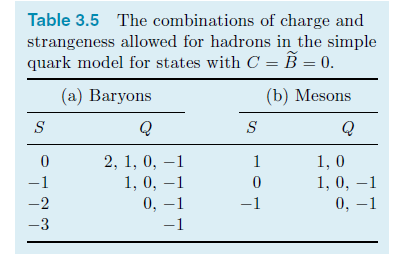
Which of the following possible hadronic states with quantum numbers (Q,B, S,C, B̃) = (1, 0, 0, 1, 1), (−1, 1,−2, 0,−1), (0, 0, 1, 0, 1) and (−1, 1, 0, 1,−1) are compatible with the simple quark model and which are not?
Derive the allowed combinations of charm C and electric charge Q for mesons and baryons in the simple quark model.
Draw the quark diagram for: (a) The decay Δ++ → π+ + p of the Δ(1232) resonance discussed in Section 3.5 and (b) The two corresponding diagrams for the process π−p → Δ0 → π0n.
Draw a lowest-order Feynman diagram at the quark level for each of the following decays:(a) D− → K0 + π−; (b) Λ → p + e− + ν̅e.
The Σ+(1189) = uus decays almost entirely to states composed solely of hadrons. Identify these states and make a rough estimate of the particle lifetime.
Apart from the p, n and Λ described in the text, the only baryon lighter than the Σ0(1193) = uds is its charged companion Σ+(1189) = uus. Use this fact to identify the dominant decay mode of the Σ0(1193) and make a rough estimate of its lifetime.
The Σ+(1189), Σ0(1193) and Σ−(1197) baryons have the quark compositions uus, uds and dds, respectively. Which of the following reactions are allowed and which are forbidden in strong interactions?(a) π− + p → K− +Σ+; (b) π− + p → K0 +Σ0;(c) π+ + p → K0 + Σ+; (d) π+
Six observed hadrons have the quantum numbers (Q, B, S, C, B̃) = (2, 1, 0, 1, 0), (0, 1,−2, 1, 0), (0, 0, 1, 0,−1), (0,−1, 1, 0, 0), (0, 1,−1, 1, 0) and (−1, 1,−3, 0, 0), respectively. Identify their quark constituents.
The particles X0(1193) and Yˆ’(1321) can be produced in the strong interaction processes Kˆ’+ p †’ Ï€0+ X0and Kˆ’+ p †’ K++ Yˆ’respectively. Deduce the baryon number, strangeness, charm and bottom quantum numbers in each case and
A large number of stopped K+(494) mesons are observed to decay to the π+π0 final state. Calculate the mean distance travel-led by the π+ mesons before they decay, in the approximations that both pions have a mass of 140 MeV/c2. The mean lifetime at rest of the π+ is τ0 = 2.6 × 10⁻⁸ s.
Classify the following experimentally observed processes into strong, electromagnetic and weak reactions by considering the particles involved and the appropriate selection rules.(a) π− → π0 + e− + ν̅e (b) γ + p → π+ + n;(c) p+ p̅ → π+ + π− + π0; (d) D− → K+ +
Which of the following reactions are allowed and which are forbidden by the conservation laws appropriate to weak interactions?(a) Λ → π+ + e− + ν̅e; (b) K+ → π+ + e− + ¯ ν̅e ;(c) K+ → π0 + μ+ + ν̅μ; (d) K− → π− + e+ + e−.
If the Sun is assumed to be a uniform spherical plasma consisting of nucleons, with radius 7 × 10⁵ km and total mass 2 × 1030 kg, calculate the mean free path λ = 1/nσ of solar neutrinos from the dominant reaction (2.35). Here n is the number of nucleons per unit volume and σ, the
A hypothetical KamLAND-type experiment detects v̅e neutrinos at a distance of 300 m from a nuclear reactor and finds that the flux is (90 ± 10)% of that expected if there were no oscillations. Assuming a two-component model with maximal mixing (θ = 450) and a mean neutrino energy of 2.5 MeV,
Calculate the oscillation lengths L13, L12 associated with ν1 → ν3 and ν1 → ν2 oscillations for electron antineutrinos of energy 3MeV. Why is a two-component mixing model a good first approximation for neutrino oscillations at distances of order 1km and of order 150– 200 km? Would it
An electron antineutrino is produced at the center of the Sun. Somewhere on its journey to the surface it passes through a region where the density is such that matter effects lead to a resonant enhancement of its oscillations. Estimate the minimum energy required for this to occur if electron
In the KamLAND experiment, anti neutrinos are detected via the reaction ν̅e + p → e+ + n, where the target protons are at rest. Show that for incident anti neutrinos of energy Eν = 3MeV, the positron produced has an energyE+ = Eν + mp − mn = 1.71MeVto within an error of 1%, irrespective of
Show that the oscillation length in (2.30h) may he written L0 = E/(1.27∆m2ij), where L0 is expressed in km, E in GeV and in ∆m2ij in (eV/c2)2.
In Section 2.3.1 it is stated that electron neutrinos interact with electrons in a different way from muon and tauon neutrinos. Justify this remark by considering the lowest-order Feynman diagrams for νe + e− → νe + e− and νμ + e− → νμ + e−.
Draw the two fourth-order Feynman diagrams for the weak reactione− + μ+ → νe + ν̅μ.
Draw the lowest-order Feynman diagram for νeνμ elastic scattering.
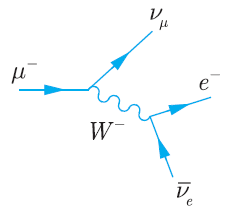
Figure 2.5 shows one of the time-ordered diagrams for muon decay μˆ’†’ eˆ’ ν̅eνμ. What are the basic processes associated with the two vertices? What are the basic processes associated with the
Which of the following reactions are allowed, and which are forbidden, by the conservation laws appropriate to weak interactions?(a) νμ + p → μ+ + n,(b) νe + p → e− + π + + p,(c) ντ + e− → τ− + νe,(d) τ+ → μ+ + v̅μ + ντ.
(a) The classical radius of an electron is defined as rc = e2/4πε0me in natural units. What is its value in fm?(b) A simple classical model of the electron is to regard it as a sphere of uniform charge density, whose radius R is such that the electrostatic potential accounts for the whole
For total centre-of-mass energies of a few GeV, the cross-section for the reaction νμ + e− → μ− + νμ is given by σ = G2F E2/π in natural units, where GF is the Fermi coupling constant (1.42). What is the cross-section in picobarns at an energy E = 3GeV?Equation 1.42GF = 1.166 × 10⁻⁵
Parapositronium is an unstable bound state of an electron and a positron. Its lifetime is given in natural units by τ = 2/mα5, where m is the mass of the electron and α is the fine structure constant. Restore the factors of h̅ and c by dimensional arguments and evaluate in seconds.
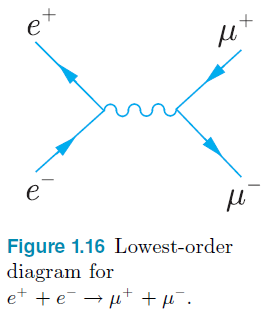
In lowest order, the process e++ e-†’ μ++ μ-is given by the Feynman diagram of Figure 1.16. Estimate the typical distance between the vertices at energies much larger than the masses of any of the particles in (a) the rest frame of the electron and (b) the
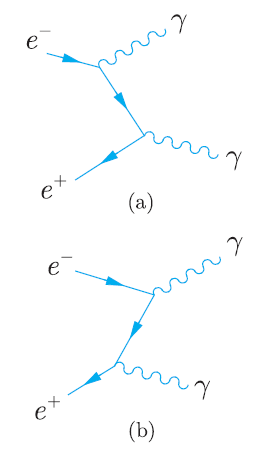
In lowest order, the process e+ + e- †’ γ + γ is given by the Feynman diagrams of Figure 1.9. Show that for electrons and positrons almost at rest, the distance between the two vertices is typically of order m-1in natural units, where m is the electron
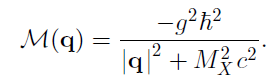
Verify by explicit integration that substituting the Yukawa potential (1.30) into (1.32) leads to (1.35) for the corresponding scattering amplitude.Equation 1.30Equation 1.32Equation 1.35 g² -r/R V (r) = 4т M@ -D /V(г)exp(ig г/h)a'r,
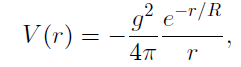
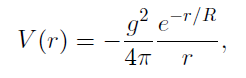
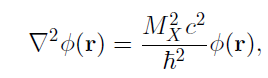
Show that the Yukawa potential of Equation (1.30) is the only spherically symmetric solution of the static Klein€“Gordon equation (1.28) that vanishes as r goes to infinity.Equation 1.30Equation 1.28 g? e-r/R V (r) = Mž2 -Ф(г), Ог) 3D h? х
Draw one fourth-order diagram for each of the reactions(a) γ + e− → γ + e− and (b) e+ + e− → e+ + e−.
The matrices αi(i = 1, 2, 3) and β in the Dirac equation (1.8) can be chosen to have the explicit formswhere 1 and 0 are the 2 × 2 unit matrix and null matrix, respectively, and the Pauli spin matrices σi areCheck that these forms satisfy the anti
Write down equations in symbol form that describe the following interactions:(a) The elastic scattering of an electron anti neutrino and a positron;(b) The elastic scattering of proton and a neutron;(c) The annihilation of a proton and an anti proton to an electron, a positron and a photon.
Draw the topologically distinct Feynman diagrams that contribute to the following process in lowest order:(a) γ + e− → γ + e−;(b) e+ + e− → e+ + e−;(c) VeV̅e elastic scattering.
Showing 4900 - 5000
of 4962
First
36
37
38
39
40
41
42
43
44
45
46
47
48
49
50
Step by Step Answers

 Get 50% OFF
Claim Now
Get 50% OFF
Claim Now