New Semester
Started
Get
50% OFF
Study Help!
--h --m --s
Claim Now
Question Answers
Textbooks
Find textbooks, questions and answers
Oops, something went wrong!
Change your search query and then try again
S
Books
FREE
Study Help
Expert Questions
Accounting
General Management
Mathematics
Finance
Organizational Behaviour
Law
Physics
Operating System
Management Leadership
Sociology
Programming
Marketing
Database
Computer Network
Economics
Textbooks Solutions
Accounting
Managerial Accounting
Management Leadership
Cost Accounting
Statistics
Business Law
Corporate Finance
Finance
Economics
Auditing
Tutors
Online Tutors
Find a Tutor
Hire a Tutor
Become a Tutor
AI Tutor
AI Study Planner
NEW
Sell Books
Search
Search
Sign In
Register
study help
physics
particle physics
Principles And Practice Of Physics 2nd Edition Eric Mazur - Solutions
Very dilute, monatomic cool gases A and B are separated by a partition but allowed to exchange energy through the partition. After a long time interval, \(v_{\text {rms, } \mathrm{A}}=6 v_{\mathrm{rms}, \mathrm{B}}\). What is the relationship between the mass of a particle of gas A and the mass of
A thermally insulated 3. 00-L flask contains monatomic xenon gas at an initial temperature of \(50.0^{\circ} \mathrm{C}\) and pressure of \(2.50 \mathrm{~atm}\). You now add enough energy to double the thermal energy of the gas. The mass of a xenon atom is \(2.18 \times 10^{-25} \mathrm{~kg}\). (a)
In a sample of a monatomic ideal gas that has a number density of \(3.61 \times 10^{24}\) particles \(/ \mathrm{m}^{3}\), the average kinetic energy of the gas particles is \(7.50 \times 10^{-21} \mathrm{~J}\). If the particles are colliding with a wall that has an area of \(1.00 \times 10^{-2}
Chamber \(\mathrm{X}\) contains monatomic ideal gas \(\mathrm{X}\). The gas particles have a root-mean-square speed of \(42 \mathrm{~m} / \mathrm{s}\). Chamber Y, identical to chamber X, contains a different monatomic ideal gas with the same mass as the gas in chamber \(\mathrm{X}\) but with twice
Neon atoms at \(260 \mathrm{~K}\) pass through a fan that gives each mole of neon gas an additional kinetic energy of \(16.0 \mathrm{~J}\). (a) What is the average temperature of the neon atoms immediately after coming through the fan? (b) If you found an increase in temperature in part \(a\), how
A pollution-control device installed in the smokestack of equipment used to run an industrial process measures the root-mean-square speed of pollutant particles given off by the process. If \(v_{\mathrm{rms}}\) exceeds a given limit, the process is shut down to prevent the release of pollutants
You are constructing an improvised detector for radon gas, using the cooling core from an old refrigerator capable of cooling air to \(255 \mathrm{~K}\), a detector tube \(50 \mathrm{~mm}\) long, a vacuum pump to evacuate the tube, and an electric circuit that can measure the time interval needed
What is the change in entropy per particle of a monatomic ideal gas heated from \(300 \mathrm{~K}\) to \(400 \mathrm{~K}\) ? Assume constant volume, and thermal equilibrium in both the initial and final states.
If \(1.85 \times 10^{5}\) atoms of a monatomic ideal gas are heated from \(300 \mathrm{~K}\) to \(500 \mathrm{~K}\) in a sealed container that has a fixed volume of \(0.0560 \mathrm{~m}^{3}\), what is the change in entropy of the gas?
A monatomic ideal gas in a container of fixed volume contains \(4.20 \times 10^{24}\) atoms. If you add enough thermal energy to double the root-mean-square speed of the gas atoms, by how much have you changed the entropy of the gas?
A container of fixed volume contains \(8.72 \times 10^{23}\) helium atoms, each of mass \(6.646 \times 10^{-27} \mathrm{~kg}\). You put the container in a freezer and decrease its temperature from \(25.0{ }^{\circ} \mathrm{C}\) to \(-135{ }^{\circ} \mathrm{C}\). What are (a) the change in the
A 3. 50-L expandable chamber contains monatomic neon gas at \(2.00 \mathrm{~atm}\) and \(30.0^{\circ} \mathrm{C}\). Thermal energy is slowly added to the gas until its volume is \(8.00 \mathrm{~L}\) while its pressure remains constant. What is the entropy change during this expansion?
A monatomic ideal gas has its volume halved while its pressure is held constant. What is the change in entropy per atom?
As a sample of argon gas is heated in a sealed container, its root-mean-square speed changes from \(350 \mathrm{~m} / \mathrm{s}\) to \(540 \mathrm{~m} / \mathrm{s}\). By how much has the entropy been increased per argon atom? The mass of an argon atom is \(6.63 \times 10^{-26} \mathrm{~kg}\).
A monatomic ideal gas is enclosed in a cubic box of side length \(\ell\). While preserving the cubic shape, the container volume is decreased until the side length is halved, and this change causes the pressure in the box to triple. (a) What is the change in entropy per particle of gas in the box?
A sample containing \(3.65 \mathrm{~mol}\) of a monatomic ideal gas is heated from \(289 \mathrm{~K}\) to \(458 \mathrm{~K}\), and the entropy remains constant. If the initial volume of the sample was \(0.0980 \mathrm{~m}^{3}\), by what factor did the pressure increase or decrease during this
A constant-volume encasement vessel surrounds a liquidnitrogen bath that has cooled \(1.00 \mathrm{~mol}\) of a monatomic ideal gas to \(77.2 \mathrm{~K}\). This system is initially in thermal equilibrium at this temperature, but over time the liquid nitrogen evaporates, and then the ideal gas and
Ten particles of a monatomic ideal gas are initially at thermal equilibrium with their surroundings. When the sample is then heated to \(634 \mathrm{~K}\) while the volume is held constant, the entropy doubles. What was the initial temperature of the sample?
In a cylindrical chamber that initially has a volume of \(2.25 \mathrm{~L}\), a sample of helium gas is at equilibrium at \(3.20 \mathrm{~atm}\) and \(85.0^{\circ} \mathrm{C}\). The gas is slowly compressed to a new equilibrium state at a volume of \(1.10 \mathrm{~L}\) and pressure of \(4.40
A thermally insulated chamber is divided by a partition into two compartments of equal volume. The left side contains \(9.00 \times 10^{23}\) helium atoms, and the right side contains \(2.70 \times 10^{24}\) argon atoms. The gases in both compartments are in equilibrium and at the same temperature.
A rigid 1. 20-1 bottle contains helium gas at \(150{ }^{\circ} \mathrm{C}\) and \(2.75 \mathrm{~atm}\). If you slowly add \(755 \mathrm{~J}\) of thermal energy to the gas, what is the entropy change for the gas? Assume the helium gas is ideal.
Suppose you are dropping five small pieces of clay randomly onto a chessboard (eight squares by eight squares). If basic states are determined by the squares on which each piece of clay lands, how many basic states are possible? Assume a square can be occupied by multiple pieces.
Consider two egg cartons, one with spaces for a dozen eggs and one with spaces for a half-dozen eggs. If each carton contains six eggs, all of different colors, what is the ratio of the number of possible basic states in the one-dozen carton to the number of possible basic states in the half-dozen
Two boxes each have a volume of \(1.50 \mathrm{~m}^{3}\). Box A contains 1000 helium atoms, and box B contains 2000 neon atoms. When the boxes are connected together by a very small tube, the atoms redistribute themselves throughout both boxes. What is the entropy change of the two-box system
A sample of neon gas is at \(100^{\circ} \mathrm{C}\). The mass of a neon atom is \(3.35 \times 10^{-26} \mathrm{~kg}\).(a) What is the average kinetic energy of a neon atom? \((b)\) If the thermal energy of the sample is \(175 \mathrm{~J}\), how many neon atoms does it contain?
At \(35^{\circ} \mathrm{C}\), the root-mean-square speed of a certain monatomic ideal gas is \(186 \mathrm{~m} / \mathrm{s}\). (a) What is the mass of each atom? (b) What is the average kinetic energy of a typical atom at that temperature?
A \(0.00126-\mathrm{kg}\) sample of an ideal gas in a fixed-volume, \(0.750-\mathrm{L}\) container at \(50.0^{\circ} \mathrm{C}\) exerts a pressure of \(2.24 \mathrm{~atm}\). What is the mass of one particle of this gas?
The atoms of an element can come in different forms, depending on the number of neutrons in the nucleus. These different forms are called isotopes of the element. The two most common isotopes of uranium are uranium-235 (143 neutrons) and uranium-238 (146 neutrons), having masses of \(3.90 \times
A sealed \(1.50-\mathrm{L}\) chamber filled with helium gas initially at \(20^{\circ} \mathrm{C}\) and \(1.00 \mathrm{~atm}\) is heated until the gas temperature is \(232^{\circ} \mathrm{C}\). (a) How much thermal energy is added to the gas during this process? (b) What is the entropy change of the
(a) At what temperature is the root-mean-square speed of neon atoms (mass \(3.35 \times 10^{-26} \mathrm{~kg}\) ) equal to the speed of sound in a typical room, \(344 \mathrm{~m} / \mathrm{s}\) ? (b) At the temperature you found in part \(a\), how much thermal energy do \(6.02 \times 10^{23}\) neon
A monatomic ideal gas is in a fixed-volume flask. (a) By what factor must you increase the root-mean-square speed of the gas particles to double the gas pressure? (b) By what factor does the thermal energy of the gas change when you increase \(v_{\text {rms }}\) by this factor?
A sample of a monatomic ideal gas contains \(\mathrm{N}\) atoms. You want to compress the gas slowly to one-fourth of its original volume. (a) By what factor must you change the absolute temperature of the sample in order to increase its entropy by \(3 N\) ? (b) For the process in part \(a\), by
The temperature of the Sun's corona (the outermost gas layer) is \(1.0 \times 10^{6} \mathrm{~K}\), and this layer is just above the photosphere layer, which has a radius of \(6.96 \times 10^{8} \mathrm{~m}\). The mass of the Sun is \(1.99 \times 10^{30} \mathrm{~kg}\). Is the rootmean-square speed
Consider a helium atom that is part of Earth's atmosphere and is initially at the planet's surface, where the temperature is \(20^{\circ} \mathrm{C}\). To what maximum altitude can this atom rise if its speed is equal to the root-meansquare speed of the helium in the atmosphere? The mass of a
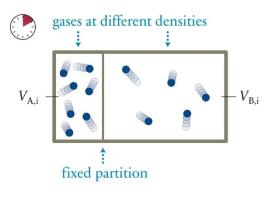
A box initially divided into two equal halves by a partition contains some number of particles. When the partition is removed, the particles are free to move throughout the volume of the box. Assume that all the particles have an average speed that allows them to cross from one side of the box to
A cylindrical chamber is oriented with its long central axis along the vertical \(y\) axis of an \(x y z\) coordinate system. The top face of the chamber is a piston that can slide up and down to change the chamber volume. The chamber is initially filled with a monatomic ideal gas. When the chamber
A cylindrical canister fitted with a piston at one end contains an ideal gas and floats at the surface of a freshwater lake, where the temperature is \(300 \mathrm{~K}\). The gas pressure inside the canister is just enough to balance atmospheric pressure, and so the piston does not slide downward.
Your work in a laboratory requires a certain dangerous ideal gas, which you will be using for the next three weeks. You know that the gas is corrosive and that gas particles are constantly colliding with one another and, more worrisome, with the walls of the container. Thus there is some finite
A tank filled with helium gas has been left in a hot car for hours. The mass of the filled tank is \(21.2 \mathrm{~kg}\), and after you use all the helium to fill 100 balloons for a child's birthday party, the tank mass is \(20.8 \mathrm{~kg}\). You notice that the filled balloons are shrinking
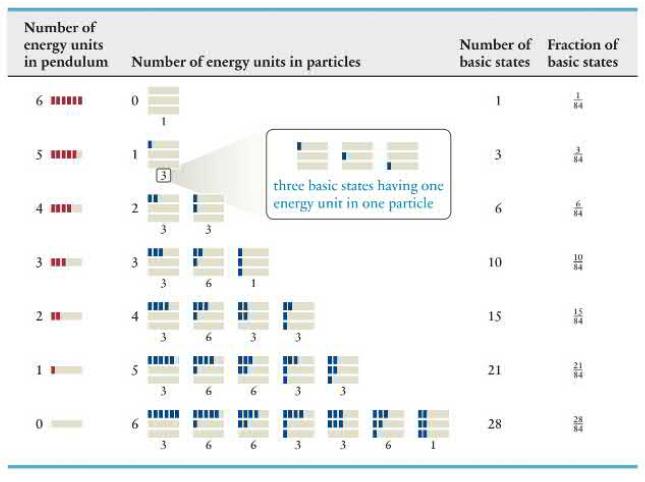
Figure 19. 4 shows that there are 15 basic states for four energy units distributed over three particles. List all 15.Data from Figure 19. 4 Number of energy units in pendulum Number of energy units in particles 6 0 Number of Fraction of basic states 1 basic states 5 mm 4 3 211 + 33 3 5 3 3 three
Suppose a container holds three types of gas. The masses of the gas particles are \(m, 4 m\), and \(9 \mathrm{~m}\). How do the average speeds of the particles compare?
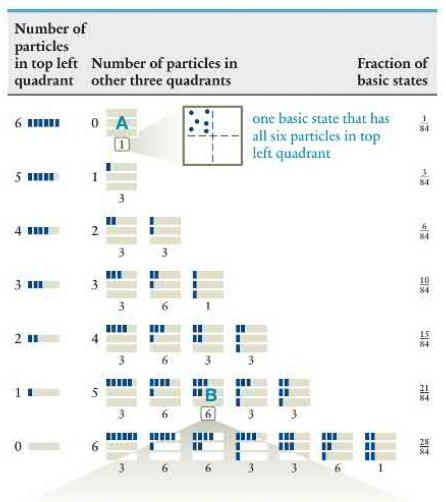
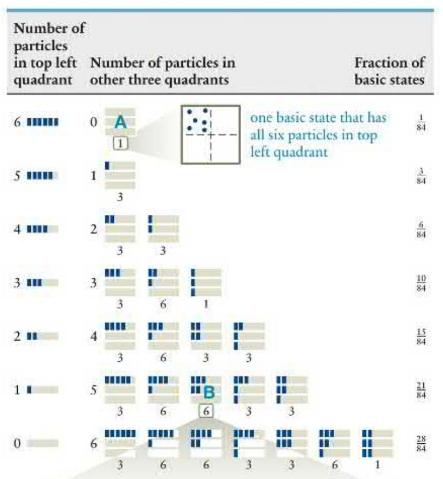
In Figure 19. 12 what is the probability of finding three particles in any compartment of the box?Data from Figure 19.12 Number of particles in top left Number of particles in Fraction of basic states one basic state that has all six particles in top left quadrant 1 84 quadrant other three
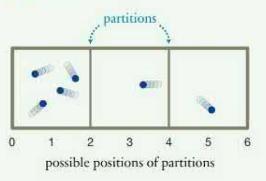
The two partitions in the container shown in Figure 19. 17 can slide freely. Where will they be positioned when the space is equipartitioned?Data from Figure 19.17 partitions, 0 1 2 3 4 5 possible positions of partitions 6
A box with a fixed partition through which energy can be exchanged contains 50 particles, 40 on the left and 10 on the right. The system contains 250 energy units. As the system approaches equilibrium, how many energy units end up on the left? On the right?
If a closed system tends to change in a specific direction, such as ice melting in an insulated glass of water, what can you say about the number of basic states for this system?
Consider a \(0.10-\mathrm{kg}\) pendulum swinging at a maximum speed of \(0.80 \mathrm{~m} / \mathrm{s}\) inside a box that contains \(1.0 \times 10^{23}\) nitrogen molecules. The mass of a nitrogen molecule is \(4.7 \times 10^{-26} \mathrm{~kg}\), and at room temperature a typical nitrogen
When you throw two dice, one red and one blue, many times, what is the fraction of throws for which the dots on the two dice add to 4 ?
Consider again the \(0.10-\mathrm{kg}\) pendulum of Exercise 19.1. The pendulum starts out swinging at a maximum speed of \(0.80 \mathrm{~m} / \mathrm{s}\) and stops swinging in \(5.0 \mathrm{~min}\). It is in a box that contains \(1.0 \times 10^{23}\) nitrogen molecules, each having a mass of
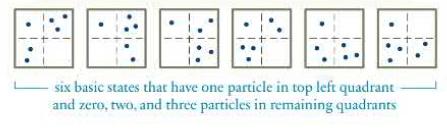
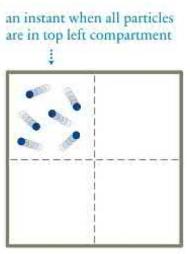
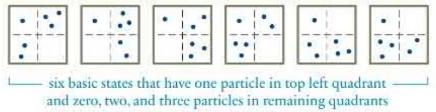
In Figure 19.10, how many basic states correspond to the macrostate in which \((a)\) all six particles are in the top left compartment and \((b)\) five particles are in the upper left compartment?Data from Figure 19.10 an instant when all particles are in top left compartment
Use the data in Figure 19.12 to determine the average number of particles in the top left compartment of the four compartment box shown there.Data from Figure 19.12 Number of particles in top left Number of particles in quadrant other three quadrants 6. 0 A 5 w 3 4 2 3 3 2 3 3 Fraction of basic
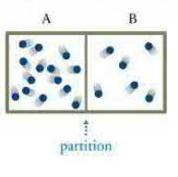
In Figure 19.13, after a very large number of particle-partition collisions have occurred, what is the probability of finding the system in (a) the macrostate \(E_{\mathrm{A}}=1\) and \((b)\) the macrostate \(E_{\mathrm{A}}=7\) ?Data from Figure 19.13 A B partition
Suppose the system depicted in Figure 19.13 evolves toward equilibrium from the macrostate \(E_{\mathrm{A}}=4, E_{\mathrm{B}}=6\). Determine the changes in (a) the number of energy units and (b) the number of basic states for compartment \(\mathrm{A}\), for compartment B, and for the system.Data
Suppose ten distinguishable particles are equipartitioned in a container that is divided into 100 equal-sized compartments.(a) How many basic states are associated with this system? \((b)\) What is the natural logarithm of this number of basic states?
A partition divides a container into two equal compartments, A and B. Initially compartment A contains a gas of distinguishable particles and compartment B is empty. (a) What is the change in the entropy of the gas if the partition is removed and the gas is allowed to expand into the volume \(V\)
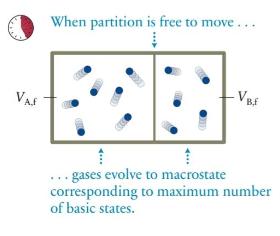
The box in Figure 19.19 contains seven gas particles in compartment \(\mathrm{A}\) and five in compartment \(\mathrm{B}\), and the partition separating the compartments is free to move. Let the volume of the box be \(V\) and the initial ratio of the compartment volumes be \(V_{\mathrm{B},
A sample of helium gas containing \(6.02 \times 10^{2.3}\) atoms at atmospheric pressure \(\left(1.01 \times 10^{5} \mathrm{~Pa}\right)\) occupies a volume of \(22.4 \times 10^{-3} \mathrm{~m}^{3}\). The mass of a helium atom is \(6.646 \times 10^{-27} \mathrm{~kg}\). What is the rms speed of the
A sample of a monatomic ideal gas consisting of \(1.00 \times 10^{23}\) atoms in a volume of \(4.00 \times 10^{-3} \mathrm{~m}^{3}\) is initially at a temperature of \(290 \mathrm{~K}\). The gas is cooled until it reaches a pressure of \(5.00 \times 10^{4} \mathrm{~N} / \mathrm{m}^{2}\).(a) What is
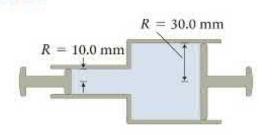
The liquid-filled cylinder in Figure P18.1 is clamped in place and has a piston on either end. The piston on the right is cylindrical and has a radius of \(30.0 \mathrm{~mm}\). The piston on the left is also cylindrical and has a radius of \(10.0 \mathrm{~mm}\). If the right cylinder is pushed
On Earth, a cylindrical container of water open to the atmosphere experiences atmospheric pressure at the top surface and a greater pressure at the bottom of the container. How do these pressures change when the container is being carried on the orbiting International Space Station?
A box has six faces with three distinct areas \(A
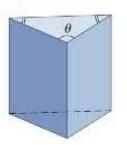
You are designing a wedge-shaped container as illustrated in Figure P18.4. You must choose a value for the angle \(\theta\), which then determines the other two equal angles in this isosceles wedge. (a) When the container is filled with a fluid, what must the value of \(\theta\) be if \(F / A\),
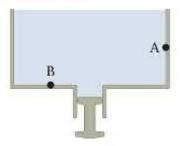
The open fixed container in Figure P18.5 is filled with a liquid and fitted with a piston at the bottom. Give the direction (if any) of the following:(a) the force \(\vec{F}_{\text {w }}^{c}\) exerted by the liquid on the wall at location \(A\),(b) the pressure \(P\) in the liquid at
You and your snowboard, with a combined mass of \(70 \mathrm{~kg}\), ride a half-pipe that has a radius of \(5.0 \mathrm{~m}\). As you pass the bottom, you create a pressure of \(27 \mathrm{kN} / \mathrm{m}^{2}\) on the half-pipe while moving at \(8.2 \mathrm{~m} / \mathrm{s}\). If your snowboard
For the floor in any room, the floor loading is the maximum safe average pressure on the floor (the gravitational force exerted by Earth on all objects resting on the floor divided by the floor area), and the floor's point loading is the maximum safe actual pressure (the gravitational force exerted
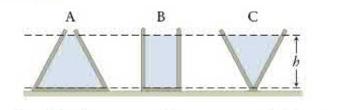
Three jars each have volume \(V\) and height \(h\), but they have different shapes as shown in Figure P18.8. Water is to be added to each jar and the pressure is to be measured right at the bottom of each jar. Rank the jars in order of increasing pressure if the volume of water is(a) V and (b) V /
In a galaxy far, far away, a planet composed of an incompressible liquid of uniform mass density \(ho\) has mass \(m_{\text {planet }}\) and radius \(R\). Determine the pressure midway between the surface and the center of the planet.
A cube measuring \(100 \mathrm{~mm}\) on a side floats upright in water with \(70.0 \mathrm{~mm}\) submerged. What is the mass of the cube?
A scuba diving weight has a mass of \(5.0 \mathrm{~kg}\) and is made from a material that has a mass density of \(2000 \mathrm{~kg} / \mathrm{m}^{3}\). How much force is required to lift it from the bottom of a shallow pool?
You have three bricks made of lead, stone, and plastic. The bricks have identical dimensions. When completely submerged \((a)\) which brick feels the greatest buoyant force, and \((b)\) which is most likely to float when released?
A ship constructed of \(2.50 \times 10^{6} \mathrm{~kg}\) of steel is roughly shaped like a box of length \(50.0 \mathrm{~m}\), width \(20.0 \mathrm{~m}\), and height \(20.0 \mathrm{~m}\). (a) What is the mass density of the ship? (b) Does the ship float? (c) If it floats, what is the maximum cargo
A wooden block of height \(b\) is pushed from the air into a bucket of water that has a depth equal to \(2 h\). Make a graph showing how the buoyant force exerted on the block changes as its bottom moves from the surface to the bottom of the bucket. You do not need to specify the size of the
Glass A contains \(250 \mathrm{~g}\) of water, and an identical glass B contains \(220 \mathrm{~g}\) of water with a \(30 \mathrm{~g}\) cube of ice floating in it. How do the water levels in the two glasses compare?
A rowboat floating in a small swimming pool has a large concrete block in it. If the block is thrown overboard into the pool, does the water level in the pool rise, fall, or stay the same?
You have constructed a raft that is \(2.00 \mathrm{~m}\) long, \(2.00 \mathrm{~m}\) wide, and \(0.100 \mathrm{~m}\) thick. If the mass of the raft is \(40.0 \mathrm{~kg}\) and your mass is \(55.0 \mathrm{~kg}\), how many \(65.0-\mathrm{kg}\) friends can cross a river with you during one trip?
A spherical balloon filled with helium gas must lift a \(1.50-\mathrm{kg}\) scientific payload off the ground, and the mass of the empty balloon is \(0.500 \mathrm{~kg}\).(a) What is the minimum diameter of the balloon? \((b)\) A helium shortage forces the scientists to consider using nitrogen gas
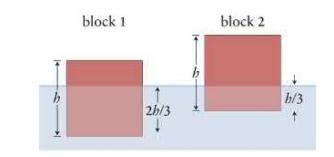
Two same-sized blocks of wood float in a tank as shown in Figure P18.19. Block 1 has two-thirds of its volume submerged, and block 2 has one-third of its volume submerged. Determine the ratio \(ho_{1} / ho_{2}\) of the mass densities of the blocks.Data from Figure P18.19 block 1 block 2 b/3 2h/3
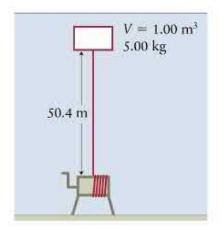
A \(5.00-\mathrm{kg}\) air-filled, sealed, rigid float tank that has a volume of \(1.00 \mathrm{~m}^{3}\) is pulled \(50.4 \mathrm{~m}\) down to the seafloor in order to assist in lifting a sunken object. A diver standing on the seafloor cranks a winch to pull the tank down (Figure P18.20).(a) How
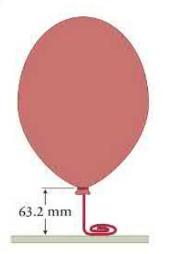
You want to determine the lifting force of a helium balloon. When you tie a long cord to the balloon and then release the balloon, it floats up until it supports a \(63.2-\mathrm{mm}\) length of cord and then it remains stationary, as shown in Figure P18.21. A 1. 00-m length of the cord has a mass
A cylindrical water tank that has a diameter of \(2.50 \mathrm{~m}\) contains water to a depth of \(3.75 \mathrm{~m}\). A \(40.0-\mathrm{kg}\) object placed in the water floats with \(75 \%\) of its volume submerged. By how much does the addition of the object increase the pressure in the water at
An uninflated balloon of mass \(6.00 \times 10^{-3} \mathrm{~kg}\) has a volume of \(6.90 \times 10^{-2} \mathrm{~m}^{3}\) when fully inflated with a mixture of helium and hydrogen gas. You tie a long, heavy cord to the balloon and allow the balloon to float above a table. The length of cord lifted
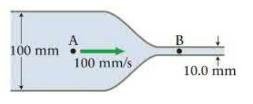
The pipe in Figure P18.24 shrinks from a diameter of \(100 \mathrm{~mm}\) in the wide section to a diameter of \(10.0 \mathrm{~mm}\) in the narrow section. If the water's speed is \(100 \mathrm{~mm} / \mathrm{s}\) at location A, what is its speed at location B?Data from Figure P18.24 100 mm 100
In an air duct running along the outside of a building, air flowing through the duct has a mass density of \(1.20 \mathrm{~kg} / \mathrm{m}^{3}\) and is moving at \(5.38 \mathrm{~m} / \mathrm{s}\). The duct passes through a wall into an air-conditioned room. If the mass density of the air in the
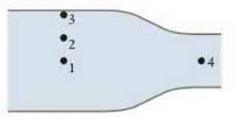
A viscous liquid is flowing through the pipe in Figure P18.26. If the flow is laminar, rank the speed of the liquid at points 1-4 in order of increasing speed.Data from Figure P18.26 2 4
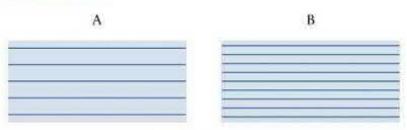
Figure P18.27 shows streamlines of water flowing in two regions \(A\) and \(B\) of the same pipe (neither of the two regions shown spans the entire diameter of the pipe). Between these two regions no other pipes are connected to this one. Compare the speed, pressure, and pipe diameter in the two
The water in a river flows gently in a continuous, straight channel of uniform width. Over a certain distance downstream, the water's speed decreases. What is most likely happening? State your reasons.
You are traveling in a car when the driver lights a cigarette. Why is it that when you open a window slightly the smoky air blows out of the car? Why doesn't air from the outside flow in through the opening instead?
The capped end of a pipe in your basement springs a leak. The pipe has a diameter of \(50.0 \mathrm{~mm}\) and is attached to a joist so that it is \(2.00 \mathrm{~m}\) above the basement floor. The water squirts out horizontally through a hole that has a diameter of \(3.00 \mathrm{~mm}\) and hits
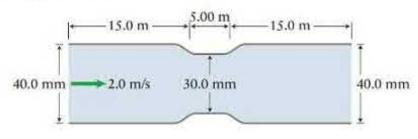
A garden hose \(30.0 \mathrm{~m}\) long and \(40.0 \mathrm{~mm}\) in diameter attached to a faucet carries water that enters the hose at \(2.00 \mathrm{~m} / \mathrm{s}\). The hose was previously cut at its center and has been repaired by splicing a length of hose that is \(5.00 \mathrm{~m}\) long
Consider a nonviscous fluid undergoing laminar flow in an open, horizontal channel. The Bernoulli effect says that where the flow speed is greater, the pressure is smaller, but the pressure at the surface, in contact with the surrounding air, is atmospheric pressure everywhere. How is that possible?
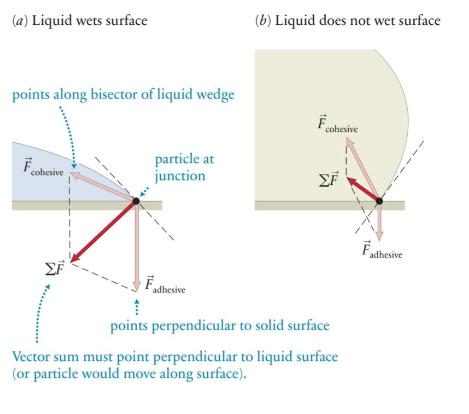
A drop of liquid is placed on a surface. A particle of the liquid at the contact point is subject to a cohesive force of \(4.00 \mathrm{~N}\) directed \(52.0^{\circ}\) above the surface. If the contact angle is \(104^{\circ}\), what is the magnitude of the adhesive force between the particle and
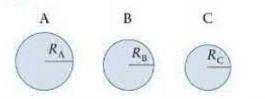
Three water droplets are shown in Figure P18.34. All three are in the same room with the same atmospheric pressure. In which of the three droplets is the pressure greatest and why? Data from Figure P18.34 B C RA R Re
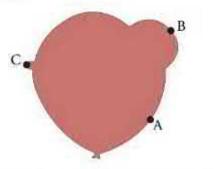
A partially inflated and irregularly shaped balloon is shown in Figure P18.35. Rank the points on the balloon's surface in order of \((a)\) increasing tension in the membrane and \((b)\) increasing pressure on the inside.Data from Figure P18.35 A B
Suppose a certain liquid in contact with a surface has cohesive and adhesive forces such that its bchavior is exactly between wetting and not wetting a surface. How do the magnitudes of the adhesive and cohesive forces compare?
A glass capillary tube has a diameter of \(2.00 \mathrm{~mm}\) and contains a small amount of liquid that forms a concave spherical meniscus. A particle of the liquid located where the liquid surface meets the tube wall is subject to a cohesive force of \(4.00 \mathrm{~N}\) at an angle of
Dishwashing liquid dissolved in water forms an aqueous solution containing bubbles (the "suds") that are soap-film spheres filled with air. How does the pressure difference across the surface of one of these bubbles in the solution compare with the pressure difference across the surface of a bubble
What is the relationship between the radius of a capillary tube \(R_{\text {tube }}\) and the radius of curvature \(R_{\text {men }}\) of the spherical meniscus a liquid forms in the tube, in terms of the contact angle \(\theta_{c}\) ? Answer for both a wetting liquid and a nonwetting liquid.
Liquid A forms a concave meniscus of radius \(R\) in a capillary tube in which its capillary rise is \(b_{A}\). Liquid \(B\) has twice the surface tension and twice the mass density of liquid \(\mathrm{A}\) and forms a concave meniscus of radius \(R / 2\) in an identical capillary tube. How does
Figure 18. 32 shows a drop of a wetting liquid and a drop of a nonwetting liquid sitting on a horizontal solid surface and surrounded by air. Show that, for both drops, the relationship between the contact angle and the magnitudes of the cohesive and adhesive forces exerted on a particle of liquid
You have three capillary tubes that are made of paraffin wax and have diameters of \(1.00 \mathrm{~mm}, 2. 00 \mathrm{~mm}\), and \(3.00 \mathrm{~mm}\). (a) Is the meniscus that water forms in each tube convex or concave? (b) How might you change the water so that the answer to part \(a\) changes?
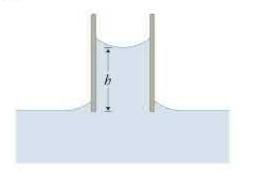
Figure P18.43 shows the capillary rise \(h\) for the liquid in a capillary tube sitting in a dish of liquid. Suppose you insert an identical capillary tube into the liquid but push this tube deep enough into the liquid to make the top of the tube be a distance \(h / 2\) above the surface of the
Showing 2800 - 2900
of 4962
First
22
23
24
25
26
27
28
29
30
31
32
33
34
35
36
Last
Step by Step Answers

 Get 50% OFF
Claim Now
Get 50% OFF
Claim Now